
Market Overview
| Study Period | 2021 - 2031 |
|---|---|
| Forecast Data Period | 2026 - 2031 |
| Historical Data Period | 2021 - 2024 |
| Growth Rate | 1.06 % |
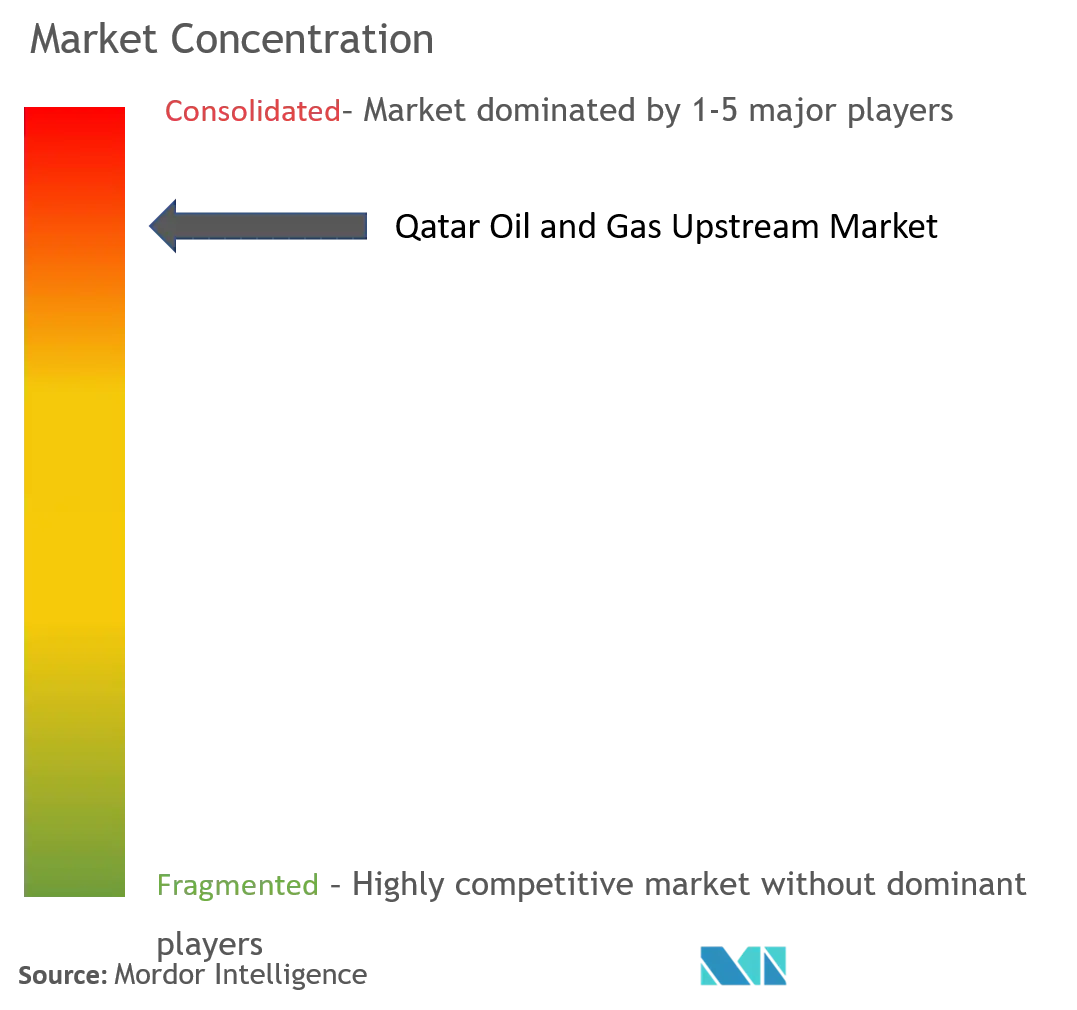
| Market Concentration | High |
Major Players *Disclaimer: Major Players sorted in no particular order Image © Mordor Intelligence. Reuse requires attribution under CC BY 4.0. | |
Qatar Oil And Gas Upstream Market Analysis by Mordor Intelligence
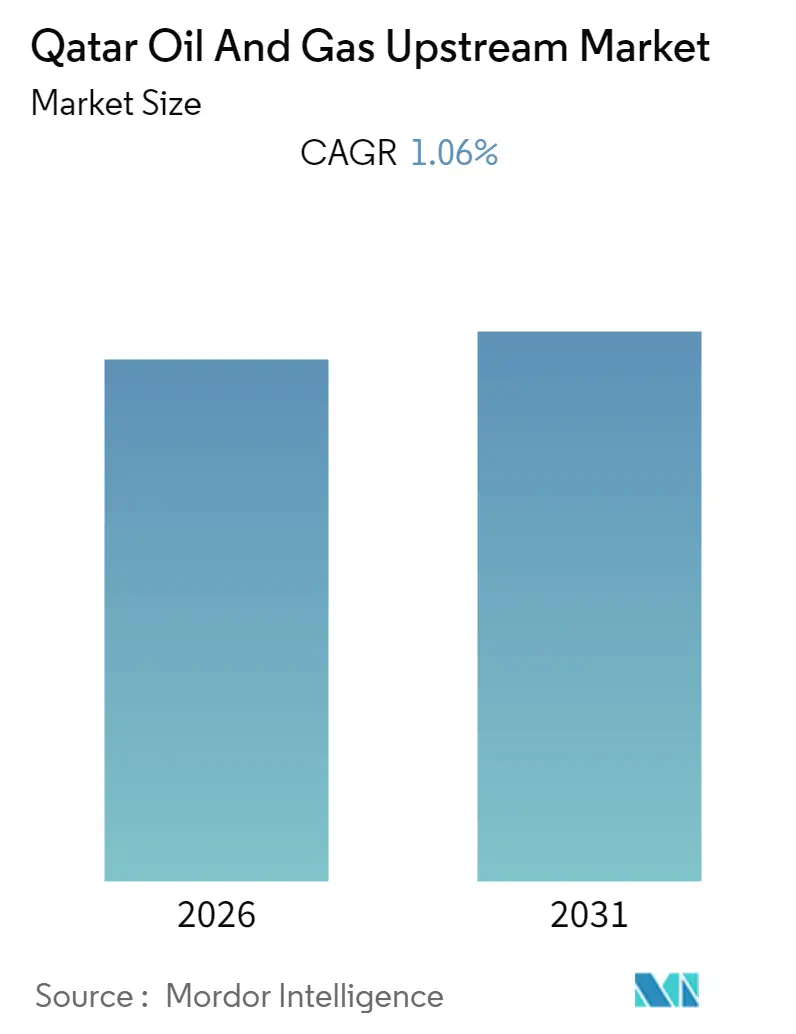
The Qatar Oil and Gas Upstream Market size is expected to register a CAGR of 1.06% during the forecast period (2026-2031).
- Qatar is a significant exporter of natural gas to the world. Most of the oil and gas producing fields of the country are situated in the Persian Gulf. The gas basins, including the South Pars field, are located to the north of the country and are produced by both Iran and Qatar.
- New studies have revealed that the North Field's productive layers extend well into Qatari land in Ras Laffan, which may pave the way for a new Natural gas production project in the north of Qatar and act as an opportunity for the market players.
- An increase in the country's natural gas production is expected to drive the market in the forecast period. The country has vast reservoirs of oil and gas that may be used to boost the growth in the sector.
Note: Market size and forecast figures in this report are generated using Mordor Intelligence’s proprietary estimation framework, updated with the latest available data and insights as of 2026.
Qatar Oil And Gas Upstream Market Trends and Insights
Offshore to Dominate the Market
- The South Pars is a natural-gas condensate field located in the Persian Gulf. It is by far the world's largest natural gas field, with ownership of the field shared between Iran and Qatar. The natural gas field provides the most significant share of natural gas production in the country.
- In 2019, Qatargas have awarded McDermott International a substantial contract for engineering, procurement, construction and installation (EPCI) for expansion of the North Field offshore facilities in Qatar. Many new projects are expected to be initiated in the forecast period, which is expected to make the export of natural gas more profitable and thereby contribute to the growth of the upstream market.
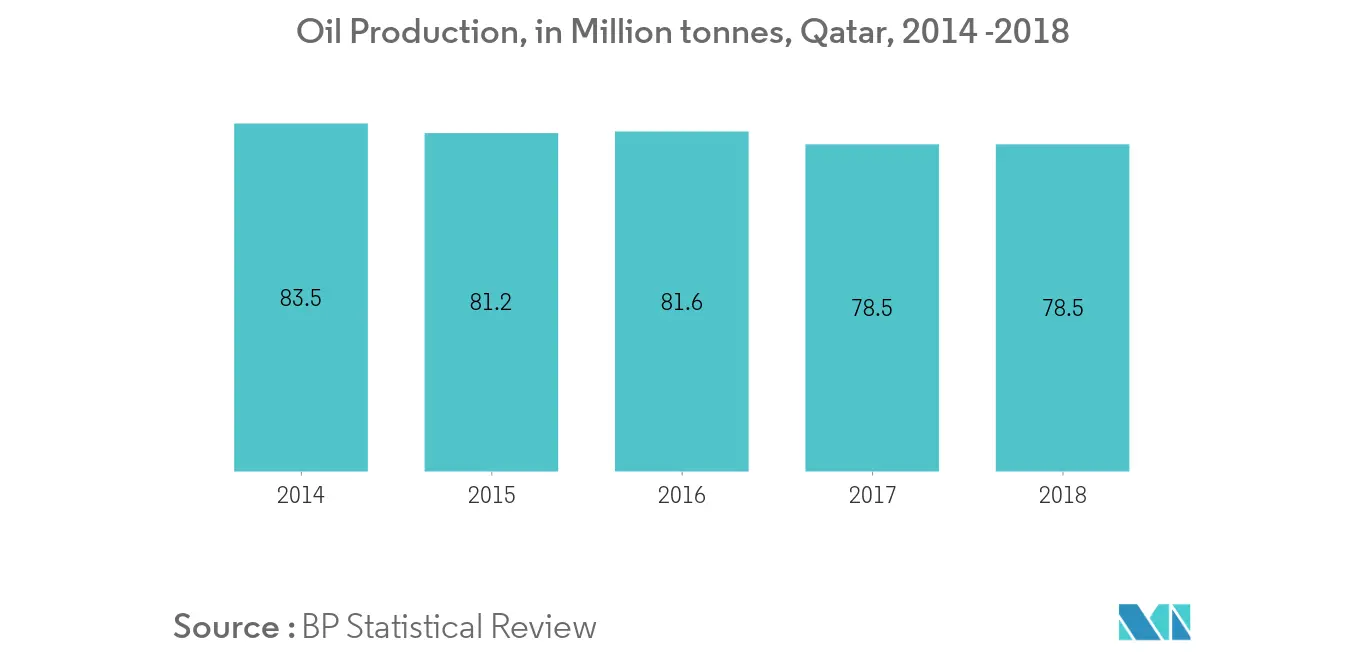
- The oil production remained stagnant at 78.5 million tonnes in 2017 - 2018 period. The country's oil consumption increased by 3.5%, year on year, to 12.2 million tons (mt), in 2018 from 11.8 mt in 2017. The increase in oil consumption in the country is expected to provide some growth in the sector.
- Hence, the offshore segment is expected to dominate the market due to the position of the oil and gas reservoirs in the country, and the significant investments being made into the offshore oil and gas field projects.
Increasing Gas Production to Drive the Market
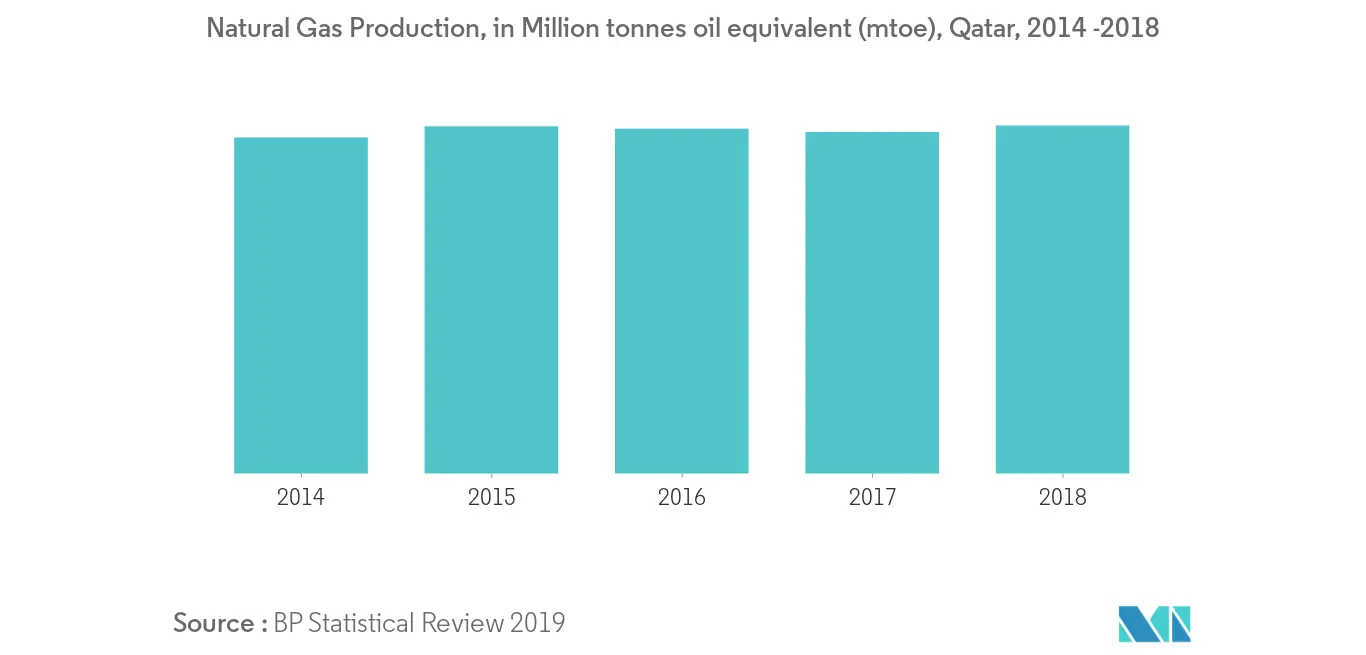
- Production of natural gas increased in the country, by 1.8%, to 150.9 million tonnes of oil equivalent in 2018 from 148.2 Million tonnes oil equivalent, in 2017. The increase in the production of natural gas is expected to positively impact the upstream sector.
- Qatar held an estimated 24.7 trillion cubic meters of proved natural gas reserves in 2018. Most of the country's proved gas reserves are held offshore. The country has among the largest reserves of natural gas, accounting for 12.5% of the established global reserves. The successful exploitation of reserves is likely to provide growth to the market.
- Qatar has been among the largest producer of natural gas in the region, and is expected to increase its natural gas production further in the forecast period. However, intricate ties between Iran and Saudi Arabia and its direct impact on the Persian Gulf is a cause of concern for the government of Qatar.
- The Qatar oil and gas industry is expected to grow slightly in the forecast period due to an increase in oil and gas production in the region.
Regulatory Landscape
Qatar's upstream hydrocarbons are governed under a state-ownership model. Law No. 3 of 2007 on the Exploitation of Natural Resources provides the legal basis for state control of natural resources and the framework for granting upstream rights. QatarEnergy holds the central role in upstream governance, administering access to acreage and supervising technical, safety, and environmental requirements across exploration and production activities.
Foreign participation in upstream activity is typically structured through contractual arrangements such as Exploration and Production Sharing Agreements (EPSA) and Development and Production Sharing Agreements (DPSA). These agreements are negotiated and managed under QatarEnergy's oversight, which consolidates licensing, operatorship decisions, and compliance expectations under a single national entity. This approach aligns upstream development, including North Field-related programs, with Qatar's national energy strategy.
Value Chain Analysis
Qatar's upstream value chain is highly centralized around QatarEnergy. It plans field development, manages operatorship structures with international partners, and drives procurement through structured vendor qualification and tendering processes. The chain starts with exploration and appraisal (onshore and offshore), moves through drilling and completions, and then into surface facilities and offshore infrastructure such as platforms, subsea pipelines, compression, and associated brownfield modifications.
Execution commonly routes through major EPC and EPCI contractors. Ras Laffan Industrial City acts as the main integration point between upstream production and LNG export-linked processing, while Mesaieed supports liquids processing value streams through NGL infrastructure. In practice, project delivery and material availability depend on the capacity and sequencing of EPC/EPCI packages, as well as operational continuity in offshore installation campaigns, which came into focus during early-2026 regional disruptions affecting North Field expansion workstreams.
Competitive Landscape
The Qatar oil and gas upstream market is moderately consolidated. The major companies include Qatargas Operating Company Limited, Qatar Petroleum, ConocoPhillips Company, Exxon Mobil Corporation, and Total S.A.
Qatar Oil And Gas Upstream Industry Leaders
-
Qatargas Operating Company Limited
-
Qatar Petroleum
-
ConocoPhillips Company
-
Exxon Mobil Corporation
-
Total S.A.
- *Disclaimer: Major Players sorted in no particular order
Market Opportunities and Future Outlook
Active contracting around the North Field West (NFW) program creates near-term whitespace for upstream-linked services and equipment covering gas handling, compression, utilities, and offshore tie-ins feeding Qatar's LNG system. In February 2026, QatarEnergy awarded the EPC contract for the NFW onshore LNG facilities to a joint venture led by Technip Energies with Consolidated Contractors Company and Gulf Asia Contracting. It also awarded Baker Hughes a major equipment package covering gas turbines, centrifugal compressors, and integrated power systems for NFW trains.
The inclusion of carbon capture and sequestration capacity (1.1 Mtpa) within NFW broadens the opportunity set for CO2 handling, monitoring, and related project engineering around upstream gas development and processing interfaces. Beyond greenfield capacity additions, offshore activity also centers on maintenance and debottlenecking programs, evidenced by contractor selections in 2025 for the Bul Hanine offshore oil field to maintain and increase production potential. Digital subsurface workflows represent another opportunity lane, with Qatar Shell's July 2025 collaboration with QASR Technologies focused on AI-driven reservoir analysis that supports demand for reservoir modeling, production optimization, and data integration capabilities across upstream operations.
Recent Industry Developments
- July 2026: QatarEnergy LNG initiated a search for offshore contractors for a sizeable EPCI scope tied to offshore pipelines under the North Field West expansion program. The move advances the offshore portion of NFW and opens a major contracting window for subsea installation capacity and long-lead materials aligned with Qatar's broader North Field buildout.
- June 2026: QatarEnergy and ExxonMobil signed a commercial discovery declaration for the Glaucus and Pegasus gas fields in Block 10 offshore Cyprus. Formalizing commerciality strengthens QatarEnergy's international upstream portfolio and supports integrated monetization pathways that link Eastern Mediterranean gas to regional processing and export options.
- May 2026: QatarEnergy, TotalEnergies, ConocoPhillips, and Syrian Petroleum Company signed an MoU to cooperate on oil and gas exploration in Block 3 offshore Syria. The agreement signals continued outbound upstream positioning by QatarEnergy and its partners in frontier and redevelopment-oriented offshore basins, complementing domestic expansion programs centered on the North Field.
Research Methodology Framework and Report Scope
Market Definition and Coverage
For this study, the Qatar oil and gas upstream market is defined as the value generated from exploration and production activity inside Qatar, covering field development and production operations across both oil and gas assets onshore and offshore.
Scope exclusions: Midstream transport, LNG liquefaction, refining, petrochemicals, and retail fuel distribution are excluded from this market sizing.
Segmentation Overview
- Location of Deployment
- Onshore
- Offshore
Data Sources, Market Sizing, and Validation
Desk Research
Desk work starts with building a fact base around Qatar production volumes, reserves reporting, and project timelines. These signals anchor what upstream activity can realistically support, before we translate activity into value. Public sources used include IEA, OPEC, the U.S. EIA, World Bank macro series, and UN trade statistics when we need context for equipment and materials flows.
We then add operator and contractor disclosures that are publicly shared, such as annual reports, investor presentations, and press releases, followed by energy ministry and regulator announcements where available. For cross-checking company exposure and project news flow, we also use a paid subscription focused on company financials and intelligence, plus a separate paid subscription for news and financials. In selected checks, an import-export shipment level database is used to confirm specific equipment flows. These sources are illustrative only, and other public references are used during data collection, validation, and clarification.
Primary Interviews and Surveys
Primary work focuses on validating what is actually being executed in Qatar, then stress-testing the assumptions behind activity levels and cost progression. We speak with a mix of upstream operators, oilfield service participants, and EPC or engineering stakeholders, along with domain experts who track offshore and onshore project cycles. This respondent input helps resolve gaps desk sources cannot fully confirm, particularly around execution pacing and scope boundaries between offshore work and onshore supporting activities.
Distribution of primary research fieldwork respondents
| Company type | Respondent position |
|---|---|
| Top tier: 25% | CXOs: 18% |
| Mid tier: 55% | Functional/Unit leaders: 34% |
| Smaller Players: 20% | Managers: 48% |
Market-Sizing & Forecasting
Sizing is built using a top-down approach where national upstream activity is reconstructed from production levels, field development plans, and expected drilling and workover intensity across onshore and offshore assets. To keep the model practical, we convert activity into value using a set of cost and spend ratios that are discussed and validated in interviews, then applied to the expected level of operations by year.
To corroborate totals, bottom-up approximations are also run for selected slices. Examples include sampled offshore project spend, drilling days multiplied by typical day rates, and spot checks on development programs mapped to likely service intensity. The variables that tend to matter most in this market include crude oil and natural gas production volumes, active rig counts and drilling days, offshore development schedules, brownfield maintenance intensity, and the direction of oil price and gas demand that influences investment timing. For forecasting, we use scenario analysis grounded in expert consensus on project timing and execution risk, which helps us adjust for schedule slips, ramp-up pacing, and cost inflation without forcing the model to match the past too closely.
Data Validation & Update Cycle
Model outputs are checked against independent signals such as published production trends, project award flow, and the implied spend level that upstream activity in Qatar would require. When we see variances, they are flagged and reviewed in steps: first at the assumption level, then at the arithmetic level, and finally through an analyst review before sign-off.
If an outlier is driven by a single input, we re-check the source trail and, when needed, reconnect with the relevant interviewee to confirm the direction of change. The report is refreshed annually, and interim updates are triggered when material events occur, such as major project sanctions, meaningful schedule revisions, or sharp commodity price moves. Before delivery, a final pass is completed so the numbers reflect the latest available updates.
Mordor Intelligence's Qatar Oil and Gas Upstream Market Size Measured Against Other Published Estimates
Published market sizes for Qatar upstream often do not line up because studies do not always count the same activity set, and the timing of the spend cycle is treated inconsistently across publishers. Differences also come from how each publisher converts physical activity into value, especially when offshore development and brownfield work progress at different speeds.
Project award signals and production-linked activity checks are the evidence we use to keep the estimate tied to what is being executed onshore and offshore. This is the step that anchors Mordor Intelligence to a narrower upstream-only spend boundary rather than folding in downstream or LNG value add. Another common gap driver is the forecast stance, where some estimates assume earlier ramp-ups or stronger cost escalation, even when field schedules are still being finalized. Currency timing and update cadence can also shift the headline number, especially when oil prices and service rates move during the year.
Benchmark comparison
| Source | Market Size | Gaps in Research Methodology |
|---|---|---|
| Mordor Intelligence | USD 26.70 B (2024) | |
| Global Consultancy A | USD 27.00 B (2024) | The published figure appears to use a broader upstream definition that blends some adjacent activities into the total, and the value build is less transparent on how offshore project timing and cost inflation are applied year to year. |
| Industry Publisher B | USD 38.00 B (2023) | This estimate is based on a different base year and likely includes a wider oil and gas value pool, which can pull in LNG-linked or midstream connected value that is not counted under upstream-only scope. |
Taken together, the spread is mainly explained by scope boundaries, base-year alignment, and how project timing is converted into annual value. By grounding the model in observable activity signals and then checking the math with simple bottom-up spot tests, the market size remains traceable to clear assumptions that can be repeated in future refreshes.
Key Questions Answered in the Report
What is the current Qatar Oil and Gas Upstream Market size?
The Qatar Oil and Gas Upstream Market is projected to register a CAGR of 1.06% during the forecast period (2026-2031)
Who are the key players in Qatar Oil and Gas Upstream Market?
Qatargas Operating Company Limited, Qatar Petroleum, ConocoPhillips Company, Exxon Mobil Corporation and Total S.A. are the major companies operating in the Qatar Oil and Gas Upstream Market.
What years does this Qatar Oil and Gas Upstream Market cover?
The report covers the Qatar Oil and Gas Upstream Market historical market size for years: 2020, 2021, 2022, 2023 and 2024. The report also forecasts the Qatar Oil and Gas Upstream Market size for years: 2026, 2027, 2028, 2029, 2030 and 2031.