
Market Overview
| Study Period | 2022 - 2031 |
|---|---|
| Forecast Data Period | 2026 - 2031 |
| Historical Data Period | 2022 - 2024 |
| Growth Rate | 5.12 % |
| Market Concentration | Low |
Major Players *Disclaimer: Major Players sorted in no particular order Image © Mordor Intelligence. Reuse requires attribution under CC BY 4.0. | |
Oman Oil And Gas Upstream Market Analysis by Mordor Intelligence
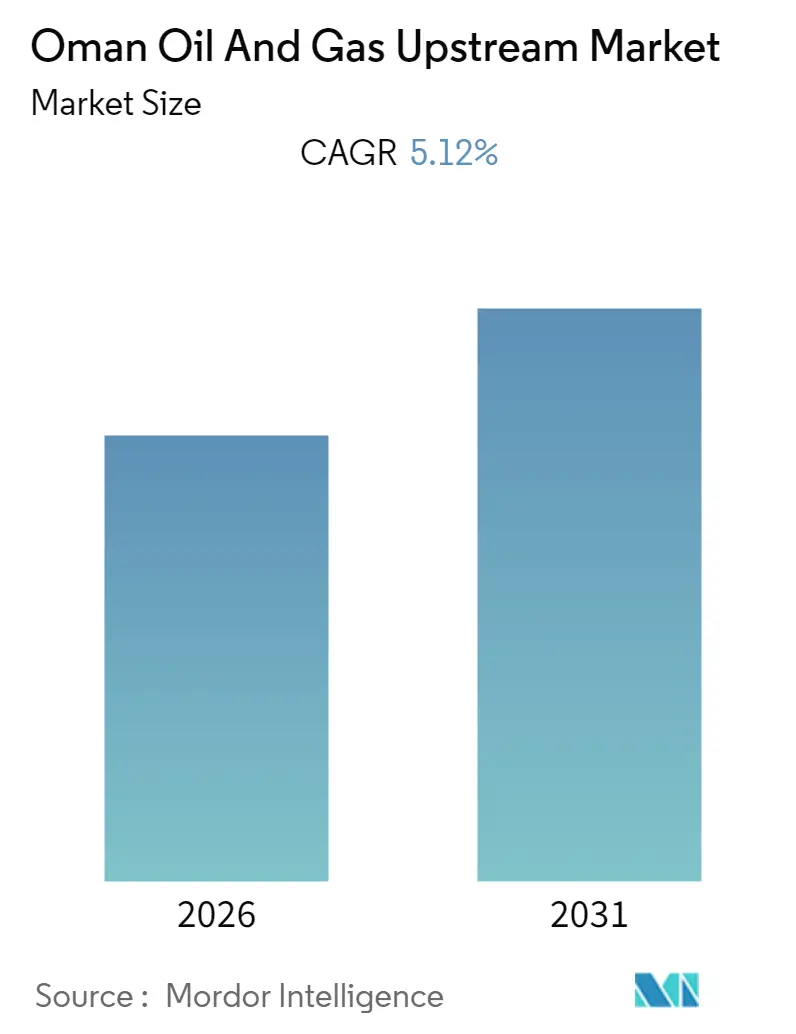
The Oman Oil and Gas Upstream Market size is expected to register a CAGR of 5.12% during the forecast period (2026-2031).
The market was negatively impacted by COVID-19 in 2020. Currently. The market has reached pre-pandemic levels.
- In the long-term, supportive government policies, efforts to grow the offshore sector, and upcoming projects are the key drivers for the country's oil and gas upstream market. Also, the increased exploration activities in the country are expected to be the significant driver for Oman's oil and gas upstream market.
- On the other hand, the requirement for high capital investment and a lack of financing due to a global economic slowdown are some restraints for Oman's oil and gas upstream market.
- Nevertheless, many discoveries in recent years and ongoing exploration activities are the key opportunities to provide a significant opportunity for the country's oil and gas industry market players.
Note: Market size and forecast figures in this report are generated using Mordor Intelligence’s proprietary estimation framework, updated with the latest available data and insights as of 2026.
Market Trends and Insights
Onshore Sector to Dominate the Market
- The onshore sector has dominated the Oman oil and gas market in recent years and is expected to continue to do so during the forecast period. The country's oil and gas production comes from onshore oil and gas fields. Offshore oil and gas exploration and production activities in the country are relatively recent and will take significant time to develop.
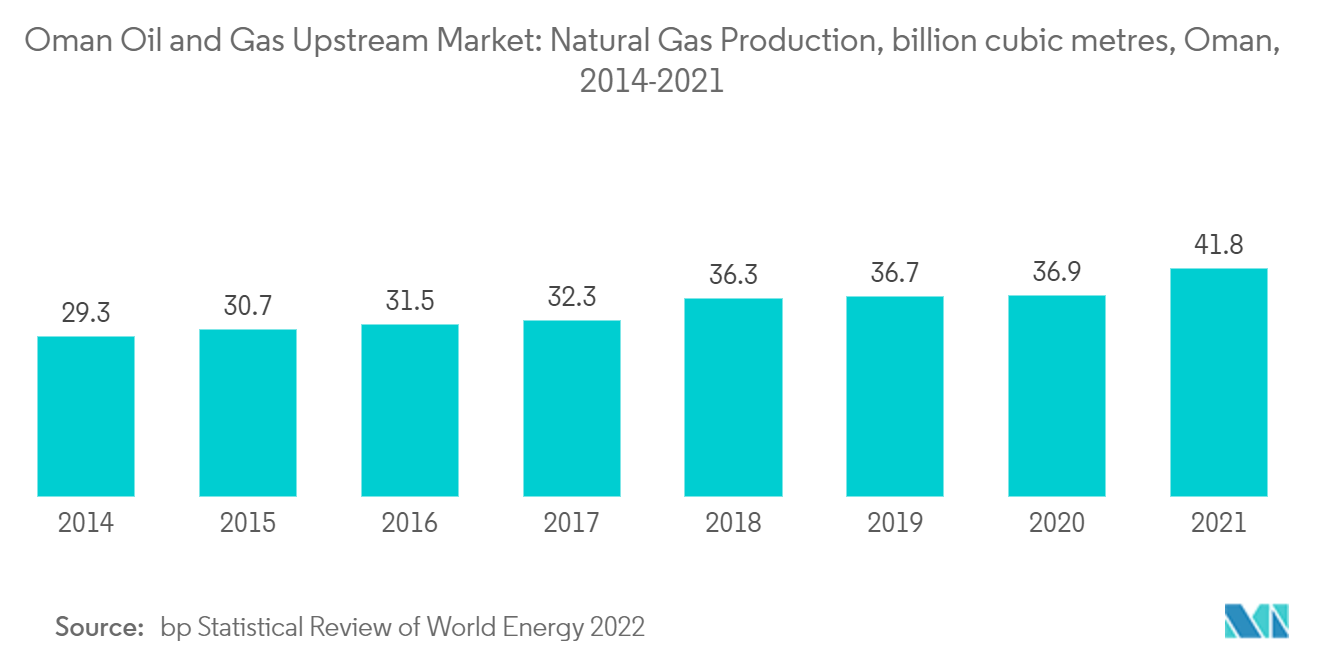
- The natural gas production in Oman was 41.8 billion cubic meters, a 13% increase from the previous year. It is expected to grow more due to the onset of an increase in exploration activities in the country.
- As of 2022, some critical assets in Oman's oil and gas exploration and production market are Block 6, Khazzan, Mukhaizna, Block 9, Wadi Aswad, Block 3 & 4, Abu Butabul, Karim small fields, Yumna, and Rima Cluster of Small Fields. Block 6 is the top field in the Oman oil and gas exploration and production market.
- Futhermore, in June 2022, the Ministry of Energy and Minerals (MEM) announced that Oman's crude oil reserves stood at 5.2 billion barrels and gas reserves at around 24 trillion cubic feet. Also, the government reported revenues of USD 17.4 billion (and a USD 2 billion surplus) in the first half of 2022 based on an average oil price of USD 87 per barrel, and it is on track to record its first annual surplus in a decade.
- Owing to improved production and revenues, the Onshore sector of Oman is expected to dominate the market during the forecast period.
Increased Exploration Activities to Drive the Market
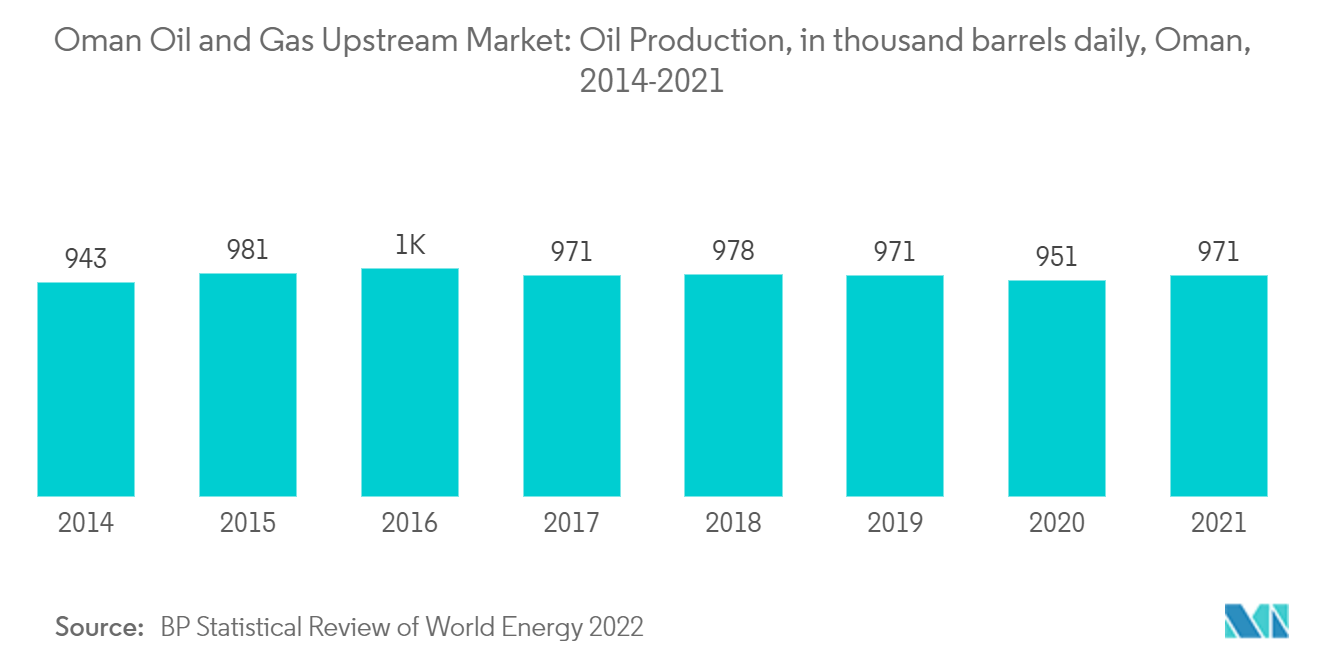
- The oil production in Oman stood at 971 Thousand Barrels Daily in 2021, an increase of 2% from the previous year. Though there has been a slow growth in oil production in Oman, considering the increasing demand for oil from significant economies, production is expected to ramp up in the future.
- In May 2022, Oman and Iran decided to work jointly on developing the Hengam offshore oilfield in the Persian Gulf. Joint Technical Committee will develop the oilfields in a phased manner. Hengam field is a reserve that Oman and Iran jointly share. The fresh oilfield is expected to make significant production in the future.
- Furthermore, in June 2022, the Ministry of Energy and Minerals stated that it had made new oil discoveries that would raise Oman's production by 50,000 to 100,000 barrels in the coming two to three years. At full capacity, the plant will boost OQ's total production capacity of 219,000 barrels per day of oil equivalent, representing 12.6 % of Oman's total oil production.
- Moreover, in September 2022, Oman signed an exploration and production sharing agreement deal with Shell for Block 11. The exploration activities will undertake the seismic survey of 1,400km², and further well exploration will occur.
- All of the above factors with respect to production & exploration agreements, discoveries, and growing production are expected to help drive the Oman oil and gas market during the forecast period.
Regulatory Landscape
Upstream oil and gas in Oman is administered by the Ministry of Energy and Minerals (MEM). The Oil and Gas Law, issued under Royal Decree 8/2011, provides the core legal basis for licensing, petroleum agreements, and sector oversight. In April 2026, MEM announced the 2026 Oman Licensing Round, offering five onshore blocks (Blocks 12, 16, 42, 45, and 55) totaling about 48,000 square kilometers. This reinforces the use of competitive licensing and reconfigured acreage to promote exploration activity.
In 2026, MEM also issued and approved policy instruments that link upstream development with national transition priorities. Royal Decree 37/2026 approved a concession agreement for Block 18 (PC Oman Ventures Ltd and OQ Exploration and Production Batinah Offshore LLC), and Royal Decree 25/2026 approved an amendment to the petroleum agreement for Block 5. In May 2026, MEM launched an updated Net Zero Strategy and introduced a carbon markets regulatory framework, adding a compliance and reporting layer that upstream operators increasingly need to factor into project design and operations.
Value Chain Analysis
Oman's upstream value chain begins with acreage allocation and petroleum agreements administered by the Ministry of Energy and Minerals, followed by geoscience work (seismic and subsurface studies), drilling and well services, and field development activities such as surface facilities, flowlines, and utilities. Production operations then run across onshore and offshore assets. Activity is supported by national and international operators and partnerships, with OQ Exploration and Production (OQEP) managing a portfolio of upstream assets and working with IOCs and NOCs, including concession activity for offshore Block 18 (Petronas as operator alongside OQEP) and offshore Block 80 (OQEP with Turkish Petroleum Overseas Company Limited).
Within the upstream-to-midstream interface, processing and debottlenecking needs at producing assets shape the practical flow of hydrocarbons. Capacity expansions raise effective throughput and help stabilize field deliverability. A recent example is OQEP's commissioning of the Bisat-C expansion facility at Block 60 in June 2025, which increased oil processing capacity to 95,000 bpd and water processing to 800,000 bpd, supporting production handling and reducing bottleneck risk. Contracting and partnership structures (EPSAs, concessions, and amendments such as the Block 9 EPSA amendment with Occidental Oman and Mitsui E&P Middle East) remain core mechanisms for deploying capital and specialized technical capabilities through development and production stages.
Competitive Landscape
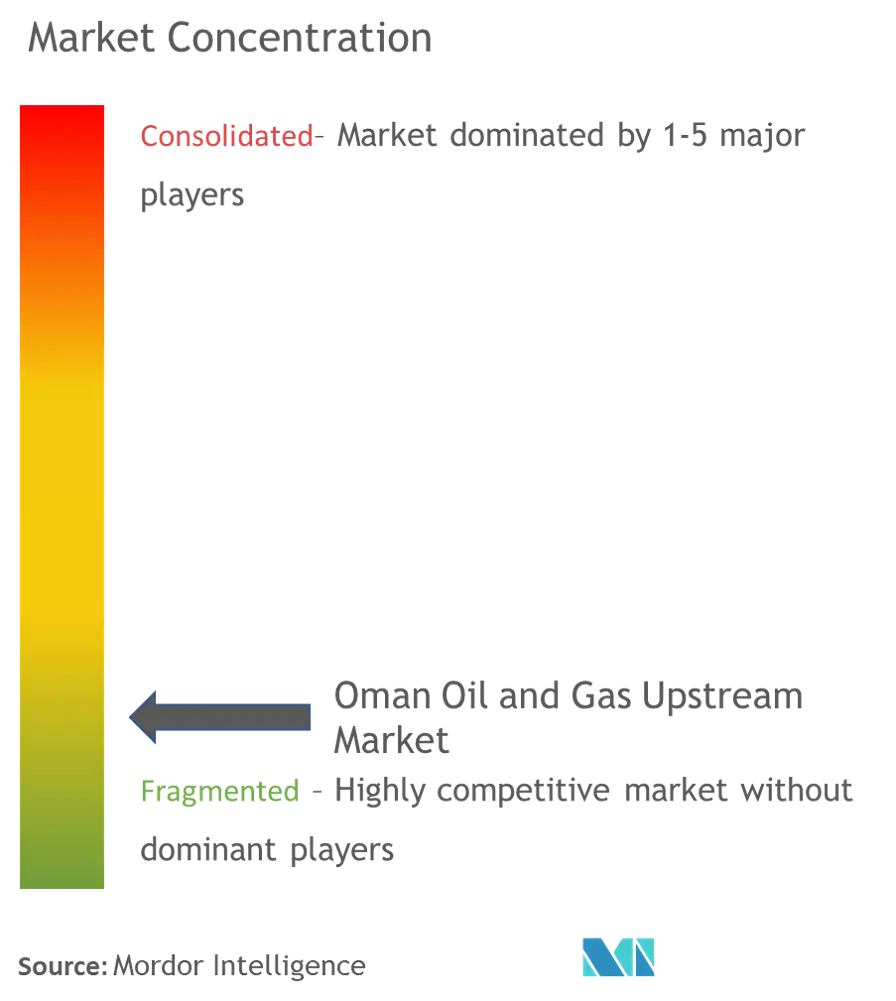
The Oman oil and gas upstream market is fragmented. Some key players (in no particular order) are BP Plc, Royal Dutch Shell, Oman Oil Marketing Company SAOC, Total SA, and Eni Spa, among others.
Oman Oil And Gas Upstream Industry Leaders
-
BP Plc
-
Royal Dutch Shell
-
Oman Oil Marketing Company SAOC
-
Total SA
-
Eni SpA
- *Disclaimer: Major Players sorted in no particular order
Oman Oil And Gas Upstream Market Companies Covered in this Report
- Petroleum Development Oman
- Royal Dutch Shell Plc
- Oman Oil Company SAOC
- Petrogas E&P LLC
- Occidental Petroleum Corporation
- Tethys Oil AB
- BP Plc
- Total SA
- Daleel Petroleum LLC
- Eni SpA
- PTT Exploration and Production Public Company Limited (PTTEP)
Market Opportunities and Future Outlook
Near-term whitespace for upstream participation is visible in Oman's 2026 Licensing Round, where MEM opened five onshore blocks (12, 16, 42, 45, and 55) spanning about 48,000 square kilometers. The round reflects a push to activate more granular exploration across available concession areas. On the offshore side, newly concluded concession frameworks, including Block 18 (Petronas with OQEP) and Block 80 (OQEP with Turkish Petroleum), create additional entry points for exploration services, subsurface studies, drilling campaigns, and early-phase field development tied to committed work programs.
A second opportunity track is the operational and infrastructure layer around gas processing, emissions reduction, and recovery optimization at producing hubs. In 2026, project awards and engineering selections for gas processing expansions include the Budour-Northeast Birba Integrated Project, a turnkey award to ENPPI with a stated objective that includes reducing routine flaring. Engineering work for the Budour Tayseer Gas Project, covering acid gas removal and sulphur recovery scope involving Worley Comprimo and BASF and awarded by SPETCO, further points to active demand for EPC, process technology, and environmental control solutions tied to upstream gas development. Policy moves such as MEM's May 2026 carbon markets framework also reinforce demand for measurement, monitoring, and operational changes that connect upstream production with lower-emissions performance and carbon-related compliance.
Recent Industry Developments in Oman Oil And Gas Upstream Market
- June 2026: OQ Exploration and Production signed an amendment to the Block 9 Exploration and Production Sharing Agreement with the Ministry of Energy and Minerals, Occidental Oman, and Mitsui E&P Middle East, effective July 1, 2026. The amendment is designed to raise operational activity and support reserves growth. It strengthens the Block 9 investment case and service demand for drilling and field operations.
- May 2026: The Ministry of Energy and Minerals signed an agreement with Victarens Global Energy to invest USD 220 million in methane hydrate exploration on onshore Block 83. The agreement expands the upstream resource portfolio beyond conventional plays. It also adds specialized exploration workflows and partnerships into Oman's upstream activities.
- February 2026: The Ministry of Energy and Minerals signed a concession agreement for offshore Block 18 with Petronas as operator (70%) and OQ Exploration and Production (30%), launching a four-year exploration phase. The concession increases offshore exploration momentum. It also raises demand for marine geoscience, drilling logistics, and early-stage development studies.
Oman Oil And Gas Upstream Market Report Scope and Research Methodology
Market Definition and Coverage
For this study, the Oman oil and gas upstream market covers activities that enable crude oil and natural gas to be explored, developed, drilled, and produced within Oman, with results represented as upstream output tied to onshore and offshore operations.
Scope exclusions: midstream transport and storage, refining, petrochemicals, retail fuels, and non-upstream power and utilities are excluded from this sizing.
Segments Covered in This Report
- Location of Deployment
- Onshore
- Offshore
Data Sources, Market Sizing, and Validation
Desk Research
Desk research was used to anchor the model to Oman-specific upstream fundamentals, before assumptions were stress-tested with field inputs. We mainly referenced public production series and policy context, such as Ministry of Energy and Minerals publications, OPEC and OPEC+ communications, data series from organizations such as the IEA and the World Bank, and trade and macro indicators from bodies such as UN Comtrade and the IMF.
To keep the market logic consistent year to year, we also reviewed operator announcements, investor presentations, and project updates reported by reputed press and industry association websites. When needed, paid subscriptions covering company financials and intelligence, news and financials, and patents were used to speed up cross-checks around activity intensity and technology direction. These desk sources are illustrative only, and many other public and paid references were also used for data collection, validation, and clarification.
Primary Interviews and Surveys
Primary work focused on validating what the desk data cannot fully show, such as how activity levels shift by field maturity, how quickly new wells translate into stable production, and what cost and schedule assumptions are realistic. We spoke with a mix of upstream operators, service providers, drilling and completions specialists, and local ecosystem participants, then compared viewpoints across onshore and offshore exposure and across Oman-linked decision makers.
Insights from these discussions were used to confirm model inputs, adjust ramp-up timing, and reconcile differences between stated plans and observed execution, especially where project phasing changes.
Distribution of primary research fieldwork respondents
| Company type | Respondent position |
|---|---|
| Top tier: 37% | CXOs: 14% |
| Mid tier: 48% | Functional/Unit leaders: 30% |
| Smaller Players: 15% | Managers: 56% |
Market-Sizing & Forecasting
Sizing starts from a top-down reconstruction where Oman-level crude oil output (barrels per day) and natural gas output (cubic feet) are mapped to upstream activity splits for onshore versus offshore, and then aligned to the report definition. Once that structure is stable, we corroborate it with selective bottom-up checks, such as sampled well counts and typical productivity ranges, plus a limited roll-up of project activity and service intensity to see if totals drift away from reality.
Practical inputs that shape the model include crude oil and gas production trends, drilling and workover activity direction, enhanced oil recovery intensity in mature assets, planned project start-ups and plateau timing, and regulatory or fiscal signals that affect upstream investment pacing. Where data gaps exist, assumptions are filled using ranges agreed through interviews, then tightened using consistency checks against historical patterns.
For forecasting, scenario analysis is applied so the base case reflects the most repeatable view of activity and production translation, while upside and downside cases reflect changes in ramp-up timing, decline behavior, and execution pace. Expert inputs are used to validate which variables are most sensitive in Oman, and then the forecast is reviewed to ensure the implied trajectory stays consistent with known field maturity and project timelines.
Data Validation & Update Cycle
Outputs are validated through triangulation across independent signals, including time-series consistency, onshore versus offshore reasonableness, and alignment with stated project milestones. Before sign-off, anomalies are flagged, investigated, and either corrected in the model or explained with a clear assumption trail. A second analyst review is then completed to reduce avoidable variance.
The report is refreshed annually, and interim updates are triggered when material events occur, such as a major project delay, a policy change affecting upstream investment, or a sustained deviation in production trends. Right before delivery, a final pass is run so the client receives the latest adjusted view based on newly available public updates and any needed re-contacts.
Mordor Intelligence's Oman Oil and Gas Upstream Market Size Compared Against Other Published Estimates
Published estimates for Oman upstream often do not line up because the scope can swing between production-centric sizing and spend-based sizing, and because sources also vary in how they treat onshore versus offshore activity and the year they use as a starting point. Differences also appear when one study uses aggressive ramp-up assumptions for projects, while another assumes slower execution or faster decline in mature fields.
The key gap drivers in this market usually come from whether the number is built around upstream output signals (oil and gas production volumes) or around broader upstream value pools that can include drilling, completions, and other field services priced through day rates and service intensity. Currency timing and inflation handling can also move USD totals, especially when one estimate uses a single conversion point and another uses annual averages.
Benchmark comparison
| Source | Market Size | Gaps in Research Methodology |
|---|---|---|
| Mordor Intelligence | USD 0.00 B (2026) | |
| Regional Consultancy A | USD 16.59 B (2026) | This figure is presented as an upstream revenue pool, and the scope description includes a wider set of exploration, drilling, and production activities. As a result, service-heavy spend is likely counted alongside upstream operations rather than being tied strictly to production outputs. |
| Industry Brief B | USD 0.00 B (2026) | The public summary does not clearly state the sizing basis. Without a transparent link to production series, decline assumptions, and onshore-offshore splits, the number can shift depending on what is implicitly included and how the USD conversion year is handled. |
The table shows that the spread is mainly driven by what gets counted as the market. In Mordor Intelligence's model, the market is expressed through upstream production outputs by onshore and offshore deployment, rather than bundling a broader upstream spending value pool into one USD total. When the scope and variables are made explicit, buyers can trace the estimate back to practical drivers and repeat the logic as new production and project updates emerge.
Key Questions Answered in the Report
What is the current Oman Oil and Gas Upstream Market size?
The Oman Oil and Gas Upstream Market is projected to register a CAGR of 5.12% during the forecast period (2026-2031)
Who are the key players in Oman Oil and Gas Upstream Market?
BP Plc, Royal Dutch Shell, Oman Oil Marketing Company SAOC, Total SA and Eni SpA are the major companies operating in the Oman Oil and Gas Upstream Market.
What years does this Oman Oil and Gas Upstream Market cover?
The report covers the Oman Oil and Gas Upstream Market historical market size for years: 2021, 2022, 2023 and 2024. The report also forecasts the Oman Oil and Gas Upstream Market size for years: 2026, 2027, 2028, 2029, 2030 and 2031.