
Disposable Face Mask Market Size and Share
Market Overview
| Study Period | 2020 - 2031 |
|---|---|
| Market Size (2026) | USD 2.69 Billion |
| Market Size (2031) | USD 2.97 Billion |
| Growth Rate (2026 - 2031) | 1.98 % |
| Fastest Growing Market | Middle East and Africa |
| Largest Market | Asia Pacific |
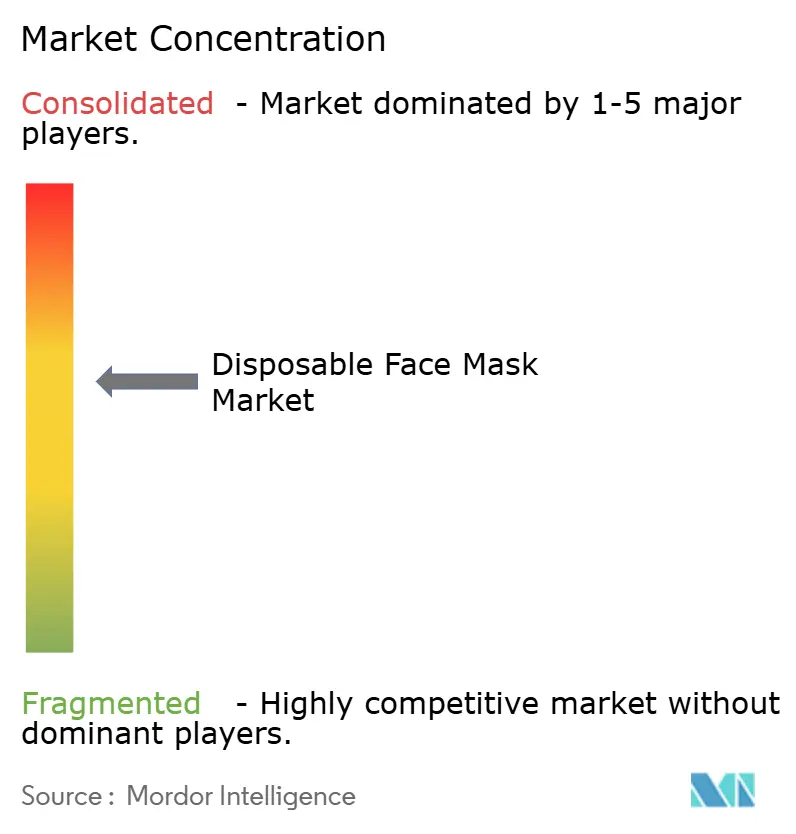
| Market Concentration | Medium |
Major Players *Disclaimer: Major Players sorted in no particular order Image © Mordor Intelligence. Reuse requires attribution under CC BY 4.0. | |
Disposable Face Mask Market Analysis by Mordor Intelligence
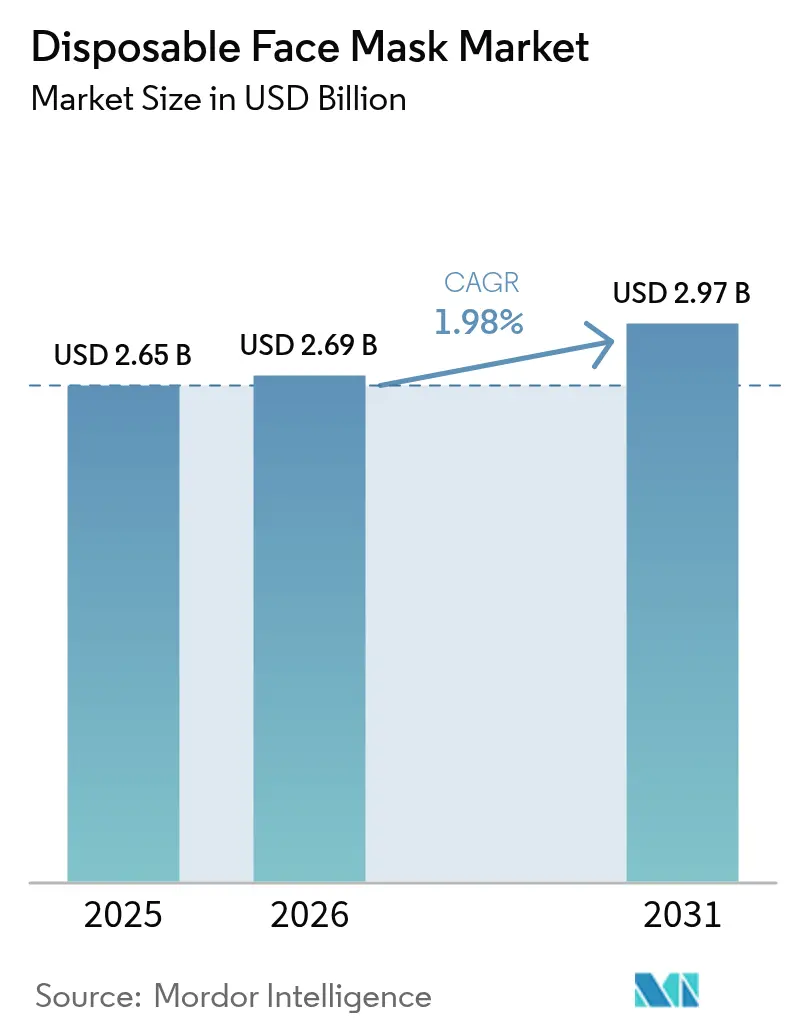
The Disposable Face Mask Market size is expected to increase from USD 2.65 billion in 2025 to USD 2.69 billion in 2026 and reach USD 2.97 billion by 2031, growing at a CAGR of 1.98% over 2026-2031.
Stable institutional procurement by national stockpiles, reinforced workplace-safety rules, and standardized filtration tests are anchoring the Disposable face mask market in a post-pandemic equilibrium. Government reserve mandates convert what were once emergency purchases into recurring budget lines, while updated OSHA and CDC regulations keep employer demand intact.[1]Occupational Safety and Health Administration, “Respiratory Protection,” U.S. Department of Labor, osha.gov Material-cost swings in melt-blown polypropylene and tightening single-use-plastic legislation continue to influence pricing strategies, yet producers with vertically integrated resin capacity are better able to absorb volatility. E-commerce disintermediation, especially in Latin America and Southeast Asia, reshapes distribution economics by steering buyers toward lower-priced private-label stock-keeping units. Competitive pressure remains high as large multinationals exit commoditized masks, leaving a fragmented field dominated by Asian contract manufacturers.
Key Report Takeaways
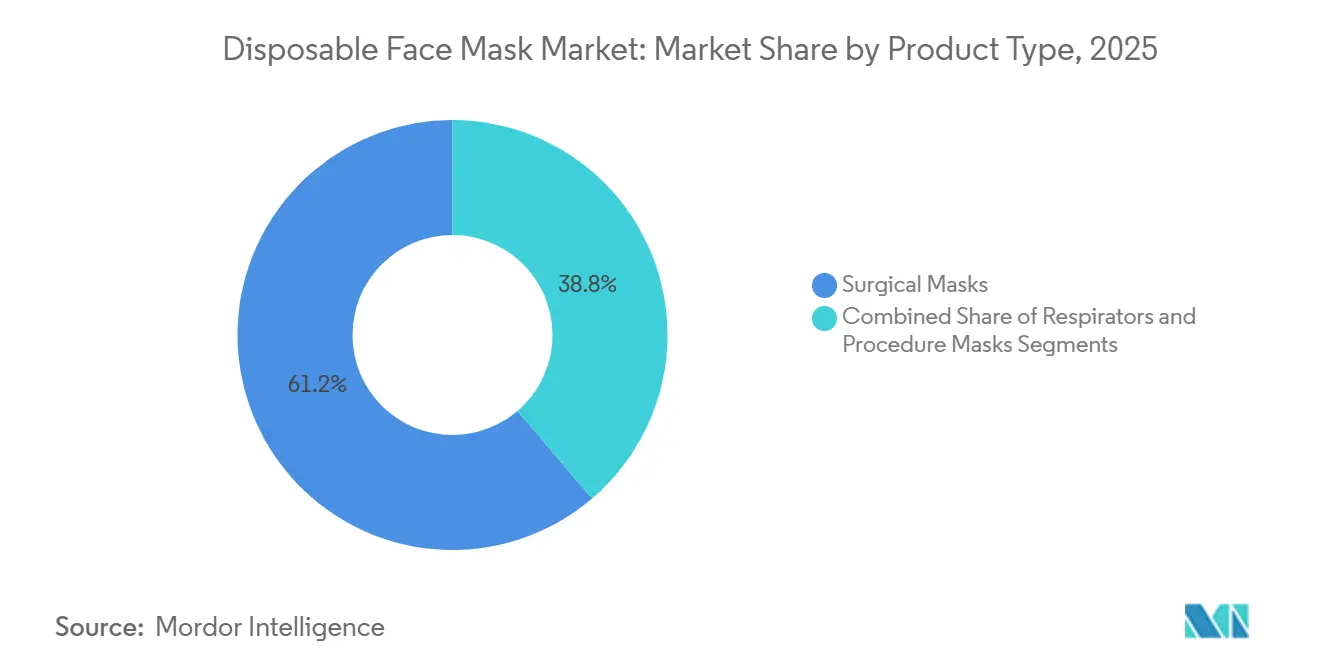
- By product type, surgical masks led with 61.24% revenue share in 2025, while respirators are projected to expand at a 4.42% CAGR through 2031.
- By material, melt-blown polypropylene accounted for 86.32% of 2025 value, whereas the “Others” category of bamboo, silk, and bioplastics is forecast to grow at a 5.53% CAGR over 2026-2031.
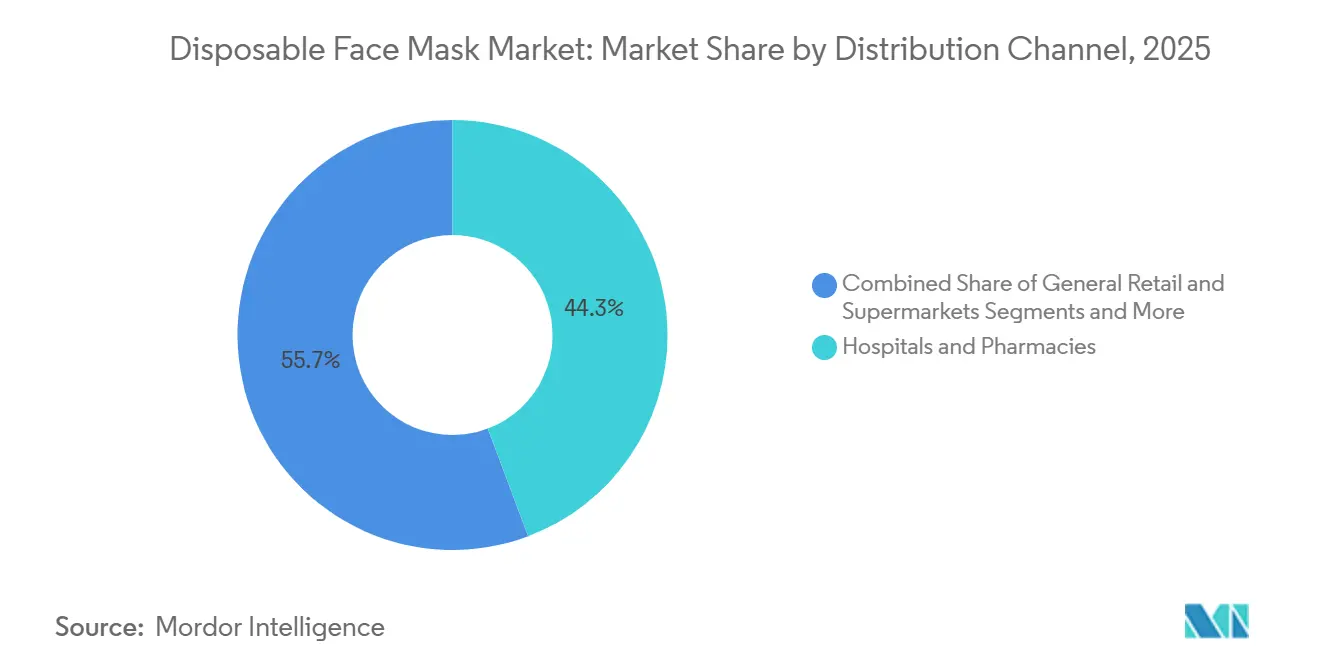
- By distribution channel, hospitals and pharmacies captured 44.26% of sales in 2025, yet online and direct-to-consumer outlets are advancing at a 6.03% CAGR to 2031.
- By user demographic, adults dominated with 81.67% of demand in 2025; the pediatric segment is expanding at a 3.13% CAGR through 2031.
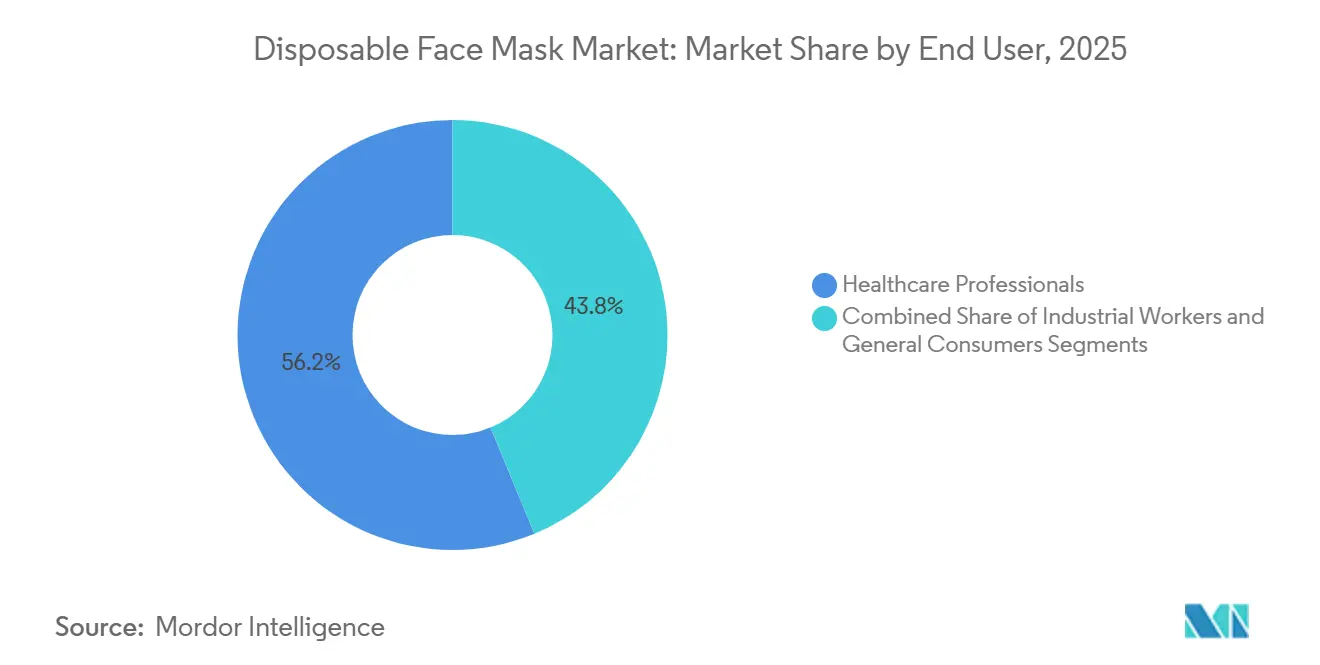
- By end user, healthcare professionals held 56.22% share in 2025, while industrial and construction workers represent the fastest-growing group at a 4.62% CAGR to 2031.
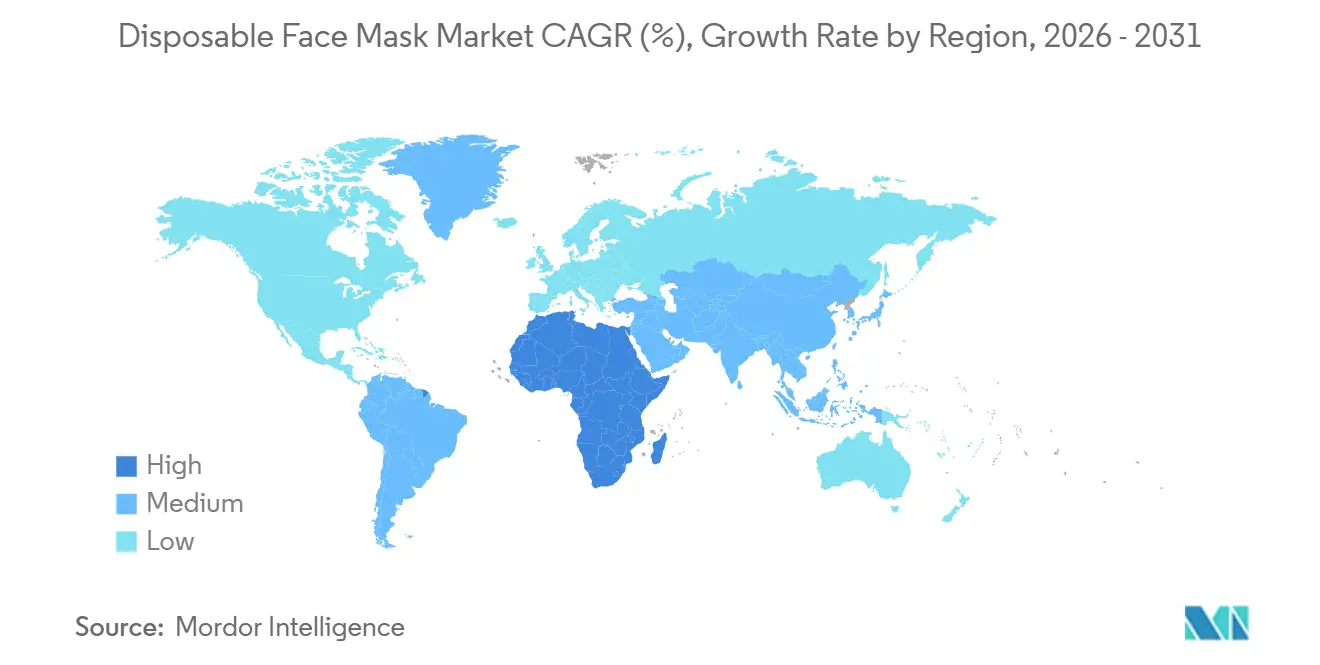
- By geography, Asia-Pacific led with 39.62% of 2025 value, and the Middle East & Africa region is on track for the highest growth at a 4.89% CAGR through 2031.
Note: Market size and forecast figures in this report are generated using Mordor Intelligence’s proprietary estimation framework, updated with the latest available data and insights as of 2026.
Global Disposable Face Mask Market Trends and Insights
Drivers Impact Analysis*
| Driver | (~) % Impact on CAGR Forecast | Geographic Relevance | Impact Timeline |
|---|---|---|---|
| Post-COVID Pandemic Stockpiling by National Strategic Reserves | +0.4% | North America, Europe, APAC core | Long term (≥ 4 years) |
| Re-Institutionalization of Infection-Prevention Standards in Non-Acute Healthcare Settings | +0.3% | Global, with concentration in North America & EU | Medium term (2-4 years) |
| Mandated Use in Severe Seasonal Flu Outbreaks Across Asia | +0.3% | APAC core (China, Japan, South Korea, India) | Short term (≤ 2 years) |
| Corporate "Air-Quality First" ESG Commitments | +0.2% | Global, led by North America & EU multinationals | Medium term (2-4 years) |
| Rapid E-Commerce Private-Label Penetration in LATAM | +0.2% | South America (Brazil, Argentina, Mexico) | Short term (≤ 2 years) |
| WHO-Led Filtration-Test Standardization (ISO 16890, ASTM F3502) Triggers Mask-Replacement Cycles | +0.3% | Global, with early adoption in North America & EU | Medium term (2-4 years) |
| Source: Mordor Intelligence | |||
Post-COVID Stockpiling by National Strategic Reserves
Federal agencies converted emergency buys into permanent rotation programs that guarantee multi-year respirator volumes. The United States Strategic National Stockpile held 350 million N95s in 2024, 26 times pre-2020 levels, while Canada’s vendor-managed model forces suppliers to backfill expiring lots.[2] Centers for Disease Control and Prevention, “Strategic National Stockpile,” cdc.gov Similar six-month supply buffers in Germany and France institutionalize base-line demand, particularly for certified respirators, and motivate manufacturers to maintain NIOSH-compliant production lines.
Re-Institutionalized Infection-Prevention in Non-Acute Healthcare Settings
CMS embedded documented mask policies into Medicare reimbursement rules for nursing homes in 2024, turning episodic mask use into a compliance requirement.[3]Centers for Medicare & Medicaid Services, “Infection Prevention and Control,” U.S. Department of Health and Human Services, cms.gov Outpatient dialysis centers and home-health agencies now purchase year-round stock, decoupling demand from public sentiment. Occupational health frameworks such as ISO 45001 further normalize respiratory protection across ancillary healthcare services.
Mandated Mask Use During Severe Seasonal Flu in Asia
Japanese, South Korean, Chinese, and Indian health ministries activate mask advisories whenever WHO flu surveillance flags elevated A(H3N2) prevalence. Because vaccination penetration remains low in several South-East Asian economies, governments find disposable masks a cost-effective prophylaxis, creating predictable Q3-Q4 procurement spikes.
Corporate “Air-Quality First” ESG Programs
Revised OSHA respiratory-protection rules issued in 2024 compel employers to fit-test staff facing particulate hazards, and many multinationals disclose compliance metrics in sustainability reports. Public companies subject to SEC and EU CSRD reporting treat mask provision as a tangible health-and-safety deliverable, locking annual volumes into operating budgets.
Restraints Impact Analysis*
| Restraint | (~) % Impact on CAGR Forecast | Geographic Relevance | Impact Timeline |
|---|---|---|---|
| Raw-Material Cost Spikes for Melt-Blown Polypropylene | -0.3% | Global, with acute impact in APAC manufacturing hubs | Short term (≤ 2 years) |
| Saturation of Low-End SKUs Driving ASP Erosion | -0.2% | Global, most severe in APAC & South America | Medium term (2-4 years) |
| Legislative Clampdown on Single-Use Plastics in the EU & Canada | -0.2% | Europe, North America (Canada) | Long term (≥ 4 years) |
| Rise of Reusable Respirators & Biodegradable Mask Substitutes | -0.2% | North America, Europe, with spillover to APAC | Medium term (2-4 years) |
| Source: Mordor Intelligence | |||
Raw-Material Cost Spikes for Melt-Blown Polypropylene
Polypropylene prices averaged USD 1,378 per metric ton in Q4 2025, and smaller suppliers could not hedge feedstock exposure. Fixed-price government contracts squeeze margins during cost surges, discouraging long-term capacity investments outside vertically integrated firms.
Saturation of Low-End SKUs Drives ASP Erosion
Pandemic-era capacity expansions left a glut of procedure masks selling for USD 0.10-0.15 in bulk, barely above variable cost. Commodity producers face a volume-versus-margin dilemma that bifurcates the Disposable face mask market between certified respirators and undifferentiated low-end masks.
*Our forecasts treat driver/restraint impacts as directional, not additive. The impact forecasts reflect baseline growth, mix effects, and variable interactions.
Segment Analysis
By Product Type: Respirators Gain Ground in Certified Segments
Surgical masks captured 61.24% of Disposable face mask market share in 2025, while respirators are advancing at a 4.42% CAGR through 2031. Certified N95 and FFP2 devices command ASPs of USD 1.50-3.00, offering superior margin profiles that coax manufacturers to retool. OSHA fit-testing mandates reinforce the Disposable face mask market trend toward certified options, and ASTM F3502 provides an intermediate “Workplace Performance” tier for buyers who want better protection without full respirator protocols. Procedure masks retreat to cost-sensitive niches such as food service. Manufacturers capable of offering the entire certified-to-value continuum remain best positioned to capture shifting procurement patterns.
Second-order effects include the widening gap between brand-anchored respirators and commodity procedure masks. Companies with in-house melt-blown lines integrate vertically to control filtration media quality, while others outsource but differentiate through packaging or ear-loop comfort. Replacement cycles driven by standard updates ensure periodic demand spikes that benefit respirator portfolios, further tilting revenue mix toward certified SKUs.



By Material: Polypropylene Dominance Masks Emerging Alternatives
Melt-blown polypropylene held 86.32% of the Disposable face mask market size in 2025, owing to high filtration efficiency per cost unit. Yet bamboo fiber and PLA bioplastics are projected to scale at a 5.53% CAGR as EU recycling mandates steer R&D budgets into compostable substrates. Producers juggle the economics of premium-priced bioplastics against uncertain willingness-to-pay, targeting European tenders that value sustainability metrics. For now, polypropylene remains unmatched in electrostatic charge retention and breathability, but pilot electro-spinning lines for nanocellulose composites point to a measured diversification of raw-material risk.
Cost volatility further motivates diversification. Vertically integrated suppliers hedge feedstock swings by controlling refinery off-takes, whereas mid-tier firms pursue long-term resin contracts or lightweight mask designs that use less polypropylene per unit. In parallel, consumer brands tap into eco-conscious niches by blending PLA outer layers with conventional melt-blown cores, a hybrid approach that meets filtration thresholds while signaling environmental progress.
By Distribution Channel: E-Commerce Disrupts Traditional Retail
Hospitals and pharmacies retained a 44.26% revenue share in 2025, but online channels are registering a 6.03% CAGR to 2031 as Latin American and South-East Asian shoppers pivot to mobile marketplaces. Disposable face mask market dynamics favor platforms that bundle masks with related health items for free shipping thresholds. Subscription models create predictable monthly volumes for work-from-home consumers, while direct-to-consumer manufacturer sites reclaim 15-20% margin otherwise lost to wholesalers.
Brick-and-mortar outlets respond with value-added services such as on-site fit checks and immediate availability for urgent needs, yet foot traffic continues to drop outside acute outbreak windows. Pharmacies retain an advantage for regulated N95s when buyers require authenticity verification, but private-label imports erode price corridors. Future distribution strategies will hinge on last-mile logistics efficiency and real-time inventory visibility.
By User Demographics: Adult Segment Dominates, Pediatric Niche Expands
Adults generated 81.67% of Disposable face mask market demand in 2025. Pediatric masks, though smaller in absolute volume, are advancing at a 3.13% CAGR as schools and daycare centers integrate mask policies aligned with CDC congregate-setting guidance. Manufacturers confront design challenges related to seal integrity on small faces and must pass FDA pediatric device validation, raising barriers to entry.
The geriatric demographic grows steadily as long-term care facilities institutionalize infection-control protocols mandated by CMS, ensuring constant reorder cycles. Market segmentation by workplace role also shapes adult demand: healthcare and industrial masks require differing durability and breathability specs, enabling tiered product positioning.
By End User: Industrial Workers Emerge as Growth Segment
Healthcare professionals accounted for 56.22% of Disposable face mask market size in 2025, anchored by surgical-suite norms and airborne precaution guidelines. Industrial and construction users, driven by a 4.62% CAGR outlook, now procure certified respirators for dust and fume exposure after OSHA issued more than 1,200 citations in 2024. Consumer demand normalizes to lower baselines except in Asia-Pacific cultures with high voluntary mask adoption.
Institutional buyers in manufacturing increasingly specify reusable half-facepiece respirators for full-shift wear, reserving disposables for visitors and short tasks. This procurement mix change pressures disposable-only vendors and rewards firms with hybrid portfolios that include filter cartridges and cleaning supplies.
Geography Analysis
Asia-Pacific retained 39.62% of Disposable face mask market share in 2025, buoyed by domestic consumption in China, Japan, South Korea, and India and by the region’s export leadership. WHO flu advisories sustain periodic consumer spikes, while industrial demand climbs with large-scale infrastructure projects. Domestic manufacturers scale melt-blown capacity quickly, allowing rapid response to regional outbreaks and price changes.
North America stands as the second-largest market. The U.S. and Canada continue to fund strategic stockpiles that impose rolling replenishment schedules under vendor-managed inventory contracts. Mexico leverages nearshoring to supply polypropylene masks to U.S. buyers seeking diversification away from Asia. Yet emerging single-use-plastic rules in Canada foreshadow tighter scrutiny on non-medical disposables.
Europe’s demand is driven by EN 149 FFP2 adoption and sustainability legislation. Regulation 2025/40 requires high recycled content in consumer packaging, nudging R&D toward compostable masks. Fragmented national procurement encourages localized production, often supported by government grants aimed at strategic autonomy.
Middle East and Africa, the fastest-growing cluster at 4.89% CAGR, benefits from expanded GCC hospital networks and South African centralized tenders that stipulate ISO and ASTM compliance. Price sensitivity slows certified respirator adoption in sub-Saharan economies, but multilateral financing for pandemic preparedness is bridging the affordability gap.
South America experiences strong e-commerce penetration. Brazilian and Argentine online retailers push private-label masks that undercut pharmacy prices by up to 40%, fragmenting the Disposable face mask market landscape. Currency volatility and import duties complicate supply planning, yet favorable demographics keep baseline volumes resilient.

Regulatory Landscape
Disposable face masks fall under both medical-device and occupational-safety rulebooks, so compliance obligations vary by intended use and the claims made on-pack. In the United States, surgical masks are regulated by the FDA as Class II medical devices (21 CFR 878.4040), which ties manufacturers to medical-device quality system expectations. N95-class respirators are certified by NIOSH under 42 CFR Part 84, and the process includes site qualification and ongoing quality controls, which raises the barrier to entry for certified products.
In Europe, medical masks are governed by Regulation (EU) 2017/745 (MDR), supported by harmonized technical standards. In October 2025, the European Commission issued Implementing Decision (EU) 2025/2078 updating harmonized standards, including EN 14683:2025 for medical face masks. This update reinforces the need for suppliers to keep test methods and technical documentation current for institutional tenders and notified-body pathways.
Value Chain Analysis
The disposable face mask value chain starts with polymers, where polypropylene feedstock is converted into spunbond nonwovens (outer and inner layers) and melt-blown nonwoven (the filtration layer). Melt-blown capacity is the most critical upstream constraint because of specialized equipment and process know-how, which makes filtration-media sourcing, electrostatic performance control, and batch traceability central to quality and cost management. This sensitivity is amplified by market conditions such as Q4 2025 polypropylene pricing at USD 1,378 per metric ton, which increases margin pressure for assemblers that do not have resin or nonwoven integration.
In the midstream, converters assemble 3-ply surgical and procedure masks and certified respirators (where applicable) using automated forming, ultrasonic welding, and packaging lines that must pass audits for FDA/ISO-aligned quality systems or NIOSH certification. On the downstream side, the customer base spans institutional buyers (hospitals, pharmacies, government stockpiles) and faster-growing online and direct-to-consumer channels. E-commerce and private-label programs in Latin America and Southeast Asia compress price corridors and redirect value capture toward packaging efficiency, authentication controls for regulated SKUs, and last-mile logistics performance.
Competitive Landscape
The market reflects moderate fragmentation. Honeywell’s USD 1.325 billion sale of its PPE unit in November 2024 underlined how multinational conglomerates view masks as margin-dilutive. Solventum, spun out of 3M, posted USD 8.2 billion in 2024 sales but recorded USD 574 million in litigation accruals for respirator liability, revealing regulatory risk. Kimberly-Clark’s professional segment cited USD 5.1 billion in Q3 2024 revenue yet noted commodity input cost pressure.
Asian contract manufacturers, many vertically integrated into melt-blown fabric, compete on unit cost and speed, often supplying white-label inventory to Western distributors. European mid-size firms carve niches in biodegradable materials, while U.S. producers target domestic hospitals with supply-chain-resilience narratives. Barriers to entry center on NIOSH certification and sustained quality-control audits, insulating top respirator brands but leaving procedure mask segments open to new entrants.
Future competitive advantage will hinge on automation in sealing and packaging, regulatory affairs agility, and omnichannel distribution partnerships. Companies that can certify product lines to evolving ISO or ASTM standards in weeks rather than months will win institutional tenders tied to compliance milestones.
Disposable Face Mask Industry Leaders
Honeywell International Inc.
Kimberly-Clark Corporation
Owens & Minor Inc.
Alpha Pro Tech Ltd.
Solventum
- *Disclaimer: Major Players sorted in no particular order

Market Opportunities and Future Outlook
Standard-driven refresh cycles and tighter product-definition requirements create opportunities for suppliers that can update documentation, labeling, and test evidence quickly across surgical masks and respirator portfolios. A concrete example is ASTM International's April 2026 implementation of ASTM F2100-26, which shifts emphasis from material-focused criteria toward a more comprehensive finished-product standard (including labeling and instructions). That change increases the premium on compliant packaging, traceability, and rapid change-control capabilities that fit institutional procurement.
Regionalized replenishment procurement also supports opportunities beyond acute-care demand, especially where governments and employers are formalizing rotation programs. In North America, strategic stockpile rotation and domestic capacity narratives are supported by new manufacturing investments, including U.S. Medical Glove Company's May 2025 launch of a Harvard, Illinois facility with six high-speed 3-ply mask lines (over 75 million masks per year capacity, with surge capability cited above 230 million per year). In Europe, security-of-supply discussions are influencing buyer preferences for local automated production, as reflected by French manufacturer Inspire Protection highlighting automated FFP2/FFP3 and surgical-mask lines in July 2026 while pursuing industrial and defense continuity contracts.
Recent Industry Developments
- May 2026: Alpha Pro Tech reported higher face mask sales for the first quarter ended March 31, 2026, including a year-over-year increase cited in its quarterly release. The update indicates demand pockets for established suppliers in a normalized market, supporting continued production utilization and channel focus on higher-turn institutional and export orders.
- May 2025: Honeywell completed the USD 1.325 billion sale of its Personal Protective Equipment business to Protective Industrial Products (PIP). The divestiture changed competitive dynamics by moving a large branded PPE portfolio into a specialist safety distributor-manufacturer, while Honeywell exited a commoditized category with tight pricing and compliance overhead.
- July 2024: Ansell completed the acquisition of Kimberly-Clark's personal protective equipment business, including the Kimtech and KleenGuard mask lines. The deal consolidated PPE brands under a focused safety player, strengthening category breadth for industrial and healthcare channels where bundled procurement and distributor reach influence mask purchasing decisions.


Research Methodology Framework and Report Scope
Market Definition and Coverage
This market covers single use face masks sold for protection and filtration in healthcare, industrial settings, and everyday personal use, where the product is designed to be discarded after use and not cleaned for reuse.
Scope exclusions: We exclude reusable or washable fabric masks, non-mask PPE items, and capital equipment used to manufacture masks.
Segmentation Overview
- By Product Type
- Surgical Masks
- Respirators (N95/KN95/FFP2)
- Procedure Masks
- By Material
- Melt-blown Polypropylene
- Cotton & Cellulose
- Others (Bamboo, Silk, Bioplastics)
- By Distribution Channel
- Hospitals & Pharmacies (Offline)
- General Retail & Supermarkets
- Online & Direct-to-Consumer
- By User Demographics
- Adult
- Pediatric / Child
- Geriatric
- By End-User
- Healthcare Professionals
- Industrial/Construction Workers
- General Consumers
- By Geography
- North America
- United States
- Canada
- Mexico
- Europe
- Germany
- France
- United Kingdom
- Italy
- Spain
- Rest of Europe
- Asia-Pacific
- China
- Japan
- India
- South Korea
- Australia
- Rest of Asia-Pacific
- Middle East & Africa
- GCC
- South Africa
- Rest of Middle East & Africa
- South America
- Brazil
- Argentina
- Rest of South America
- North America
Data Sources, Market Sizing, and Validation
Desk Research
For the initial structure of the model, we start with public data that can explain demand signals and supply readiness for disposable masks. Sources used include, such as CDC guidance and usage advisories, WHO technical guidance, UN Comtrade trade flows for key nonwoven and mask-related HS codes, and USITC trade statistics for cross-checking import reliance.
To keep assumptions grounded, we also refer to sources such as OSHA and NIOSH documentation for workplace protection requirements, along with peer reviewed studies on filtration performance and melt-blown polypropylene supply constraints. Company annual reports, investor presentations, and press releases are used to track capacity additions, channel mix shifts, and pricing commentary, and select paid subscriptions support company financials, patent lookups, and shipment-level import/export checks. These desk sources are not exhaustive, and many other public and paid references were used to validate data points and resolve open questions.
Primary Interviews and Surveys
Primary work is used to verify what the desk data cannot show clearly, especially the split between medical, industrial, and consumer demand, and the way average selling prices move when shortages ease. We speak with manufacturers, distributors, healthcare procurement teams, and industrial safety buyers across major regions so our assumptions on volumes, channel mix, and compliance-led demand can be stress-tested against how orders actually run.
Distribution of primary research fieldwork respondents
| Company type | Respondent position | Region |
|---|---|---|
| Top tier: 28% | CXOs: 12% | APAC: 44% |
| Mid tier: 52% | Functional/Unit leaders: 42% | EMEA: 31% |
| Smaller Players: 20% | Managers: 46% | Americas: 25% |
Market-Sizing & Forecasting
Sizing starts with a top-down build where population and workforce exposure, healthcare procedure intensity, and industrial safety adoption are converted into an addressable mask consumption pool by region, which is then adjusted for disposable mask penetration and replacement frequency. Once the demand pool is shaped, it is aligned with trade and production signals so totals stay realistic when supply tightens or when inventory normalizes.
Key inputs that get tracked and refreshed include hospital and clinic usage protocols, industrial compliance intensity for dust and particulate exposure, raw material indicators linked to melt-blown polypropylene availability, import dependence and tariff related cost shifts, and channel mix across hospital pharmacies, general retail, and online direct sales. The forecast is typically run using scenario analysis supported by short time-series smoothing for stable submarkets, since outbreaks, policy tightening, and price normalization can move the market in steps instead of in a straight line. Where a bottom-up roll-up is possible, sampled supplier volumes and observed price bands are used as a reasonableness check, and gaps are filled using conservative ranges validated through distributor feedback and trade flows.
Data Validation & Update Cycle
Model outputs are checked against independent signals, such as import volumes, capacity announcements, and procurement cycle patterns, and then variances are reviewed to confirm whether they are driven by real events rather than inconsistent assumptions. If an outlier is found in a country or channel, we revisit the driver assumptions and, when needed, re-contact sources to confirm whether the shift is demand-led, supply-led, or purely pricing-related.
Before sign-off, the work goes through multiple analyst reviews where inputs, calculations, and unit consistency are rechecked, followed by a final sanity pass on growth rates and implied per-capita usage. Reports are refreshed annually, and interim updates are made when major regulatory changes, supply disruptions, or public health events materially change consumption or pricing.
Mordor Intelligence's Disposable Face Mask Market Sizing Compared With Other Published Estimates
Published market numbers for disposable face masks often do not match because firms may include different product sets, apply different price assumptions, or anchor the model to different years when pricing was unusually high or unusually normalized.
Some estimates bundle broad disposable mask types that lean toward industrial dust protection and general nonwoven face covers. In Mordor Intelligence, respirators, procedure masks, and surgical masks are counted only when they are single use face-worn products sold into healthcare, industrial, or consumer channels, with pricing and volume checked against trade flows and channel discussions so temporary spikes do not get carried forward.
Benchmark comparison
| Source | Market Size | Gaps in Research Methodology |
|---|---|---|
| Mordor Intelligence | USD 2.69 B (2026) | |
| Industry Publisher A | USD 2.82 B (2026) | Uses a broader product bucket that can mix general nonwoven disposable covers and dust-protection items, and price normalization is not clearly reconciled to import and production signals. |
| Global Publisher B | USD 2.67 B (2025) | Anchors the series to a different base year and applies a single global growth path, which can understate regional shifts tied to healthcare protocols and industrial compliance changes. |
The spread across the three values mainly comes from product inclusion choices and how fast average selling prices are assumed to normalize after disruption years. By keeping the demand pool tied to usage protocols and then cross-checking it with trade and channel indicators, the resulting number stays easier to trace back to clear, repeatable inputs.


Key Questions Answered in the Report
How large is the Disposable face mask market in 2026?
It reached USD 2.69 billion in 2026 and is on track to hit USD 2.97 billion by 2031 at a 1.98% CAGR.
Which product segment is growing fastest?
Certified respirators such as N95, KN95, and FFP2 devices show the highest growth at a 4.42% CAGR through 2031.
What region leads demand today?
Asia-Pacific holds the largest share at 39.62% thanks to dense populations, local manufacturing capacity, and cultural mask acceptance.
Why are polypropylene prices critical for producers?
Melt-blown polypropylene accounts for up to 80% of unit material cost, so feedstock volatility directly affects margins.
How is e-commerce changing distribution?
Online and direct-to-consumer channels are expanding at a 6.03% CAGR as platforms in Latin America and South-East Asia undercut traditional retail prices.
Are sustainability regulations influencing the market?
Yes, EU and Canadian single-use-plastic laws are pushing suppliers to trial biodegradable fibers, adding cost but opening new premium niches.
Page last updated on:


 Your data is secure and never sold or shared.


