
Disposable Medical Devices Sensors Market Size and Share
Market Overview
| Study Period | 2020 - 2031 |
|---|---|
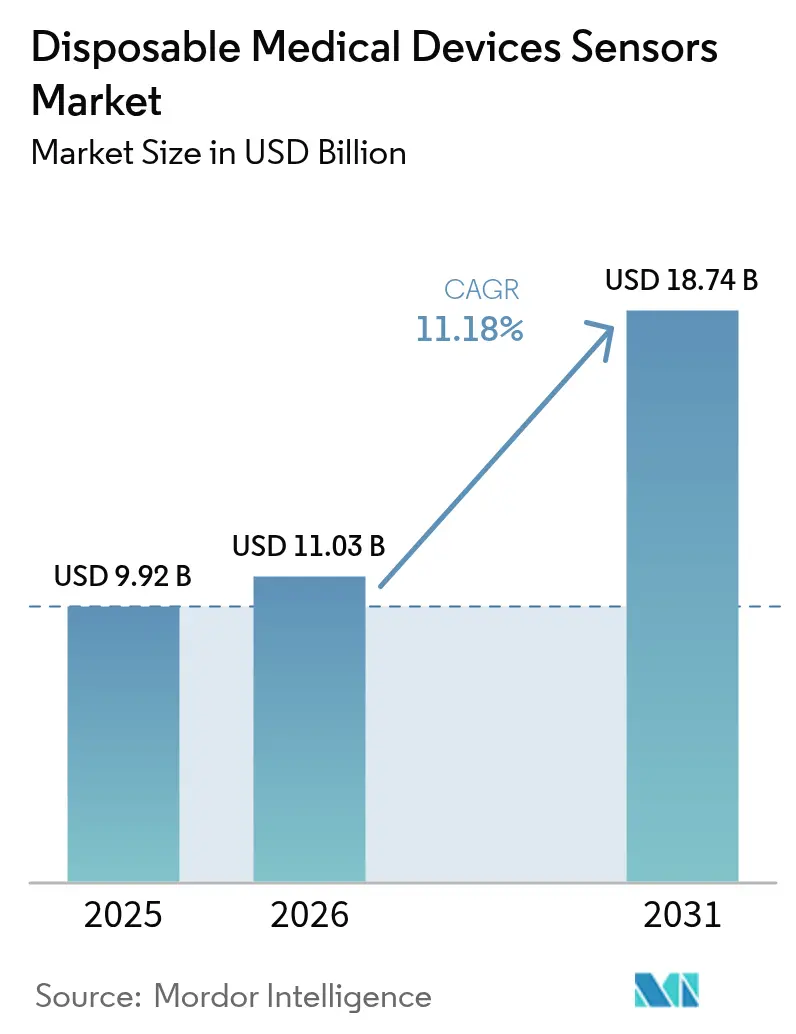
| Market Size (2026) | USD 11.03 Billion |
| Market Size (2031) | USD 18.74 Billion |
| Growth Rate (2026 - 2031) | 11.18 % |
| Fastest Growing Market | Asia Pacific |
| Largest Market | North America |
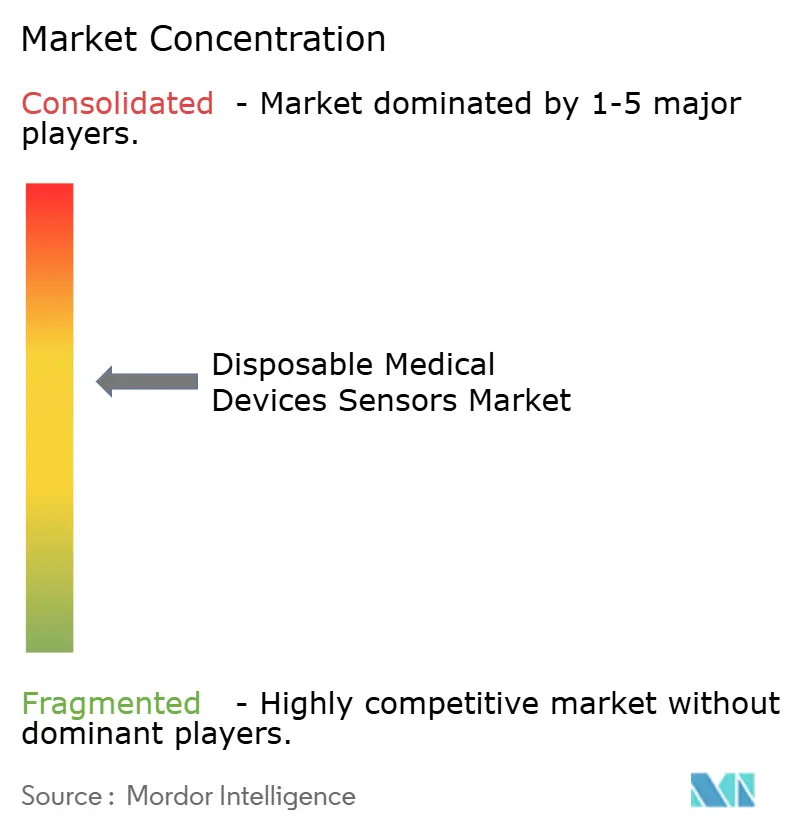
| Market Concentration | Medium |
Major Players *Disclaimer: Major Players sorted in no particular order Image © Mordor Intelligence. Reuse requires attribution under CC BY 4.0. | |
Disposable Medical Devices Sensors Market Analysis by Mordor Intelligence
The disposable medical device sensors market size was valued at USD 9.92 billion in 2025 and estimated to grow from USD 11.03 billion in 2026 to reach USD 18.74 billion by 2031, at a CAGR of 11.18% during the forecast period (2026-2031). Continual emphasis on infection prevention, wider use of single-use devices during the COVID-19 pandemic, and accelerating demand for remote patient monitoring underpin this expansion[1]. Cost advantages over reusable devices, the shift toward home-based care, and rapid technology advances in miniaturization, connectivity, and biodegradability further stimulate growth. Competitive strategies center on partnerships that combine sensing hardware with data analytics, while providers amplify purchases to lower the risk of cross-contamination and avoid sterilization expenses. Finally, sustainability pressures are steering leading firms to explore eco-friendly materials and closed-loop recycling models, creating new innovation lanes for the disposable medical device sensors market.
Key Report Takeaways
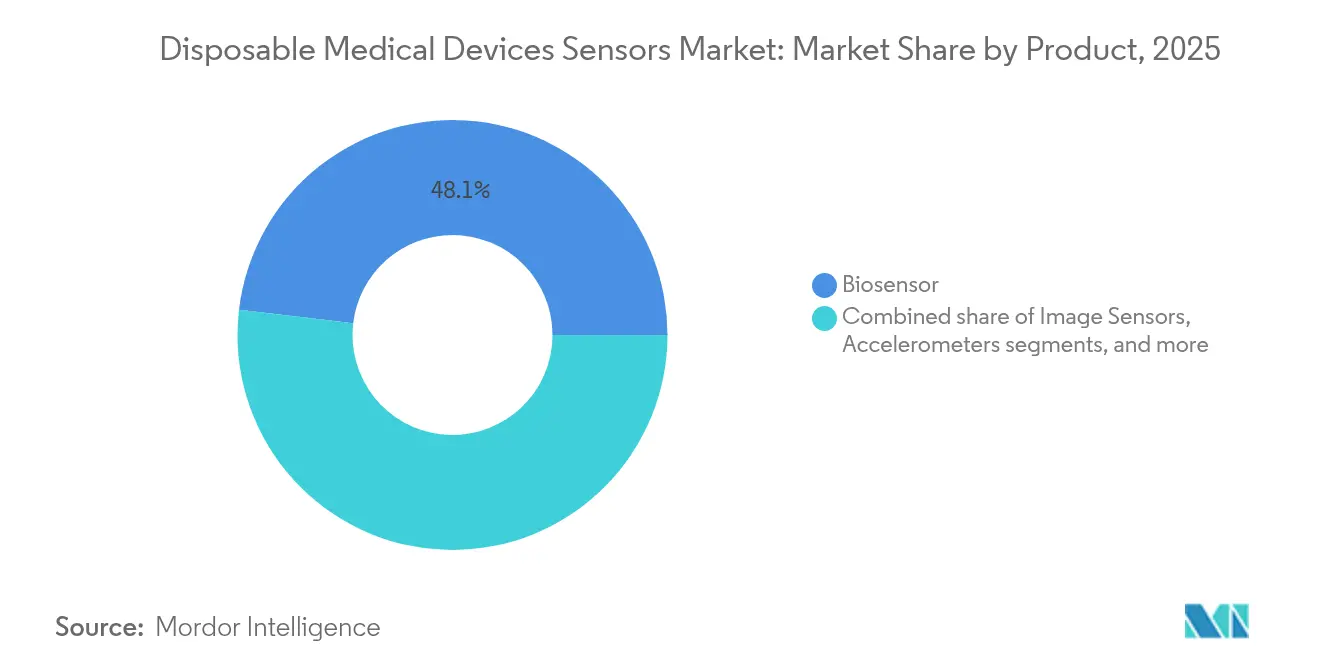
- By product category, biosensors led with 48.12% revenue share in 2025; image sensors are projected to expand at a 13.38% CAGR to 2031.
- By application, patient monitoring held 46.05% of the disposable medical device sensors market share in 2025, while diagnostics is expected to grow at 14.11% through 2031.
- By technology, MEMS accounted for a 42.25% share of the disposable medical device sensors marke size in 2025 and nanotechnology-enabled sensors are advancing at a 13.71% CAGR to 2031.
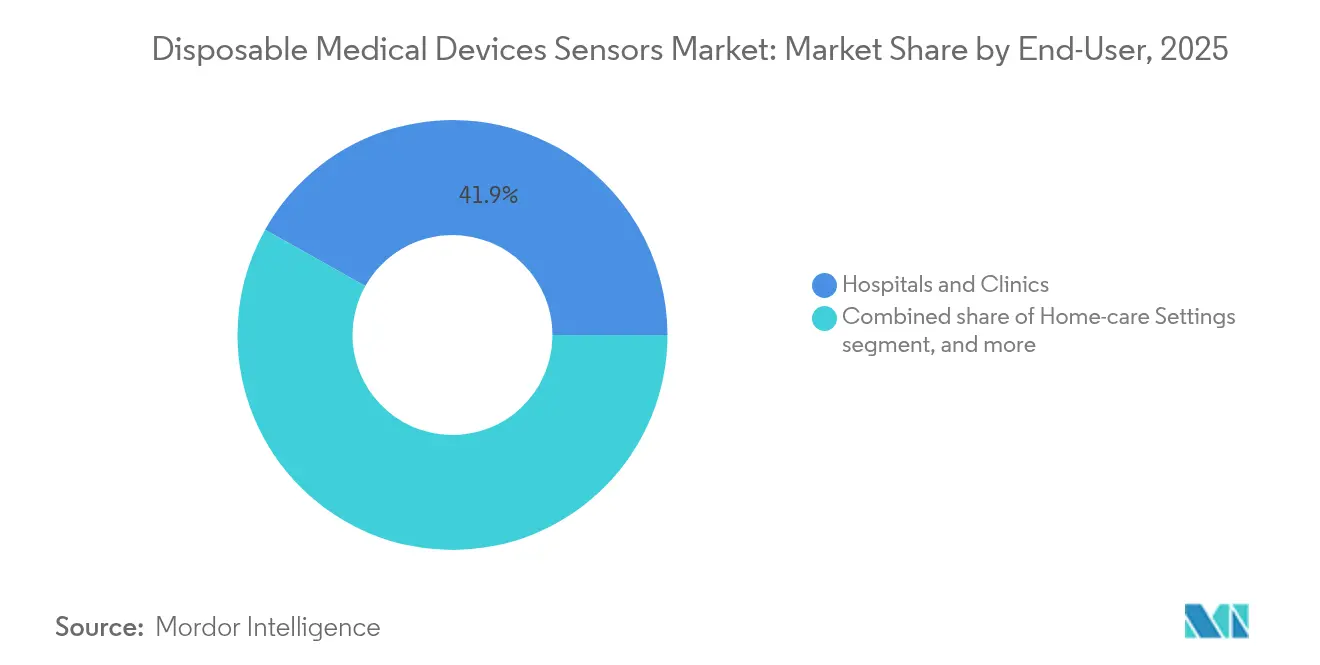
- By end-user, hospitals and clinics captured 41.85% of revenue in 2025; home-care settings are forecast to climb at a 14.33% CAGR to 2031.
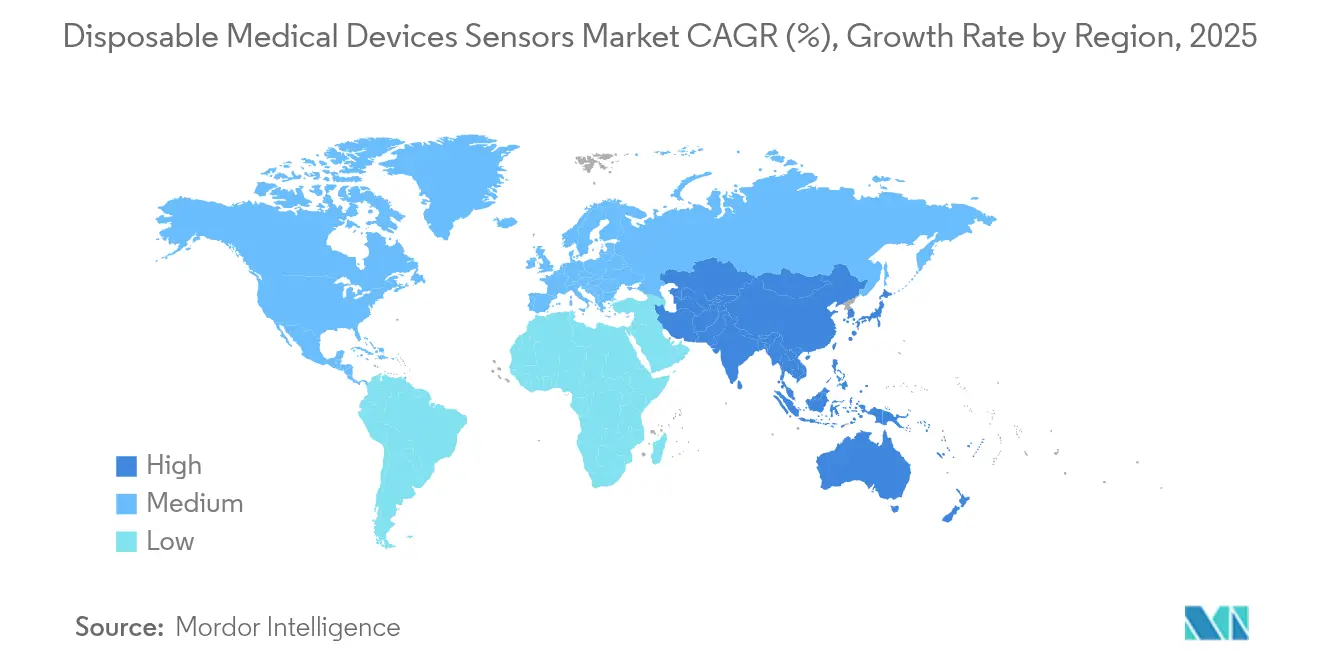
- By geography, North America dominated with 38.21% share in 2025, whereas Asia-Pacific is anticipated to witness the fastest 12.29% CAGR to 2031.
Note: Market size and forecast figures in this report are generated using Mordor Intelligence’s proprietary estimation framework, updated with the latest available data and insights as of 2026.
Market Trends and Insights
Drivers Impact Analysis of Disposable Medical Devices Sensors Market*
| Driver | % Impact on CAGR Forecast | Geographic Relevance | Impact Timeline |
|---|---|---|---|
| Growing Prevalence Of Chronic Diseases | +2.8% | Global, highest in North America & Asia-Pacific | Long term (≥ 4 years) |
| Rising Demand For Point-Of-Care Diagnostics | +2.1% | Global, led by North America & Europe | Medium term (2-4 years) |
| Expansion Of Wearable Health Monitoring Devices | +1.9% | Asia-Pacific core, spill-over to North America | Medium term (2-4 years) |
| Technological Advancements In Biosensor Miniaturization | +1.6% | Global, concentrated in developed markets | Long term (≥ 4 years) |
| Increasing Adoption In Emerging Markets | +1.4% | Asia-Pacific, Middle East & Africa, Latin America | Long term (≥ 4 years) |
| Supportive Government And Reimbursement Policies | +1.2% | North America & European Union | Short term (≤ 2 years) |
| Source: Mordor Intelligence | |||
Growing Prevalence of Chronic Diseases
The number of adults living with diabetes exceeded 537 million in 2024, spurring unprecedented demand for disposable glucose-monitoring sensors such as Abbott’s FreeStyle Libre, which supports more than 6 million users across 60 countries. Providers increasingly favor single-use cardiac sensors for long-term rhythm assessment as cardiovascular disease remains the top global mortality cause. Continuous, disposable solutions remove sterilization tasks and maintain accuracy over extended use, supporting chronic-care protocols for aging populations. As health systems pivot from episodic to continuous care, the disposable medical device sensors market gains an enduring revenue stream from refill demand.
Rising Demand for Point-of-Care Diagnostics
The pandemic reinforced the clinical value of near-patient testing, and disposable biosensors proved essential for rapid antigen detection in emergency departments and rural clinics. U.S. regulators continue to ease market entry by granting expedited pathways for qualified point-of-care devices, enhancing speed to market. Smartphone-connected sensor sticks permit immediate readouts and cloud upload, reshaping diagnostic data flows. Faster diagnosis trims patient wait times, cuts downstream costs, and elevates clinical outcome expectations, ensuring a sustained lift for the disposable medical device sensors market.
Expansion of Wearable Health Monitoring Devices
Global shipments of consumer and medical wearables are on track to touch 2 billion units, with MEMS accelerometers and biosensors embedded for vitals tracking. Adhesive single-use patches improve skin comfort and reduce hygiene risks for multi-day wear. Advances from STMicroelectronics allow non-invasive, continuous cardiac and blood-pressure sensing in miniaturized form factors. Predictive analytics integrated into these wearables supports early intervention and chronic-disease adherence programs, further deepening disposable sensor penetration.
Technological Advancements in Biosensor Miniaturization
MEMS pressure sensors can now be manufactured for roughly USD 10 per unit while retaining clinical-grade accuracy, enabling cost-effective disposability[2]. Nanostructured electrodes push detection limits to molecular levels, allowing earlier disease identification. Three-dimensional printing reduces development cycles, and biopolymers introduce compostable substrates that address disposal concerns. Coupled with low-power wireless chips, ultra-small sensors send data seamlessly to electronic health record systems, enhancing the appeal of the disposable medical device sensors market.
Restraints Impact Analysis of Disposable Medical Devices Sensors Market*
| Restraints Impact Analysis | (~) % Impact on CAGR Forecast | Geographic Relevance | Impact Timeline |
|---|---|---|---|
| Stringent Regulatory Approval Process | −1.8% | Global, most pronounced in North America & Europe | Short term (≤ 2 years) |
| Concerns Over Data Privacy And Security | −1.2% | Global, highest in developed markets | Medium term (2-4 years) |
| Price Sensitivity In Cost-Constrained Settings | −0.9% | Emerging markets, rural healthcare facilities | Long term (≥ 4 years) |
| Limited Standardization And Interoperability | −0.7% | Global, affecting connected-device ecosystems | Medium term (2-4 years) |
| Source: Mordor Intelligence | |||
Stringent Regulatory Approval Process
New U.S. Quality System Regulation rules, effective February 2026, add clinical and documentation burdens that may lengthen time-to-market for smaller innovators. Interoperability guidelines now require compliance evidence during premarket submissions, driving extra verification costs[3]. As harmonization across regions remains limited, firms must navigate multiple approval tracks, which can delay global releases and temporarily moderate growth for the disposable medical device sensors market.
Concerns Over Data Privacy and Security
Connected sensors enlarge attack surfaces for cyber threats, prompting hospitals to mandate rigorous encryption audits before purchase. HIPAA and GDPR frameworks require granular consent and robust data handling, complicating device design and adding cost. Lack of a unified cybersecurity benchmark leads manufacturers to adopt conservative architectures that may curtail feature sets and slow adoption, particularly in sensitive clinical workflows.
*Our forecasts treat driver/restraint impacts as directional, not additive. The impact forecasts reflect baseline growth, mix effects, and variable interactions.
Disposable Medical Devices Sensors Market Segment Analysis
By Product:
Biosensors Lead Innovation WaveBiosensors captured 48.12% of revenue in 2025, reinforcing their role as the principal growth engine of the disposable medical device sensors market. Electrochemical formats dominate glucose and cardiac-marker monitoring, while optical biosensors accelerate infectious-disease screening where rapid turnaround is critical. Image sensors hold the fastest 13.38% CAGR because advances in compact CMOS chips elevate capsule endoscopy and single-use scopes, broadening clinical reach. Pressure sensors remain staples in intensive-care units, replacing reusable transducers that require calibration. Accelerometers, temperature probes and hybrid devices complete an expanding toolkit for multi-parameter monitoring in hospital and home settings.

By Application:
Diagnostics Drives Market EvolutionPatient monitoring held 46.05% of 2025 revenue as hospitals and payers endorsed continuous surveillance for chronic ailments and post-procedure recovery. Remote monitoring codes in the United States underpin large-scale rollouts, pushing disposable medical device sensors market share steadily higher in this category. Diagnostics, however, shows the sharpest 14.11% CAGR as point-of-care platforms shift testing from centralized labs to bedsides, retail clinics and even homes. Rapid antigen assays and lab-on-a-chip cartridges reduce diagnosis time from hours to minutes, improving triage and containment efforts.
By End-User:
Home-Care Settings Transform Healthcare DeliveryHospitals and clinics accounted for 41.85% of sales in 2025, driven by strict sterilization policies that favor single-use devices over reusable counterparts. Diagnostic labs depend on disposables to eliminate cross-sample contamination, preserving result integrity. Ambulatory surgical centers likewise deploy single-use sensors as outpatient procedures grow in complexity and monitoring requirements. These institutional customers anchor baseline demand, ensuring volume stability for producers.
By Technology:
MEMS Dominance Faces Nanotechnology ChallengeMEMS platforms delivered 42.25% of 2025 revenue thanks to mature fabs that supply low-cost pressure, motion and flow sensors. CMOS imaging chips complement MEMS by powering high-resolution disposable scopes and retinal cameras. RFID and NFC tags provide instant connectivity, letting clinicians upload readings directly to electronic health records. Together, these technologies form the backbone of today’s disposable sensor ecosystem.
Geography Analysis
North America Disposable Medical Devices Sensors Market
North America accounted for 38.21% of global revenue in 2025, sustained by sophisticated payer systems and rapid RPM reimbursement expansion. FDA exemptions for specific device classes shorten approval cycles and invite continued innovation. Leading providers integrate sensor data with electronic health records, demanding standardized communication protocols and boosting uptake across hospital networks.
APAC Disposable Medical Devices Sensors Market
Asia-Pacific is projected to register a 12.29% CAGR through 2031, the fastest worldwide. Government investment in public health infrastructure, a soaring chronic-disease burden, and rising consumer purchasing power fuel demand. China’s updated reimbursement policies and India’s cost-driven innovation culture provide fertile ground for local producers, challenging incumbent multinationals. Although venture financing cooled from prior peaks, strategic investors still back firms with differentiated, affordable solutions, enlarging total addressable volume for the disposable medical device sensors market.
EMEA and South America Disposable Medical Devices Sensors Market
Europe shows consistent growth supported by the EU Medical Device Regulation, which embeds environmental requirements that accelerate biodegradable sensor adoption. Sustainability mandates cause firms to redesign products and supply chains, spawning collaboration between materials scientists and device makers. The Middle East, Africa, and South America collectively offer untapped opportunities as hospital construction and universal health-coverage initiatives gather pace. Suppliers that tailor rugged, low-cost disposables to local conditions stand to capture early mover advantages and strengthen global diversity in the disposable medical device sensors market.
Regulatory Landscape
Disposable medical device sensors are governed by risk-based classification and quality system requirements. In the United States, FDA oversight covers establishment registration, device listing, and premaket pathways such as 510(k) and exemptions, with the Quality Management System Regulation (QMSR) aligning U.S. quality-system expectations with ISO 13485:2016 taking effect in February 2026. The change is likely to increase design controls, supplier management, and documentation standards for high-volume disposable sensor manufacturing. Across major markets, updates to safety, labeling, and sterilization residuals also affect disposable probes and single-use sensor components.
Competitive Landscape
Market structure remains moderately fragmented, though consolidation is anticipated as data analytics becomes integral to device value. Abbott and Medtronic forged an alliance to connect FreeStyle Libre sensors with automated insulin pumps, signaling a preference for cooperative ecosystems over isolated platforms. GE Healthcare’s AI Innovation Lab invests in deep-learning algorithms that complement its hardware footprint, reinforcing end-to-end solutions rather than stand-alone sensors.
Product differentiation increasingly rests on miniaturization and software sophistication. New entrants exploit 3-D printing and nanomaterials to leapfrog legacy designs at a fraction of historical development cost. Meanwhile, incumbents explore circular-economy models that convert used sensors into feedstock, aligning with hospital sustainability targets and warding off regulatory risk. Successful firms combine transparent data-security frameworks with scalable manufacturing to secure multi-year supply contracts and defend share in the disposable medical device sensors market.
Disposable Medical Devices Sensors Industry Leaders
-
Medtronic plc
-
GE Healthcare
-
Koninklijke Philips N.V.
-
Abbott Laboratories
-
Honeywell International Inc.
- *Disclaimer: Major Players sorted in no particular order
Disposable Medical Devices Sensors Market Companies Covered in this Report
- Medtronic
- GE Healthcare
- Koninklijke Philips
- Abbott Laboratories
- Honeywell International
- NXP Semiconductors
- Sensirion
- Dexcom
- Roche
- OmniVision Technologies Inc.
- STMicroelectronics
- TDK InvenSense
- Smiths Group
- Starboard Medical Inc.
- Shenzhen Med-Link Electronics
- Medical Sensors India Pvt. Ltd.
- Tekscan Inc.
- Nova Biomedical
- Lifescan
- Cardea Bio (Paragraf)
- Gentag
Read Analysis of Disposable Medical Devices Sensors Companies
Market Opportunities and Future Outlook
Regulatory changes and standard alignment can translate into execution advantages for vendors that can scale disposable-sensor manufacturing while meeting compliance timelines. The FDA QMSR effective February 2026 aligns U.S. quality-system requirements with ISO 13485:2016, which supports global, multi-site supply chains and reduces divergence in supplier qualification for high-volume components. Market-entry pathways and hospital workflow requirements further support opportunities around low-risk disposable sensing and connected monitoring, particularly where recurring sensor replacement fits existing care models.
Recent Industry Developments in Disposable Medical Devices Sensors Market
- July 2026: Inflexion acquired German medical device manufacturer Primed for approximately EUR 300 million, expanding exposure to sterile, single-use disposable products used in surgery and intensive care. The deal improves access to established manufacturing and distribution in a core disposable category that frequently incorporates single-use sensing and monitoring components. Consolidation can also shift competitive dynamics through improved supply assurance and greater pricing leverage with hospital buyers.
- June 2026: Medtronic received US FDA 510(k) clearance for its Nellcor pulse oximetry system with the Nell-EQ intelligent processor, aimed at improving consistency of oxygen saturation monitoring across varied skin tones. The clearance supports upgraded installed-base pathways for pulse oximetry ecosystems where disposable probes and related single-use sensing accessories drive recurring demand. It also raises the performance benchmark that competing oximetry and disposable-probe suppliers must meet in regulated markets.
- August 2024: Medtronic secured FDA clearance for Simplera, a disposable continuous glucose monitoring (CGM) product, and formalized its global collaboration with Abbott for joint CGM development. The action reinforces interoperability between CGM sensors and insulin-delivery ecosystems and highlights an emphasis on scalable, replaceable sensing elements in patient monitoring.
Disposable Medical Devices Sensors Market Report Scope and Research Methodology
Market Definition and Coverage
For this study, the market covers single-use sensors that are built into or used with medical devices to capture a physiological or biochemical signal and convert it into an electrical output for diagnosis, monitoring, or therapy across care settings.
Scope exclusions: We exclude reusable probes, multi-patient cables, and smart consumables such as infusion sets.
Segments Covered in This Report
- By Product
- Biosensors
- Electrochemical Biosensors
- Optical Biosensors
- Image Sensors
- Accelerometers
- Pressure Sensors
- Temperature Sensors
- Other Products
- Biosensors
- By Application
- Patient Monitoring
- Diagnostics
- Therapeutics
- By End-User
- Hospitals & Clinics
- Home-care Settings
- Diagnostic Laboratories
- Ambulatory Surgical Centers
- Research & Academic Institutes
- By Technology
- MEMS
- CMOS
- 3-D Printed Polymeric Sensors
- Nanotechnology-enabled Sensors
- RFID / NFC Tags
- Geography
- North America
- United States
- Canada
- Mexico
- Europe
- Germany
- United Kingdom
- France
- Italy
- Spain
- Rest of Europe
- Asia-Pacific
- China
- Japan
- India
- Australia
- South Korea
- Rest of Asia-Pacific
- Middle East & Africa
- GCC
- South Africa
- Rest of Middle East & Africa
- South America
- Brazil
- Argentina
- GCC
- Rest of South America
- Rest of Middle East
- North America
Data Sources, Market Sizing, and Validation
Desk Research
Desk research started by mapping where disposable sensors are used most often, and then tying demand to real-world healthcare activity. Public sources were used to anchor the model, such as CDC and WHO publications for disease burden and testing patterns, OECD health statistics for procedure volumes and care delivery trends, and FDA databases for device clearances and safety signals.
To cross-check the commercialization pace, we also reviewed sources such as USITC trade data for relevant device and component movements, peer-reviewed clinical journals for adoption and replacement practices, and company annual reports, investor presentations, and reputable press for product mix and pricing commentary. In a few places, a paid subscription covering company financials and another covering patents were used to improve consistency of revenue splits and technology direction. These examples are not exhaustive, and many other public and paid references were used to collect, validate, and clarify data points.
Primary Interviews and Surveys
Primary work was used to pressure-test assumptions that cannot be reliably read from public documents, especially around which sensor items are truly disposable at point of care and how pricing changes with volume. We spoke with a mix of manufacturers, component suppliers, distributors, and hospital and home-care stakeholders across APAC, EMEA, and the Americas, and then aligned the inputs back to the desk model before finalizing the totals.
Distribution of primary research fieldwork respondents
| Company type | Respondent position | Region |
|---|---|---|
| Top tier: 33% | CXOs: 18% | APAC: 48% |
| Mid tier: 49% | Functional/Unit leaders: 28% | EMEA: 31% |
| Smaller Players: 18% | Managers: 54% | Americas: 21% |
Market-Sizing & Forecasting
Sizing was built using a top-down approach where procedure and monitoring volumes were reconstructed by care setting, and then translated into disposable sensor demand using utilization and replacement rates. For each major use case, we applied practical inputs such as patient monitoring days, diagnostic test volumes, single-use attachment rates, average sensors used per episode, channel mix, and average selling prices adjusted for hospital versus home-care purchasing.
Once the demand pool was formed, selective bottom-up approximations were used as a check, such as supplier revenue sampling, region-level channel checks, and volume times ASP calculations for common disposable sensor formats. Where revenue splits were not directly observable, gaps were handled by using proxy mixes from comparable device categories, followed by an expert check on whether the implied volumes looked realistic.
For forecasting, we relied on scenario analysis supported by trend lines in procedure recovery, chronic disease monitoring expansion, infection prevention protocols, and the pace of remote patient monitoring adoption. Assumptions were reviewed with interviewees so the forecast reflects what is likely to be purchased and used, not only what is technically possible.
Data Validation & Update Cycle
Model outputs were triangulated against independent signals, including the implied sensors per procedure, realistic price corridors by region, and year-over-year growth that matches observed adoption cycles. When large variances showed up, the assumptions were re-opened and selectively rechecked with experts until the drivers were clearly explained.
Before sign-off, the work goes through multi-step analyst reviews that look for unit consistency, currency timing alignment, and whether any one input is over-driving the result. Reports are refreshed annually, and interim updates are made when material events change demand or pricing, followed by a final pre-delivery review so clients receive the latest view.
Mordor Intelligence's Global Disposable Medical Devices Sensors Market Estimate Compared With Other Published Estimates
Different sources often publish different market sizes for disposable medical device sensors because the market boundary is not always treated the same way. The biggest differences usually come from whether a source is counting only sensor elements versus also counting full sensor-enabled disposables, and whether the sizing logic is anchored on healthcare activity or mainly on supplier revenue statements.
Key gaps also come from the year used as the starting point, the pace of ASP change assumed for high-volume disposables, and how currency conversion is handled when a model blends regions. By tracking procedure-linked demand indicators and refreshing price and utilization assumptions through interviews, Mordor Intelligence keeps the estimate tied to single-use sensor consumption, rather than broad device revenue that can include adjacent consumables.
Benchmark comparison
| Source | Market Size | Gaps in Research Methodology |
|---|---|---|
| Mordor Intelligence | USD 11.03 B (2026) | |
| Industry Research Firm A | USD 4.78 B (2024) | Uses a narrower product interpretation that reads closer to handheld or portable scanning sensors, which can leave out several disposable sensor formats used in routine monitoring and in-hospital workflows. |
| Industry Insights Publisher B | USD 12.95 B (2024) | Uses an earlier base year and a broader disposable medical sensors framing, where some sensor-enabled consumables and aggressive ASP and adoption expansion assumptions can lift the total faster. |
The spread across the table is mostly explained by what gets counted as a disposable sensor and how tightly usage is connected to real clinical activity. With a clear inclusion rule and repeatable demand drivers (episodes, attachment, and price), the final number stays easier to audit and update as practice patterns shift.
Key Questions Answered in the Report
What is the current market size of disposable medical device sensors market?
The disposable medical device sensors market is valued at USD 11.03 billion in 2026 and is projected to hit USD 18.74 billion by 2031.
Which product segment holds the largest share?
Biosensors account for 48.12% of 2025 revenue, making them the leading product category.
Which application area is growing the fastest?
Diagnostics leads growth with a 14.11% CAGR to 2031 as point-of-care testing gains broad acceptance.
Why are home-care settings important for future demand?
Home-care applications post a 14.33% CAGR because payers and providers favor remote monitoring to cut hospitalization costs and improve patient comfort.
Which region offers the strongest growth outlook?
Asia-Pacific is forecast to grow at 12.29% CAGR through 2031, benefiting from expanding healthcare infrastructure and rising chronic-disease prevalence.
How are regulations affecting new sensor launches?
Tighter quality-system and interoperability rules extend development timelines and raise compliance costs, especially for small innovators, tempering short-term market growth.