
Digital Workplace In Legal and Professional Services Market Size and Share
Market Overview
| Study Period | 2020 - 2031 |
|---|---|
| Market Size (2026) | USD 6.18 Billion |
| Market Size (2031) | USD 15.16 Billion |
| Growth Rate (2026 - 2031) | 19.68 % |
| Fastest Growing Market | Asia-Pacific |
| Largest Market | North America |
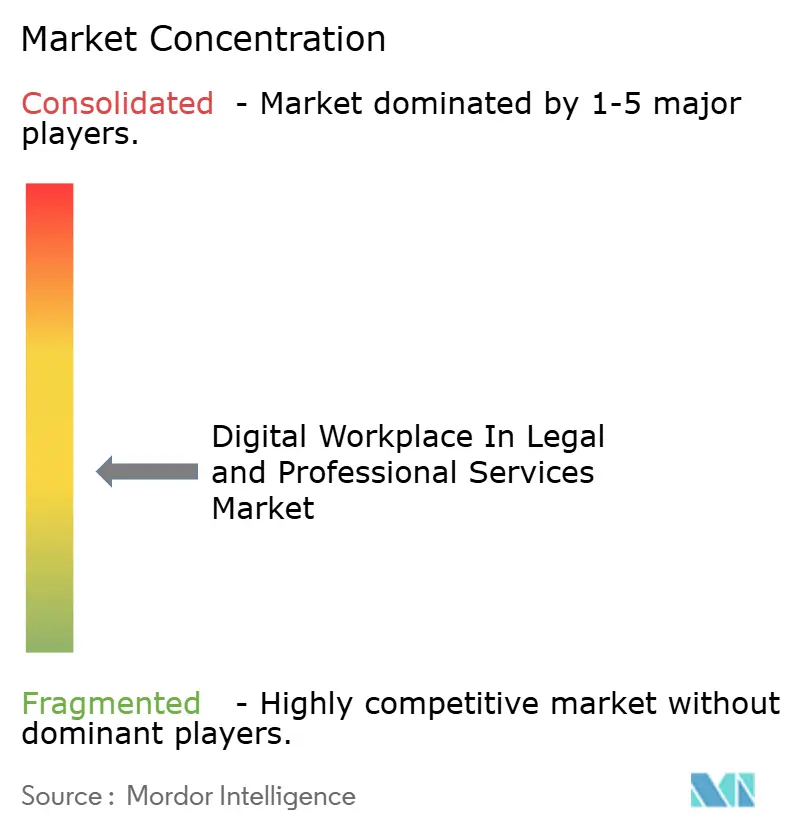
| Market Concentration | Medium |
Major Players *Disclaimer: Major Players sorted in no particular order Image © Mordor Intelligence. Reuse requires attribution under CC BY 4.0. | |
Digital Workplace In Legal and Professional Services Market Analysis by Mordor Intelligence
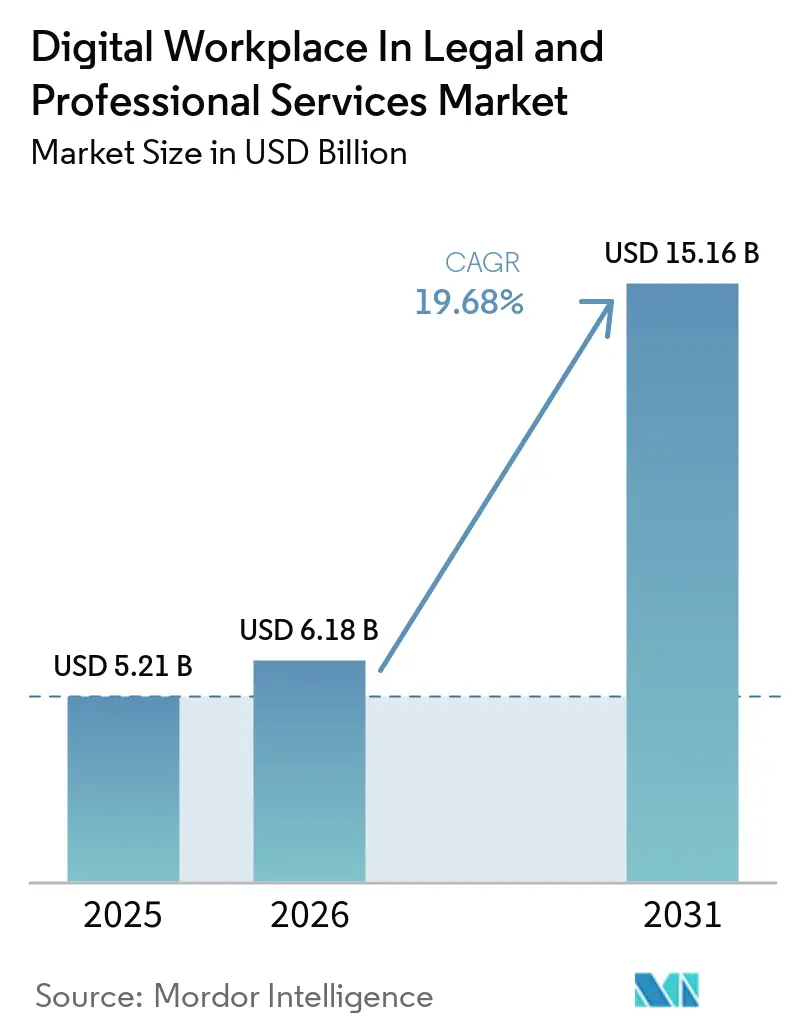
The digital workplace in legal and professional services market size is projected to be USD 5.21 billion in 2025, USD 6.18 billion in 2026, and reach USD 15.16 billion by 2031, growing at a CAGR of 19.68% from 2026 to 2031. Growth in the digital workplace in legal and professional services market reflects a broader shift from isolated software upgrades to firm-wide platform consolidation across law firms and professional services organizations. Hybrid work has become a durable operating model, and that keeps demand high for collaboration tools, endpoint management, and digital work experience systems. Cloud migration is also reshaping buying patterns because firms now treat SaaS delivery as a practical route for modernizing time, billing, practice management, and document workflows. AI-assisted knowledge workflows are becoming more central to the digital workplace in legal and professional services market because firms want faster retrieval, guided drafting, and tighter matter coordination inside daily work tools. At the same time, legal buyers remain more selective than general enterprise buyers because privilege obligations, confidential client data, and matter-level workflow complexity raise the importance of governance, security, and attorney oversight.
Key Report Takeaways
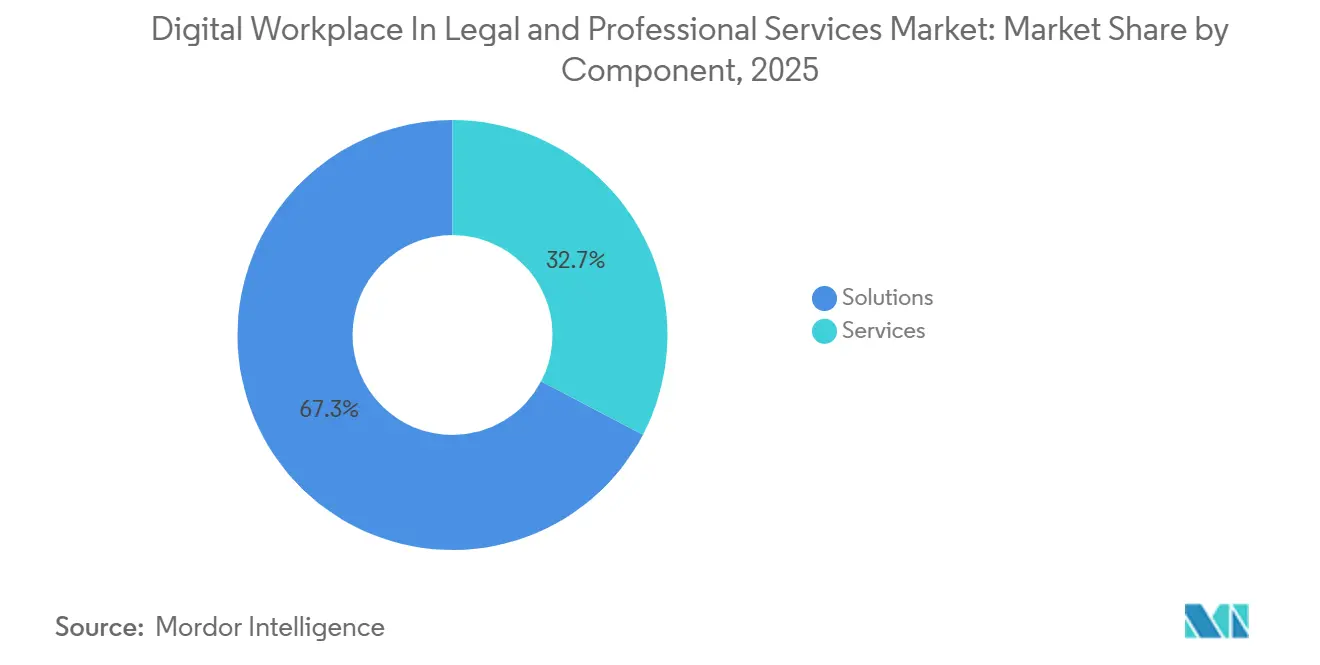
- By component, solutions held 67.33% share in 2025, while workflow automation, AI-assisted knowledge management, and employee experience tools showed the fastest expansion within solution subsegments of the digital workplace in legal and professional services market.
- By deployment mode, cloud accounted for 63.44% share in 2025 and is projected to expand at a 20.54% CAGR through 2031.
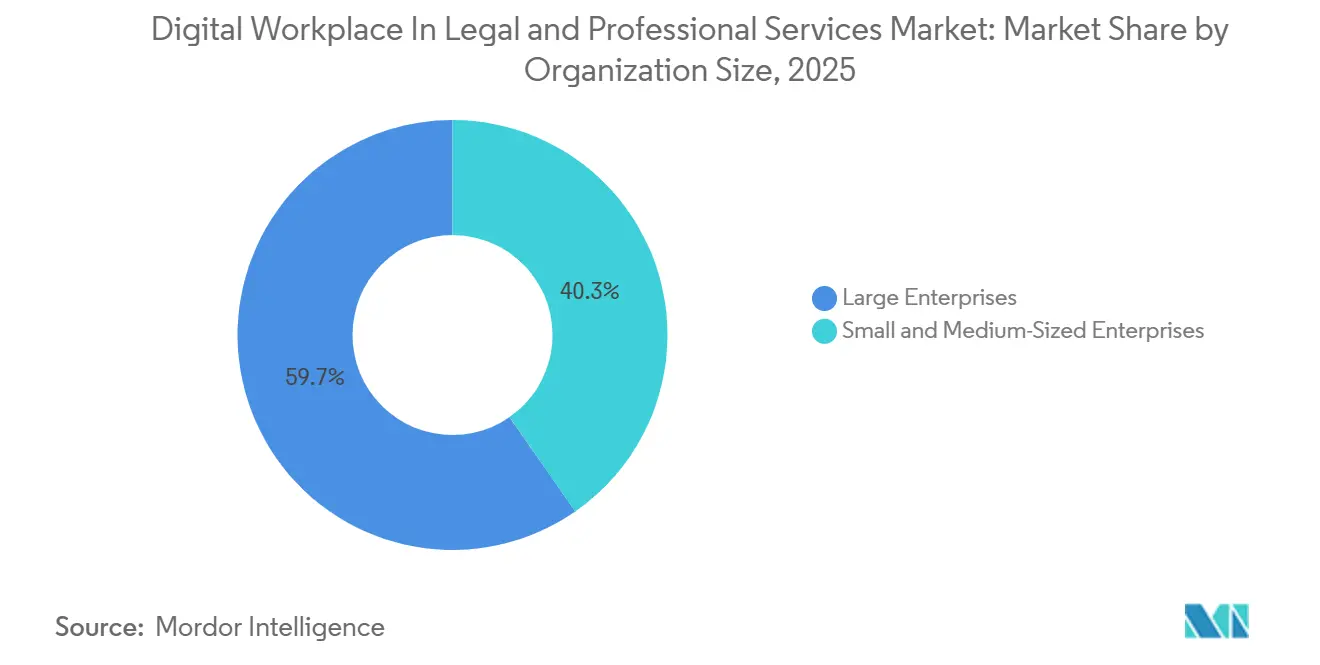
- By organization size, large enterprises held 59.67% share in 2025, while small and medium-sized enterprises remained the fastest-growing segment as subscription pricing lowered adoption barriers.
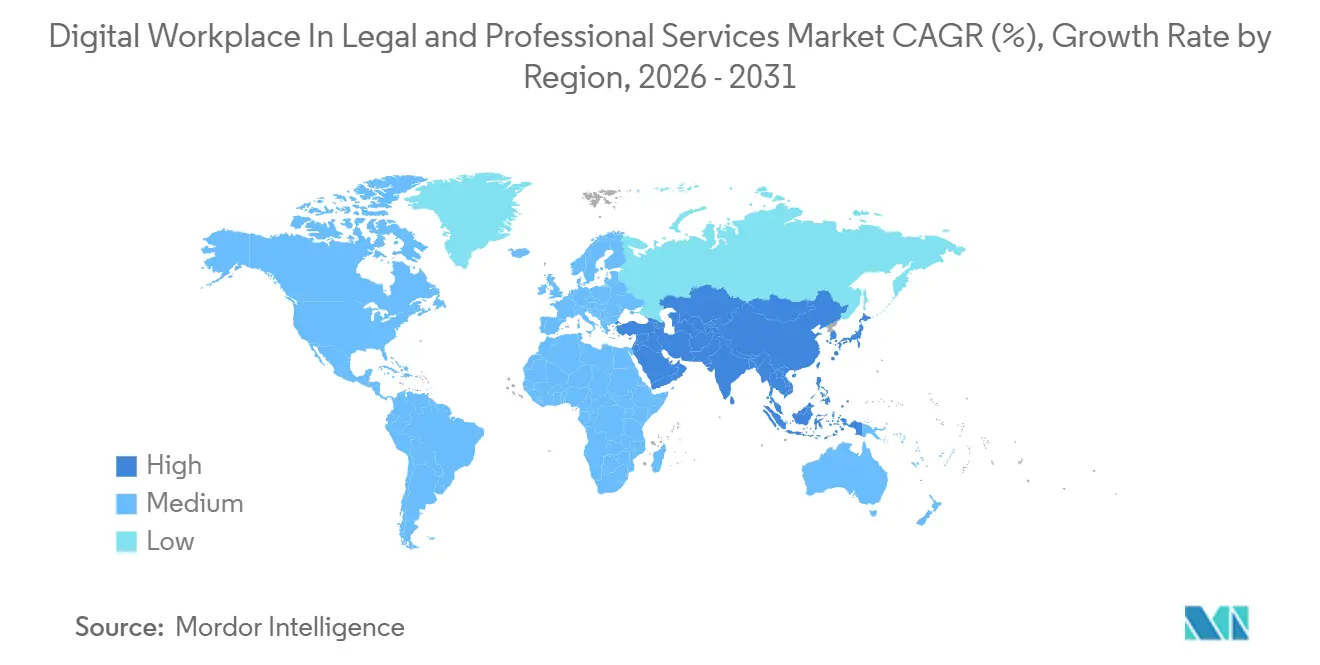
- By geography, North America held 39.56% share in 2025, while Asia-Pacific remained the fastest-growing regional cluster as legal teams invested in cloud infrastructure and AI-assisted workflows.
Note: Market size and forecast figures in this report are generated using Mordor Intelligence’s proprietary estimation framework, updated with the latest available data and insights as of January 2026.
Market Trends and Insights
Drivers Impact Analysis of Digital Workplace In Legal and Professional Services Market*
| Driver | (~) % Impact on CAGR Forecast | Geographic Relevance | Impact Timeline |
|---|---|---|---|
| Continuing Hybrid Work in Law Firms and Professional Services | +4.5% | Global, strongest in North America and Europe | Medium term (2-4 years) |
| Cloud-First Modernization of Client-Facing and Internal Workflows | +4.2% | Global, led by North America and United Kingdom | Medium term (2-4 years) |
| Rising Demand for AI-Assisted Knowledge Retrieval and Matter Workflow Automation | +3.8% | North America and Europe, spill-over to Asia-Pacific | Short term (≤ 2 years) |
| Security-First Digitization for Privileged, Confidential, and Regulated Workloads | +3.1% | Global, especially North America and European Union | Medium term (2-4 years) |
| Matter-Level Productivity Analytics and Digital Employee Experience Management | +2.2% | North America and Europe, growing in Asia-Pacific | Long term (≥ 4 years) |
| Client Portal Consolidation and Zero-Friction Cross-Office Collaboration | +1.8% | Global | Short term (≤ 2 years) |
| Source: Mordor Intelligence | |||
Continuing Hybrid Work in Law Firms and Professional Services
Hybrid work has moved from a temporary arrangement to a steady operating model, and that keeps the digital workplace in legal and professional services market on a strong demand path. A 2025 study of Am Law 200 firms found that 55.9% operated flexible hybrid policies and 39.5% used fixed hybrid schedules, while 82% required specific in-office days and fully remote policies had nearly disappeared.[1] That shift raises the technology standard for each attorney because firms now need the same collaboration quality, access speed, and endpoint control across office and home environments. It also keeps spending active on unified endpoint management, virtual desktop infrastructure, and meeting systems that support a more consistent experience across locations. A 2026 survey of 130 US legal professionals showed that 55% of hybrid and remote attorneys would begin a job search if they were required to return to the office 3-5 days per week, which links digital workplace quality directly to retention in the digital workplace in legal and professional services market.
Cloud-First Modernization of Client-Facing and Internal Workflows
Cloud migration has become an operating default rather than a side initiative, and that is changing how vendors compete in the digital workplace in legal and professional services market. A 2025 survey of UK law firm leaders found that 64% expected their firms to be fully in the cloud by 2027, while 94% reported all-time-high demand for innovation resources.[2] The same study showed that competing priorities, cost, and technical complexity still slowed progress, which means modernization remains active even where cloud direction is already clear. This matters because cloud is now the base layer for AI orchestration, matter analytics, and workflow tools that firms want to run at scale. Blank Rome’s June 2025 decision to standardize on Intapp Cloud Infrastructure across five core practice tools showed how large firms are using platform consolidation to unlock wider returns inside the digital workplace in legal and professional services market.
Rising Demand for AI-Assisted Knowledge Retrieval and Matter Workflow Automation
Demand in the digital workplace in legal and professional services market is shifting toward legal-specific AI that can support research, drafting, review, and matter execution inside daily work systems. Microsoft’s Legal Agent for Copilot in Word reached public preview in 2026 and was built for playbook-driven contract review, clause-risk identification, and redline generation inside Word.[3] LexisNexis also expanded that direction by integrating Protégé into Microsoft 365 Copilot, which brings authoritative legal research and drafting support directly into the working environment rather than forcing lawyers to switch between systems. The practical effect is that senior lawyers can use AI in a more continuous way because trusted legal content sits inside the same workflow where drafting happens. Even so, adoption still depends on governance and review structures because firms want AI to improve speed without weakening supervision, accuracy, or privilege-sensitive work in the digital workplace in legal and professional services market.
Security-First Digitization for Privileged, Confidential, and Regulated Workloads
Security pressure is pushing the digital workplace in legal and professional services market toward integrated platforms that combine collaboration, endpoint control, identity management, and data protection. Between January and May 2026, Mandiant documented an extortion campaign that targeted dozens of US legal and professional services firms through voice phishing, with data exfiltration completed in under one hour in some cases. Jones Day confirmed a breach tied to the same group in April 2026, and Fox Rothschild disclosed a similar incident in May 2026, which kept law firm security exposure in clear view across the sector. These events are making zero-trust architecture, data-loss prevention, and unified endpoint management harder to separate from workplace refresh decisions. As a result, vendors that can package collaboration and security together are gaining a stronger position in the digital workplace in legal and professional services market.
Restraints Impact Analysis of Digital Workplace In Legal and Professional Services Market*
| Restraint | (~) % Impact on CAGR Forecast | Geographic Relevance | Impact Timeline |
|---|---|---|---|
| High Integration Friction With Legacy Document, Billing, and Case Management Systems | -2.2% | Global, especially small and mid-size firms | Long term (≥ 4 years) |
| Elevated Confidentiality, E-Discovery, and Data Residency Compliance Burden | -1.8% | Global, particularly European Union and North America | Medium term (2-4 years) |
| Billable-Hour Sensitivity and Slow Change Adoption Across Senior Legal Users | -1.0% | Global | Long term (≥ 4 years) |
| AI Governance Risk in Privilege-Sensitive Knowledge Workflows | -0.9% | North America and European Union | Short term (≤ 2 years) |
| Source: Mordor Intelligence | |||
High Integration Friction with Legacy Document, Billing, And Case Management Systems
Legacy systems remain one of the clearest limits on expansion in the digital workplace in legal and professional services market. Many firms still run document management, practice management, billing, and case systems that were built through years of custom connections and local workflow adjustments. That makes platform consolidation slower because data migration, workflow mapping, and interoperability often matter more than feature comparison during vendor review. The burden is heavier for mid-market firms because they often lack dedicated integration teams and must delay upgrades while maintaining manual workarounds across core legal workflows. In practice, this means procurement decisions in the digital workplace in legal and professional services market now depend as much on integration architecture as they do on user-facing functionality.
Elevated Confidentiality, E-Discovery, and Data Residency Compliance Burden
Compliance demands continue to slow deployment cycles in the digital workplace in legal and professional services market, even when long-term demand remains firm. Legal buyers need digital workplace tools to support defensible retention schedules, chain-of-custody records, and export-ready evidence formats because e-discovery requirements are built into daily document handling. GDPR and other data residency requirements also complicate multi-region rollouts by limiting where certain client data can be processed or stored. ISO 27001 certification and SOC 2 Type II attestation have become minimum qualification thresholds at many larger firms, while some clients also expect proof that privileged material was not exposed during AI processing. Those checks lengthen procurement timelines and raise ownership costs, which slows near-term rollout speed across the digital workplace in legal and professional services market.
*Our forecasts treat driver/restraint impacts as directional, not additive. The impact forecasts reflect baseline growth, mix effects, and variable interactions.
Digital Workplace In Legal and Professional Services Market Segment Analysis
By Component:
Solutions Keep the Largest Position as Legal AI Layers ExpandSolutions accounted for 67.33% of the digital workplace in legal and professional services market size in 2025, supported by widespread use of collaboration platforms, enterprise mobility tools, workflow automation software, and virtual desktop infrastructure. That lead shows that firms still prioritize the software and platform layer where daily communication, matter coordination, and knowledge access take place. Growth inside the segment is uneven because unified communication tools are closer to maturity at larger firms, while workflow automation, AI-assisted knowledge management, and employee experience tools are expanding faster. The services side remains important, but larger firms are also building internal centers of excellence to reduce dependence on outside IT support across the digital workplace in legal and professional services industry.
A major shift inside this segment is the move from document storage toward structured intelligence that can support governed AI use. NetDocuments introduced its Legal Context Graph in May 2026 to map relationships among matters, documents, people, and legal concepts across the document environment. That approach gives AI tools a more context-aware foundation instead of relying only on raw search across unstructured content. This raises the value of vendors whose data architecture is already built around permissions, matter context, and governed knowledge flow in the digital workplace in legal and professional services market. It also gives specialist providers a more defensible role within the digital workplace in legal and professional services industry as legal buyers look beyond general collaboration features.
By Deployment Mode:
Cloud Becomes the Standard Path for Core System ModernizationCloud held 63.44% share of the digital workplace in legal and professional services market size in 2025 and is projected to expand at a 20.54% CAGR through 2031. The stronger point behind that figure is that law firms are now moving historically resistant systems, including time, billing, and practice management, toward SaaS delivery. This has changed the debate from whether firms will adopt cloud to how quickly they can complete migration without breaking data control, customization, or workflow continuity. It also keeps competition concentrated around vendors that can support both collaboration and legal-specific operations on a secure cloud base.
OpenText completed the divestiture of eDOCS to NetDocuments in January 2026 for USD 163 million, which reinforced the retreat from legacy on-premises legal document systems. On-premises deployments are likely to persist where data residency rules, government security frameworks, or client mandates restrict cloud processing. Hybrid environments are still present, but they are functioning more as a transition stage than a stable long-term design. Firms that stay hybrid for too long face higher integration complexity and greater data consistency risk across the digital workplace in legal and professional services market. That is why cloud continues to define the main direction of travel across the digital workplace in legal and professional services market.
By Organization Size:
Large Enterprises Lead Spending While SMEs Set the Growth PaceLarge enterprises held 59.67% of the digital workplace in legal and professional services market share in 2025 because major law firms and large professional services networks run broader stacks across collaboration, endpoint services, AI tools, and matter analytics. These buyers also sustain recurring spend through licensing renewals, integration work, and custom workflow development across multiple practice and support functions. Their scale gives them stronger purchasing power, but it also creates more complex technology estates that can slow standardization and increase governance needs. That mix keeps large enterprises central to current revenue even as growth leadership starts to shift elsewhere.
Small and medium-sized enterprises are the fastest-growing part of the digital workplace in legal and professional services market because SaaS pricing and vendor marketplaces have lowered the entry barrier for advanced tools. Smaller firms can now assemble cloud-native collaboration, e-signature, filing, and legal workflow tools without the infrastructure burden that once favored only large enterprises. A 2025 survey highlighted by the ABA Journal found that close to three-quarters of respondents used cloud-based remote working tools, while videoconferencing, e-signatures, and e-filing ranked among the most common technologies in active use. This confirms that adoption at smaller firms is already operational rather than experimental. Vendors that offer simpler onboarding and pre-integrated legal ecosystems are therefore gaining strong traction in the digital workplace in legal and professional services market.
Geography Analysis
North America Digital Workplace in Legal and Professional Services Market
North America held 39.56% of the digital workplace in legal and professional services market size in 2025, which kept it as the leading regional block. The United States drove most of that position because large law firms already had deep Microsoft 365 penetration and continued to invest in AI layers such as Copilot, Harvey AI, and Protégé on top of existing collaboration stacks. The region also ties workplace technology more closely to retention because firms compete aggressively for legal talent and need a smoother digital work experience across office and hybrid settings. Canada added support through major professional services networks in Toronto and Vancouver, while Mexico remained at an earlier adoption stage centered on cloud communication tools. Security regulation and active threat warnings also shaped regional demand by pushing buyers toward identity management, endpoint security, and zero-trust architecture in the digital workplace in legal and professional services market.
Europe Digital Workplace in Legal and Professional Services Market
Europe remained a major investment zone for the digital workplace in legal and professional services market because GDPR and related privacy requirements pushed firms toward privacy-aware cloud designs at the same time that a large installed base of older systems still needed phased migration. Germany and the United Kingdom held the largest national positions within the region, and the UK legal IT environment showed that cloud had become the default delivery model rather than a differentiator. France, the Netherlands, and the Nordic countries continued to expand as mid-market firms adopted cloud-based collaboration and client-facing tools to improve digital service delivery. Osborne Clarke’s completion of its 3E SaaS migration in 2025 illustrated how full-stack legal cloud transformation was becoming possible, even if execution remained complex.
APAC, South America and MEA Digital Workplace in Legal and Professional Services Market
Asia-Pacific was the fastest-growing region in the digital workplace in legal and professional services market, supported by legal department expansion in China, India, South Korea, and Southeast Asia. India stood out because in-house legal teams, Big Four service expansion, and court digitization programs were all increasing demand for cloud collaboration, e-discovery, and workflow automation. Japan and Australia remained more mature and focused on the current upgrade cycle, which centered on AI-assisted knowledge retrieval and unified endpoint management. South America was still emerging, with Brazil leading adoption through court digitization and large-firm modernization, while the Middle East and Africa remained earlier-stage markets shaped by national digital transformation plans and initial investment in secure client portals and remote access tools.
Competitive Landscape
The digital workplace in legal and professional services market is moderately fragmented because competition sits across horizontal platforms, global IT service providers, and specialist legal technology vendors. Microsoft remains the strongest platform force through Teams, SharePoint, Intune, and Azure, which together form the base productivity stack for many large law firms and professional services organizations. That installed base gives Microsoft a durable advantage because legal buyers often extend what they already use rather than rebuild the full environment from scratch. At the same time, the digital workplace in legal and professional services market still leaves room for specialist vendors that can solve legal-specific workflow, privilege, and knowledge issues more directly than broad enterprise platforms.
ServiceNow widened its reach in February 2026 with the launch of Autonomous Workforce and EmployeeWorks, which combined conversational AI, enterprise search, and governed workflow automation across legal, HR, finance, and procurement use cases. Icertis also expanded its partnership with Microsoft in May 2026 by embedding Vera contract intelligence into Microsoft 365 Copilot and Fabric, and the company cited deployments that reduced external legal spend for NDA review by 60%. These moves show that channel access through Microsoft has become a practical route to scale in the digital workplace in legal and professional services market. They also show that contract intelligence, governed AI, and workflow orchestration are now core competitive themes rather than side capabilities.
Another area of competition is the enterprise interface where users access knowledge and complete work. Atlassian’s September 2025 agreement to acquire The Browser Company for USD 610 million suggested a longer-term contest over AI-native browser experiences as the working layer for knowledge professionals. This is relevant because a more context-aware browser could change how users access legal research, documents, and matter tools without relying on separate application hopping. At the same time, certifications such as SOC 2 Type II and ISO 27001 are acting as real entry barriers, which helps protect established positions even in a market that remains fragmented. That combination keeps the digital workplace in legal and professional services market open to innovation, while still favoring vendors with trust, integration depth, and governed data architecture.
Digital Workplace In Legal and Professional Services Industry Leaders
-
Microsoft Corporation
-
Accenture plc
-
IBM Corporation
-
Citrix Systems, Inc.
-
DXC Technology Company
- *Disclaimer: Major Players sorted in no particular order
Digital Workplace In Legal and Professional Services Market Companies Covered in this Report
- Microsoft Corporation
- Accenture plc
- IBM Corporation
- Citrix Systems, Inc.
- DXC Technology Company
- Capgemini SE
- Cognizant Technology Solutions Corporation
- Tata Consultancy Services Limited
- Wipro Limited
- HCL Technologies Limited
- NTT DATA Group Corporation
- Unisys Corporation
- Fujitsu Limited
- Atos SE
- Kyndryl Holdings, Inc.
- ServiceNow, Inc.
- Cisco Systems, Inc.
- Google LLC
- Atlassian Corporation
- OpenText Corporation
- Adobe Inc.
- Oracle Corporation
Recent Industry Developments in Digital Workplace In Legal and Professional Services Market
- June 2026: Relativity acquired Gavel, a document automation and contract review startup. The acquisition extended Relativity's legal data intelligence platform into the contracting segment, building on its prior acquisition of contract review provider Heretik and marking the company's second publicly confirmed M&A transaction in the contract review space.
- June 2026: LexisNexis made Protégé, its authoritative AI workflow platform, generally available within Microsoft 365 Copilot and Teams via the Microsoft Marketplace. The integration brings trusted legal research and drafting intelligence directly into the Microsoft 365 environment, with global rollout beginning following US general availability.
- May 2026: Icertis and Microsoft announced an expanded multi-year strategic partnership, integrating Icertis Vera contract intelligence into Microsoft 365 Copilot, Microsoft Fabric, and Copilot Studio. The partnership enables agentic AI for enterprise contracting within Microsoft 365 applications, targeting legal and business professionals across millions of enterprise users.
- May 2026: ServiceNow and Microsoft announced an expanded AI governance partnership at Knowledge 2026, integrating ServiceNow AI Control Tower with Microsoft Agent 365. ServiceNow AI specialists will be listed in the Microsoft Agent 365 Marketplace, enabling governed multi-agent orchestration across both platforms for enterprise legal and workplace service functions.
Global Digital Workplace In Legal and Professional Services Market Report Scope
The Digital Workplace in Legal and Professional Services Market comprises a comprehensive ecosystem of technologies and platforms specifically designed for legal firms and professional services organizations, including consulting, accounting, and advisory firms. This market includes cloud-based productivity tools, enterprise collaboration platforms, document and knowledge management systems, secure communication solutions, workflow automation, and virtual desktop infrastructures. These solutions support remote, hybrid, and office-based work models while ensuring compliance with stringent regulatory, confidentiality, and data governance requirements.
The Digital Workplace in Legal and Professional Services Market Report is Segmented by Component (Solutions [Unified Communication and Collaboration, Unified Endpoint Management, Enterprise Mobility and Management, Employee Experience Platforms and Intranet, Workflow Automation and Knowledge Management, and Virtual Desktop Infrastructure and Cloud PC] and Services), Deployment Mode (Cloud, On-Premises, and Hybrid), Organization Size (Large Enterprises and Small and Medium-Sized Enterprises), and Geography (North America, South America, Europe, Asia-Pacific, and Middle East, Africa). The Market Forecasts are Provided in Terms of Value (USD).
Segmentation Overview
| Solutions | Unified Communication and Collaboration |
| Unified Endpoint Management | |
| Enterprise Mobility and Management | |
| Employee Experience Platforms and Intranet | |
| Workflow Automation and Knowledge Management | |
| Virtual Desktop Infrastructure and Cloud PC | |
| Services |
| Cloud |
| On-Premises |
| Hybrid |
| Large Enterprises |
| Small and Medium-Sized Enterprises |
| North America | United States |
| Canada | |
| Mexico | |
| South America | Brazil |
| Argentina | |
| Chile | |
| Colombia | |
| Rest of South America | |
| Europe | Germany |
| United Kingdom | |
| France | |
| Italy | |
| Spain | |
| Netherlands | |
| Nordics | |
| Russia | |
| Rest of Europe | |
| Asia-Pacific | China |
| Japan | |
| India | |
| South Korea | |
| Australia and New Zealand | |
| Southeast Asia | |
| Rest of Asia-Pacific | |
| Middle East | Saudi Arabia |
| United Arab Emirates | |
| Turkey | |
| Israel | |
| Rest of Middle East | |
| Africa | South Africa |
| Egypt | |
| Nigeria | |
| Kenya | |
| Rest of Africa |
| By Component | Solutions | Unified Communication and Collaboration |
| Unified Endpoint Management | ||
| Enterprise Mobility and Management | ||
| Employee Experience Platforms and Intranet | ||
| Workflow Automation and Knowledge Management | ||
| Virtual Desktop Infrastructure and Cloud PC | ||
| Services | ||
| By Deployment Mode | Cloud | |
| On-Premises | ||
| Hybrid | ||
| By Organization Size | Large Enterprises | |
| Small and Medium-Sized Enterprises | ||
| By Geography | North America | United States |
| Canada | ||
| Mexico | ||
| South America | Brazil | |
| Argentina | ||
| Chile | ||
| Colombia | ||
| Rest of South America | ||
| Europe | Germany | |
| United Kingdom | ||
| France | ||
| Italy | ||
| Spain | ||
| Netherlands | ||
| Nordics | ||
| Russia | ||
| Rest of Europe | ||
| Asia-Pacific | China | |
| Japan | ||
| India | ||
| South Korea | ||
| Australia and New Zealand | ||
| Southeast Asia | ||
| Rest of Asia-Pacific | ||
| Middle East | Saudi Arabia | |
| United Arab Emirates | ||
| Turkey | ||
| Israel | ||
| Rest of Middle East | ||
| Africa | South Africa | |
| Egypt | ||
| Nigeria | ||
| Kenya | ||
| Rest of Africa | ||
Key Questions Answered in the Report
What is the size of the digital workplace in legal and professional services market?
The digital workplace in legal and professional services market size was USD 5.21 billion in 2025, reached USD 6.18 billion in 2026, and is forecast to reach USD 15.16 billion by 2031 at a 19.68% CAGR.
Which deployment model is expanding the fastest in legal and professional services?
Cloud is the fastest-growing deployment mode, and it is projected to grow at a 20.54% CAGR through 2031 as firms modernize core systems such as time, billing, and practice management.
Why are law firms investing more in workplace platforms?
Hybrid work, stronger security needs, and rising use of AI-assisted knowledge and drafting tools are pushing firms to consolidate platforms and improve daily workflow efficiency.
Which buyer group contributes the most revenue today?
Large enterprises led with 59.67% share in 2025 because major law firms and large professional services networks run broader and more integrated technology stacks.
Which region is growing the fastest?
Asia-Pacific is the fastest-growing region, supported by legal department expansion, cloud infrastructure investment, and increasing use of AI-assisted workflows across key markets.
What is shaping vendor competition the most?
Vendor competition is being shaped by Microsofts platform reach, specialist legal AI partnerships, and stricter buyer demands around privilege protection, security controls, and integration depth.