
Global Dental Liners And Bases Market Size and Share
Market Overview
| Study Period | 2020 - 2031 |
|---|---|
| Market Size (2026) | USD 1.63 Billion |
| Market Size (2031) | USD 2.05 Billion |
| Growth Rate (2026 - 2031) | 4.68 % |
| Fastest Growing Market | Asia Pacific |
| Largest Market | North America |
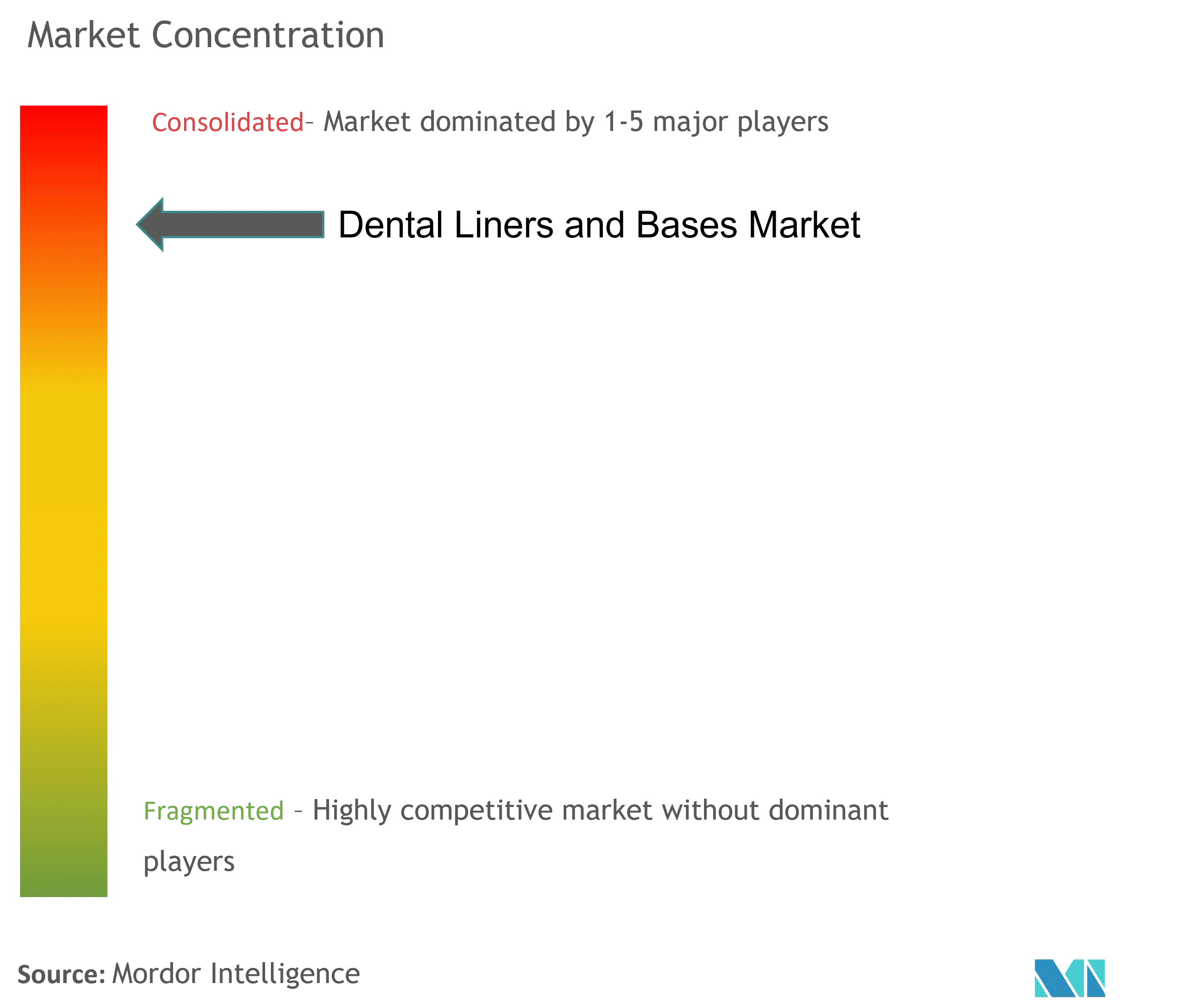
| Market Concentration | Medium |
Major Players *Disclaimer: Major Players sorted in no particular order Image © Mordor Intelligence. Reuse requires attribution under CC BY 4.0. | |
Global Dental Liners And Bases Market Analysis by Mordor Intelligence
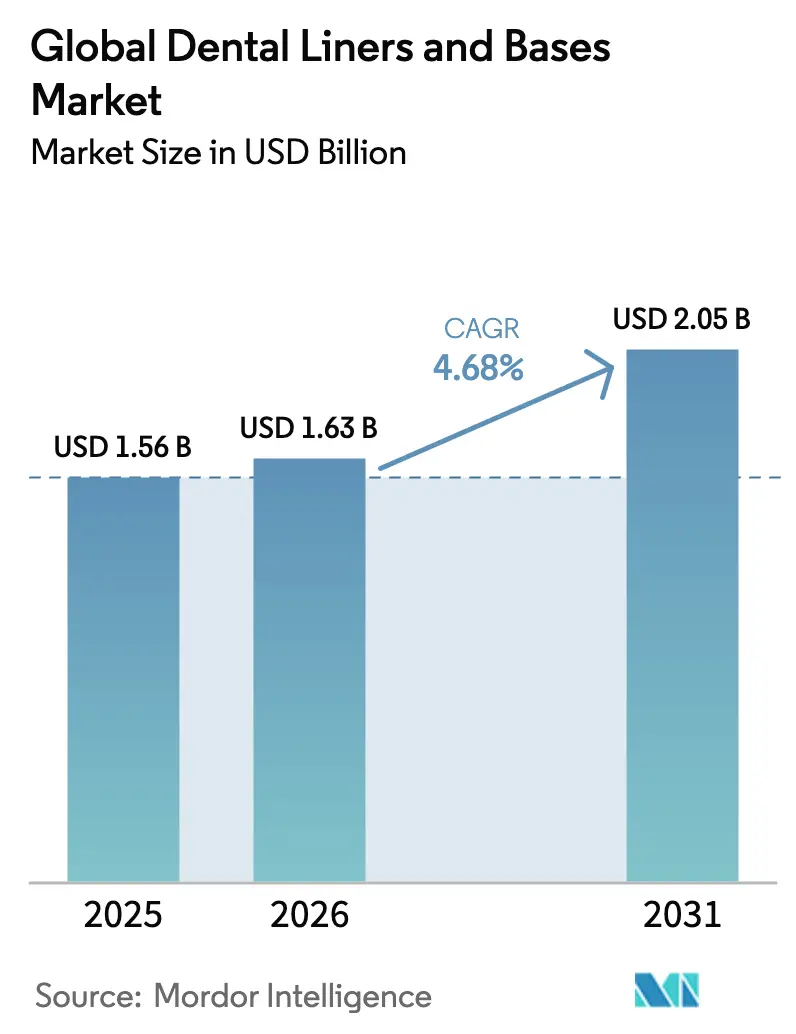
dental liners and bases market size in 2026 is estimated at USD 1.63 billion, growing from 2025 value of USD 1.56 billion with 2031 projections showing USD 2.05 billion, growing at 4.68% CAGR over 2026-2031. This performance anchors the sector as a steady-growth arena within restorative dentistry, propelled by the dual pull of material innovation and demographic need. Rising global caries incidence, rapid uptake of bio-active resin-modified glass ionomer (RMGI) systems, and stronger value-based care mandates are reshaping clinical protocols, while North America retains spending leadership and Asia-Pacific supplies volume momentum. Manufacturers are prioritising ion-releasing chemistries that extend the life of direct restorations, and clinics are upgrading chairside workflows to support minimally invasive treatment strategies. Geopolitical raw-material shocks and stricter biocompatibility rules remain near-term headwinds, but demand elasticity stays high because most restorative procedures require a liner or base regardless of macro-economic swings.
Key Report Takeaways
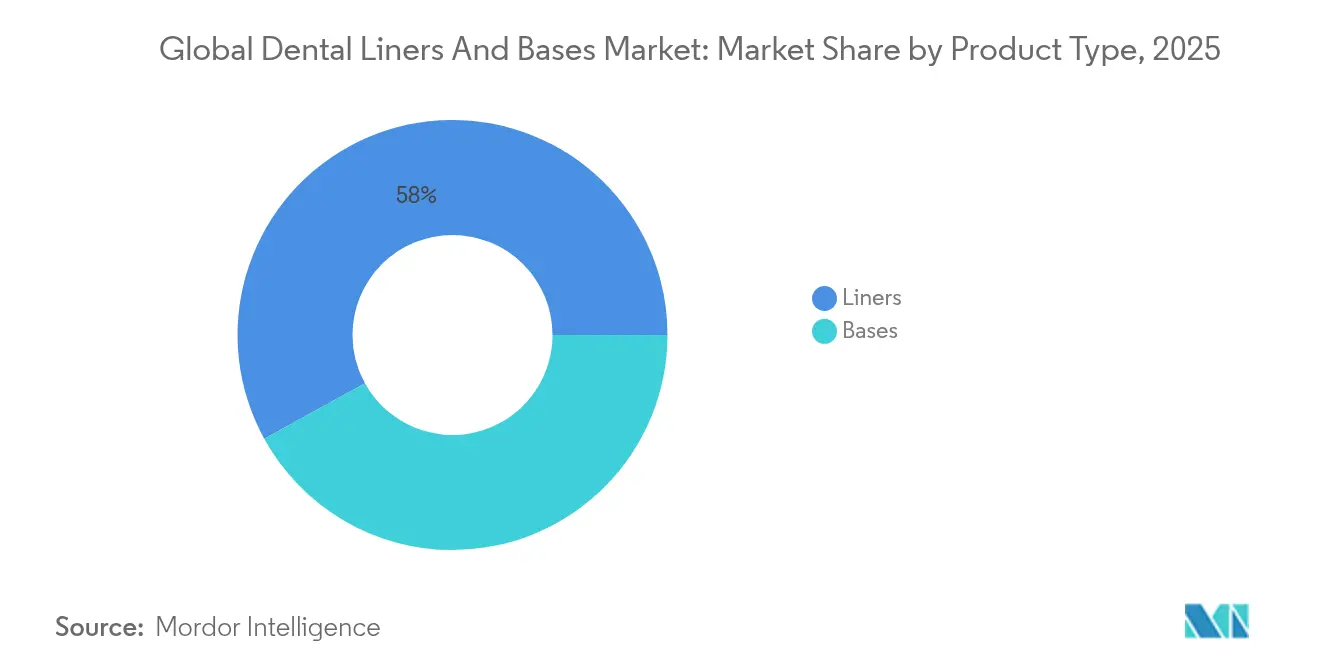
- By product type, liners captured 58.02% of the dental liners and bases market share in 2025.
- By material, glass ionomers held 33.92% of the dental liners and bases market size in 2025 while bio-active RMGI posted the fastest 5.32% CAGR through 2031.
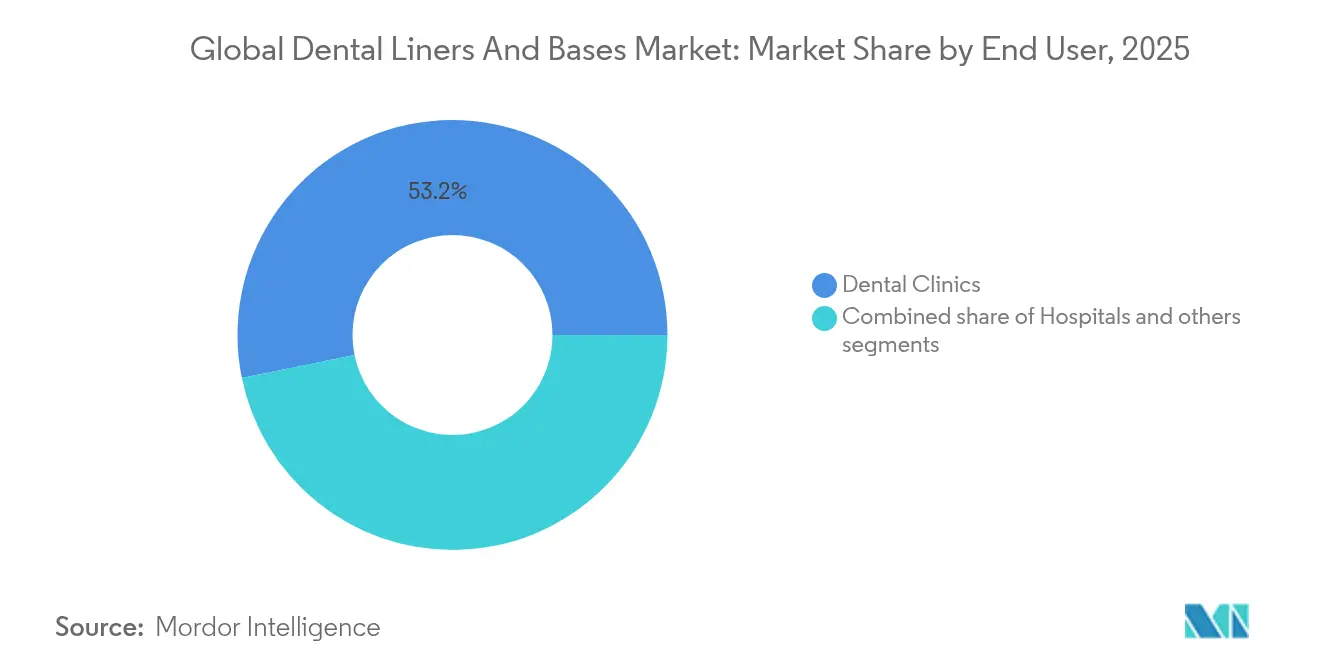
- By end user, dental clinics accounted for 53.21% revenue in 2025 and are expanding at a 5.64% CAGR to 2031.
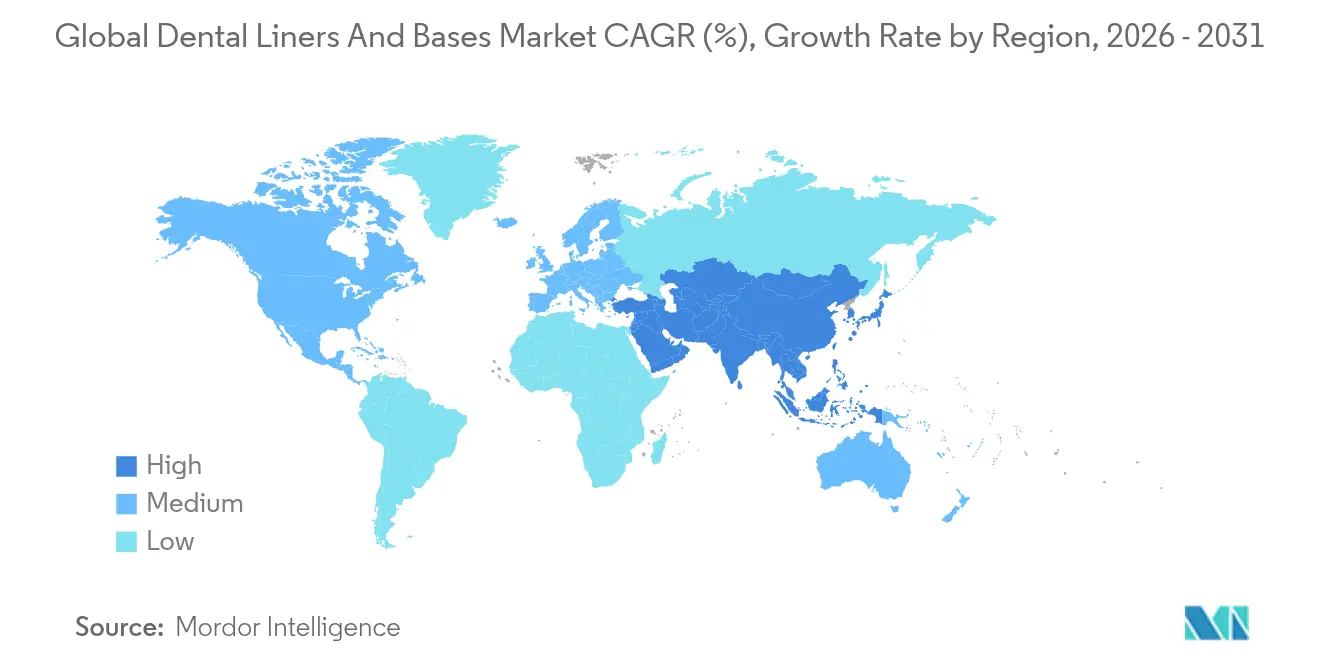
- By geography, North America led with 41.88% revenue in 2025; Asia-Pacific is set to register the strongest 6.03% CAGR during the forecast window.
Note: Market size and forecast figures in this report are generated using Mordor Intelligence’s proprietary estimation framework, updated with the latest available data and insights as of 2026.
Market Trends and Insights
Drivers Impact Analysis of Global Dental Liners And Bases Market*
| Driver | (~) % Impact on CAGR Forecast | Geographic Relevance | Impact Timeline |
|---|---|---|---|
| Rising prevalence of dental caries & restorative procedures | +1.2% | Global, with higher impact in Asia-Pacific and Latin America | Long term (≥ 4 years) |
| Growing geriatric edentulous population | +0.9% | North America & Europe, expanding to Asia-Pacific | Long term (≥ 4 years) |
| Technological advances in bio-active & RMGI materials | +0.8% | Global, led by North America and Europe | Medium term (2-4 years) |
| Shift to minimally-invasive ion-releasing liner systems | +0.7% | Global, with early adoption in developed markets | Medium term (2-4 years) |
| Dental tourism packages upgrading to premium liners/bases | +0.4% | Asia-Pacific core, spill-over to MEA and Latin America | Short term (≤ 2 years) |
| Chairside CAD/CAM-optimised flowable liner workflows | +0.5% | North America & Europe, expanding to Asia-Pacific | Medium term (2-4 years) |
| Source: Mordor Intelligence | |||
Rising Prevalence of Dental Caries and Restorative Procedures
Age-standardised incidence for permanent-tooth decay climbed from 28,154 per 100,000 in 1990 to 29,896 in 2021 and is projected to reach 30,414 by 2030. The persistent disease burden drives liner utilisation because deep carious lesions mandate pulp-protective barriers before composite placement. Low- and middle-income countries contribute the sharpest case growth, yet high-income regions sustain procedure value through premium material adoption. Clinical trial data show that ion-releasing liners cut secondary-caries risk in posterior restorations over a three-year horizon. Health ministries are therefore endorsing liner use in public-sector treatment guidelines, reinforcing volume demand.
Growing Geriatric Edentulous Population
People aged 65 years and older now retain more natural teeth yet present with complex dentin changes that heighten restorative failure risk. A cross-sectional assessment of oral-frailty symptoms in seniors underscores the need for advanced pulp-capping agents during full-mouth rehabilitation. National insurance schemes across Europe and Japan reimburse liners in vital-pulp therapy, widening clinical usage. Bio-active formulations that trigger secondary-dentin formation align with preventive geriatrics, and their adoption is directly linked to lower retreatment outlays in long-term-care facilities.
Technological Breakthroughs in Bio-Active RMGI Chemistries
Latest RMGI platforms integrate pre-reacted glass technology that delivers sustained fluoride, calcium, and phosphate release without compromising flexural strength. Nano-silica reinforcement from natural diatom sources further boosts compressive-strength metrics by 22% while preserving film thickness. These gains solve legacy glass-ionomer fragility, encouraging clinicians to specify RMGI liners under bulk-fill composites in load-bearing posterior sites. Manufacturers that secure regulatory clearance under the FDA’s 2024 Dental Cements pathway enjoy accelerated time-to-market.
Shift Toward Minimally Invasive Ion-Releasing Protocols
Selective-caries-removal concepts limit dentin excavation, making thin-layer liners essential for pulp vitality. Bio-active calcium-silicate systems such as Biodentine outperform calcium-hydroxide liners in vitality preservation and dentin bridge thickness. These materials are now integrated into digital treatment plans where CAD/CAM software recommends liner thickness based on residual dentin mapping. Clinical guidelines from the American Academy of Operative Dentistry updated in 2025 formally endorse ion-releasing liners for deep preparations, accelerating practice-wide standardisation.
Restraints Impact Analysis of Global Dental Liners And Bases Market*
| Restraint | (~) % Impact on CAGR Forecast | Geographic Relevance | Impact Timeline |
|---|---|---|---|
| Cytotoxicity & solubility concerns for legacy materials | -0.6% | Global, with stricter enforcement in Europe and North America | Medium term (2-4 years) |
| Limited reimbursement in cost-sensitive economies | -0.4% | Asia-Pacific, Latin America, and MEA | Long term (≥ 4 years) |
| Emerging nanomaterial regulatory hurdles | -0.3% | Europe and North America, expanding globally | Short term (≤ 2 years) |
| Supply-chain volatility of specialty glass powders | -0.2% | Global, with acute impact in Asia-Pacific manufacturing | Short term (≤ 2 years) |
| Source: Mordor Intelligence | |||
Cytotoxicity and Solubility Concerns with Legacy Chemistries
In-vitro studies reveal that resin-modified calcium-hydroxide products show concentration-dependent cytotoxicity against human pulp cells. Solubility issues plague older formulations, leading to marginal gaps and restoration failure. The European Medical Device Regulation now enforces expanded biocompatibility dossiers, compelling product reformulations that inflate development spend. Clinicians in paediatric dentistry are especially cautious, driving a gradual phase-out of high-solubility liners in favour of silica-reinforced alternatives
Limited Reimbursement in Cost-Sensitive Economies
Insurance packages in many emerging markets reimburse only basic restorative care, leaving advanced liner upgrades as out-of-pocket items. In India, where dental service revenue touched USD 600 million in 2024, subsidy ceilings still exclude bio-active liners. Similar gaps persist across Latin America, hampering penetration for premium formulations despite growing clinical awareness. Manufacturers respond with tiered product lines that keep ion-release capability but reduce ancillary features to meet unit-price thresholds.
*Our forecasts treat driver/restraint impacts as directional, not additive. The impact forecasts reflect baseline growth, mix effects, and variable interactions.
Global Dental Liners And Bases Market Segment Analysis
By Product Type:
Liners Dominate High-Value ApplicationsLiners held 58.02% revenue in 2025 and maintain a 5.07% CAGR as they underpin nearly every deep-cavity restoration. This dominance reflects strict adherence to pulp-protection standards and the widespread clinical emphasis on thin-film barriers under composite resins. The dental liners and bases market size attributed to liners accounted for USD 0.91 billion in 2025, and higher viscosity variants are entering chairside CAD/CAM catalogues. Bases fulfil bulk build-up roles in extensive lesions, yet many new materials combine liner and base functionality, blurring categorical boundaries. Manufacturers therefore promote multi-purpose kits that reduce inventory points for clinics, streamlining procurement.
Second-generation liners embed antibacterial quaternary-ammonium monomers, and early studies indicate 28% lower secondary-caries recurrence versus conventional calcium-hydroxide products. As digital workflow adoption rises, liner dispensers equipped with RFID chips help track expiration and usage, linking material management to electronic health records. These workflow efficiencies reinforce demand for premium liners within the dental liners and bases market.



By Material:
Glass Ionomers Retain Lead but Bio-Active RMGI Gains SpeedGlass ionomers captured 33.92% revenue in 2025 owing to trusted bonding affinity and fluoride-release profiles. However, the dental liners and bases market share for this class is gradually ceded to bio-active RMGI systems, which expand 5.32% annually. Clinicians favour RMGI for dual-cure handling that complements bulk-fill composite placement. Fluoride-release assessment shows Vitrebond emitting peak 2.4 µg/cm² in week one, outperforming chemical glass ionomer alternatives. Zinc-oxide-eugenol consumption declines amid concerns about eugenol-triggered polymerisation inhibition when used with resin composites. Calcium-silicate platforms such as Biodentine migrate from endodontic repair into routine liner indication, adding competitive tension within the dental liners and bases market.
By End User:
Dental Clinics Accelerate Adoption of Digital-Material CombosDental clinics delivered 53.21% of 2025 revenue and are tracking a 5.64% CAGR. Their dominance reflects patient preference for single-visit procedures and the clinics’ agility in integrating digital scanning, milling, and flowable-liner delivery systems. Hospital settings focus on medically compromised cohorts who often need elaborate build-up protocols, sustaining baseline demand for high-strength bases. Academic centres remain innovation hubs that validate bio-active prototypes under controlled trials; collaborations such as Dentsply Sirona’s 2024 partnership with Alexandria University of 756 treatment centres exemplify this model.
Geography Analysis
North America Dental Liners and Bases Market
North America commanded 41.88% revenue in 2025, supported by insurance coverage and early adoption of bio-active chemistries. The dental liners and bases market size for the region stood at USD 0.65 billion in 2025. The United States contributes the bulk share, buoyed by Medicare Part B expansions that reimburse restorative procedures when medically linked.
APAC Dental Liners and Bases Market
Asia-Pacific is the fastest-growing cluster at 6.03% CAGR. Rising middle-class expenditure, dental-tourism hubs in Thailand and India, and widespread private-practice investment in CAD/CAM platforms underpin momentum. China’s domestic manufacturers increase resin-modified glass ionomer output, trimming lead times for clinics. Japan’s super-aged society drives demand for biocompatible liners compatible with polypharmacy constraints. South-East Asian ministries scale school-sealant programmes, indirectly stimulating liner education campaigns that raise practitioner familiarity.
EMEA and LATAM Dental Liners and Bases Market
Europe shows resilient yet regulatory-tempered growth. The European Chemicals Agency proposal to tighten silica exposure limits compels process retrofits across liner plants, creating transitional supply tightness. Latin America and the Middle East & Africa record emerging-market gains, buttressed by dental tourism packages that bundle premium liners with implant services for international patients.

Regulatory Landscape
Dental liners and bases are regulated as dental devices in major markets, with the United States framework anchored in FDA classifications under 21 CFR Part 872 (including dental cements used for base and lining indications). A key recent reference point is the FDA guidance dated September 30, 2024, on performance criteria for dental cements, which reinforces standardized bench testing expectations (including setting-time performance for base/lining use) and supports more consistent submissions across manufacturers.
Across global commercialization, conformity to recognized consensus standards remains central to approvals and ongoing compliance, particularly ISO 9917-1 (acid-base cements) and ISO 9917-2 (resin-modified cements), which are commonly used to substantiate safety and performance claims. Product change management in the United States frequently runs through the Traditional 510(k) route, with ongoing clearances by large restorative suppliers such as Dentsply Sirona (for example, K242462 in October 2024 and K243546 in February 2025) reflecting the pace of iterative material and delivery-system updates within this category.
Value Chain Analysis
The value chain for dental liners and bases starts with upstream inputs such as specialty glass powders, resins, photoinitiators, and active fillers used in glass ionomer and resin-modified formulations. These inputs are converted through proprietary formulation, compounding, and packaging into chairside-ready formats, where delivery design differentiates products; for example, automated mixing and dispensing systems (such as 3M/Solventum Clicker-style dispensing associated with products like Vitrebond Plus) reduce variability during placement and support workflow standardization in clinics.
Midstream activities include quality systems, verification testing, and regulatory documentation aligned to FDA requirements and international standards such as ISO 9917-1/9917-2, followed by market access through national registrations and distributor onboarding. Downstream distribution runs heavily through dental-specialty channels and large dealers (for example, Henry Schein listings for restorative cements/liners), then to dental clinics and hospitals where purchasing decisions are shaped by supply reliability, shelf-life management, and compatibility with restorative workflows, including bulk-fill composites and minimally invasive protocols.
Competitive Landscape
Market structure is moderately fragmented. The top five suppliers hold an estimated about half of the combined revenue, leaving room for specialised entrants targeting bio-activity niches within the dental liners and bases market. Dentsply Sirona, 3M Solventum, GC Corporation, and Coltene dominate legacy portfolios, yet newer challengers such as Desktop Health drive resin-additive advances. Strategic pivots focus on R&D alliances with bioceramic startups and vertical integration of specialty glass powders to curb raw-material volatility.
Product pipelines spotlight ion-releasing chemistries that sustain caries-inhibiting conditions. 3M’s 2024 spin-off of Solventum sharpened investment in bio-compatible dental materials, freeing resources formerly shared with broader healthcare units. Dentsply Sirona extended its DS Academy coursework, training 6,000 clinicians on digital restorative workflows that integrate one-step liner placement.
M&A velocity rose in 2024. Patient Square Capital’s USD 4.1 billion acquisition of Patterson Companies consolidated North American distribution, promising wider access to premium liner lines. Straumann Group logged CHF 585.5 million Q3 revenue with 11.2% organic growth, driven by liner-related restorative kits in Asia-Pacific.
Regulatory evolutions shape competitive tactics. The FDA’s 2024 performance-based guidance for dental cements cut 510(k) timelines, favouring firms that already possess robust bench-testing infrastructures. EU proposals on silica drive R&D towards alternative fillers, and early patents signal potential substitution of calcium-phosphate nanopowders. Combined, these shifts create an innovation race centred on safety-plus-bioactivity attributes inside the dental liners and bases market.
Global Dental Liners And Bases Industry Leaders
3M
Envista Holdings Corporation (Kerr Corporation)
Dentsply Sirona
Den-Mat Holdings, LLC
GC Corporation
- *Disclaimer: Major Players sorted in no particular order
Global Dental Liners And Bases Market Companies Covered in this Report
- 3M
- Dentsply Sirona
- GC Corporation
- Ivoclar Vivadent
- VOCO
- Coltene Holding
- Shofu Inc.
- BISCO
- Septodont
- Kerr (Envista Holdings)
- SDI
- Pulpdent Corporation
- Kuraray Noritake Dental
- Prime Dental Mfg.
- Dyadent Group Intl.
- DMG Chemisch-Pharmazeutische Fabrik
- DenMat Holdings
- Parkell
- Tokuyama Dental

Market Opportunities and Future Outlook
Opportunities concentrate around higher-performance glass ionomer and resin-modified glass ionomer systems that combine ion release with simplified handling for deep restorations, aligning with practice moves toward minimally invasive, pulp-protective protocols. In-market product positioning for light-cure liners such as 3M/Solventum Vitrebond Plus highlights how suppliers compete on chairside efficiency and consistent placement through improved delivery formats, particularly in high-throughput dental clinic settings.
A second focus area is faster iteration and broader international rollout of upgraded restorative materials supported by clearer performance-based submissions and standardized test methods. The FDA dental cements performance-criteria guidance dated September 2024, together with continued use of the Traditional 510(k) pathway as illustrated by Dentsply Sirona clearances in 2024 and 2025, offers a practical route for manufacturers to refresh liner/base portfolios more frequently while staying aligned to ISO 9917-1/9917-2 expectations. This environment supports portfolio modernization, including reformulations that address biocompatibility and solubility concerns and delivery-system enhancements that reduce technique sensitivity at the chairside.
Recent Industry Developments in Global Dental Liners And Bases Market
- May 2026: Dentsply Sirona launched Palodent 360 in India, a retainer-less circumferential matrix system designed for Class II restorative workflows to enable faster placement and improved chairside efficiency. The rollout expands Dentsply Sirona's direct restoration portfolio and reinforces its end-to-end Class II workflow offering in emerging markets.
- April 2026: Kerr Dental launched ZenSeal Pro with ZenSave Tips, an advancement in bioceramic sealer delivery engineered to improve canal treatment efficiency. This enhances Kerr’s bioceramic sealers portfolio, potentially shifting endodontic-materials adoption dynamics.
- July 2024: Desktop Health validated Flexcera Smile Ultra+ resin for All-on-X provisionals, widening bio-active restorative applications. The broadened restorative-materials platform may influence liner/base material integration and chairside workflows.


Global Dental Liners And Bases Market Report Scope and Research Methodology
Market Definition and Coverage
This market covers the value of dental liners and dental bases used under restorations to protect the pulp, manage sensitivity, and support restorative procedures in clinics and dental labs. Values are captured at the point where these materials are sold into the professional dental channel.
Scope exclusions: This sizing excludes restorative composites, permanent luting cements, impression materials, prophylaxis consumables, and dental equipment.
Segments Covered in This Report
- By Product Type
- Liners
- Bases
- By Material
- Glass Ionomer
- Zinc Oxide Eugenol
- Calcium Hydroxide
- Resin-Modified Glass Ionomer
- Others (Biodentine, bio-active)
- By End User
- Hospitals
- Dental Clinics
- Others
- By Geography
- North America
- United States
- Canada
- Mexico
- Europe
- Germany
- United Kingdom
- France
- Italy
- Spain
- Rest of Europe
- Asia-Pacific
- China
- India
- Japan
- South Korea
- Australia
- Rest of Asia-Pacific
- South America
- Brazil
- Argentina
- Rest of South America
- Middle East and Africa
- GCC
- South Africa
- Rest of Middle East and Africa
- North America
Data Sources, Market Sizing, and Validation
Desk Research
To set a consistent market boundary, we start by mapping how liners and bases are described in clinical use and in restorative materials literature, then align that with how products are typically stocked and sold through dental distributors. Public health and procedure context are taken from sources such as the World Health Organization (oral disease burden), the US CDC oral health pages, and OECD health statistics on dental care utilization.
For product and material context, we review sources such as FDA device and materials communication pages, peer reviewed journals in restorative dentistry, and professional bodies such as the American Dental Association for terminology and use cases. We also review company annual reports, investor decks, and press releases for demand commentary and product mix, and we selectively use paid subscriptions for company financials and patent databases to support innovation and revenue logic. The desk sources listed above are illustrative and not exhaustive, since additional documents are cross-checked for data collection, validation, and clarification.
Primary Interviews and Surveys
Primary work is used to confirm what is actually purchased as a liner or base in day to day restorative care, and to pressure-test average selling price ranges across materials and pack sizes. We spoke with manufacturers, distributors, dental service organizations, independent clinics, and key opinion leaders across major regions so procedure mix, channel margins, and substitution trends could be adjusted before finalizing the model.
Distribution of primary research fieldwork respondents
| Company type | Respondent position | Region |
|---|---|---|
| Top tier: 27% | CXOs: 17% | APAC: 49% |
| Mid tier: 56% | Functional/Unit leaders: 30% | EMEA: 30% |
| Smaller Players: 17% | Managers: 53% | Americas: 21% |
Market-Sizing & Forecasting
Sizing starts with a top-down build where restorative procedure volumes and dentist visit levels are translated into a demand pool for liner and base usage, then converted to value using region-specific price ranges. Because a single restoration can use different materials based on depth and technique, the model factors in adoption splits for common chemistries (such as calcium hydroxide, glass ionomer, and resin-modified options), and then applies realistic usage rates per procedure.
To keep totals grounded, we check results with bottom-up approximations, including sampled revenue roll-ups from reported dental materials businesses, distributor channel checks on sell-through, and a volume times ASP cross-check using typical pack formats. Key inputs include caries and restoration incidence signals, the share of direct restorations versus indirect workflows, average units used per restorative visit, country level price corridors, and the pace of bioactive material adoption as indicated by clinicians.
For forecasting, scenario analysis is used, where procedure growth, price progression, and mix shift are varied within ranges validated by interviews. When bottom-up data is missing in smaller markets, gaps are handled through proxying from comparable countries using dentist density, dental spend direction, and distributor coverage, followed by a final adjustment pass to reduce over-counting of adjacent restorative materials.
Data Validation & Update Cycle
After the first build, outputs are triangulated against independent signals such as dental consumables spend direction, restorative procedure indicators, and company commentary on restorative materials demand. Variance checks are run at country and region levels, and outliers are investigated by revisiting price points, material mix, and any step changes in procedure volumes.
Before sign-off, the work goes through multi-step analyst reviews, and re-contacts are triggered when interview feedback conflicts with desk signals or when a country total moves beyond an expected band. The report is refreshed annually, with interim updates when material events occur, such as major regulatory actions or sharp FX moves affecting USD reporting. Right before delivery, a final fresh pass is completed so clients receive the latest updated view.
Mordor Intelligence's Dental Liners and Bases Market Size Versus Other Published Estimates
Published market values for dental liners and bases can differ more than expected because the scope line is not always drawn the same way, and because price and currency handling can change the USD value even when local demand looks steady. Another common reason is timing, since some estimates are refreshed at different points in the year, which can miss later changes in procedure volumes or pricing.
In this study, extra care is taken to refresh ASP ranges during late-stage validation, and then re-check USD conversion timing so inflation-led list price changes and FX shifts do not get mixed into volume growth. Those refresh and validation steps, applied by Mordor Intelligence, tend to narrow the gap created when other figures use older price cards, fold in adjacent restorative materials, or assume faster mix shift into higher priced chemistries without matching procedure reality.
Benchmark comparison
| Source | Market Size | Gaps in Research Methodology |
|---|---|---|
| Mordor Intelligence | USD 1.63 B (2026) | |
| Trade Journal A | USD 1.48 B (2024) | Uses an earlier base year and general historic growth framing, which can understate the effect of recent restorative procedure rebound and price resets that lifted 2026 value. |
| Regional Consultancy B | USD 1.63 B (2025) | Appears to anchor value closer to a single year conversion and broader dental materials bundling, which can blur the split between liners and bases versus neighboring restorative categories. |
Overall, the spread is explained mostly by calendar timing, what gets counted as a liner or base versus nearby restorative materials, and how ASP progression is applied during the forecast step. By keeping the demand pool tied to restorative procedure usage and by re-validating price and FX assumptions close to publication, the final number stays easier to trace back to clear, repeatable inputs.


Key Questions Answered in the Report
Which product segment contributes the largest revenue?
Endoscopy devices generate 58.02% of 2025 sales due to their central role in diagnostics and therapy.
Which region is expanding the fastest?
Asia-Pacific shows a 6.03% CAGR through 2031 as infrastructure investment meets rising disease incidence.
How are AI tools affecting colonoscopy outcomes?
AI systems such as GI Genius deliver 99.7% sensitivity and cut adenoma miss rates by half, raising screening effectiveness.
Why are specialty clinics gaining share from hospitals?
Payers favor their lower cost per procedure and rapid turnover, and ASCs are projected to perform 44 million procedures by 2034.
What regulatory change most influences device availability in Europe?
The EU Medical Device Regulation extends recertification timelines to 20272028, requiring more extensive evidence before market entry.
Page last updated on:





