
Market Overview
| Study Period | 2021 - 2031 |
|---|---|
| Forecast Data Period | 2026 - 2031 |
| Base Year Market Size (2025) | 14.44 gigawatt |
| Market Volume (2026) | 16.16 gigawatt |
| Market Volume (2031) | 28.39 gigawatt |
| Growth Rate (2026 - 2031) | 11.93 % |
| Market Concentration | Medium |
Major Players *Disclaimer: Major Players sorted in no particular order Image © Mordor Intelligence. Reuse requires attribution under CC BY 4.0. | |
Denmark Renewable Energy Market Analysis by Mordor Intelligence
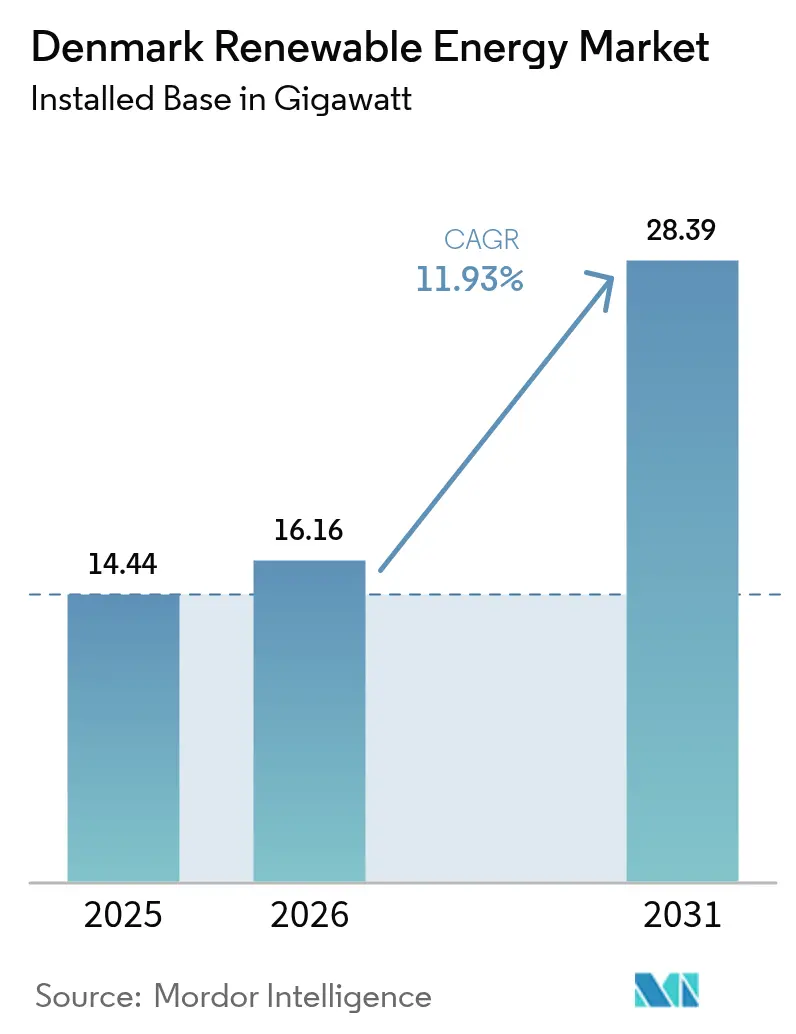
Denmark Renewable Energy Market size in 2026 is estimated at 16.16 gigawatt, growing from 2025 value of 14.44 gigawatt with 2031 projections showing 28.39 gigawatt, growing at 11.93% CAGR over 2026-2031.
The Danish renewable energy market is benefiting from binding climate law milestones that accelerate offshore wind auctions, hydrogen subsidies, and corporate power purchase agreements. A legally mandated 70% reduction in greenhouse gases by 2030, compared to 1990, underpins steady demand for utility-scale projects, even when wholesale prices fluctuate. Simultaneously, the energy-island program channels DKK 210 billion (approximately USD 30 billion) into Bornholm and North Sea hubs, providing Denmark with a renewable energy market momentum that offsets the maturation of legacy wind farms. Corporate buyers, particularly data-center operators, now sign hourly-matched PPAs that stimulate hybrid solar–wind projects and battery storage. Finally, green-bond listings in Copenhagen narrow developers’ funding costs by 20–30 basis points, adding financial depth to the Denmark renewable energy market.
Key Report Takeaways
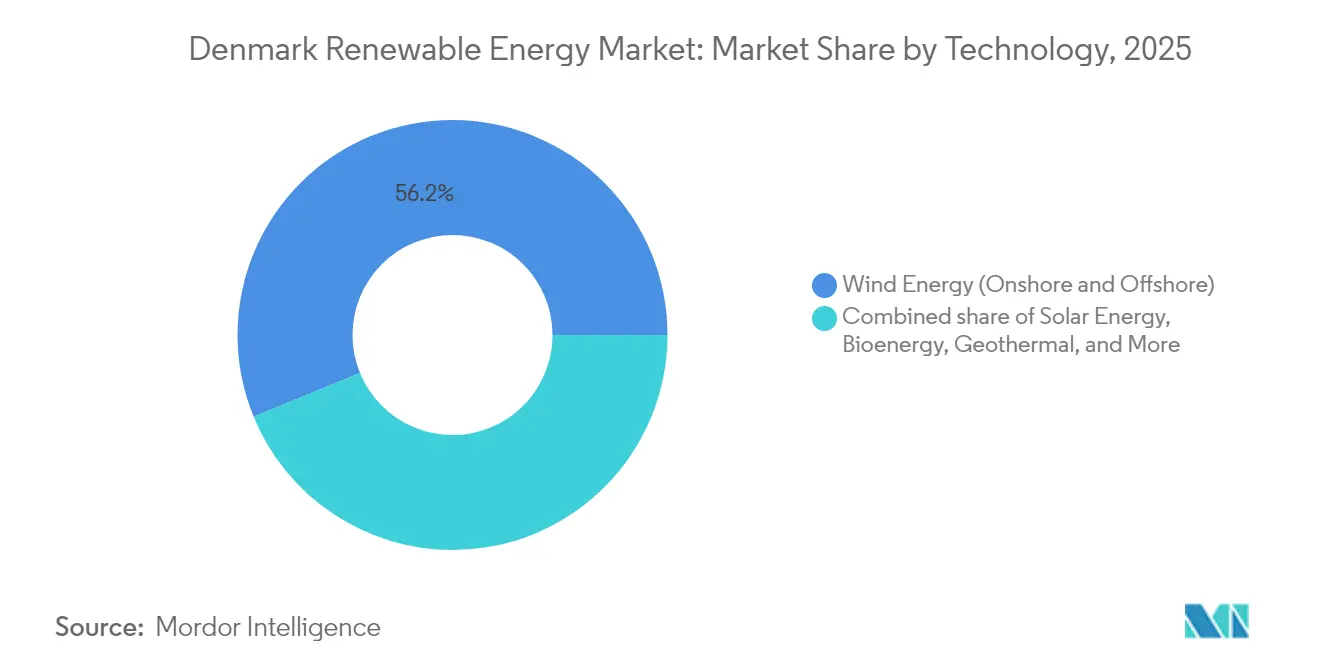
- By technology, wind energy commanded 56.20% of Denmark's renewable energy market share in 2025; geothermal capacity is forecast to expand at a 47.52% CAGR through 2031.
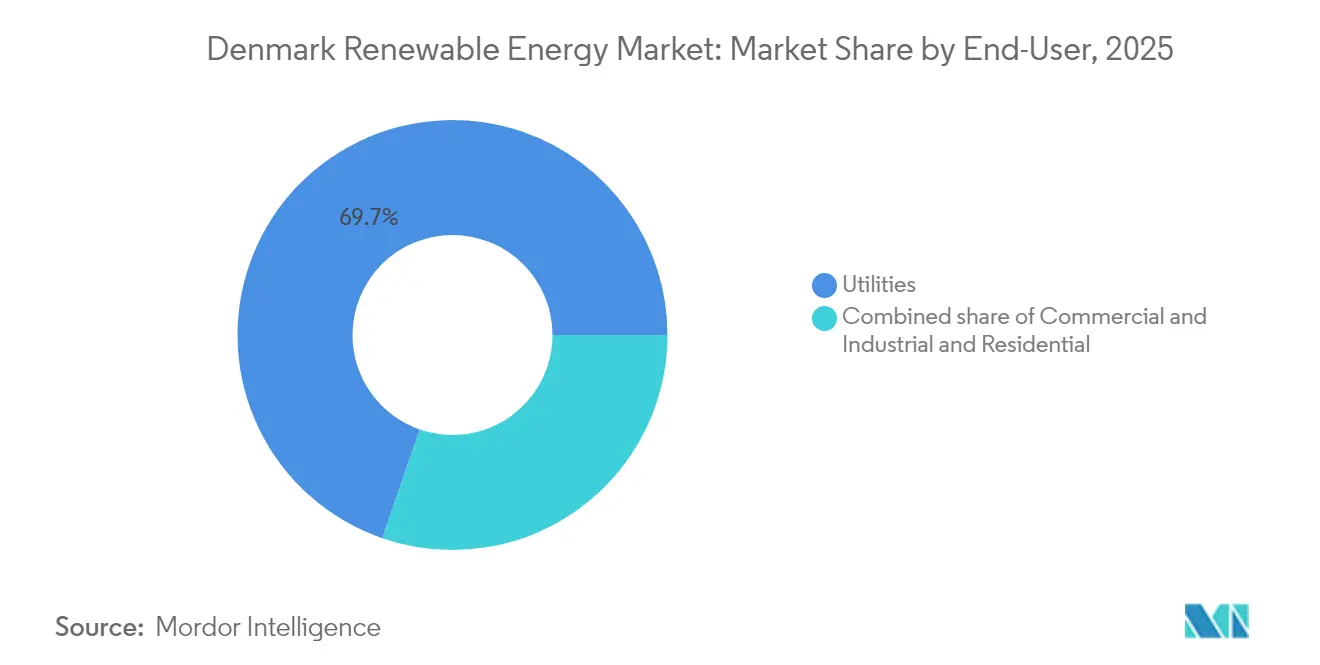
- By end user, utilities held 69.70% of Denmark's renewable energy market share in 2025, while the commercial and industrial segment is projected to grow at a 14.44% CAGR to 2031.
- Offshore wind, led by Ørsted, Copenhagen Infrastructure Partners, and Vattenfall, captured over 70.00% of the pipeline capacity in 2025.
- Ørsted, Vestas, and Copenhagen Infrastructure Partners collectively issued EUR 3.95 billion of green bonds in 2024, demonstrating strong investor demand.
Note: Market size and forecast figures in this report are generated using Mordor Intelligence’s proprietary estimation framework, updated with the latest available data and insights as of 2026.
Denmark Renewable Energy Market Trends and Insights
Drivers Impact Analysis*
| Driver | (~) % Impact on CAGR Forecast | Geographic Relevance | Impact Timeline |
|---|---|---|---|
| National 70% GHG-reduction target accelerates build-out | 2.8% | National, with offshore concentration in North Sea and Baltic zones | Medium term (2-4 years) |
| Energy-island and offshore-hub programme | 3.2% | Bornholm (Baltic), North Sea hub west of Jutland | Long term (≥4 years) |
| Power-to-X hydrogen pipeline bankability | 1.9% | Esbjerg, Fredericia industrial clusters; export corridors to Germany | Medium term (2-4 years) |
| Corporate solar and wind PPAs from data-centre cluster | 1.5% | Greater Copenhagen, Fredericia; spillover to Aarhus metro | Short term (≤2 years) |
| EU-ETS price uplift boosting biomass co-firing economics | 0.9% | National, legacy coal-plant sites (Avedøre, Studstrup) | Short term (≤2 years) |
| Green-bond capital inflows via Copenhagen listing rules | 1.4% | National, with global institutional allocations | Medium term (2-4 years) |
| Source: Mordor Intelligence | |||
National 70% GHG-Reduction Target Accelerates Build-out
The Climate Act of 2020 locks in a 70% emissions reduction mandate by 2030, pushing developers to add 8 GW of new capacity in six years. The Denmark renewable energy market gains predictability as annual compliance reviews trigger subsidy tweaks rather than policy U-turns. Sector coupling deepens the addressable load because megawatts must serve electrolysers, heat pumps, and EV chargers, increasing the marginal value of each project. Offshore wind is allocated 4.5 GW of the 2024–2030 build plan, while 1.7 GW is allocated to hybrid projects that combine wind, solar, and battery storage. Ørsted raised EUR 1.75 billion in a May 2024 green bond, signaling financiers’ confidence that statutory goals will not be diluted.[1]
Energy-Island & Offshore-Hub Programme
The Bornholm and North Sea islands amount to Denmark’s largest energy infrastructure since the Great Belt link, with 6 GW slated for completion in 2030 and modular expansion to 10 GW by 2040.[2] EU Innovation Fund grants of EUR 645 million enable the construction of subsea HVDC cables to Germany and Poland, allowing for the export of surplus power while importing balancing electricity. The islands serve as grid stability anchors by clustering synchronous condensers and battery farms offshore, thereby trimming system balancing costs by 12% compared to dispersed projects. Copenhagen Infrastructure Partners committed EUR 2.3 billion to Bornholm in 2024, underlining how de-risked the scheme has become. The Denmark renewable energy market, therefore, sees the islands not only as generation assets but as modular nodes for hydrogen production and data-center colocation.
Power-to-X Hydrogen Pipeline Bankability
Denmark aims to install 4 to 6 GW of electrolysers by 2030, aligning its green hydrogen exports with Germany’s pipeline rollout. The first tender, awarded in late 2023, was valued at DKK 1.25 billion and included projects such as European Energy’s 150 MW Padborg and H2 Energy’s 1 GW Esbjerg sites. Bankability depends on sub-EUR 3 per-kg delivered hydrogen, a hurdle narrowed by Denmark’s electricity-tax exemption through 2030.[3] Early evidence comes from Nature Energy’s 20 MW Holstebro plant, which produces synthetic methane. As regulation clarifies EU hydrogen certification, the Denmark renewable energy market converts policy momentum into multi-gigawatt demand for renewable electrons.
Corporate Solar & Wind PPAs from Data-center Cluster
Hyperscale operators signed more than 1 GW of renewable PPAs since 2023, led by Microsoft’s 180.6 MW hourly-matched contract with European Energy. Meta’s Odense facility now sources 730 MW through direct-wire wind farms. These corporate deals diverge from legacy PPAs: they stipulate hourly matching, impose curtailment penalties, and span 15 years. The Danish Energy Agency forecasts that data-center electricity use will climb to 8.8 TWh by 2030, securing a stable demand floor for the Danish renewable energy market. Developers thus find a creditworthy alternative to utilities, lowering merchant-price risk.
Restraints Impact Analysis*
| Restraint | (~) % Impact on CAGR Forecast | Geographic Relevance | Impact Timeline |
|---|---|---|---|
| Grid congestion and curtailment risk | -1.8% | Western Denmark (Jutland), high wind-penetration zones | Short term (≤2 years) |
| Lengthy permitting for onshore repowering | -1.2% | National, acute in coastal municipalities | Medium term (2-4 years) |
| Skilled-labour bottlenecks inflating EPC costs | -0.9% | National, offshore vessel constraints in North Sea | Short term (≤2 years) |
| Biomass sustainability-criteria uncertainty | -0.6% | National, legacy coal-plant conversion sites | Medium term (2-4 years) |
| Source: Mordor Intelligence | |||
Grid Congestion & Curtailment Risk
Western Denmark curtailed 1.4 TWh of wind output in 2023, 40% more than in 2022, largely because the 400 kV backbone cannot export surplus power from Jutland to Zealand.[4] Energinet is investing DKK 40 billion through 2030 in a 600 MW Jutland–Funen link, a 1,200 MW subsea cable to Germany, and onshore upgrades. Until these assets go live, curtailment will reduce revenue for projects in high-penetration zones and deter corporate PPA buyers who are sensitive to volume penalties. Dynamic-access pilots that allow for 20% overplanting in exchange for higher curtailment may unlock 800 MW of extra capacity by 2027; however, developers still price congestion risk into bids, tempering the near-term growth of the Denmark renewable energy market.
Lengthy Permitting for Onshore Repowering
Repowering 2 MW legacy turbines with 5 MW machines promises a 30% efficiency gain, yet environmental assessments and municipal vetoes extend the timelines to three years.[5] Coastal municipalities blocked 15% of repowering bids since 2022 despite national targets. Noise-setback rules require four times the tip height distance, disqualifying many mature sites. A 2024 fast-track scheme helps projects that reduce turbine counts while increasing capacity, but exclusion zones around Natura 2000 areas cover 18% of Danish land. Consequently, about 600 MW of repowering that could have been online by 2026 remains in limbo, nudging investment toward offshore wind and slowing the Denmark renewable energy market.
*Our forecasts treat driver/restraint impacts as directional, not additive. The impact forecasts reflect baseline growth, mix effects, and variable interactions.
Segment Analysis
By Technology: Offshore Wind Anchors, Geothermal Surges From Niche Base
Wind energy contributed 56.20% of the installed capacity and retained the largest share of the Danish renewable energy market in 2025, thanks to flagship offshore assets such as Horns Rev 3 and Kriegers Flak. Upcoming energy-island tenders will add 6 GW, while onshore repowering replaces vintage machines with 5 MW-class units powered by Vestas V236 turbines. These upgrades reduce levelized costs by 18%, further strengthening the Danish renewable energy market. Geothermal’s footprint was under 50 MW in 2024; yet, the segment is set to climb at a 47.52% CAGR through 2031 as Copenhagen and Aarhus integrate subsurface heat into their district-heating networks. Solar PV growth stems from corporate rooftops and utility parks linked to hyperscale PPAs, while bioenergy fills dispatchable gaps despite RED III sustainability scrutiny. Ocean energy remains pre-commercial, but wave-power pilots off Hanstholm may scale after 2030.
A maturing turbine supply chain and HVDC rollout underpin the Denmark renewable energy market size for offshore projects, while rooftop solar growth helps keep urban emissions in check. Bioenergy’s share could shrink if forest-biomass audits disqualify pellets, yet biogas injections from agricultural waste offer a low-carbon bridge. Overall, diversified technologies mitigate intermittency and position the Denmark renewable energy market for stable expansion even amid changing policy incentives.

By End-User: Utilities Dominate, C&I Segment Accelerates on Data-Center Demand
Utilities absorbed 69.70% of total electricity from renewables in 2025, a dominance reflecting their historical role as wholesale buyers and grid operators. However, the commercial-and-industrial segment is projected to advance at 14.44% CAGR, outpacing the overall Denmark renewable energy industry and reshaping offtake patterns. Hyperscale data-center PPAs illustrate the shift: Microsoft's 180.6 MW contract or Meta's 730 MW direct-wire supply bypasses utilities, offering developers bankable 15-year revenue streams. Residential rooftop uptake is slower because net-metering credits are valued at wholesale rates, limiting the payback appeal. Community solar pools, pioneered by Better Energy, allow households to co-own utility-scale arrays, incrementally widening participation.
Utilities will remain the largest single customer base, but their share of Denmark's renewable energy market is expected to decline as corporate contracts capture a larger share of new capacity. The resulting competitive landscape pushes utilities toward hybrid projects with batteries, while corporates push for hourly-matched guarantees, collectively broadening the Denmark renewable energy market.
Geography Analysis
Western Denmark hosts 62.00% of the installed wind capacity, leveraging North Sea resources that deliver a 50% capacity factor. However, the region also suffers the bulk of curtailment due to east-west transmission limits. Energinet’s multi-billion-dollar grid reinforcement will eventually funnel Jutland’s excess generation to Zealand’s load centers, thereby expanding the Danish renewable energy market. Bornholm is evolving into a Baltic offshore hub, with its 3 GW energy island securing EU funding and HVDC backbones to Germany and Poland, facilitating cross-border power trade. The Greater Copenhagen and Fredericia corridors exhibit the fastest C&I uptake, as hyperscale data centers consumed 2.1 TWh in 2024 and are projected to reach 8.8 TWh by 2030, underscoring their strategic importance.
Southern Denmark, around Esbjerg, is the Power-to-X nucleus; electrolysers here will convert wind surpluses into hydrogen, which will be shipped to German industry. Municipal vetoes constrain onshore wind in coastal areas, yet a 2024 fast-track law attempts to bypass stalemates when turbine counts fall but megawattage rises. Denmark’s HVDC ties with Sweden, Germany, and Norway reduce domestic balancing costs, allowing the Denmark renewable energy market to export wind surplus and import Nordic hydro when calm conditions prevail. Collectively, diversified regional roles knit a balanced national portfolio that can scale toward 2030 objectives.
Regulatory Landscape
Denmark’s renewable-energy framework is anchored by the Act on the Promotion of Renewable Energy and the Electricity Supply Act, with Energistyrelsen (Danish Energy Agency) as the primary competent authority for policy implementation, EU-directive transposition, and key project approvals. Forsyningstilsynet (Danish Utility Regulator) oversees utility-sector regulation, while offshore site rights are held by the Danish state and require dedicated authorizations for preliminary investigations and exploitation. Permitting pathways vary by plant size, with onshore electricity production plants (VE-anlaeg) above 25 MW requiring a license from the Danish Energy Agency, while projects between 10 MW and 25 MW use a notification procedure.
In 2026, updates clarified institutional roles and cross-border offshore configurations. A revised regulation governing the Danish Energy Agency’s tasks and powers entered into force on February 6, 2026, and a legislative amendment enabling offshore electricity production with foreign grid connections took effect on July 1, 2026. These changes strengthen the legal basis for offshore assets built around regional interconnection and align with Denmark’s offshore build-out and energy-island infrastructure, where grid-connection governance led by Energinet is becoming more central to execution as congestion management and project prioritization tighten.
Competitive Landscape
Three players, Ørsted, Copenhagen Infrastructure Partners, and Vattenfall, control over 70% of offshore pipeline capacity, giving the Denmark renewable energy market a moderately concentrated offshore tier. Onshore wind and solar are more fragmented; Better Energy, European Energy, and NRGi Renewables pursue projects with sub-EUR 200 million budgets, financed on three-year payback horizons. Ørsted’s vertical integration into hydrogen, as illustrated by its stake in the 1 GW Esbjerg Power-to-X project, captures molecule premiums in addition to electrons. Copenhagen Infrastructure Partners’ EUR 12 billion CI V fund earmarks 30% for hydrogen infrastructure, mirroring this pivot. Turbine OEMs Vestas and Siemens Gamesa wield negotiating leverage by bundling 15-year service contracts, stabilizing their margins.
Battery-storage integrators, notably HOFOR Vind and Andel Energi, fill gaps in intermittency unaddressed by incumbents due to utility ownership limits in liberalized markets. Patent filings on floating foundations and wave-energy converters suggest early-stage competition for deeper waters where fixed-bottom turbines are expensive. The Danish renewable energy market, therefore, features a tiered structure: capital-intensive offshore clusters dominated by a few giants, and nimble onshore solar niches populated by mid-sized developers that chase C&I PPAs.
Denmark Renewable Energy Industry Leaders
-
Vestas Wind Systems A/S
-
Orsted A/S
-
Arcon-Sunmark A/S
-
Vattenfall A/S
-
Better Energy A/S
- *Disclaimer: Major Players sorted in no particular order

Market Opportunities and Future Outlook
Execution-driven whitespace is forming around integrated projects that turn variable renewable output into firm or storable value, especially where grid congestion and curtailment risk affect offtake terms. Hybrid energy parks that combine solar PV, battery energy storage, and flexible demand are moving through Denmark’s build pipeline, including Kvosted Energy Park in Viborg (around 100 MW solar paired with a 50 MW/200 MWh battery system, commissioned in late 2025/early 2026). These setups align with corporate buyers looking for hourly-matched supply and give developers ways to manage volume and curtailment penalties that show up more often in advanced PPA structures.
Power-to-X and offshore wind provide the clearest near-term industrial demand pull, with specific project and licensing milestones in 2026. In January 2026, the Danish Energy Agency granted a 30-year electricity production license to RWE’s 1.1 GW Thor offshore wind farm, with turbine installation scheduled to begin in spring 2026, which adds visibility to Denmark’s offshore pipeline and supplier activity. On hydrogen, European Energy and ENGIE announced plans in June 2026 to develop a 150 MW green hydrogen plant at Kassoe, and Plug Power completed commissioning of a 5 MW electrolyzer system at European Energy’s Made PtX facility in July 2026, indicating movement from awarded tenders to operating assets. With policy changes enabling offshore projects with foreign grid connections (effective July 2026), these steps broaden monetization routes beyond the domestic grid and support the case for locating electrolysers near ports and offshore landing points in industrial clusters such as Esbjerg and the wider Jutland corridor.
Recent Industry Developments
- July 2026: Ørsted signed a seven-year power purchase agreement for electricity from the Gode Wind 1 offshore wind park. The deal highlights the role of long-tenor PPAs in underwriting offshore cash flows and supports ongoing corporate and utility procurement activity across Northern Europe, which can affect portfolio capital allocation decisions for developers with Danish build programs.
- May 2026: Energinet introduced stricter maturity requirements for new grid connection projects, including a DKK 0.5 million deposit, effective June 3, 2026. The change prioritizes more advanced projects in the connection queue and alters development strategies by raising the cost of holding speculative grid positions, particularly where congestion is binding.
- May 2025: Denmark relaunched a 3 GW offshore wind tender using two-sided Contracts for Difference after the December 2024 auction round received no bids. The redesign pointed to a shift toward risk-sharing structures intended to restore developer participation and reopen the offshore procurement pipeline for large-scale capacity additions.
Research Methodology Framework and Report Scope
Market Definition and Coverage
For this report, the Denmark renewable energy market is measured as renewable power installed capacity operating in the country, reported in gigawatts (GW), and covering major renewable generation technologies used to supply electricity.
Scope exclusions: It does not count renewable heat, renewable transport fuels, or power-to-X output as market value, and it also excludes non-generation grid assets and general energy services.
Segmentation Overview
- By Technology
- Solar Energy (PV and CSP)
- Wind Energy (Onshore and Offshore)
- Hydropower (Small, Large, PSH)
- Bioenergy
- Geothermal
- Ocean Energy (Tidal and Wave)
- By End-User
- Utilities
- Commercial and Industrial
- Residential
Data Sources, Market Sizing, and Validation
Desk Research
Desk work starts with aligning definitions to what is counted as renewable generation capacity in Denmark, and then mapping what data series can be refreshed each year without gaps. We mainly lean on public energy statistics and policy publications to build the historical backbone, such as data from the Danish Energy Agency, Energinet, Eurostat, the International Energy Agency, and IRENA.
To turn the raw series into a usable model, we also review project pipelines, auction and tender announcements, permitting updates, and grid connection timelines, supported by company annual reports, investor presentations, and reputable press coverage. Where revenue context is needed to sanity check build rates, we selectively reference paid subscriptions for company financials and intelligence, news and financials, patent databases, and contract and tender tracking. The sources listed here are illustrative rather than exhaustive, and additional public references are also used to collect, cross-check, and clarify inputs.
Primary Interviews and Surveys
Primary interviews and surveys in Denmark cover developers, utilities, equipment and service providers, distributors, and commercial or residential users. We use their input to validate secondary data, test build timing, grid delays, utilization, project costs, and demand assumptions, fill register gaps, and triangulate final analysis.
Distribution of primary research fieldwork respondents
| Company type | Respondent position |
|---|---|
| Top tier: 27% | CXOs: 18% |
| Mid tier: 48% | Functional/Unit leaders: 32% |
| Smaller Players: 25% | Managers: 50% |
Market-Sizing & Forecasting
Sizing is built using a top-down and bottom-up combination, where national capacity statistics and plant registration series are used to reconstruct the installed base by renewable technology, followed by an annual build-out path for the forecast period. We then corroborate totals through selective bottom-up approximations, such as tracking a sampled set of projects, checking typical turbine or module ratings for recent builds, and validating commissioning timing through channel checks, before final numbers are locked.
For Denmark specifically, the model focuses on technology-wise installed capacity, annual additions, announced offshore wind award volumes, repowering rates for mature wind sites, and the share of utility-scale versus distributed solar additions. When specific inputs are missing for a niche technology in a given year, we bridge the gap using nearest-year observed ratios and then recheck the implied build rate against policy targets and grid readiness signals.
Forecasting uses scenario analysis supported by short-series trend checks, since project timing can shift when permitting, auctions, and grid connections change. The base case is adjusted using expert consensus on likely commissioning slippage and expected auction cadence, and then the final trajectory is reviewed to ensure it remains consistent with Denmark-specific pipeline realities and historic construction speed.
Data Validation & Update Cycle
Validation is done in layers, since no single dataset fully explains the market. We compare modeled capacity additions with independent signals such as auction outcomes, grid connection updates, and observed changes in technology shares, and then investigate any large variances before sign-off.
If an assumption creates an unusual jump in additions or an unexpected technology shift, respondents are re-contacted and the desk evidence is re-checked, then the model is revised and reviewed again. The report is refreshed annually, with interim updates when material events occur, and a final pre-release pass is completed so clients receive the latest view based on newly released data and announcements.
Mordor Intelligence's Denmark Renewable Energy Market Size Measured Against Other Published Estimates
Published market estimates for Denmark renewable energy can look far apart because different studies are not measuring the same underlying market. Differences often come from the unit choice (installed GW versus USD value), what technologies and energy uses are included, and how closely the forecast follows real commissioning schedules.
Some external figures publish a USD value for renewables that can also fold in renewable heating and power-to-X, which increases the total and changes the year-to-year path. For Mordor Intelligence, the number is tracked as installed renewable electricity generation capacity in Denmark in GW, and it is kept separate from heat, fuels, and hydrogen-derived energy carriers.
Benchmark comparison
| Source | Market Size | Gaps in Research Methodology |
|---|---|---|
| Mordor Intelligence | USD 14.44 B (2025) | |
| Global Consultancy A | USD 7.87 B (2025) | This estimate is expressed as a USD value number and can vary with assumed power prices, capex timing, and whether the calculation is based on annual spend, revenue, or a blended view across project types, instead of an installed-capacity count. |
| Industry Publisher B | USD 22.00 B (2024) | The scope appears wider because it includes renewable heating and cooling and power-to-X elements alongside power generation, and it is also anchored to a different reference year, which shifts comparability. |
Overall, the spread is mainly explained by unit choice, plus inclusion of adjacent energy uses beyond electricity generation, and then by the specific year used for anchoring. When buyers align these items before comparing figures, the differences usually become traceable to a small set of assumptions rather than a true disagreement on Denmark renewable build-out.
Key Questions Answered in the Report
What capacity target does Denmark plan to achieve by 2031?
The country plans to expand operational renewables from 14.44 GW in 2025 to 28.39 GW by 2031, reflecting a 11.93% CAGR.
Which technology currently leads electricity generation?
Offshore and onshore wind together supplied 56.20% of 2025 capacity and will remain the anchor as energy-island projects add 6 GW.
How fast is corporate renewable procurement growing?
Commercial-and-industrial demand is forecast to rise at a 14.44% CAGR to 2031, driven by data-center PPAs that already exceed 1 GW.
What is the main restraint facing new wind projects?
Grid congestion in western regions caused 1.4 TWh of curtailment in 2023, reducing revenue until new HVDC links go live around 2029.
How does the green-bond market support expansion?
Copenhagen’s exchange priced EUR 12 billion of green debt since 2023, trimming average project-finance spreads by up to 30 basis points.
Which regions will house Denmark’s first large-scale hydrogen projects?
Esbjerg and Fredericia host electrolysers totaling up to 1.3 GW, benefiting from proximity to offshore wind and export pipelines.