
Democratic Republic Of Congo Automotive Lubricants Market Size and Share
Market Overview
| Study Period | 2021 - 2031 |
|---|---|
| Forecast Data Period | 2026 - 2031 |
| Base Year Market Size (2025) | 8.01 Million liters |
| Market Volume (2026) | 8.14 Million liters |
| Market Volume (2031) | 8.86 Million liters |
| Growth Rate (2026 - 2031) | 1.71 % |
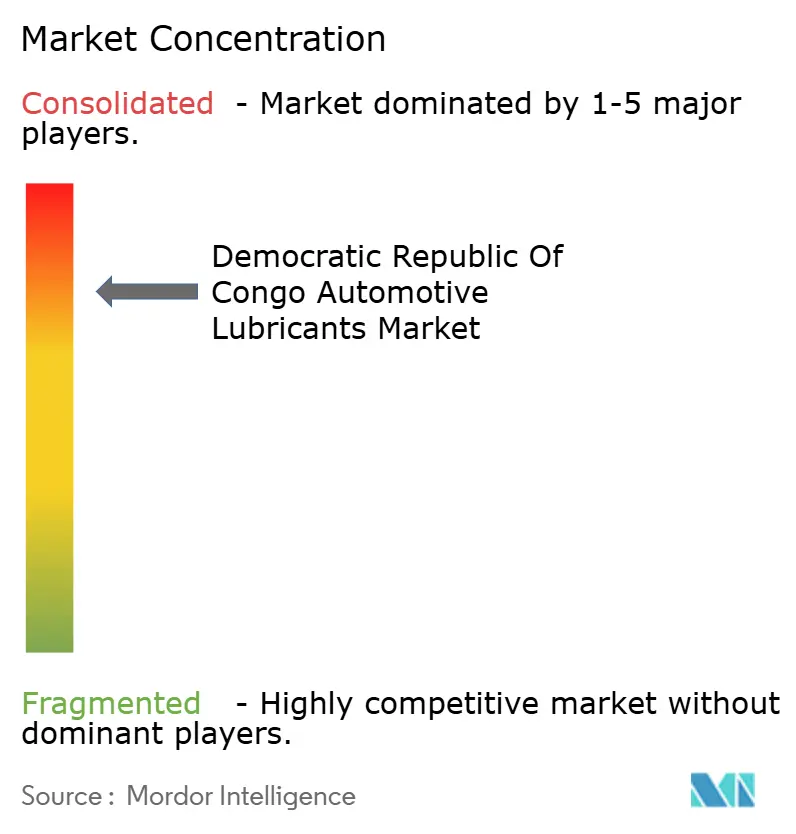
| Market Concentration | High |
Major Players *Disclaimer: Major Players sorted in no particular order Image © Mordor Intelligence. Reuse requires attribution under CC BY 4.0. | |
Democratic Republic Of Congo Automotive Lubricants Market Analysis by Mordor Intelligence
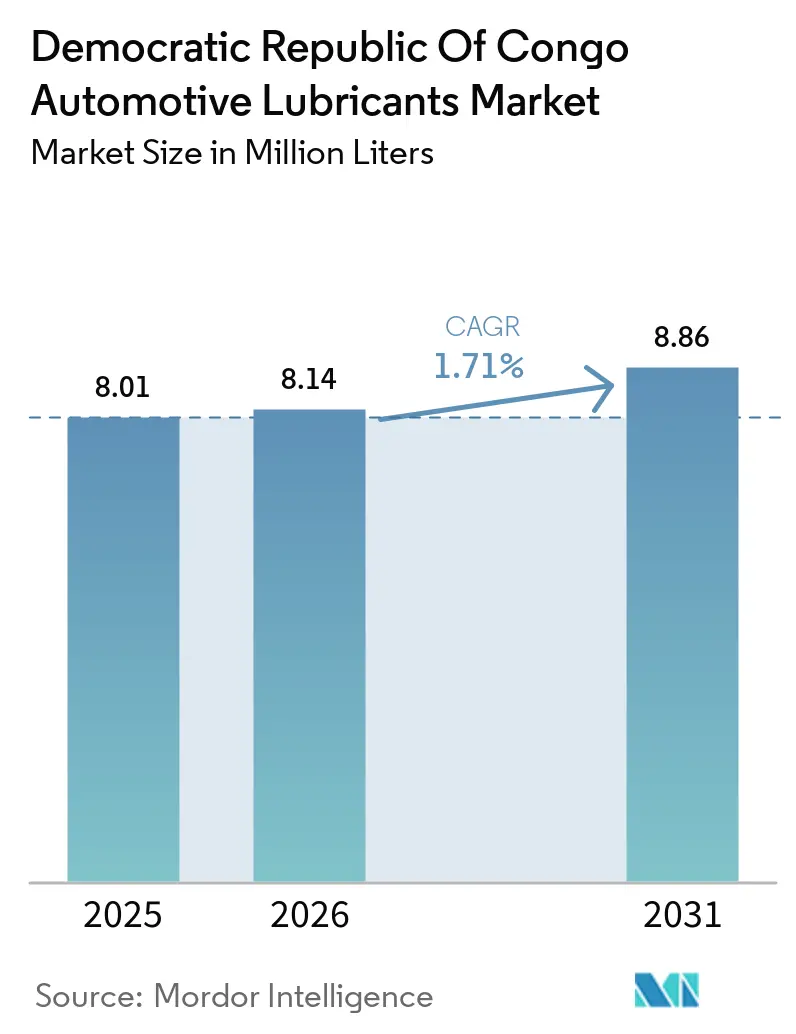
The Democratic Republic of Congo Automotive Lubricants Market size was valued at 8.01 million liters in 2025 and is estimated to grow from 8.14 million liters in 2026 to reach 8.86 million liters by 2031, at a CAGR of 1.71% during the forecast period (2026-2031). In the copper-cobalt mining sector, structural upgrades are taking place, while the informal moto-taxi transport industry is experiencing significant growth. Additionally, a recently imposed import-age cap on vehicles is subtly reshaping demand. In response, multinationals are strengthening their distribution hubs in Lubumbashi and Kinshasa, aiming to secure lucrative mining contracts. Meanwhile, distributors are adjusting pack sizes to cater to the budget-conscious moto-taxi operators. Infrastructure challenges persist, with only a small proportion of roads paved. This shortfall compels fleet owners to reduce recommended drain intervals, leading to increased consumption per vehicle, even as the overall fleet growth remains modest. Furthermore, counterfeit products are widespread in informal channels, undermining trust in premium synthetics. This has resulted in a steady demand for economy-grade mineral oils, even as awareness of original equipment manufacturer specifications rises.
Key Report Takeaways
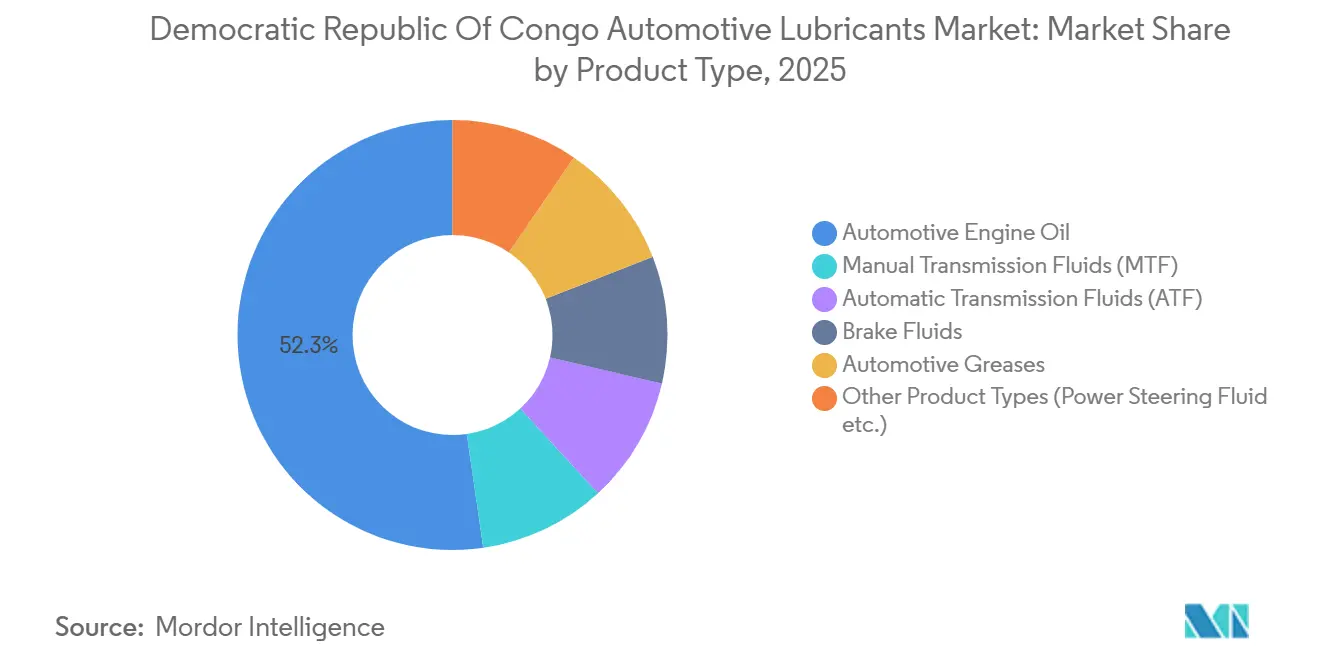
- By product type, automotive engine oil led with 52.28% of the Democratic Republic of Congo automotive lubricants market share in 2025, while automatic transmission fluids are expected to record the highest projected CAGR at 2.97% from 2026 to 2031.
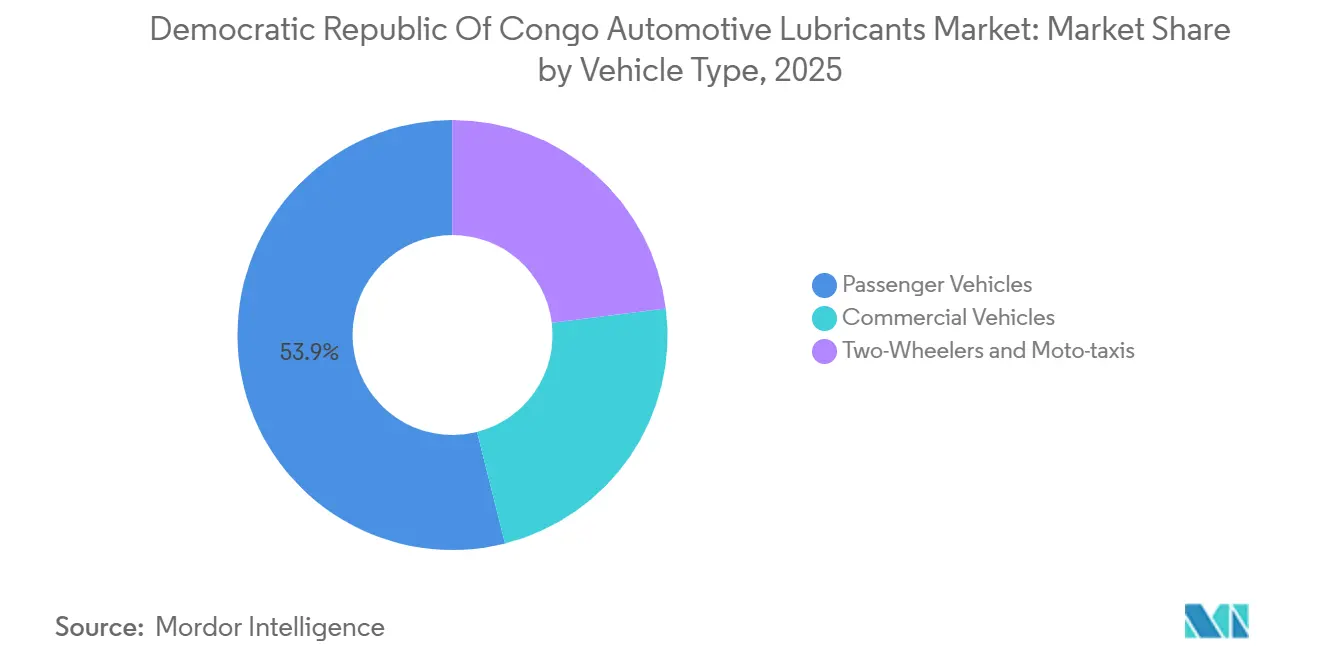
- By vehicle type, passenger cars accounted for a 53.93% share of the Democratic Republic of Congo automotive lubricants market size in 2025, whereas commercial vehicles are forecast to expand at a 2.16% CAGR from 2026 to 2031.
Note: Market size and forecast figures in this report are generated using Mordor Intelligence’s proprietary estimation framework, updated with the latest available data and insights as of January 2026.
Democratic Republic Of Congo Automotive Lubricants Market Trends and Insights
Drivers Impact Analysis*
| Driver | (~) % Impact on CAGR Forecast | Geographic Relevance | Impact Timeline |
|---|---|---|---|
| Increasing average vehicle age & surge in used-car imports | +0.40% | National, concentrated in Kinshasa, Lubumbashi, and Goma | Medium term (2-4 years) |
| Rapid growth of copper-cobalt mining fleets | +0.50% | Haut-Katanga and Lualaba, spill-over to logistics corridors | Long term (≥4 years) |
| Expansion of informal passenger-transport moto-taxis | +0.3% | Urban centers such as Kinshasa, Kisangani, and Goma | Short term (≤2 years) |
| Poor road quality is causing shorter drain intervals | +0.20% | National, acute in rural and mining-access routes | Medium term (2-4 years) |
| Gradual shift toward logistics-ready truck corridors | +0.20% | Kolwezi-Dilolo-Lobito and Lubumbashi-Durban corridors | Long term (≥4 years) |
| Source: Mordor Intelligence | |||
Increasing Average Vehicle Age and Surge in Used-Car Imports
The country imported a significant number of used vehicles, most of which were already over a decade old. However, a presidential decree set to take effect in January prohibits imports of vehicles older than fifteen years[1]Presidency of the Democratic Republic of Congo, “Decree on Vehicle Import Age Limits,” presidence.cd. Operators are reducing drain intervals for aging engines, which experience increased blow-by and sludge. This change is driving higher lubricant demand per vehicle, even as the overall vehicle fleet grows at a slower pace. Japan, Europe, and the United Arab Emirates remain key sources for younger used cars, but financial constraints are leading to a gradual replacement process. Ports such as Matadi, Boma, and Banana manage most roll-on-roll-off arrivals. The new deep-water terminal at Banana is expected to enhance clearance times and lower landed costs. However, despite improvements in port efficiency, affordability challenges continue to keep older cars in operation.
Rapid Growth of Copper-Cobalt Mining Fleets
Equipment supplier Epiroc has commenced shipments of underground rigs to Kamoa-Kakula, where Ivanhoe Mines is set to implement successive capacity expansions through the forecast period. Each haul truck or load-haul-dump machine consumes a significant amount of diesel engine oil per change and operates multiple hydraulic circuits. This makes the mining belt in the Democratic Republic of Congo the densest hub for high-value demand in the country's automotive lubricants market[2]Epiroc, “Underground Mining Equipment Orders,” epirocgroup.com. The Lobito Corridor, a significant infrastructure project, is set to re-route a substantial volume of concentrate annually. This initiative will centralize trucks at new railheads, establishing consistent drain-interval cycles. Meanwhile, battery-electric haul trucks, currently undergoing trials, have eliminated the need for engine oil. However, this shift has increased demand for thermal-management fluids and specialty greases, expanding the product range instead of reducing the overall volume.
Expansion of Informal Passenger-Transport Moto-Taxis
In Kinshasa, moto-taxis have increased their share of the commuter market, with the capital hosting a significant number of motorcycles. These motorcycles, typically equipped with small engines, require frequent oil changes due to challenges like dust, heat, and stop-start duties. Ride-hailing platform Yango has introduced scheduled maintenance for a portion of its fleet, subtly steering riders towards branded lubricants. Despite this, informal kiosks continue to dominate the distribution landscape, leading to a flourishing market for small pack sizes and budget-friendly monogrades. For suppliers, even minor adjustments in recommended maintenance intervals can result in significant volume shifts, especially given the vast scale of the fleet.
Poor Road Quality Causing Shorter Drain Intervals
Only a small percentage of roads are paved, and a significant portion of surfaces on unmaintained stretches fail within a few years. Fine dust accelerates oxidation, while deep potholes raise sump temperatures through sustained high engine revolutions. As a result, fleet managers routinely reduce original equipment manufacturer intervals. The overhaul of a major highway eased the Kinshasa-Matadi runs. However, most secondary arteries remain rutted. Consequently, operators prioritize robust additive packs over low-viscosity fuel savers, maintaining demand for mineral oil grades. Distributors, by pairing filtration guidance with affordable drums, have gained share among trucking cooperatives that seek a balance between cost and wear protection.
Restraints Impact Analysis*
| Restraint | (~) % Impact on CAGR Forecast | Geographic Relevance | Impact Timeline |
|---|---|---|---|
| Counterfeit & adulterated lubricants in open drums | -0.30% | National, acute in informal retail (Kinshasa, Lubumbashi, Kisangani) | Short term (≤2 years) |
| Limited in-country blending/packaging capacity | -0.20% | National, imports from Kenya, Tanzania, South Africa | Medium term (2-4 years) |
| Weak enforcement of axle-load limits is degrading engines | -0.10% | Mining-access and logistics corridors | Long term (≥4 years) |
| Source: Mordor Intelligence | |||
Counterfeit and Adulterated Lubricants in Open Drums
Angolan police recently dismantled a network involved in distributing counterfeit oils into border markets, seizing drums that did not meet viscosity and additive standards. Prosecutions remain uncommon due to the lack of a national standard aligned with the American Petroleum Institute, prompting cost-conscious drivers to choose the least expensive products. These counterfeit products erode consumer trust, weaken brand reputation, and reduce the adoption of synthetic oils, even among professional vehicle fleets. Distributors are addressing the issue by introducing tamper-evident packaging and verification through quick response codes, but informal kiosks often transfer bulk oils into reused soda bottles, undermining these protective measures. Without stricter enforcement, the growth of premium products will remain slow, despite increasing awareness of original equipment manufacturer specifications.
Limited In-Country Blending and Packaging Capacity
Major brands are increasingly reliant on imports for finished goods in the Democratic Republic of Congo. TotalEnergies transports products from its Mombasa plant, Engen sources from South African blends, and Puma Energy is set to utilize Hass Petroleum’s depot in Lubumbashi under an existing agreement. Freight costs increase the overall price per liter, making the supply chain vulnerable to currency fluctuations and congested border posts. The lack of local blending facilities limits customization options, especially for high-sulfur diesel or biofuel blends that are often used in generators. Establishing a local plant would necessitate investments in reliable power, base-oil storage, and laboratory infrastructure. However, many are hesitant to commit due to policy uncertainties and inconsistent electricity supply. Until these challenges are addressed, the automotive lubricants market in the Democratic Republic of Congo will remain dependent on regional supply chains, incurring a premium on landed costs.
*Our forecasts treat driver/restraint impacts as directional, not additive. The impact forecasts reflect baseline growth, mix effects, and variable interactions.
Segment Analysis
By Product Type: Engine Oils Dominate, ATF Gains on Fleet Modernization
Automotive engine oil held 52.28% Democratic Republic of Congo automotive lubricants market share in 2025, reflecting the dominance of combustion engines across cars, trucks, and moto-taxis. Monograde SAE 40 and 15W-40 multigrades remain staples for aging diesel fleets, yet 5W-30 and 0W-20 synthetics are inching up as slightly newer Japanese and European imports enter the parc. Manual transmission fluid still serves most light vehicles, but automatic transmission fluid is forecast to grow at 2.97% a year through 2026 to 2031 as urban congestion fuels demand for automatics. Brake fluids, greases, and specialty oils make up the remainder of the market, with lithium-complex greases becoming increasingly popular in the mining sector, where they handle extreme loads.
Puma-Hass distribution introduced transmission fluids compatible with advanced specifications and diesel oils formulated for African sulfur levels, thereby broadening the premium tier. At a distributor forum, TotalEnergies showcased its synthetic lubricants, highlighting their extended drain capabilities. Yet, many operators remain skeptical, especially when subpar roads necessitate frequent oil changes. While mineral oils continue to dominate sales in moto-taxi hubs, even minor shifts in viscosity preferences can sway the overall size of the automotive lubricants market in the Democratic Republic of the Congo, given that engine oil volumes overshadow all other categories. Suppliers who combine filtration advice with demonstrable cost-per-hour savings are gradually steering fleets towards more profitable semi-synthetics.



By Vehicle Type: Passenger Cars Lead, Commercial Segment Accelerates
Passenger vehicles consumed 53.93% of lubricants in 2025 as imported sedans, SUVs, and light pickups remain the transport of choice for urban households and informal taxis. Still, commercial vehicles, heavy trucks, buses, and mining support gear are projected to grow lubricant demand at 2.16% annually from 2026 to 2031. Backed by mining exports and the Lobito rail corridor, commercial growth is outpacing passenger cars. While two-wheelers contribute less volume individually, their sheer numbers lead to significant aggregate demand. In Kinshasa, for instance, moto-taxis alone consume substantial quantities of oil every change cycle.
Mining is the primary driver of this commercial growth. The Kamoa-Kakula complex has ramped up its underground haulage. Even as battery-electric load-haul-dump machines forgo engine oil, they still rely on high-performance grease and coolant. Truckers on the Southern Corridor to Durban are upgrading from older rigs to more modern units, which in turn heightens their specifications toward higher-performance oil standards. In the passenger segment, an age cap is set to phase out older vehicles, subtly increasing the demand for lower-viscosity multigrades. The two-wheeler fleet is fragmented; while ride-hailing platforms capture only a small portion, their push for scheduled maintenance is already driving up branded liter sales in downtown Kinshasa.
Geography Analysis
Kinshasa and Lubumbashi dominate the national landscape, each boasting dense vehicle clusters, well-developed road grids, and convenient access to airports or rail for imported stocks. In Kinshasa, where moto-taxis command a significant share, there is a surge in sales of small-pack engine oils. Meanwhile, in Lubumbashi, the proximity to copper mines skews preferences towards medium and large-sized containers, catering to diesel fleets.
The Lobito Corridor, set to launch soon, will reroute export traffic westward via the Dilolo railheads, boosting lubricant throughput in Lualaba and Haut-Katanga provinces. Secondary cities like Kisangani, Goma, and Mbuji-Mayi are witnessing growth spurts, driven by moto-taxi surges and wet-season river transport. However, their lack of paved roads means that mineral-based lubricants remain the dominant choice. Recent road renovations have shortened travel times between Kinshasa and Matadi, facilitating quicker restocking of imports. Additionally, the Banana port, expected to become operational in the near future, is anticipated to offer container capacity that could reduce freight costs.
In rural areas, trucks overloaded with axles kick up dust that seeps into seals, leading operators to increase grease application frequencies. As a result, distributors have positioned mobile vans along key routes and the northern timber corridor, ensuring large-sized drums are readily available near logging camps. These regional nuances contribute to the uneven expansion of the automotive lubricants market in the Democratic Republic of Congo, favoring suppliers agile enough to balance shipments between bulk mining contracts and single-liter moto-packs.
Competitive Landscape
The Democratic Republic of Congo Automotive Lubricants Market is highly concentrated. Puma Energy's agreement with Hass Petroleum marks its inaugural entry into the country's lubricant market, granting access to a large depot in Lubumbashi. Together, they aim to target mining and industrial clients with advanced diesel oils and automatic transmission fluids. Local distributors Pacific Petroleum and UNICOIL thrive by offering flexible payment terms and breaking bulk into used bottles, effectively tapping into the informal moto-taxi market a segment that's challenging for multinationals to monitor. Yet, the prevalence of counterfeits undermines brand equity, pushing legitimate businesses to adopt measures like tamper-evident caps and QR codes.
Democratic Republic Of Congo Automotive Lubricants Industry Leaders
TotalEnergies
Shell plc
Engen Petroleum
Puma Energy
FUCHS
- *Disclaimer: Major Players sorted in no particular order

Recent Industry Developments
- February 2026: Puma Energy has signed a five-year distribution agreement with Hass Petroleum, aiming to deliver Puma-branded lubricants throughout the Democratic Republic of Congo. Central to the deal is a 2.5 million-liter depot located in Lubumbashi. This move not only bolsters the nationwide availability of lubricants but also cements Puma's market presence. With this partnership, the distribution infrastructure for lubricants expands, granting broader access to automotive lubricants and propelling the growth of DRC’s automotive lubricants market.
- May 2024: Engen and Vivo Energy had finalized their merger, birthing a formidable pan-African energy entity. The agreement encompassed Engen’s operations in the Democratic Republic of Congo, ensuring the retention of service stations and depots. This move fortified the distribution of fuel and lubricants in the region, leveraging Vivo Energy’s broadened network. As a result of this merger, Engen solidified its lubricant distribution foothold in DRC, bolstering both supply reliability and market presence in the automotive lubricants arena.


Democratic Republic Of Congo Automotive Lubricants Market Report Scope
Democratic Republic of Congo Automotive Lubricants refers to a broad range of specialized fluids and greases designed to reduce friction, protect components, and enhance performance in vehicles operating across the country’s diverse terrain and climate. These lubricants include engine oils, transmission fluids, brake fluids, greases, and other products, ensuring reliability, efficiency, and durability for passenger cars, commercial vehicles, and two-wheelers in the Congolese automotive sector.
The Democratic Republic of Congo Automotive Lubricants Market is segmented by product type and vehicle type. By product type, the market is segmented into automotive engine oil (0W-XX, 5W-XX, 10W-XX, 15W-XX, monogrades, and other grades), manual transmission fluids (MTF), automatic transmission fluids (ATF), brake fluids, automotive greases, and other product types such as power steering fluids. By vehicle type, the market is segmented into passenger vehicles, commercial vehicles, and two-wheelers & moto-taxis. For each segment, the market sizing and growth forecasts have been done on the basis of volume (million liters).
| Automotive Engine Oil | 0W-XX |
| 5W-XX | |
| 10W-XX | |
| 15W-XX | |
| Monogrades | |
| Other Grades | |
| Manual Transmission Fluids (MTF) | |
| Automatic Transmission Fluids (ATF) | |
| Brake Fluids | |
| Automotive Greases | |
| Other Product Types (Power Steering Fluid etc.) |
| Passenger Vehicles |
| Commercial Vehicles |
| Two-Wheelers & Moto-taxis |
| By Product Type | Automotive Engine Oil | 0W-XX |
| 5W-XX | ||
| 10W-XX | ||
| 15W-XX | ||
| Monogrades | ||
| Other Grades | ||
| Manual Transmission Fluids (MTF) | ||
| Automatic Transmission Fluids (ATF) | ||
| Brake Fluids | ||
| Automotive Greases | ||
| Other Product Types (Power Steering Fluid etc.) | ||
| By Vehicle Type | Passenger Vehicles | |
| Commercial Vehicles | ||
| Two-Wheelers & Moto-taxis |


Key Questions Answered in the Report
What is the size of the Democratic Republic of Congo Automotive Lubricants Market?
The Democratic Republic of Congo Automotive Lubricants Market stands at 8.14 million liters in 2026 and is forecast to reach 8.86 million liters by 2031 at a 1.71% CAGR from 2026 to 2031.
Which product category holds the biggest share of lubricant demand?
Automotive engine oil led with 52.28% of the 2025 volume.
What is the fastest-growing product category?
Automatic transmission fluid is expected to expand at 2.97% a year through 2031.
How will the Lobito Corridor affect lubricant sales?
By concentrating copper freight at new railheads, it will lift heavy-duty lubricant demand in Lualaba and Haut-Katanga provinces.
Page last updated on:


 Your data is secure and never sold or shared.


