
Kenya Automotive Lubricants Market Size and Share
Market Overview
| Study Period | 2021 - 2031 |
|---|---|
| Forecast Data Period | 2026 - 2031 |
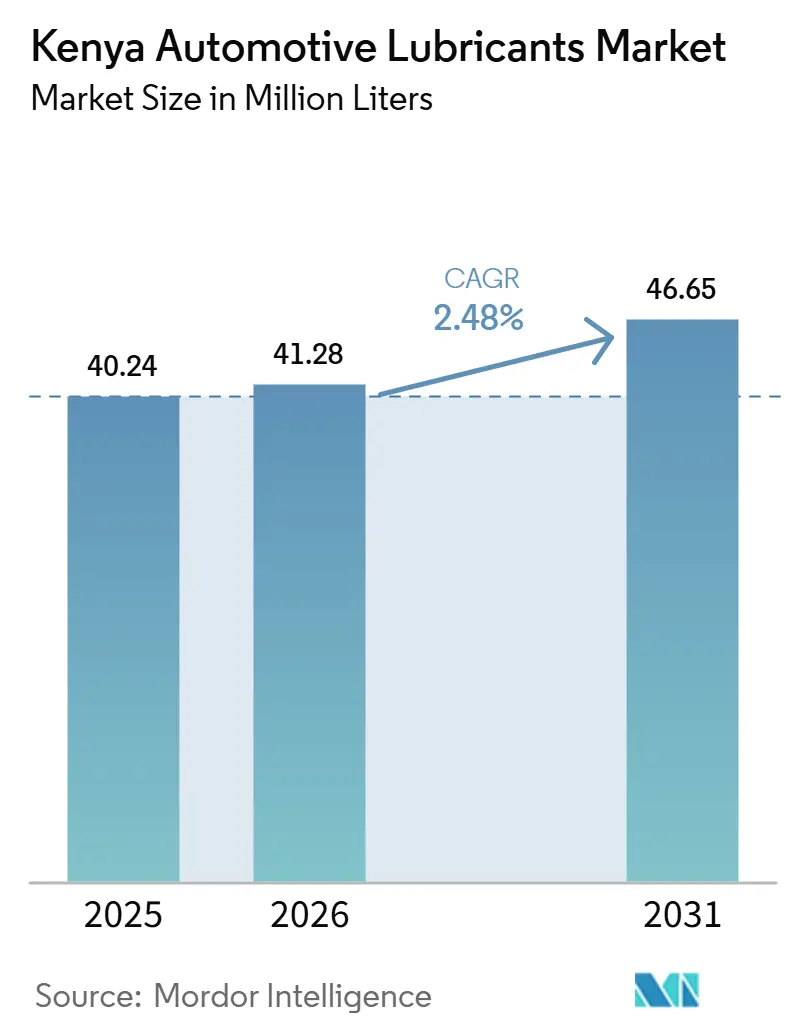
| Base Year Market Size (2025) | 40.24 Million liters |
| Market Volume (2026) | 41.28 Million liters |
| Market Volume (2031) | 46.65 Million liters |
| Growth Rate (2026 - 2031) | 2.48 % |
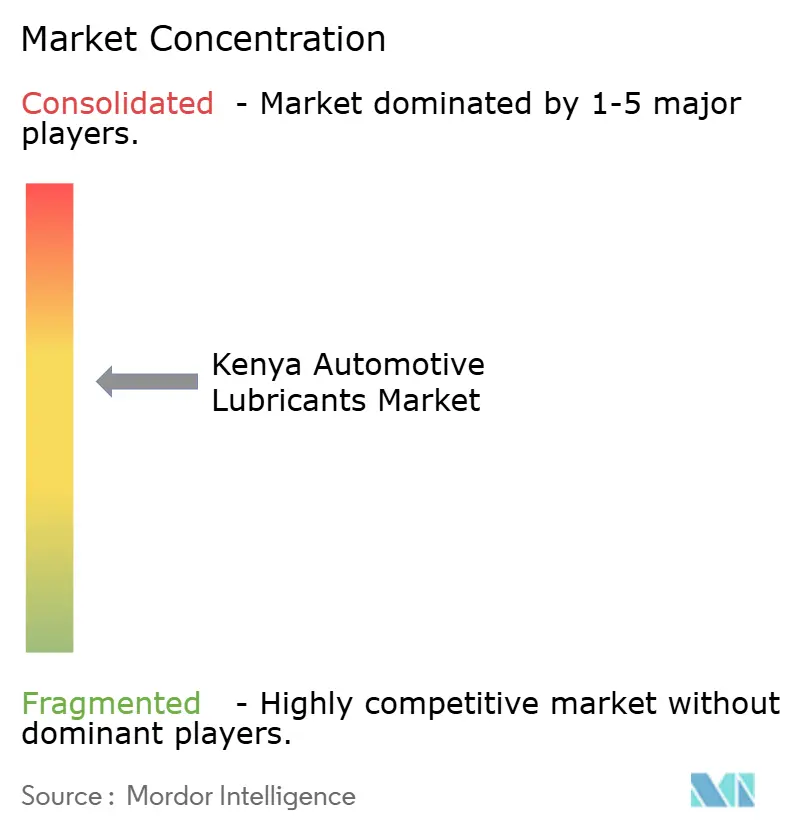
| Market Concentration | Medium |
Major Players *Disclaimer: Major Players sorted in no particular order Image © Mordor Intelligence. Reuse requires attribution under CC BY 4.0. | |
Kenya Automotive Lubricants Market Analysis by Mordor Intelligence
The Kenya Automotive Lubricants Market was valued at 40.24 million liters in 2025 and is estimated to grow from 41.28 million liters in 2026 to reach 46.65 million liters by 2031, at a CAGR of 2.48% during the forecast period (2026–2031). A vehicle base that continues to rely heavily on imported units is shaping the Kenya automotive lubricants market. Motor vehicle imports reached KES 131.6 billion (~USD 1.02 billion) in 2025, supporting steady replacement-driven lubricant consumption across older engines that require frequent oil changes. Commercial activity is also supporting demand, as mining and quarrying grew by 14.9% in 2025, while road development spending increased by 29.1% to KES 171.9 billion (~USD1.33 billion) in 2024/25. These trends sustain the consumption of heavy-duty engine oils, transmission fluids, and greases across transport and equipment fleets. The Kenya automotive lubricants market is also undergoing a channel shift, with branded retail outlets and formal workshops expanding their presence. At the same time, local blending capacity in Mombasa continues to support product availability and price competitiveness for major suppliers. Counterfeit supply continues to limit pricing power and weaken confidence in lower-trust outlets, as enforcement actions in Busia, Mumias, and Chavakali indicate that informal distribution remains a significant challenge for the Kenya automotive lubricants market. Electric mobility in buses and motorcycles is beginning to create a long-term demand shift. However, the large installed internal combustion engine fleet is expected to keep near-term lubricant volumes on a steady growth path in the Kenya automotive lubricants market.
Key Report Takeaways
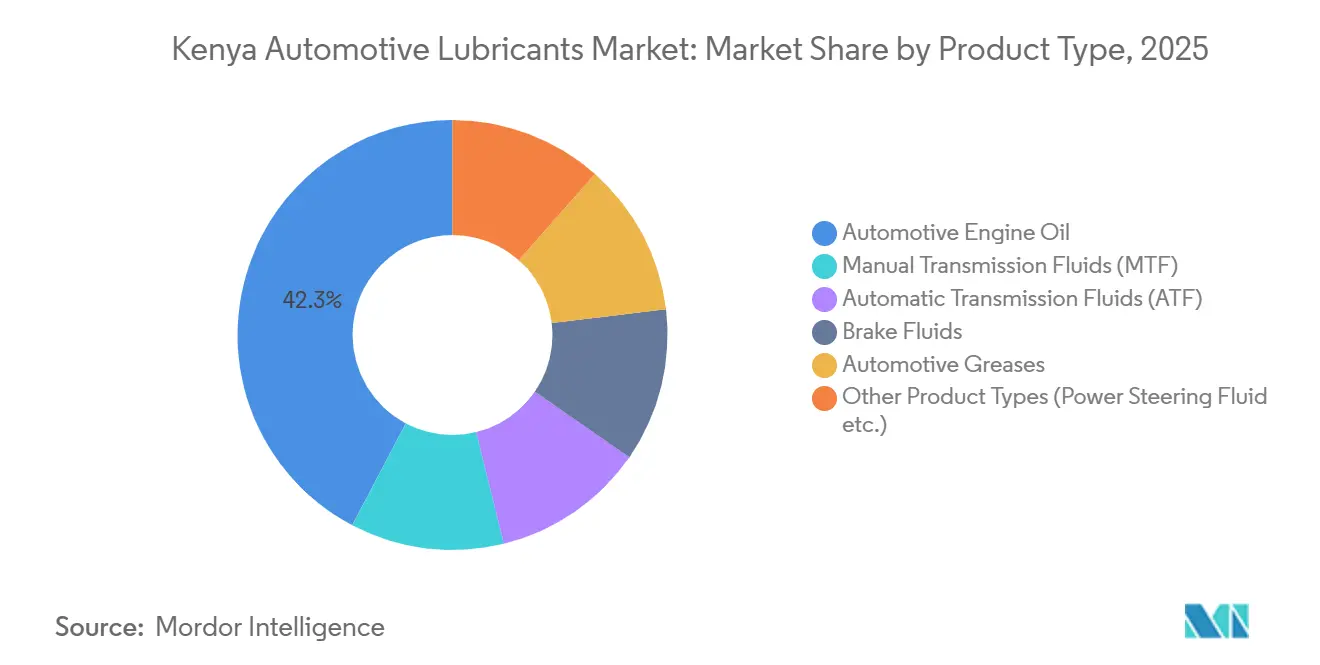
- By product type, automotive engine oil held 42.28% of total volume in 2025, while automotive greases recorded the fastest projected CAGR at 3.19% through 2031.
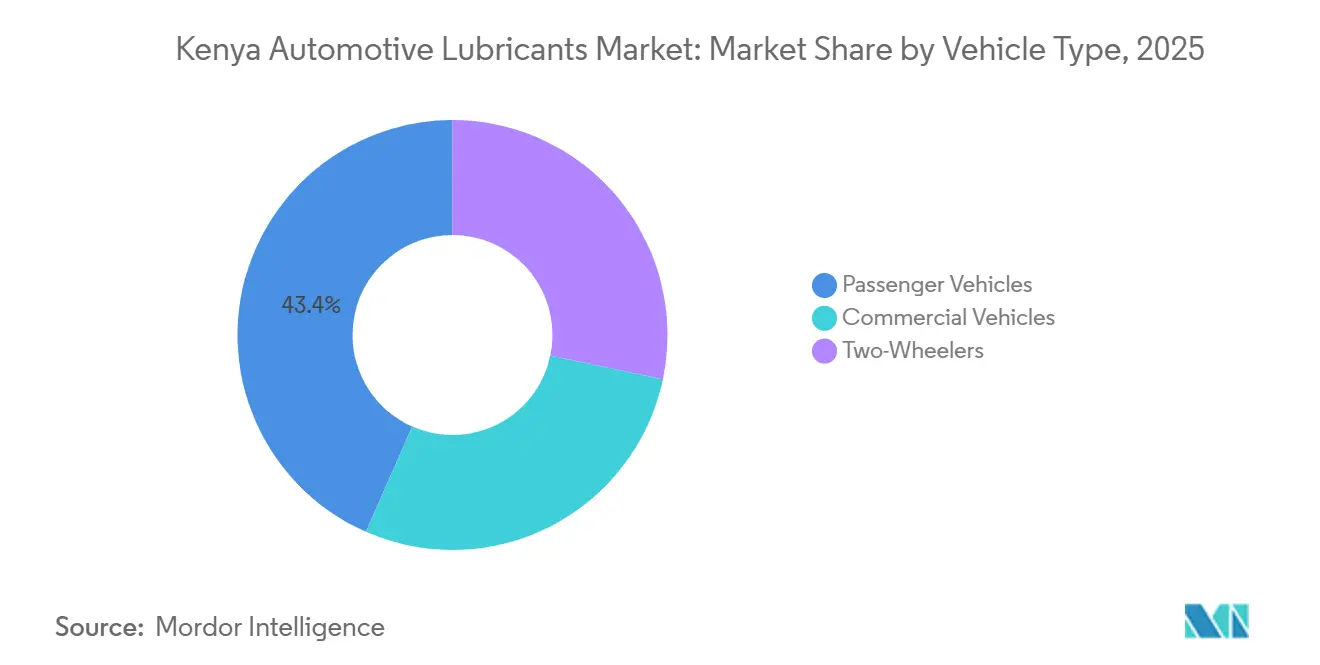
- By vehicle type, passenger vehicles accounted for 43.41% of total volume in 2025, while two-wheelers are forecast to grow at the fastest CAGR of 3.30% through 2031.
Note: Market size and forecast figures in this report are generated using Mordor Intelligence’s proprietary estimation framework, updated with the latest available data and insights as of January 2026.
Kenya Automotive Lubricants Market Trends and Insights
Drivers Impact Analysis*
| Driver | (~) % Impact on CAGR Forecast | Geographic Relevance | Impact Timeline |
|---|---|---|---|
| High dependence on used vehicle imports increasing lubricant consumption | +0.7% | National, concentrated in Nairobi, Mombasa & secondary cities receiving imported stock | Medium term (2-4 years) |
| Expansion of motorcycle taxi fleet driving two-wheeler lubricant demand | +0.6% | National, strongest in Nairobi, Kisumu, Nakuru, Eldoret, and rural corridors in Western Kenya | Short term (≤ 2 years) |
| Growth in construction, mining, and logistics sectors boosting commercial lubricant demand | +0.5% | APAC-style multi-hub; Rift Valley (quarrying), Mombasa (logistics), Nairobi (construction hubs) | Medium term (2-4 years) |
| Increasing penetration of branded and higher-quality lubricants in urban areas | +0.3% | Urban-led, primarily Nairobi and Mombasa, with spill-over to Kisumu and Nakuru | Medium term (2-4 years) |
| Local blending facilities improving product availability and cost competitiveness | +0.2% | Mombasa (primary blending hub), distribution reach extending nationally | Short term (≤ 2 years) |
| Source: Mordor Intelligence | |||
High Dependence on Used Vehicle Imports Increasing Lubricant Consumption
The Kenya automotive lubricants market continues to see steady demand from a vehicle base that remains skewed toward imported units rather than a rapid shift to newer platforms. Motor vehicle imports reached KES 131.6 billion (~USD 1.02 billion) in 2025, highlighting the scale of ongoing vehicle inflows into the country and the importance of replacement servicing after import and registration[1]Kenya National Bureau of Statistics, “Economic Survey 2026,” KNBS, knbs.or.ke. Older engines typically require higher-viscosity oils and shorter drain intervals, which keep lubricant turnover higher than it would be in a younger fleet. This trend also slows the shift toward lower-viscosity synthetic formulations, as a large share of the operating fleet still performs better with conventional grades used by mechanics and everyday vehicle owners. As a result, the Kenya automotive lubricants market maintains a durable volume floor even when new vehicle adoption does not accelerate quickly. This pattern supports volume stability but keeps premiumization slower than in markets where modern engines and long-drain synthetic use are already more common.
Expansion of Motorcycle Taxi Fleet Driving Two-Wheeler Lubricant Demand
The Kenya automotive lubricants market is registering its fastest demand growth from two-wheelers, with the segment projected to expand at a CAGR of 3.30% through 2031. This growth is linked to the country’s large and highly active boda boda fleet, where motorcycles operate under commercial conditions and require frequent oil changes to remain in service. Their operating cycle differs from private car ownership, as riders cover high daily mileage and follow shorter maintenance intervals because they depend on their vehicles for income. This pattern drives repeat lubricant purchases that are more regular and easier to predict than many passenger vehicle service cycles. It also gives distributors a clearer route to demand through workshops, rider clusters, and fleet-linked maintenance programs. As a result, the Kenya automotive lubricants market is becoming more sensitive to two-wheeler uptime, rider economics, and mechanic recommendations than it was in the past.
Price Sensitivity Limiting Adoption of Synthetic and Premium Lubricants
The Kenya automotive lubricants market remains strongly volume-led, as affordability continues to shape most lubricant purchase decisions. Imported inputs account for a large share of lubricant consumption, and price pressures from base oils, foreign exchange fluctuations, and distribution costs limit the pace at which synthetic and semi-synthetic products can penetrate the mass market. This challenge becomes more evident when distributors resist pricing or rebate changes on popular product lines, highlighting the limited flexibility many outlets have to promote premium products without losing customers. As a result, branded suppliers often have a stronger opportunity to grow through volume retention and channel loyalty than through rapid product mix improvement. The Kenya automotive lubricants market, therefore, continues to rely on conventional formulations, particularly in rural and semi-urban areas, where vehicle owners and commercial riders prioritize immediate cost savings over lifecycle performance. Service-led programs targeting mechanics and workshop owners can support premiumization, but the shift toward higher-value formulations is likely to remain gradual rather than abrupt.
Increasing Penetration of Branded and Higher-Quality Lubricants in Urban Areas
The Kenya automotive lubricants market is gradually becoming more formal in major cities as branded retail networks expand their service presence. Shell plc (Vivo Energy Kenya) had more than 336 Shell service stations by July 2025, with newer station formats featuring lubricant bays and on-site oil change services that help motorists purchase authenticated products more easily. Rubis Energy Kenya distributes Castrol products through a network of nearly 300 service stations, strengthening branded access in formal retail settings and supporting cross-selling through forecourt traffic. This shift is significant because urban buyers increasingly value product authenticity, workshop trust, and visible service quality, rather than focusing only on headline prices. As a result, the Kenya automotive lubricants market is gradually moving away from purely informal purchase behavior in dense urban corridors. This trend creates better conditions for branded suppliers to defend margins and build repeat purchases through service experience, rather than relying solely on shelf presence.
Restraints Impact Analysis*
| Restraint | (~) % Impact on CAGR Forecast | Geographic Relevance | Impact Timeline |
|---|---|---|---|
| High prevalence of counterfeit and low-quality lubricants in informal markets | -0.5% | National, most severe in peri-urban and cross-border zones (Busia, Mumias, Chavakali) | Short term (≤ 2 years) |
| Price sensitivity limiting adoption of synthetic and premium lubricants | -0.3% | National, pronounced in rural and semi-urban markets with high price-sensitive consumer base | Medium term (2-4 years) |
| Gradual electrification of public transport (e-buses, e-mobility pilots) | -0.1% | Nairobi (primary) with planned expansion to Mombasa and other urban corridors | Long term (≥ 4 years) |
| Source: Mordor Intelligence | |||
High Prevalence of Counterfeit and Low-Quality Lubricants in Informal Markets
The Kenya automotive lubricants market continues to face a significant drag from counterfeit and low-quality products sold through informal channels. Enforcement actions by the Anti-Counterfeit Authority in Busia, Mumias, and Chavakali indicate that the issue is not limited to a single route or retail format and that inland distribution remains vulnerable to imitation supply[2]Anti-Counterfeit Authority, “Counterfeit Motor Vehicle Engine Oil Trade Busted in Busia Kenya,” ACA, aca.go.ke . Counterfeit products reduce legitimate sales volume and, more importantly, weaken trust in the lubricant category when engine problems occur after a poor-quality purchase. This challenge makes it harder for branded players to communicate the value of quality differentiation in highly price-sensitive neighborhoods. The Kenya automotive lubricants market remains particularly exposed in peri-urban workshops and informal spare-parts channels, where buyers often rely on visual packaging cues rather than product verification.
Price Sensitivity Limiting Adoption of Synthetic and Premium Lubricants
The Kenya automotive lubricants market remains strongly volume-led, as affordability continues to shape most lubricant purchase decisions. Imported inputs account for a large share of lubricant consumption, and price pressures from base oils, foreign exchange, and distribution costs limit the pace at which synthetic and semi-synthetic products can penetrate the mass market. This challenge becomes more evident when distributors resist pricing or rebate changes on popular product lines, highlighting the limited room many outlets have to promote premium products without losing customers. As a result, branded suppliers often have stronger growth prospects through volume retention and channel loyalty than through rapid product mix improvement. Therefore, the Kenya automotive lubricants market continues to lean toward conventional formulations, particularly in rural and semi-urban areas, where vehicle owners and commercial riders prioritize immediate cost over lifecycle performance. Service-led programs targeting mechanics and workshop owners can support this transition, but the shift toward higher-value formulations is likely to remain gradual rather than abrupt.
*Our forecasts treat driver/restraint impacts as directional, not additive. The impact forecasts reflect baseline growth, mix effects, and variable interactions.
Segment Analysis
By Product Type: Engine Oil Volume Anchored by Aged Import Fleet
Automotive engine oil accounted for 42.28% of the total volume in 2025, making it the largest product category in the Kenya automotive lubricants market. This leadership reflects the scale of the country’s passenger and commercial vehicle base and the servicing needs of engines that continue to use conventional viscosity grades, which are common in older imported vehicles. Demand remains anchored in routine replacement cycles, as owners and workshops continue to prefer familiar grades that match vehicle condition, operating terrain, and maintenance budgets. As a result, the segment remains the clearest indicator of the replacement-driven nature of the Kenya automotive lubricants market.
Engine oil also benefits from the broadest retail visibility, as consumers associate it closely with regular workshop visits and direct purchase decisions. Higher-performance, low-viscosity grades are becoming more visible in Nairobi and Mombasa, but affordability constraints and the slow transition of the operating fleet toward newer engines continue to limit their growth. This trend keeps the product mix weighted toward mineral and conventional multigrade products rather than a rapid shift to full synthetics. Automotive engine oil is, therefore, accounted for 42.28% of the Kenya automotive lubricants market share in 2025, while the premium end of the category continues to expand from a smaller base. This balance explains why branded suppliers are investing in service bays and authenticity-focused retail instead of relying only on shelf-based premium positioning.
Automotive greases are projected to record the fastest growth among product types in the Kenya automotive lubricants market, with a CAGR of 3.19% through 2031. This growth is linked to applications in mining, quarrying, construction, transport equipment, and agricultural machinery, where lubrication needs extend well beyond engine compartments. High-load and dust-intensive duty cycles create frequent relubrication requirements for bearings, chassis components, axles, and wheel-end assemblies. This positions greases for steady growth when construction material movement, hauling, and site activity remain healthy.
Manual and automatic transmission fluids also retain a relevant role, as they serve both the commercial fleet and the growing base of used passenger vehicles with automatic transmissions. Brake fluids and power steering fluids remain essential categories, but their volume growth remains steadier because consumers usually purchase them as part of scheduled service rather than as frequent standalone products. Product growth in the Kenya automotive lubricants industry therefore remains uneven, with engine oil dominating total volume while greases expand faster from a smaller base.



By Vehicle Type: Two-Wheelers Challenging the Passenger Vehicle Baseline
Passenger vehicles accounted for 43.41% of total volume in 2025, making them the largest vehicle type segment in the Kenya automotive lubricants market. This leading position reflects a broad installed car base and sustained servicing demand from older engines that require regular oil replacement. The segment also benefits from the expanding reach of branded service station networks, which are shifting more lubricant transactions toward verified, workshop-led purchases.
Commercial vehicles represent the next major demand block, particularly for heavy-duty engine oils, transmission fluids, and greases used in freight, logistics, and route-based transport. Kenya’s role in regional trade flows and domestic movement, linked to infrastructure and quarrying activity, further strengthens this segment’s importance. Demand from commercial vehicles may not be as visible at retail service stations as passenger vehicle demand, but it remains highly important for bulk accounts and workshop service volumes. Therefore, major suppliers continue to compete through fleet relationships, supply reliability, and product availability, in addition to consumer branding.
Two-wheelers are forecast to record a CAGR of 3.30% through 2031, making them the fastest-growing vehicle type in the Kenya automotive lubricants market. This growth reflects the scale and intensity of boda boda usage, where frequent servicing makes motorcycle oil a high-repeat purchase category. Commercial riding patterns shorten oil life and increase mechanics’ influence over brand selection, giving lubricant suppliers a clear incentive to focus on workshop outreach and small-pack distribution.
This shift does not indicate that two-wheelers will overtake passenger vehicles in absolute volume during the forecast period. However, it highlights where incremental growth is concentrating. Electric motorcycles pose an emerging moderation risk over the longer term because they eliminate engine oil demand from part of the fleet. Within the forecast period, however, internal combustion motorcycles are expected to remain the dominant operating base and continue to support strong lubricant turnover. Therefore, the Kenya automotive lubricants market is likely to see two-wheelers gain importance in channel strategy, especially in areas with high rider density and strong mechanic networks. This trend makes motorcycle-focused distribution one of the more practical routes to faster volume growth in the coming years.
Geography Analysis
The Kenya automotive lubricants market demand remains unevenly concentrated across major urban areas and transport corridors. Nairobi remains the largest center for lubricant throughput, supported by the country’s densest vehicle base, the highest concentration of formal workshops, and the broadest reach of branded service station infrastructure. The city also provides the clearest route for premium and authenticated lubricant sales, as service-bay models combine fuel, oil changes, and convenience retail in a single visit. Castrol’s service-bay expansion through Rubis in Nairobi follows this approach and supports formal channel growth around trusted servicing points. As a result, Nairobi serves as the main testing ground for how effectively branded suppliers can shift lubricant purchases away from unverified roadside replacement and into controlled retail-service environments.
Mombasa plays a different role in the Kenya automotive lubricants market, as it functions as a supply and blending hub rather than solely a retail demand center. TotalEnergies’ Shimanzi blending plant and the wider port-linked oil marketing infrastructure give the city a strategic position in finished lubricant availability, cost control, and regional distribution. The 2025 licensing regulations reinforced this role by increasing formal oversight of facility construction, storage, import, export, and wholesale activities. Therefore, Mombasa anchors the formal side of the Kenya automotive lubricants market, particularly where local blending and compliant distribution help large players compete against gray-market supply.
Western Kenya and the broader upcountry corridor are emerging growth zones for the Kenya automotive lubricants market, driven by motorcycle density, agricultural equipment use, and secondary commercial activity. These regions rely more heavily on independent mechanics, spare-parts shops, and mobile service practices than Nairobi or Mombasa, which keeps informal retail channels more relevant. This creates a strong expansion opportunity for branded suppliers, but it also makes price competition and counterfeit risk more challenging outside the largest urban centers. The Kenya automotive lubricants market is, therefore, split between a more formal urban core and a more fragmented secondary-town landscape. Network expansion by Shell and Rubis into smaller towns aims to narrow this gap and extend access to authenticated lubricants beyond the two largest cities.
Competitive Landscape
The Kenya automotive lubricants market remains moderately concentrated within the formal branded tier, led by Shell plc (Vivo Energy Kenya), TotalEnergies, Rubis Energy Kenya, OLA Energy Corporation, and BP p.l.c. These companies benefit from integrated supply infrastructure, service station networks, and recognized lubricant brands, rather than relying on a single channel. As a result, the Kenya automotive lubricants market favors companies that can maintain product visibility, availability, and trust across workshops and forecourts. Independent sellers continue to exert pressure, but the formal segment requires higher standards for service quality and product authenticity.
Each leading supplier uses a distinct approach to defend its position in the Kenya automotive lubricants market. Shell plc (Vivo Energy Kenya) has expanded its Shell station network and introduced newer motorist-destination formats with dedicated lubricant bays. These formats strengthen in-bay oil change capture and help convert station traffic into branded lubricant sales. TotalEnergies continues to leverage its Mombasa blending scale, which supports local competitiveness and regional supply reach. Rubis uses its Castrol relationship and large service station base to strengthen premium retail availability and authenticated service access across urban corridors.
The competitive landscape also includes specialty and premium brands such as FUCHS, Motul, Mobil, Chevron through Caltex, and Oryx Energies. These companies compete more selectively by segment, application, or channel. Their presence remains important because the Kenya automotive lubricants market is not defined only by forecourt competition but also by commercial fleets, industrial links, and high-performance niches. Counterfeit supply remains the most distinct external pressure, as companies cannot address it through brand advertising or headline pricing alone. This dynamic keeps traceability, formal service access, and product verification central to competitive strategy. Over time, the Kenya automotive lubricants market is likely to reward suppliers that combine physical distribution with stronger mechanic relationships, workshop programs, and account-level service reliability, rather than relying only on product labels.
Kenya Automotive Lubricants Industry Leaders
TotalEnergies
Rubis Energy Kenya
OLA Energy Corporation
BP p.l.c. (Castrol)
Shell plc (Vivo Energy Kenya)
- *Disclaimer: Major Players sorted in no particular order

Recent Industry Developments
- July 2025: Shell Plc (Vivo Energy Kenya) opened its 336th Shell service station, Shell Imara Daima, on Mombasa Road in Nairobi, strengthening the company’s market leadership and supporting its integrated retail-plus-lubricants strategy.
- May 2025: Kenya's Energy and Petroleum Regulatory Authority (EPRA) gazetted the Petroleum (Lubricants Facility Construction and Business Licensing) Regulations, 2025 (Legal Notice 99). The regulations introduce mandatory EPRA licensing for lubricant blending, storage, import, export, and wholesale operations. The compliance framework requires Environmental Impact Assessment (EIA) clearance, adherence to Kenya Bureau of Standards (KEBS) standards, and audit acknowledgment from the National Environment Management Authority (NEMA), as per Kenya Law.


Kenya Automotive Lubricants Market Report Scope
Automotive lubricants reduce friction between contacting surfaces, thereby minimizing energy loss. These lubricants are vital for ensuring vehicles operate smoothly and have a prolonged lifespan. Engine oil, the most prevalent lubricant, not only reduces friction among engine components but also prevents corrosion, combats rust, and aids in cleaning the engine.
The Kenya Automotive Lubricants Market is segmented by product type and vehicle type. By product type, the market is segmented into automotive engine oil (0W-XX, 5W-XX, 10W-XX, 15W-XX, monogrades, and other grades), manual transmission fluids (MTF), automatic transmission fluids (ATF), brake fluids, automotive greases, and other product types (power steering fluid, etc.). By vehicle type, the market is segmented into passenger vehicles, commercial vehicles, and two-wheelers. For each segment, the market sizing and forecasts have been done on the basis of volume (liters).
| Automotive Engine Oil | 0W-XX |
| 5W-XX | |
| 10W-XX | |
| 15W-XX | |
| Monogrades | |
| Other Grades | |
| Manual Transmission Fluids (MTF) | |
| Automatic Transmission Fluids (ATF) | |
| Brake Fluids | |
| Automotive Greases | |
| Other Product Types (Power Steering Fluid etc.) |
| Passenger Vehicles |
| Commercial Vehicles |
| Two-Wheelers |
| By Product Type | Automotive Engine Oil | 0W-XX |
| 5W-XX | ||
| 10W-XX | ||
| 15W-XX | ||
| Monogrades | ||
| Other Grades | ||
| Manual Transmission Fluids (MTF) | ||
| Automatic Transmission Fluids (ATF) | ||
| Brake Fluids | ||
| Automotive Greases | ||
| Other Product Types (Power Steering Fluid etc.) | ||
| By Vehicle Type | Passenger Vehicles | |
| Commercial Vehicles | ||
| Two-Wheelers |


Key Questions Answered in the Report
What is the market size of the Kenya automotive lubricants market?
The market reached 41.28 million liters in 2026 and is forecast to reach 46.65 million liters by 2031, with a 2.48% CAGR over 2026-2031.
Which product type leads to lubricant consumption in Kenya?
Automotive engine oil led total volume in 2025 with a 42.28% share, reflecting frequent replacement cycles across passenger and commercial vehicles.
Which vehicle type is growing the fastest in Kenya?
Two-wheelers are forecast to grow at a 3.30% CAGR through 2031, supported by the commercial intensity of boda boda operations.
Why do greases have stronger growth potential than some other lubricant products?
Automotive greases are projected to grow at a 3.19% CAGR because construction, mining, transport equipment, and agricultural applications require frequent relubrication.
Page last updated on:





