
Cameroon Automotive Lubricants Market Size and Share
Market Overview
| Study Period | 2021 - 2031 |
|---|---|
| Forecast Data Period | 2026 - 2031 |
| Base Year Market Size (2025) | 39.57 Million liters |
| Market Volume (2026) | 42.58 Million liters |
| Market Volume (2031) | 59.16 Million liters |
| Growth Rate (2026 - 2031) | 6.80 % |
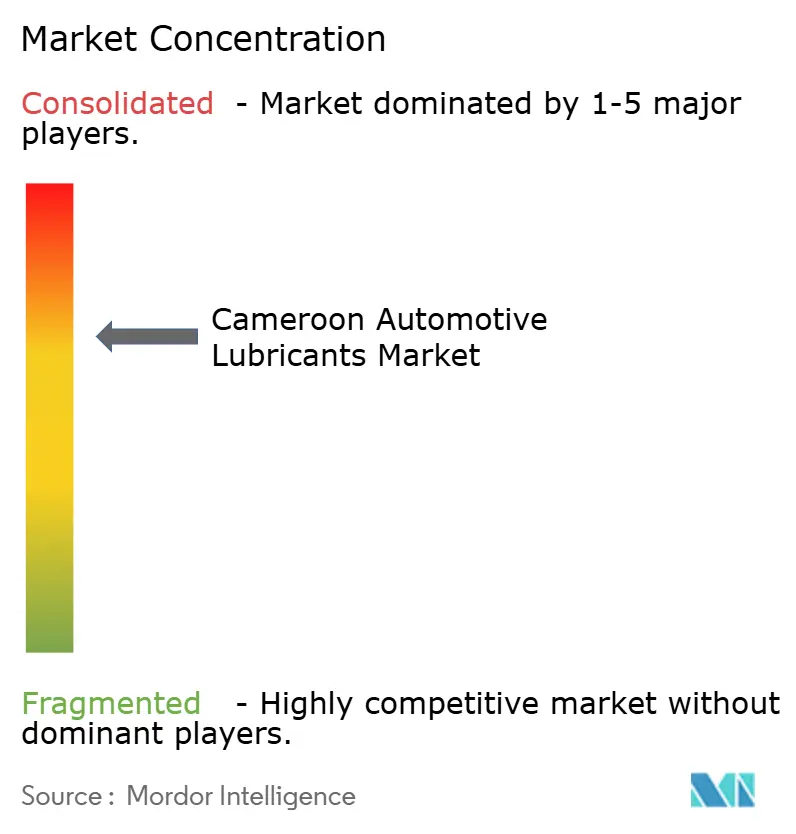
| Market Concentration | Medium |
Major Players *Disclaimer: Major Players sorted in no particular order Image © Mordor Intelligence. Reuse requires attribution under CC BY 4.0. | |
Cameroon Automotive Lubricants Market Analysis by Mordor Intelligence
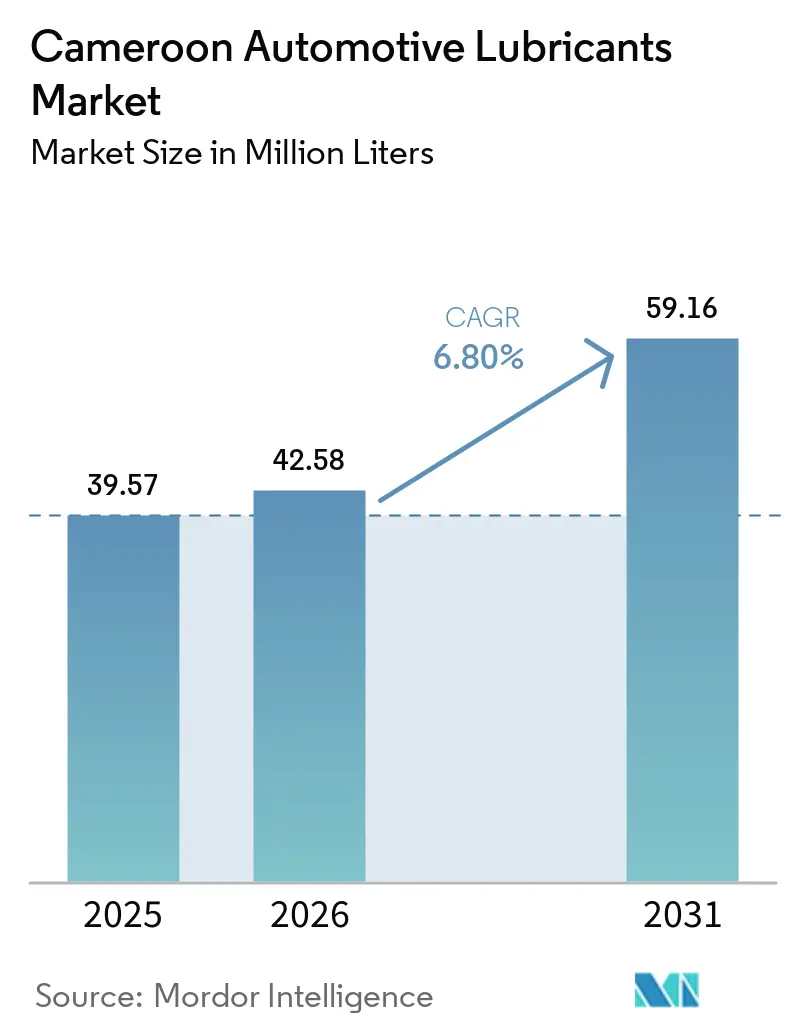
The Cameroon Automotive Lubricants Market size is expected to grow from 39.57 million liters in 2025 to 42.58 million liters in 2026 and is forecast to reach 59.16 million liters by 2031 at 6.80% CAGR over 2026-2031. Volume growth is attributed to an aging vehicle parc of 1.6–2.0 million units, with an average age of 18 years. This results in shorter drain intervals and sustained lubricant demand. The 2026 Finance Law introduces fiscal reforms, including higher excise duties on vehicles older than 12 years. However, analysts project a gradual rejuvenation of the fleet, ensuring that high-mileage engines will continue to utilize 15W-40 and 20W-50 lubricant grades. In the first half of 2025, Cameroon spent XAF 333.7 billion (USD 595 million) on fuel and lubricants, reflecting its reliance on imports and exposure to changes in global base-oil prices. Additionally, ongoing logistics and road-building initiatives, supported by Africa Global Logistics’ XAF 12 billion (USD 0.02 billion) expansion at Kribi in 2025, are expected to drive additional heavy-duty lubricant consumption in construction, mining, and freight transport.
Key Report Takeaways
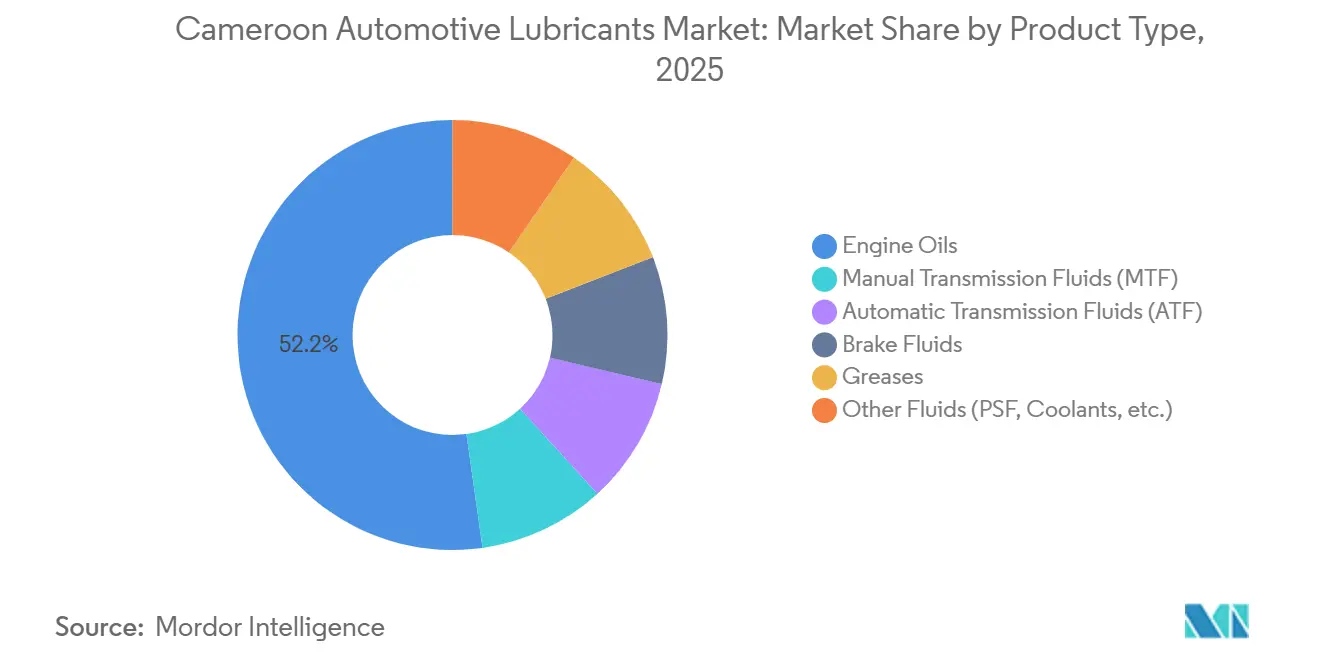
- By product type, engine oils captured 52.22% of the Cameroon automotive lubricants market share in 2025, while automatic transmission fluids are expected to record the fastest projected growth at a 6.94% CAGR through 2031.
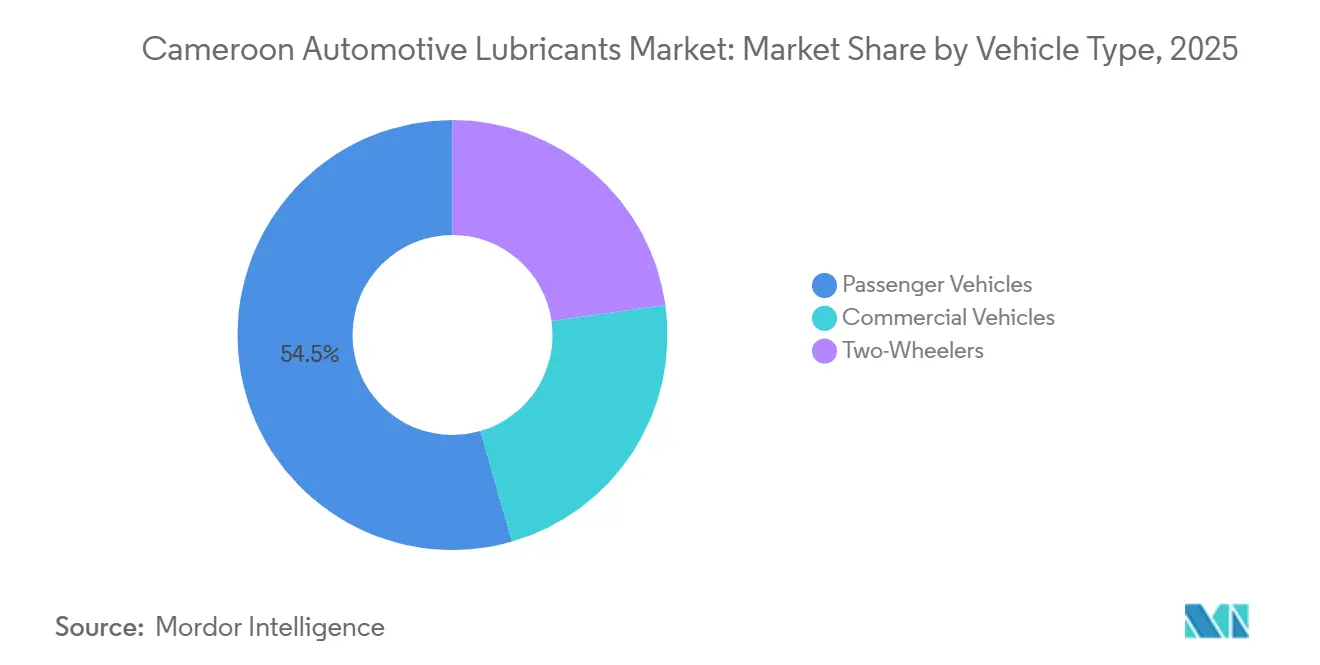
- By vehicle type, passenger vehicles accounted for 54.46% of the Cameroon automotive lubricants market size in 2025; commercial vehicles are expected to advance at a 7.06% CAGR to 2031.
Note: Market size and forecast figures in this report are generated using Mordor Intelligence’s proprietary estimation framework, updated with the latest available data and insights as of January 2026.
Cameroon Automotive Lubricants Market Trends and Insights
Drivers Impact Analysis*
| Drivers | (~) % Impact on CAGR Forecast | Geographic Relevance | Impact Timeline |
|---|---|---|---|
| Increasing average vehicle age | +1.8% | National, concentrated in urban centers (Douala, Yaoundé) and cross-border trade routes | Medium term (2-4 years) |
| Growth in vehicle parc and used-car imports | +1.5% | National, with spillover to CEMAC trade corridors (Chad, CAR) | Short term (≤ 2 years) |
| Expansion of logistics, mining and construction sectors | +1.4% | National, early gains in Douala port zone, Kribi, Ngaoundéré, Garoua | Medium term (2-4 years) |
| Shift toward synthetic and high-performance lubricants | +0.9% | Urban commercial fleets (Douala, Yaoundé), mining operators | Long term (≥ 4 years) |
| OEM drain-interval optimization demanding premium additives | +0.6% | National, led by fleet operators and OEM-authorized service centers | Long term (≥ 4 years) |
| Source: Mordor Intelligence | |||
Increasing Average Vehicle Age
Over 92% of Cameroon’s 1.6-2.0 million vehicles are more than 15 years old, with an average age of 18 years. Aging components such as piston rings, valve seals, and gaskets contribute to increased oil consumption, while dusty road conditions reduce safe oil drain intervals. The 2026 Finance Law introduces scrappage incentives and imposes higher excise duties on vehicles older than 12 years. However, previous scrappage initiatives faced challenges due to unclear funding mechanisms. Additionally, high ambient temperatures of 40-45 degrees Celsius accelerate oil oxidation, prompting mechanics to reduce drain intervals by 20% compared to Original Equipment Manufacturer (OEM) recommendations. These factors ensure baseline lubricant demand growth until significant fleet renewal occurs.
Growth in Vehicle Parc and Used-Car Imports
Vehicle import values reached XAF 375 billion (USD 0.67 billion) in 2024, driven by tariff reductions under European Union (EU) and United Kingdom (UK) partnership agreements, which eliminated duties on trucks and began phasing out tariffs on cars. In 2023, China accounted for 18.9% of imported vehicles. Meanwhile, petroleum road-freight volumes increased by 14.8% month-over-month in March 2026 as marketers moved stock inland. The expanding vehicle parc directly contributes to higher annual lubricant consumption, though this growth is partially offset by Finance Law’s stricter excise duties on older vehicles.
Expansion of Logistics, Mining & Construction Sectors
The Ministry of Public Works allocated 92% of its XAF 740 billion (USD 1.32 billion) 2026 budget to road infrastructure, targeting 650 kilometers of new pavement and key corridors such as Ebolowa-Kribi[1]. In 2025, Africa Global Logistics expanded its Kribi hub with an additional 10,000 square meters of paved yard and 10 container trucks. These developments involve the use of heavy machinery, including graders, excavators, and haul trucks, which require high-Total Base Number (TBN) engine oils, hydraulic fluids, and greases for severe-duty operations.
Shift Toward Synthetic & High-Performance Lubricants
Chevron Corporations’s 2025 appointment of Gapuma as the regional distributor for Group II base oils has reduced lead times for Central African blenders[2]. In 2024, TotalEnergies updated its Rubia product line to meet stricter European Automobile Manufacturers' Association (ACEA) specifications and introduced Excellium Formula 4 additive fuel in Cameroon, emphasizing premium product performance. Fleet operators, aiming to manage fuel costs and minimize downtime, are increasingly adopting higher-priced synthetic lubricants that support extended drain intervals and predictive maintenance practices.
Restraints Impact Analysis*
| Restraints | (~) % Impact on CAGR Forecast | Geographic Relevance | Impact Timeline |
|---|---|---|---|
| Price sensitivity and dependency on imports | -1.2% | National, acute in rural and informal sectors | Short term (≤ 2 years) |
| Counterfeit and adulterated lubricants presence | -0.8% | National, concentrated in informal retail channels | Medium term (2-4 years) |
| Emerging EV and hybrid penetration (long-term) | -0.3% | Urban centers (Douala, Yaoundé), institutional fleets | Long term (≥ 4 years) |
| Source: Mordor Intelligence | |||
Price Sensitivity & Dependency on Imports
In the first half of 2025, Cameroon imported fuel and lubricants worth USD 595 million, making prices dependent on fluctuations in global crude oil markets. Pre-shipment Program for the Evaluation of Conformity to Standards (PECAE) inspections add an additional 0.27-0.45% to the Free on Board (FOB) value. Inflation averaged 5% in 2024, further impacting household budgets. As all base oils are imported, local blenders experience limited cost relief, even with increased domestic blending capacity.
Counterfeit & Adulterated Lubricants
The seizure of 20,000 liters of counterfeit oils in South Africa in January 2026 highlights the scale of regional counterfeiting operations. In Cameroon, Nicop Oil employs sealed packaging and batch tracking to address imitation products. While the Program for the Evaluation of Conformity to Standards (PECAE) certification helps limit non-compliant imports, insufficient enforcement at the retail level allows substandard oils to remain competitively priced, discouraging consumers from purchasing compliant brands.
*Our forecasts treat driver/restraint impacts as directional, not additive. The impact forecasts reflect baseline growth, mix effects, and variable interactions.
Segment Analysis
By Product Type: Engine Oils Drive Volume, ATF Gains Momentum
Engine oils accounted for 52.22% of the Cameroon automotive lubricants market share in 2025 and are projected to maintain their position through 2031. This is due to the continued use of legacy gasoline and diesel engines, which prefer high-viscosity mineral blends such as 15W-40 and 20W-50. The market size for engine oils in Cameroon is expected to grow in line with the expansion of the vehicle parc and increased maintenance frequency. Synthetic grades like 5W-30 and 10W-40, represented by TotalEnergies Quartz INEO RCP 5W-30, are gaining adoption among fleets aiming to reduce fuel consumption and extend oil change intervals. Automatic transmission fluids (ATF) are anticipated to record the highest compound annual growth rate (CAGR) of 6.94%, driven by the rising import of vehicles equipped with step-automatic transmissions and the adoption of modern heavy-duty transmissions by logistics fleets. Products such as Fluidmatic XLD FE, approved by Voith and Allison, address this demand.
Manual gear oils, greases, brake fluids, and power-steering fluids account for the remaining market share. Greases experience demand in quarry and road-building equipment, where resistance to extreme pressure and water washout is essential. PATOIL’s HIDRUS hydraulic series is specifically designed for cranes and bulldozers operating in temperatures as high as 40°C. While the deployment of electric motorcycles by Bee Group reduces the demand for engine oils, these vehicles still require specialty greases and coolants, thereby diversifying the formulation mix in the market.

By Vehicle Type: Passenger Cars Anchor Base, Commercial Fleets Accelerate
Passenger cars accounted for 54.46% of the 2025 volume, driven by their significant numbers and high lubricant consumption due to aging vehicles and demanding operating conditions. The Cameroon automotive lubricants market associated with passenger cars remains a key segment, despite efforts to modernize the fleet through scrappage incentives. Mechanics typically recommend oil-change intervals of 3,500-4,000 kilometers, which is 20% shorter than Original Equipment Manufacturer (OEM) guidelines, to address challenges such as dust ingestion and sub-optimal fuel quality.
Commercial vehicles, including long-haul trucks, buses, and light vans, are expected to grow at a Compound Annual Growth Rate (CAGR) of 7.06% through 2031, supported by increasing road freight activity and rising construction expenditures. Fleets operating along the Douala-Ndjamena and Douala-Bangui corridors collectively record over 78,000 truck transits annually, primarily using bulk Rubia Works 1000 15W-40 for engines and DynaTrans ACX 50 for axles. The adoption of synthetic high-Total Base Number (TBN) lubricants by these fleets reduces downtime, providing suppliers with higher margins that help offset the lower unit volumes compared to passenger car lubricants.
Geography Analysis
Douala and Yaoundé account for most of the lubricant demand in Cameroon. These cities host a significant concentration of registered vehicles, formal service shops, and over 300 branded fuel stations that stock Original Equipment Manufacturer (OEM)-approved products, supporting distributor volumes during the forecast period. Together, these two cities contribute to more than half of the national automotive lubricants market consumption, driven by passenger-car ownership and organized fleet operations. In 2024, Douala's port throughput reached 1.2 million twenty-foot equivalent units (TEU), while the commissioning of Kribi’s second container terminal in May 2025 increased national handling capacity to 1 million TEU. This development reduced vessel wait times and improved the reliability of lubricant imports.
New infrastructure projects are creating additional demand for lubricants across Cameroon. The Ministry of Public Works’ 2026 road plan includes the construction of 476 kilometers of new paved roads and the rehabilitation of 5,222 kilometers of unpaved roads. These projects are expected to increase lubricant sales to contractors operating heavy machinery such as earthmovers and tipper trucks. Additionally, the National Shippers’ Council issued a tender in April 2026 for full-service stations at Ngouletang, Garoua-Boulaï, and Kousseri. These stations will enhance branded lubricant availability along the Chad and Central African Republic (CAR) corridors, reducing reliance on informal roadside vendors.
Regional integration within the Economic and Monetary Community of Central Africa (CEMAC) zone is creating growth opportunities for the automotive lubricants market. Bocom Petroleum received preferential accreditation in 2024, enabling duty-free exports of Cameroon-blended lubricants to Congo and Gabon. This positions Douala as a key hub for the Central African automotive lubricants market. However, marketers are increasingly relying on road transport for last-mile delivery, with petroleum road freight increasing. As supply chains expand, previously underserved northern regions, including Ngaoundéré and Maroua, now have improved access to genuine lubricants, reducing the prevalence of counterfeit products.
Competitive Landscape
The cameroon automotive lubricants market remains moderately consolidated. TotalEnergies operates the largest branded network in the region, offering a comprehensive range of products, including Quartz passenger-car oils, Rubia heavy-duty oils, and Excellium additive fuel, designed to deliver combined fuel and lubricant performance. The company has secured approvals, such as all six products meeting Stellantis FPW9.55535 standards, and has co-developed the Rubia Optima 4300 XFE 5W-20 specifically for Ford Trucks, reinforcing its position within authorized workshops. Additionally, Bocom Petroleum is constructing a blending plant in Douala to serve both Cameroon and neighboring Central African Economic and Monetary Community (CEMAC) markets, a development expected to reduce lead times and minimize foreign exchange risks for regional buyers.
Nicop Oil focuses on the premium synthetic segment, importing sealed European drums with batch authentication to assure fleet managers concerned about counterfeit products. International companies such as Shell, BP p.l.c., and Exxon Mobil Corporation operate through licensed distributors and fuel-station partnerships but face challenges in expanding beyond urban commercial fleets due to price sensitivity. Emerging competitors include Asia-based TERZO Lubricants, which employs blockchain-based traceability to address counterfeiting, and PTT Lubricants, offering American Petroleum Institute (API) SP-certified oils designed for stability in hot climates.
Cameroon Automotive Lubricants Industry Leaders
-
TotalEnergies
-
Shell plc
-
BP p.l.c.
-
Puma Energy
-
Exxon Mobil Corporation
- *Disclaimer: Major Players sorted in no particular order
Recent Industry Developments
- April 2026: The National Shippers’ Council has invited investors to establish full-service fuel and lubricant stations at Ngouletang, Garoua-Boulaï, and Kousseri, located along the Douala-Bangui and Douala-Ndjamena corridors. This initiative is expected to support the growing demand for automotive lubricants in Cameroon, driven by increased transportation activities along these key trade routes.
- July 2024: TotalEnergies in Cameroon introduced Excellium Formule 4 additive fuel following 900 laboratory tests, reporting a 3.3% reduction in fuel consumption for heavy-duty vehicles. This development aligns with the growing demand for efficient automotive lubricants in Cameroon, driven by the need for cost-effective and sustainable solutions in the transportation sector.
Cameroon Automotive Lubricants Market Report Scope
Automotive lubricants, including oils and greases, are fluids designed to reduce friction, wear, and heat among moving engine parts by forming a protective thin film. They support smooth operation, prevent metal-to-metal contact, remove debris, protect against corrosion, and improve vehicle efficiency.
The cameroon automotive lubricants market is segmented by product type and vehicle type. By product type, the market is segmented into engine oils, manual transmission fluids (MTF), automatic transmission fluids (ATF), brake fluids, greases, and other fluids (PSF, coolants, etc.), and by vehicle type, the market is segmented into passenger vehicles, commercial vehicles, and two-wheelers. The market sizes and forecasts are provided in terms of volume (Liters).
| Engine Oils | 0W-XX |
| 5W-XX | |
| 10W-XX | |
| 15W-XX | |
| Monogrades | |
| Other Grades | |
| Manual Transmission Fluids (MTF) | |
| Automatic Transmission Fluids (ATF) | |
| Brake Fluids | |
| Greases | |
| Other Fluids (PSF, Coolants, etc.) |
| Passenger Vehicles |
| Commercial Vehicles |
| Two-Wheelers |
| By Product Type | Engine Oils | 0W-XX |
| 5W-XX | ||
| 10W-XX | ||
| 15W-XX | ||
| Monogrades | ||
| Other Grades | ||
| Manual Transmission Fluids (MTF) | ||
| Automatic Transmission Fluids (ATF) | ||
| Brake Fluids | ||
| Greases | ||
| Other Fluids (PSF, Coolants, etc.) | ||
| By Vehicle Type | Passenger Vehicles | |
| Commercial Vehicles | ||
| Two-Wheelers |
Key Questions Answered in the Report
What is current market size of Cameroon Automotive Lubricants Market?
The Cameroon Automotive Lubricants Market size is expected to grow from 39.57 million liters in 2025 to 42.58 million liters in 2026 and is forecast to reach 59.16 million liters by 2031 at 6.80% CAGR over 2026-2031.
How large will Cameroon’s lubricant demand be by 2031?
Volume is expected to reach 59.16 million liters by 2031.
Which product type leads to current demand?
Engine oils hold 52.22% of the 2025 volume, far ahead of other fluids.
Why are automatic transmission fluids growing the fastest?
The influx of used vehicles equipped with automatics and modern heavy-duty trucks drives a 6.94% CAGR in automatic transmission fluid (ATF) demand.