
Counterfeit Money Detection Market Size and Share
Market Overview
| Study Period | 2019 - 2030 |
|---|---|
| Market Size (2025) | USD 4.10 Billion |
| Market Size (2030) | USD 5.31 Billion |
| Growth Rate (2025 - 2030) | 5.30 % |
| Fastest Growing Market | Asia Pacific |
| Largest Market | North America |
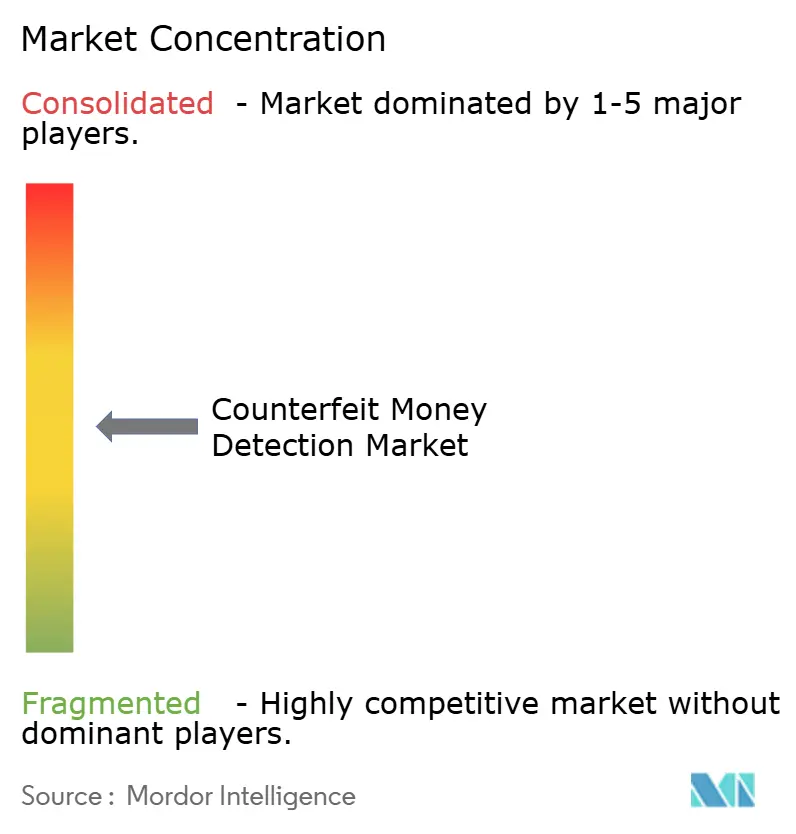
| Market Concentration | Medium |
Major Players *Disclaimer: Major Players sorted in no particular order Image © Mordor Intelligence. Reuse requires attribution under CC BY 4.0. | |
Counterfeit Money Detection Market Analysis by Mordor Intelligence
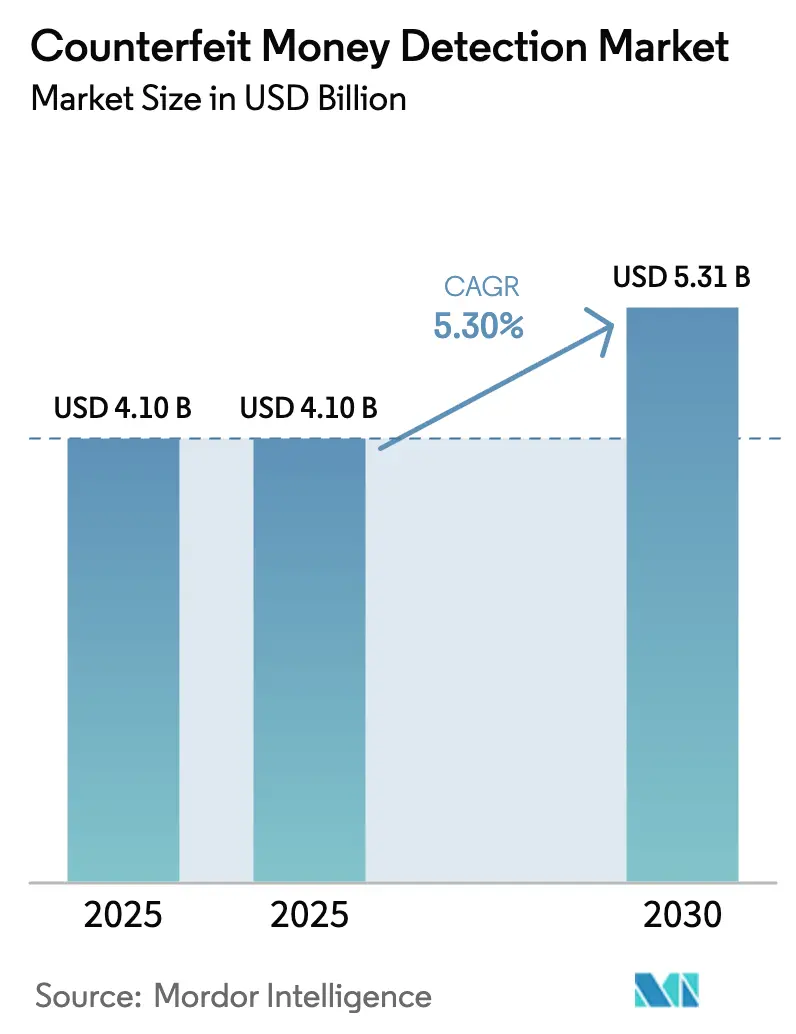
The Counterfeit Money Detection Market size was valued at USD 4.10 billion in 2025 and is estimated to grow from USD 4.10 billion in 2025 to reach USD 5.31 billion by 2030, at a CAGR of 5.30% during the forecast period (2025-2030).
Ongoing advances in high-resolution printing and generative artificial intelligence are elevating the threat profile, prompting financial institutions, retailers, and transit operators to upgrade authentication capabilities. Law-enforcement data indicate that USD 70 million–USD 200 million in forged U.S. notes circulate at any point in time. The appearance of so-called “supernotes” with multilayer forgeries has increased demand for multi-spectral scanners that combine ultraviolet, infrared, magnetic, and machine-vision analytics. North America leads adoption owing to rigorous compliance regimes, while rapid kiosk deployment across emerging Asian economies underpins the fastest regional growth. Hardware remains dominant today, yet cloud-connected software platforms are reshaping long-term technology roadmaps.
Key Report Takeaways
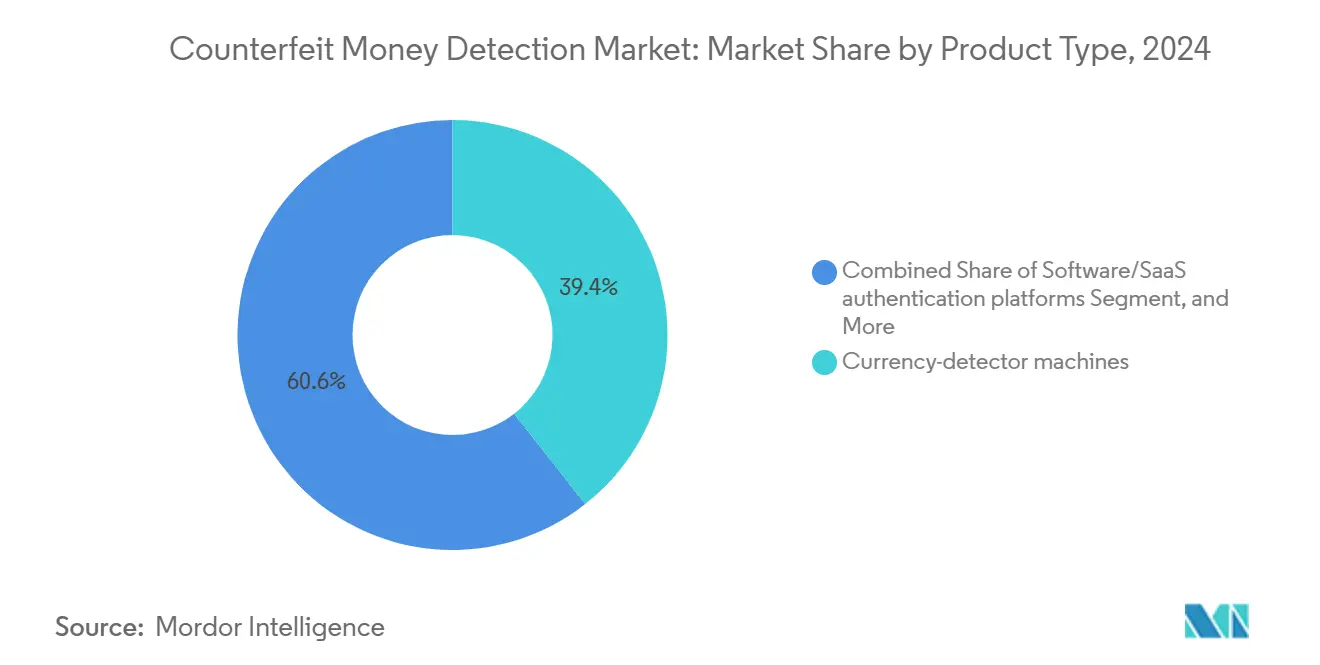
- By product type, currency-detector machines captured 39.4% of the counterfeit money detection market share in 2024, whereas software/SaaS platforms are projected to advance at a 6.5% CAGR to 2030.
- By technology, ultraviolet scanners accounted for a 28.6% share of the counterfeit money detection market size in 2024, while machine-vision and AI solutions are expanding at a 5.6% CAGR through 2030.
- By end-user, banking and financial institutions held 55.1% of the counterfeit money detection market share in 2024; transportation and ticketing kiosks record the highest projected CAGR at 6.0% to 2030.
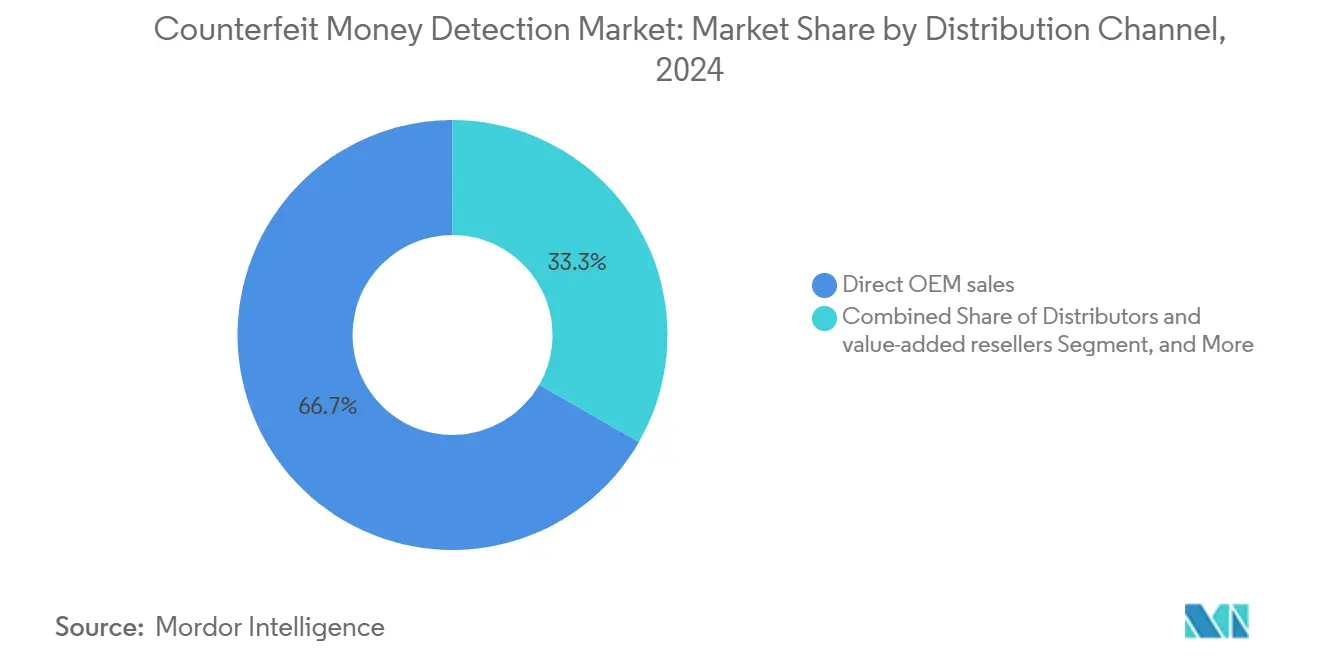
- By distribution channel, direct OEM sales controlled 66.7% of the counterfeit money detection market size in 2024 and online marketplaces are progressing at a 7.2% CAGR.
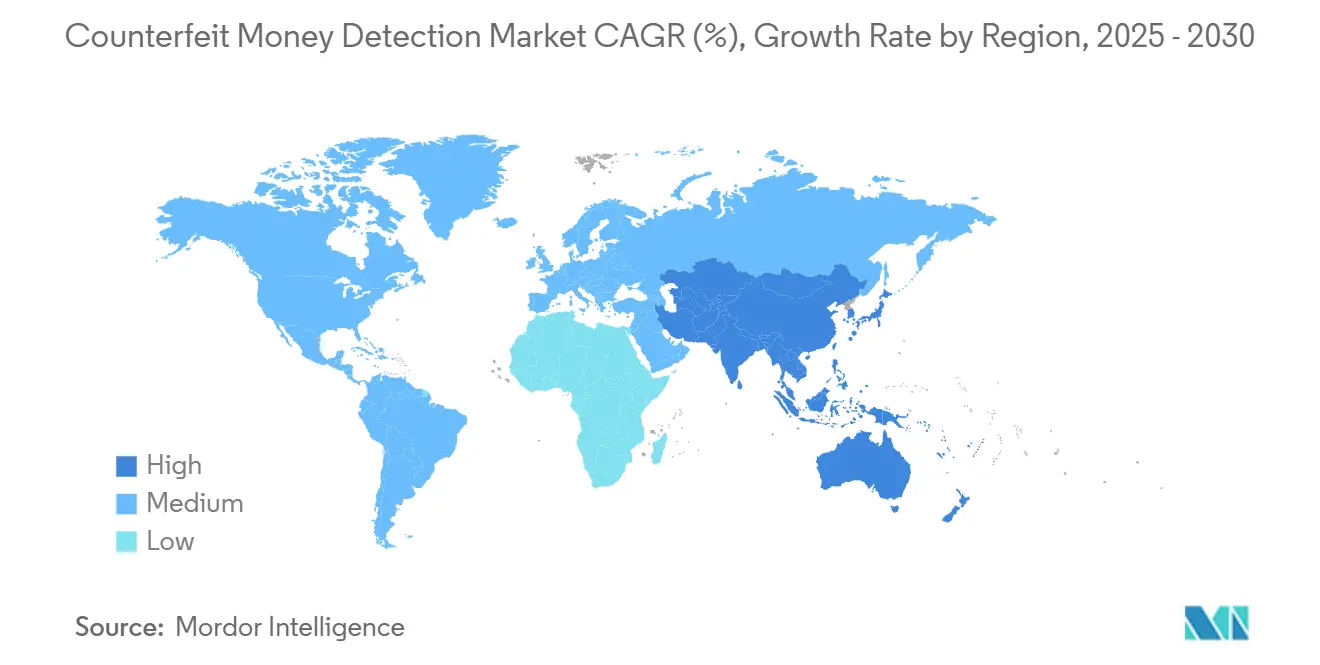
- By geography, North America led with 38.5% revenue share in 2024, while Asia-Pacific is forecast to grow at a 6.9% CAGR through 2030.
Note: Market size and forecast figures in this report are generated using Mordor Intelligence’s proprietary estimation framework, updated with the latest available data and insights as of January 2026.
Market Trends and Insights
Drivers Impact Analysis of Counterfeit Money Detection Market*
| Driver | (~) % Impact on CAGR Forecast | Geographic Relevance | Impact Timeline |
|---|---|---|---|
| Rising incidence and sophistication of counterfeit currency | +1.2% | Global, with higher impact in cash-dependent economies | Medium term (2-4 years) |
| Government mandates for enhanced banknote-security detection devices | +0.9% | North America and EU, expanding to APAC | Short term (≤ 2 years) |
| Expansion of retail and hospitality POS cash-handling operations | +0.8% | APAC core, spill-over to MEA and Latin America | Medium term (2-4 years) |
| Integration of AI and machine-vision into multi-currency detectors | +1.1% | Global, led by developed markets | Long term (≥ 4 years) |
| Surge in automated kiosks, ticketing and vending machines in emerging markets | +0.7% | APAC and MEA, with selective adoption in Latin America | Medium term (2-4 years) |
| Adoption of polymer banknotes requiring new multispectral detection algorithms | +0.6% | Global, with early adoption in developed economies | Long term (≥ 4 years) |
| Source: Mordor Intelligence | |||
Rising Counterfeit Currency Sophistication
Sophisticated crime syndicates exploit AI-driven image processing and commercial inkjet technology to replicate micro-printing, security threads, and optically variable inks with high fidelity. The Federal Reserve recorded a 19% jump in counterfeit incident reports during early 2024, illustrating how advanced forgeries are outpacing legacy UV-only devices.[1]Federal Reserve Board, “Currency and Coin Services FY 2024 Update,” federalreserve.gov Manufacturers now embed convolutional neural networks that scan substrates at multiple wavelengths and flag anomalies within 200 milliseconds, maintaining teller-line throughput. Multi-spectral cameras also reduce false-positive rates, which historically disrupted branch operations. Continuous learning models ingest newly seized specimens supplied by enforcement agencies, lowering update cycles from quarterly firmware releases to real-time cloud pushes. Stakeholders report fewer customer disputes and improved compliance audit scores following such upgrades.
Government Mandates for Higher-Grade Devices
Regulators are codifying minimum authentication thresholds to combat money laundering and terror finance. U.S. Treasury Order 101-17 requires Federal Reserve depository institutions to perform documented counterfeit-risk assessments and deploy equipment that authenticates mixed-denomination notes at sub-second speeds. The European Central Bank enforces performance tests for devices processing euro banknotes in bulk, while the Reserve Bank of India obliges quarterly calibration of note-sorting machines against defined soil, limpness, and tear parameters. These directives compel periodic refresh cycles and increase budgets for calibration services, benefiting vendors with field-service footprints. Institutions failing inspections face financial penalties and reputational risk, accelerating procurement decisions.
Retail and Hospitality POS Automation
Labor shortages and rising cash-drawer shrinkage motivate retailers to integrate bill validators directly into point-of-sale terminals. The 2025 partnership between Crane Payment Innovations and Verifone embeds note acceptance and authentication inside Commander POS, removing manual checks and trimming transaction times by 18%. Hotels and quick-service restaurants adopt compact desktop scanners that verify USD 100 bills in under one second, reducing queue friction. PayComplete customer data show firms deploying automated cash management experience 40% fewer reconciliation discrepancies, freeing staff for revenue-generating tasks. Broader rollouts across convenience stores and gaming venues are expected as devices add support for polymer notes and multi-currency recognition.
AI-Enabled Multi-Currency Detection
Machine-vision advances shift detection from rule-based thresholds to statistical inference. Researchers at Concordia University demonstrated over 90% accuracy in distinguishing genuine from counterfeit Canadian coins using fuzzy association rule mining methodologies. Vendors are scaling similar principles to banknotes by integrating GPU-accelerated inference engines that evaluate pixel-level features across ultraviolet, infrared, and visible bands. Edge-to-cloud architectures allow new models to be trained centrally before secure deployment to branch devices, reducing logistical overhead. Quantum-algorithm research funded by the U.S. Department of Homeland Security suggests multi-spectral image correlation could achieve quadratic speed-ups compared with classical pipelines. Such capability is essential for high-volume fare-collection and casino cages where peak throughput exceeds 1,000 notes per minute.
Restraints Impact Analysis of Counterfeit Money Detection Market*
| Restraint | (~) % Impact on CAGR Forecast | Geographic Relevance | Impact Timeline |
|---|---|---|---|
| Accelerating shift toward cashless payments lowers cash volumes | -1.8% | Global, with higher impact in developed economies | Long term (≥ 4 years) |
| High upfront cost of advanced detection hardware for SMEs | -0.7% | Global, particularly affecting emerging markets | Short term (≤ 2 years) |
| Frequent banknote-redesign cycles create equipment obsolescence risk | -0.5% | Global, with regional variations in redesign frequency | Medium term (2-4 years) |
| Mobile-phone based authenticity apps reduce demand for dedicated devices | -0.6% | Global, with faster adoption in tech-savvy demographics | Medium term (2-4 years) |
| Source: Mordor Intelligence | |||
Accelerating Shift Toward Cashless Payments
Contactless cards, e-wallets, and account-to-account rails continue to win share in developed economies, reducing physical cash velocity. Nordic retailers processed more than 80% of in-store payments electronically in 2024, trimming cash-handling budgets and deferring device refresh projects.[2]European Central Bank, “Card Payments Continue to Gain Ground,” ecb.europa.eu Central bank digital currency pilots in China and Europe test programmable money that inherently eliminates counterfeiting risk. Nevertheless, cash remains the preferred tender for low-value purchases in the United States and many Asian markets, tempering the near-term impact. Vendors hedge exposure by releasing note recyclers that also support digital-payment top-ups, thereby maintaining relevance in blended-payment environments.
High Upfront Cost for SMEs
Advanced multi-spectral detectors range from USD 700 to USD 2,500 per unit, an outlay small retailers deem prohibitive amid thin margins. Pay-as-you-go SaaS platforms lower capex yet still require compatible imaging hardware. Emerging Asian and African merchants often default to manual feel-and-look techniques, increasing the circulation window for counterfeit bills. Manufacturers are responding with subscription bundles that bundle hardware, software, and service into a single monthly fee, mirroring printer-as-a-service offerings. Wider adoption hinges on micro-financing programs and government subsidies targeting fraud reduction in informal economies.
*Our forecasts treat driver/restraint impacts as directional, not additive. The impact forecasts reflect baseline growth, mix effects, and variable interactions.
Counterfeit Money Detection Market Segment Analysis
By Product Type:
Software Platforms Drive InnovationCurrency-detector machines dominated revenue with 39.4% counterfeit money detection market share in 2024, underscoring the enduring need for dedicated throughput in banks and CIT vaults. Hybrid currency counters blend authentication with tally functions, appealing to mid-size supermarkets seeking efficiency gains. The counterfeit money detection market size attributable to software platforms is, however, expanding rapidly as SaaS authentication services post a 6.5% CAGR projection. Continuous algorithm updates via the cloud shorten response cycles when new forgeries emerge, a critical advantage over firmware-linked hardware. Digimarc’s 2024 release of watermark-enabled mobile validation exemplifies how digital overlays can protect physical notes at distribution and retail endpoints.
Software’s rise does not spell the demise of hardware. Instead, vendors position scanners as edge sensors streaming feature vectors to cloud engines that refine risk scores. Portable handheld checkers serve hospitality and ride-sharing drivers who require ad-hoc verification. RFID-embedded bills and blockchain-anchored serial tracking remain nascent but illustrate future convergence paths. As deployments widen, the counterfeit money detection market will likely pivot toward license-based recurring revenue rather than one-time capital sales, bolstering vendor valuations.



By Technology:
AI Transforms Detection CapabilitiesUltraviolet fluorescence maintained a 28.6% counterfeit money detection market share in 2024 due to low cost and entrenched workflows. Yet machine-vision and AI pipelines are forecast to expand at a 5.6% CAGR, capturing spend from institutions anxious about polymer substrates and optically variable inks. Edge cameras ingest frames at multiple wavelengths and use convolutional neural networks to flag anomalies against growing counterfeit libraries. Giesecke+Devrient’s RollingStar Venus security thread, released in September 2024, forces devices to analyze nano-scale mirror arrays that shift color at oblique angles.[3]Giesecke+Devrient, “RollingStar Venus Security Thread,” gi-de.comThis evolution raises the bar for spectrum resolution and processing throughput.
Infrared absorption, magnetic signature, and micro-printing verification remain essential in multi-layer architectures. Vendors package these methods into modular slots so buyers can tailor configurations by regional tender mix. Quantum-accelerated spectral matching remains in the research phase, yet pilot programs suggest significant performance gains for casino cages and central banks. Continuous innovation implies that the counterfeit money detection industry must maintain high R&D intensity to stay ahead of forgers’ toolkits.
By Distribution Channel:
Digital Procurement Gains TractionDirect OEM sales captured 66.7% of 2024 revenue, highlighting the complexity of enterprise-scale integrations with cash recyclers, ATM fleets, and teller networks. Technical consulting, on-site training, and multi-year maintenance contracts favor relationship-driven selling. Nevertheless, the counterfeit money detection market is witnessing a rapid uptake of e-commerce channels, advancing at a 7.2% CAGR as SMEs source plug-and-play devices online. Marketplace ratings and transparent pricing reduce information asymmetry, empowering buyers to benchmark feature sets.
To manage channel conflict, manufacturers segment offerings: flagship multi-spectral models remain direct, while entry-level UV scanners list on digital storefronts. Value-added resellers thrive in emerging markets by bundling installation and local-language support. Retail office-supply outlets continue to serve micro-merchants but face share erosion as next-day delivery becomes ubiquitous. The shift mirrors B2B trends toward self-service research and procurement, forcing incumbents to bolster digital content and real-time inventory visibility.
By End-User Industry:
Transportation Emerges as Growth DriverBanks and credit unions commanded 55.1% counterfeit money detection market size in 2024, anchored by compliance duties and vault throughput exceeding 20,000 notes daily. Central banks deploy high-speed sorters such as Giesecke+Devrient’s BPS C evo, introduced December 2024, which processes 63,000 notes per hour while exporting encrypted fitness data to audit platforms. Retail chains integrate countertop scanners into cash drawers to avoid lane delays. Yet automated fare-collection and ticketing kiosks represent the fastest-growing vertical at a 6.0% CAGR, underpinned by mass-transit expansions across Asian megacities.
Transit authorities value sealed-bill paths, vandal-resistant casings, and multi-currency recognition for tourists. International Currency Technologies supplies validators for vending machines and gaming cabinets, reflecting overlapping requirements for unattended environments. Hospitality groups adopt ultra-compact detectors at front desks to authenticate high-denomination notes without breaking eye-contact with guests, preserving service quality. Government treasuries, universities, and hospitals comprise a steady but smaller segment, purchasing devices for tuition, permit, and copay windows.
Geography Analysis
North America Counterfeit Money Detection Market
North America retained 38.5% revenue leadership in 2024. Compliance with U.S. Treasury directives and the high global circulation of dollars necessitate multiple detection upgrades. The counterfeit money detection market size in the United States is bolstered by central-bank plans to introduce redesigned notes in 2026, triggering presale equipment evaluations. Canada’s polymer series requires detectors to support windowed holograms, while Mexico’s tourist corridors maintain currency exchange kiosks that demand real-time dual-currency authentication.
APAC Counterfeit Money Detection Market
Asia-Pacific is the fastest-growing region at a 6.9% CAGR. Japan rolled out redesigned yen notes in July 2024, prompting banks and retail chains to retrofit scanners. India’s HaRBInger hackathon incentivizes AI-based forensics, and Reserve Bank guidelines mandate quarterly sorter calibration. China aligns high AI patent output with domestic OEMs, embedding deep-learning modules within branch devices. Southeast Asian metro projects incorporate cash-accepting kiosks as inclusive payment options, sustaining detector demand even amid mobile-wallet adoption.
EMEA and LATAM Counterfeit Money Detection Market
Europe shows steady uptake anchored by European Central Bank performance tests and low counterfeit incidence of 18 notes per million genuine in 2024. Polymer conversions in the United Kingdom and Central Eastern Europe create distinct spectral challenges. Middle East and Africa exhibit emerging potential; Libya’s polymer dinar series issued in January 2025 underscores the need for updated equipment. Latin America’s growth centers on Brazil’s retail modernization and tourism flows in Mexico and Peru, although currency volatility tempers broader investment.

Competitive Landscape
The counterfeit money detection market is moderately fragmented. Crane NXT, Glory, and Giesecke+Devrient lead through breadth of product lines and sustained R&D outlays. Crane NXT’s USD 375 million acquisition of De La Rue Authentication Solutions in February 2025 strengthens its holographic and micro-structure portfolio. Glory integrates AI inspection modules into cash recyclers, appealing to branch transformation projects. Giesecke+Devrient surpassed EUR 3 billion revenue in 2023 and reinvested EUR 490 million into R&D, underscoring capital intensity.
Software-centric entrants such as NOOS Technologies deliver mobile SDKs that turn smartphones into bill verifiers, challenging dedicated hardware in low-volume settings. Authentix expanded optical-thin-film capabilities by acquiring Nanotech Security assets in July 2024. Competitive focus has shifted from standalone accuracy metrics to ecosystem integration, analytics dashboards, and lifecycle service agreements. Consolidation is expected to continue as incumbents acquire niche algorithm providers to accelerate AI roadmaps and defend margins against commoditized UV devices.
Counterfeit Money Detection Industry Leaders
Crane NXT, Co. (Crane Payment Innovations)
Cassida Corporation
UVeritech, Inc. (FraudFighter)
Giesecke+Devrient Currency Technology GmbH
Diebold Nixdorf, Incorporated
- *Disclaimer: Major Players sorted in no particular order
Counterfeit Money Detection Market Companies Covered in this Report
- Crane NXT, Co. (Crane Payment Innovations)
- GLORY LTD.
- Cassida Corporation
- Solidus B.V. (Safescan)
- Dri Mark Products, Inc.
- Cummins-Allison Corp.
- UVeritech, Inc. (FraudFighter)
- Shenzhen Ribao Technology Co., Ltd.
- Carnation Enterprises, LLC
- AccuBANKER USA LLC
- Shenzhen Grace Ratecolor Technology Co., Ltd.
- Giesecke+Devrient Currency Technology GmbH
- De La Rue PLC
- Magner International Corporation
- Semacon Business Machines, Inc.
- Julong Co., Ltd.
- Laurel Bank Machines Co., Ltd.
- Kisan Electronics Co., Ltd.
- Digital Check Corp.
- Diebold Nixdorf, Incorporated

Recent Industry Developments in Counterfeit Money Detection Market
- January 2025: The Central Bank of Libya released new polymer 5, 10, and 20 dinar notes featuring SPARK Live foil and hologram windows to counter forgeries.
- December 2024: Giesecke+Devrient launched the BPS C evo sorter with 63,000-note-per-hour throughput and Linux-based security architecture.
- December 2024: The National Bank of Romania issued a 100-leu polymer commemorative note with laser micro-perforations and optically variable ink.
- November 2024: Digimarc introduced a watermark-based anti-counterfeit solution that pairs mobile authentication with AI copy detection for government programs.


Global Counterfeit Money Detection Market Report Scope
Segmentation Overview
| Currency-detector machines |
| Currency counters with counterfeit detection |
| Portable/handheld detectors |
| Software / SaaS authentication platforms |
| Other Product Types |
| Ultraviolet (UV) |
| Infrared (IR) |
| Magnetic (MG) |
| Watermark and micro-printing analysis |
| Machine-vision and AI |
| Multispectral / hyperspectral imaging |
| Other Technologies |
| Direct OEM sales |
| Distributors and value-added resellers |
| Online/e-commerce marketplaces |
| Retail office-supply stores |
| Banking and financial institutions |
| Retail and e-commerce |
| Hospitality and leisure |
| Transportation and ticketing kiosks |
| Government offices and educational institutions |
| Other End-user Industries |
| North America | United States | |
| Canada | ||
| Mexico | ||
| Europe | Germany | |
| United Kingdom | ||
| France | ||
| Italy | ||
| Spain | ||
| Rest of Europe | ||
| Asia-Pacific | China | |
| Japan | ||
| India | ||
| South Korea | ||
| Australia | ||
| Rest of Asia-Pacific | ||
| South America | Brazil | |
| Argentina | ||
| Rest of South America | ||
| Middle East and Africa | Middle East | Saudi Arabia |
| United Arab Emirates | ||
| Rest of Middle East | ||
| Africa | South Africa | |
| Egypt | ||
| Rest of Africa | ||
| By Product Type | Currency-detector machines | ||
| Currency counters with counterfeit detection | |||
| Portable/handheld detectors | |||
| Software / SaaS authentication platforms | |||
| Other Product Types | |||
| By Technology | Ultraviolet (UV) | ||
| Infrared (IR) | |||
| Magnetic (MG) | |||
| Watermark and micro-printing analysis | |||
| Machine-vision and AI | |||
| Multispectral / hyperspectral imaging | |||
| Other Technologies | |||
| By Distribution Channel | Direct OEM sales | ||
| Distributors and value-added resellers | |||
| Online/e-commerce marketplaces | |||
| Retail office-supply stores | |||
| By End-User Industry | Banking and financial institutions | ||
| Retail and e-commerce | |||
| Hospitality and leisure | |||
| Transportation and ticketing kiosks | |||
| Government offices and educational institutions | |||
| Other End-user Industries | |||
| By Geography | North America | United States | |
| Canada | |||
| Mexico | |||
| Europe | Germany | ||
| United Kingdom | |||
| France | |||
| Italy | |||
| Spain | |||
| Rest of Europe | |||
| Asia-Pacific | China | ||
| Japan | |||
| India | |||
| South Korea | |||
| Australia | |||
| Rest of Asia-Pacific | |||
| South America | Brazil | ||
| Argentina | |||
| Rest of South America | |||
| Middle East and Africa | Middle East | Saudi Arabia | |
| United Arab Emirates | |||
| Rest of Middle East | |||
| Africa | South Africa | ||
| Egypt | |||
| Rest of Africa | |||


Key Questions Answered in the Report
What is the projected value of the counterfeit money detection market by 2030?
Forecasts place the counterfeit money detection market at USD 5.31 billion in 2030, reflecting a 5.30% CAGR between 2025 and 2030.
Which product type leads revenue today?
Currency-detector machines hold a 39.4% share thanks to entrenched use in banks and large retailers.
Which technology is growing fastest?
Machine-vision and AI-driven systems are advancing at a 5.6% CAGR as users seek adaptive multi-spectral analysis.
Which region will see the quickest expansion?
Asia-Pacific is expected to grow at a 6.9% CAGR, driven by transit automation and banknote redesigns.
How are government mandates influencing demand?
U.S. Treasury, European Central Bank, and Reserve Bank of India directives enforce higher detection standards, creating mandatory upgrade cycles.
What role do online channels play in equipment sales?
Online marketplaces are the fastest-growing distribution channel, expanding at a 7.2% CAGR as SMEs favor digital procurement.
Page last updated on:





