
Cyber Deception Market Size and Share
Market Overview
| Study Period | 2020 - 2031 |
|---|---|
| Market Size (2026) | USD 2.24 Billion |
| Market Size (2031) | USD 4.12 Billion |
| Growth Rate (2026 - 2031) | 13.01 % |
| Fastest Growing Market | Asia-Pacific |
| Largest Market | North America |
| Market Concentration | Medium |
Major Players *Disclaimer: Major Players sorted in no particular order Image © Mordor Intelligence. Reuse requires attribution under CC BY 4.0. | |
Cyber Deception Market Analysis by Mordor Intelligence
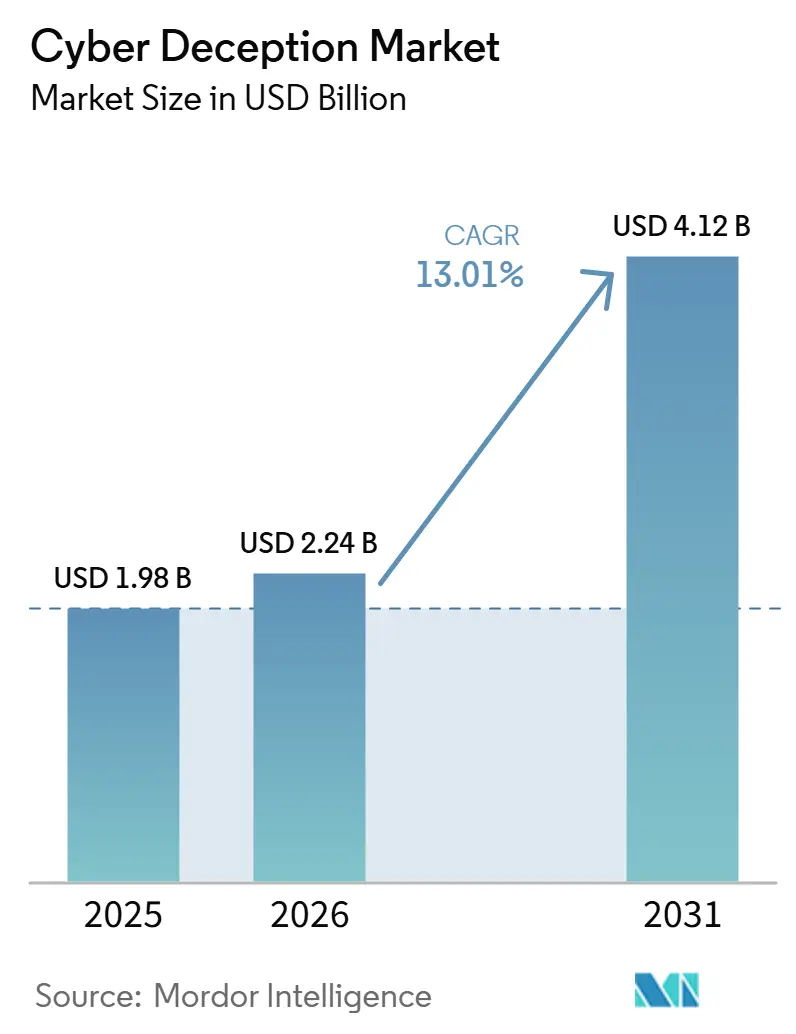
The cyber deception market size was valued at USD 1.98 billion in 2025 and estimated to grow from USD 2.24 billion in 2026 to reach USD 4.12 billion by 2031, at a CAGR of 13.01% during the forecast period (2026-2031). Growing attacker sophistication, the pivot toward zero-trust architectures, and the embedding of honeypots inside extended detection and response (XDR) platforms drive that expansion.[1]Tomer Weingarten, “SentinelOne Completes Acquisition of Attivo Networks,” SentinelOne.com Citation
Vendors are integrating identity-aware decoys, container-based traps, and fake data artifacts directly into cloud-native security stacks, turning deception into a mainstream control rather than a specialized add-on. For instance, large financial groups now pair deceptive credentials with transaction scoring engines so that anomalous payments trigger both account throttling and attacker telemetry capture. Parallel cost pressures continue to steer mid-sized enterprises toward managed deception services that wrap 24/7 monitoring, threat hunting, and tuning in a single subscription. As a result, competitive momentum favors providers that can demonstrate low-touch deployment, API-level orchestration, and measurable threat intelligence value per dollar invested.
Key Report Takeaways
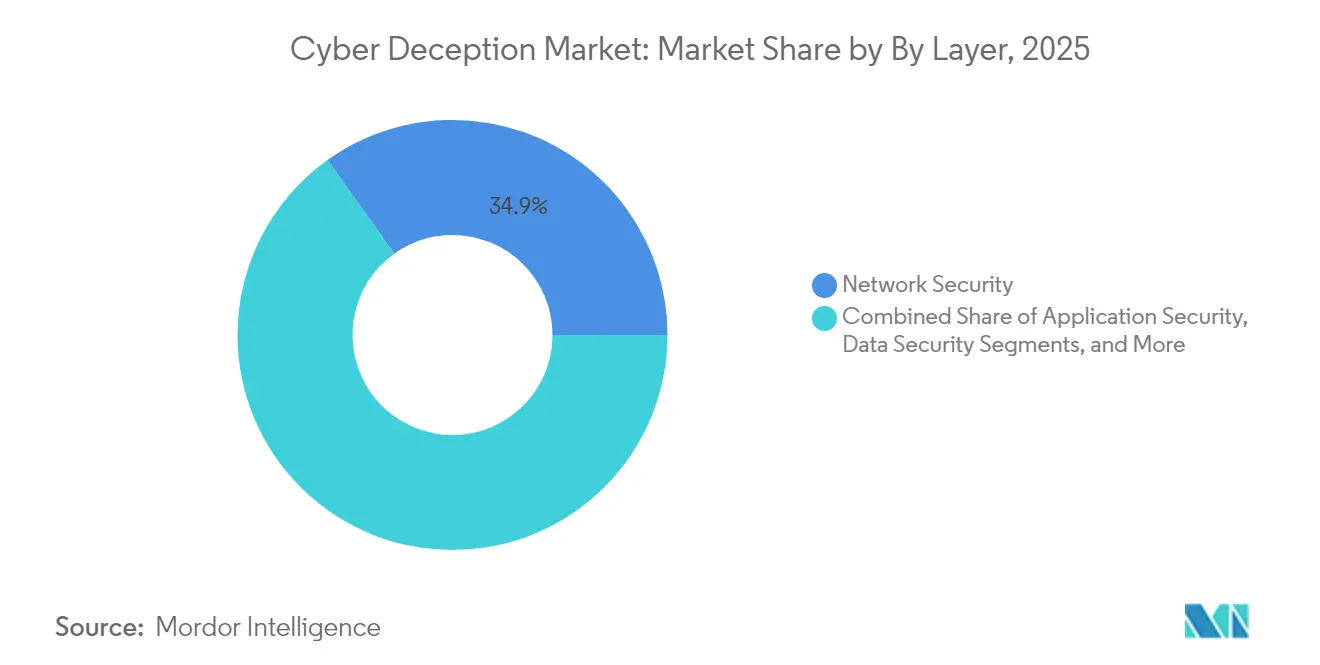
- By layer, network security led with a 34.88% revenue share of the cyber deception market size in 2025, whereas endpoint security is advancing at a 17.63% CAGR through 2031.
- By service type, managed services captured 38.74% of the cyber deception market share in 2025, and the same segment posts the highest forecast growth at 17.72% through 2031.
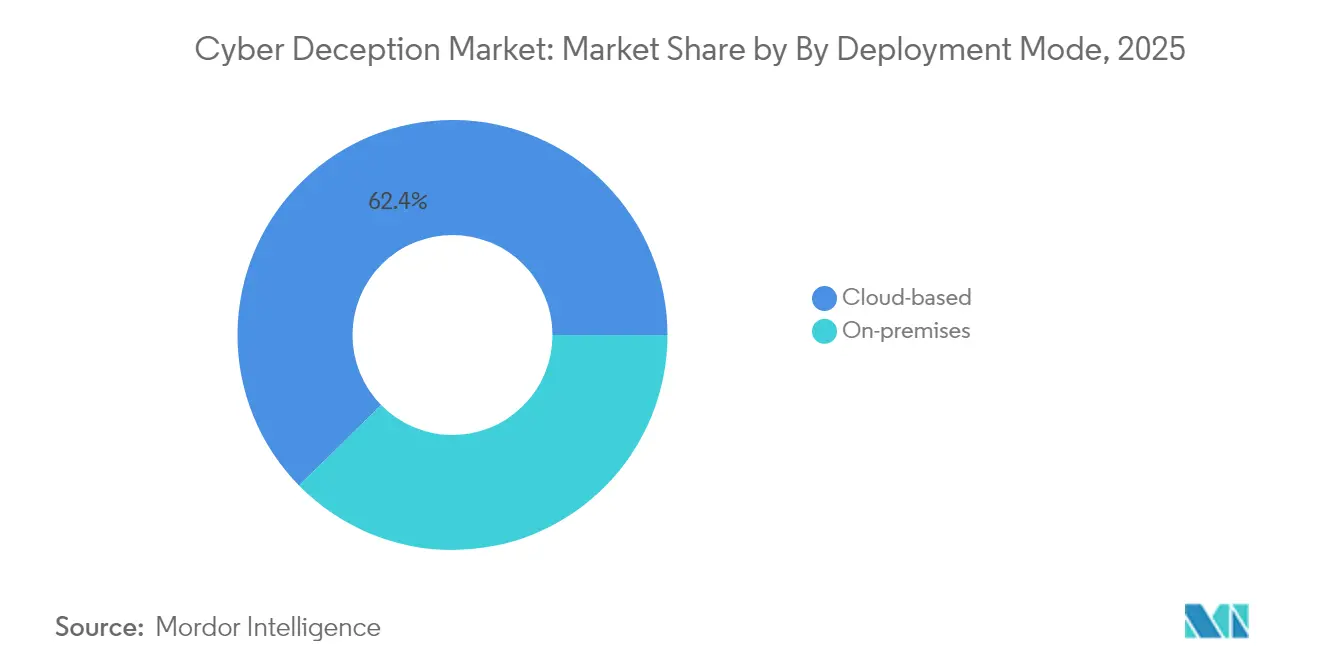
- By deployment mode, cloud-based solutions held 62.35% of the cyber deception market size in 2025 and are projected to expand at an 18.02% CAGR to 2031.
- By end-user industry, financial services commanded a 26.62% share of the cyber deception market size in 2025; government and defense are forecast to accelerate at a 19.78% CAGR through 2031.
Note: Market size and forecast figures in this report are generated using Mordor Intelligence’s proprietary estimation framework, updated with the latest available data and insights as of 2026.
Market Trends and Insights
Drivers Impact Analysis of Cyber Deception Market*
| Driver | (~) % Impact on CAGR Forecast | Geographic Relevance | Impact Timeline |
|---|---|---|---|
| Escalating sophistication and volume of cyber-attacks | +3.2% | Global | Short term (≤ 2 years) |
| Rapid cloud migration and API-first architectures | +2.8% | North America and Europe, Asia Pacific core | Medium term (2-4 years) |
| Mandates for zero-trust and breach-assumed postures | +2.5% | North America and Europe | Medium term (2-4 years) |
| Shortage of skilled cyber workforce boosting automation demand | +2.1% | Global | Long term (≥ 4 years) |
| Convergence with Identity Threat Detection and Response (ITDR) | +1.8% | North America and Europe | Medium term (2-4 years) |
| Shift of deception tooling into XDR/SSE platforms | +1.6% | Global | Long term (≥ 4 years) |
| Source: Mordor Intelligence | |||
Escalating Sophistication and Volume of Cyber-Attacks
Advanced persistent threats now leverage living-off-the-land tactics, supply-chain infiltration, and AI-generated phishing lures that bypass signature engines. Deception fills detection gaps by luring adversaries into high-fidelity decoys that log every command and payload. The U.K. National Cyber Security Centre’s 5,000-node deception program, launched in 2024, illustrates how national agencies harvest attacker tradecraft to refine defense playbooks.[2]NATIONAL CYBER SECURITY CENTRE, “Nation-Scale Cyber Deception Evidence Base,” ncsc.gov.uk Enterprises mirror that approach: a U.S. healthcare network, for example, seeded honey tokens across its electronic records cluster and cut ransomware dwell time from days to under two hours after the first decoy trigger.
Rapid Cloud Migration and API-First Architectures
Serverless functions, microservices, and multicloud data paths multiply attack surfaces beyond the reach of perimeter firewalls. Containerized deception appliances now deploy via Terraform scripts and autoscale with Kubernetes clusters, letting security teams cloak every new workload in minutes. Research published in Scientific Reports demonstrated that a single-tenant cloud honeypot caught 67% of credential-stuffing attempts missed by WAF rules while adding under 1% latency to API calls. Organizations adopting Infrastructure-as-Code rally around such evidence because decoys move at the same velocity as DevOps pipelines.
Mandates for Zero-Trust and Breach-Assumed Postures
Policy is a force multiplier. The U.S. Department of Defense now stipulates deception layers as one of nine zero-trust pillars required across all agencies by 2027. Parallel updates to the NIST Cybersecurity Framework position deception as a control for “continuous validation” activities, pushing federal contractors to embed traps alongside identity, endpoint, and network controls.[3]NATIONAL INSTITUTE OF STANDARDS AND TECHNOLOGY, “NIST Cybersecurity Framework Revision,” nist.gov Commercial banks in Europe echo that alignment; one pan-European lender added synthetic SWIFT messages to detect fraudulent transfers and met new PSD2 monitoring clauses without re-architecting its core banking host.
Shortage of Skilled Cyber Workforce Boosting Automation Demand
The global shortfall of roughly 4 million practitioners drives buyers to tools that “self-drive.” Modern platforms auto-generate decoys tied to Active Directory attributes, update kernel lures in real time, and surface distilled attacker paths rather than raw alerts. A U.S. Army Research Office grant to Penn State University funds automated honeypot farms capable of adapting to contested radio links with no operator input, proving that autonomous deception is technically viable.[4]PENN STATE UNIVERSITY, “Army Research Office Grant Funds Autonomous Deception Research,” psu.edu Managed service providers seize that model to deliver deception at scale to resource-constrained mid-market clients.
Restraints Impact Analysis of Cyber Deception Market*
| Restraint | (~) % Impact on CAGR Forecast | Geographic Relevance | Impact Timeline |
|---|---|---|---|
| High integration and tuning costs for brown-field networks | -1.8% | Global, particularly legacy-heavy industries | Short term (≤ 2 years) |
| Limited cybersecurity budgets among SMBs | -1.5% | Global, concentrated in emerging markets | Medium term (2-4 years) |
| Proliferation of open-source decoy frameworks lowering perceived value | -1.2% | Global | Long term (≥ 4 years) |
| Adversarial-AI capable of fingerprinting decoy | -0.9% | Advanced economies with AI capabilities | Long term (≥ 4 years) |
| Source: Mordor Intelligence | |||
High Integration and Tuning Costs for Brown-Field Networks
Organizations running flat, legacy networks lack segmentation points for realistic decoy placement. Retrofitting virtual LANs, span ports, and identity services drives up project costs and extends timelines beyond 12 months in industries such as energy or manufacturing. One European petro-chemical firm reported that prerequisite network upgrades doubled its initial deception budget before the first trap was online, proving that tooling alone cannot solve architectural rot.
Limited Cybersecurity Budgets Among SMBs
While ransomware groups target small suppliers to leapfrog into enterprise ecosystems, most SMBs still prioritize antivirus renewals over deception investments. Open-source projects such as Modern Honey Network and T-Pot offer basic trap functionality, but many owners lack the expertise to interpret alerts, eroding perceived ROI. For example, a Latin-American logistics broker deployed Cowrie SSH decoys yet disabled them within weeks after alert fatigue overwhelmed its two-person IT staff.
*Our forecasts treat driver/restraint impacts as directional, not additive. The impact forecasts reflect baseline growth, mix effects, and variable interactions.
Cyber Deception Market Segment Analysis
By Layer:
Network Security Dominates Despite Endpoint AccelerationNetwork deception products accounted for a 34.88% share of the cyber deception market in 2025, reflecting their historical role as perimeter tripwires. Endpoint deception, however, is scaling at a 17.63% CAGR as every remote laptop and IIoT gateway becomes a pivot point. That growth reshapes the cyber deception market because device-centric lures close visibility gaps that network taps cannot monitor behind encrypted tunnels.
In practice, vendors push lightweight agents that spin up bogus registry hives, fake browser cookies, and decoy USB drives whenever a threat actor lands on an endpoint. For instance, a Southeast-Asian telecom placed false 5G management scripts on engineering laptops; attackers triggered the lure within hours, enabling security teams to isolate compromised accounts before any core switch was touched. Application security deception also gathers momentum—the rise of API honeypots that mimic GraphQL endpoints lets SaaS providers detect credential abuse in real time. Data-centric deception, meanwhile, embeds honey-tokens inside structured query language tables and object storage buckets; one retailer used that tactic to discover rogue warehouse APIs siphoning customer PII within minutes. Altogether, the layered approach moves the cyber deception market toward unified consoles that orchestrate decoys across packets, processes, and data artifacts.



By Service Type:
Managed Services Lead Growth and ShareManaged deception services held 38.74% of the cyber deception market share in 2025 and carry an 17.72% CAGR, evidence that many enterprises would rather outsource trickery than recruit scarce deception engineers. Providers run centralized “Decoy Operations Centers” that manage thousands of traps, share new indicators across tenants, and supply post-incident forensics. That model aligns with board mandates to reduce mean-time-to-detect without ballooning headcount.
Professional services still matter because successful deception demands network baselining, crown-jewel mapping, and cultural buy-in. Consultants now embed field exercises, phishing simulations, and purple-team labs into deployment phases so that internal responders learn how to act on decoy telemetry. For example, a Fortune 100 manufacturer hired a boutique integrator to knit deception alerts directly into its SAP GRC console, proving value to auditors within a single quarter. This blended approach underlines why the cyber deception industry monetizes both recurring managed fees and high-margin consulting.
By Deployment Mode:
Cloud-Based Solutions Accelerate Market TransformationCloud-hosted products captured 62.35% of the cyber deception market in 2025 and are on course for an 18.02% CAGR. Elastic scalability, pay-per-decoy billing, and API-level provisioning lower barriers for DevSecOps teams. A global media streamer, for instance, uses Terraform modules to spin up regional honeypots side-by-side with customer data clusters, obtaining attacker telemetry in under 20 minutes per region.
On-premises appliances persist in air-gapped military and critical-infrastructure zones, but even those owners adopt cloud dashboards for analytics. Hybrid models, therefore, blend local decoys with SaaS-based control planes that crunch billions of log entries daily. As cloud-native adoption widens, attack surface coverage grows faster than staff capacity, reinforcing managed service demand and, in turn, lifting the entire cyber deception market.
By End-User Industry:
Financial Services Lead While Government AcceleratesBanks, insurers, and payment processors retained the largest 26.62% slice of the cyber deception market in 2025. They rely on decoy SWIFT connectors, fake employee portals, and synthetic payment files to spot lateral movement and account takeover. Case in point: a multinational bank embedded honey-tokens in dormant trading accounts; threat actors triggered those tokens during an insider scheme, allowing compliance teams to freeze assets within hours.
Government and defense organizations are the fastest climbers, growing at 19.78% CAGR because zero-trust mandates attach budget to deception rollouts. Initiatives like the U.S. DoD’s phased migration plan funnel procurement toward platforms that report readiness metrics directly into program management dashboards. Healthcare operators adopt deception to protect connected imaging devices, while retail chains deploy it to flag fraudulent gift-card APIs. Energy utilities use SCADA decoys that mirror Modbus traffic, revealing state-sponsored reconnaissance well before a breaker-trip attempt. Collectively, these case studies keep the cyber deception market responsive to sector-specific pain points.
Geography Analysis
North America Cyber Deception Market
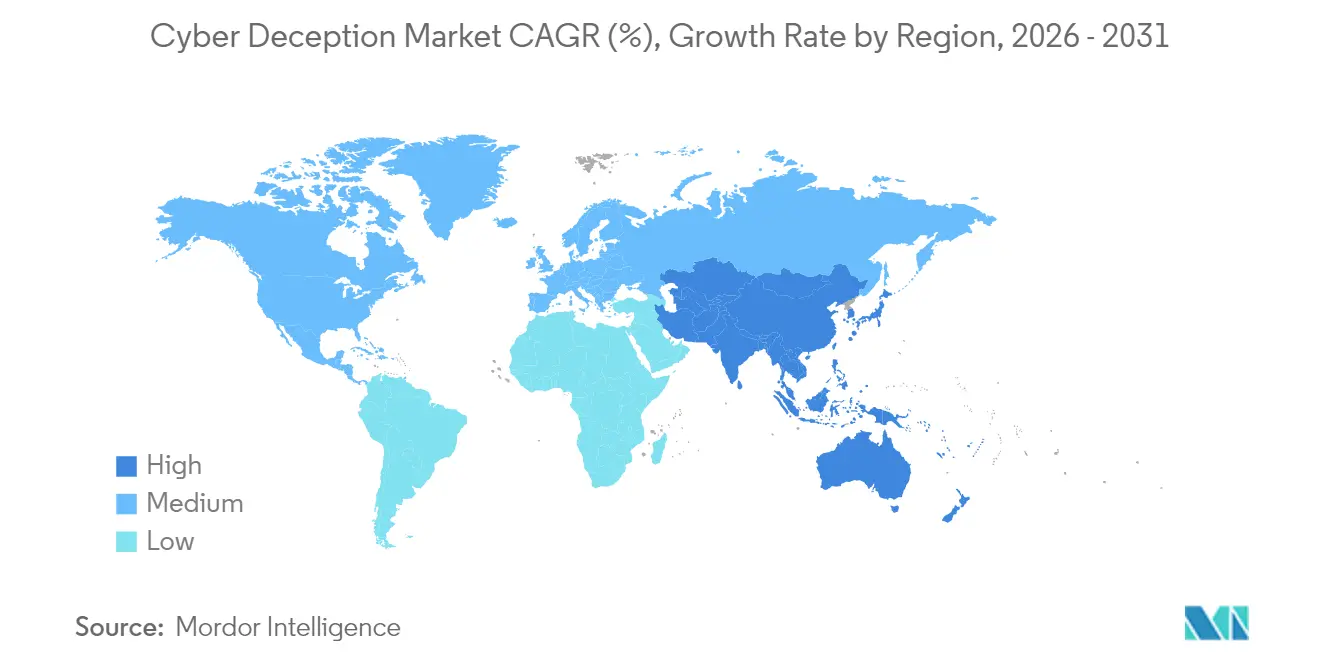
North America controlled 43.10% of the cyber deception market in 2025, anchored by mature budgets, R&D clusters in Silicon Valley and Tel Aviv, and regulatory catalysts such as executive orders on zero-trust migration. U.S. technology consolidators continue to absorb niche vendors; SentinelOne’s USD 616.5 million purchase of Attivo Networks merged deception with autonomous endpoint protection in a single agent. Canadian telcos likewise deploy deception inside 5G cores to meet CRTC supply-chain directives.
APAC Cyber Deception Market
Asia-Pacific is the fastest riser at 22.05% CAGR. Nations such as Singapore, Australia, and Japan issue sectoral cyber frameworks that explicitly call for threat-hunting controls, spawning budgets for deception pilots. For example, an Australian energy grid deployed containerized ICS decoys to comply with the Security of Critical Infrastructure Act amendments, catching credential-harvesting bots within weeks. Chinese cloud hyperscalers bundle deception APIs so that domestic SaaS developers can add “honeypot as code” to CI/CD pipelines. Meanwhile, Indian fintech start-ups lure carding gangs with fake Unified Payments Interface endpoints, feeding intelligence to local CERT teams.
EMEA and South America Cyber Deception Market
Europe maintains steady mid-teens growth. The EU Cyber Resilience Act pushes continuous monitoring, and Germany’s BSI agency cites deception as a recommended control. Strict data-residency rules mean several vendors now offer sovereign-cloud nodes in Frankfurt, Paris, and Madrid. In the Middle East and Africa, smart-city build-outs in Riyadh and Dubai allocate funding for OT decoys inside district cooling plants. South American growth is modest yet rising; Brazil’s PIX instant-payment rails drive banks to plant decoy APIs that emulate transaction gateways, intercepting credential sprays directed at small merchants.

Regulatory Landscape
Cyber deception is increasingly embedded in mainstream cybersecurity control catalogs and federal cyber policy, rather than treated as a niche technique. In the United States, NIST Special Publication 800-53 Rev. 5 includes explicit deception-related controls such as SC-26 (Decoys) and SC-30 (Concealment and Misdirection), which are commonly flowed down into government and regulated-industry security requirements through procurement and audit programs.
Policy signals in 2026 reinforced deception-aligned capabilities within national security and federal acquisition. In March 2026, the White House released the Cyber Strategy for America, which emphasizes modern, AI-enabled cyber capabilities that can detect, divert, and deceive threat actors. In June 2026, NSPM-12 established cybersecurity governance for National Security Systems, further tightening requirements alignment for sensitive environments, and a June 2026 Federal Register notice directed FAR Council action to update contractor clauses around vulnerability disclosure programs on a defined timeline, increasing compliance pressure on suppliers to operationalize controls mapped to NIST guidance.
Value Chain Analysis
The cyber deception value chain begins with core technology and content creation, including decoy templates (services, credentials, documents, and data artifacts), telemetry capture, and orchestration engines that integrate with enterprise identity, endpoint, network, and cloud stacks. Vendors then package these as platforms or modules (cloud-based, on-premises, or hybrid), while system integrators and managed security service providers operationalize deployments through environment baselining, crown-jewel mapping, decoy placement, and continuous tuning within SOC workflows (SIEM, SOAR, and threat hunting processes).
Downstream, end users (notably government, defense, BFSI, telecom, and critical infrastructure) consume deception outputs as high-fidelity alerts and attacker behavior telemetry, feeding incident response and intelligence cycles. Evidence-building and shared operational learning also shape the chain: the UK National Cyber Security Centre ran Active Cyber Defence 2.0 cyber deception trials across 121 organizations with 14 commercial providers and published findings in December 2025, helping reduce buyer uncertainty about efficacy and deployment patterns. Parallel standardization work such as the DAD-CDM initiative to extend STIX for hybrid deception scenarios addresses an interoperability gap that otherwise keeps integrations proprietary and raises switching costs.
Competitive Landscape
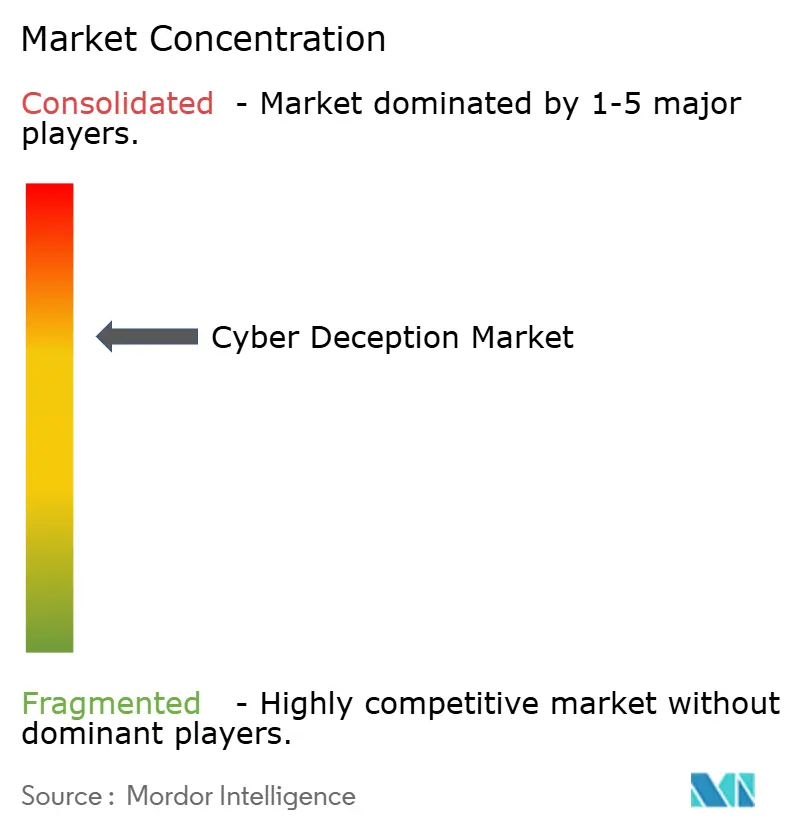
The cyber deception market remains moderately fragmented but is tilting toward platform suites. Beyond SentinelOne’s Attivo deal, Proofpoint picked up Illusive Networks to dock decoys inside email threat-intelligence loops, while Commvault absorbed TrapX Security to fuse ransomware detection with data-backup orchestration. CrowdStrike and Fortinet stitched together Falcon and FortiDeceptor telemetry, showcasing how cross-vendor alliances matter when customers already run heterogeneous security stacks.
Competitive moats now revolve around AI-driven decoy generation, low-code orchestration, and integration mileage across SIEM, SOAR, and identity tools. Vendors focusing on vertical add-ons, SCADA lures for manufacturing, 5G protocol decoys for telecom, gain traction because generic Windows traps no longer suffice. Adversarial-AI research challenges vendors to deliver adaptive deception that randomizes fingerprints each time an attacker probes. Given that the top five suppliers collectively control under 50% of revenue, room remains for specialists like CounterCraft to carve public-sector niches.
Cyber Deception Industry Leaders
SentinelOne Inc.
Akamai Technologies Inc.
CrowdStrike Holdings Inc.
Trend Micro Incorporated
Cisco Systems Inc.
- *Disclaimer: Major Players sorted in no particular order
Cyber Deception Market Companies Covered in this Report
- SentinelOne Inc.
- Illusive Networks Ltd.
- Acalvio Technologies Inc.
- Akamai Technologies Inc.
- Rapid7 Inc.
- CrowdStrike Holdings Inc.
- TrapX Security Inc.
- Fidelis Cybersecurity LLC
- Trend Micro Incorporated
- Cisco Systems Inc.
- Fortinet Inc.
- Countercraft
- Morphisec Ltd.
- Zscaler Inc.
- LogRhythm Inc.
- Smokescreen Technologies Pvt Ltd.
- Cymmetria Ltd.
- Illumio Inc.
- ExtraHop Networks Inc.
- Darktrace plc
- Thales Group (Data Threat Deception)
- Palo Alto Networks Inc.
- Guardicore Ltd. (Akamai)
- Kaspersky Lab AO
- Allure Security Technology Inc.
- Minerva Labs Ltd.

Market Opportunities and Future Outlook
A key whitespace is shifting deception from point deployments into repeatable, programmatic controls aligned to zero-trust, SOC automation, and measurable operational outcomes. Federal roadmaps provide visible pull-through: CISA's Strategic Technology Roadmap (2022-2026) calls out Existing and Advanced Deception Technologies for adoption across state, local, tribal, and territorial stakeholders and critical infrastructure, and the NITRD FY2025 Cybersecurity Implementation Roadmap lists adaptive and dynamic deception as active federal R&D themes. These programs support procurement pathways for platforms that can demonstrate low-false-positive sensing, automated decoy generation, and integration into incident workflows, rather than standalone honeypots.
Another opportunity involves standardizing how deception telemetry is expressed, shared, and operationalized across heterogeneous security stacks. MITRE ATT&CK mapping is increasingly used to design deception coverage, with published work indicating that a meaningful subset of techniques can be addressed with defender-controlled decoys. This creates a practical framework for vendors and MSSPs to sell outcome-based deployments tied to ATT&CK technique coverage and detection engineering. On the supply side, market activity points to productization around AI-era attack automation countermeasures, exemplified by Acalvio's March 2026 launch of 360 Deception emphasizing dynamic deception and asset cloaking, alongside vendor efforts to unify deception across endpoint, cloud, and OT use cases to match converged enterprise attack surfaces.
Recent Industry Developments in Cyber Deception Market
- June 2026: Fidelis Security released unified active deception capabilities spanning on-premises, endpoints, cloud, and OT environments. The release centers deception as a cross-domain sensor rather than a network-only control, supporting buyers standardizing detections across hybrid estates. It also raises competitive pressure on suite vendors to deliver consistent policy, telemetry, and response workflows across IT and OT.
- March 2026: Acalvio launched 360 Deception, adding dynamic deception, HoneyPaths, and asset cloaking positioned against AI-driven attack automation. The launch highlights a shift toward deception that adapts to reconnaissance and lateral-movement patterns rather than relying on static decoys. It also supports the argument that deception fits as an integrated layer inside broader zero-trust and automated operations programs.
- December 2025: The UK National Cyber Security Centre published findings from its Active Cyber Defence 2.0 cyber deception trials involving 121 organizations and 14 commercial providers. The program built a national evidence base on how deception can produce early warning and actionable attacker telemetry. Public-sector validation at this scale supports wider procurement confidence and encourages more standardized deployment playbooks across regulated sectors.


Cyber Deception Market Report Scope and Research Methodology
Market Definition and Coverage
Cyber deception is defined here as the revenue generated from software and related services that deploy decoys, lures, and traps across enterprise IT environments to detect intrusions earlier, study attacker behavior, and slow lateral movement.
Scope exclusions: This sizing excludes general threat intelligence feeds, standalone SIEM tooling, and endpoint protection revenues when deception is not a paid, identifiable module or service.
Segments Covered in This Report
- By Layer
- Application Security
- Network Security
- Data Security
- Endpoint Security
- By Service Type
- Professional Services
- Managed Services
- By Deployment Mode
- On-premises
- Cloud-based
- By End-user Industry
- BFSI
- IT and Telecommunications
- Healthcare and Life Sciences
- Retail and e-Commerce
- Energy and Utilities
- Government and Defense
- Other Industries
- By Geography
- North America
- United States
- Canada
- Mexico
- South America
- Brazil
- Argentina
- Rest of South America
- Europe
- Germany
- United Kingdom
- France
- Russia
- Rest of Europe
- Asia-Pacific
- China
- Japan
- India
- South Korea
- Australia
- Rest of Asia-Pacific
- Middle East and Africa
- Middle East
- Saudi Arabia
- United Arab Emirates
- Rest of Middle East
- Africa
- South Africa
- Egypt
- Rest of Africa
- Middle East
- North America
Data Sources, Market Sizing, and Validation
Desk Research
Desk work started with public, checkable baselines that explain how big the security spending pool is and how it is shifting toward proactive detection. We leaned on sources such as NIST and CISA guidance, MITRE ATT&CK references for common adversary behaviors, and OECD or World Bank digital economy indicators to ground the demand backdrop.
To make the model usable, we also reviewed public company filings, earnings transcripts, product documentation, and reputable press coverage to understand packaging signals and typical contract structures. Where needed, our analysts used paid subscriptions for company financials and intelligence, news and financials, and patent databases to corroborate timelines and positioning. These desk sources are illustrative only, and many additional public references were used for cross-checks and clarification during the work.
Primary Interviews and Surveys
Primary work focused on practical confirmation on what teams actually buy and renew, and how deception is priced as part of broader security programs. We spoke with a mix of security leaders, architects, and operational managers across major regions, and we used their input to close gaps on attach rates, common deployment patterns, and how budgets move when threat levels change.
Distribution of primary research fieldwork respondents
| Company type | Respondent position | Region |
|---|---|---|
| Top tier: 27% | CXOs: 13% | APAC: 43% |
| Mid tier: 57% | Functional/Unit leaders: 27% | EMEA: 33% |
| Smaller Players: 16% | Managers: 60% | Americas: 24% |
Market-Sizing & Forecasting
The core model uses a top-down approach where security software and services spend is reconstructed into an addressable pool, and then narrowed using penetration assumptions for deception deployments across relevant enterprise environments. To keep the totals realistic, we also sanity-check results using selective bottom-up approximations, such as sampled price points multiplied by estimated deployed nodes, plus channel checks on typical deal sizes.
Inputs that matter in this market include enterprise adoption of zero-trust and XDR programs, attack intensity trends (especially ransomware and lateral movement), cloud versus on-prem footprint mix, average contract duration and renewal behavior, and pricing movement for platform subscriptions and managed services. When data is uneven by region, we handle gaps through conservative proxying using similar security control adoption rates, and then recheck with interview feedback.
For forecasting, we used scenario analysis supported by a simple multivariate regression view on key demand drivers, and then we adjusted the path using expert consensus on budget cycles and procurement timing. The final curve reflects how pricing and deployment coverage typically expand after initial pilots, rather than assuming immediate full-scale rollouts.
Data Validation & Update Cycle
Validation is done through several passes so that outliers are caught early and assumptions stay explainable. We compare model outputs against independent signals like public security spending trends, procurement patterns, and adoption indicators from standards bodies, and then we rework any large variances that cannot be defended.
Before sign-off, another analyst reviews the logic, the math, and the reasonableness of the inputs, and we re-contact sources when a key assumption shifts or a new data point conflicts with earlier guidance. The report is refreshed annually, and interim updates are made when material events occur that can move pricing, demand, or product scope. Right before delivery, a final pass is completed so clients receive the latest updated view.
Mordor Intelligence's Cyber Deception Market Size Versus Other Published Estimates
Published market sizes for cyber deception can vary widely, even when the topic sounds identical, because the boundaries around what is counted are often not aligned. Differences usually come from how vendors bundle deception into larger security suites, how services are treated, and whether the number is anchored to an actual pricing year or an assumed price curve.
A refresh-led gap shows up when currency timing and subscription pricing are not updated at the same pace as deployment growth, which can push a single year up or down by a noticeable margin. By refreshing average selling price assumptions closer to the stated year and re-validating attach rates through follow-up checks, Mordor Intelligence reduces drift that can happen when older price points are carried forward into newer demand estimates.
Benchmark comparison
| Source | Market Size | Gaps in Research Methodology |
|---|---|---|
| Mordor Intelligence | USD 2.24 B (2026) | |
| Industry Association A | USD 2.65 B (2024) | Uses an earlier base year and a longer horizon, which can blend pilot-stage deployments with scaled rollouts and apply broader pricing growth without rechecking renewal and bundle effects each year. |
| Global Consultancy B | USD 2.18 B (2024) | Sizes the adjacent deception technology space, which can include a different mix of components and deployment definitions, and it may apply a separate base-year pricing structure that does not map cleanly to cyber deception buying. |
The spread across the three figures is mainly explained by year alignment and how tightly deception is separated from neighboring security categories. When scope is kept consistent and pricing and penetration inputs are updated in step with the stated currency year, the resulting value is easier to trace back to clear variables and repeatable checks.


Key Questions Answered in the Report
How big is the cyber deception market in 2026?
The cyber deception market size is USD 2.24 billion in 2026 and is forecast to grow at a 13.01% CAGR to USD 4.12 billion by 2031.
Which segment grows fastest within cyber deception?
Endpoint deception is advancing at a 17.63% CAGR as remote work and IoT proliferation make every device a potential decoy platform.
Why are managed services popular for cyber deception deployments?
Managed offerings supply 24/7 monitoring, expert tuning, and shared threat intelligence, allowing firms to adopt deception without expanding internal headcount.
What drives adoption of deception in government and defense?
Zero-trust mandates and nation-state threat escalation push agencies to deploy decoys that validate user and device behavior continuously.
How does cloud migration influence cyber deception strategies?
Cloud-native workloads need decoys that autoscale and integrate through APIs, making SaaS deception platforms the preferred deployment mode.
Page last updated on:





