
Connected Rail Market Size and Share
Market Overview
| Study Period | 2019 - 2031 |
|---|---|
| Market Size (2026) | USD 102.47 Billion |
| Market Size (2031) | USD 143.25 Billion |
| Growth Rate (2026 - 2031) | 6.93 % |
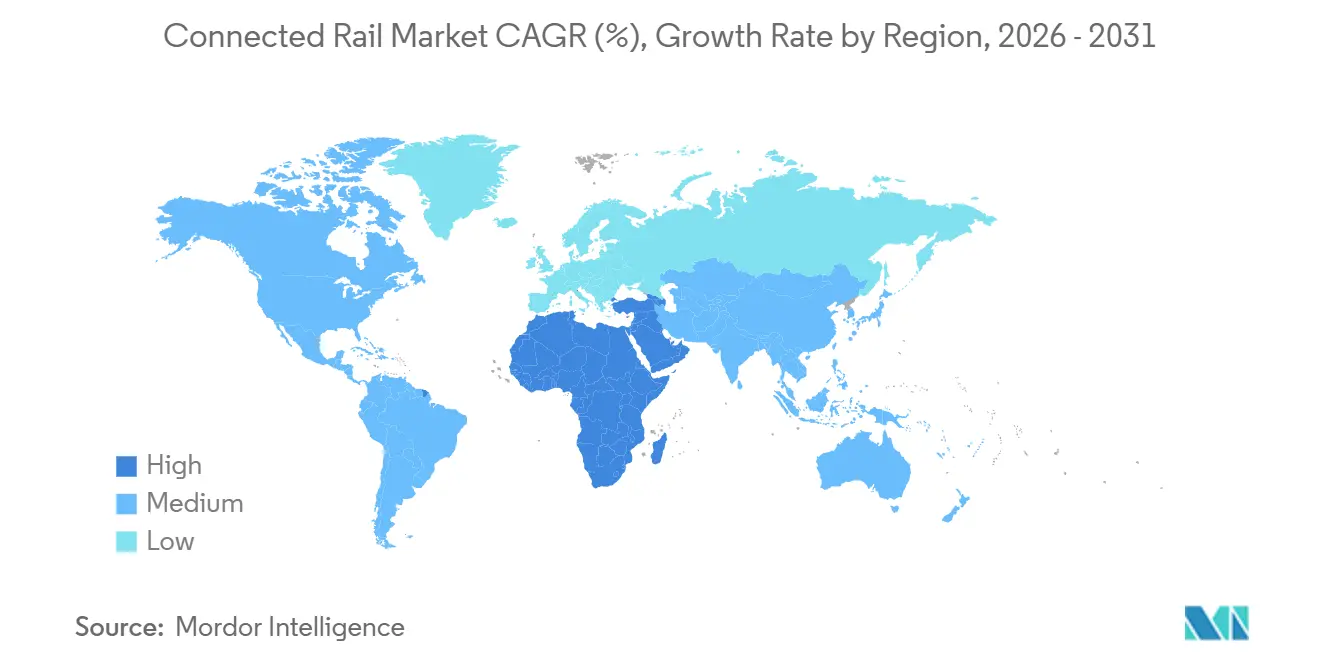
| Fastest Growing Market | Middle East and Africa |
| Largest Market | Europe |
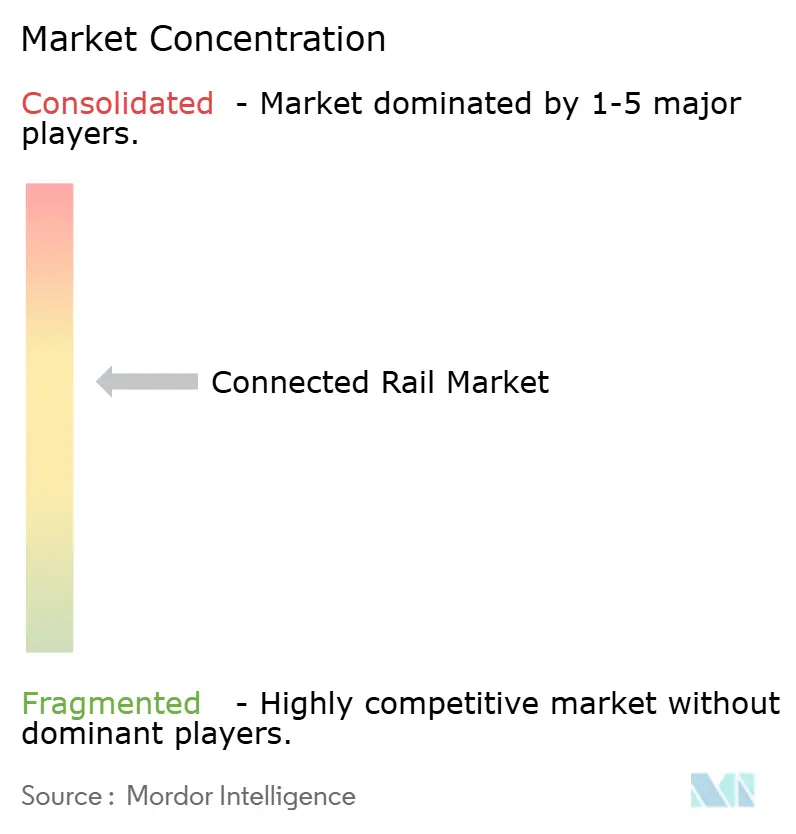
| Market Concentration | Medium |
Major Players *Disclaimer: Major Players sorted in no particular order Image © Mordor Intelligence. Reuse requires attribution under CC BY 4.0. | |
Connected Rail Market Analysis by Mordor Intelligence
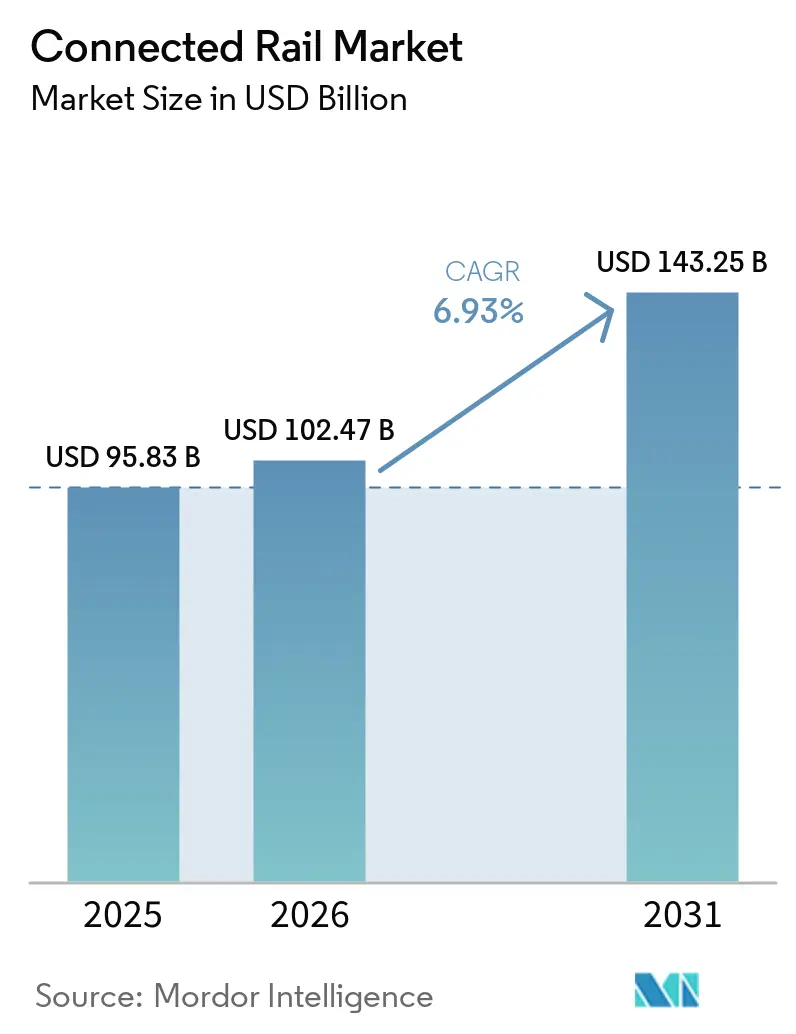
The Connected Rail Market size was valued at USD 95.83 billion in 2025 and is estimated to grow from USD 102.47 billion in 2026 to reach USD 143.25 billion by 2031, registering a CAGR of 6.93% during the forecast period (2026-2031). Policy mandates and spectrum awards for FRMCS, coupled with predictive maintenance's ability to significantly reduce unplanned downtime, are reshaping cost-benefit dynamics for operators in both passenger and freight sectors. While Europe anchored revenues in 2025, swift greenfield deployments in Riyadh, Dubai, and emerging corridors in Africa are driving demand in the connected rail market. These new lines are integrating technologies such as CBTC, private 5G, and account-based ticketing from the outset. Vendors are adapting by pairing hardware with data analytics subscriptions, transforming capital expenses into manageable operating costs. Meanwhile, telecom-driven entrants are advocating cloud-native FRMCS solutions that boast extremely low latency for automated train control. Concurrently, escalating cybersecurity compliance costs, driven by the EU’s NIS2 Directive and similar North American regulations, are squeezing margins for smaller players. This pressure is, in turn, fueling heightened demand for managed security services to safeguard the increasingly digitalized rail infrastructure.
Key Report Takeaways
- By service, Passenger Information Systems led with 28.17% of the connected rail market share in 2025, while Predictive Maintenance is advancing at a 6.95% CAGR to 2031.
- In the rail signaling system, Positive Train Control held 36.57% of the connected rail market in 2025, whereas CBTC is projected to expand at a 6.98% CAGR between 2026 and 2031.
- By rolling stock type, Electric Multiple Units captured 23.35% of 2025 revenue, and Light Rail/Tram Cars represent the fastest-growing segment with a 7.02% CAGR through 2031.
- By connectivity technology, Wi-Fi accounted for 47.71% of 2025 revenue, but cellular (4G/5G) is registering the highest growth at 7.05% over 2026-2031.
- By application, safety & security accounted for 27.46% of 2025 revenue, but operational efficiency is registering the highest growth at 7.09% over 2026-2031.
- By geography, Europe commanded 28.71% of 2025 revenue, yet the Middle East and Africa segment is set to grow at 7.13% through 2031.
Note: Market size and forecast figures in this report are generated using Mordor Intelligence’s proprietary estimation framework, updated with the latest available data and insights as of January 2026.
Market Trends and Insights
Drivers Impact Analysis of Connected Rail Market*
| Driver | (~) % Impact on CAGR Forecast | Geographic Relevance | Impact Timeline |
|---|---|---|---|
| Government Funding and Digital-Rail Mandates | +1.8% | Europe, Asia-Pacific core, spill-over to Middle East | Medium term (2-4 years) |
| Predictive-Maintenance ROI and Uptime Gains | +1.5% | Global, with early adoption in Europe and Japan | Short term (≤ 2 years) |
| Private 5G / FRMCS Corridor Roll-Outs | +1.4% | Europe (Germany, Netherlands, Switzerland), Middle East | Medium term (2-4 years) |
| Passenger Demand for Real-Time Connectivity | +1.2% | Europe, North America, Asia-Pacific urban corridors | Short term (≤ 2 years) |
| Freight Crew Shortages Driving Automation | +1.1% | Asia-Pacific (India, Japan), North America, Europe | Long term (≥ 4 years) |
| MaaS-Ready Open API Ecosystems | +0.9% | Europe, Asia-Pacific (Japan, South Korea), North America | Medium term (2-4 years) |
| Source: Mordor Intelligence | |||
Government Funding & Digital-Rail Mandates
Europe's Connecting Europe Facility has allocated significant funding for Level 2 ERTMS, covering an extensive network of route-kilometers. This move is not only compressing procurement cycles but also pushing vendors towards standardizing their modular software stacks. Meanwhile, Network Rail has established a long-term framework agreement with Thales and Siemens, which solidifies digital interlocking as the standard for British mainlines. In Brazil, a similar trend is emerging: São Paulo's substantial investment in a Level 2 rollout marks Latin America's inaugural foray into large-scale ETCS implementation. These unified mandates are shrinking the market for proprietary signaling and simultaneously favoring vendors with multi-country certifications, thereby streamlining both passenger and freight cross-border movements. With government co-funding bridging the financial divide between legacy and digital solutions, the connected rail market is experiencing a surge in tender volumes, resulting in accelerated revenue recognition.
Predictive-Maintenance ROI & Uptime Gains
Operators are increasingly adopting condition-based monitoring across their fleets, aiming to enhance asset utilization without the need for new rolling stock purchases. Hitachi Rail's initiative on Copenhagen Metro's fleet of trains achieved a significant reduction in unplanned maintenance and showcased an advanced warning system for critical bearing failures [1]“HMAX predictive maintenance platform,” Hitachi Rail, hitachirail.com . Indian Railways, outfitting thousands of diesel locomotives with advanced analytics, achieved a notable reduction in fuel consumption, highlighting the global significance of such advancements, even in markets outside the affluent tier. In recent years, South Korea's KORAIL has integrated AI-driven monitoring into its high-speed units, aiming to significantly reduce wheelset replacements by analyzing correlations between track geometry and accelerometer data. Predictive maintenance not only reduces spare-part inventories and postpones capital renewals but also boosts free cash flow. This, in turn, creates a positive feedback loop, further amplifying digital investments. Moreover, operators benefit from clearer performance metrics, bolstering the argument for outcome-based service contracts, a burgeoning commercial trend in the connected rail sector.
Private 5G / FRMCS Corridor Roll-Outs
In a significant move, regulators in Germany and the Netherlands allocated specific frequency bands to railways. This decision empowers operators to establish private 5G networks, seamlessly managing both passenger internet traffic and critical ETCS safety packets, free from interference from public networks. On the Hamburg–Berlin main line, Nokia showcased its FRMCS-ready solution, achieving impressive low-latency performance for automated train control, all while concurrently streaming multi-angle CCTV feeds [2]“Nokia launches commercial FRMCS solution,” Nokia, nokia.com . In a forward-looking memorandum with Ericsson, Saudi Arabia outlines a strategic transition from greenfield high-speed projects to operations free of GSM-R, a model poised to influence corridors across the Gulf and Africa. The Netherlands, in a notable agreement with Thales for ERTMS-over-IP, underscores the role of cloud-native cores in streamlining upgrades amidst evolving spectrum policies. By opening up license-exempt or lightly licensed spectrum, regulators are not only reducing entry barriers for telecom-centric suppliers but also amplifying competition and broadening solution options for railways.
Passenger Demand for Real-Time Connectivity
In 2024, Nomad Digital introduced gigabit-class Wi-Fi along Caltrain’s electrified corridor, significantly enhancing Italo’s download speeds. These advancements highlight the growing importance of reliable streaming in shaping travel preferences on medium-haul routes [3]“Gigabit Wi-Fi on Caltrain,” Nomad Digital, nomaddigital.com . Meanwhile, Icomera’s platform has expanded its coverage, now connecting a substantial number of vehicles. With the integration of AI-driven automatic passenger counting, train operators can provide real-time crowding data at the carriage level. In efforts to improve urban mobility, transit authorities in Dubai and Riyadh have extended account-based ticketing to include ride-hailing and micro-mobility services. This integration establishes the rail segment as a crucial component of comprehensive Mobility-as-a-Service ecosystems. Passengers have responded favorably, improving Net Promoter Scores and strengthening political support for ongoing digital advancements. As more metropolitan and commuter lines adopt high-speed connectivity, the connected rail market establishes a new benchmark for customer experience.
Restraints Impact Analysis of Connected Rail Market*
| Restraint | (~) % Impact on CAGR Forecast | Geographic Relevance | Impact Timeline |
|---|---|---|---|
| High Capex & Long Payback Cycles | -1.3% | Global, acute in emerging markets with limited public funding | Long term (≥ 4 years) |
| Escalating Cybersecurity & Compliance Costs | -0.9% | Europe (NIS2), North America, Asia-Pacific | Short term (≤ 2 years) |
| Unclear National Spectrum Roadmaps (FRMCS) | -0.7% | Europe (Switzerland, Austria), Asia-Pacific | Medium term (2-4 years) |
| Legacy-System Interoperability Hurdles | -0.6% | Global, particularly in mixed-vendor environments | Medium term (2-4 years) |
| Source: Mordor Intelligence | |||
High Capex & Long Payback Cycles
Digital rail projects often demand commitments spanning multiple years and significant financial investments, which can overshadow annual maintenance budgets. Switzerland's SBB is making a substantial long-term investment in digital interlocking and the migration to FRMCS. This investment represents a notable portion of its projected operating revenue and promises only long-term returns. Meanwhile, India's National Rail Plan allocates a significant amount for infrastructure development by the end of the decade. However, only a small fraction of this is directed toward digital systems, creating competition between tech upgrades and other priorities like electrification and gauge-conversion projects. In emerging markets, currency depreciation increases the costs of imported sensors and edge computing. Compounding this challenge, local lenders often hesitate to finance assets that lack collateral value. Such hurdles extend payback periods to the limits of executive tenures, reducing internal support for expansive deployments. While vendors are introducing subscription pricing as a countermeasure, balance-sheet constraints continue to hinder adoption in several rapidly growing segments of the connected rail market.
Escalating Cybersecurity & Compliance Costs
Effective in 2024, the EU's NIS2 Directive mandates prompt incident reporting and audits, imposing significant financial penalties for non-compliance. This has led mid-sized operators to allocate substantial annual resources to security operations centers and ISO 27001 certification. A radio-stop spoofing incident in Poland in 2024, which disrupted train operations, spurred an EU directive mandating encrypted FRMCS channels by 2030. This move aims to hasten the transition from outdated GSM-R radios. Meanwhile, Denmark's DSB faced a ransomware attack, which paralyzed ticketing servers for an extended period and resulted in considerable revenue losses and remediation costs. In North America, Class I freight railroads are making significant investments. Their focus is on segregating operational-technology networks from corporate IT and enhancing wayside equipment with intrusion detection systems. However, smaller shortlines grapple with overlapping requirements from the FRA and TSA. This struggle is delaying digital upgrades and stunting the near-term growth of the connected rail market.
*Our forecasts treat driver/restraint impacts as directional, not additive. The impact forecasts reflect baseline growth, mix effects, and variable interactions.
Connected Rail Market Segment Analysis
By Service:
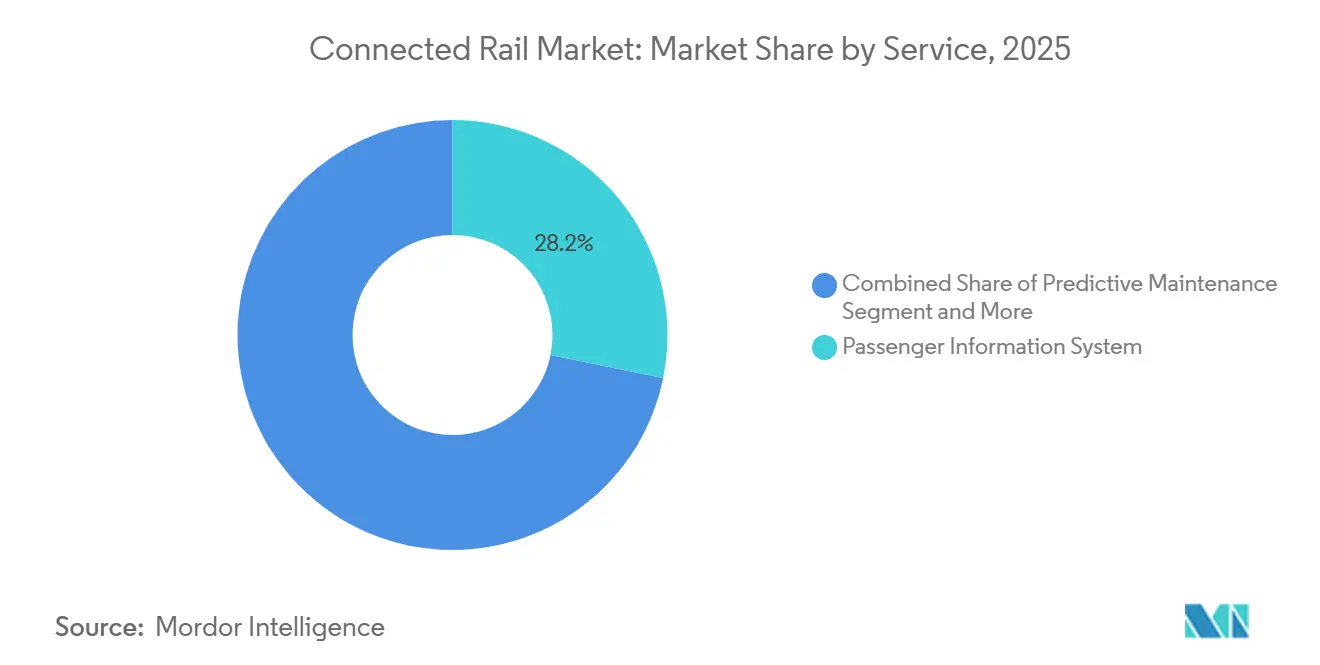
Predictive Maintenance Gains TractionPassenger Information Systems accounted for 28.17% of the connected rail market share in 2025, illustrating how real-time arrival displays and push notifications have become hygiene factors for metro and commuter patrons. Predictive Maintenance is the fastest-growing service line, with a 6.95% CAGR through 2031, reflecting its ability to cut spare-part inventories by up to 20% and reduce unplanned downtime across mixed rolling-stock fleets. The connected rail market size for Passenger Information Systems benefited from Italo’s Wi-Fi 6 retrofit on 51 high-speed units, which lifted user satisfaction scores and validated premium fares tied to bandwidth guarantees. In freight, train tracking and monitoring remain indispensable for asset visibility across 1,000+ km corridors. At the same time, AI-enabled crowd-flow analytics in urban systems now feed real-time load balancing that mitigates dwell overruns.
Predictive platforms such as Hitachi’s HMAX and Wabtec’s EdgeLINC ingest vibration, thermal, and energy-draw data at the edge, uploading only anomaly events to cloud servers and saving 70% in bandwidth charges. KORAIL’s wheel-set monitoring trial exemplifies an Asia-Pacific surge in analytics talent hiring inside railway IT units, spurred by operators’ desire to retain telemetry sovereignty. Automated fare collection systems are converging toward account-based architectures that extend beyond gated networks to bus, tram, and micro-mobility legs, a shift visible in Dubai’s NOL upgrade and Riyadh’s cloud-native platform. Passenger mobility and entertainment are where Tier-2 vendors like Nomad Digital out-compete conglomerates by promising route-specific service-level agreements measured in passenger speed tests. This granularity makes the connected rail market an attractive play for specialists that wrap software and field services into recurring revenue contracts.



By Rail Signaling System:
CBTC Outpaces Legacy PTCPositive Train Control accounted for 36.57% of the connected rail market in 2025, anchored by North American safety mandates covering more than 57,000 route-miles of freight and passenger track. Yet Communication-Based Train Control will grow at 6.98% between 2026 and 2031 as dense metro networks seek shorter headways without infrastructure expansion. Alstom’s EUR 2.8 billion CBTC contract in Hamburg commits the operator to 90-second intervals, effectively doubling peak capacity, showcasing the operational leverage embedded in software-defined signaling. Siemens’ Berlin package integrates CBTC with automatic energy-optimized coasting, providing a template that other European capitals now benchmark.
Hybrid architectures that integrate CBTC protocols with 5G backhaul demonstrate installation savings of 25% compared with traditional wayside networks, as demonstrated in Hitachi’s Japanese pilot. Meanwhile, ETCS Level 2 and Level 3 continue to erode national ATC standards in Europe, compressing vendor landscapes toward interoperable product lines. PTC remains the workhorse for hazardous-material corridors in the United States but lacks the dynamic timetable-optimization features baked into newer systems, limiting its export potential. These shifts ensure that CBTC and ETCS carry the mantle of growth for the connected rail market over the next decade.
By Rolling Stock Type:
EMUs Lead, Light Rail AcceleratesElectric Multiple Units account for 23.35% of connected rail revenue in 2025, thanks to their dominance in high-frequency corridors where on-board diagnostics and passenger Wi-Fi deliver immediate paybacks. Light Rail and Tram Cars, however, will post the fastest expansion at 7.02% CAGR through 2031 as cities modernize streetcar fleets with battery propulsion, collision-avoidance sensors, and 5G modems. CRRC’s intelligent EMU, unveiled in 2024 with Beidou positioning, showcases Asia’s ambition to bake connectivity into traction at the factory floor, while Queensland Rail’s 65-unit Wi-Fi retrofit signals growing demand in Oceania.
Diesel locomotives lag in digitization because fuel-savings algorithms still outweigh passenger-experience drivers in freight. Nevertheless, edge-compute retrofits that optimize combustion and predict traction-motor anomalies are inching adoption forward. Subway and metro vehicles remain hotbeds for CBTC and GOA 3 automation pilots in cities like Oslo and Riyadh. Passenger coaches on intercity lines increasingly carry seat sensors and HVAC telemetry for dynamic reservation systems. Freight wagons are last in the queue, yet European trials of GPS and load sensors show how yard dwell times could shrink by 15% once visibility tools scale, a latent upside for the connected rail market.
By Connectivity Technology:
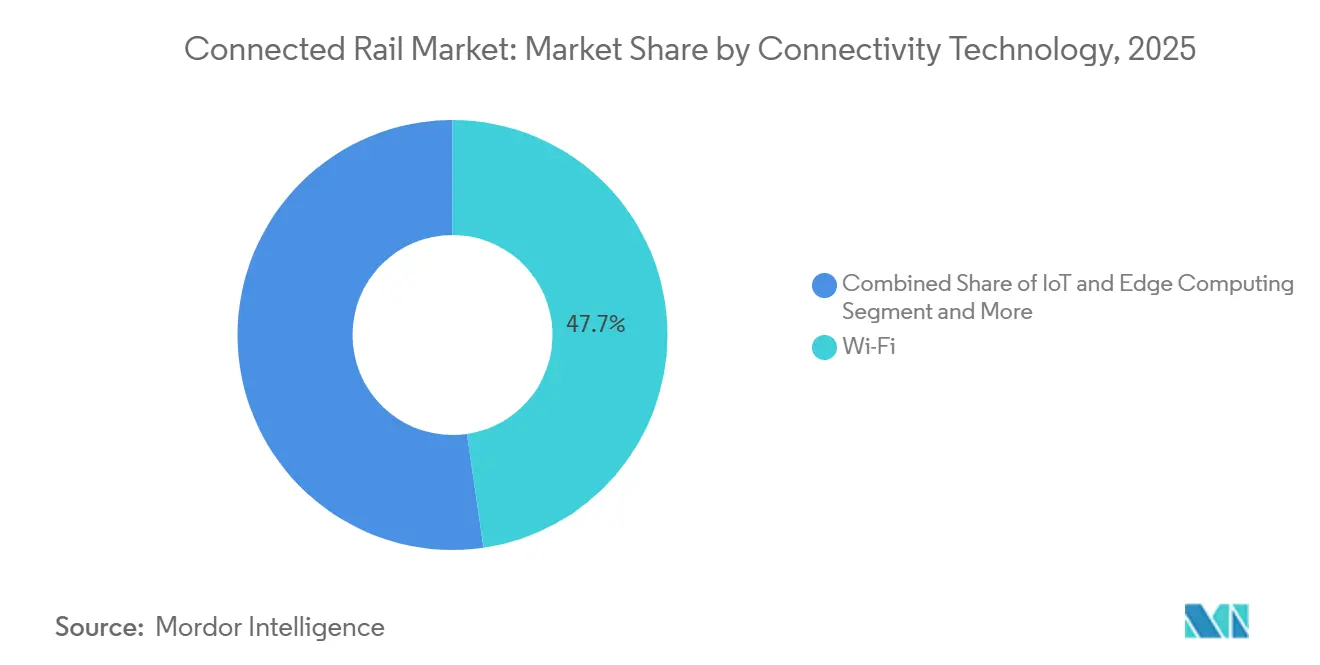
Cellular Gains on Wi-FiWi-Fi represented 47.71% of 2025 revenue by leveraging trackside access points that handle dense metro loads without cellular handoffs. Cellular (4G/5G) will rise at 7.05% through 2031 as private-network economics tilt in favor of spectrum that supports both passenger broadband and mission-critical control messages. Nomad Digital’s bonded 5G backhaul on Caltrain hit gigabit speeds, setting a U.S. benchmark that rivals European performance metrics. Icomera’s satellite overlays in rural Scandinavia illustrate how orbital capacity complements terrestrial gaps, keeping the connected rail market on a path to near-ubiquitous coverage.
IoT and edge computing push intelligence closer to sensors, allowing rolling stock to flag anomalies locally and forward only condensed alerts, thereby slashing data costs and facilitating real-time interventions. V2X messaging remains pre-commercial but is earmarked in ETSI draft FRMCS specifications as a mandatory component for automated train operation after 2028. As standards are finalized, vendors that control both the radio and analytics layers will gain first-mover advantages in the connected rail market.
By Application:
Operational Efficiency Climbs FastestSafety & Security contributed 27.46% of 2025 application revenue, fueled by video analytics that satisfy NIS2 and TSA directives. Operational Efficiency will grow the fastest, at 7.09% CAGR through 2031, as digital energy-management and crew-rostering suites target 10% to 15% opex reductions. JR Central’s EX-MaaS platform merges high-speed reservations with local transit and ride-hailing, extending efficiency gains beyond the rail perimeter and signaling a wider competitive set for operators.
Real-time passenger services mature quickly inside metros but remain uneven in regional corridors where mobile coverage gaps persist. Smart ticketing enjoys a tailwind from Dubai’s account-based rollout and Riyadh’s cloud platform, which eliminates plastic cards and enables post-trip billing, thereby lowering transaction costs. KORAIL’s February 2026 ticketing integration with SRT shows how inter-operator harmonization unlocks new revenue by simplifying journey planning. Collectively, these use cases tighten the feedback loop between operational data and customer experience, reinforcing the growth thesis for the connected rail market.
Geography Analysis
Europe Connected Rail Market
Europe accounted for 28.71% of connected rail revenue in 2025, buoyed by initiatives like the Third ERTMS Work Plan and significant digital interlocking contracts in the UK. Additionally, pilots for the Future Railway Mobile Communication System (FRMCS) were rolled out on the Hamburg–Berlin route. Italy's upgrade of its Italo fleet to Wi-Fi 6, coupled with Switzerland's substantial commitment to digital interlocking, further bolsters the region's investment landscape. However, spectrum delays in Switzerland have pushed the full FRMCS rollout to the next decade, highlighting the critical need for regulatory clarity in the connected rail arena.
MEA Connected Rail Market
The Middle East and Africa segment is forecast to log a 7.13% CAGR through 2031, the fastest regional growth rate. Initiatives like Dubai's modernization of its NOL system and Riyadh's cloud ticketing system are embedding digital capabilities from the start, sidestepping expensive retrofits. Saudi Arabia's strategy to prioritize 5G for its future high-speed lines not only showcases the region's move away from GSM-R but also serves as a model for emerging corridors in Africa, where legacy systems are scarce. Contracts like Huawei's in Mozambique and Etihad Rail's partnership with Via for Mobility as a Service (MaaS) highlight a diversifying supplier landscape in the connected rail domain.
APAC and the Americas Connected Rail Market
Asia-Pacific's narrative is twofold. While Japan's JR operators aim to advance automation and semi-autonomous Shinkansen operations over the next few years, South Korea's KORAIL is focusing on AI-driven fleet diagnostics and unified ticketing. China's CRRC is pushing for indigenous 5G-equipped Electric Multiple Units (EMUs) to gain a competitive edge in exports. India, balancing grand infrastructure goals with constrained digital budgets, faces a significant vacancy in locomotive pilots. Yet this gap is accelerating the adoption of remote operations, potentially overcoming staffing challenges. In North America, while the focus remains on Positive Train Control (PTC) compliance, there's a gradual shift towards passenger Wi-Fi and edge analytics, highlighted by Caltrain's gigabit service. Meanwhile, South America, with São Paulo spearheading the ETCS Level 2 standardization, is emerging as a new frontier for European suppliers. These diverse regional developments paint a rich tapestry of opportunities in the connected rail market.

Competitive Landscape
In the fragmented connected rail market, no single vendor commands a significant share of global revenues. Siemens Mobility, Alstom, Hitachi Rail, and Thales bolster their earnings by pairing signaling hardware with extended analytics subscriptions. Alstom's deal with Hamburg-U-Bahn guarantees long-term software updates, ensuring frequent headways—a strategy Siemens has adopted for its projects in Berlin and Oslo. Connectivity specialists like Nomad Digital and Icomera, though tier-2, distinguish themselves by offering route-specific broadband SLAs, a nuance that larger conglomerates find challenging to match.
Telecom giants—Nokia, Ericsson, and Huawei—leverage their private 5G know-how to secure FRMCS corridors, sidestepping traditional GSM-R players who lack software-defined radio capabilities. Illustrating this shift, Nokia has initiated a pilot between Hamburg and Berlin, while Ericsson has inked a deal in Saudi Arabia. With the backdrop of NIS2 and similar North American regulations, cybersecurity-as-a-service is emerging as a lucrative domain. Vendors bundling intrusion detection, incident response, and compliance reporting eye a European market with significant potential. Patent filings for train-to-infrastructure V2X have increased notably in recent years. Still, lagging standards have stymied commercialization, presenting a golden opportunity for early movers once ETSI finalizes the FRMCS V2X specs.
Freight automation is heating up as a competitive arena. Trials by DB Cargo on remote operations and Indian Railways' foray into single-operator freight operations hint at a burgeoning interest in Grade-of-Automation 2 tenders. With no clear leader in this niche yet, it stands as a strategic opportunity. However, mounting compliance costs are straining smaller regional suppliers, leading to a more concentrated market. This shift sees financially stronger players absorbing these niche firms, broadening their end-to-end offerings in the connected rail landscape.
Connected Rail Industry Leaders
Siemens Mobility
Alstom
Hitachi Rail
Thales Group
Wabtec Corporation
- *Disclaimer: Major Players sorted in no particular order
Connected Rail Market Companies Covered in this Report
- Siemens Mobility
- Alstom
- Hitachi Rail
- Thales Group
- Wabtec Corporation
- Cisco Systems
- Huawei Technologies
- CRRC Corporation
- Nokia
- Ericsson
- ABB Ltd.
- IBM Corporation
- Fujitsu Ltd.
- Indra Sistemas
- Toshiba Corp.
- DXC Technology
- Atkins (SNC-Lavalin)
- Nomad Digital
- Trimble Inc.
- SNCF Digital Services

Recent Industry Developments in Connected Rail Market
- August 2026: Via Rail announced plans to improve connectivity for long-distance train passengers at one of Canada’s busiest airports. The Crown corporation will develop a new integrated transit hub in Dorval, Quebec, connecting Via Rail and exo trains with shuttle services to Montréal–Trudeau International Airport.
- February 2025: Deutsche Bahn awarded Siemens Mobility a EUR 2.8 billion contract to digitize 3,000 km of German track with ETCS Level 2, FRMCS-ready radios, and integrated control centers.
- May 2024: Hitachi Rail finalized the EUR 1.66 billion acquisition of Thales Ground Transportation Systems, expanding its signaling and communications portfolio.


Global Connected Rail Market Report Scope
The scope of the report includes Service (Passenger Information System and More), Rail Signaling System (Positive Train Control and More), Rolling Stock Type (Diesel Locomotive and More), Connectivity Technology (Wi-Fi and More), Application (Real-Time Passenger Services and More), and Geography.
| Passenger Information System |
| Predictive Maintenance |
| Train Tracking & Monitoring |
| Automated Fare Collection |
| Passenger Mobility & Entertainment |
| Positive Train Control (PTC) |
| Communication-Based Train Control (CBTC) |
| Automatic Train Control (ATC) |
| Diesel Locomotive |
| Electric Locomotive |
| Electric Multiple Unit (EMU) |
| Diesel Multiple Unit (DMU) |
| Light Rail / Tram Car |
| Subway / Metro Vehicle |
| Passenger Coach |
| Freight Wagon |
| Wi-Fi |
| Cellular (4G/5G) |
| IoT & Edge Computing |
| V2X Communication |
| Real-Time Passenger Services |
| Safety & Security |
| Operational Efficiency |
| Smart Ticketing |
| North America | United States |
| Canada | |
| Rest of North America | |
| South America | Brazil |
| Argentina | |
| Rest of South America | |
| Europe | United Kingdom |
| Germany | |
| Spain | |
| Italy | |
| France | |
| Russia | |
| Rest of Europe | |
| Asia-Pacific | India |
| China | |
| Japan | |
| South Korea | |
| Rest of Asia-Pacific | |
| Middle East and Africa | United Arab Emirates |
| Saudi Arabia | |
| Turkey | |
| Egypt | |
| South Africa | |
| Rest of Middle East and Africa |
| By Service | Passenger Information System | |
| Predictive Maintenance | ||
| Train Tracking & Monitoring | ||
| Automated Fare Collection | ||
| Passenger Mobility & Entertainment | ||
| By Rail Signaling System | Positive Train Control (PTC) | |
| Communication-Based Train Control (CBTC) | ||
| Automatic Train Control (ATC) | ||
| By Rolling Stock Type | Diesel Locomotive | |
| Electric Locomotive | ||
| Electric Multiple Unit (EMU) | ||
| Diesel Multiple Unit (DMU) | ||
| Light Rail / Tram Car | ||
| Subway / Metro Vehicle | ||
| Passenger Coach | ||
| Freight Wagon | ||
| By Connectivity Technology | Wi-Fi | |
| Cellular (4G/5G) | ||
| IoT & Edge Computing | ||
| V2X Communication | ||
| By Application | Real-Time Passenger Services | |
| Safety & Security | ||
| Operational Efficiency | ||
| Smart Ticketing | ||
| By Geography | North America | United States |
| Canada | ||
| Rest of North America | ||
| South America | Brazil | |
| Argentina | ||
| Rest of South America | ||
| Europe | United Kingdom | |
| Germany | ||
| Spain | ||
| Italy | ||
| France | ||
| Russia | ||
| Rest of Europe | ||
| Asia-Pacific | India | |
| China | ||
| Japan | ||
| South Korea | ||
| Rest of Asia-Pacific | ||
| Middle East and Africa | United Arab Emirates | |
| Saudi Arabia | ||
| Turkey | ||
| Egypt | ||
| South Africa | ||
| Rest of Middle East and Africa | ||


Key Questions Answered in the Report
What was the connected rail market size in 2025, and what is the expected value by 2031?
The connected rail market size stood at USD 95.83 billion in 2025 and is forecast to reach USD 143.25 billion by 2031, reflecting robust investment in signaling, connectivity, and analytics.
Which service segment is expanding the fastest in the connected rail market?
Predictive Maintenance is the fastest-growing service, advancing at a 6.95% CAGR through 2031 as operators shift toward condition-based interventions.
Which region will post the highest growth rate through 2031?
The Middle East and Africa are projected to lead with a 7.13% CAGR, propelled by greenfield metro projects that embed CBTC and private 5G from inception.
How significant is CBTC relative to legacy PTC systems?
While PTC held 36.57% of revenue in 2025, CBTC will expand at a 6.98% CAGR to 2031, driven by metro operators seeking headway reductions without new track.
What impact does the EU’s NIS2 Directive have on rail operators?
NIS2 mandates 24-hour incident reporting and regular audits, increasing annual cybersecurity spending by EUR 2 million to EUR 5 million for mid-sized European railways and accelerating demand for managed security services.
Which companies are leading private 5G deployments in rail?
Nokia, Ericsson, and Huawei head early FRMCS and private 5G deployments, positioning themselves as telecom-native challengers to traditional GSM-R suppliers.
Page last updated on:





