
Connected Car Market Size and Share
Market Overview
| Study Period | 2019 - 2030 |
|---|---|
| Market Size (2025) | USD 63.44 Billion |
| Market Size (2030) | USD 131.87 Billion |
| Growth Rate (2025 - 2030) | 15.76 % |
| Fastest Growing Market | Middle East |
| Largest Market | Asia Pacific |
| Market Concentration | Medium |
Major Players *Disclaimer: Major Players sorted in no particular order Image © Mordor Intelligence. Reuse requires attribution under CC BY 4.0. | |
Connected Car Market Analysis by Mordor Intelligence
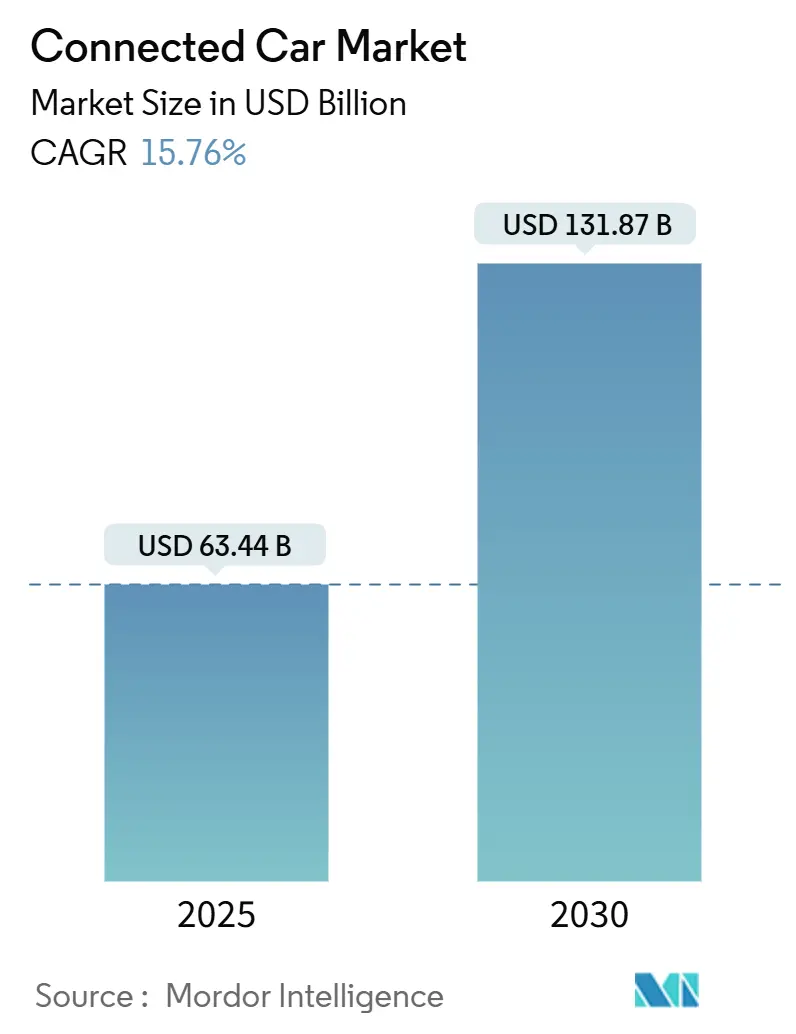
The connected car market size reached USD 63.44 billion in 2025 and is forecast to climb to USD 131.87 billion by 2030, reflecting a 15.76% CAGR. This rapid rise mirrors the sector’s pivot from hardware-centric design to software-defined vehicles that operate as mobile computing platforms rather than simple transportation assets. Regulatory safety mandates, widespread 5G roll-outs, and automakers’ shift toward recurring revenue from connected services continue to expand addressable value pools. National cybersecurity rules and supply-chain reshoring policies reshape sourcing strategies, while sovereign connectivity projects accelerate technology adoption. At the same time, fragmented competition among automotive suppliers, semiconductor leaders, and cloud platforms encourages innovation that keeps the connected car market on a strong growth trajectory.
Key Report Takeaways
- By technology, 4G/LTE captured 48.22% of connected car market share in 2024; 5G/C-V2X is advancing at a 21.62% CAGR through 2030.
- By application, Infotainment & HMI accounted for 33.27% of the connected car market size in 2024; Over-the-Air Updates hold a 22.39% CAGR to 2030.
- By connectivity, Embedded solutions held 47.28% of 2024 revenue; Integrated architectures record the fastest 19.32% CAGR through 2030.
- By vehicle connectivity, V2C led with 36.71% share in 2024, while V2G grows at a 20.61% CAGR.
- By car type, SUVs/MPVs commanded 42.82% share of the connected car market size in 2024 and expand at a 17.42% CAGR.
- By end market, OEM-Fitted offerings held 67.29% share in 2024; the Aftermarket segment registers a 19.81% CAGR to 2030.
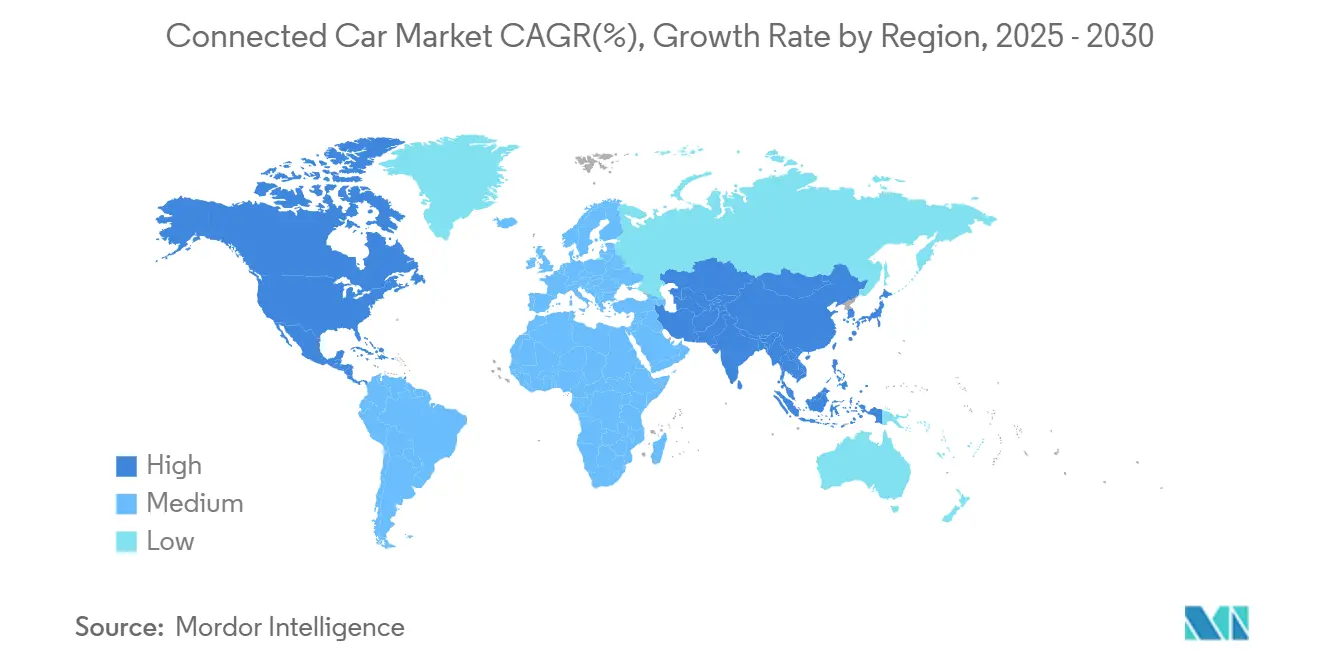
- By geography, Asia-Pacific led with 40.28% revenue share in 2024; the Middle East records the highest 19.28% CAGR through 2030.
Note: Market size and forecast figures in this report are generated using Mordor Intelligence’s proprietary estimation framework, updated with the latest available data and insights as of January 2026.
Market Trends and Insights
Drivers Impact Analysis of Connected Car Market*
| Driver | (~) % Impact on CAGR Forecast | Geographic Relevance | Impact Timeline |
|---|---|---|---|
| 5G/C-V2X Roll-Outs Enabling Low-Latency Services | +4.10% | Global with early adoption in China, the United States, and the EU | Long term (≥ 4 years) |
| Regulatory Mandates for ecall and Safety Telematics | +3.20% | Europe expanding to North America and Asia-Pacific | Medium term (2-4 years) |
| Consumer Demand for Infotainment and In-Car Apps | +2.80% | Global, strongest in North America and Europe | Short term (≤ 2 years) |
| Usage-Based-Insurance Demand for Embedded Data | +2.30% | North America and Europe, emerging Asia-Pacific | Medium term (2-4 years) |
| OEM-Run Edge App Marketplaces | +1.90% | Global, led by premium brands in developed markets | Medium term (2-4 years) |
| V2G Revenue Opportunities for Automakers and Utilities | +1.40% | Europe and North America, pilots in Asia-Pacific | Long term (≥ 4 years) |
| Source: Mordor Intelligence | |||
5G/C-V2X Roll-Outs Enabling Low-Latency Services
Cellular V2X shifts connected vehicles toward real-time interactions. China targets 30 million V2X-ready vehicles yearly by 2034, while joint demonstrations by the 5G Automotive Association and USDOT validate cross-border standards. Network slicing ensures automotive-grade service levels and supports future autonomous driving. These capabilities position 5G as an indispensable backbone for the connected car market [1].
Regulatory Mandates for eCall and Safety Telematics
Next Generation eCall moves emergency calling from 2G/3G to 4G/5G networks, with voluntary EU compliance targeted for January 2026. Urban response times have improved, and rural times have grown since deployment, underscoring direct safety benefits. Alignment with the United Kingdom network sunset plans up to 2033 shows how rule harmonization speeds technology diffusion. In the United States, the Department of Transportation has earmarked USD 60 million for nationwide V2X pilots that mirror Europe’s safety focus. [2]
Usage-Based-Insurance Pressure For Embedded Data
Insurers are refining their risk pricing models, leading to an accelerated adoption of telematics. Telematics technology enables insurers to collect real-time driving data, which helps assess risk more accurately and offers personalized premiums. In the wake of high-profile data-sharing violations, regulators are tightening their scrutiny, pushing for more precise consent mechanisms. These violations have highlighted the need for transparency in how data is collected, shared, and used. As OEMs grapple with balancing privacy concerns and the demand for real-time data, they bolster their cybersecurity and data governance frameworks. Strengthening these frameworks ensures compliance with regulations while safeguarding consumer trust and addressing the growing risks of cyber threats.
V2G Revenue Opportunities for OEMs and Utilities
Bidirectional charging pilots show EV batteries can supply homes during outages and ease peak-demand pressures. GM and Pacific Gas & Electric offer up to USD 4,500 in incentives for V2G-enabled home systems, while European studies estimate USD 4 billion in annual grid savings from smart charging. Automakers now factor energy services into total cost-of-ownership equations[3].
Restraints Impact Analysis of Connected Car Market*
| Restraint | (~) % Impact on CAGR Forecast | Geographic Relevance | Impact Timeline |
|---|---|---|---|
| Escalating Cybersecurity and OTA Risks | -2.7% | Global, heightened in Europe and North America | Short term (≤ 2 years) |
| Trade Curbs on Chinese Telematics Chipsets | -2.1% | North America and allied regions | Medium term (2-4 years) |
| High Connectivity and Data-Hosting Costs | -1.8% | Global, acute in emerging markets | Medium term (2-4 years) |
| Data-Localization Rules Raising Backend Spend | -1.5% | Europe, China, and jurisdictions with strict sovereignty laws | Long term (≥ 4 years) |
| Source: Mordor Intelligence | |||
Trade Curbs on Chinese Telematics Chipsets
A U.S. rule effective March 2025 bans software links to Chinese or Russian components by model year 2027 and hardware by 2030. Chinese automakers respond by fast-tracking domestic chip design to 25% self-sufficiency by 2025. Dual supply chains raise costs and complicate platform choices, but regionalized sourcing reduces geopolitical risk over the long term.
Data-Localization Rules Raising Backend Spend
The EU Data Act effective September 2025 requires real-time vehicle data sharing with third parties while treating Vehicle Identification Numbers as personal data under GDPR. Automakers must create region-specific clouds that satisfy privacy protections and mandatory data-sharing obligations. Similar trends in other jurisdictions point to rising backend infrastructure complexity [4].
*Our forecasts treat driver/restraint impacts as directional, not additive. The impact forecasts reflect baseline growth, mix effects, and variable interactions.
Connected Car Market Segment Analysis
By Technology:
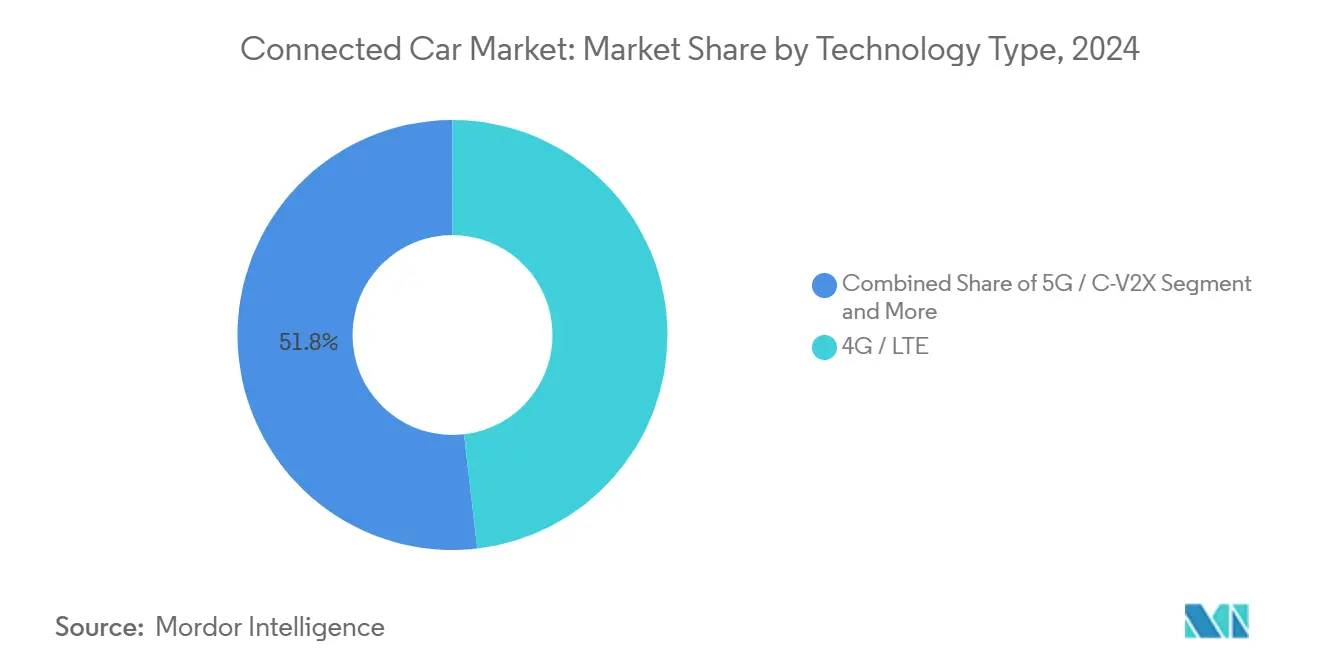
5G momentum builds despite 4G leadership4G/LTE accounted for 48.22% of 2024 revenue, confirming its role as the workhorse of the connected car market. Its maturity ensures reliable coverage and cost-effective modules. 5G/C-V2X posts a 21.62% CAGR as mandates for ultra-low-latency services such as real-time V2X interactions accelerate adoption. Connected car market size projections for 5G platforms show steep climbs once standalone networks mature. Suppliers now ship flat-panel antennas that combine 5G and sidelink radios, smoothing transition pathways for OEMs.
Legacy 2G and 3G are winding down, pushed by Europe’s NG-eCall guidelines that require 4G compatibility from 2026. Demonstrations by global telecom regulators validate performance targets and bolster investor confidence. Coupled with China’s commitment to 30 million V2X-ready vehicles every year by 2034, the momentum tilts strongly toward 5G. Multi-band modules supporting fallback to LTE protect automakers against network gaps during the transition.

By Application:
OTA updates unlock ongoing valueInfotainment and HMI led with a 33.27% share, reflecting consumer preference for personalized digital cabins. Over-the-air updates grew at a 22.39% CAGR, signaling OEM reliance on remote feature deployment to monetize software post-sale. Connected car market share data highlight OTA’s potential to eclipse infotainment revenue once platform penetration widens.
Regulatory pressures are increasingly pushing for Over-the-Air (OTA) updates, allowing software fixes to be mandated without the need for physical recalls. With automakers rolling out in-vehicle app stores, these OTA pipelines are evolving into the backbone for continuous feature refreshes. Furthermore, safety-critical updates are now required to adhere to stringent encryption standards, driving up the demand for secure update frameworks.
By Connectivity:
Integrated architecture gains prominenceEmbedded solutions held 47.28% share thanks to OEM control over user experience and data. Integrated connectivity posts 19.32% CAGR as unified modules reduce BOM cost while supporting multiple radio standards. Connected car market size for integrated platforms grows as telecom carriers endorse network-slicing models dedicated to automotive QoS.
Tethered systems decline because consumers prefer stand-alone vehicle connectivity that does not rely on smartphones. Semiconductor suppliers such as Qualcomm drive convergence by merging cockpit and ADAS compute onto single SoCs, lowering latency while cutting weight and wiring. Cloud providers supply SDKs that abstract network management so developers can focus on user features.
By Vehicle Connectivity:
V2G accelerates grid integrationVehicle-to-Cloud leads with 36.71% share, essential for diagnostics and data monetization. Vehicle-to-Grid records a 20.61% CAGR as utilities incent EV owners to participate in demand-response programs. Connected car market size linked to V2G broadens once bidirectional chargers reach mass adoption and standards harmonize power-handshake protocols.
Government incentives and favorable rate structures encourage fleets to install V2G-ready chargers. Studies estimate grid operators could save USD 4 billion annually in Europe with smart charging. Automakers increasingly design traction batteries and power electronics to manage grid back-feed without degrading cycle life.
By Car Type:
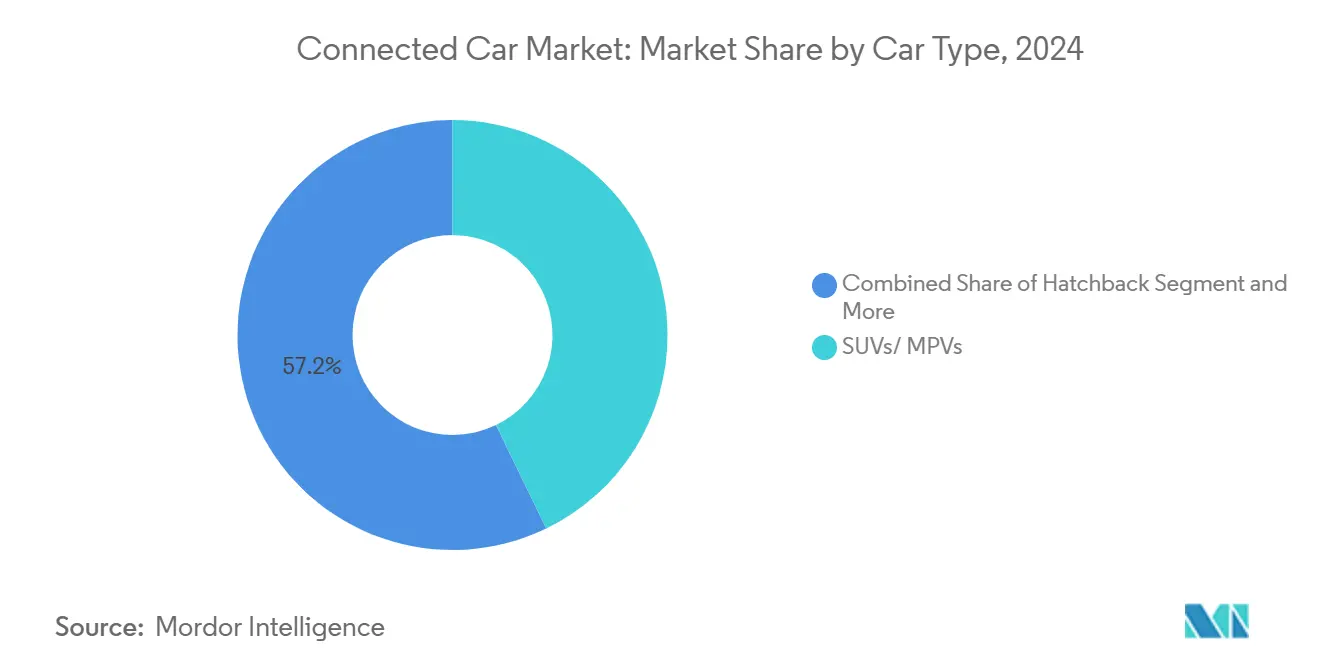
SUVs dominate adoption curveSUVs/MPVs held 42.82% share and grow at 17.42% CAGR, benefiting from larger cabin real estate that accommodates multiple displays and advanced antennas. Their higher sticker prices absorb connectivity costs, making premium features standard sooner. Connected car market size inside the SUV category rises as luxury trims bundle subscription-based digital services.
Sedans lag due to shrinking segment demand, while hatchbacks focus on cost-sensitive buyers who want essential safety and infotainment only. Chinese OEMs shorten model cycles to 1.3 years, using SUVs as launch pads for AI-driven cockpits that later cascade down to smaller vehicles.
By End Market:
Aftermarket gains but OEM dominance continuesOEM-Fitted solutions controlled 67.29% of 2024 revenue, as automakers lock in telemetry platforms at assembly. The aftermarket grows 19.81% CAGR driven by retrofit kits for older fleets and niche solutions outside OEM roadmaps. Connected car market share in the aftermarket remains modest, yet new EU data-access rules lower entry barriers for service providers.
Independent suppliers now offer cloud-based analytics that integrate with OEM APIs to deliver fleet optimization services without additional hardware. Diagnostic leaders expand coverage to new EV brands, signaling convergence between traditional service equipment and connected telematics.
Geography Analysis
APAC Connected Car Market
Asia-Pacific kept 40.28% share thanks to China’s aggressive V2X policy and large domestic EV base. Government subsidies, strong supply chains, and raw-material control create favorable conditions. Japan and South Korea plan nationwide Level 4 autonomy by 2027, reinforcing regional leadership. Connected car market size in Asia-Pacific benefits from 5G penetration that already covers most metropolitan areas.
Middle East Connected Car Market
The Middle East is the fastest-growing region at 19.28% CAGR. Ambitious electrification targets such as the UAE’s 50% EV goal by 2050 and Saudi Arabia’s 30% EV plan for Riyadh by 2030 drive telematics demand. Government funding and low energy costs make large-scale charging infrastructure viable. Chinese automakers capture rising regional interest with connected models that ship standard with infotainment suites.
North America and Europe Connected Car Market
North America and Europe balance innovation with compliance overhead. The U.S. Connected Vehicle Rule reshapes sourcing by banning Chinese and Russian connected components on a phased timeline, pushing OEMs toward allied semiconductor partners. Europe enforces UN Regulation 155 for cybersecurity and the Data Act for data-sharing, raising backend costs but setting global benchmarks for safety and privacy.
Competitive Landscape
Competition remains fragmented with no firm exceeding a double-digit share. Continental integrates biometric monitoring and edge AI into cockpits, while Qualcomm’s Digital Chassis merges cockpit and ADAS compute, helping its automotive revenue expand 25% in 2023. Automakers like GM co-create software marketplaces such as SDVerse to decouple software sourcing from hardware cycles.
White-space opportunities include edge computing nodes that host microservices inside vehicles, specialized cybersecurity stacks that satisfy UNECE requirements, and data-monetization engines that translate raw telemetry into actionable insights for fleets. Traditional suppliers hire AI engineers and acquire cloud expertise, blurring lines between hardware and software players.
Strategic alliances accelerate time to market. NVIDIA partners with Magna, Hyundai, and GM to embed Drive AGX across multiple vehicle lines, providing OEMs with scalable AI compute. Bosch targets EUR 6 billion in future software and services revenue, signaling a pivot from component sales to platform subscriptions. The overall competitive environment fosters rapid innovation but also heightens the need for cross-industry standards to ensure interoperability and security.
Connected Car Industry Leaders
-
Continental AG
-
Robert Bosch GmbH
-
Harman International
-
Denso Corporation
-
Qualcomm Technologies
- *Disclaimer: Major Players sorted in no particular order

Connected Car Market Companies Covered in this Report
- Continental AG
- Robert Bosch GmbH
- Harman International (Samsung)
- Denso Corporation
- Qualcomm Technologies
- Visteon Corporation
- Aptiv PLC
- Tesla Inc.
- General Motors (OnStar)
- Ford Motor Company
- BMW Group
- Daimler Truck / Mercedes-Benz Group
- Toyota Motor Corp.
- Hyundai Motor Group
- Panasonic Automotive
- NXP Semiconductors
- Verizon Communications
- AT&T
- Vodafone Automotive
- Cerence Inc.
- Airbiquity
- Geotab
Recent Industry Developments in Connected Car Market
- March 2025: General Motors and NVIDIA launched a collaboration using NVIDIA Drive AGX for next-gen driver assistance and Omniverse for digital-twin factories.
- March 2025: Magna and NVIDIA agreed to integrate Drive AGX into L2+ to L4 safety solutions, with demonstrations set for late 2025.
- January 2025: Hyundai Motor Group selected NVIDIA AI Enterprise tools for data management and simulation of autonomous functions.
Global Connected Car Market Report Scope
| 5G / C-V2X |
| 4G / LTE |
| 3G |
| 2G |
| Driver Assistance (ADAS) |
| Safety & Security |
| Telematics & Diagnostics |
| Infotainment & HMI |
| Mobility & Fleet Management |
| Over-the-Air (OTA) Updates |
| Integrated |
| Embedded |
| Tethered |
| Vehicle-to-Vehicle (V2V) |
| Vehicle-to-Infrastructure (V2I) |
| Vehicle-to-Pedestrian (V2P) |
| Vehicle-to-Cloud (V2C) |
| Vehicle-to-Grid (V2G) |
| Hatchback |
| Sedan |
| SUVs / MUVs |
| OEM-Fitted |
| Aftermarket |
| North America | United States |
| Canada | |
| Rest of North America | |
| South America | Brazil |
| Argentina | |
| Rest of South America | |
| Europe | Germany |
| United Kingdom | |
| France | |
| Italy | |
| Spain | |
| Russia | |
| Rest of Europe | |
| Asia-Pacific | China |
| Japan | |
| India | |
| South Korea | |
| Australia | |
| Rest of Asia-Pacific | |
| Middle East & Africa | Saudi Arabia |
| United Arab Emirates | |
| Turkey | |
| South Africa | |
| Egypt | |
| Rest of Middle East & Africa |
| By Technology Type | 5G / C-V2X | |
| 4G / LTE | ||
| 3G | ||
| 2G | ||
| By Application | Driver Assistance (ADAS) | |
| Safety & Security | ||
| Telematics & Diagnostics | ||
| Infotainment & HMI | ||
| Mobility & Fleet Management | ||
| Over-the-Air (OTA) Updates | ||
| By Connectivity | Integrated | |
| Embedded | ||
| Tethered | ||
| By Vehicle Connectivity | Vehicle-to-Vehicle (V2V) | |
| Vehicle-to-Infrastructure (V2I) | ||
| Vehicle-to-Pedestrian (V2P) | ||
| Vehicle-to-Cloud (V2C) | ||
| Vehicle-to-Grid (V2G) | ||
| By Car Type | Hatchback | |
| Sedan | ||
| SUVs / MUVs | ||
| By End Market | OEM-Fitted | |
| Aftermarket | ||
| By Geography | North America | United States |
| Canada | ||
| Rest of North America | ||
| South America | Brazil | |
| Argentina | ||
| Rest of South America | ||
| Europe | Germany | |
| United Kingdom | ||
| France | ||
| Italy | ||
| Spain | ||
| Russia | ||
| Rest of Europe | ||
| Asia-Pacific | China | |
| Japan | ||
| India | ||
| South Korea | ||
| Australia | ||
| Rest of Asia-Pacific | ||
| Middle East & Africa | Saudi Arabia | |
| United Arab Emirates | ||
| Turkey | ||
| South Africa | ||
| Egypt | ||
| Rest of Middle East & Africa | ||
Key Questions Answered in the Report
How large is the connected car market in 2025?
It reached USD 63.44 billion in 2025 and is on track to hit USD 131.87 billion by 2030, reflecting a 15.76% CAGR.
Which region leads in connected car adoption?
Asia-Pacific holds 40.28% of global revenue, driven by China’s large electric-vehicle base and nationwide V2X targets.
What technology segment grows fastest?
5G/C-V2X solutions register the highest 21.62% CAGR because low-latency services enable autonomous and safety functions.
What is the role of V2G in future revenue models?
Vehicle-to-Grid programs let EVs feed power back to the grid, opening new income streams for automakers and utilities while supporting energy stability.
How do cybersecurity rules affect automakers?
Regulations like UNECE R155/R156 require continuous threat monitoring and secure update systems, increasing compliance investments.