
Commercial Flooring Market Size and Share
Market Overview
| Study Period | 2020 - 2031 |
|---|---|
| Market Size (2026) | USD 115.80 Billion |
| Market Size (2031) | USD 153.08 Billion |
| Growth Rate (2026 - 2031) | 5.74 % |
| Fastest Growing Market | North America |
| Largest Market | Asia-Pacific |
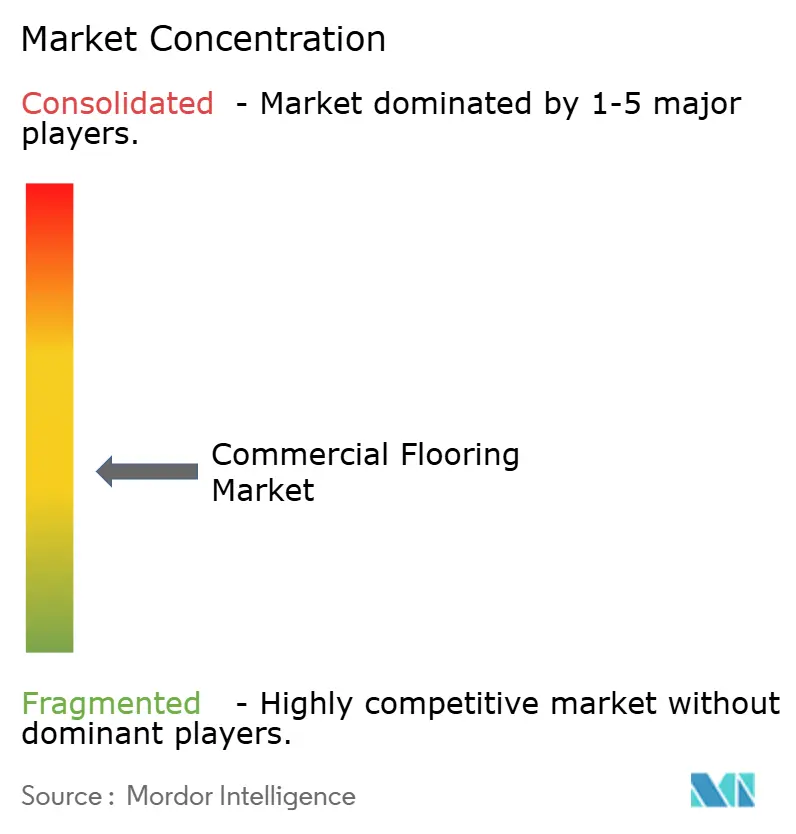
| Market Concentration | Medium |
Major Players *Disclaimer: Major Players sorted in no particular order Image © Mordor Intelligence. Reuse requires attribution under CC BY 4.0. | |
Commercial Flooring Market Analysis by Mordor Intelligence
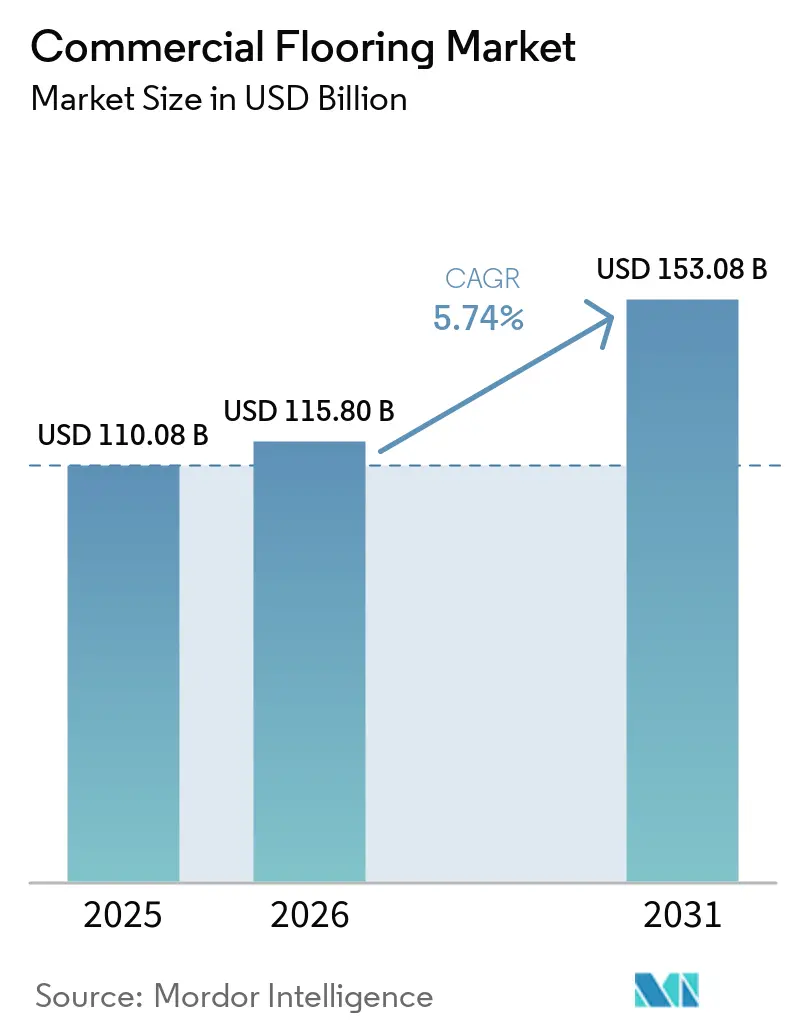
The commercial flooring market size is expected to grow from USD 110.08 billion in 2025 to USD 115.80 billion in 2026 and is forecast to reach USD 153.08 billion by 2031 at 5.74% CAGR over 2026-2031. The growth outlook reflects a careful balance between steady renovation cycles in mature economies and sustained buildouts in fast-growing regions, with low-maintenance, modular, and resilient formats improving project economics for owners and operators. Specification trends favor products that combine durability, low emissions, and strong documentation, which align with evolving green building criteria in large corporate and public bids[1]. Environmental Product Declarations and material health transparency increasingly shape the shortlists for healthcare, education, and workplace projects, raising the bar for the technical data and third-party validation that manufacturers must provide. Policy signals on extended producer responsibility and circular procurement are beginning to influence product design and end-of-life pathways across key markets, strengthening interest among established brands in take-back and recycling programs.
Key Report Takeaways
- By product type, non-resilient flooring led with 54% of the commercial flooring market share in 2025, and resilient flooring is projected to expand at a 7.20% CAGR through 2031.
- By end user, offices accounted for a 32% share of the commercial flooring market in 2025, and healthcare is forecast to grow at a 7.05% CAGR through 2031.
- By distribution channel, indirect sales accounted for 65% of sales in 2025, and direct sales are projected to grow at a 7.37% CAGR through 2031.
- Geographically, Asia-Pacific accounted for 38% of the commercial flooring market in 2025, and North America is expected to record the fastest growth at a 7.50% CAGR through 2031.
Note: Market size and forecast figures in this report are generated using Mordor Intelligence’s proprietary estimation framework, updated with the latest available data and insights as of January 2026.
Market Trends and Insights
Drivers Impact Analysis of Commercial Flooring Market*
| Driver | (~) % Impact on CAGR Forecast | Geographic Relevance | Impact Timeline |
|---|---|---|---|
| Resilient/LVT shift in specifications | +1.8% | Global, strongest in North America and the Asia-Pacific | Medium term (2-4 years) |
| Renovation and replacement cycles in mature markets | +1.2% | North America, Europe, Asia-Pacific core | Short term (≤ 2 years) |
| Asia-Pacific non‑residential pipeline expansion | +1.5% | Asia-Pacific (India, Indonesia, Vietnam, China) | Medium term (2-4 years) |
| LEED/WELL low‑emitting materials and EPD adoption | +0.9% | Global, led by North America and the European Union | Medium term (2-4 years) |
| Public procurement and EPR push circularity | +0.4% | European Union, expanding to the United Kingdom and select Asia-Pacific | Long term (≥ 4 years) |
| Healthcare and cleanroom performance needs | +0.2% | Global, strongest in North America healthcare hubs | Short term (≤ 2 years) |
| Source: Mordor Intelligence | |||
Resilient/LVT Shift in Commercial Specifications Gains Momentum Through Diamond Hard Coatings and EPD Transparency
LVT has become a mainstream specification in offices, education, retail, and other high-traffic settings as owners balance lifecycle cost, installation speed, and modular design. The category’s traction has been reinforced by protective surface chemistries, with new collections offering high scratch, stain, and scuff resistance that meet the durability needs of healthcare and workplace corridors[2]. FloorScore certification and ortho-phthalate-free claims are now common qualifiers for shortlists, and these documentation elements also support indoor air quality credits in green building submissions. Specifiers are prioritizing product-specific EPDs and material disclosure documents because they count toward LEED points and help satisfy corporate procurement policies around emissions and health. The modular nature of LVT reduces downtime during occupied renovations, which is valuable for hospitals, schools, and multi-tenant offices that cannot fully vacate during upgrades. Leading brands continue to expand LVT capacity and assortments as hard surfaces gain share in commercial settings that historically favored other finishes.
Renovation and Replacement Cycles Intensify as Aging Stock Meets Post Pandemic Space Reconfigurations
North America and Europe are in an active renovation cycle as owners deferred maintenance from the early pandemic period and reconfigure interiors for collaboration, acoustics, and indoor air quality. Labor availability remains a pinch point, prolonging lead times and increasing the value of products that install quickly and predictably in phased projects. Manufacturers that provide comprehensive EPD coverage across soft and hard surfaces enable owners to maintain project momentum while accumulating the documentation needed for green building targets. Low-carbon options in acoustic vinyl, rubber, and hybrid constructions have improved performance while reducing Global Warming Potential, strengthening their fit for tenant improvements and institutional refresh programs. Monetary policy shifts in late 2025 marginally improved financing conditions, supporting a measured uptick in remodeling intentions for 2026. As corporate occupiers rezone offices for hybrid work, design briefs often call for biophilic visuals, reduced noise transmission, and finish systems that balance cleanability and comfort.
Asia-Pacific Non Residential Construction Pipeline Expands on Infrastructure Spending and Grade An Office Absorption
Asia-Pacific’s demand profile benefits from public investment programs, ongoing urbanization, and a steady pipeline of Grade A office projects that emphasize ESG features. Fit-outs for technology, financial services, and professional services continue to prioritize durable, low-emitting floors with documented embodied carbon performance, which support LVT, rubber, and porcelain in heavy-use areas. Several economies in the region are upgrading civic, healthcare, and education facilities, and these projects often include indoor air quality and circular procurement requirements that favor products with verified EPDs and take-back options. In developed Asia-Pacific hubs, higher construction costs and tighter supply promote renovation and repositioning work, where modular surfaces minimize disruption and speed handovers. In emerging Asia-Pacific markets, value engineering remains important, but leading urban centers are adopting green codes that nudge procurement toward lower-emission solutions, supported by third-party documentation. These combined dynamics sustain a multi year pipeline that supports the commercial flooring market beyond traditional replacement alone.
LEED/WELL Driven Low Emitting Materials and EPD Adoption Reshape Specification Gatekeeping
LEED v5, ratified in March 2025, embeds stronger expectations on embodied carbon accounting, which makes verified product EPDs and complementary material disclosures prerequisites for many institutional bids. WELL, v2 features that address material restrictions and VOC content also influence product eligibility, steering buyers toward well-documented, resilient rubber and carpet systems that meet health benchmarks. Flooring’s large project footprint means a single compliant product can unlock multiple credit pathways, and brands with full line EPD coverage simplify submittals for design teams. Program operators and certification bodies continue to expand databases cataloging compliant products, increasing transparency, and helping specifiers compare embodied carbon values at the point of selection. Public procurement rules in Europe are converging on environmental disclosure and digital product passports, which institutionalize reporting and verification across building materials. Together, these requirements are moving documentation from a differentiator to a baseline for access to large corporate and public projects.
Restraints Impact Analysis of Commercial Flooring Market*
| Restraint | (~) % Impact on CAGR Forecast | Geographic Relevance | Impact Timeline |
|---|---|---|---|
| Chemical regulations tighten on phthalates and PFAS | -0.6% | North America, expanding European Union focus | Short term (≤ 2 years) |
| Skilled installer shortage extends timelines and raises costs | -0.8% | Global, acute in North America, the United Kingdom, and Australia | Short term (≤ 2 years) |
| Embodied‑carbon and EPD scoring penalize non‑documented products | -0.3% | North America, Europe, select Asia-Pacific hubs | Medium term (2-4 years) |
| Polished concrete and resin systems displace coverings | -0.4% | Global, strongest in warehouse and industrial | Medium term (2-4 years) |
| Source: Mordor Intelligence | |||
Chemicals Regulation on Phthalates and PFAS Raises Compliance Costs and Accelerates Material Substitution
State-level rulemaking and national proposals are reshaping the compliance landscape for per- and polyfluoroalkyl substances and phthalates in floor coverings and related materials. New Mexico finalized PFAS regulations in March 2026 that ban intentionally added PFAS in carpets starting January 2028 and establish reporting, labeling, and enforcement provisions, which will affect adjacent categories as rules evolve[3]. Additional state actions, along with a 2026 congressional proposal aimed at curbing non-essential PFAS uses, point to a broader regulatory framework that could reduce patchwork variability over time. Manufacturers have begun reformulating products to remove intentionally added PFAS, with some publishing public commitments and updated technical data sheets to confirm changes in chemistry. Stricter ortho-phthalate testing methods and updated standards improve detection and reporting, raising the bar on product claims and compliance declarations for resilient formats. These shifts increase testing and R&D costs, but they also push faster adoption of alternative chemistries and product families that meet evolving thresholds for emissions and restricted substances. The net effect is a measured remix of specifications toward low-emitting, well-documented flooring portfolios that maintain performance without the use of targeted additives.
Skilled Installer Shortage Prolongs Lead Times, Raises Costs, and Stalls Project Completions
Contractors across regions report limited availability of qualified flooring installers, which constrains project throughput and can force rescheduling for commercial fit-outs. The shortage increases delivered costs and heightens the value of products that install with a lower risk of callbacks, including systems with integrated Underlayments and simplified adhesives. Industry training programs are expanding to develop new talent for resilient, carpet, hardwood, and tile installations. Still, capacity remains below the level needed to close the gap in the near term. Owners and GCs often extend bid timelines or prequalify installers earlier, which adds complexity to project planning in healthcare and education, where shutdown windows are limited. The constraint also nudges the specification toward modular and click-fit systems in appropriate settings, thereby shortening installation sequences and reducing facility downtime. As demand normalizes and training pipelines scale, backlogs can ease, but in the short run, the labor challenge remains a binding factor in many local markets.
*Our forecasts treat driver/restraint impacts as directional, not additive. The impact forecasts reflect baseline growth, mix effects, and variable interactions.
Commercial Flooring Market Segment Analysis
By Product Type:
Non-Resilient Leads but Resilient Gains Specification Momentum Through LVT UptakeNon-resilient flooring held 54% of commercial flooring demand in 2025, supported by ceramic and porcelain tile formats that remain widely used in institutional buildings, hospitality spaces, and corporate lobbies. These materials continue to appeal to buyers who value long service life, hygiene, and a consistent visual finish. Large-format porcelain is also gaining attention in premium mixed-use and office interiors, as developers seek cleaner layouts with fewer grout lines. Stone and wood, or engineered planks, still hold a place in upscale hospitality and headquarters projects where natural finishes matter, though moisture-resistant LVT alternatives are putting pressure on both categories because they offer a similar look with lower upkeep [4]. The leading position of non-resilient flooring also reflects slower change in public and institutional procurement, where buyers continue to favor materials with a long record of durability and lifecycle value.
Resilient flooring is forecast to grow the fastest at a 7.20% CAGR through 2031 as LVT gains wider acceptance in offices, retail, education, and healthcare. The shift is driven by waterproof performance, faster installation, and a better total cost profile for many projects. Specifiers are also showing renewed interest in thicker constructions that improve comfort underfoot while maintaining structural stability. Vinyl sheet and rubber flooring remain important in healthcare and education, where seamless installation and infection-control requirements often matter more than design variety. Soft coverings such as carpets and rugs have seen some pressure as hard surfaces gain share in office projects, but modular carpet tile still holds an important role in open-plan spaces where acoustic control is needed.


By End-User:
Healthcare Outpaces All Segments as Cleanroom and Acoustic Performance Become Non-NegotiableOffices accounted for 32% of commercial flooring demand in 2025, making them the largest end-user segment. Demand in this segment continues to come from tenant improvement activity and the redesign of collaboration-heavy spaces in high-quality office stock. Healthcare, however, is forecast to grow the fastest at a 7.05% CAGR through 2031. Growth in this segment is supported by hospital and senior living construction, stricter infection control standards, and the replacement of older flooring systems with easier-to-clean, easier-to-maintain surfaces. Acoustic performance is also becoming increasingly important in patient-focused environments, which is driving interest in floors that reduce sound transmission without compromising hygiene or durability.
Education remains a stable source of demand, supported by school renovation work and sustainability goals in higher education facilities. Institutional and public buyers are also moving more quickly toward EPD-documented products as environmental reporting rules become more central in procurement decisions. Light industrial and high-tech facilities continue to favor heavy-duty resilient flooring, epoxy terrazzo, and polished concrete because these materials can handle forklift traffic, thermal cycling, and demanding maintenance conditions. Hospitality remains an important end user, especially in the GCC and APAC markets, where flooring is closely tied to visual identity, guest experience, and premium positioning. Overall, end-user demand is becoming more specialized, with performance needs shaping material selection more directly than before.
By Distribution Channel:
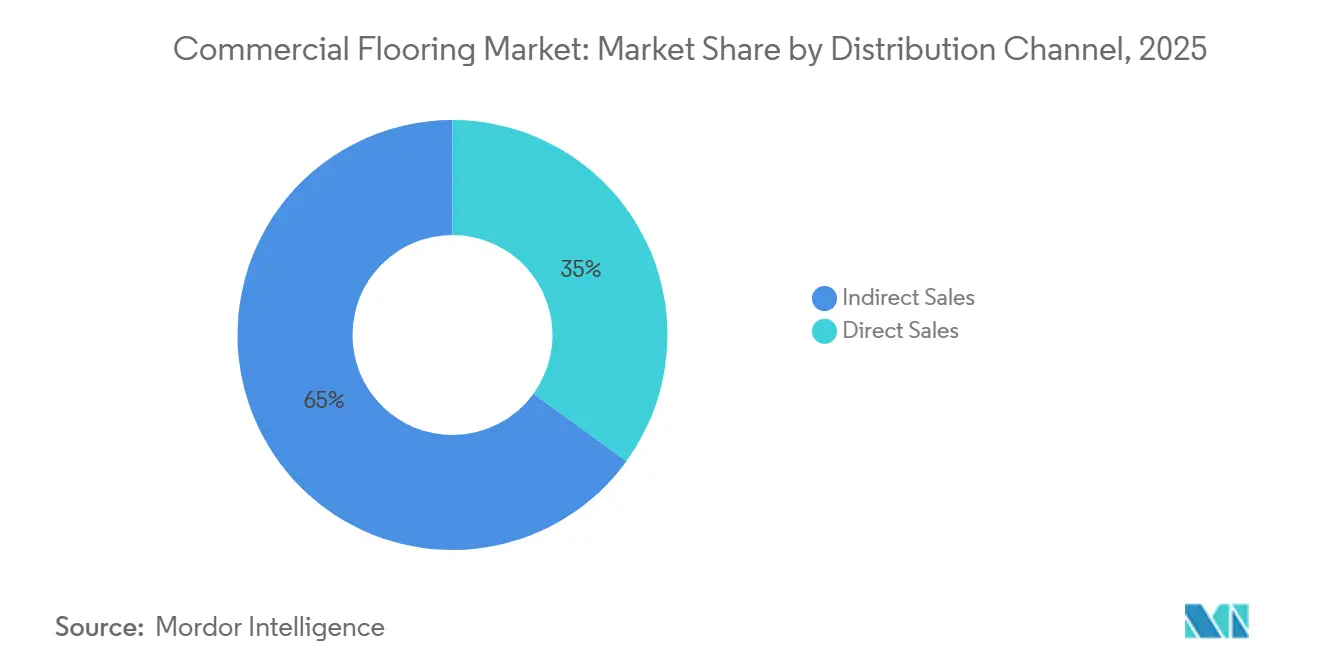
Indirect Sales Dominate but Direct Channel Growth Signals Specification-Led Procurement ShiftIndirect sales, through distributors and dealers, accounted for 65% of commercial flooring distribution in 2025. This channel remains strong because it offers local inventory access, installation coordination, and project-level pricing support that many customers still rely on. At the same time, direct sales are forecast to grow the fastest at a 7.37% CAGR through 2031. That shift suggests manufacturers are allocating more resources to direct specification teams and digital tools to engage more closely with architects, facility managers, and general contractors. The strongest momentum is visible in resilient and modular tile categories, where standardized products and accessible documentation make digital selection and approval easier.
The channel mix is also changing as larger players invest in hybrid models that combine direct engagement with dealer-based fulfillment. This is making the line between direct and indirect distribution less clear than before. Online e-commerce remains the smallest channel, but it is gaining traction as younger procurement professionals become more comfortable with digital sourcing, online sample requests, BIM integration, and technical document access. These tools are helping shorten specification cycles and reducing the information advantage that distributor networks once held. Even so, distributors and dealers remain important in custom carpet tile, specialty resinous flooring, and natural stone, where project complexity still demands in-person guidance and stronger logistics support.
Geography Analysis
North America Commercial Flooring Market
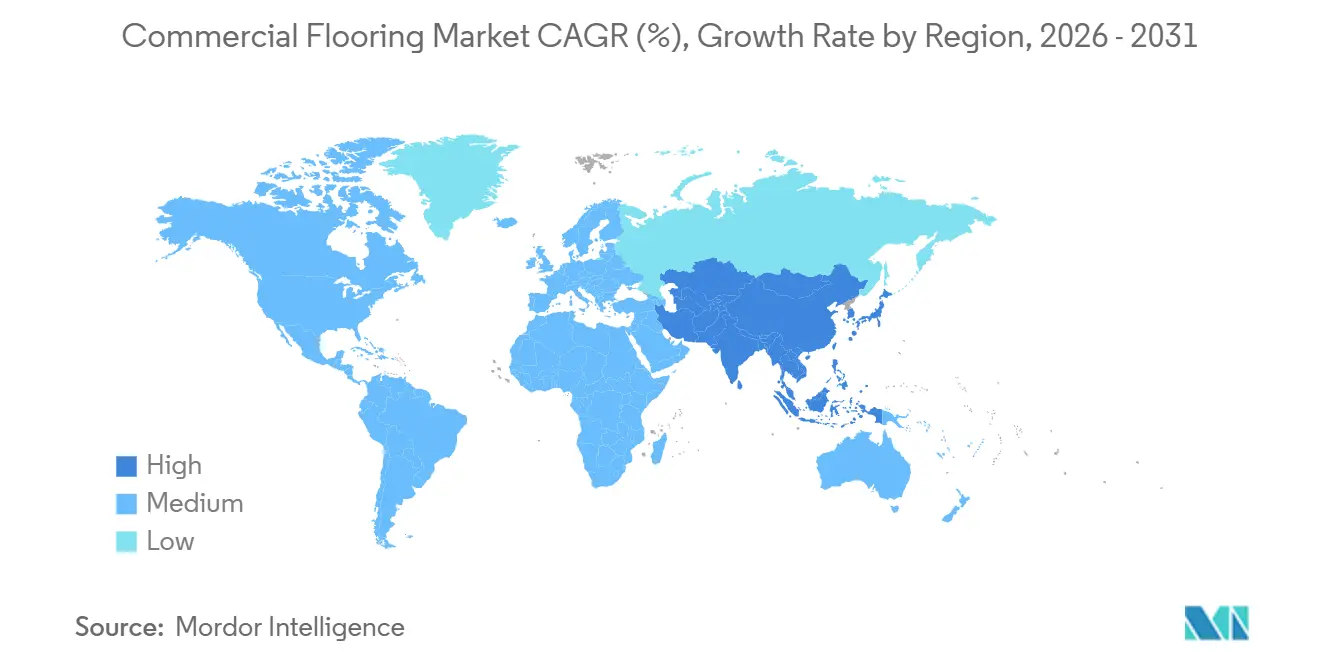
North America is the fastest-growing regional market, forecast to expand at a 7.50% CAGR through 2031. The region is recovering from an earlier period of interest-rate-related softness, and demand is improving across office, healthcare, and education renovation activity. Domestic manufacturers are also in a stronger position to benefit from interest in locally produced flooring and shifting trade conditions. At the same time, the regulatory environment around PFAS is becoming stricter, raising compliance costs but also creating room for manufacturers to offer reformulated product lines with stronger environmental positioning. Canada and Mexico add to the regional outlook through nearshoring-related growth in logistics and industrial development.
APAC Commercial Flooring Market
Asia-Pacific held the largest regional share at 38% in 2025, supported by non-residential construction activity in India, China, Indonesia, and Vietnam. Office supply growth, infrastructure spending, and large urban development projects continue to support flooring demand across the region. Japan and Australia present a different pattern, where refurbishment, relocation activity, and ESG-led upgrades are creating opportunities for higher-specification flooring solutions. Across the region, manufacturers are also pushing more premium and acoustically enhanced surfaces as commercial demand becomes more quality-driven. While cost remains a major factor in emerging APAC markets, green building codes in key urban centers are gradually pushing EPD adoption and raising expectations for documented environmental performance.
EMEA and South America Commercial Flooring Market
Europe is expanding at a moderate pace as macroeconomic pressure and slower non-residential construction limit short-term growth. Even so, the region is being reshaped by sustainability regulations, which are raising the bar for environmental reporting and making product documentation increasingly important for market access. These changes are especially relevant for carpet and soft coverings, where extended producer responsibility and circularity requirements are likely to tighten further through 2030. The Middle East and Africa present a mixed picture, with hospitality and mixed-use development supporting demand in the UAE and Saudi Arabia. South America is recovering from a lower base and is seeing gradual support from retail, hospitality, and light industrial activity. Across these regions, growth remains uneven, but demand is clearly moving toward better-documented, more sustainable flooring solutions.
Competitive Landscape
The commercial flooring market shows moderate concentration, leaving meaningful runway for regional specialists and niche innovators focused on material health, circularity, and performance. Mohawk participates across ceramic, carpet tile, LVT, sheet, hardwood, and laminate with a broad brand portfolio and continued footprint optimization to support product mix and service levels. Shaw leverages strong North American distribution and commercial brands to maintain scale in key end-use sectors, while also investing in recyclable, PVC-free, resilient offerings. Tarkett maintains a global position in resilient and soft surfaces across healthcare, education, and the workplace, supported by lifecycle transparency and low-carbon development. Interface leads in modular carpet tile with a growing resilient portfolio and a long-standing EPD program that enables comprehensive documentation for large projects.
Strategic moves emphasize technology, sustainability, and channel reach. One global coatings leader deepened its presence in resinous floors for institutional and industrial environments through a distribution partnership with a major commercial brand, expanding access and specification visibility among enterprise buyers. Shaw introduced a PVC-free, resilient platform that is fully recyclable and linked to a take-back program with published environmental guarantees, aligning with institutional circularity goals. Several global flooring leaders continue to streamline operations and adjust capacity for resilient categories to enhance responsiveness and cost positions in commercial programs. In parallel, brands with full EPD coverage and active take-back capabilities are better placed to win bids as public procurement criteria and LEED v5 documentation standards tighten.
Opportunities are widening for healthcare-ready resilient systems that integrate antimicrobial performance, sound attenuation, and cleanroom compatibility, as well as for technology facilities that require ESD control and stable thermal performance. Suppliers that publish verifiable embodied carbon values and maintain robust material health disclosures stand to benefit from specification filters that prioritize third-party validation. Hybrid distribution, which combines direct engagement for complex specifications with digital procurement for sampling and compliance checks, is expected to gain share as owners demand faster, more transparent decision cycles. The commercial flooring market continues to favor portfolios that match durability and aesthetics with circularity and traceable documentation across the entire product lifecycle.
Commercial Flooring Industry Leaders
-
Mohawk Industries
-
Shaw Industries Group
-
Tarkett
-
Gerflor
-
Interface
- *Disclaimer: Major Players sorted in no particular order
Commercial Flooring Market Companies Covered in this Report
- Mohawk Industries
- Shaw Industries Group
- Tarkett
- Interface
- Gerflor
- Forbo Flooring Systems
- Mannington Commercial
- Milliken
- Armstrong Flooring (commercial brand under AHF Products)
- Altro
- RAK Ceramics
- Polyflor (James Halstead)
- Karndean Designflooring
- NOX Corporation
- LX Hausys (HFLOR)
- Ecore International
- Roppe Holding Company
- J+J Flooring
- Crossville
- Florim
Recent Industry Developments in Commercial Flooring Market
- April 2026: AHF Products introduced its next-generation Armstrong Natural Creations LVT collection, featuring 51 SKUs with Diamond 10 Technology, achieving a perfect 10 on the Mohs hardness scale, FloorScore certification, and freedom from ortho phthalates and heavy metals, backed by a 30-year commercial warranty and targeting high-traffic healthcare, education, retail, and workplace environments.
- April 2026: Crossville launched its Cleve porcelain tile collection, a carbon-neutral product inspired by quartzite, featuring a proprietary FeatherSoft finish, V4 variation rating, four nature-grounded colorways, and a complete trim package, manufactured in the United States and supporting the company's goal to reduce tile carbon footprint by 30%.
- May 2025: RAK Ceramics launched a next-generation slab production facility featuring advanced Continua+ PCR 2180 technology with an annual production capacity of 4 million square meters and sizes up to 180×360 cm, integrating IoT-enabled smart manufacturing and zero manual intervention for quality inspection.
- October 2024: PPG and Shaw Industries signed a strategic agreement to offer PPG FLOORING resinous products through Shaw's Patcraft brand, expanding resinous access for institutional, industrial, and workplace customers.
Global Commercial Flooring Market Report Scope
Segmentation Overview
| Rugs and Carpets | |
| Resilient Flooring | Luxury Vinyl Tiles |
| Vinyl sheets | |
| Rubber | |
| Linoleum | |
| Others | |
| Non-Resilient Flooring | Wood Flooring |
| Laminate Flooring | |
| Stone/Marble Flooring | |
| Ceramic Flooring | |
| Others |
| Offices & Corporate |
| Retail |
| Healthcare |
| Education |
| Hospitality |
| Institutional/Public |
| Other Commercial End-Users |
| Direct Sales |
| Indirect Sales |
| North America | Canada |
| United States | |
| Mexico | |
| South America | Brazil |
| Peru | |
| Chile | |
| Argentina | |
| Rest of South America | |
| Europe | United Kingdom |
| Germany | |
| France | |
| Spain | |
| Italy | |
| BENELUX (Belgium, Netherlands, Luxembourg) | |
| NORDICS (Denmark, Finland, Iceland, Norway, Sweden) | |
| Rest of Europe | |
| Asia-Pacific | India |
| China | |
| Japan | |
| Australia | |
| South Korea | |
| South-East Asia | |
| Rest of Asia-Pacific | |
| Middle East & Africa | United Arab Emirates |
| Saudi Arabia | |
| South Africa | |
| Nigeria | |
| Rest of Middle East & Africa |
| By Product Type | Rugs and Carpets | |
| Resilient Flooring | Luxury Vinyl Tiles | |
| Vinyl sheets | ||
| Rubber | ||
| Linoleum | ||
| Others | ||
| Non-Resilient Flooring | Wood Flooring | |
| Laminate Flooring | ||
| Stone/Marble Flooring | ||
| Ceramic Flooring | ||
| Others | ||
| By End-user | Offices & Corporate | |
| Retail | ||
| Healthcare | ||
| Education | ||
| Hospitality | ||
| Institutional/Public | ||
| Other Commercial End-Users | ||
| By Distribution Channel | Direct Sales | |
| Indirect Sales | ||
| By Geography | North America | Canada |
| United States | ||
| Mexico | ||
| South America | Brazil | |
| Peru | ||
| Chile | ||
| Argentina | ||
| Rest of South America | ||
| Europe | United Kingdom | |
| Germany | ||
| France | ||
| Spain | ||
| Italy | ||
| BENELUX (Belgium, Netherlands, Luxembourg) | ||
| NORDICS (Denmark, Finland, Iceland, Norway, Sweden) | ||
| Rest of Europe | ||
| Asia-Pacific | India | |
| China | ||
| Japan | ||
| Australia | ||
| South Korea | ||
| South-East Asia | ||
| Rest of Asia-Pacific | ||
| Middle East & Africa | United Arab Emirates | |
| Saudi Arabia | ||
| South Africa | ||
| Nigeria | ||
| Rest of Middle East & Africa | ||
Key Questions Answered in the Report
What is the current size of the commercial flooring market, and how fast is it expected to grow?
The commercial flooring market size is estimated at USD 115.8 billion in 2026 and is projected to reach USD 153.08 billion by 2031, growing at a 5.74% CAGR from 2026 to 2031.
How large was the commercial flooring market in 2025?
The commercial flooring market was valued at USD 110.08 billion in 2025, setting the base for forecast expansion through 2031.
Which product category leads demand in commercial flooring?
Non-resilient flooring held the largest share at 54% in 2025, while resilient flooring is expected to grow the fastest at a 7.20% CAGR through 2031.
Which end-user segment is the most important in commercial flooring demand?
Offices accounted for the largest end-user share at 32% in 2025, while healthcare is projected to post the fastest growth at a 7.05% CAGR through 2031.
Which sales channel currently dominates the commercial flooring space?
Indirect sales led distribution with a 65% share in 2025, but direct sales are forecast to expand faster at a 7.37% CAGR over 2026 to 2031.
Which region leads the commercial flooring market, and which region is growing the fastest?
Asia-Pacific held the largest regional share at 38% in 2025, while North America is expected to be the fastest-growing region with a 7.50% CAGR through 2031.