
Hardwood Flooring Market Size and Share
Market Overview
| Study Period | 2020 - 2031 |
|---|---|
| Market Size (2026) | USD 55.46 Billion |
| Market Size (2031) | USD 73.79 Billion |
| Growth Rate (2026 - 2031) | 5.88 % |
| Fastest Growing Market | Asia Pacific |
| Largest Market | Europe |
| Market Concentration | Medium |
Major Players *Disclaimer: Major Players sorted in no particular order Image © Mordor Intelligence. Reuse requires attribution under CC BY 4.0. | |
Hardwood Flooring Market Analysis by Mordor Intelligence
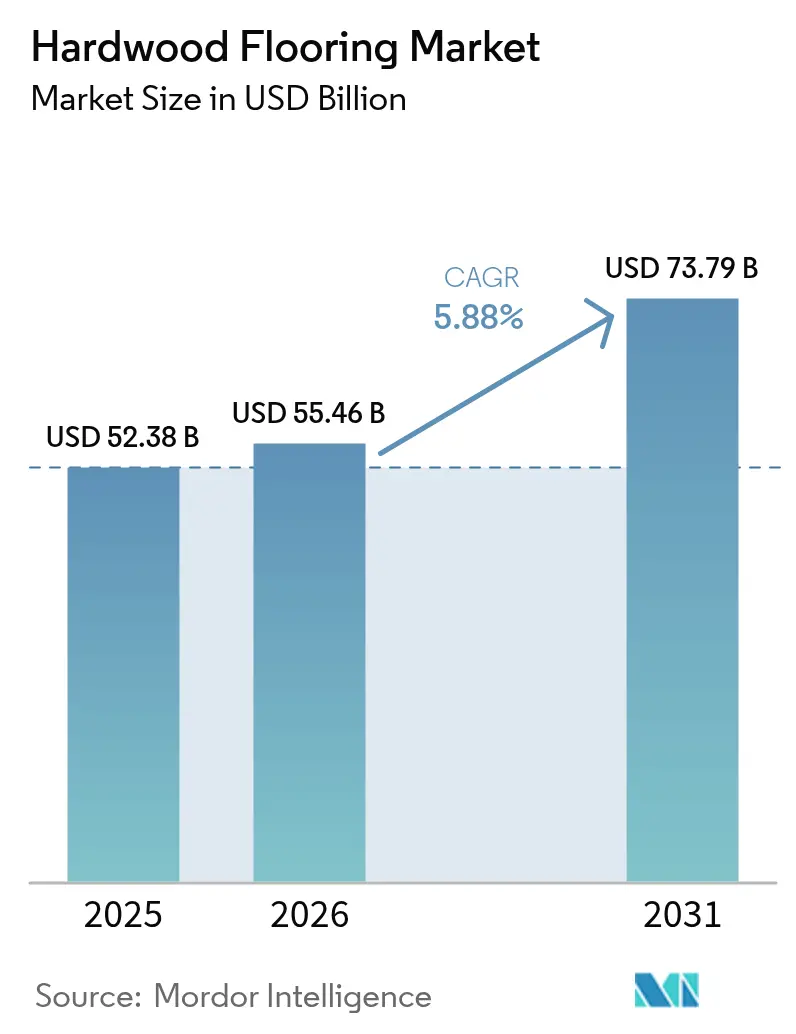
The hardwood flooring market size is expected to grow from USD 52.38 billion in 2025 to USD 55.46 billion in 2026 and is forecast to reach USD 73.79 billion by 2031 at 5.88% CAGR over 2026-2031. Renovation-focused spending in high-income economies, rapid engineered-wood innovations, and digital sales adoption collectively sustain a steady expansion trajectory even as interest-rate volatility challenges new-build activity. Rising demand for biophilic interiors, strict timber-traceability laws, and the growing popularity of thermally modified hardwood expand the hardwood flooring market into niches that command higher price realization. Leading companies broaden sourcing bases to manage phytosanitary risks and position certified products that satisfy emerging deforestation regulations. Technology-enabled click-lock systems shorten installation times, improving product competitiveness against resilient flooring while keeping labor shortages in check.
Key Report Takeaways
- By product type, engineered wood accounted for 71.98% of the hardwood flooring market share in 2025, while engineered wood is projected to expand fastest at a CAGR of 6.05% between 2026 and 2031.
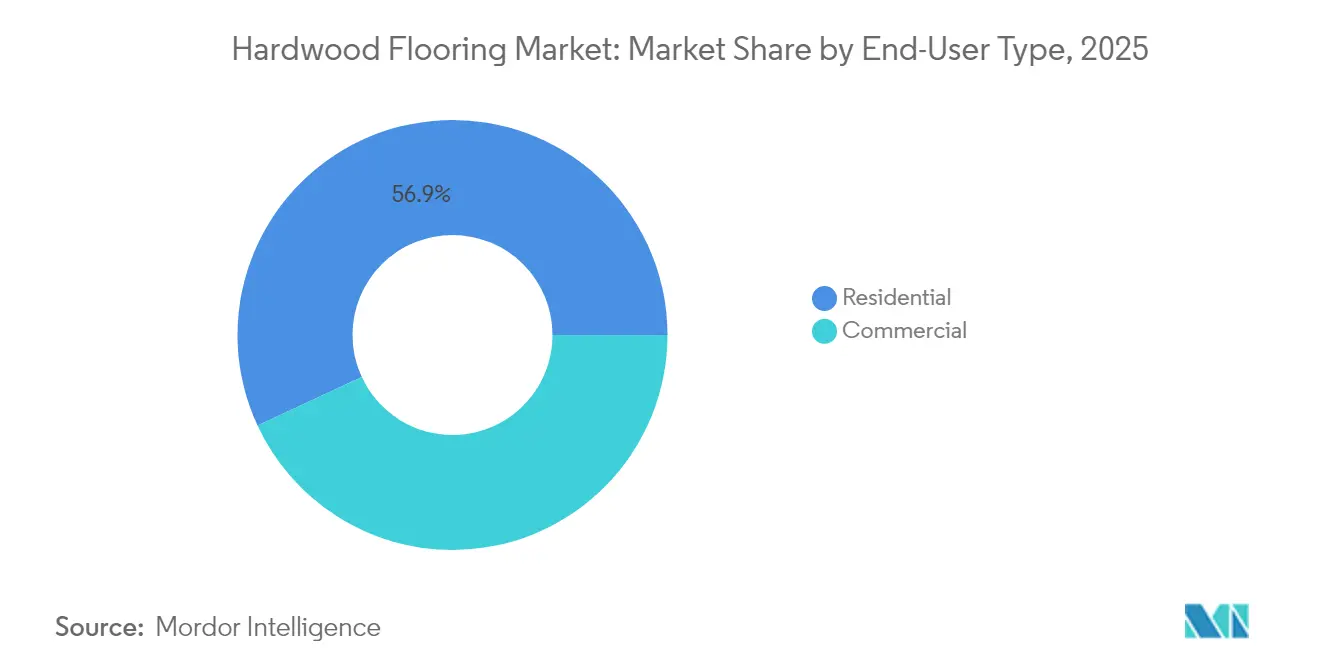
- By end user, residential applications captured 56.92% of the hardwood flooring market share in 2025, with commercial use forecast to grow at the highest CAGR of 7.42% during 2026–2031.
- By distribution channel, offline stores represented 66.55% of the hardwood flooring market share in 2025, while online stores are projected to rise fastest at a CAGR of 14.60% from 2026 to 2031.
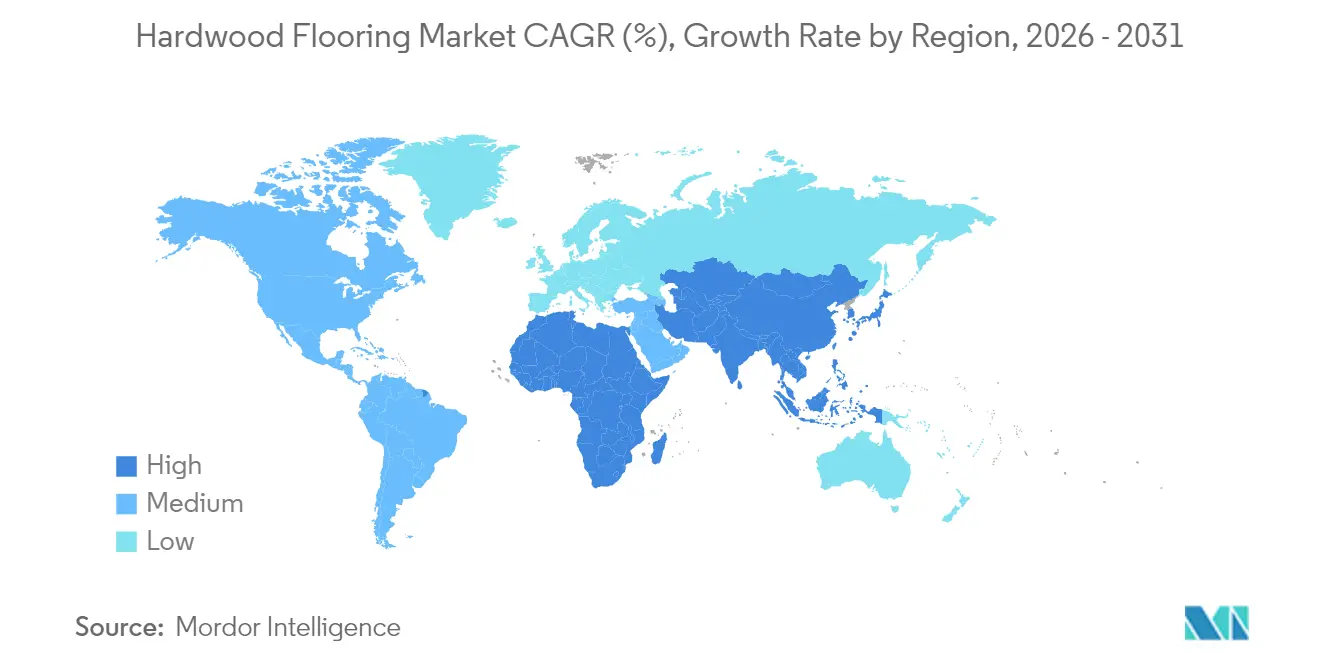
- By geography, Europe held 33.05% of the hardwood flooring market share in 2025, while the Asia-Pacific is expected to grow at the highest CAGR of 7.48% during 2026–2031.
Note: Market size and forecast figures in this report are generated using Mordor Intelligence’s proprietary estimation framework, updated with the latest available data and insights as of 2026.
Market Trends and Insights
Drivers Impact Analysis of Hardwood Flooring Market*
| Driver | (~) % Impact on CAGR Forecast | Geographic Relevance | Impact Timeline |
|---|---|---|---|
| Surging home-renovation spending in developed economies | +1.8% | North America & Europe | Medium term (2-4 years) |
| Expansion of engineered-wood click-lock technologies | +1.2% | Global | Long term (≥ 4 years) |
| Growing preference for biophilic interior aesthetics | +0.9% | North America & Europe, spill-over to APAC | Medium term (2-4 years) |
| Rising residential construction in emerging Asia | +1.5% | APAC core, spill-over to MEA | Long term (≥ 4 years) |
| Commercial adoption of thermally modified hardwood floors | +0.7% | Global, early gains in North America & Europe | Medium term (2-4 years) |
| Uptake of reclaimed & recycled hardwood within circular-economy projects | +0.4% | Europe & North America | Long term (≥ 4 years) |
| Source: Mordor Intelligence | |||
Surging Home-Renovation Spending in Developed Economies
Elevated mortgage costs encourage households to remodel rather than relocate, fueling steady hardwood flooring upgrades in North America and Europe. Market research shows flooring projects deliver high resale value and tangible lifestyle benefits, making premium hardwood a favored investment even during macro uncertainty. The trend smooths revenue cyclicality by trying to increase demand for an aging housing stock rather than to volatile newly built pipelines. Manufacturers leverage the replacement cycle by bundling design services and extended-warranty packages that lift margins. Retailers benefit from predictable traffic and higher ticket values as consumers prioritize living-space enhancements over discretionary goods. Growth momentum is therefore embedded in renovation budgets that remain resilient despite shifting economic sentiment.
Expansion of Engineered-Wood Click-Lock Technologies
Proprietary locking mechanisms such as Uniclic and Välinge 5G fold-down profiles enable floating installations that cut labor time by up to 60%, expanding the hardwood flooring market among DIY enthusiasts and light-commercial specifiers. Moisture-resistant cores mitigate cupping concerns, allowing kitchens and basements to adopt engineered planks historically reserved for vinyl. Patent protection around locking systems creates pricing power and licensing revenue streams for technology owners, while driving industry-wide R&D is aimed at slimmer, more dimensionally stable constructions. This efficiency gains lower total project costs, making engineered hardwood a feasible upgrade path when budgets might otherwise tilt to resilient flooring. As a result, click-lock innovation acts as a structural demand driver with long-tail global relevance.
Growing Preference for Biophilic Interior Aesthetics
Architects and designers increasingly specify authentic wood surfaces to meet wellness goals in offices, schools, and healthcare environments. Studies link natural materials to improved productivity and occupant satisfaction, compelling corporate clients to allocate higher finish budgets to hardwood. Wide-plank, nature-grade visuals celebrate organic variation, a language design incompatible with digitally printed vinyl alternatives. Manufacturers highlight low-VOC finishes and traceable sourcing to align with green-building certification benchmarks, creating further pull for premium SKUs. This demand shift translates into higher average selling prices and stimulates product line extensions that pair contrasting species and textures for curated, nature-inspired spaces.
Rising Residential Construction in Emerging Asia
Rapid urbanization accelerates multi-family housing starts throughout China, India, Vietnam, and Indonesia, boosting hardwood penetration beyond luxury developments. Local sawmills scale rubberwood and acacia processing, shortening lead times and reducing landed costs for regional installers. Moreover, rising disposable incomes allow middle-class buyers to upgrade finish packages from laminate to engineered hardwood. Global suppliers co-locate finishing lines in Southeast Asia to capitalize on tariff advantages and proximity to growth markets. Consequently, emerging Asia constitutes the most durable volume opportunity for the hardwood flooring market over the next decade.
Restraints Impact Analysis of Hardwood Flooring Market*
| Restraint | (~) % Impact on CAGR Forecast | Geographic Relevance | Impact Timeline |
|---|---|---|---|
| High upfront cost versus vinyl & laminate alternatives | -1.1% | Global | Short term (≤ 2 years) |
| Stricter sustainability & deforestation regulations | -0.8% | Europe & North America, expanding to APAC | Medium term (2-4 years) |
| Supply-chain disruptions from phytosanitary import checks | -0.6% | Global | Short term (≤ 2 years) |
| Volatility in bio-based adhesive resin pricing | -0.3% | Global | Short term (≤ 2 years) |
| Source: Mordor Intelligence | |||
High Upfront Cost Versus Vinyl & Laminate Alternatives
Luxury vinyl tile replicates wood visuals at a fraction of the material and labor costs, siphoning entry-level demand away from hardwood. Inflation-driven lumber price spikes widen the gap, amplifying consumer price sensitivity. DIY-friendly resilient planks require no sanding or finishing, saving an additional 30-50% on installation labor. Commercial specifiers balancing budget and durability perceive limited ROI in hardwood for back-of-house or moisture-exposed zones. Manufacturers counter by amplifying value propositions around refinishing longevity and end-of-life recyclability yet cost parity remains elusive in price-driven bids.
Stricter Sustainability & Deforestation Regulations
The European Union Deforestation Regulation (EUDR), coming into effect in December 2025, obliges importers to provide full traceability to plot-level origin, adding 2-4% compliance costs across the supply chain[1]European Commission, “Regulation on Deforestation-Free Supply Chains,” europa.eu. . FSC and PEFC certifications transition from optional differentiation to baseline market access requirements, elevating audit fees and documentation burdens. Smaller mills face disproportionate overhead, accelerating consolidation toward vertically integrated groups. Retailers standardize EUDR-ready procurement frameworks globally, effectively extending European rules to third-country sales. Transition uncertainty dampens short-term export volumes and elongates shipping cycles as documentation is verified.
*Our forecasts treat driver/restraint impacts as directional, not additive. The impact forecasts reflect baseline growth, mix effects, and variable interactions.
Hardwood Flooring Market Segment Analysis
By Product Type:
Engineered Wood Drives InnovationEngineered planks captured 71.98% of the hardwood flooring market share in 2025 and are forecast to maintain a 6.05% CAGR to 2031, underscoring their dominance in both scale and momentum. This leadership stems from multilayer cores that curb seasonal movement and accept factory-applied finishes, translating into lower call-backs and higher installer productivity. Engineered wood in the hardwood flooring market is anticipated to witness significant growth by 2031, highlighting its importance in both residential renovations and expansive commercial projects.
Solid wood maintains relevance among heritage restorations and premium custom homes, where the capability to sand multiple times supports century-long lifespans. Red and white oak species command pricing premiums due to grain uniformity and domestic availability, while maple earns niche demand in sports flooring for its hardness. Yet, scalable product innovation skews toward engineered formats: Välinge’s Woodura surface densification triples dent resistance and unlocks thinner wear layers that optimize raw-material yield. Producers also integrate recycled wood fibers into core layers, elevating sustainability credentials without compromising stability. These advances consolidate engineered wood’s status as the hardwood flooring market’s technology bellwether.




By End-User Type:
Commercial AccelerationResidential remodeling supplied 56.92% revenue in 2025, anchoring the hardwood flooring market with predictable upgrade cycles tied to aging housing stock. Pandemic-era nesting accelerated living-room and bedroom refits, a momentum that has normalized but remains structurally elevated relative to pre-2023 levels. Driven by a consistent trend of homeowners opting to stay put and renovate, the residential demand for hardwood flooring is anticipated to significantly boost the market size by 2031.
Conversely, the commercial segment is projected to expand to a 7.42% CAGR, the fastest across all end-user groups. Corporate workplace revamps center on wellness themes that prioritize tactile, low-VOC surfaces, positioning thermally modified ash and oak as attractive, durable options. Hospitality chains specify hardwood in lobby zones to reinforce brand identity via natural materials, while boutique retail adopts reclaimed planks for storytelling. Large-format office retrofits further lift demand, with square-foot volumes outpacing new office starts. Consequently, commercial growth adds balance to the hardwood flooring market by reducing reliance on consumer sentiment swings.
By Distribution Channel:
Digital Transformation AcceleratesBrick-and-mortar outlets preserved a 66.55% share in 2025, leveraging in-store vignettes and pro-install networks that remain critical for big-ticket flooring purchases. Showroom walk-throughs enable sensory evaluation—color, texture, and acoustic absorption—that digital interfaces cannot fully replicate. However, omnichannel journeys increasingly begin online; Floor & Decor reports that web-initiated orders accounted for 19% of total sales in 2024.
Online pure-plays and click-and-collect hybrids are forecast to capture the bulk of incremental growth at 14.60% CAGR through 2031. Configurations using AR place planks into photos of customer rooms, reducing selection friction. Sample-by-mail programs cut decision cycles, while integrated installers close service gaps. E-commerce also accelerates rural penetration where showrooms are sparse, broadening the hardwood flooring market’s geographic reach. Yet digital fulfillment imposes new logistics challenges: bulky, heavy cartons require specialized carriers and white-glove delivery, favoring retailers with capital to build dedicated distribution centers.
Geography Analysis
Europe Hardwood Flooring Market
Europe retained a 33.05% share of the hardwood flooring market in 2025, underpinned by stringent eco-labeling norms and a renovation-oriented building stock. Nordic design preferences favor light-tone engineered oak finished with natural oils, a look that permeates German and Dutch markets. The pending EUDR compliance deadline incentivizes domestic mills to secure chain-of-custody certifications, reinforcing regional supply security. France’s MaPrimeRénov’ subsidy boosts residential retrofits, while commercial upgrades linked to the Paris 2024 legacy program elevate demand in hospitality and mixed-use venues.
APAC Hardwood Flooring Market
Asia-Pacific registers the fastest momentum with a 7.48% CAGR, adding millions of square feet of new apartments annually. China’s coastal provinces allocate higher finish budgets in response to up-market consumer shifts, while tier-two cities introduce local subsidies that reward low-formaldehyde flooring. India’s Pradhan Mantri Awas Yojana projects and Jakarta’s TOD schemes include green-building clauses that lift engineered-wood inclusion rates. Regional sawmills integrate kiln-drying and UV finishing lines to serve export markets facing anti-dumping duties, bolstering intra-Asia value addition.
North America Hardwood Flooring Market
North America sustains a mature, yet sizeable demand base anchored by renovation spending. Lumber tariffs and phytosanitary checks create periodic supply volatility, yet abundant FSC-certified Appalachian oak stabilizes input costs for domestic producers. U.S. builders increasingly specify thermally modified species for decking and three-season rooms, cross-selling indoor planks for design continuity. Canadian installers capitalize on favorable currency dynamics when sourcing from European mills, diversifying supply. While growth lags Asia, stable replacement demand ensures North America remains core to multinationals’ revenue mix.

Regulatory Landscape
Hardwood flooring supply chains are increasingly shaped by deforestation traceability and import-disclosure requirements for plant products. In the European Union, the EU Deforestation Regulation (EUDR) establishes due-diligence obligations tied to geolocation-based traceability, with application timelines referenced at 30 December 2026 for large and medium-sized operators (and micro/small operators already covered by the EU Timber Regulation), and 30 June 2027 for other micro and small operators. The European Commission also issued implementation updates and tools in July 2026 to support compliance.
In the United States, imported wood products face layered oversight through USDA APHIS and customs processes, including Lacey Act declaration requirements that expanded with Phase VII implementation beginning 1 December 2024 for remaining plant-based product codes, affecting wood flooring declarations on species and origin. Separately, Section 232 actions and related Federal Register notices in 2025-2026 introduced additional duty and tariff uncertainty for certain wood-based imports, reinforcing the need for resilient sourcing, documentation, and compliance workflows among global producers, distributors, and retailers.
Value Chain Analysis
The hardwood flooring value chain starts with forest management, logging, and timber procurement, then moves through sawmilling, kiln drying, and grading. For engineered wood, the process continues with veneer or lamella preparation and core manufacturing. Midstream flooring plants assemble engineered planks (core build-up, pressing, and profiling), apply factory finishes (UV-cured coatings and oils), and produce installation-ready formats, including click-lock systems licensed from technology owners. Quality and compliance expectations increasingly extend upstream, requiring chain-of-custody and chemical-emissions documentation that downstream distributors, retailers, and project specifiers ask for.
Downstream, products flow through wholesalers, specialty flooring retailers, and home-center channels, while e-commerce adds sampling, visualization, and white-glove delivery. Channel shifts in 2026 reflect ongoing value-chain reconfiguration, including Johnson Hardwood moving to direct distribution in the Southeast United States after a regional distributor closure, and ownership changes that update manufacturing footprints, such as Mutares completing the acquisition of Hamberger Industriewerke's flooring business (HARO) and adding automated sites in Germany and Bulgaria. Bottlenecks remain concentrated around import compliance (documentation and phytosanitary checks), bulky-product logistics, and installer availability, which increases the strategic value of click-lock formats and localized inventory positions.
Competitive Landscape
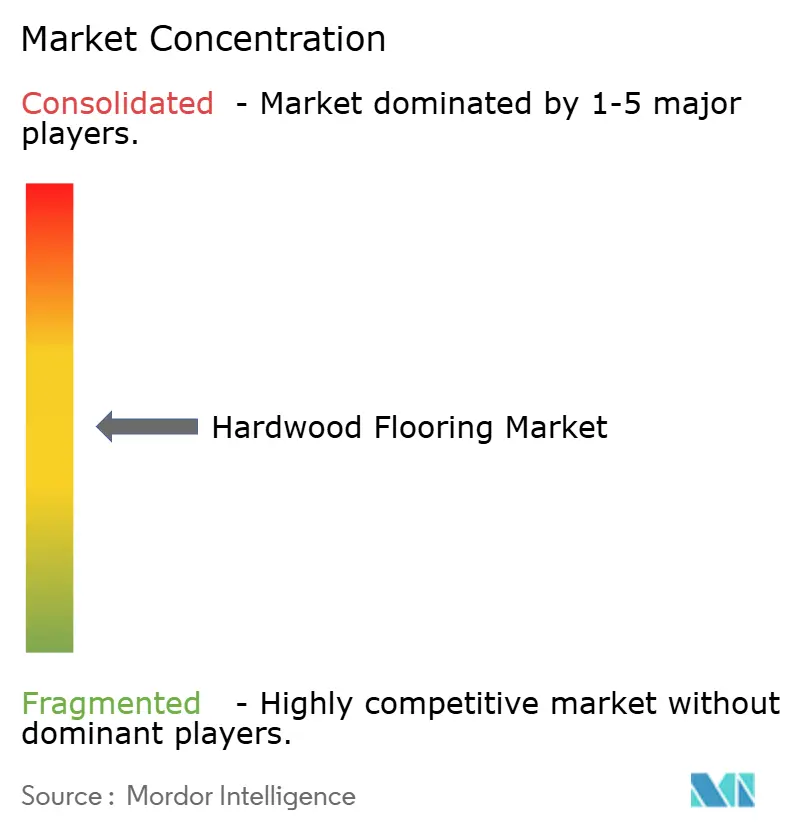
The hardwood flooring market exhibits moderate concentration; the five largest producers held 43% combined revenue in 2024. Mohawk Industries, AHF Products, and Kährs Group leverage vertically integrated sourcing and proprietary installation technologies to protect margins. Armstrong Flooring’s asset sale to AHF Products illustrates consolidation opportunities that emerge when leveraged players falter.
Strategic focus has pivoted to cost optimization and sustainable differentiation. Mohawk’s 2025 restructuring targets USD 100 million in annual savings through plant rationalizations and automation, buffering margin pressure from rising adhesive costs[3]Mohawk Industries, “Q1 2025 Results,” mohawkindustries.com. . Technology IP remains another battleground: Unilin enforces locking patents aggressively, collecting licensing royalties that fund next-generation R&D. Mid-sized regional specialists differentiate via locally popular species and fast-cycle custom color programs, a nimbleness that global giants struggle to match.
E-commerce upstarts employ direct-to-consumer models that bypass wholesale markups, leveraging algorithmic pricing and drop-shipping partnerships to undercut showroom quotes. Traditional retailers respond by integrating augmented-reality visualization and same-week installation services, replicating the digital convenience selling point. Sustainability further shapes rivalry: mills that achieve cradle-to-gate Environmental Product Declarations gain specification preference in institutional projects, nudging laggards toward greener chemistry and biomass energy adoption.
Hardwood Flooring Industry Leaders
Mohawk Industries
Shaw Industries Group
AHF Products (Bruce Hardwood)
Tarkett S.A.
Kährs Group
- *Disclaimer: Major Players sorted in no particular order
Hardwood Flooring Market Companies Covered in this Report
- Armstrong Flooring
- Mohawk Industries
- Shaw Industries Group
- AHF Products (Bruce Hardwood)
- Tarkett S.A.
- Mannington Mills
- Somerset Hardwood Flooring
- Kährs Group
- Bauwerk Group
- Boral Timber
- Haro (Hamberger Flooring)
- Swiss Krono Group
- Quick-Step (Unilin)
- Balterio
- Mirage (Boa-Franc)
- Dinesen
- Floor & Décor Holdings
- LL Flooring (Lumber Liquidators)
- Greenply Industries
- Nature Home Holding

Market Opportunities and Future Outlook
Compliance-led differentiation is creating space for verified, deforestation-free, and documentation-ready hardwood flooring programs that reduce friction for importers, retailers, and specifiers as EUDR deadlines approach. In March 2026, the American Hardwood Export Council launched the American Hardwood Assured (AHA) platform, using satellite imagery and AI to support legal and deforestation-free claims for U.S. hardwood exports, giving suppliers and downstream sellers a way to package traceability into procurement-ready offerings.
Manufacturing efficiency and product performance are also becoming more data-driven, which opens opportunities around waste reduction, consistency, and premium positioning in engineered wood. In 2026, Kähr's partnered with Prevas to implement AI-powered vision inspection on production lines (June 2026), and Raute deployed AI-enhanced defect detection for veneer-based engineered wood production (July 2026). On the demand creation side, digital merchandising and visualization are improving conversion for wood visuals; Roomvo's 2026 trends reporting noted engineered wood reaching 34% of visualized wood flooring products in 2025, supporting investments in AR and visualization, sample programs, and curated premium collections aligned to biophilic design and higher-end renovation budgets.
Recent Industry Developments in Hardwood Flooring Market
- July 2026: Mohawk Industries partnered with Montgomery Community College, Gaston College, and NCEdge to launch a multi-year workforce training program connected to its Mount Gilead manufacturing facility in North Carolina. The initiative targets talent pipelines and skills development that support manufacturing continuity and process upgrades. Strengthening labor availability and training capacity helps reduce operational constraints for large-scale flooring output.
- June 2025: AHF Products launched Armstrong Flooring TimberTones Densified Hardwood, manufactured in Somerset, Kentucky and positioned for modern commercial spaces. The product focuses on enhanced durability while keeping real-wood aesthetics central to specification-driven projects. New performance-oriented engineered offerings support premium mix strategies in channels where hardwood competes with resilient flooring on functionality.
- December 2024: Cyncly acquired Broadlume to integrate CRM, website, and visualization capabilities for flooring retailers. The combined platform strengthens digital lead handling and online-to-offline selling workflows that are increasingly relevant for high-ticket flooring purchases. Improved visualization and retail tech integration can shorten decision cycles and support omnichannel conversion for hardwood categories.


Hardwood Flooring Market Report Scope and Research Methodology
Market Definition and Coverage
For this methodology, the hardwood flooring market includes factory-made solid and engineered hardwood flooring products sold as finished floor surfaces in residential and commercial buildings, measured in value terms at the point of first sale.
Scope exclusions: This sizing excludes softwood flooring, laminate, vinyl, ceramic, carpet, and installation labor and tools.
Segments Covered in This Report
- By Product Type
- Solid Wood
- Red Oak
- White Oak
- Maple
- Other Solid Woods
- Engineered Wood
- Solid Wood
- By End-User Type
- Residential
- Commercial
- By Distribution Channel (Value)
- Offline Stores
- Online Stores
- By Geography
- North America
- Canada
- United States
- Mexico
- South America
- Brazil
- Peru
- Chile
- Argentina
- Rest of South America
- Europe
- United Kingdom
- Germany
- France
- Spain
- Italy
- BENELUX (Belgium, Netherlands, Luxembourg)
- NORDICS (Denmark, Finland, Iceland, Norway, Sweden)
- Rest of Europe
- Asia-Pacific
- India
- China
- Japan
- Australia
- South Korea
- South East Asia (Singapore, Malaysia, Thailand, Indonesia, Vietnam, Philippines)
- Rest of Asia-Pacific
- Middle East And Africa
- United Arab Emirates
- Saudi Arabia
- South Africa
- Nigeria
- Rest of Middle East And Africa
- North America
Data Sources, Market Sizing, and Validation
Desk Research
Desk work started with mapping the demand pool for hardwood flooring by connecting housing completions, renovation activity, and commercial fit-out cycles to floor covering spend. To keep assumptions grounded, we relied on public indicators such as U.S. Census building and housing releases, Eurostat construction series, and comparable national statistics, which help explain when demand expands or slows.
We also reviewed trade and supply signals that influence availability and pricing, such as U.S. International Trade Commission trade statistics, UN Comtrade flows, and forestry and timber context from sources such as FAO. Product and application direction was cross-checked through association publications and technical articles, including those from the National Wood Flooring Association and standards bodies, and then aligned with company filings, investor presentations, and reputable press for pricing and channel signals. Where they improved consistency, we used paid subscriptions for company financials, patents, and shipment-level trade checks. The sources listed here are illustrative rather than exhaustive, since other references were also used for data collection, validation, and clarification.
Primary Interviews and Surveys
Primary discussions were run with a mix of manufacturers, distributors, retailers, and installers, followed by conversations with architects and large buyers who shape material choice and replacement cycles. Since this is a global market, we balanced inputs across APAC, EMEA, and the Americas to test how renovation intensity, species preferences, and channel mix are shifting, and then used those views to close gaps from desk findings and confirm the final assumptions.
Distribution of primary research fieldwork respondents
| Company type | Respondent position | Region |
|---|---|---|
| Top tier: 27% | CXOs: 13% | APAC: 40% |
| Mid tier: 57% | Functional/Unit leaders: 39% | EMEA: 33% |
| Smaller Players: 16% | Managers: 48% | Americas: 27% |
Market-Sizing & Forecasting
The core model uses a top-down build where construction and renovation indicators reconstruct addressable flooring demand, which is then adjusted for hardwood adoption, replacement timing, and typical price per square area to reach a value estimate. To keep totals realistic, we corroborated results with selective bottom-up approximations, including sampled average selling price (ASP) by channel and region, and supplier and distributor roll-ups where coverage was clear, then used conservative peer proxies to fill gaps.
Inputs used in the model include housing starts and completions, remodeling and repair spending trends, nonresidential floor space additions, import dependence versus local output, and engineered versus solid mix shifts that affect ASP. Because inflation and freight swings can distort value trends, ASP progression was handled by linking to observable material and logistics signals, then rechecked with interview feedback.
For the forecast, scenario analysis was used so the outlook can reflect different paths for new-build cycles, renovation resilience, and premiumization. Assumptions were stress tested at the region level, and the final numbers were locked only after the demand signals and price logic aligned.
Data Validation & Update Cycle
Validation is done through multiple checks, starting with comparing model output against independent signals like construction activity, trade flows, and visible price movements, and then reviewing variances that fall outside expected ranges. When a mismatch showed up, we revisited the drivers first, then recontacted selected interviewees to confirm whether the issue was scope, pricing, or timing.
Before sign-off, the work goes through a multi-step analyst review so inputs, formulas, and regional splits are consistent and traceable. Reports are refreshed annually, with interim updates triggered by material events such as sharp currency shifts, sudden tariff changes, or major capacity announcements, and a final pre-delivery pass is completed so clients receive the latest updated view.
Mordor Intelligence's Hardwood Flooring Market Estimate Compared With Other Published Estimates
It is normal to see different market values for hardwood flooring, even when the topic name looks the same, because the definitions and pricing mechanics are not always aligned. The differences usually come from what is counted as hardwood flooring, which year is used for the starting value, and how price and product mix are carried forward.
A refresh-led difference can be visible in this market because engineered share shifts can change average selling price, and currency conversion windows can move a global total even if local volumes stay steady. By revalidating ASP and exchange-rate timing close to publication, then reconciling the output with trade and construction indicators, Mordor Intelligence keeps the estimate tied to the same demand and pricing signals used through the model.
Benchmark comparison
| Source | Market Size | Gaps in Research Methodology |
|---|---|---|
| Mordor Intelligence | USD 55.46 B (2026) | |
| Trade Journal A | USD 2.07 B (2025) | The figure reflects a United States-only industry value estimate tied closely to domestic production and trade context, so it does not represent global demand across regions and channels. |
| Industry Report B | USD 14.20 B (2025) | The estimate uses a different time window and may capture a narrower value pool, which can happen when revenues are closer to manufacturer sales and when channel margins and product mix are treated differently. |
Seen together, the spread is mainly explained by geography and what part of the value chain is counted, followed by year and price timing. Our approach keeps each step traceable to construction, renovation, trade, and mix inputs, so readers can reconcile the total with observable signals and repeat the logic with updated assumptions.


Key Questions Answered in the Report
How large is the global hardwood flooring space in 2026, and what CAGR is expected through 2031?
It stands at USD 55.46 billion in 2026 and is forecast to climb to USD 73.79 billion by 2031, reflecting a 5.88% CAGR.
Which product type currently dominates hardwood flooring sales?
Engineered wood leads with 71.98% share in 2025 and also posts the fastest projected growth at a 6.05% CAGR.
What makes engineered wood increasingly popular with homeowners and contractors?
Multilayer cores provide moisture stability and click-lock systems trim installation time by up to 60%, lowering total project cost.
Which geographic region is projected to post the highest growth in hardwood flooring demand?
Asia-Pacific is expected to register a 7.48% CAGR through 2031, driven by rapid residential construction and rising disposable incomes.
How significant are online channels for purchasing hardwood flooring?
E-commerce remains a minority channel today but is forecast to grow at a 14.60% CAGR, fueled by AR visualization tools and sample-by-mail programs.
How concentrated is competition among top hardwood flooring suppliers?
The top five companies hold about 43% of global revenue, indicating moderate concentration with space for regional specialists and digital entrants.
Page last updated on:





