
Coconut Water Market Size and Share
Coconut Water Market Analysis by Mordor Intelligence
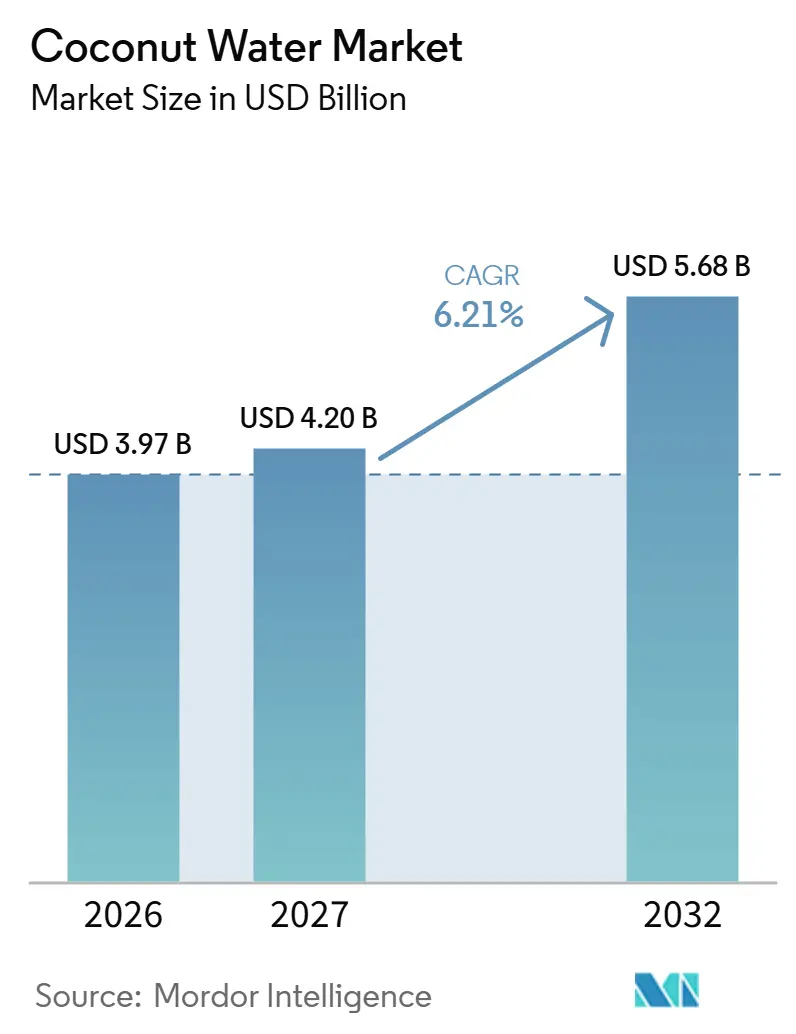
The coconut water market size is estimated at USD 3.97 billion in 2026 and is projected to be USD 4.2 billion in 2027, reaching USD 5.68 billion by 2032, growing at a CAGR of 6.21% from 2027 to 2032.
Health-oriented beverage choices create room for packaged coconut water, but suppliers must turn a credible nutritional proposition into repeat drinking occasions. In the United States, retail reach and recognizable hydration positioning can help cartons and bottles compete for everyday beverage choices. In April 2026, the Iran conflict disrupted global plastic-resin supplies and triggered a packaging crisis in Malaysia. Suppliers can extend their reach through differentiated products while supporting authenticity claims with production controls. Contested shelf exposure, packaging constraints, and changing label requirements favor suppliers that combine verifiable coconut-water purity with reliable retail supply.
Key Report Takeaways
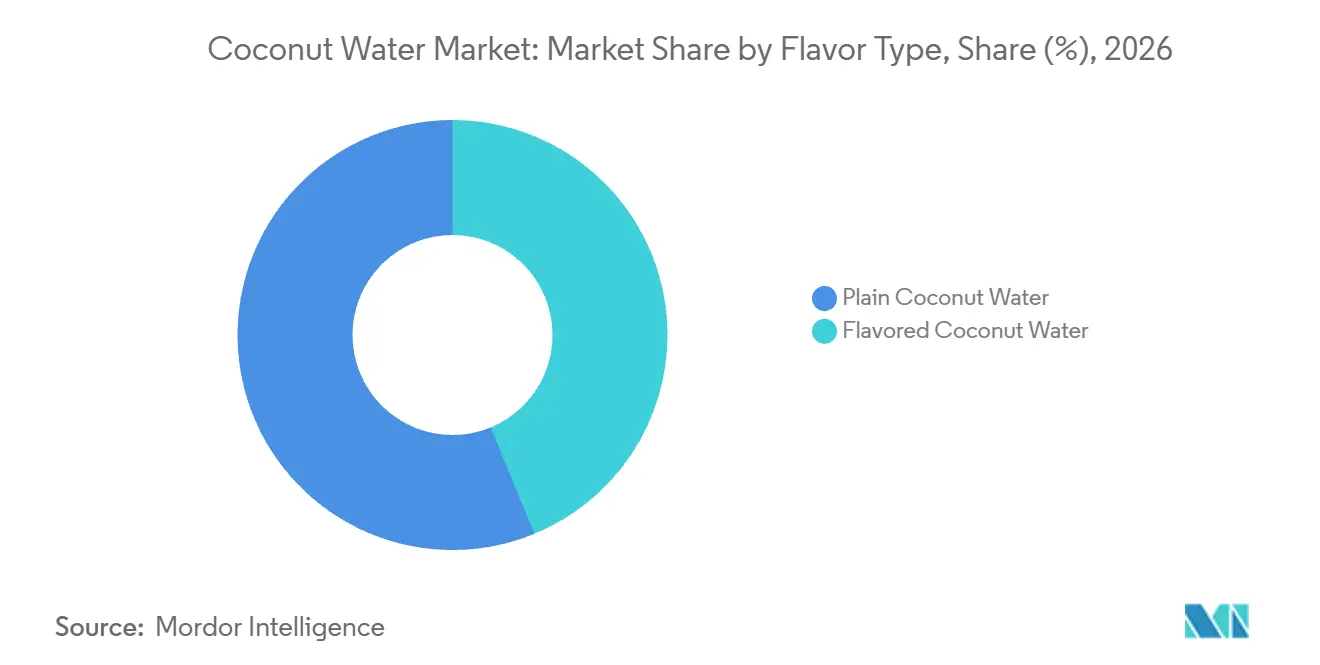
- Plain coconut water led the flavor category with a 56.22% coconut water market share in 2026, while flavored coconut water is forecast to be the fastest-growing segment at a CAGR of 6.45% from 2027 to 2032.
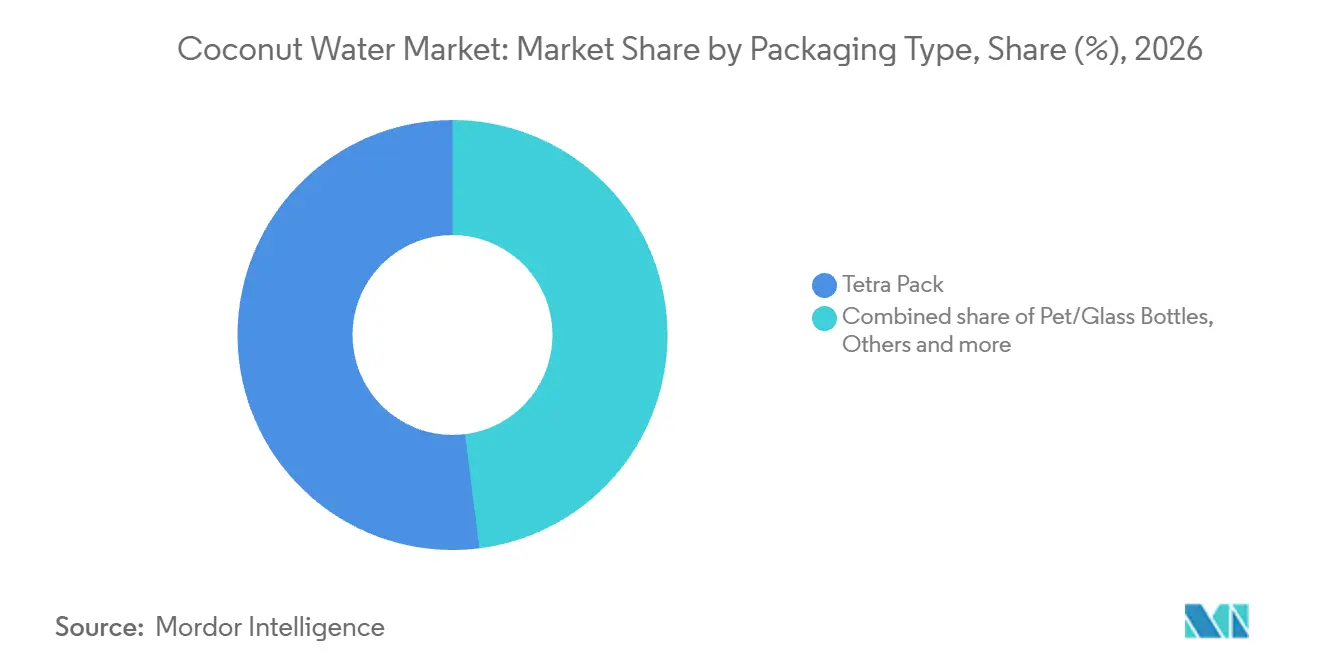
- Within packaging, Tetra Pack held a 52% share of the coconut water market size in 2026, and PET/glass bottles are projected to grow fastest at a CAGR of 6.75% from 2027 to 2032.
- Conventional products led the ingredient category at 67.69% of sales in 2026, while natural and organic products are forecast to grow fastest at a CAGR of 7.15% from 2027 to 2032.
- By distribution channel, supermarkets/hypermarkets led with 56.83% of sales in 2026, while online retail stores are projected to grow fastest at a CAGR of 7.6% from 2027 to 2032.
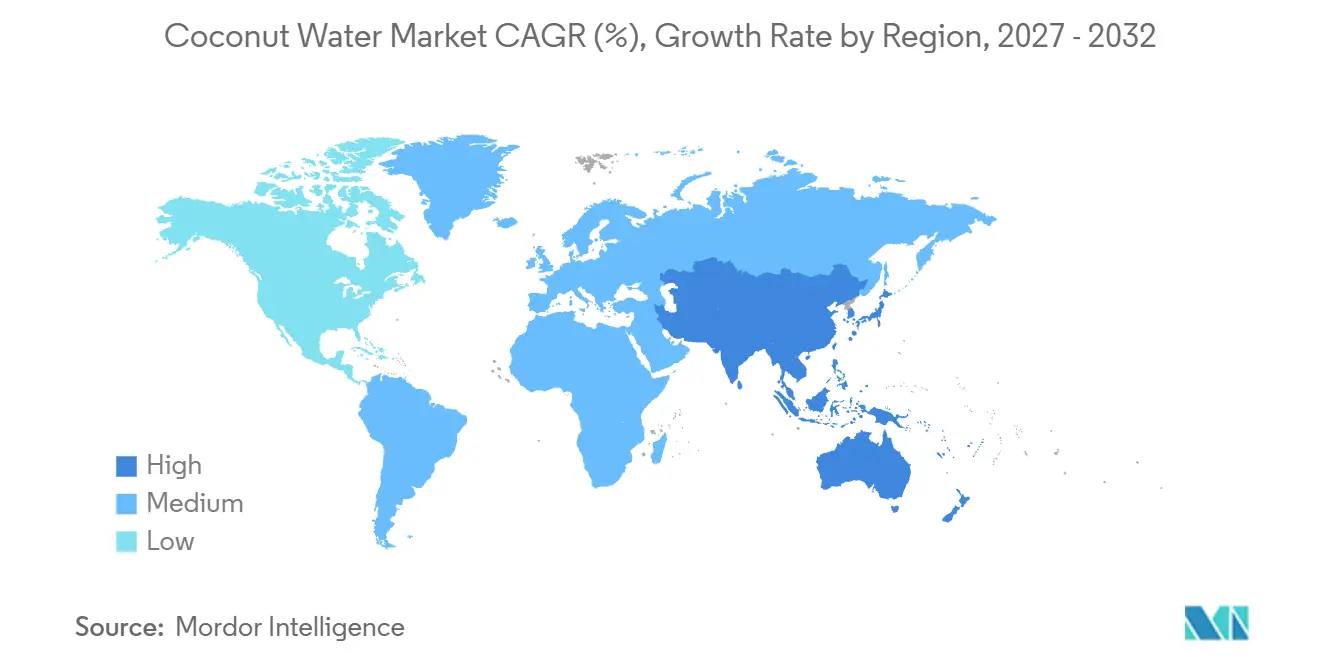
- North America was the largest geography at 37.09% of global sales in 2026, whereas Asia-Pacific is forecast to grow fastest at a CAGR of 7.7% from 2027 to 2032.
Note: Market numbers in this report are based on Mordor Intelligence's proprietary estimation framework, which combines nine months of actuals with Q4 projections for base year 2026.
Market Trends and Insights
Drivers Impact Analysis of Coconut Water Market*
| Driver | (~) % Impact on CAGR Forecast | Geographic Relevance | Impact Timeline |
|---|---|---|---|
| Rising Consumer Preference for Natural and Healthy Beverages | +2.4% | The United States | Medium term (2-4 years) |
| Growing Fitness and Wellness Trends Among Consumers | +1.8% | The United States | Medium term (2-4 years) |
| Aggressive Marketing and Celebrity Endorsements | +1.5% | The United States | Short term (≤ 2 years) |
| Product Innovation in terms of Flavor | +1.2% | The United States | Medium term (2-4 years) |
| Sustainability and Plant-Based Trends | +0.7% | Coconut-growing areas of the Philippines | Long term (≥ 4 years) |
| Health Benefits Associated with Consumption of Coconut Water | +0.6% | The United States and Canada | Long term (≥ 4 years) |
| Source: Mordor Intelligence | |||
Rising Consumer Preference for Natural and Healthy Beverages
Health-focused beverage choices create an opening for coconut-water producers to compete on formulation rather than refreshment alone. In EY's survey fielded in November and December 2025, 52% of US consumers expressed willingness to pay more for beverages supporting their health and wellness goals.[1] The same survey found that 66% chose lower-sugar, lower-calorie drinks. In a February 2026 US survey, 16% of Gen Z and millennial respondents and 11% of Gen X and older respondents said ingredients and clean label mattered most in beverage selection. The majority willingness to pay for health support gives producers a broad positioning signal, while the ingredient findings identify a more specific selection priority. Connecting coconut water to a defined health-oriented drinking need can therefore encourage consideration beyond shoppers who put ingredients and clean label first.
Growing Fitness and Wellness Trends Among Consumers
Post-exercise rehydration gives coconut-water suppliers a specific use occasion within fitness-oriented drinking. In a study published online in December 2025, 8 recreational athletes drank natural coconut water after exercise-induced dehydration. Postrehydration fluid status did not differ significantly among the 3 tested drinks, with coconut water as effective as a commercial carbohydrate-electrolyte sports drink. Separately, in Numerator's March 2025 survey of 2,019 receipt-verified US beverage purchasers, 23% planned to drink more coconut water in the coming months. A fitness-focused offer can therefore compete as a natural post-exercise alternative without promising a rehydration advantage over established sports drinks.
Aggressive Marketing and Celebrity Endorsements
Celebrity partnerships can make a coconut-water brand recognizable before consumers evaluate its ingredients or price. The Vita Coco Company, Inc. reported a USD 5.7 million increase in consolidated marketing investment for the six months ended June 30, 2026, compared with the prior-year period. Its September 2025 Major League Hydration roster brought athletes into the promotion of Vita Coco coconut water. The roster positions coconut water around athletic hydration, giving the endorsement a product-use context. The spending increase signals broader promotional investment, while this campaign gives a supplier a way to seek consideration when consumers choose an exercise drink.
Product Innovation in terms of Flavor
Flavor development can widen coconut water's appeal by giving buyers more ways to choose the beverage for a particular drinking occasion. In the United States, Coaqua launched 6 coconut-water flavors in 12-ounce cans in 2025. The lineup included Espresso’d, combining espresso with coconut water, and Chocolate’y, combining chocolate with coconut water. For buyers who do not prefer plain coconut water, recognizable coffee or chocolate flavors can make the beverage worth considering. Because these variants share a 12-ounce format, the brand can broaden taste choice without asking retailers to introduce a different serving size for each flavor.
Restraints Impact Analysis of Coconut Water Market*
| Restraint | (~) % Impact on CAGR Forecast | Geographic Relevance | Impact Timeline |
|---|---|---|---|
| Consumer's Inclination Towards Fresh Coconut Water | -0.8% | North America and Asia-Pacific | Short term (≤ 2 years) |
| Competition from Alternative Hydration Products | -0.6% | North America, United Kingdom, and Germany | Medium term (2-4 years) |
| High Price Compared to Other Beverages | -0.4% | The United States | Short term (≤ 2 years) |
| Fluctuating Raw Material Price | -0.2% | Vietnam's Dong Thap and Vinh Long provinces | Short term (≤ 2 years) |
| Source: Mordor Intelligence | |||
Consumer's Inclination Towards Fresh Coconut Water
Freshly served coconut water creates a conversion challenge for packaged-beverage suppliers when the buyer values service directly from the fruit. That buyer is choosing both the liquid and a serving experience, so a bottled or carton alternative must justify changing the occasion. Portable formats and controlled serving sizes can help a packaged product compete, but those attributes do not automatically reproduce the appeal of fresh service. Interest in coconut water can therefore support an unpackaged purchase without contributing to demand for a ready-to-drink package. The remaining burden for the brand owner is to earn acceptance of the packaged format, with additional distribution alone unable to resolve a serving-experience preference.
Competition from Alternative Hydration Products
Alternative hydration products can constrain coconut-water demand by competing for the retail exposure needed to turn interest into purchases. In its 2025 annual filing, The Vita Coco Company, Inc. identified sports drinks, energy drinks, enhanced waters, and other functional beverages as competitors. It warned that larger rivals could use retail relationships to reduce visibility and shelf space for its coconut-water products. For a coconut-water supplier, that risk makes retail access a competitive constraint even when consumers value the beverage's attributes. Discounting or additional advertising could help defend its position, but the company warned that these responses could weaken margins. The resulting exposure is a choice between protecting visibility and preserving earnings on each sale.
*Our forecasts treat driver/restraint impacts as directional, not additive. The impact forecasts reflect baseline growth, mix effects, and variable interactions.
Coconut Water Market Segment Analysis
By Flavor Type:
Plain Products Anchor Sales While Flavors Broaden OccasionsPlain coconut water accounted for a 56.22% share of the coconut water market size in 2026. Royal Plus Public Company Limited's total domestic sales in Thailand rose 6.3% year over year in Q2 2026, supported partly by its COCO ROYAL 100% coconut water brand. Domestic sales represented approximately 1% of the company's revenue. Royal Plus exports mainly to the Americas, Asia, the Middle East, and Europe, placing COCO ROYAL's Thai contribution within a predominantly overseas beverage business.
Flavored coconut water is forecast to be the fastest-growing segment, with a CAGR of 6.45% from 2027 to 2032. By August 2025, Raw C had added a 1-liter bottle of its Pure Coconut Water infused with Chocolate after reported high demand, with the product available through Woolworths across Australia. For flavored-product suppliers, this offers a route to expand an established recipe through pack size and national grocery distribution, rather than depending entirely on new flavor development.

By Packaging Type:
Cartons Lead While Bottle Suppliers Expand Commercial RoutesTetra Pack represented a 52% coconut water market share in 2026. Tetra Pak describes laminated cartons as predominant for coconut liquid products in most countries, with most of these carton products aseptically packed. It also identifies chilled distribution for non-aseptically packed coconut liquids. These different routes tie the container decision to the processing and distribution system rather than packaging appearance alone. A carton-based strategy consequently depends on a coordinated manufacturing route that can support both the intended retail format and the distribution conditions for the finished beverage.
PET/glass bottles are projected to be the fastest-growing segment, at a CAGR of 6.75% from 2027 to 2032. Royal Plus reported growth in 100% coconut water in PET bottles in Q3 2025, alongside expansion of its own-brand markets and more original design manufacturing customers. That gives bottled coconut water 2 commercial routes through an export manufacturer's branded business and its customer-led production activity. The combination can broaden demand for a bottling operation without requiring every new customer to buy the producer's own brand.
By Ingredient:
Conventional Scale Meets Retailer-Led Organic ExpansionConventional coconut water was the largest ingredient segment, with a 67.69% share in 2026. For conventional coconut water, the commercial proposition can center on the drink's flavor, pack size, and availability without requiring organic positioning. Access to buyers without an organic requirement does not depend on organic certification, so a conventional supplier can prioritize the coconut-water recipe and serving format when differentiating its offer.
Natural and organic products are forecast to be the fastest-growing segment, at a CAGR of 7.15% from 2027 to 2032. In February 2025, Natural Grocers by Vitamin Cottage, Inc. rolled out certified-organic coconut water in its US stores, in 17.5-ounce cans sold individually and in 12-packs. Selling the product under its own label makes the specialty retailer a competing organic coconut-water supplier, as well as a route to customers for beverage brands.
By Distribution Channel:
Large-Store Ranges Deepen as Online Access ExpandsSupermarkets/hypermarkets were the largest distribution segment, accounting for 56.83% of sales in 2026. In mid-to-late November 2025, Walmart allocated significant space to coconut water in new sets. Vita Coco reported 27,000 additional points of distribution and a 150% year-over-year increase for the November 13, 2025, to February 10, 2026, comparison period. Because the additional points came through one retailer's new sets, the opportunity for suppliers centers on winning space during category resets.
Online retail stores are forecast to be the fastest-growing segment, with a CAGR of 7.6% from 2027 to 2032. FMI reported that US online food sales grew nearly 19% in 2025, even as food shopping remained primarily store-led. Convenience/grocery stores have a role in the wider mix, illustrated by Vita Coco's sale of beverages and other products through convenience outlets. Other distribution channels include on-premise locations, where the company distributes its broader product portfolio through offices, fitness clubs, airports, and educational institutions. Online expansion can add reach for coconut-water suppliers without making established physical distribution redundant.
Geography Analysis
North America Coconut Water Market
North America accounted for a 37.09% share of the coconut water market size in 2026. Vita Coco Coconut Water net sales in the company's Americas segment, primarily the United States and Canada, reached USD 256 million in the first half of 2026. That compared with USD 206.6 million in the first half of 2025. The company's FY2025 filing described Vita Coco as overindexing to younger households and multicultural shoppers in the United States, giving brand positioning a specific US audience.
Asia-Pacific Coconut Water Market
Asia-Pacific is forecast to be the fastest-growing geography, at a CAGR of 7.7% from 2027 to 2032. China's coconut-water market exceeded CNY 10.06 billion (USD 1.41 billion) in 2025. IFBH Limited extended its Roasted Coconut water to Mainland China and Hong Kong in the first half of 2026, following its launch in selected markets in the second half of 2025. The product's sales grew 100% year over year as of June 30, 2026. For suppliers, extending an existing coconut-water variant into major destination markets offers a growth route through broader product ranges alongside geographic reach.
In Europe, the Netherlands acts as a coconut-water import and re-export hub, with Dutch companies providing processing, bottling, and blending services. That intermediary role gives suppliers an entry route using trade and processing services alongside direct development of a consumer brand. In South America, Brazil's Zanlorenzi Bebidas said in September 2025 that Campo Largo coconut water had moved from its fifth- to second-best-selling product since production began in 2021. Middle East and Africa were sales destinations for Vita Coco coconut water through its international teams in 2025. Brazil's outside suppliers face an established domestic competitor in Campo Largo, ranked third by NielsenIQ for coconut-water sales in qualifying self-service stores and atacarejo during January to December 2025.
Regulatory Framework and Outlook
This comparison examines selected jurisdictions from the perspective of a producer placing packaged ready-to-drink coconut water in retail channels. The commercial differences concern how food identity, safety controls, label content, and packaging obligations enter the producer's operating requirements. For the same retail beverage, a packaging obligation can require a different response from a product-identity or label-content rule.
Regulatory Table of Coconut Water Market
| Decision factor | United States | Germany | China | Brazil | Saudi Arabia |
|---|---|---|---|---|---|
| Primary authority | Food and Drug Administration (FDA) | Zentrale Stelle Verpackungsregister (ZSVR), with German Environment Agency oversight | State Administration for Market Regulation and local market-supervision authorities | Ministry of Agriculture and Livestock (MAPA); Anvisa | Saudi Food and Drug Authority (SFDA) |
| Key instruments or direction | 21 CFR Part 120 juice hazard controls; Part 101 food labeling | Regulation (EU) 2025/40 and VerpackDG, applicable from August 12, 2026 | GB 7718-2011; GB 7718-2025 effective March 16, 2027 after a 2-year transition | IN MAPA 9/2020 identity and quality; Decree 12.709/2025 registration; Anvisa label rules | GSO 9 prepackaged-food labeling |
| Commercial effect | Written hazard-control plan if hazard analysis identifies a reasonably likely food hazard; compliant packaged-food labels | Packaging-design and material-compliance work | Label compliance and transition planning for production from March 16, 2027 | Establishment and beverage registration; product-identity and label compliance | Arabic labeling of consumer-facing packages |
| Current policy attractiveness | Medium | Medium | Medium | Medium | Medium |
| Future direction of policy attractiveness | Hardening | Hardening | Hardening | Hardening | No change |
| Source: Mordor Intelligence | |||||
US producers face established juice hazard-control and labeling duties, while a proposed front-label nutrition rule for most packaged foods carries a December 2026 final-rule agenda target. Germany's packaging duties and higher recycling-system quotas from 2028 point toward more compliance work, while China's March 16, 2027, transition sets a label deadline for new production. Brazil's registration and identity duties are joined by a pending ingredient-declaration proposal following an October 19, 2026, consultation close, adding potential label work for affected formulations. Saudi Arabia's operative retail-labeling framework centers on Arabic consumer-facing labels, making continued language compliance the basis for a steady outlook.
Value Chain Stages
The value chain compares where suppliers capture earnings from near-origin processing through final retail distribution. Vita Coco's FY2025 filing stated that coconut water needs to enter an aseptic package or become concentrate within hours after a coconut is cut from the tree. As of June 30, 2026, the company sourced its broader product portfolio from approximately 20 factories and co-packers, supported by coconut farmers worldwide. For coconut water, that hours-long window makes aseptic-packing or concentration capacity near harvest areas central to reliable supply.
Value Chain Analysis Table of Coconut Water Market
| Primary activity | Key participants | Value capture | Bottleneck | Resilience response |
|---|---|---|---|---|
| Origin sourcing and processing | Coconut-water producers such as Copra Inc., a Vita Coco subsidiary | Private-label and branded coconut-water sales | Processing within hours of harvest | Coordinate harvest intake with nearby processing capacity |
| Packaging supply | Packaging-material suppliers such as Tetra Pak | Packaging-material sales | Vita Coco's FY2025 dependence on one supplier for most product packaging | Prequalify alternative materials and contingency supply |
| Brand and OEM supply | Own-brand and OEM manufacturers such as Thai Coconut Public Company Limited | Finished-beverage and OEM sales | Coordinating own-brand and OEM production commitments | Allocate production against firm channel commitments |
| Distribution and retail | Brand channel managers such as The Vita Coco Company, Inc.; retailers such as Walmart | Wholesale beverage sales and retail sales | Translating channel access into store-level availability | Align product ranges with store-level delivery |
| Source: Mordor Intelligence | ||||
Vita Coco reported in its FY2025 filing that most of its products were packaged with materials from Tetra Pak, purchased directly or through contract manufacturers.[3] The factory network spreads sourcing across locations, while the packaging relationship concentrates material exposure. A Tetra Pak supply interruption could therefore affect most of Vita Coco's portfolio rather than being confined to one production site.
Competitive Landscape
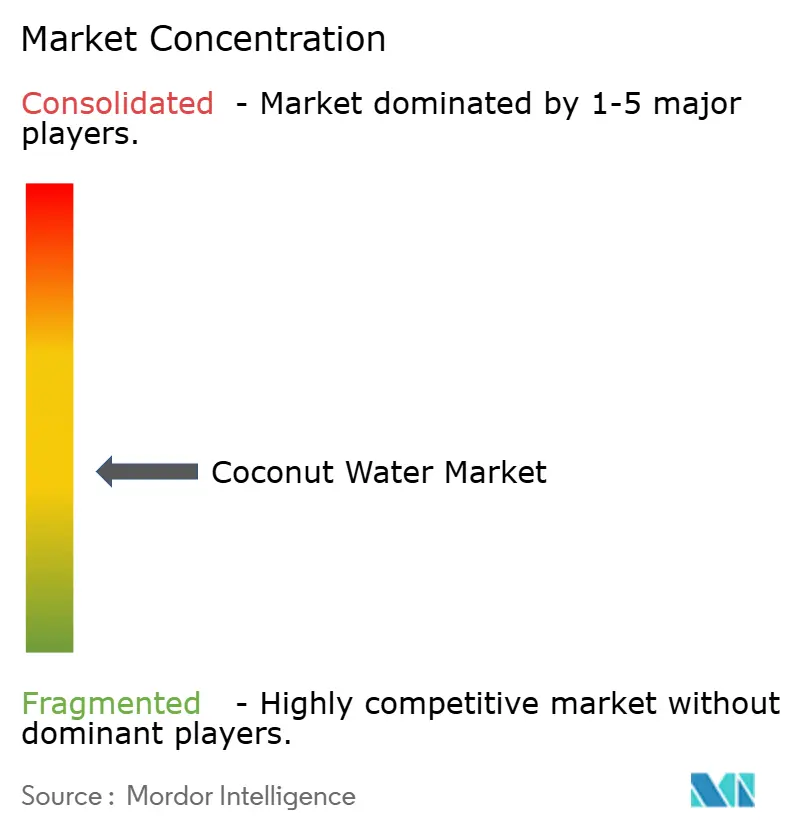
Competition is moderately fragmented, with branded specialists offering different packaging and ingredient positions. The Vita Coco Company, Inc. reported that Vita Coco Coconut Water net sales grew 29% in the six months ended June 30, 2026, compared with the prior-year period.[2] ZICO Rising, Inc. offers 100% pure coconut water, and Iberia Foods, LLC offers coconut water in 10.5- and 16.9-fluid-ounce packs. Harmless Harvest Inc. offers shelf-stable coconut water that needs no refrigeration, while C2O Coconut Water sells cans and cartons across plain, organic, pulp, and flavored varieties. Shelf-stable processing, can and carton formats, and pack sizes give these suppliers different ways to compete for the same beverage choice.
Vita Coco completed its acquisition of Copra, Inc., a producer of super-premium Thai Nam Hom coconut water, on July 22, 2026. Copra's business included private-label and Copra-branded products and a factory in Thailand, with sales predominantly in the Americas. Owning Copra gives Vita Coco direct control of an existing Thai production asset with access to Nam Hom coconuts. The transaction places a private-label supplier under the same owner as a branded competitor, linking customers' premium sourcing to a company that also competes for retail sales.
Competitive direction also depends on how a supplier substantiates the identity of the beverage it sells. In 2026, IF, a brand operated by IFBH Limited, implemented isotope-based testing at raw-material receiving to detect added sugar or water before coconut-water production. Checking incoming material can make the purity proposition part of sourcing control, instead of leaving it only to the finished-product stage. Thailand's Food Act prohibits producing, importing for sale, or distributing substituted or imitation food sold as genuine and food labeled to deceive buyers about quality. For IF, early screening connects brand differentiation to a defined adulteration risk, making quality control relevant to both product positioning and food-law obligations.
Coconut Water Industry Leaders
-
The Vita Coco Company, Inc.
-
ZICO Rising, Inc.
-
Iberia Foods, LLC
-
Harmless Harvest Inc.
-
C2O Coconut Water
- *Disclaimer: Major Players sorted in no particular order
Coconut Water Market Companies Covered in this Report
- The Vita Coco Company, Inc.
- ZICO Rising, Inc.
- Iberia Foods, LLC
- Harmless Harvest Inc.
- C2O Coconut Water
- Amy and Brian Naturals
- EQUATOR Beverage Company
- GraceKennedy Group
- Nam Viet Foods & Beverage JSC
- Taste Nirvana International Inc.
- Thai Agri Foods Public Company Limited
- Kalbe International
- Blue Monkey Beverage LLC
- Raw C
- CoAqua
- Goya Foods Inc.
- Edward and Sons Trading Co.
- Celebes Coconut Corp.
- RITA Food and Drink Co.
- Pulau Sambu Singapore Pte Ltd.
Key Opportunities for Market Participants
The opportunities below compare 3 routes for extending premium coconut-water distribution into Chinese retail outlets. During 2025, IFBH Limited expanded its China distributor network from 3 to 7 partners. In its February 2026 results announcement, the company identified millions of convenience stores, supermarkets, and specialty outlets as largely unpenetrated by premium coconut-water brands. Different outlet types make channel-specific assortments a more concrete next step than a uniform national rollout.
Market Opportunities Table of Coconut Water Market
| Opportunity | Why now | Buyer / lead segment | Recommended play | Main barrier | Likely beneficiaries |
|---|---|---|---|---|---|
| Chinese convenience-store penetration | Broader partner coverage can reach underpenetrated convenience outlets | Convenience-store buyers in China | Test single-serve packs through clustered local distributors | Converting partner reach into individual store placements | IFBH Limited and its distribution partners |
| Premium specialty-retail development | Specialty outlets form part of the identified untapped premium opportunity | Chinese specialty-outlet buyers | Offer distinct ingredient and flavor propositions through specialist partners | Establishing a clear premium proposition at outlet level | IFBH Limited and its Innococo brand |
| Supermarket range extension | Expanded distribution offers access to underpenetrated supermarket outlets | Supermarket buyers in China | Trial multiunit ranges with chain-level replenishment | Securing lasting space within each retailer's range | IFBH Limited and cooperation partners such as COFCO |
| Source: Mordor Intelligence | |||||
IFBH Limited's Group revenue fell 46.7% to USD 50.4 million in the first half of 2026 compared with the first half of 2025, primarily because of lower coconut-water sales volumes. From April 2026, geopolitical tensions disrupted global supply chains, causing coconut-water and packaging shortages and higher procurement costs that constrained IFBH's product supply to distributors. Channel-specific trials must therefore establish demand and replenishment reliability before IFBH scales placements. The central opening is selective store penetration that can be supplied consistently, rather than distributor coverage alone.
Recent Industry Developments in Coconut Water Market
- Jul 2026: On July 29, Coco5 announced its rollout at Costco locations across the US Midwest with an 18-count variety pack of its coconut-water-based electrolyte drink, made with 26% real coconut water.
- Jul 2026: The Vita Coco Company, Inc. completed its acquisition of Copra, Inc., a Thai Nam Hom coconut-water producer with a factory in Thailand and sales predominantly in the Americas, on July 22.
- Apr 2026: IF, a coconut-water brand operated by IFBH Limited, announced the implementation of isotope-ratio testing at raw-material receiving to detect added sugar or water before production.
Coconut Water Market Report Scope and Research Methodology
Market Definition and Coverage
Global coconut water market covers packaged, ready-to-drink coconut water beverages sold through retail, foodservice, and other distribution channels worldwide. It measures annual sales value across beverage variants, formulations, and packaging formats.
Scope exclusions: Fresh coconut water sold from opened coconuts or served unpackaged, coconut milk, coconut cream, coconut oil, coconut-based smoothies and blended coconut beverages, coconut-water powders and drink mixes, and bulk coconut water sold as an ingredient are excluded.
Segments Covered in This Report
- By Flavor Type
- Plain Coconut Water
- Flavored Coconut Water
- By Packaging Type
- Pet/Glass Bottles
- Tetra Pack
- Others
- By Ingredient
- Conventional
- Natural and Organic
- By Distribution Channel
- Supermarkets/Hypermarkets
- Convenience/Grocery Stores
- Online Retail Stores
- Other Distribution Channels
- By Geography
- North America
- United States
- Canada
- Mexico
- Rest of North America
- Europe
- Germany
- United Kingdom
- Italy
- France
- Spain
- Netherlands
- Poland
- Belgium
- Sweden
- Rest of Europe
- Asia-Pacific
- China
- India
- Japan
- Australia
- Indonesia
- South Korea
- Thailand
- Singapore
- Rest of Asia-Pacific
- South America
- Brazil
- Argentina
- Colombia
- Chile
- Peru
- Rest of South America
- Middle East and Africa
- South Africa
- Saudi Arabia
- United Arab Emirates
- Nigeria
- Egypt
- Morocco
- Turkey
- Rest of Middle East and Africa
- North America
Data Sources, Market Sizing, and Validation
Desk Research
Public sources such as the CBI European market potential study for coconut water, Eurostat trade statistics, the European Fruit Juice Directive, and research from the Vietnam Coconut Association help analysts distinguish packaged beverage demand from ingredient use, assess regional trade and consumption, interpret product categories, and understand producer-country supply conditions. These sources place regional retail and foodservice signals within the global market boundary and help separate coconut water from other coconut products.
Company filings, investor presentations, and reputable business and trade reporting provide product, channel, capacity, pricing, and strategic context, with issuer disclosures checked against reported operating results and independent coverage where available. The named sources are illustrative and not exhaustive, and further sources inform collection, validation and clarification.
Primary Interviews and Surveys
Interviews and structured surveys would include beverage company executives, category and channel leaders, packaging and procurement specialists, distributors, and retail or foodservice buyers across the global market. These discussions would test secondary evidence on product boundaries, price and pack mix, channel coverage, and regional demand, while targeted follow-up would resolve conflicting or missing inputs. Evidence from interviews would be triangulated with company disclosures, trade data, and observed retail pricing before it informs model assumptions.
Distribution of primary research fieldwork respondents
| Company type | Respondent position | Region |
|---|---|---|
| Top tier: 32% | CXOs: 20% | APAC: 38% |
| Mid tier: 48% | Functional/Unit leaders: 35% | EMEA: 27% |
| Smaller Players: 20% | Managers: 45% | Americas: 35% |
Market-Sizing & Forecasting
The model estimates global annual consumer sales value from the top down, using the packaged ready-to-drink boundary defined in the market definition and then checking selected totals against supplier and channel evidence. Key inputs include coconut-water category sales and consumption trends, regional retail and foodservice reach, average selling prices by pack and market, trade flows for concentrate and finished product, and company revenue or volume disclosures. Together these indicators show market scale, regional mix, and changes in price and product mix. Segment shares are built from evidence on flavor, packaging, formulation, channel, and geographic sales, with gaps addressed by comparing multiple sources and using the closest supported category or market indicators.
A multivariate regression can relate historical market value to these demand, distribution, and price indicators, while scenario analysis tests alternative adoption and pricing paths where time series are short or inconsistent. Selective bottom-up checks, such as sampled average selling price multiplied by observed or disclosed volume and supplier roll-ups, test the top-down result. Unsupported inputs are bounded using comparable markets and explicit assumptions. Primary experts can review whether each variable's forecast direction and commercial range fit observed channel, product, and regional conditions before those assumptions are retained.
Data Validation & Update Cycle
Analysts triangulate market totals and segment patterns across company disclosures, trade and production signals, consumer and channel evidence, and independent published estimates, then investigate material variances in units, timing, pricing, and product coverage. A second review checks calculations, source dates, boundary consistency, and regional and segment totals, with anomalies resolved or affected inputs re-contacted before sign-off. The dataset is refreshed annually, updated between cycles when material market events change assumptions, and given a fresh pre-delivery review.
Mordor Intelligence's Coconut Water Market Estimate Compared With Other Published Estimates
Published estimates can differ in the transactions and products they count and the inputs used to model demand. Global coconut water market covers packaged, ready-to-drink coconut water beverages sold through retail, foodservice, and other distribution channels worldwide.
Key Gap Drivers include the study's defined coverage and market-specific modeling choices. Segment shares are built from evidence on flavor, packaging, formulation, channel, and geographic sales, with gaps addressed by comparing multiple sources and using the closest supported category or market indicators.
Benchmark comparison
| Source | Market Size | Gaps in Research Methodology |
|---|---|---|
| Mordor Intelligence | USD 4.2 B (2027) | |
| Global Consultancy A | USD 5.1 B (2025) | At its 2025 base, this estimate is 21.4% above this report's 2027 value of USD 4.2 B, 2 years later. Its faster forecast trajectory can contribute to the higher reported level. |
| Global Market Research Publisher B | USD 3-5 B (2025) | Its faster forecast trajectory can contribute to the higher end of the range. |
Mordor Intelligence's analysts triangulate market totals and segment patterns across company disclosures, trade and production signals, consumer and channel evidence, and independent published estimates, then investigate material variances in units, timing, pricing, and product coverage.
Key Questions Answered in the Report
What is the coconut water market size and growth outlook?
The size is projected at USD 4.2 billion in 2027 and USD 5.68 billion by 2032, with a 6.21% CAGR from 2027 to 2032.
What supports demand for packaged coconut water?
Health-oriented beverage choices support the opportunity. In EY's 2025 survey, 52% of US consumers were willing to pay more for beverages supporting health and wellness goals.
Which coconut-water flavor category has the largest share?
Plain coconut water led with 56.22% of sales in 2026. Flavored coconut water is forecast to grow at a CAGR of 6.45% from 2027 to 2032.
Which companies compete in packaged coconut water?
Major competitors include The Vita Coco Company, Inc., ZICO Rising, Inc., Iberia Foods, LLC, Harmless Harvest Inc., and C2O Coconut Water.
What challenge could limit coconut-water supplier margins?
Vita Coco identified competition from sports drinks, energy drinks, and enhanced waters. It warned that defending shelf space through discounts or additional marketing could weaken margins.
Which region has the fastest coconut-water growth outlook?
Asia-Pacific is forecast to grow fastest at a CAGR of 7.7% from 2027 to 2032. North America had the largest share, at 37.09% of global sales in 2026.