
Market Overview
| Study Period | 2021 - 2031 |
|---|---|
| Forecast Data Period | 2026 - 2031 |
| Base Year Market Size (2025) | USD 83.29 Billion |
| Market Size (2026) | USD 87.08 Billion |
| Market Size (2031) | USD 108.79 Billion |
| Growth Rate (2026 - 2031) | 4.55 % |
| Market Concentration | Medium |
Major Players *Disclaimer: Major Players sorted in no particular order Image © Mordor Intelligence. Reuse requires attribution under CC BY 4.0. | |
North America Bottled Water Market Analysis by Mordor Intelligence
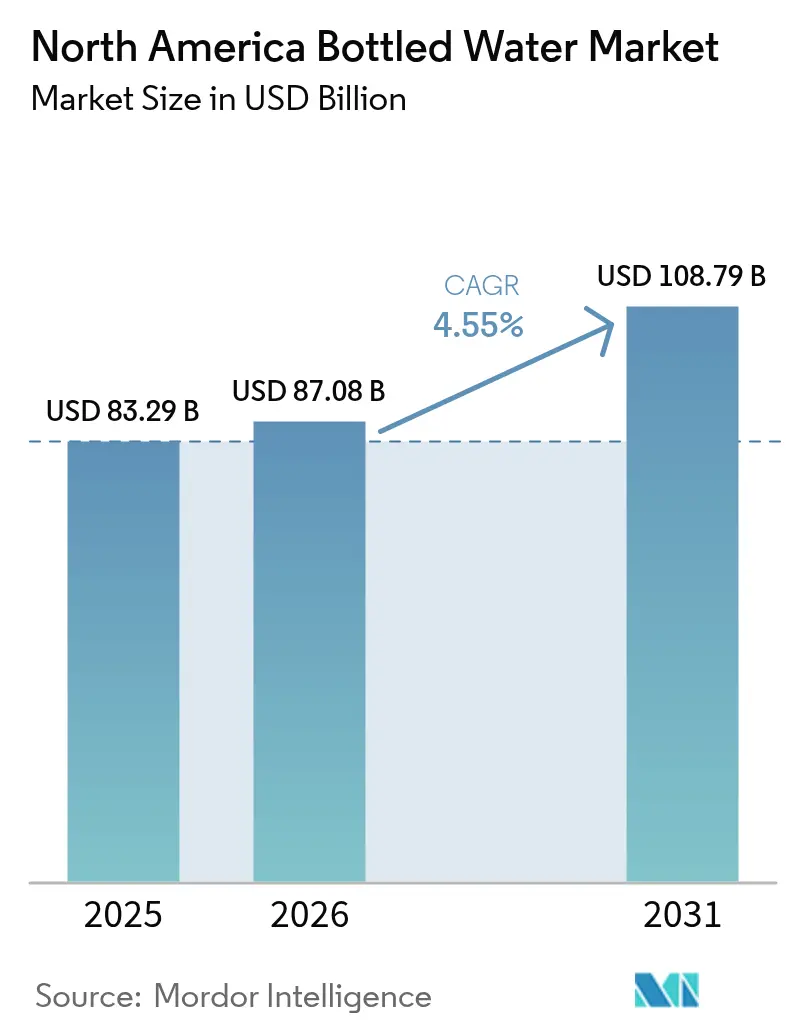
The North American bottled water market size is expected to grow from USD 83.29 billion in 2025 to USD 87.08 billion in 2026 and is forecast to reach USD 108.79 billion by 2031 at 4.55% CAGR over 2026-2031. Market growth is driven by increased health consciousness, persistent water quality issues, and a recovery in the tourism and hospitality sectors. While still water remains the primary sales segment, functional and flavored water variants are experiencing increased demand as consumers prioritize health and performance benefits. Manufacturers are implementing packaging innovations, including recycled PET materials and lightweight cans, to meet sustainability requirements while maintaining profitability. The market expansion is further supported by population growth and the convenience of portable bottled water. Functional water, enhanced with vitamins, has gained consumer acceptance due to its convenience, health benefits, and improved taste compared to tap water.
Key Report Takeaways
- By product type, still water led with 74.12% of the market share in 2025, while functional and flavored water are projected to rise at a 5.22% CAGR through 2031.
- By packaging format, PET bottles accounted for 78.05% share of the market in 2025, whereas cans are expected to grow at a 5.61% CAGR through 2031.
- By category, the mass segment held 69.10% share in 2025, and premium offerings are set to expand at a 6.02% CAGR between 2026 and 2031.
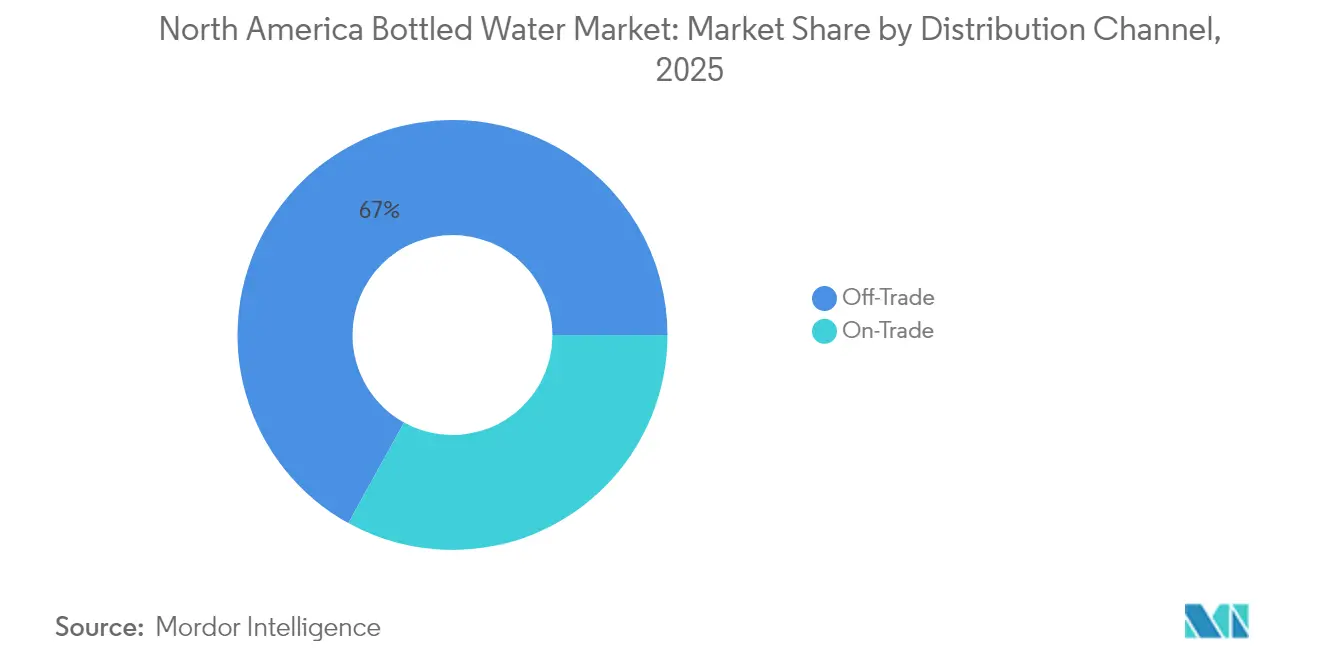
- By distribution channel, off-trade outlets captured 66.95% share in 2025, while on-trade venues are forecast to register a 4.78% CAGR through 2031.
- By geography, the United States commanded 82.10% of the market share in 2025, whereas Mexico is poised for the fastest growth at a 6.38% CAGR through 2031.
Note: Market size and forecast figures in this report are generated using Mordor Intelligence’s proprietary estimation framework, updated with the latest available data and insights as of 2026.
Market Trends and Insights
Drivers Impact Analysis of North America Bottled Water Market*
| Driver | (~) % Impact on CAGR Forecast | Geographic Relevance | Impact Timeline |
|---|---|---|---|
| Rising demand for functional water from fitness enthusiasts | +1.2% | United States and Canada, urban centers | Medium term (2-4 years) |
| Advertisements and promotional campaigns | +0.8% | North America, digital and traditional media | Short term (≤ 2 years) |
| Growing tourism and hospitality sector | +0.9% | United States, Mexico, Canada tourist destinations | Medium term (2-4 years) |
| Expansion of food service establishments | +0.7% | Urban North America, franchise corridors | Long term (≥ 4 years) |
| Water quality and safety concerns | +1.1% | Global, rural and urban areas | Long term (≥ 4 years) |
| Increased awareness of waterborne diseases | +0.6% | Mexico, rural United States, Canada | Medium term (2-4 years) |
| Source: Mordor Intelligence | |||
Rising Demand for Functional Water From Fitness Enthusiasts
The growing emphasis on health and wellness has transformed consumer perception of hydration from a basic need to a performance enhancement tool. This shift has increased demand for water products enhanced with electrolytes and vitamins. Consumers now associate functional beverages with healthy lifestyles and proactive health management. The fitness community particularly seeks products with natural electrolytes, adaptogens, and minerals for recovery and performance benefits, as these components directly support their athletic pursuits and training goals. According to the U.S. Census Bureau data[1] from 2023, 21.1% of Americans participated in daily sports, exercise, and recreational activities, indicating a substantial market for functional hydration products. This increased fitness participation has created a robust consumer base seeking specialized hydration solutions. The younger demographic's preference for functional benefits over traditional beverages has reshaped market dynamics significantly. This shift in consumer behavior, combined with growing health awareness, has driven demand for premium functional water products.
Advertisements and Promotional Campaigns
Digital marketing strategies target health-conscious consumers through social media platforms and influencer collaborations to increase brand visibility and educate consumers about hydration benefits. Companies use data analytics to create personalized messages that position bottled water as essential for health-focused consumers. Marketing campaigns focus on brand differentiation through source purity, mineral content, and sustainability credentials to support premium pricing. The emphasis on digital channels allows companies to reach specific consumer segments with tailored messaging about product benefits and environmental commitments. In the premium segment, brand reputation and quality perception significantly influence consumer purchase decisions. The growth of direct-to-consumer channels enables targeted marketing campaigns that reduce retail markups, allowing companies to allocate more resources to consumer education and loyalty programs. These direct channels provide companies with valuable consumer data and feedback, enhancing their ability to refine marketing strategies. Companies leverage this information to develop more effective promotional campaigns and strengthen customer relationships across digital platforms.
Growing Tourism and Hospitality Sector
Tourism in the region is increasing, due to which the demand for bottled water products is increasing. According to the U.S. Bureau of Economic Analysis data[2] from 2023, travel and tourism output in the United States increased by 7% in 2023. Hospitality operators increasingly view bottled water as both a revenue generator and a guest satisfaction tool, particularly in regions with questionable tap water quality or taste. The sector's growth creates predictable demand patterns that support long-term supply contracts and distribution partnerships. Hotels implementing sustainability initiatives, such as Marriott's 15% water intensity reduction goals, create opportunities for eco-friendly packaging and refillable bottle programs, according to Marriott International data from 2024. Tourism's seasonal nature requires flexible supply chain management, favoring suppliers with robust distribution networks and inventory management capabilities.
Expansion of Food Service Establishments
The growth of restaurants and quick-service establishments generates consistent demand for bottled water through direct sales and operational requirements, especially in areas with urban development and population growth. Food service operators choose bottled water for their beverage programs due to quality consistency, brand recognition, and higher profit margins compared to tap water. The expansion of franchise networks across North America has standardized bottled water procurement, enabling national supply agreements and volume-based discounts. The standardization of procurement processes has led to improved supply chain efficiency and cost management for food service operators. Additionally, the consistent quality and brand recognition of bottled water products help maintain service standards across multiple locations. Food service establishments are incorporating premium bottled water options to enhance dining experiences and increase average transaction values. The introduction of premium water options has enabled restaurants to differentiate their beverage offerings and capture higher-margin sales. The trend towards healthier beverage choices has further strengthened bottled water's position in food service establishments' beverage programs.
Restraints Impact Analysis of North America Bottled Water Market*
| Restraint | (~) % Impact on CAGR Forecast | Geographic Relevance | Impact Timeline |
|---|---|---|---|
| Environmental concerns and plastic waste | -1.4% | North America, environmentally conscious regions | Long term (≥ 4 years) |
| Strong competition from water purifier appliances | -0.9% | United States and Canada, urban households | Medium term (2-4 years) |
| Consumer shift towards sustainability | -0.8% | North America, millennial and Gen Z demographics | Long term (≥ 4 years) |
| High cost associated with functional water | -0.5% | Price-sensitive segments, rural areas | Short term (≤ 2 years) |
| Source: Mordor Intelligence | |||
Environmental Concerns and Plastic Waste
Environmental awareness has increased consumer resistance to single-use plastic bottles, leading to regulatory measures and corporate sustainability commitments that raise operational costs. Companies are investing in recycling infrastructure and alternative packaging materials, which increases production costs and supply chain complexity. Plastic bottle bans in airports and public venues require companies to use aluminum and glass alternatives. These alternatives have resulted in higher transportation costs across the supply chain. The shift in consumer preferences has also led to increased scrutiny of packaging materials and their environmental impact. The environmental factors continue to drive innovation in packaging design and biodegradable materials development. Companies are implementing comprehensive recycling systems to address sustainability concerns. These initiatives require significant capital investments that affect industry profit margins. The industry is also experiencing pressure to develop more sustainable solutions while maintaining product quality. The balance between environmental responsibility and operational efficiency remains a key challenge for companies in the sector.
Strong Competition From Water Purifier Appliances
Water purification systems for homes and offices provide economical alternatives to bottled water, attracting environmentally conscious consumers and budget-focused households. The adoption of these systems continues to grow as consumers recognize the long-term cost benefits and environmental impact reduction. Installation of purification systems eliminates the need for regular bottled water purchases and storage. These systems also reduce plastic waste associated with bottled water consumption. The convenience of having purified water on demand further enhances their appeal to households and businesses. Water purifiers with IoT features and automated filter replacement notifications simplify maintenance, addressing the convenience advantage of bottled water. The integration of smart technology enables users to monitor water quality and system performance in real-time. In urban areas where tap water meets quality standards, competition increases as bottled water companies focus on convenience, portability, and taste advantages instead of safety benefits. The market dynamics have shifted towards emphasizing user experience and technological innovation. Manufacturers continue to develop advanced features to maintain competitive advantages in the water purification segment.
*Our forecasts treat driver/restraint impacts as directional, not additive. The impact forecasts reflect baseline growth, mix effects, and variable interactions.
North America Bottled Water Market Segment Analysis
By Product Type:
Still Water Dominance Faces Functional DisruptionStill bottled water maintains commanding market leadership with 74.12% share in 2025, reflecting consumer preference for pure, unflavored hydration solutions across diverse consumption occasions. However, functional and flavored bottled water segments demonstrate superior growth momentum at 5.22% CAGR through 2031, driven by health-conscious consumers seeking enhanced benefits beyond basic hydration. This growth differential suggests a gradual market evolution where traditional still water consumption stabilizes while innovation concentrates in value-added segments. Sparkling bottled water occupies a smaller but stable niche, appealing to consumers seeking carbonation without artificial additives or sweeteners.
The functional water segment benefits from technological advances in mineral infusion, electrolyte balancing, and vitamin fortification that maintain product stability and taste profiles. Companies increasingly position functional variants as lifestyle products rather than mere beverages, targeting fitness enthusiasts, health-conscious professionals, and wellness-focused demographics willing to pay premium prices. In March 2024, Essentia Water launched its first-ever range of flavored and functional water products. The products are available in lemon lime, peach-mango, and raspberry pomegranate flavors. The segment's growth trajectory aligns with broader consumer trends toward preventive health measures and performance optimization, creating sustained demand that justifies higher production costs and marketing investments


By Packaging Format:
PET Bottles Dominate Despite Sustainability PressurePET bottles command 78.05% market share in 2025, benefiting from lightweight properties, cost efficiency, and an established supply chain infrastructure that supports mass market distribution. The format's dominance reflects practical considerations, including transportation costs, breakage resistance, and consumer convenience preferences across diverse retail channels. However, cans experience accelerated growth at 5.61% CAGR through 2031, driven by premium positioning, sustainability perceptions, and enhanced product differentiation capabilities.
Sustainability initiatives increasingly influence packaging decisions, with companies investing in recycled content, lightweighting technologies, and alternative materials to address environmental concerns while maintaining cost competitiveness. The National Association for Packaging Innovation focuses on recyclability improvements, barrier properties for extended shelf life, and design elements that enhance brand differentiation in competitive retail environments. In October 2023, A US-based mountain spring mineral water introduced 100% recycled polyethylene terephthalate (rPET) for its water bottles. The bottles feature CleanFlake label technology, which enhances the recovery of high-quality PET during recycling.
By Category:
Premium Segment Outpaces Mass Market GrowthThe mass market segment holds 69.10% share in 2025, serving price-conscious consumers who prioritize value and availability over premium features or brand prestige. This segment benefits from economies of scale, efficient distribution networks, and broad retail presence that ensures consistent market access. Conversely, the premium segment accelerates at 6.02% CAGR through 2031, reflecting consumer willingness to pay higher prices for perceived quality, unique sourcing, enhanced packaging, or functional benefits. The premium segment's growth trajectory indicates market maturation where differentiation becomes increasingly important for margin preservation and brand loyalty.
Premium positioning strategies emphasize source authenticity, mineral content, sustainability credentials, or functional enhancements that justify price premiums over mass market alternatives. Companies leverage premium segments to improve overall profitability while using mass market volumes to maintain manufacturing efficiency and distribution leverage.
By Distribution Channel:
Off-Trade Dominance Challenged by On-Trade RecoveryOff-trade channels hold a 66.95% market share in 2025, with distribution through supermarkets, hypermarkets, convenience stores, and online retail platforms. This dominance stems from household consumption patterns and bulk purchasing preferences. The channel's strength reflects established consumer shopping habits, effective promotional activities, and efficient inventory management that ensures consistent product availability. On-trade channels are projected to grow at a 4.78% CAGR through 2031. This growth is attributed to tourism recovery, restaurant expansion, and overall hospitality sector development. The channel benefits from higher per-unit pricing and premium product positioning, contributing to increased profitability.
Online retail within off-trade channels shows significant growth due to improved delivery logistics and subscription-based services. Convenience stores and grocery outlets maintain strong performance through strategic location placement and effective promotional programs. The Organisation for Economic Co-operation and Development's tourism recovery forecasts from 2024 indicate positive growth for on-trade channels as international travel returns to normal levels and hospitality venues expand their beverage offerings. Distribution strategies now emphasize the integration of multiple channels, utilizing data analytics and focusing on customer experience optimization across various purchasing points.
Geography Analysis
United States Bottled Water Market
The United States holds 82.10% of the North American bottled water market in 2025, supported by established consumption patterns, comprehensive distribution networks, and consumer purchasing power across mass market and premium segments. United States consumption reached 16.2 billion gallons in 2024, showing a 2% increase that indicates market maturity while maintaining growth, according to the International Bottled Water Association. The market's strength stems from clear regulations, established quality standards, and widespread consumer trust in bottled water safety. Recent FDA testing confirming the absence of PFAS in bottled water samples has further strengthened consumer confidence and demonstrated regulatory compliance.
Mexico Bottled Water Market
Mexico projects the highest regional growth rate at 6.38% CAGR through 2031, driven by infrastructure limitations, water quality issues, and the world's highest per-capita bottled water consumption. In 2023, the Mexican government allocated USD 1.386 billion through SDG Bonds for clean water and sanitation projects, benefiting over 18.7 million people. However, according to the Ministry of Finance and Public Credit, persistent infrastructure gaps continue to drive bottled water demand.
Canada Bottled Water Market
Canada maintains a stable market position with moderate growth, distinguished by strict water quality standards, environmental awareness, and consumer preference for premium products. Statistics Canada's 2024 Biennial Industrial Water Survey offers detailed water use data that guides market strategies and regulatory compliance. The Canadian market leverages its proximity to U.S. distribution systems, aligned consumer preferences, and harmonized regulations to facilitate trade and optimize supply chains.
Caribbean Bottled Water Market
The Rest of North America, including Caribbean territories, represents a small portion of the market but presents growth potential through tourism expansion and infrastructure development.
Regulatory Landscape
In the United States, bottled water is regulated as a packaged food, with processing and bottling facilities subject to Current Good Manufacturing Practice (CGMP) requirements under FDA rules in 21 CFR Part 129. Product quality and identity requirements are defined under 21 CFR 165.110, which sets standards of quality for bottled water, including chemical, physical, and microbiological parameters. FDA guidance for small entities also covers compliance expectations tied to total coliform and E. coli controls.
In Canada, bottled water is governed under the Food and Drugs Act and the Food and Drug Regulations (FDR), Part B, Division 12, with federal oversight split between Health Canada (standards and labeling policy) and the Canadian Food Inspection Agency (CFIA) for inspection and enforcement, including requirements for prepackaged water and ice labeling. Cross-border and import-cost dynamics also shape category costs, including a temporary 10% ad valorem import surcharge imposed by the United States effective February 24, 2026, which can raise costs for imported finished bottled water and packaging inputs used by North American supply chains.
Competitive Landscape
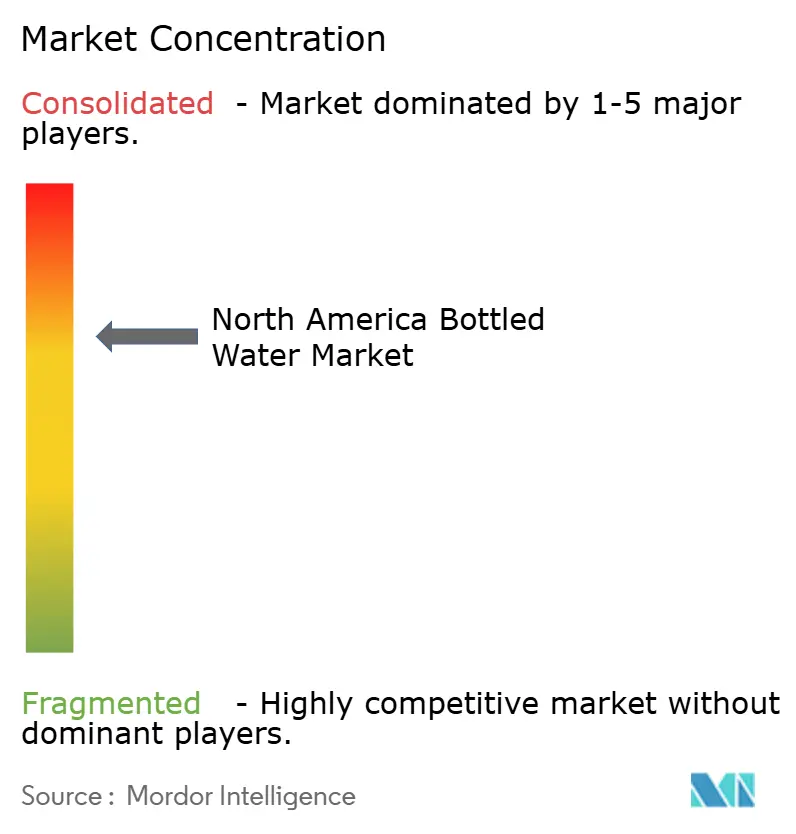
The North American bottled water market is moderately consolidated. Major players in the market include Primo Brands Corporation, The Coca-Cola Company, PepsiCo, Inc., Danone S.A., andNestlé S.A. The market structure continues to evolve through strategic mergers and acquisitions, creating new competitive landscapes. Companies increasingly focus on building comprehensive portfolios that address various consumer preferences and price points. The ongoing vertical integration and geographic expansion enable companies to achieve significant economies of scale while serving diverse market segments.
Companies are shifting their competitive focus beyond traditional factors like price and availability. The industry now emphasizes sustainability initiatives, functional product development, and distribution channel optimization as key differentiators. Technology adoption has become crucial across various operational aspects, including supply chain management and consumer engagement platforms. Companies invest heavily in smart packaging solutions and IoT-enabled distribution tracking systems. Advanced data analytics capabilities are being developed to improve demand forecasting and inventory management.
The market presents significant growth opportunities in functional water segments, which cater to health-conscious consumers. Sustainable packaging solutions continue to gain importance as environmental concerns influence purchasing decisions. Direct-to-consumer channels are emerging as viable alternatives to traditional retail distribution. These new channels enable companies to bypass conventional retail markup structures. The shift toward direct distribution also supports the implementation of premium pricing strategies while maintaining profit margins.
North America Bottled Water Industry Leaders
-
Primo Brands Corporation
-
The Coca-Cola Company
-
PepsiCo, Inc.
-
Danone S.A.
-
Nestlé S.A.
- *Disclaimer: Major Players sorted in no particular order
North America Bottled Water Market Companies Covered in this Report
- Primo Brands Corporation
- The Coca-Cola Company
- PepsiCo, Inc.
- Danone S.A.
- Nestle S.A.
- Niagara Bottling LLC
- Otsuka Holdings Co. Ltd.
- The Wonderful Company LLC
- Voss of Norway AS
- National Beverage Corp.
- Highland Spring Ltd.
- Flow Hydration Inc.
- Talking Rain Beverage Co. (Sparkling Ice)
- Hint Water Inc.
- Keurig Dr Pepper Inc. (CORE Hydration)
- Absopure Water Company
- Penta Water
- Eternal Water
- Propel Fitness Water
- Deer Park Spring Water
Market Opportunities and Future Outlook
Scale-led capacity buildouts and vertical integration are creating opportunities for suppliers and co-manufacturers to support high-throughput PET formats while meeting sustainability requirements. Niagara Bottling announced a USD 160 million investment for a new manufacturing and warehousing facility in the Town of Perth, New York (April 2026), and also moved upstream by purchasing the rPlanet Earth PET recycling and packaging facility in Vernon, California (May 2026). Together, these steps point to demand for secure rPET supply and closed-loop packaging capabilities, particularly given PET bottles' 78.05% share in 2025, as brands also continue exploring alternative formats such as cans for differentiation.
Portfolio expansion and operational resilience efforts are also opening room across premium, functional, and digitally enabled distribution models. Cizzle Brands completed an USD 83.75 million acquisition of Flow Water Inc. in January 2026, and disclosed USD 184 million in contracted manufacturing volume, reflecting how brand owners are using ownership and contracted capacity to lock in supply and accelerate premium positioning. On the risk-management side, the International Bottled Water Association joined the Food and Ag-ISAC in April 2026 to enhance cybersecurity for manufacturing and distribution operations, supporting traceability, secure plant connectivity, and resilient logistics for operators serving off-trade and recovering on-trade channels.
Recent Industry Developments in North America Bottled Water Market
- June 2026: PepsiCo reported progress on its 2030 water ambitions, including 58% progress toward watershed replenishment goals, equivalent to 23 billion liters of water returned, restored, or replenished. The company expanded reporting to include direct operations at both company-owned and franchise-bottler owned manufacturing facilities in high water-risk areas, strengthening alignment between water stewardship and beverage production footprints.
- February 2025: Win Win Water launched a bottled water product using 100% plant-based, fully biodegradable bottles made with Luminy PLA, including the bottle, label, and lid. The launch highlights packaging substitution pathways aimed at reducing single-use plastic exposure in a category facing mounting sustainability scrutiny.
- August 2024: Flow Beverage Corp introduced a mineral spring sparkling water line in 300 ml aluminum bottles containing 70% recycled aluminum, offered as an unflavored option and three flavored variants. The move reinforces aluminum as a premium-leaning packaging alternative that supports recycled-content messaging and format differentiation versus PET-heavy assortments.
North America Bottled Water Market Report Scope and Research Methodology
Market Definition and Coverage
For this methodology, the market covers packaged drinking water sold as bottled water across North America, counted in value terms at the point of sale to trade and retail, and then to the final consumer.
Scope exclusions: We exclude non-bottled drinking water formats and services (such as municipal tap water supply and refill kiosk services) where the product is not sold as a packaged bottled water unit.
Segments Covered in This Report
- By Product Type
- Still Bottled Water
- Sparkling Bottled Water
- Functional/Flavored Bottled Water
- By Packaging Format
- PET Bottles
- Glass Bottles
- Cans
- By Category
- Mass
- Premium
- By Distribution Channel
- On-Trade
- Off-Trade
- Supermarkets/Hypermarkets
- Convenience/Grocery Stores
- Online Retail Stores
- Others Distribution Channel
- By Geography
- United States
- Canada
- Mexico
- Rest of North America
Data Sources, Market Sizing, and Validation
Desk Research
Desk work started by mapping category boundaries and the demand signals that can be tracked consistently across the United States, Canada, and Mexico. We relied on public source types such as US Census retail trade series, US International Trade Commission trade statistics, USDA and Health Canada food and beverage references, and customs and tariff schedules to help classify packaged water movements.
To ground the pricing and mix story, we reviewed company annual reports and investor presentations, trade association releases for packaged beverages, and reputable business press coverage on category pricing and packaging shifts. Where useful, paid subscription access for company financials and a shipment-level import-export database were used to cross-check reported revenues, product mentions, and trade flows. The sources listed here are illustrative only, and during data collection, validation, and clarification we also consulted other references.
Primary Interviews and Surveys
Primary interviews and short surveys were used to pressure-test desk assumptions on pack mix, channel margins, and the pace of price changes by format, especially for still versus sparkling and functional water. We spoke with bottlers, packaging and distribution participants, and buyers from retail and foodservice. Inputs were balanced across key North American markets so gaps could be filled and assumptions could be reconciled.
Distribution of primary research fieldwork respondents
| Company type | Respondent position |
|---|---|
| Top tier: 36% | CXOs: 17% |
| Mid tier: 45% | Functional/Unit leaders: 24% |
| Smaller Players: 19% | Managers: 59% |
Market-Sizing & Forecasting
Sizing was built using a top-down approach where beverage consumption indicators plus trade and domestic production signals were used to reconstruct a realistic demand pool for bottled water across North America, then value was derived using a price and mix layer. To keep totals grounded, selective bottom-up checks were also run, such as rolling up sampled supplier revenues and cross-checking implied volume by major channel, and then the model was adjusted when gaps showed up.
A few model inputs that mattered in the North America view included bottled water per-capita consumption direction, retail versus foodservice channel mix shifts, single-serve versus multi-pack packaging mix, observed price per liter movement (including promotional intensity), and the share change between still and sparkling offerings. Where a variable was not available for every country-year, we handled the gap through proxy indicators (for example, trade volumes or packaged beverage growth), then corrected through expert feedback.
For forecasting, scenario analysis was used so different price and mix paths could be tested alongside expected consumption growth, and then the most likely case was selected based on what interviewees flagged as realistic for the next few years. This keeps the forecast explainable and easier to re-run when a new price cycle or packaging shift appears.
Data Validation & Update Cycle
Model outputs were checked against independent signals like trade movements, reported category performance in public filings, and directionally consistent pricing and mix patterns in the market. Any sharp jumps were reviewed line by line, and when variance could not be explained by a clear input change, follow-up contacts were triggered to confirm what changed in channel behavior or pricing.
Before sign-off, the work is reviewed in multiple steps so assumptions, conversions, and year mapping stay consistent. Reports are refreshed annually, and interim updates are made when material events affect pricing, supply, or demand. Right before delivery, a final check is completed so clients receive the most current view available.
Mordor Intelligence's North America Bottled Water Market Estimate Compared With Other Published Estimates
It is common to see different market size numbers for bottled water because authors do not always match on geography coverage, what counts as bottled water, and how price per liter is carried forward across years. Differences also come from whether the estimate is anchored to retail sell-out value versus a supply-side revenue view, which can shift totals when channel margins change.
The biggest gap drivers in this category are often refresh timing and how price and mix are updated, since exchange-rate timing and a fast-moving promotional environment can change implied value even when volumes look stable. When price ladders are refreshed by pack type and then stress-checked using trade signals and channel checks close to publication, the 2026 total stays aligned with the latest selling conditions, which is how Mordor Intelligence handles the update cadence.
Benchmark comparison
| Source | Market Size | Gaps in Research Methodology |
|---|---|---|
| Mordor Intelligence | USD 87.08 B (2026) | |
| Regional Consultancy A | USD 58.77 B (2024) | Uses an earlier anchor year and a tighter product list centered on spring, purified, mineral, and sparkling, which can miss value from functional or flavored variants and newer channel pricing patterns. |
| Industry Research Group B | USD 62.53 B (2025) | Limits geographic coverage to the United States and Canada and applies a longer-horizon growth view, which changes the implied current value when Mexico and near-term pricing normalization are treated differently. |
The spread in the table is largely explained by country coverage and the year used for anchoring prices, followed by how pack mix and channel value are translated into one USD total. Our checks keep the sizing steps traceable to visible demand and pricing inputs, so the number can be replicated and refreshed cleanly in the next cycle.
Key Questions Answered in the Report
What is the current size of the North America bottled water market?
The market is valued at USD 87.08 billion in 2026 and is expected to reach USD 108.79 billion by 2031.
Who are the key players in North America Bottled Water Market?
Danone S.A., The Coca-Cola Company, Nestle SA, BlueTriton Brands, and Niagara Bottling LLC are the major companies operating in the North America Bottled Water Market.
Which segment is growing the fastest?
Functional and flavored water shows the strongest momentum with a 5.22% CAGR forecast for 2026-2031.
What is the future outlook for the bottled water market in North America?
The market is expected to continue growing at a 4.55% CAGR, driven by health trends, innovation in product offerings, and expansion into new retail channels like e-commerce and subscription services.