
Cocktail Syrup Market Size and Share
Market Overview
| Study Period | 2021 - 2031 |
|---|---|
| Market Size (2026) | USD 5.89 Billion |
| Market Size (2031) | USD 7.24 Billion |
| Growth Rate (2026 - 2031) | 4.21 % |
| Fastest Growing Market | Asia-Pacific |
| Largest Market | North America |
| Market Concentration | Medium |
Major Players *Disclaimer: Major Players sorted in no particular order Image © Mordor Intelligence. Reuse requires attribution under CC BY 4.0. | |
Cocktail Syrup Market Analysis by Mordor Intelligence
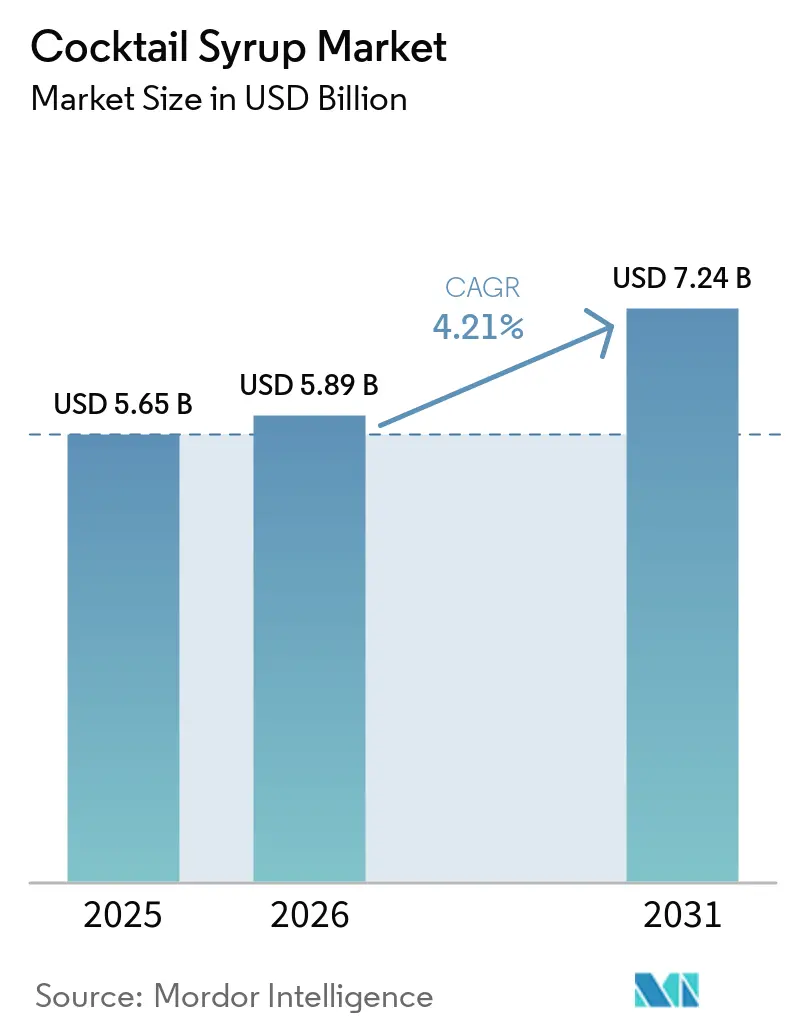
The cocktail syrup market size is expected to grow from USD 5.65 billion in 2025 to USD 5.89 billion in 2026 and is forecast to reach USD 7.24 billion by 2031 at 4.21% CAGR over 2026-2031. The cocktail syrup market is experiencing significant growth as premium drinks, travel recovery, and stronger home cocktail-making habits drive demand for high-value syrups. Consumers are increasingly seeking quality ingredients for their beverages, both at home and in social settings. In 2025, travel and tourism contributed USD 11.6 trillion to the global GDP and supported 366 million jobs, which boosted traffic in hotels, bars, and restaurants. This rise in hospitality activities has directly supported the expansion of the cocktail syrup market across various regions. Additionally, the growing trend of at-home mixology has further amplified the demand for diverse and premium syrup options. The market is also benefiting from innovations in flavors and packaging, catering to evolving consumer preferences. As a result, the cocktail syrup market is poised for sustained growth in the coming years.
Key Report Takeaways
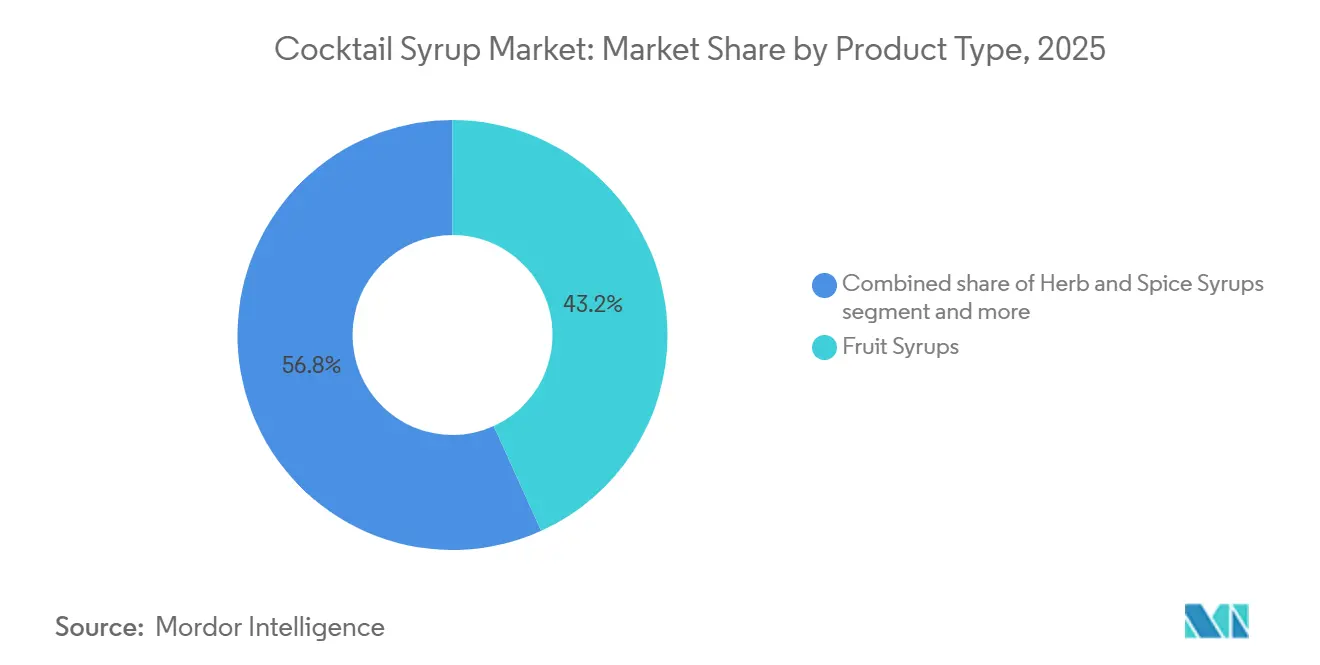
- By product type, fruit syrups led with 43.18% of the cocktail syrup market size in 2025, while herb and spice syrups are forecast to grow at a 6.01% CAGR through 2031.
- By flavor, sweet held 49.41% share in 2025, while mint is projected to expand at a 5.75% CAGR through 2031.
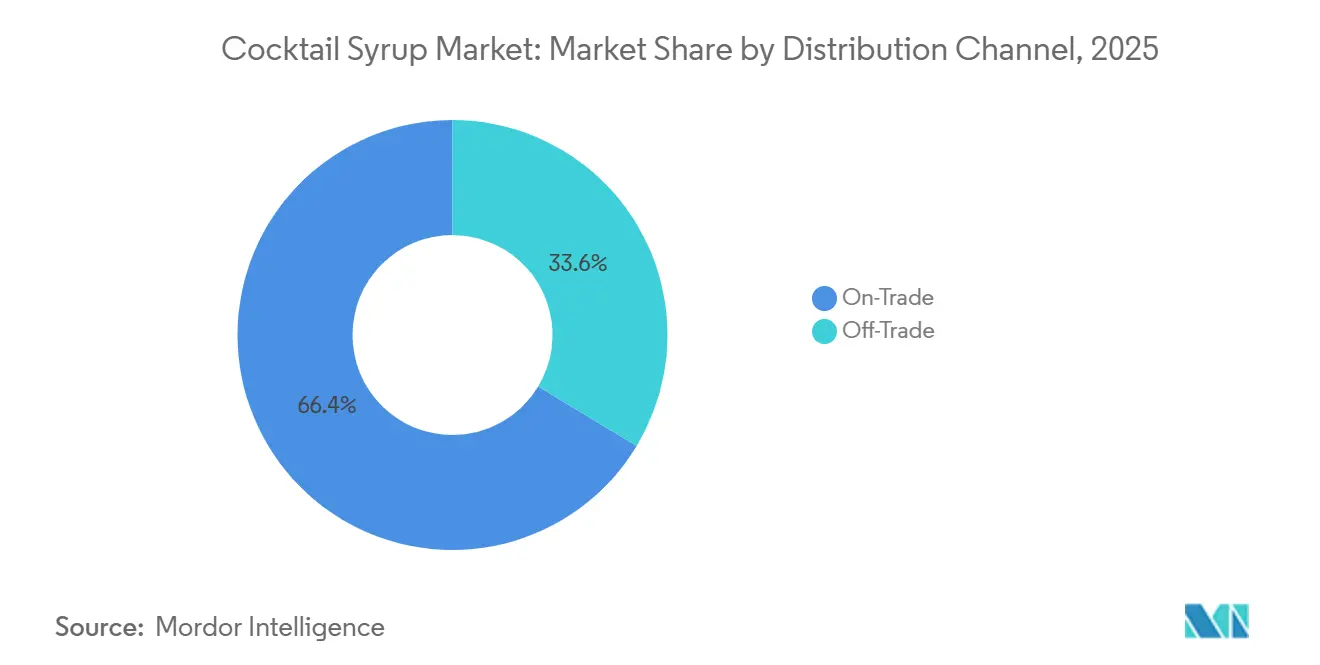
- By distribution channel, on-trade channels held 66.37% of the cocktail syrup market share in 2025, while off-trade is expected to record the highest CAGR at 5.47% through 2031.
- By geography, North America held 36.89% of the cocktail syrup market share in 2025, while Asia-Pacific is projected to grow at a 5.81% CAGR through 2031.
Note: Market size and forecast figures in this report are generated using Mordor Intelligence’s proprietary estimation framework, updated with the latest available data and insights as of January 2026.
Market Trends and Insights
Drivers Impact Analysis of Cocktail Syrup Market*
| Driver | (~) % Impact on CAGR Forecast | Geographic Relevance | Impact Timeline |
|---|---|---|---|
| Rising consumption of cocktails and mixed alcoholic beverages | +1.0% | Global, strongest in North America and Asia-Pacific urban markets | Medium term (2-4 years) |
| Expansion of hospitality and tourism industries | +0.8% | Global, Asia-Pacific, with spillover to Middle East and Africa and South America | Long term (≥ 4 years) |
| Expansion of premium and craft beverage trends | +0.7% | North America and Europe, expanding into premium urban centers in Asia-Pacific | Medium term (2-4 years) |
| Increasing demand from bars, pubs, and restaurants | +0.6% | Global, concentrated in urban on-premise clusters | Short term (≤ 2 years) |
| Growing popularity of flavored and customized drinks | +0.5% | Global, strongest in North America, Europe, and urban Asia-Pacific | Medium term (2-4 years) |
| Growth of home bartending and DIY cocktail culture | +0.4% | North America and Europe, expanding into Asia-Pacific | Short term (≤ 2 years) |
| Source: Mordor Intelligence | |||
Rising consumption of cocktails and mixed alcoholic beverages
The rising consumption of cocktails and mixed alcoholic beverages is a key driver of the global cocktail syrup market. Consumers are increasingly seeking premium, flavorful, and customized drinking experiences, leading to greater demand for cocktails across bars, restaurants, clubs, and home settings. Cocktail syrups play a crucial role in enhancing taste, consistency, and preparation efficiency, making them an essential ingredient in a wide range of alcoholic beverages. The growing popularity of classic cocktails, craft beverages, and innovative mixology trends has further accelerated syrup usage among bartenders and consumers. Additionally, the expansion of social drinking culture, rising disposable incomes, and increasing interest in at-home cocktail preparation are supporting market growth. The introduction of exotic, fruit-based, and botanical flavors by manufacturers is also attracting consumers looking for unique beverage experiences. As cocktail consumption continues to rise globally, demand for high-quality cocktail syrups is expected to increase steadily.
Expansion of hospitality and tourism industries
The expansion of the hospitality and tourism industries is a significant driver of the cocktail syrup market. As international travel continues to recover and grow, demand for premium food and beverage experiences across hotels, resorts, restaurants, bars, and entertainment venues is increasing. According to UN Tourism, global international tourist arrivals reached approximately 1.52 billion in 2025, reflecting a 4% increase from 2024 and the highest level ever recorded[1]Source: UN Tourism, “International tourist arrivals up 4% in 2025 reflecting strong travel demand around the world”, untourism.int. The growing influx of tourists has encouraged hospitality establishments to expand their beverage offerings, including signature cocktails and premium mixed drinks. Cocktail syrups are widely used to enhance flavor variety, ensure consistency, and streamline beverage preparation in high-volume service environments. Additionally, rising investments in tourism infrastructure and luxury hospitality services are supporting the adoption of innovative cocktail ingredients.
Expansion of premium and craft beverage trends
The growing popularity of premium and craft beverages is significantly supporting the expansion of the global cocktail syrup market. Consumers are increasingly gravitating toward high-quality, artisanal, and personalized drinking experiences, prompting bars, restaurants, and beverage producers to enhance their offerings with premium ingredients. This trend is being reinforced by rising disposable incomes and stronger purchasing power across several economies. For example, according to the International Monetary Fund (IMF), GDP per capita in the United Arab Emirates increased from USD 42.84 thousand in 2021 to USD 50.22 thousand in 2024[2]Source: International Monetary Fund, “United Arab Emirates Database”, imf.org. Higher consumer spending capacity has encouraged greater consumption of premium cocktails, craft spirits, and specialty mixed drinks. As a result, demand for cocktail syrups featuring distinctive flavors, natural ingredients, and authentic taste profiles is increasing. The continued evolution of craft beverage culture is therefore creating favorable conditions for sustained growth in the cocktail syrup market.
Increasing demand from bars, pubs, and restaurants
The increasing demand from bars, pubs, and restaurants is contributing significantly to the growth of the global cocktail syrup market. These establishments rely on cocktail syrups to deliver consistent flavor profiles, improve preparation efficiency, and expand their beverage menus with innovative offerings. The rising popularity of cocktail culture has encouraged hospitality operators to introduce premium and signature drinks that require a wide variety of flavored syrups. For instance, as of 2024, the Australian Bureau of Statistics reported 6,961 bars, pubs, and taverns operating across the country, supporting the rapid expansion of the cocktail scene[3]Source: Australian Bureau of Statistics. “Counts of Australian Businesses, including Entries and Exits”, abs.gov.au. The growing number of on-trade venues has created a favorable environment for mixologists to experiment with unique recipes and premium ingredients. As consumers increasingly seek distinctive and high-quality cocktail experiences, demand for specialty syrups continues to rise.
Restraints Impact Analysis of Cocktail Syrup Market*
| Restraint | (~) % Impact on CAGR Forecast | Geographic Relevance | Impact Timeline |
|---|---|---|---|
| High sugar content concerns among health-conscious consumers | -0.5% | Global, strongest in North America and Europe | Medium term (2-4 years) |
| Growing demand for low-calorie and sugar-free alternatives | -0.4% | North America and Europe, expanding to Asia-Pacific | Short term (≤ 2 years) |
| Volatility in prices of sugar, fruits, and flavoring ingredients | -0.3% | Global, with Europe and Asia-Pacific more exposed to import-dependent supply chains | Short term (≤ 2 years) |
| Stringent food safety and labeling regulations | -0.2% | Europe and North America, expanding into Asia-Pacific | Long term (≥ 4 years) |
| Source: Mordor Intelligence | |||
High sugar content concerns among health-conscious consumers
High sugar content concerns among health-conscious consumers are limiting the growth potential of the cocktail syrup market. Traditional cocktail syrups often contain significant amounts of added sugars, which can conflict with the growing consumer preference for healthier beverage options. Rising awareness of health issues such as obesity, diabetes, and cardiovascular diseases has encouraged consumers to monitor and reduce their sugar intake. As a result, many consumers are opting for low-sugar, sugar-free, or naturally sweetened alternatives when selecting beverages. This shift is particularly evident among younger consumers and wellness-focused demographics who prioritize clean-label and functional ingredients. Additionally, stricter nutritional labeling requirements and public health campaigns promoting reduced sugar consumption are influencing purchasing decisions. Consequently, manufacturers face increasing pressure to reformulate products and develop healthier syrup alternatives to remain competitive in the market.
Growing demand for low-calorie and sugar-free alternatives
The growing demand for low-calorie and sugar-free alternatives presents a challenge for the traditional cocktail syrup market. As consumers become increasingly health-conscious, they are actively seeking beverages with reduced sugar content and fewer calories while maintaining flavor and quality. This shift in consumer preferences is influencing purchasing decisions across both on-trade and off-trade channels, reducing the appeal of conventional syrups that rely heavily on sugar-based formulations. Many consumers are turning to naturally sweetened, zero-sugar, or functional beverage ingredients as part of broader wellness and weight-management goals. In response, beverage manufacturers and hospitality operators are expanding their offerings of healthier cocktail options. This trend is placing pressure on cocktail syrup producers to invest in reformulation and product innovation. Failure to adapt to evolving health and nutrition preferences may limit market penetration and constrain growth opportunities for traditional syrup products.
*Our forecasts treat driver/restraint impacts as directional, not additive. The impact forecasts reflect baseline growth, mix effects, and variable interactions.
Cocktail Syrup Market Segment Analysis
By Product Type:
Herb and Spice Syrups Lead the Premiumisation WaveBy product type, fruit syrups dominated the cocktail syrup market, accounting for 43.18% of total revenue in 2025. The segment's leadership is primarily driven by the widespread consumer preference for fruit-based flavors in both alcoholic and non-alcoholic beverages. Fruit syrups offer versatility across a broad range of cocktails, mocktails, sodas, and specialty drinks, making them a staple ingredient in bars, restaurants, and households. Popular flavors such as strawberry, mango, raspberry, passion fruit, and citrus varieties continue to experience strong demand due to their familiar taste profiles and broad consumer appeal. The growing trend of premium cocktails and craft beverages has further encouraged manufacturers to introduce innovative fruit syrup formulations with natural ingredients and reduced sugar content.
Herb and spice syrups are projected to be the fastest-growing product type in the cocktail syrup market, registering a CAGR of 6.01% through 2031. Growth in this segment is being fueled by rising consumer interest in unique and sophisticated flavor experiences that go beyond traditional fruit-based offerings. Bartenders and mixologists are increasingly incorporating flavors such as rosemary, basil, lavender, ginger, cinnamon, cardamom, and thyme into premium cocktail creations to enhance complexity and aroma. The popularity of craft cocktails and experiential drinking trends has created strong demand for specialty syrups that enable flavor customization. Furthermore, consumers are becoming more receptive to botanical and spice-infused beverages, particularly in premium hospitality venues and upscale restaurants.



By Flavor:
Sweet Profiles Dominate, but Mint Signals a Structural ShiftBy flavor, sweet syrups accounted for the largest share of the cocktail syrup market, representing 49.41% of total revenue in 2025. The segment's dominance is attributed to the fundamental role sweet syrups play in balancing and enhancing the taste profile of a wide variety of cocktails and mocktails. Sweet flavors are highly versatile and are commonly used across classic cocktails, flavored beverages, specialty coffees, and non-alcoholic drinks. Their broad consumer acceptance, combined with the growing popularity of indulgent and dessert-inspired beverages, has continued to support strong demand worldwide. Manufacturers are also expanding their portfolios with premium sweet syrup variants featuring natural sweeteners, fruit extracts, and organic ingredients to cater to evolving consumer preferences.
Mint-flavored syrups are anticipated to be the fastest-growing flavor segment in the cocktail syrup market, registering a CAGR of 5.75% through 2031. Growth is being driven by increasing consumer demand for refreshing and aromatic beverage experiences, particularly in premium cocktails, mocktails, and specialty drinks. Mint syrups are widely used in popular beverages such as mojitos, mint lemonades, iced teas, and craft cocktails, contributing to their rising popularity across foodservice establishments. The flavor’s association with freshness and natural ingredients aligns well with current consumer preferences for clean and botanical taste profiles. Furthermore, beverage manufacturers and mixologists are increasingly experimenting with mint-based formulations to create innovative drink offerings that appeal to younger consumers.
By Distribution Channel:
On-Trade Concentration Creates Off-Trade OpportunityBy distribution channel, on-trade channels accounted for the largest share of the cocktail syrup market, contributing 66.37% of total revenue in 2025. The segment’s dominance is largely driven by the extensive use of cocktail syrups across bars, pubs, restaurants, hotels, lounges, and other foodservice establishments. Growing consumer spending on dining-out experiences and premium beverages has significantly increased demand for professionally crafted cocktails and mocktails. Hospitality operators rely heavily on a diverse range of syrups to create customized and innovative drink offerings that cater to evolving consumer tastes. The continued expansion of nightlife culture, tourism activities, and premium hospitality services across major urban centers has further strengthened the position of on-trade channels.
Off-trade channels are expected to register the fastest growth in the cocktail syrup market, expanding at a CAGR of 5.47% through 2031. Growth is being fueled by increasing consumer interest in preparing cocktails and specialty beverages at home, supported by the rising trend of home mixology. The growing availability of cocktail syrups through supermarkets, hypermarkets, specialty stores, and online retail platforms has made these products more accessible to a broader consumer base. E-commerce channels, in particular, have played a crucial role in driving sales by offering a wide variety of flavors, premium products, and convenient delivery options.
Geography Analysis
North America Cocktail Syrup Market
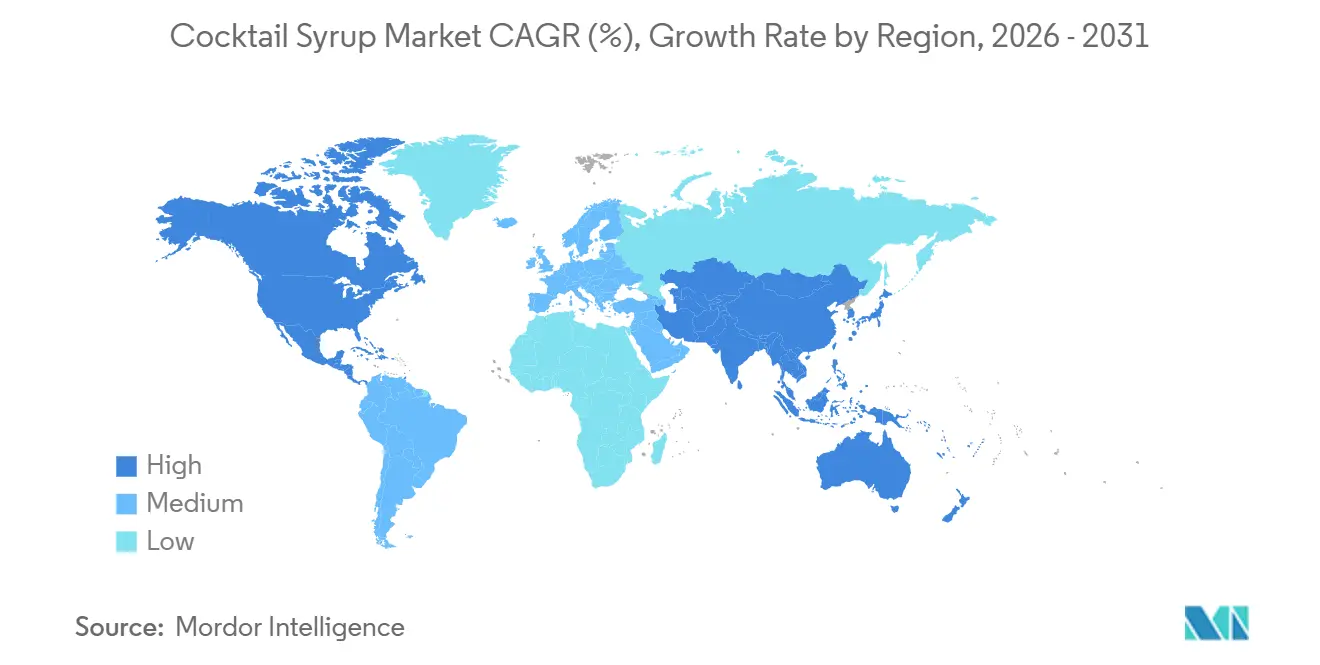
North America accounted for the largest share of the global cocktail syrup market, representing 36.89% of total revenue in 2025. The region's leadership is supported by a well-established cocktail culture, high consumer spending on premium beverages, and the widespread presence of bars, restaurants, lounges, and hospitality venues. The United States remains the primary contributor, driven by strong demand for craft cocktails, flavored beverages, and innovative mixology experiences. Rising consumer preference for premium and customized drinks has encouraged beverage operators to expand their use of cocktail syrups across both alcoholic and non-alcoholic applications. In addition, the growing popularity of at-home cocktail preparation and premium beverage ingredients has further strengthened market demand.
APAC Cocktail Syrup Market
Asia-Pacific is projected to be the fastest-growing region in the cocktail syrup market, expanding at a CAGR of 5.81% through 2031. Rapid urbanization, rising disposable incomes, and changing consumer lifestyles are driving increased demand for premium beverages and modern drinking experiences across the region. Countries such as China, India, Japan, South Korea, and Australia are witnessing growing consumption of cocktails, mocktails, specialty coffees, and flavored beverages, creating significant opportunities for syrup manufacturers. The expansion of international restaurant chains, cafés, bars, and hospitality establishments has further accelerated product adoption. Younger consumers are increasingly experimenting with new flavors and beverage formats, encouraging demand for innovative syrup varieties.
EMEA and South America Cocktail Syrup Market
Europe represents a mature and significant market for cocktail syrups, supported by a strong café culture, established hospitality sector, and growing demand for premium and craft beverages. Consumers across the region increasingly favor natural, organic, and artisanal syrup formulations, encouraging product innovation among manufacturers. South America is experiencing steady market growth, driven by expanding urban populations, increasing tourism activities, and rising popularity of flavored alcoholic and non-alcoholic beverages. Meanwhile, the Middle East and Africa region is gradually emerging as a promising market due to the expansion of cafés, hotels, restaurants, and premium dining establishments.

Competitive Landscape
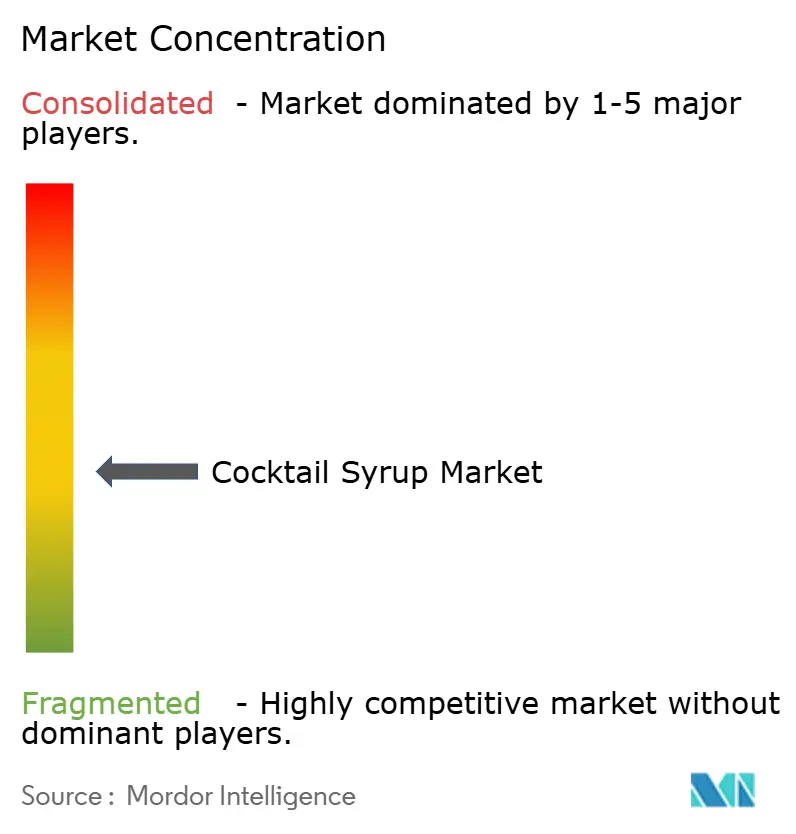
The cocktail syrup market is moderately fragmented at the global level, with a mix of multinational beverage ingredient manufacturers, specialty syrup producers, and regional players competing across various distribution channels. While numerous companies offer extensive product portfolios, competition is primarily driven by flavor innovation, product quality, ingredient sourcing, and brand recognition. Market participants are increasingly focusing on natural ingredients, clean-label formulations, and reduced-sugar offerings to align with evolving consumer preferences. The presence of both established brands and niche artisanal producers contributes to a diverse competitive environment. Companies also continue to expand their flavor ranges to cater to changing beverage trends and consumer demand for unique drinking experiences.
Despite the fragmented nature of the broader market, the premium on-trade segment exhibits a higher degree of concentration. Leading brands with strong reputations among bartenders, mixologists, hotels, restaurants, and premium beverage chains maintain a significant competitive advantage in this category. These companies benefit from established relationships with foodservice operators, extensive distribution networks, and consistent product quality standards. Premium on-trade customers often prioritize reliability, flavor consistency, and brand credibility, creating barriers for smaller competitors seeking entry into the segment. Additionally, collaborations with hospitality groups and participation in mixology events help leading players strengthen brand visibility and customer loyalty.
Market participants are increasingly investing in product innovation, geographic expansion, and digital sales channels to strengthen their market positions. New product launches featuring exotic fruits, botanicals, herbs, spices, and functional ingredients have become important strategies for differentiation. Companies are also leveraging e-commerce platforms and direct-to-consumer channels to expand their reach beyond traditional foodservice customers. Strategic partnerships with beverage manufacturers, cafés, and restaurant chains further support market penetration and brand growth. Sustainability initiatives, including responsibly sourced ingredients and environmentally friendly packaging solutions, are also gaining importance as competitive factors.
Cocktail Syrup Industry Leaders
Monin S.A.S.
Maison Routin SAS
Giffard & Cie
Fabbri 1905 S.p.A.
R. Torre & Company, Inc. (Torani)
- *Disclaimer: Major Players sorted in no particular order
Cocktail Syrup Market Companies Covered in this Report
- Monin S.A.S.
- R. Torre & Company, Inc. (Torani)
- Maison Routin SAS (1883 Maison Routin)
- Giffard & Cie
- Fabbri 1905 S.p.A.
- Teisseire SAS
- American Beverage Marketers, Inc. (Finest Call)
- Liber & Co.
- ODK S.r.l.
- Bristol Syrup Company Ltd
- Funkin Cocktails Ltd.
- Fee Brothers, Inc.
- Collins Brothers LLC
- Small Hand Foods, Inc.
- Sonoma Syrup Co.
- Toschi Vignola S.r.l.
- BG Reynolds, LLC
- Cocktail & Sons, Inc.
- The Simple Syrup Co.
- Liquid Alchemist LLC

Recent Industry Developments in Cocktail Syrup Market
- May 2026: ANGOSTURA expanded its portfolio beyond bitters with the launch of two premium cocktail syrups in the U.S. market: ANGOSTURA Demerara Sugar Syrup and ANGOSTURA Spicy Honey Syrup. The move represents the company’s entry into the growing premium cocktail ingredient segment and aligns with increasing demand from bartenders and home mixologists for high-quality, ready-to-use cocktail components that enhance efficiency without compromising flavor.
- July 2025: Fabbri 1905 S.p.A. launched two new syrups at
- Tuttofood 2025: Passion Fruit Maracuja Syrup, targeting the growing spritz cocktail format, and Lemon and Mint Zero Syrup, addressing zero-sugar demand. The dual launch positioned Fabbri simultaneously in the indulgence and wellness segments.
- March 2025: MONIN Americas launched Yuzu Pineapple Syrup, the company’s first syrup made using fruit grown in its own sustainable orchard. The product incorporates yuzu sourced from MONIN’s 74-acre biodynamic orchard in Portugal, marking a significant step in the company’s vertically integrated and sustainable ingredient sourcing strategy.


Global Cocktail Syrup Market Report Scope
Cocktail syrup refers to a flavored liquid sweetener specifically formulated for use in cocktails, mocktails, and other mixed beverages to enhance taste, aroma, color, and texture. The cocktail syrup market is segmented by product type, flavor, distribution channel, and geography. By product type, the market is segmented into fruit syrups, herb and spice syrups, vanilla syrups, and other product types. Based on flavor, the market is segmented into sweet, salty, sour, and mint. Based on distribution channel, the market is segmented into on-trade and off-trade channels. By geography, the market is segmented into North America, Europe, Asia-Pacific, South America, and Middle East, and Africa. For each segment, the market sizing and forecasting have been done in value terms (USD million) and volume (litres).
| Fruit Syrups |
| Herb and Spice Syrups |
| Vanilla Syrups |
| Other Product types |
| Sweet |
| Salty |
| Sour |
| Mint |
| On-Trade | |
| Off-Trade | Supermarkets/Hypermarkets |
| Specialty Stores | |
| Online Retail Stores | |
| Other Distribution Channels |
| North America | United States |
| Canada | |
| Mexico | |
| Rest of North America | |
| Europe | United Kingdom |
| Germany | |
| France | |
| Italy | |
| Spain | |
| Netherlands | |
| Sweden | |
| Belgium | |
| Poland | |
| Rest of Europe | |
| Asia-Pacific | China |
| Japan | |
| India | |
| South Korea | |
| Australia | |
| Indonesia | |
| Thailand | |
| Singapore | |
| Rest of Asia-Pacific | |
| South America | Brazil |
| Argentina | |
| Chile | |
| Colombia | |
| Peru | |
| Rest of South America | |
| Middle East and Africa | United Arab Emirates |
| South Africa | |
| Saudi Arabia | |
| Nigeria | |
| Egypt | |
| Morocco | |
| Turkey | |
| Rest of Middle East and Africa |
| By Product Type | Fruit Syrups | |
| Herb and Spice Syrups | ||
| Vanilla Syrups | ||
| Other Product types | ||
| By Flavor | Sweet | |
| Salty | ||
| Sour | ||
| Mint | ||
| By Distribution Channel | On-Trade | |
| Off-Trade | Supermarkets/Hypermarkets | |
| Specialty Stores | ||
| Online Retail Stores | ||
| Other Distribution Channels | ||
| By Geography | North America | United States |
| Canada | ||
| Mexico | ||
| Rest of North America | ||
| Europe | United Kingdom | |
| Germany | ||
| France | ||
| Italy | ||
| Spain | ||
| Netherlands | ||
| Sweden | ||
| Belgium | ||
| Poland | ||
| Rest of Europe | ||
| Asia-Pacific | China | |
| Japan | ||
| India | ||
| South Korea | ||
| Australia | ||
| Indonesia | ||
| Thailand | ||
| Singapore | ||
| Rest of Asia-Pacific | ||
| South America | Brazil | |
| Argentina | ||
| Chile | ||
| Colombia | ||
| Peru | ||
| Rest of South America | ||
| Middle East and Africa | United Arab Emirates | |
| South Africa | ||
| Saudi Arabia | ||
| Nigeria | ||
| Egypt | ||
| Morocco | ||
| Turkey | ||
| Rest of Middle East and Africa | ||


Key Questions Answered in the Report
What is the current size of the cocktail syrup sector?
The cocktail syrup market was valued at USD 5.65 billion in 2025 and stands at USD 5.89 billion in 2026, with forecasts reaching USD 7.24 billion by 2031 at a 4.21% CAGR.
Which product type leads sales in cocktail syrups?
Fruit Syrups led the category with 43.18% share in 2025 because they work across cocktails, mocktails, café drinks, and foodservice menus.
Which flavor segment is growing the fastest?
Mint is the fastest-growing flavor, with a projected 5.75% CAGR through 2031, helped by strong mojito demand and wider use in both alcoholic and nonalcoholic drinks.
Why does On-Trade still matter more than Off-Trade?
On-Trade held 66.37% share in 2025 because bars, hotels, and restaurants buy in larger volumes and turn syrups into premium-priced beverages with higher repeat rates.
Page last updated on:


 Your data is secure and never sold or shared.


