
Coal Tar Pitch Market Size and Share
Market Overview
| Study Period | 2020 - 2031 |
|---|---|
| Market Size (2026) | USD 4.76 Billion |
| Market Size (2031) | USD 5.92 Billion |
| Growth Rate (2026 - 2031) | 4.45 % |
| Fastest Growing Market | Middle East and Africa |
| Largest Market | Asia Pacific |
| Market Concentration | Medium |
Major Players *Disclaimer: Major Players sorted in no particular order Image © Mordor Intelligence. Reuse requires attribution under CC BY 4.0. | |
Coal Tar Pitch Market Analysis by Mordor Intelligence
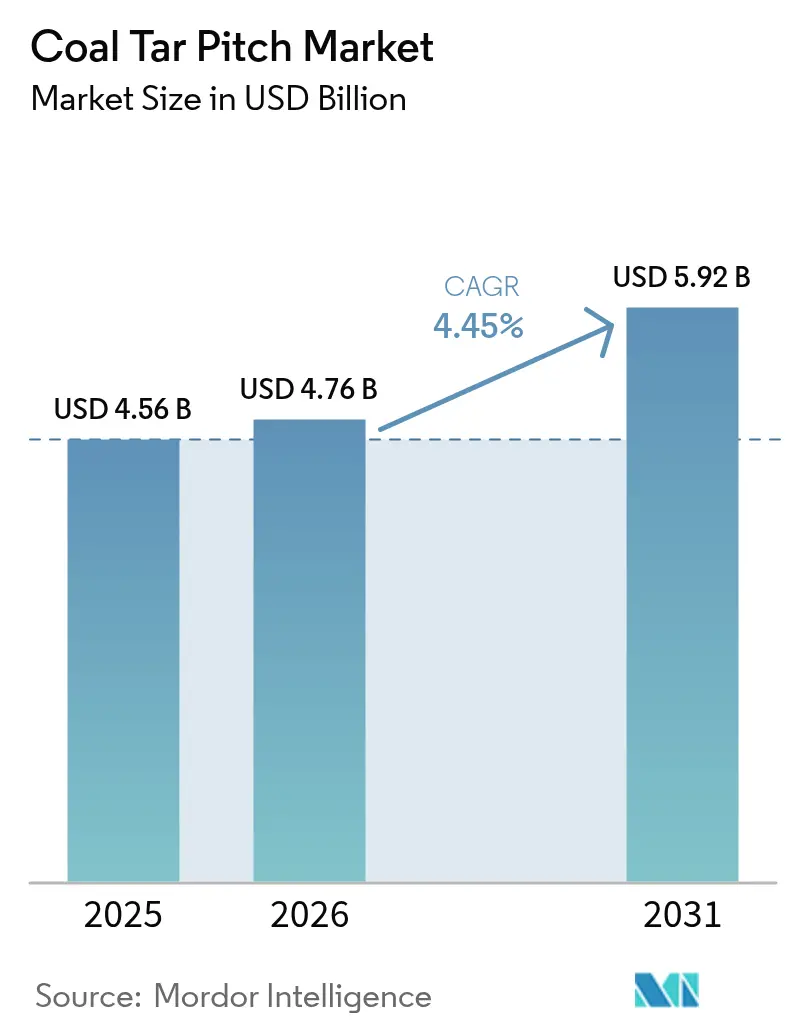
Coal Tar Pitch market size in 2026 is estimated at USD 4.76 billion, growing from 2025 value of USD 4.56 billion with 2031 projections showing USD 5.92 billion, growing at 4.45% CAGR over 2026-2031. Robust aluminum-smelting activity across the Asia-Pacific region anchors demand, while engineered low-PAH grades open up incremental revenue streams in Europe and North America. Price volatility in crude oil, recurring supply tightness due to shrinking coke-oven fleets, and widening regulatory restrictions shape the competitive landscape. Producers that can simultaneously guarantee consistent quality, reduce toxic constituents, and optimize logistics capture outsized value as end-users pivot toward circular and decarbonized production routes. Heightened strategic interest in automotive carbon-fiber applications and graphite-electrode binders further cushions the coal tar pitch market against cyclical softness in legacy roofing and pavement-sealer uses.
Key Report Takeaways
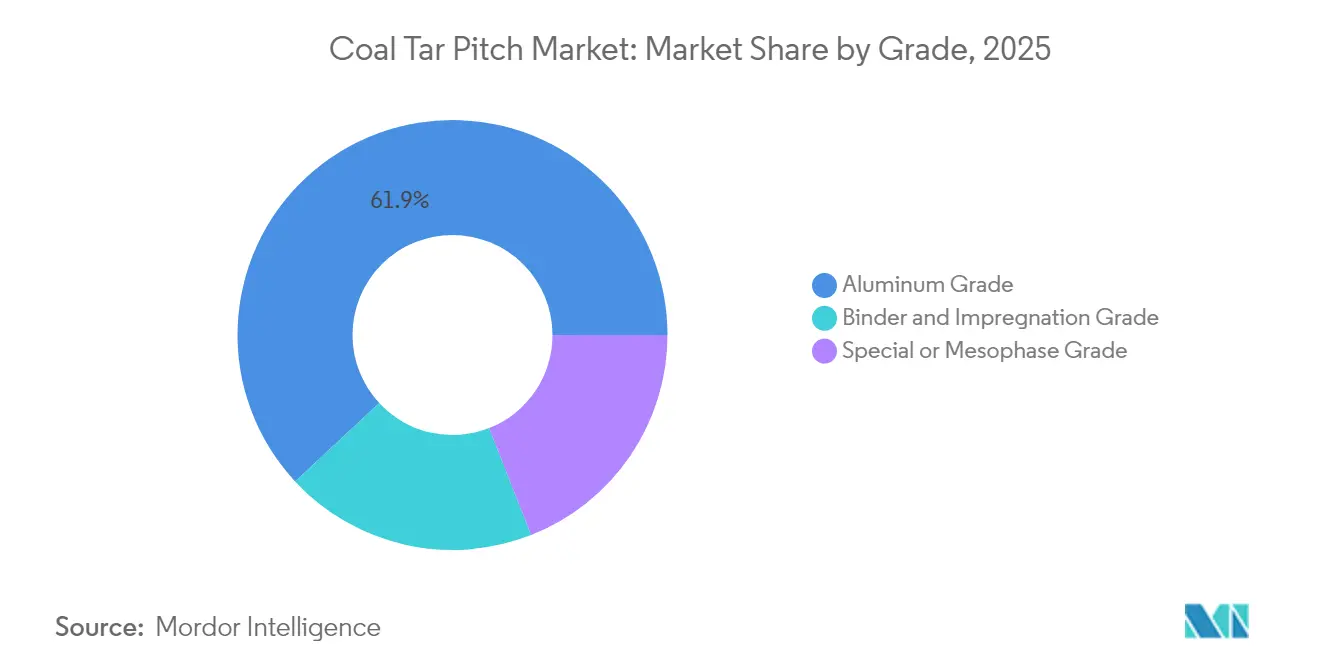
- By grade, Aluminium Grade held 61.92% of the Coal Tar Pitch market share in 2025. The Special/Mesophase Grade is expected to expand at a 5.83% CAGR by 2031, the fastest pace among all grades.
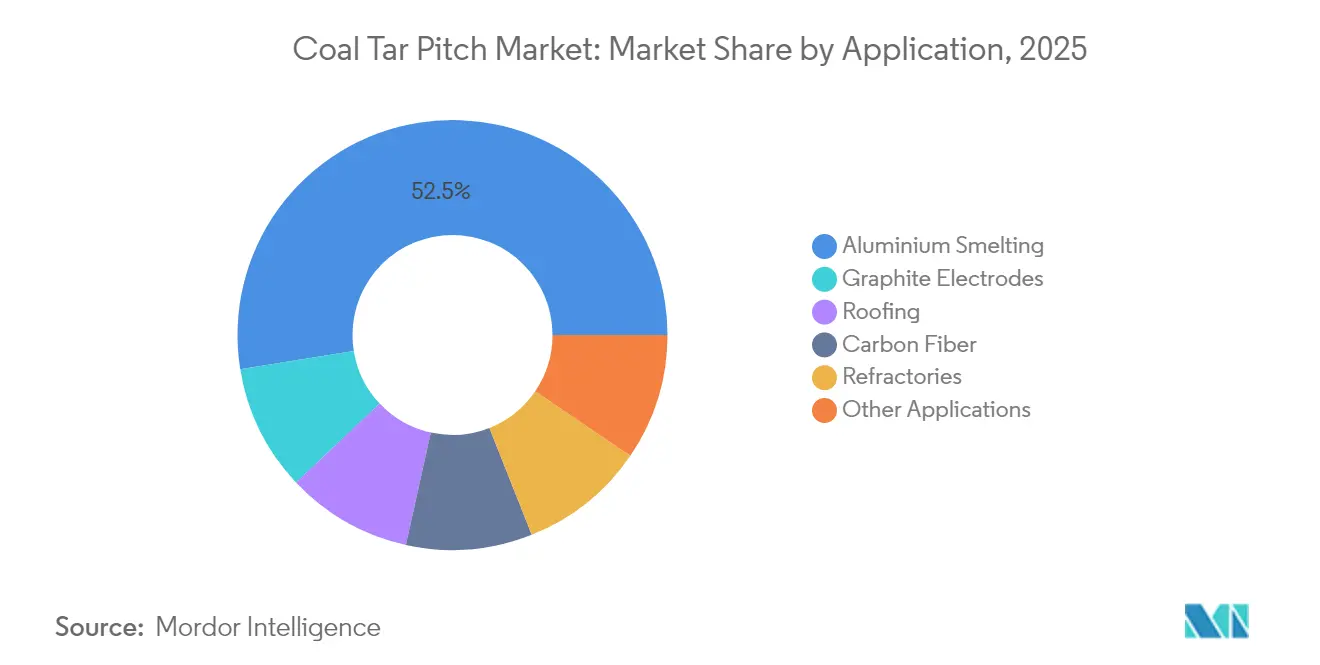
- By application, aluminum smelting contributed 52.54% of the Coal Tar Pitch market size in 2025. Carbon fiber applications are forecast to advance at a 6.11% CAGR between 2026 and 2031, the quickest among all end uses.
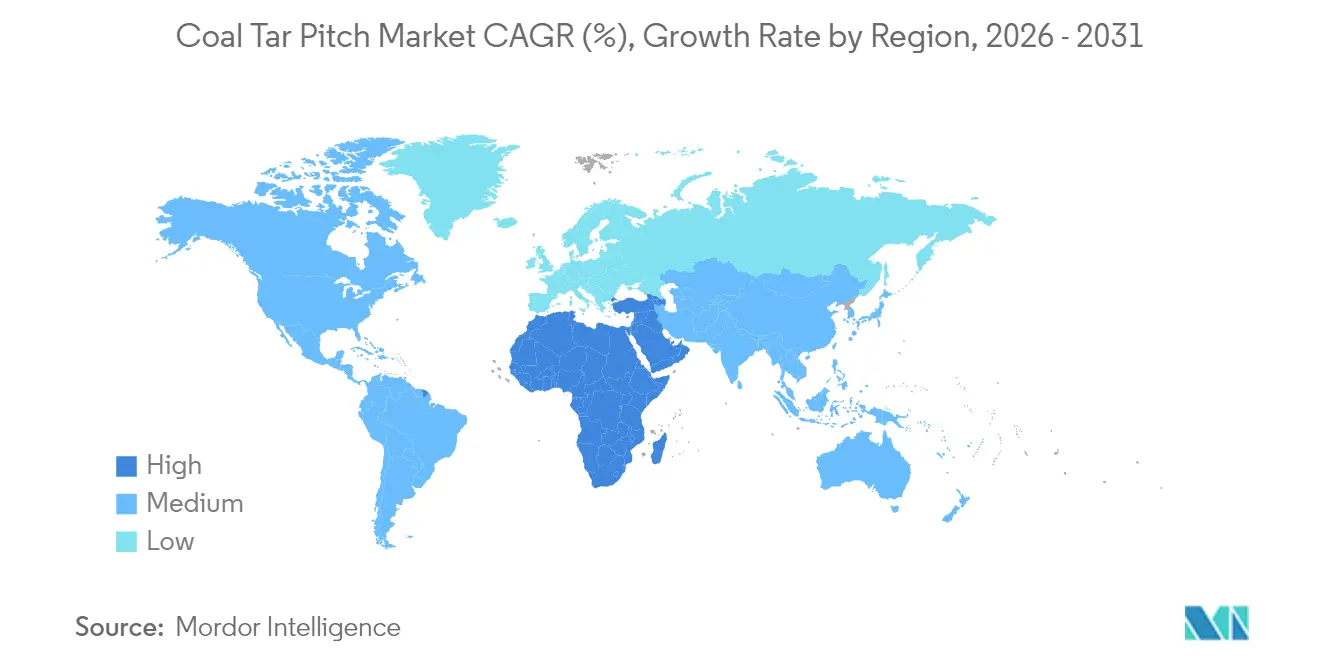
- By geography, the Asia-Pacific region accounted for 63.61% of the market share in 2025, while the market share of the Middle East and Africa is poised to grow at the fastest rate, with a share of 5.55% through 2031.
Note: Market size and forecast figures in this report are generated using Mordor Intelligence’s proprietary estimation framework, updated with the latest available data and insights as of 2026.
Market Trends and Insights
Drivers Impact Analysis of Coal Tar Pitch Market*
| Driver | (~) % Impact on CAGR Forecast | Geographic Relevance | Impact Timeline |
|---|---|---|---|
| Surging Aluminium-smelter Expansions in China and India | +1.8% | Asia-Pacific core, spill-over to MEA | Medium term (2-4 years) |
| Increasing Adoption of Graphite-electrode EAF Steelmaking | +1.2% | Global, with concentration in APAC and North America | Long term (≥ 4 years) |
| Robust Refractory Brick Output in Asia-Pacific | +0.9% | Asia-Pacific, secondary impact in Europe | Short term (≤ 2 years) |
| Low-PAH engineered Pitch Gaining EU-REACH Approvals | +0.7% | Europe and North America, expanding globally | Medium term (2-4 years) |
| Automotive Push for Pitch-based Carbon-fiber Light-weighting | +0.6% | Global, led by North America and Europe | Long term (≥ 4 years) |
| Source: Mordor Intelligence | |||
Surging Aluminium-smelter Expansions in China and India
Chinese and Indian greenfield smelters were responsible for 53.12% of the 2024 global aluminum-sector coal tar pitch offtake, underscoring a supply chain that now revolves around the Asia-Pacific’s industrial corridors. Capacity creep in China persists despite headwinds from energy policy, while India’s state-backed production ramps are reorienting regional trade flows. Himadri Speciality Chemicals leveraged its 70% domestic market share to increase H1 FY25 volumes by 32% to 278,232 MT, confirming the momentum of scale-up[1].
Increasing Adoption of Graphite-electrode EAF Steelmaking
Steelmakers are actively substituting blast furnaces with electric arc furnaces (EAF) to comply with decarbonization mandates. GrafTech’s 13% 2024 sales-volume growth to 103.2 k MT illustrates the resurgence of electrode demand, although non-LTA prices slid 19%. Each electrode requires a high-purity binder to withstand 3,500°C arcs, positioning premium coal tar pitch grades as indispensable inputs. Long project lead times for EAF retrofits signal multi-year runways, fortifying baseline consumption within the coal tar pitch market across both developed and emerging economies.
Robust Refractory Brick Output in Asia-Pacific
Rapid industrialization has elevated Asia-Pacific’s refractory brick shipments, which directly lifts demand for specialized pitch binders that confer thermal shock resistance above 1,600 °C. Rain Industries’ CARBORES platform captures this niche by delivering a similar carbon yield with 90% less toxic content compared to legacy binders[2]. Substitution risk is low because alternative resins exhibit inferior high-temperature cohesion, ensuring refractory manufacturers maintain coal tar pitch sourcing even as environmental scrutiny intensifies.
Low-PAH Engineered Pitch Gaining EU-REACH Approvals
The European Commission’s Regulation (EU) 2025/660 caps 18 PAHs at 50 mg/kg effective April 2026, pressuring legacy grades out of automotive and sporting goods segments. Producers responded by commercializing engineered, ultra-low-PAH (Polycyclic Aromatic Hydrocarbons) formulations at 15–25% price premiums, trading cost for regulatory certainty and market access. Early movers now negotiate multi-year contracts with European graphite-electrode and refractories mills, illustrating how compliance-oriented innovation secures share within the coal tar pitch market.
Restraints Impact Analysis of Coal Tar Pitch Market*
| Restraint | (~) % Impact on CAGR Forecast | Geographic Relevance | Impact Timeline |
|---|---|---|---|
| Shrinking Coke-oven Fleet in North America and EU Cuts Tar Supply | -1.10% | North America and Europe, secondary impact globally | Medium term (2-4 years) |
| Tightening PAH Exposure and Wastewater Norms Worldwide | -0.80% | Global, most stringent in Europe and North America | Short term (≤ 2 years) |
| Crude-oil Price Swings Undermine Coal-tar Cost Advantage | -0.50% | Global, with higher impact in price-sensitive markets | Short term (≤ 2 years) |
| Source: Mordor Intelligence | |||
Shrinking Coke-oven Fleet in North America and EU Cuts Tar Supply
Steel decarbonization has shut down multiple coke batteries, reducing tar availability for pitch distillation. Koppers trimmed operations to three facilities and signaled formula-priced contracts to hedge feedstock risk. Supply scarcity elevates spot prices even when end-market demand weakens, compressing margins for downstream electrode and refractory producers within the coal tar pitch market.
Tightening PAH Exposure and Wastewater Norms Worldwide
Canada’s 2025 toxic-substances listing and the New York State ban on high-PAH pavement sealers illustrate an accelerating global clampdown. Compliance retrofits add laboratory and wastewater treatment overheads that smaller distillers struggle to absorb. While this trend curtails legacy roofing volumes, it simultaneously channels investment toward ultralow-PAH alternatives, reconfiguring value pools across the coal tar pitch industry.
*Our forecasts treat driver/restraint impacts as directional, not additive. The impact forecasts reflect baseline growth, mix effects, and variable interactions.
Coal Tar Pitch Market Segment Analysis
By Grade:
Aluminum Grade Retains Scale Advantage While Mesophase Unlocks Premium UsesAluminium Grade dominated the Coal Tar Pitch market with a 61.92% share of the market size in 2025, driven by smelter expansions that increased carbon-anode demand in China and India. Its entrenched position affords economies of scale, enabling producers to amortize regulatory-compliance capex across large volumes. The grade’s high softening point and consistent QI (quinoline-insoluble) levels make it the default binder for prebake anodes, a specification unlikely to change until inert-anode technology matures post-2031.
The Special/Mesophase Grade segment, although accounting for 19.04% of the 2025 volume, is scaling fastest at a 5.83% CAGR, thanks to its role in automotive and aerospace carbon-fiber composites. Process innovations that lower cost to USD 10/kg under large-batch regimes widen the addressable base for mid-performance parts. Producers leveraging continuous pitch-polymerization reactors can pivot quickly between conventional and mesophase outputs, cushioning revenue in the coal tar pitch market against cyclical smelter downturns.

By Application:
Aluminum Smelting Leads, Carbon Fiber Traction AcceleratesAluminum smelting accounted for 52.54% of the Coal Tar Pitch market share in 2025, translating to a stable long-term offtake anchored to global primary metal output. Contract structures typically span 12–18 months with price formulas referencing coal and aluminum indices, offering predictable cash flow for integrated refiners.
Carbon-fiber applications are projected to capture a 6.11% CAGR through 2031 as electric-vehicle platforms prioritize lightweight battery packs. Early adopters in Japan and Germany are already specifying mesophase-based fabrics for structural panels, making this the key growth engine of the coal tar pitch market throughout the decade. Graphite-electrode binders follow at mid-single-digit growth linked to EAF (Electric Arc Furnace) steel trajectories, while roofing volumes contract under consumer-product PAH bans.
Geography Analysis
APAC Coal Tar Pitch Market
The Asia-Pacific region commanded 63.61% of 2025 consumption, reflecting an integrated coke-oven and smelting ecosystem that reduces logistics costs and mitigates tariff exposure. China’s Xinjiang and Inner Mongolia clusters anchor low-cost aluminum output, while India’s eastern corridor smelters accelerate domestic self-sufficiency. These two nations, combined, consumed 70% of global pitch in 2025, a share expected to remain stable through 2031 as new furnaces come online in Odisha and Yunnan provinces.
North America, EMEA and LATAM Coal Tar Pitch Market
North America’s demand share is under pressure from smelter rationalization and stricter environmental codes, yet the region’s dense EAF steel build-out sustains electrode-binder volumes. Europe’s slice is bifurcated: legacy volumes erode under PAH curbs, yet engineered low-PAH grades fetch premium pricing in Germany, France, and Scandinavia. The Middle East & Africa emerge as the fastest-growing region, with a 5.55% CAGR, driven by state-backed investments in the UAE (United Arab Emirates) and Saudi Arabia's aluminum clusters. Latin America maintains a small but stable base tied to Brazilian refractory and electrode demand, whereas policy uncertainty delays large-scale smelting upgrades. Across all regions, supply-chain diversification strategies now weigh proximity to compliant coke-oven tar against regulatory risk, prompting multi-sourcing models that reshape trade lanes within the Coal Tar Pitch market.
Value Chain Analysis
Coal tar pitch supply starts with metallurgical coke production, where crude coal tar is recovered as a byproduct from coke ovens and then sent to tar distillers. Distillation splits tar into multiple fractions, including light oil, naphthalene, and anthracene oils, and leaves pitch as the heavy residue, typically accounting for roughly half of the distilled output. As a result, upstream coke-oven operating rates and maintenance shutdowns are the main determinant of feedstock availability.
In the midstream, players upgrade pitch into aluminum-anode binder grades, electrode binder and impregnation grades, and specialty or mesophase grades through controlled heat treatment, filtration, and QA to manage softening point, QI, and PAH profiles. Downstream distribution is a mix of direct contracts to aluminum smelters, graphite-electrode producers, refractories makers, and carbon-materials compounders, alongside regional traders handling smaller lots. Bottlenecks cluster around (i) shrinking or disrupted coke-oven fleets that tighten coal tar supply, (ii) compliance requirements for emissions, wastewater, and end-use certification, and (iii) logistics needed to move viscous material safely, which increases the value of integrated production near steel and smelting corridors.
Competitive Landscape
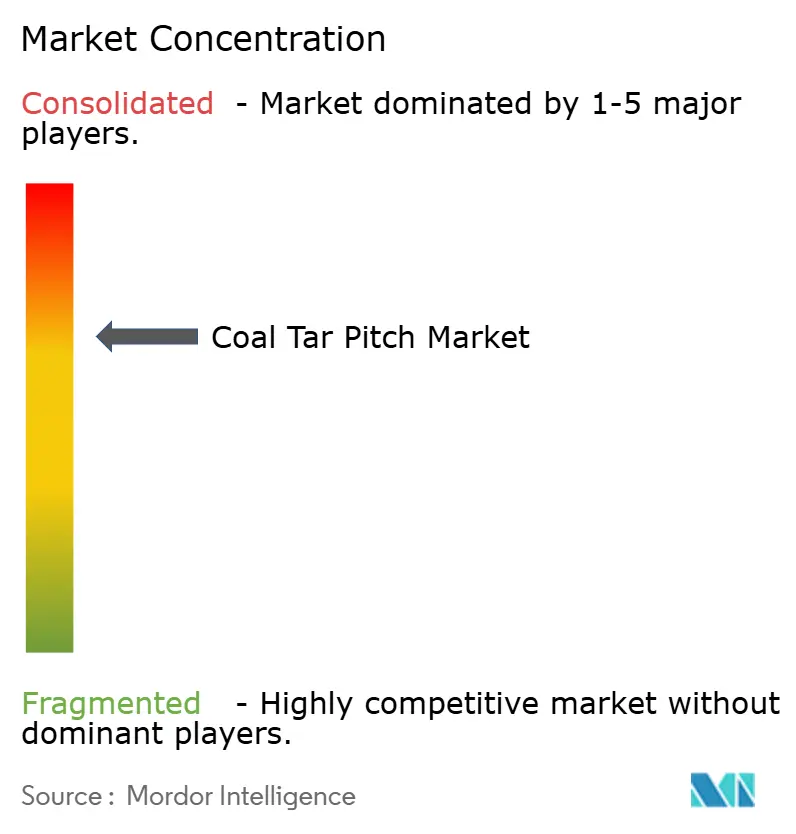
The Coal Tar Pitch market is moderately consolidated. Strategic levers now revolve around feedstock security, environmental accreditation, and downstream integration into carbon-fiber or anode finishing. Mitsubishi Chemical and Sumitomo Rubber’s 2025 tire-recycling venture demonstrates scope for circular-economy synergies that furnish alternative tar streams. Smaller regional distillers are increasingly adopting toll-processing alliances with steelmakers to secure tar flows, underscoring a shift toward collaborative risk-sharing across the coal tar pitch market.
Coal Tar Pitch Industry Leaders
-
Rain Carbon Inc.
-
Himadri Chemicals Speciality Ltd.
-
Koppers Inc.
-
Deza, a.s.
-
JFE Chemical Corporation
- *Disclaimer: Major Players sorted in no particular order
Coal Tar Pitch Market Companies Covered in this Report
- Bathco Ltd
- Bilbaina de Alquitranes S.A.
- Coopers Creek Chemical Corporation
- Crowley Chemical Company Inc.
- Deza, a.s.
- Epsilon Carbon Private Limited.
- Hengshui Zehao Chemicals Co. Ltd
- Himadri Chemicals Speciality Ltd.
- JFE Chemical Corporation
- Koppers Inc.
- Lone Star Specialties
- Mitsubishi Chemical Corporation
- Momentum Materials Solutions
- Neptune Hydrocarbons Mfg. Pvt Ltd
- NIPPON STEEL Chemical & Material Co., Ltd.
- Rain Carbon Inc.
- Shandong Jiefuyi
- voestalpine Stahl GmbH
Market Opportunities and Future Outlook
Regulatory-driven product substitution is creating whitespace for engineered low-PAH pitch in Europe and North America, where end users are aligning material selection with tighter PAH limits and documented compliance. Regulation (EU) 2025/660, effective April 2026, is a concrete trigger that accelerates qualification cycles for compliant binder and specialty grades, rewarding suppliers with demonstrated low-PAH formulations and traceable QA.
On the supply side, India shows a visible project pipeline for coal tar processing and distillation expansions clustered around steel hubs, which supports opportunities for local sourcing and contract manufacturing tied to aluminum, electrodes, and refractory demand. Recent filings and proposals include capacity additions at Sundargarh, Odisha (Spardha Steel Private Limited, January 2026) and Durg, Chhattisgarh (Shree Shyam Chemicals, June 2026), alongside earlier environmental-clearance activity in Durg (Tethys Chem Private Limited, February 2025) and Bhilai, Chhattisgarh (Supreme Synth Specialities Private Limited, May 2025). This concentration supports opportunities in long-term feedstock tie-ups with integrated steel sites, debottlenecking of distillation units, and differentiated specialty-grade production for carbon materials, where quality consistency and compliance credentials translate into pricing power.
Recent Industry Developments in Coal Tar Pitch Market
- July 2026: Himadri Speciality Chemical Ltd. disclosed progress on its capacity and product mix upgrades, aligning coal tar derivative integration with higher value carbon materials for industrial customers. The move supports tighter quality control and diversification beyond commodity binders, which is relevant as downstream users seek compliant, consistent feedstock and suppliers build resilience against coal tar availability swings.
- May 2026: Koppers Inc. announced a conditional plan to discontinue coal tar distillation and chemical manufacturing operations at its Stickney, Illinois facility by December 31, 2026, with production shifting to its Nyborg, Denmark facility. The action concentrates distillation output into a different regional asset base, which can change supply availability and freight economics for North American buyers of coal tar pitch and related distillates.
- June 2024: Rain Carbon Inc. announced plans for a North American Innovation Center focused on advancing carbon-based materials development and customer collaboration. Strengthening application development and qualification capability supports faster adoption of engineered grades, including binder systems tailored for electrodes, refractories, and other performance-driven uses where specifications and compliance requirements are tightening.
Coal Tar Pitch Market Report Scope and Research Methodology
Market Definition and Coverage
For this study, the coal tar pitch market is measured as the revenue generated from selling coal tar pitch grades used as binders and carbon precursors across industrial applications, counted at the point of sale and reported in USD.
Scope exclusions: We exclude downstream finished products like graphite electrodes, carbon blocks, and refractories, as well as internal plant transfers that are not priced as external sales.
Segments Covered in This Report
- By Grade
- Aluminium Grade
- Binder and Impregnation Grade
- Special / Mesophase Grade
- By Application
- Aluminium Smelting
- Graphite Electrodes
- Roofing
- Carbon Fiber
- Refractories
- Other Applications
- By Geography
- Asia-Pacific
- China
- India
- Japan
- South Korea
- ASEAN Countries
- Rest of Asia-Pacific
- North America
- United States
- Canada
- Mexico
- Europe
- Germany
- United Kingdom
- France
- Spain
- Italy
- NORDIC Countries
- Rest of Europe
- South America
- Brazil
- Argentina
- Rest of South America
- Middle East and Africa
- Saudi Arabia
- South Africa
- Rest of Middle-East and Africa
- Asia-Pacific
Data Sources, Market Sizing, and Validation
Desk Research
Desk work started by mapping the supply chain from coal tar distillation to pitch upgrading and sale, so the model boundary stays consistent. Public sources were used to anchor the demand pool and macro context, including World Steel Association crude steel updates, International Aluminium Institute production statistics, USGS mineral and materials summaries, UN Comtrade trade data, and EPA or ECHA pages that describe PAH-related compliance expectations for pitch handling.
After that, we reviewed company annual reports, investor presentations, plant announcements, and reputable industry press to track capacity moves, outages, and typical end uses. For cross-checking, we also referred to paid subscriptions for company financials and intelligence, patents, and shipment-level import and export tracking where available, because pitch is often traded regionally and pricing can move with feedstock. The sources mentioned are illustrative, and many other public references were also used for data collection, validation, and clarification.
Primary Interviews and Surveys
Primary work focused on validating how demand splits between aluminum anodes, graphite electrode binders, and specialty uses, and how grades are priced and contracted across regions. We spoke with producers, distributors, and downstream users, then used follow-up checks to confirm plant utilization, supply tightness signals, and the practical impact of environmental requirements on which pitch grades are actually saleable across APAC, EMEA, and the Americas.
Distribution of primary research fieldwork respondents
| Company type | Respondent position | Region |
|---|---|---|
| Top tier: 35% | CXOs: 12% | APAC: 43% |
| Mid tier: 50% | Functional/Unit leaders: 39% | EMEA: 36% |
| Smaller Players: 15% | Managers: 49% | Americas: 21% |
Market-Sizing & Forecasting
The core sizing is built using a top-down demand pool that reconstructs coal tar pitch use from the main consuming industries, and then converts that demand into value using regional pricing and grade mix. For aluminum, we connected primary aluminum output trends to anode binder intensity and replacement cycles. For graphite electrodes, we tied steel route dynamics (EAF activity) to electrode production needs and binder consumption.
To keep the totals grounded, we then checked the results using selective bottom-up approximations, such as a roll-up of available pitch capacity by region, utilization ranges discussed in interviews, and sampled price bands by grade (aluminum grade, binder and impregnation, and special grades). Key inputs that were tracked include primary aluminum production levels, crude steel and EAF share signals, electrode and anode replacement cycles, coal tar availability linked to coke operations, and observed pitch price direction tied to feedstock and compliance-driven grade shifts.
For forecasting, we relied mainly on scenario analysis, since supply constraints and feedstock volatility can cause step changes that a simple trend line can miss. Growth cases were set around aluminum and steel output expectations, regional environmental pressure on PAH profiles, and new capacity timing, then they were aligned with expert views collected during interviews. Where bottom-up coverage was incomplete in a country, gap handling used proxy indicators like trade flows and downstream output, and those proxies were corrected through interview feedback before finalizing the regional split.
Data Validation & Update Cycle
Validation was done through multiple passes, starting with internal checks for unit consistency, price and volume logic, and year-on-year variance by region. Analysts compared outputs against independent signals such as trade direction, major plant utilization commentary, and downstream production statistics, and then flagged spikes that did not match known events.
If a variance could not be explained by a feedstock move, a capacity outage, or a demand change, respondents were re-contacted and assumptions were updated. Before sign-off, the model and narrative go through an additional analyst review so the key drivers match what is observable in the market. Reports are refreshed annually, with interim updates when material events occur, and a final pre-delivery pass is performed so clients receive the latest view.
Mordor Intelligence's Coal Tar Pitch Market Size Compared With Other Published Estimates
Published market values for coal tar pitch can look far apart, even when the same end uses are being discussed, because the boundary and the pricing logic are not always aligned. Differences tend to show up when one estimate blends coal tar with pitch, uses a different base year, or counts downstream carbon products that sit after pitch in the value chain.
Trade flow direction, aluminum output statistics, and regional capacity utilization checks provide the evidence that supports Mordor Intelligence when aligning estimates to external sales of coal tar pitch by grade and application, which helps avoid mixing in adjacent products during sizing.
Benchmark comparison
| Source | Market Size | Gaps in Research Methodology |
|---|---|---|
| Mordor Intelligence | USD 4.76 B (2026) | |
| Global Consultancy A | USD 6.43 B (2025) | A different base year can lift the total when the model assumes a stronger price environment, and some versions of this scope language appear to mix coal tar pitch with broader coal tar value streams. |
| Industry Publisher B | USD 4.33 B (2024) | The estimate is anchored to an earlier year and may apply a flatter price progression across grades, which can understate revenue when specialty grades and compliance-linked premiums widen. |
The spread in the table is mainly explained by year selection and what is counted inside the product boundary, and both items directly change the revenue total. By keeping grades and end-use demand signals tied back to observable production and trade indicators, our number stays traceable to inputs that can be checked and repeated over time.
Key Questions Answered in the Report
What is the Coal Tar Pitch Market size in 2026?
The Coal Tar Pitch Market size is USD 4.76 billion in 2026.
How fast will demand for Special/Mesophase Grade grow?
Special/Mesophase Grade is projected to register a 5.83% CAGR through 2031 as automotive carbon-fiber adoption rises.
Which application currently dominates usage?
Aluminum smelting leads, accounting for 52.54% of global consumption in 2025.
Why are low-PAH grades gaining traction?
EU REACH limits on PAHs drive end-users to source engineered grades like CARBORES with 90% fewer toxic compounds.
Which region offers the highest growth potential?
Middle East & Africa is forecast to expand at 5.55% CAGR through 2031 on the back of new aluminum clusters.