
Clean Label Starch Market Size and Share
Market Overview
| Study Period | 2021 - 2031 |
|---|---|
| Market Size (2026) | USD 2.59 Billion |
| Market Size (2031) | USD 3.56 Billion |
| Growth Rate (2026 - 2031) | 6.56 % |
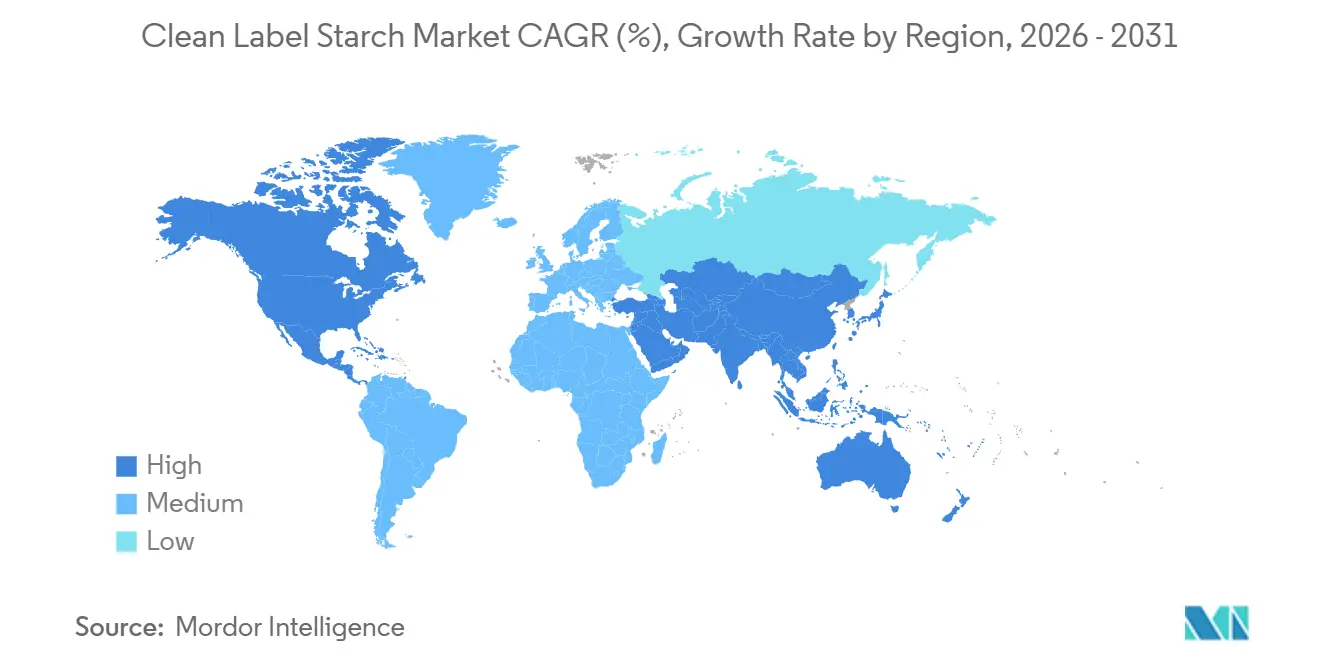
| Fastest Growing Market | Asia-Pacific |
| Largest Market | North America |
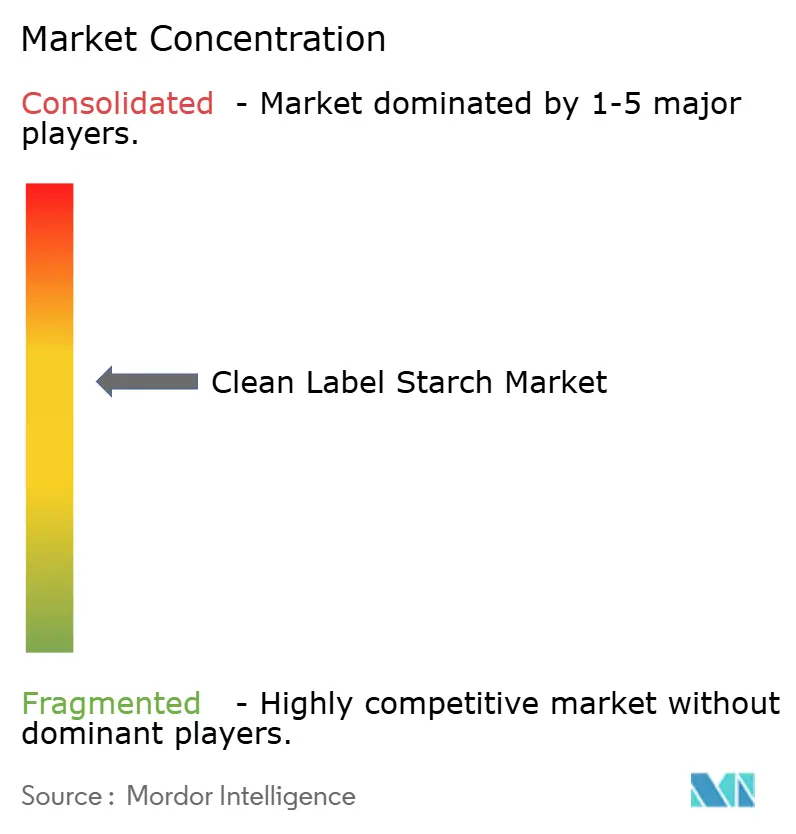
| Market Concentration | Medium |
Major Players *Disclaimer: Major Players sorted in no particular order Image © Mordor Intelligence. Reuse requires attribution under CC BY 4.0. | |
Clean Label Starch Market Analysis by Mordor Intelligence
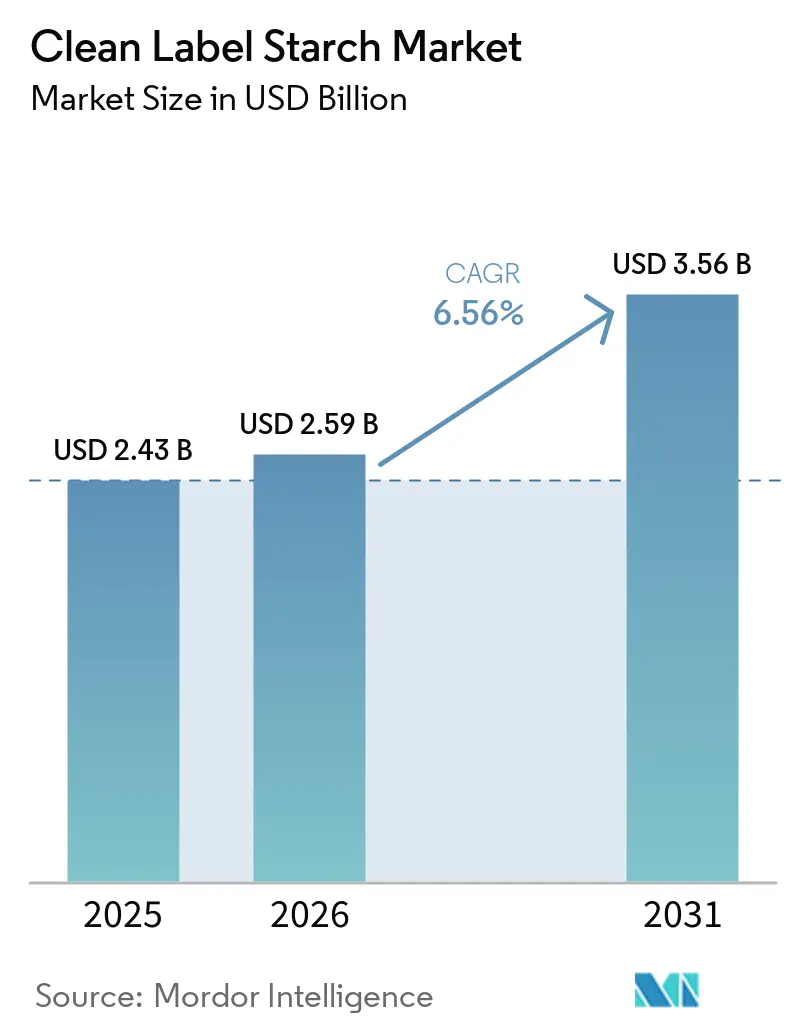
The clean label starch market size is expected to grow from USD 2.43 billion in 2025 to USD 2.59 billion in 2026 and is forecast to reach USD 3.56 billion by 2031 at a 6.56% CAGR over 2026-2031. Growth in the clean label starch market is driven by the ongoing shift in food formulation away from chemically modified ingredients toward physically processed starches that can be declared using familiar ingredient names such as corn starch, potato starch, and tapioca starch. As food manufacturers increasingly prioritize transparent ingredient labeling, clean label starches are becoming a preferred alternative across a broad range of processed food products. Their compatibility with consumer demand for recognizable ingredients is encouraging wider adoption in packaged foods, plant-based formulations, gluten-free products, and selected pharmaceutical excipient applications, expanding their role beyond conventional thickening and stabilizing functions. The market is also benefiting from continued investment in functional native starch technologies that enhance resistance to heat, shear, and varying pH conditions while preserving clean label status. These improvements allow manufacturers to incorporate native starches into more demanding processing environments that previously relied on modified starches, increasing their commercial viability across diverse end-use applications.
Key Report Takeaways
- By source, corn accounted for 48.21% of the clean label starch market in 2025. Tapioca/cassava is projected to grow at 7.05% through 2031.
- By application, food and beverage accounted for 53.46% of the clean label starch market in 2025. The pharmaceutical and supplements segment is forecast to grow at 7.35% through 2031.
- By geography, North America held a 37.88% share in 2025, while Asia-Pacific is projected to record the fastest CAGR at 7.65%.
Note: Market size and forecast figures in this report are generated using Mordor Intelligence’s proprietary estimation framework, updated with the latest available data and insights as of January 2026.
Market Trends and Insights
Drivers Impact Analysis of Clean Label Starch Market*
| Driver | (~) % Impact on CAGR Forecast | Geographic Relevance | Impact Timeline |
|---|---|---|---|
| Growing demand for clean-label and ingredient transparency in processed foods | +2.5% | Global, highest intensity in North America and Europe | Short term (≤ 2 years) |
| Rising demand for plant-based and vegan foods | +1.2% | Global, strongest in Europe and North America | Medium term (2-4 years) |
| Technological advancements in functional native starches | +0.9% | Global | Medium term (2-4 years) |
| Increasing adoption in high-value pharmaceutical and dietary supplement excipient applications | +0.6% | Asia-Pacific and North America | Long term (≥ 4 years) |
| Growing demand for gluten-free and allergen-friendly formulations | +0.5% | North America and Europe, with spillover to premium Asia-Pacific categories | Medium term (2-4 years) |
| Expansion of natural and organic food product development | +0.4% | Global | Long term (≥ 4 years) |
| Source: Mordor Intelligence | |||
Growing Demand for Clean-Label and Ingredient Transparency in Processed Foods
Consumers are increasingly scrutinizing ingredient labels and favoring food products formulated with recognizable, minimally processed ingredients. This is prompting manufacturers to replace chemically modified starches with clean-label alternatives. This shift is accelerating the adoption of native starches that can be declared simply as corn starch, potato starch, or tapioca starch, while still delivering the texture and stability required in processed foods. As clean-label positioning becomes a key purchasing factor, ingredient transparency is emerging as a major growth driver for the clean label starch market. This trend is reflected in recent product innovation across the ingredient industry. In May 2025, Marroquin Organic launched a new line of clean label starches derived from non-GMO waxy corn, specifically designed to help food manufacturers simplify ingredient lists without sacrificing functionality. Such product launches demonstrate how suppliers are responding to growing demand for transparent ingredient declarations while maintaining the functional performance expected in modern processed foods.
Rising Demand for Plant-Based and Vegan Foods
The growing adoption of plant-based diets is increasing demand for clean-label starches, which are widely used as natural texturizers, stabilizers, and binders in dairy alternatives, meat substitutes, and ready-to-eat foods. According to the OECD-FAO Agricultural Outlook 2025–2034, global pulse consumption reached 101 million tonnes (Mt) in 2024, after growing at an average of 2% annually over the previous decade, reflecting sustained demand for plant-based protein ingredients[1]Source: OECD, “OECD‑FAO Agricultural Outlook 2025‑2034” oecd.org. The report also projects global per capita pulse consumption to reach 8.6 kg by 2034, with North America recording the fastest growth at 2.2% per year, supporting the continued expansion of plant-based eating patterns that drive the use of clean-label starches in food formulations[2]Source: OECD, “OECD‑FAO Agricultural Outlook 2025‑2034” oecd.org. Manufacturers are also expanding production capacity to meet rising demand for plant-based foods, creating greater opportunities for clean-label ingredient adoption. The Good Food Institute's 2024 State of Alternative Proteins reported that the industry announced 26 new or expanded production facilities globally during 2024, while companies formed 45 new strategic partnerships across the plant-based, fermentation, and cultivated protein sectors to accelerate innovation and commercialization[3]Source: Good Food Institute, “State of Alternative Proteins” gfi.org. As manufacturers continue to scale plant-based product portfolios with simpler ingredient labels, demand for naturally sourced starches is expected to grow across bakery, dairy alternatives, sauces, and meat analogue applications.
Technological Advancements in Functional Native Starches
Technological innovation is expanding the performance capabilities of clean-label starches, enabling native starches to replace chemically modified alternatives across a wider range of food applications. According to an August 2025 article published by the Institute of Food Technologists (IFT), advances in crop breeding alongside physical, enzymatic, and biological starch modification methods are producing clean-label starches with enhanced functionality while meeting consumer demand for minimally processed ingredients. New waxy starch varieties containing less than 8% amylose provide high viscosity and excellent cold-storage stability, while high-amylose starches containing more than 50% amylose offer improved resistant starch content, dietary fiber benefits, and film-forming properties for food applications. The IFT also highlights that modern physical processing technologies, as well as enzyme-based modification techniques are enabling manufacturers to improve starch resistance to heat, shear, acidity, and retrogradation without relying on chemical modification. Advanced analytical tools such as the Rapid Visco Analyser 4800, capable of evaluating starch performance at temperatures of up to 140°C, are accelerating the development of high-performance native starches for demanding processing conditions. These technological advancements are allowing food manufacturers to formulate clean-label products with improved texture, stability, freeze-thaw performance, and shelf life, supporting broader adoption of functional native starches across processed food, beverage, and nutritional applications.
Increasing Adoption in High-Value Pharmaceutical and Dietary Supplement Excipient Applications
The growing emphasis on ingredient transparency and product quality in the pharmaceutical and nutraceutical industries is expanding the use of clean-label starches as functional excipients. Manufacturers are increasingly replacing synthetic or chemically modified excipients with high-purity, plant-derived native starches that offer both regulatory compliance and clean-label appeal. As consumers pay closer attention to the composition of tablets, capsules, and dietary supplements, pharmaceutical companies are prioritizing excipients that combine proven functionality with straightforward, recognizable sourcing. Clean-label starches are widely used as binders, disintegrants, fillers, and stabilizers in oral solid dosage forms, providing consistent processing performance while supporting formulation transparency. Their compatibility with pharmacopoeial quality standards, low impurity profiles, and suitability for plant-based and allergen-friendly formulations make them increasingly attractive to both pharmaceutical and dietary supplement manufacturers. As healthcare product development continues to focus on natural ingredients, sustainability, and consumer trust, the adoption of pharmaceutical-grade native starches is expected to increase, creating new high-value growth opportunities for the clean-label starch market.
Restraints Impact Analysis of Clean Label Starch Market*
| Restraint | (~) % Impact on CAGR Forecast | Geographic Relevance | Impact Timeline |
|---|---|---|---|
| Increasing competition from alternative hydrocolloids and texturizing ingredients | -0.8% | Global, concentrated in Europe and North America | Short term (≤ 2 years) |
| Shorter shelf-life performance in certain applications | -0.5% | Global | Medium term (2-4 years) |
| Regulatory variations across global markets | -0.4% | Asia-Pacific and Middle East and Africa | Long term (≥ 4 years) |
| Performance challenges in highly processed foods | -0.3% | North America and Europe | Medium term (2-4 years) |
| Source: Mordor Intelligence | |||
Increasing Competition from Alternative Hydrocolloids and Texturizing Ingredients
The clean label starch market faces growing competition from alternative hydrocolloids and plant-derived texturizing ingredients that offer comparable or superior functional performance in specific food applications. Ingredients such as gums, pectin, agar, carrageenan, cellulose derivatives, and dietary fibers are increasingly used to provide viscosity, stabilization, gel formation, and moisture retention, while also supporting clean-label product positioning. As food manufacturers seek multifunctional ingredients that address texture, shelf life, and processing requirements simultaneously, these alternatives can reduce reliance on clean-label starches in certain formulations. A broader portfolio of functional ingredients also enables manufacturers to tailor formulations based on application-specific performance, cost, and processing conditions. In products requiring freeze-thaw stability, acid resistance, or suspension properties, alternative hydrocolloids may outperform native starches, making them the preferred choice for some end users. As ingredient innovation continues across the hydrocolloid industry, clean-label starch suppliers face increasing pressure to differentiate their products through enhanced functionality, formulation flexibility, and application-specific performance, which limits growth potential in highly competitive food categories.
Shorter Shelf-Life Performance in Certain Applications
Despite ongoing technological improvements, clean-label starches can exhibit lower functional stability than chemically modified starches in certain food applications, particularly those requiring extended shelf life or exposure to challenging processing conditions. Native starches are generally more susceptible to retrogradation, syneresis, viscosity loss, and texture changes during prolonged storage, repeated freeze-thaw cycles, or high-acid processing environments. These limitations can affect product consistency and consumer acceptance, making them less suitable for some premium processed foods. As a result, manufacturers producing frozen meals, refrigerated desserts, sauces, dressings, and other products with long distribution cycles may continue to rely on modified starches or alternative texturizing systems to achieve the required product stability. While advances in physical and enzymatic starch modification are improving the performance of clean-label starches, achieving the same level of long-term stability across all applications remains a technical challenge. This performance gap can slow the substitution of conventional starches in high-demand food formulations, restraining broader adoption of clean-label starch solutions.
*Our forecasts treat driver/restraint impacts as directional, not additive. The impact forecasts reflect baseline growth, mix effects, and variable interactions.
Clean Label Starch Market Segment Analysis
By Source:
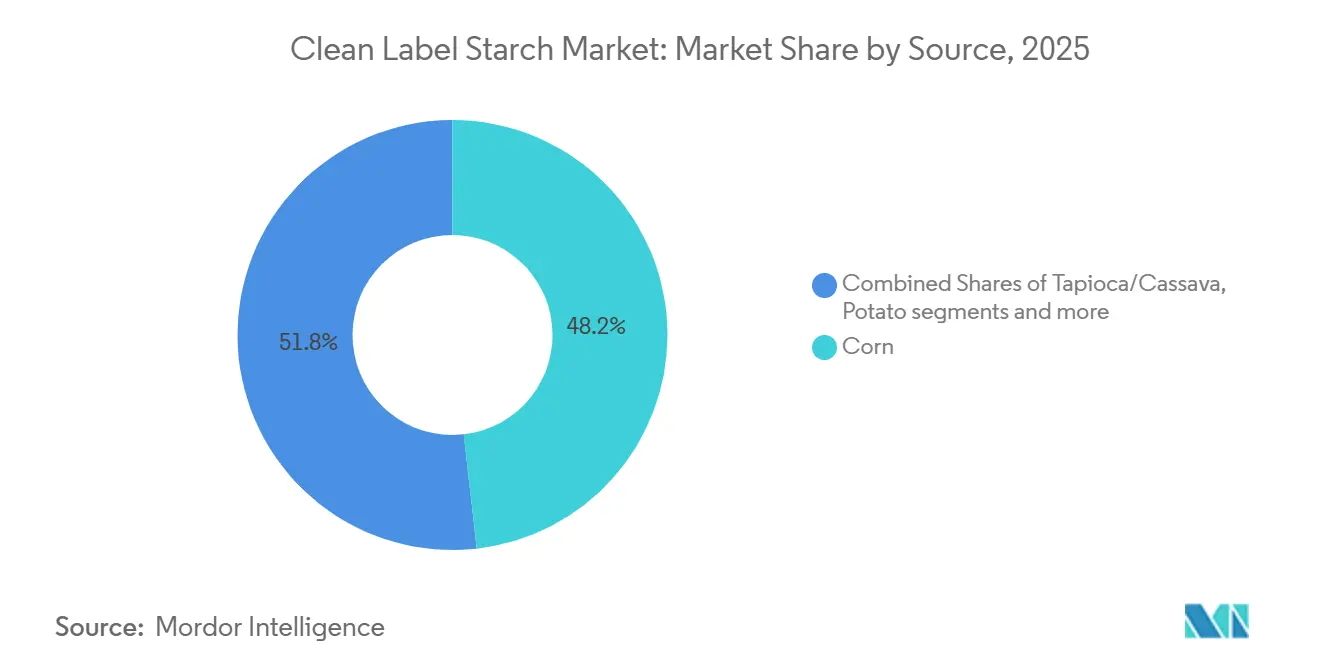
Corn Leads the Base While Tapioca/Cassava Gains SpeedCorn accounted for 48.21% of the clean label starch market share in 2025, making it the dominant source across commercial food manufacturing. Its widespread availability, cost-effectiveness, neutral flavor, and broad functional versatility make it suitable for applications including sauces, bakery products, dairy products, processed foods, and meat formulations. Well-established global supply chains and consistent raw material availability have further strengthened its adoption among manufacturers seeking reliable clean-label ingredients for large-scale production. These factors continue to position corn as the preferred source in the clean label starch market.
Tapioca/cassava is projected to register the fastest CAGR of 7.05% during the forecast period, driven by increasing demand for plant-based, gluten-free, and minimally processed food products. Its neutral taste, smooth texture, and excellent thickening properties make it well suited for dairy alternatives, beverages, confectionery, and convenience foods. Growing cassava cultivation and processing capacity in major producing regions, coupled with rising demand for clean-label ingredients in global food manufacturing, are further supporting segment growth. Meanwhile, potato, wheat, rice, pea, and other starch sources continue to gain traction in specialized applications where specific functional or formulation requirements are prioritized.



By Application:
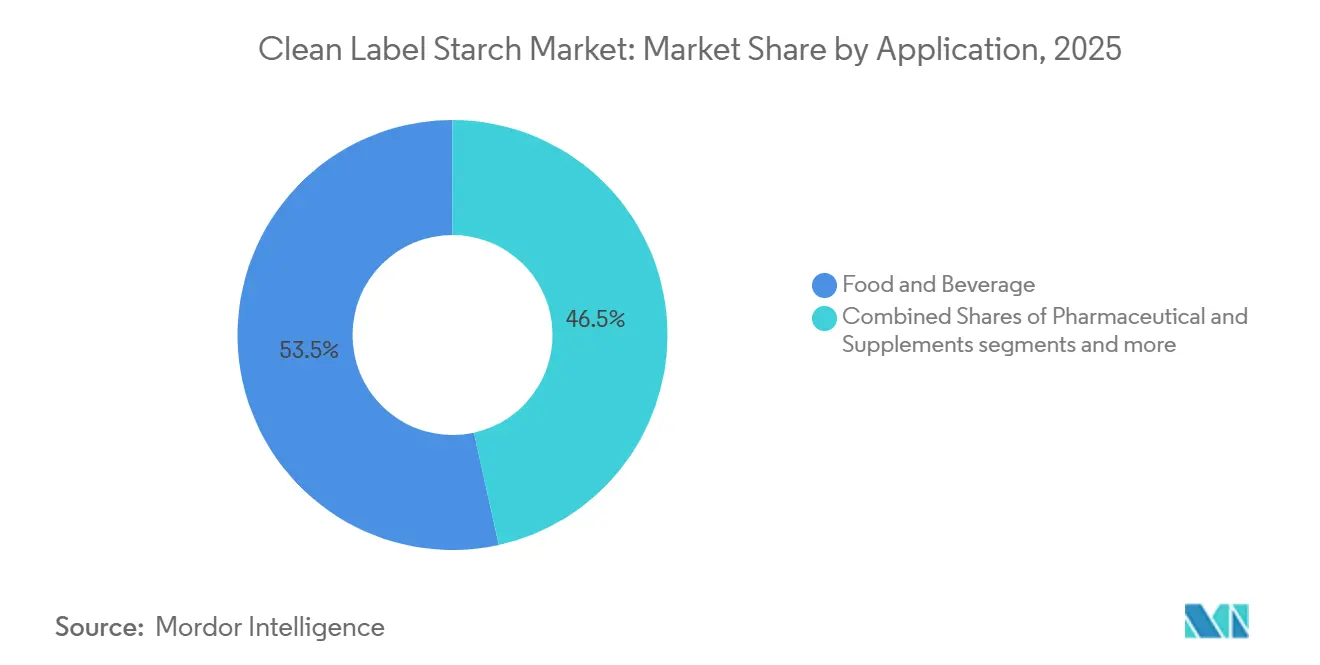
Food and Beverage Holds the Largest Share While Pharmaceuticals Move FasterFood and beverage accounted for 53.46% of the clean label starch market in 2025, making it the largest application segment. This dominance is driven by the widespread use of clean label starches as thickeners, stabilizers, texturizers, and moisture-retention agents in bakery products, dairy products, confectionery, soups, sauces, beverages, and processed foods. Rising consumer preference for simple ingredient lists and minimally processed foods is encouraging manufacturers to replace chemically modified starches with native alternatives while maintaining product quality and functionality. Ongoing reformulation efforts across packaged food categories are expected to sustain the segment's position.
Pharmaceuticals and supplements are projected to register the fastest CAGR of 7.35% during the forecast period. Growth is supported by increasing demand for high-purity, plant-derived excipients that deliver reliable performance while aligning with clean label and ingredient transparency trends. Native starches are increasingly used as binders, fillers, disintegrants, and stabilizers in tablets, capsules, and powder formulations due to their multifunctionality and compatibility with stringent quality standards. Personal care, cosmetics, animal nutrition, and industrial applications continue to create additional opportunities as manufacturers adopt naturally derived starch ingredients across a broader range of end-use segments.
Geography Analysis
North America accounted for 37.88% of the clean label starch market share in 2025, making it the largest regional market. The region's position is supported by abundant corn production, well-established starch processing infrastructure, and a mature food manufacturing industry. Growing demand for clean-label packaged foods, gluten-free products, and plant-based formulations continues to drive the adoption of native starches across a wide range of applications. Strong regulatory focus on ingredient transparency and well-developed supply chains have further reinforced the region's position in the global market.
Asia-Pacific is projected to register the fastest CAGR of 7.65% during the forecast period. The region benefits from expanding processed food production, rising pharmaceutical manufacturing, and abundant availability of starch-rich crops such as cassava and tapioca. Increasing urbanization, changing dietary preferences, and growing consumer demand for minimally processed food products are accelerating the adoption of clean-label starches. Continued investment in food processing and ingredient manufacturing is also supporting long-term market growth across the region.
Europe remains a significant market, driven by strong consumer preference for natural ingredients, stringent food labeling requirements, and continued demand for premium and organic food products. South America is experiencing steady growth, supported by expanding processed food production and increasing adoption of clean-label ingredients across the food industry. The Middle East and Africa represent an emerging market, where rising urbanization, improving food manufacturing capabilities, and growing consumer awareness of ingredient transparency are gradually creating new opportunities for clean-label starch suppliers.

Competitive Landscape
The clean label starch market is moderately consolidated, with a handful of multinational ingredient manufacturers accounting for a significant share of global revenue. Major players, including Cargill, Incorporated, Ingredion Incorporated, Roquette Frères, Tate & Lyle PLC, and Archer Daniels Midland Company, leverage extensive production capacity, diversified starch portfolios, and global distribution networks to maintain their market positions. Their broad application expertise and long-standing relationships with food and beverage manufacturers provide a competitive advantage, while regional suppliers continue to compete in specialized crop segments and local markets.
Leading companies are focusing on product innovation, portfolio expansion, and manufacturing investments to strengthen their competitive positions. Market participants continue to develop functional native starches with enhanced heat, shear, freeze-thaw, and pH stability while maintaining clean-label status, enabling broader use across processed foods, beverages, pharmaceutical excipients, and plant-based products. Research and development, sustainable sourcing, production efficiency, and application-specific ingredient solutions remain central strategies as manufacturers respond to increasing demand for high-performance clean-label ingredients.
Alongside established global players, emerging and regional manufacturers are steadily expanding their presence by targeting niche applications and underserved markets. These companies emphasize crop-specific expertise, customized formulation support, organic and non-GMO product offerings, and localized supply capabilities to differentiate themselves from larger competitors. As demand for clean-label ingredients continues to diversify across food, pharmaceutical, and industrial applications, smaller suppliers are expected to gain opportunities by serving specialized customer requirements and introducing starch solutions tailored to evolving market needs.
Clean Label Starch Industry Leaders
Cargill, Incorporated
Tate & Lyle PLC
Ingredion Incorporated
Roquette Frères
Archer Daniels Midland Company
- *Disclaimer: Major Players sorted in no particular order
Clean Label Starch Market Companies Covered in this Report
- Cargill, Incorporated
- Ingredion Incorporated
- Tate & Lyle PLC
- Archer Daniels Midland
- Roquette Freres
- Ulrick+Short
- BENEO GmbH
- Emsland Group
- Grain Processing Corporation
- Agrana Beteiligungs-AG
- Biesterfeld SE
- Gulshan Polyols Ltd.
- Avebe
- SMS Corporation
- Manildra Group
- Lehmann Ingredients
- Zih Mao Enterprise Co., Ltd.
- Lyckeby
- Gillco Ingredients
- Crespel & Deiters Group

Recent Industry Developments in Clean Label Starch Market
- March 2026: Roquette Frères inaugurated a new 1,000+ m² starch and polyol pilot center at its Lianyungang facility in China to strengthen localized research and development, pilot-scale validation, and industrial-scale development, accelerating innovation and time-to-market for advanced starch-based ingredient solutions.
- October 2025: Roquette Frères launched AMYSTA L 123, a thermally soluble pea starch produced through a patented enzyme- and chemical-free process, expanding its label-friendly starch portfolio with a plant-based ingredient designed to improve texturizing performance while supporting clean-label food formulations.
- July 2025: Royal Avebe and Brenntag expanded their distribution partnership to the U.S. market, broadening the availability of Avebe’s specialty potato-based starches, proteins, and fibers to strengthen clean-label ingredient supply across North America's food and nutrition sector.


Global Clean Label Starch Market Report Scope
The report segments the clean label starch market by source into corn, potato, tapioca/cassava, wheat, and other sources. It evaluates the market size, growth prospects, and key demand trends for each source, while assessing their functional properties and adoption across various end-use applications.
It analyzes the clean label starch market by application, covering food and beverage, pharmaceutical and supplements, personal care and cosmetics, and other applications. The food and beverage segment is further categorized into bakery and confectionery, snacks, soups, sauces and dressings, dairy, meat products, and other food and beverage applications to provide a comprehensive assessment of application-specific demand.
The report examines the clean label starch market across five regions: North America, Europe, Asia-Pacific, South America, and the Middle East and Africa, with detailed analysis of key countries within each region. It evaluates regional market performance, growth opportunities, competitive developments, and the factors influencing demand across both established and emerging markets.
Segmentation Overview
| Corn |
| Tapioca/Cassava |
| Potato |
| Wheat |
| Others |
| Food and Beverage | Bakery and Confectionery |
| Snacks | |
| Soups, Sauces and Dressings | |
| Dairy Products | |
| Meat and Meat Products | |
| Others | |
| Pharmaceutical and Supplements | |
| Personal care and Cosmetics | |
| Others |
| North America | United States |
| Canada | |
| Mexico | |
| Rest of North America | |
| Europe | Germany |
| United Kingdom | |
| Italy | |
| France | |
| Spain | |
| Rest of Europe | |
| Asia-Pacific | China |
| India | |
| Japan | |
| Australia | |
| Rest of Asia-Pacific | |
| South America | Brazil |
| Argentina | |
| Rest of South America | |
| Middle East and Africa | South Africa |
| Saudi Arabia | |
| United Arab Emirates | |
| Rest of Middle East and Africa |
| By Source | Corn | |
| Tapioca/Cassava | ||
| Potato | ||
| Wheat | ||
| Others | ||
| By Application | Food and Beverage | Bakery and Confectionery |
| Snacks | ||
| Soups, Sauces and Dressings | ||
| Dairy Products | ||
| Meat and Meat Products | ||
| Others | ||
| Pharmaceutical and Supplements | ||
| Personal care and Cosmetics | ||
| Others | ||
| By Geography | North America | United States |
| Canada | ||
| Mexico | ||
| Rest of North America | ||
| Europe | Germany | |
| United Kingdom | ||
| Italy | ||
| France | ||
| Spain | ||
| Rest of Europe | ||
| Asia-Pacific | China | |
| India | ||
| Japan | ||
| Australia | ||
| Rest of Asia-Pacific | ||
| South America | Brazil | |
| Argentina | ||
| Rest of South America | ||
| Middle East and Africa | South Africa | |
| Saudi Arabia | ||
| United Arab Emirates | ||
| Rest of Middle East and Africa | ||


Key Questions Answered in the Report
What is the projected value of clean label starch by 2031?
The clean label starch market is forecast to reach USD 3.56 billion by 2031, rising from USD 2.59 billion in 2026 at a 6.56% CAGR.
Which source leads demand for clean label starch?
Corn led with 48.21% share in 2025 because it offers broad availability, neutral taste, and low reformulation risk across major food applications.
Which region holds the largest share and which grows the fastest?
North America held the largest share at 37.88% in 2025, while Asia-Pacific is forecast to expand the fastest at a 7.65% CAGR through 2031.
Which application is growing the fastest through 2031?
Pharmaceutical and supplements is the fastest-growing application, with a projected 7.35% CAGR from 2026 to 2031, supported by rising excipient use in oral dosage formats.
What is the main limit on wider use in processed foods?
The biggest limit is performance in frozen, refrigerated, and long-shelf-life applications, where native starch can still face retrogradation, syneresis, and freeze-thaw instability.
Page last updated on:


 Your data is secure and never sold or shared.


