
Market Overview
| Study Period | 2020 - 2031 |
|---|---|
| Forecast Data Period | 2026 - 2031 |
| Base Year Market Size (2025) | USD 1.29 Billion |
| Market Size (2026) | USD 1.36 Billion |
| Market Size (2031) | USD 1.79 Billion |
| Growth Rate (2026 - 2031) | 5.58 % |
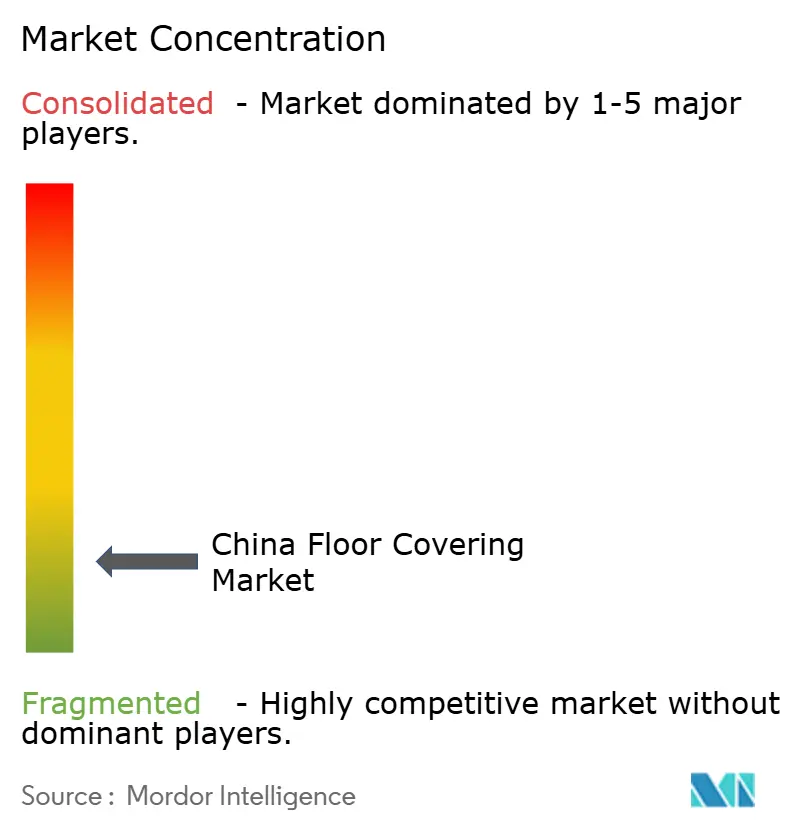
| Market Concentration | Low |
Major Players *Disclaimer: Major Players sorted in no particular order Image © Mordor Intelligence. Reuse requires attribution under CC BY 4.0. | |
China Floor Covering Market Analysis by Mordor Intelligence
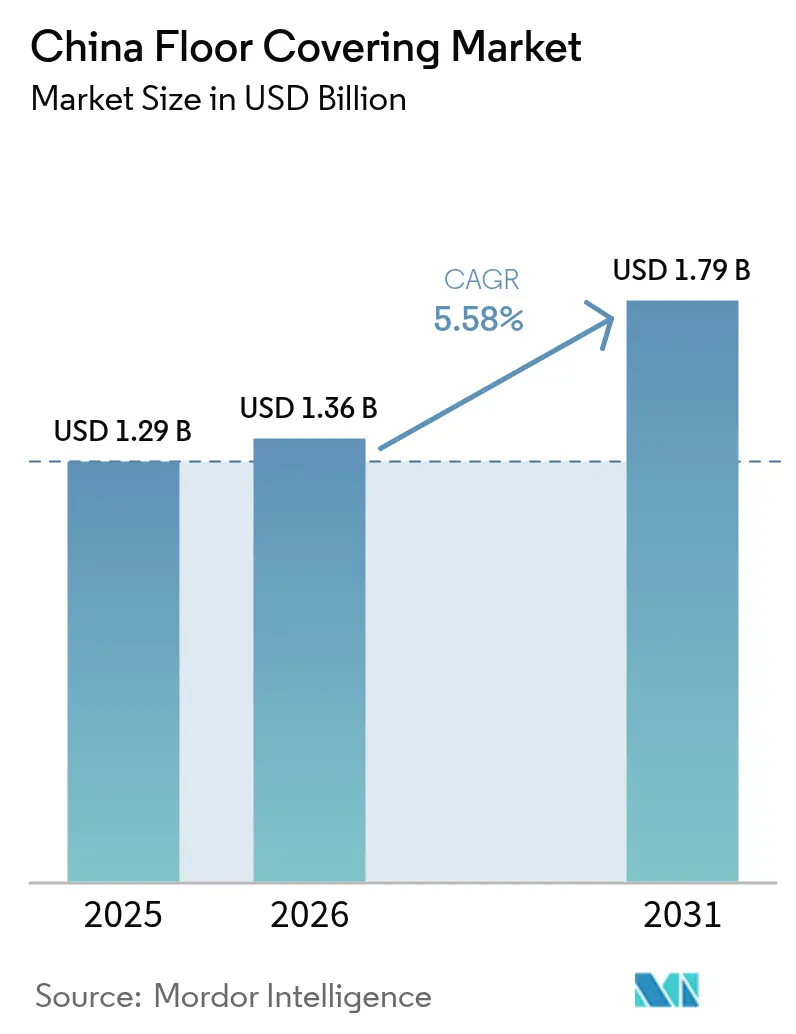
The China floor covering market size is expected to grow from USD 1.29 billion in 2025 to USD 1.36 billion in 2026 and is forecast to reach USD 1.79 billion by 2031 at 5.58% CAGR over 2026-2031. Market expansion aligns with the government’s urban renewal program, covering more than 60,000 projects and a total investment of CNY 2.9 trillion in 2024. Heightened residential standards effective May 2025 mandate 3-meter ceiling heights and stricter acoustic rules, prompting higher-specification flooring demand [1]. Resilient products built on PVC-free technology record double-digit growth, helped by GB 18584-2024 limits on volatile organic compounds that take effect in July 2025. East China continues to anchor production and distribution, yet South-Central China leads incremental volume on the back of Guangdong’s CNY 9.2 trillion project pipeline for 2025. Meanwhile, 34% tariffs on Chinese luxury vinyl plank exports to the United States redirect capacity toward the domestic opportunity, pushing brands to accelerate omnichannel penetration and invest in low-carbon manufacturing footprints.
Key Report Takeaways
- By material, non-resilient flooring led with 63.85% revenue share in 2025, while resilient flooring is projected to register the fastest 9.85% CAGR to 2031 in the China floor covering market.
- By end use, residential applications held 55.95% share in 2025, whereas healthcare facilities are forecast to expand at the quickest 8.31% CAGR through 2031 in the China floor covering market.
- By construction type, renovation captured a 44.05% share in 2025, yet new construction is poised for the highest 8.02% CAGR over the same period in the China floor covering market.
- By distribution channel, specialty stores dominated with 86.10% share in 2025, as online direct-to-consumer sales anticipate an 8.23% CAGR to 2031 in the China floor covering market.
- By region, East China seized 37.05% revenue share in 2025, while South-Central China is expected to post the sharpest 6.92% CAGR to 2031 in the China floor covering market.
Note: Market size and forecast figures in this report are generated using Mordor Intelligence’s proprietary estimation framework, updated with the latest available data and insights as of 2026.
China Floor Covering Market Trends and Insights
Drivers Impact Analysis*
| Driver | (~) % Impact on CAGR Forecast | Geographic Relevance | Impact Timeline |
|---|---|---|---|
| Rapid urban renewal and affordable housing push | +1.8% | National, with concentration in tier-1 and tier-2 cities | Medium term (2-4 years) |
| Rising demand for green-certified buildings | +1.2% | East China and South-Central China leading adoption | Long term (≥ 4 years) |
| Growth of PVC-free resilient flooring technologies | +0.9% | Global with China manufacturing focus | Medium term (2-4 years) |
| E-commerce-enabled customized design services | +0.6% | National, with urban centers driving adoption | Short term (≤ 2 years) |
| Modular and prefabricated construction uptake | +0.5% | National, with tier-2 cities showing rapid adoption | Medium term (2-4 years) |
| Export pull from Belt-and-Road infrastructure | +0.4% | Global with focus on Southeast Asia and Africa | Long term (≥ 4 years) |
| Source: Mordor Intelligence | |||
Rapid Urban Renewal and Affordable Housing Push
Continuous city-level renewal across 300 municipalities, backed by policy funding and the first-time “quality homes” pledge in the 2025 government work report, underpins demand for acoustically engineered and moisture-resistant surfaces [2]. National per-capita housing floor area surpasses 40 m², underscoring a substantial retrofit pool now shifting from basic price points to specification-driven orders.
Rising Demand for Green-Certified Buildings
Guangzhou’s Green Building Regulations mandate certified materials for all public projects, while GB 55037-2022 enhances fire-safety thresholds for commercial and residential structures [3]. These frameworks link certification status to preferential land-use ratios and loan terms, positioning low-VOC flooring as a compliance prerequisite for developers.
Growth of PVC-Free Resilient Flooring Technologies
Suppliers introduce magnesium oxide and bio-polymer cores that remove conventional PVC yet sustain dent resistance and waterproof performance. PureTech and SolidTech R series incorporate over 70% recycled feedstock, dovetailing with corporate carbon goals and upcoming VOC caps. Manufacturing partnerships with organizations like Plastic Bank demonstrate industry commitment to ocean plastic reduction while securing recycled material supply chains for next-generation flooring products
E-commerce-Enabled Customized Design Services
Visualisation tools embedded in marketplaces such as DHgate let buyers preview pattern, plank width, and color in real scale, compressing the specification cycle from weeks to hours. The system supports just-in-time manufacturing, thereby lowering inventory risk for both factory and customer.
Restraints Impact Analysis*
| Restraint | (~) % Impact on CAGR Forecast | Geographic Relevance | Impact Timeline |
|---|---|---|---|
| Volatile PVC, wood and petro-chemical feedstock prices | -1.4% | Global with China manufacturing concentration | Short term (≤ 2 years) |
| Stricter national VOC and carbon limits on flooring | -0.8% | National implementation with regional enforcement variations | Medium term (2-4 years) |
| EU-DR deforestation rules threatening wood exports | -0.5% | Europe-focused with global supply chain implications | Medium term (2-4 years) |
| Anti-dumping tariffs on Chinese vinyl and tile abroad | -0.7% | North America and Europe primarily | Short term (≤ 2 years) |
| Source: Mordor Intelligence | |||
Volatile PVC, Wood and Petro-Chemical Feedstock Prices
The March 2025 ban on U.S. log imports and resin price swings force multi-sourcing strategies and trigger producer price adjustments passed downstream within one quarter. Petrochemical feedstock fluctuations directly impact vinyl and synthetic flooring production costs, particularly affecting luxury vinyl tile manufacturing that relies on stable resin pricing for competitive positioning.
Stricter National VOC and Carbon Limits on Flooring
GB 18584-2024 formalizes emission caps effective July 2025, compelling investment in alternative binders, in-house test chambers, and longer product-approval lead times, thereby elevating compliance costs. Regional enforcement variations create compliance complexity for national distributors, while international suppliers face additional certification requirements that may limit market access for non-compliant products.
*Our forecasts treat driver/restraint impacts as directional, not additive. The impact forecasts reflect baseline growth, mix effects, and variable interactions.
Segment Analysis
By Material: Resilient Technologies Challenge Traditional Dominance
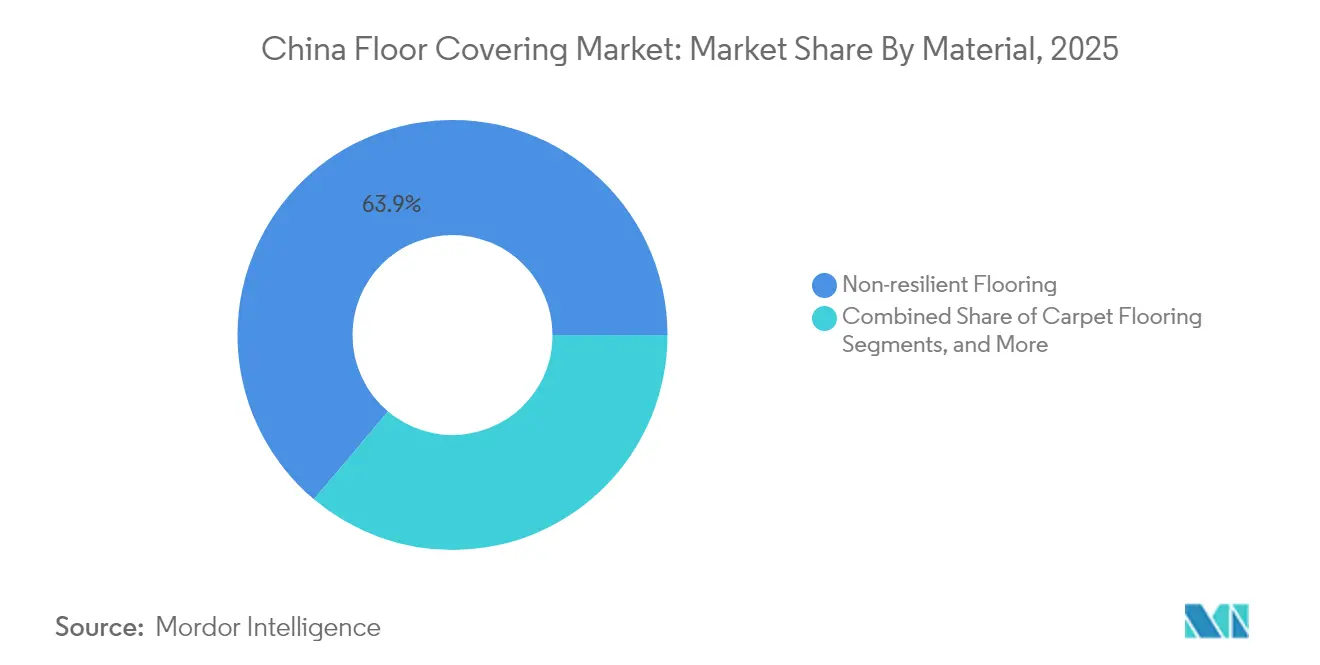
Non-resilient lines contributed 63.85% of China flooring market share in 2025. Ceramic, stone, and solid wood remain staples, yet resilient formats are accelerating at a 9.85% CAGR through 2031, closing the gap via rigid-core and SPC upgrades. The China flooring market continues to see rigid core adoption in high-rise residential projects because floating installation shortens project schedules. Pioneer magnesium-oxide cores address stricter fire codes, while PVC-free planks help builders achieve green certification benchmarks.
Manufacturers leverage digital inkjet printing for hyper-realistic textures that erode the aesthetic premium long enjoyed by parquet and marble. In parallel, ceramic producers win orders for heavy-traffic metro station concourses, capitalizing on large-format slabs that lower grout maintenance. The cross-learning across segments fosters hybrid innovations—stone-plastic composite tile that offers the look of porcelain and the thermal comfort of vinyl. Over the forecast span, resilience, recyclability, and quick-lay formats underpin the substitution trend.

By End Use: Healthcare Facilities Drive Premium Segment Expansion
Healthcare flooring logged an 8.31% CAGR, the fastest among end uses, as provincial health-commission budgets fund tier-2 and tier-3 hospital upgrades. The segment absorbs weld-seamless homogenous sheet and conductive vinyl designed to withstand daily disinfection cycles. In contrast, residential holds 55.95% share of China flooring market size, reflecting the magnitude of urban renewal. Developers of large-scale housing now differentiate via acoustic underlayment packages bundled at the presale stage. Commercial offices recover steadily; tenants prioritize low-VOC warranties and rapid replacement options compatible with raised-floor cabling.
Schools and universities align with smart-campus programs and prefer loose-lay formats that permit future tech retrofits without demolition debris. Logistics warehouses and e-commerce fulfillment centers demand high-compressive-strength rigid vinyl capable of tolerating autonomous mobile robot traffic.
By Construction: New Projects Accelerate Despite Renovation Dominance
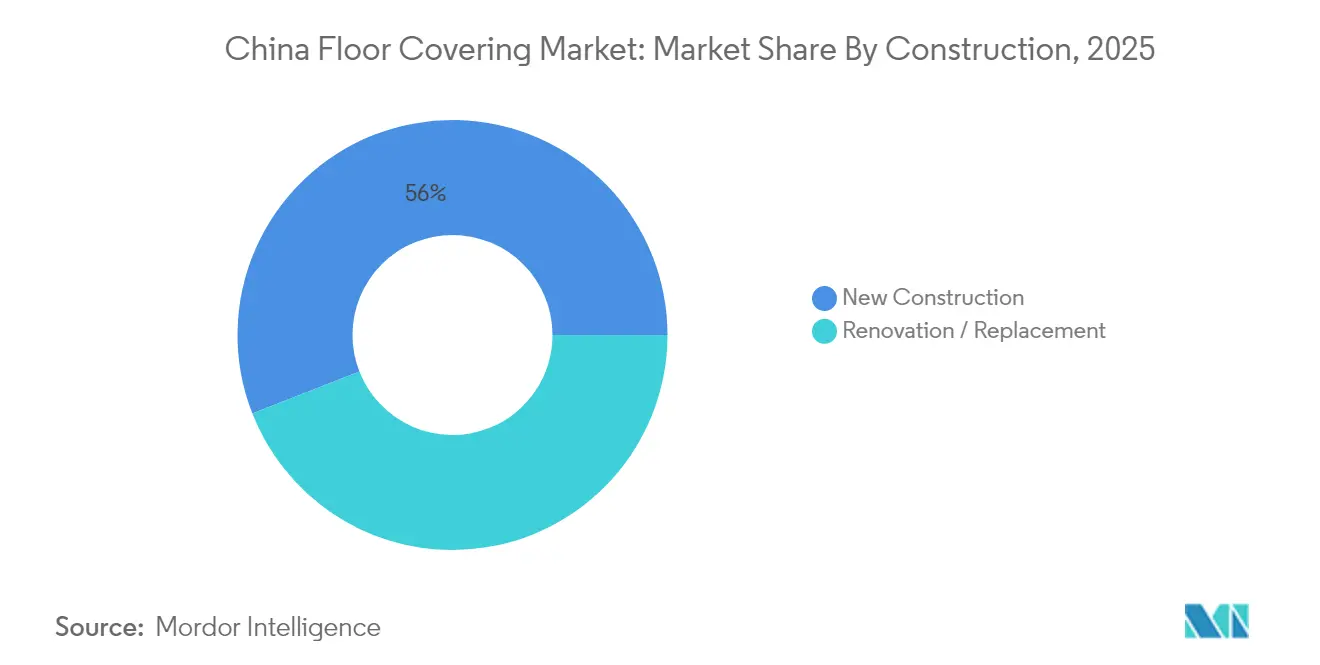
Renovation controlled 44.05% China flooring market share in 2025 and remains the volume bedrock, yet new construction is forecast to outgrow at 8.02% CAGR to 2031. High-speed rail station pipelines in the Yangtze River Delta and Pearl River Delta spur contract wins for stone and porcelain tile. Parallel mixed-use developments capitalize on integrated design-build contracts that specify resilient floors meeting both retail and residential criteria. Renovation, meanwhile, benefits from provincial subsidies for old residential block upgrades, often requiring thin-profile, self-adhesive planks that avoid door re-trimming.
By Distribution Channel: Digital Transformation Challenges Traditional Retail
Specialty dealers own 86.10% share of channel sales owing to entrenched installer relationships and sample libraries. However, direct-to-consumer online portals are climbing at 8.23% CAGR as mobile apps offer visualization, AI-driven color matching, and one-click logistics. The shift forces showrooms to add AR kiosks and subscription-based design services. Manufacturers roll out last-mile installation certification programs to retain service standards within an omnichannel model.
Geography Analysis
East China anchored 37.05% revenue in 2025, supported by cluster efficiencies around Shanghai, Suzhou, and Ningbo ports that compress inbound raw-material lead times. The Yangtze River Delta intercity rail expansion to 16,700 km by 2025 forms one-to-three-hour economic circles, lifting demand for commercial renovation in satellite cities. Government pilot projects using low-carbon building codes in Suzhou further amplify resilient-flooring penetration.
South-Central China posts the highest 6.92% CAGR, propelled by Guangdong’s CNY 9.2 trillion project roster for 2025. The Shenzhen-Zhongshan Bridge, operational since June 2024, slashes cross-bay transit to under 30 minutes and unlocks industrial land for smart-factory campuses. Flooring suppliers gain via proximity to thriving electronics and appliance sectors that adopt anti-static vinyl in cleanroom extensions.
North China’s mix of public housing retrofits and winter-proof linoleum demand supports steady growth around Beijing-Tianjin rail corridors. Northeast China receives state-owned enterprise investment incentives, translating to hospital modernization and education infrastructure orders. Southwest and Northwest China benefit from Belt and Road logistics hubs; resilient floors tolerant to desert temperature swings gain traction in distribution centers near new freight rail terminals.
Regulatory Landscape
China’s floor covering regulatory environment is tightening around indoor air quality, product safety, and green-building compliance. National requirements such as GB 18584-2024 (VOC limits effective July 2025) and the March 2025 Ministry of Housing and Urban-Rural Development residential standards that strengthen floor sound-insulation performance are pushing manufacturers and installers toward higher-specification, tested systems, especially for turnkey and renovation programs.
Material-specific and sustainability-focused standards are also reshaping product development and procurement. GB/T 30364-2024 for bamboo scrimber flooring was released in September 2024 and implemented in April 2025, while GB 18586-2026 was published to set harmful-substance limits for carpets, carpet cushions, and PVC flooring (effective October 2027). On the trade side, export exposure remains volatile, including the European Commission’s Commission Implementing Regulation (EU) 2025/1342 on multilayered wood flooring and ongoing US Department of Commerce proceedings affecting wood-based layered products, which together encourage capacity and channel rebalancing between overseas and domestic demand.
Value Chain Analysis
The China floor covering value chain starts with upstream feedstocks (PVC resin and additives tied to the domestic petrochemical base, wood and bamboo inputs, and growing volumes of recycled plastics and agricultural-waste-based materials for WPC/SPC). Manufacturers are clustered in provinces such as Zhejiang, Jiangsu, Shandong, and Guangdong, and increasingly add in-house testing, low-VOC formulation capability, and documentation to meet mandatory emissions and harmful-substance limits. Industry bodies such as the China Carpet Association and the Flooring Branch of the China Chamber of Commerce for Import and Export of Metals, Minerals and Chemicals (CCCCC) support standardization and trade engagement.
Downstream, sales flow through project channels (developers, public works, and institutional builds), regional wholesalers, specialty stores, and fast-growing online direct-to-consumer platforms that compress sampling and specification cycles. Logistics for both domestic distribution and exports leverage major ports including Shanghai, Ningbo, and Shenzhen. Traceability and carbon documentation are emerging as differentiators within the chain, including OPPEIN Home Group’s integrated procurement and raw-material traceability disclosures in its 2024 sustainability filing released May 2025, and manufacturers publishing EPDs for SPC products that support access to green-building and government procurement pathways.
Competitive Landscape
Competition is moderate, with no single firm exceeding a double-digit share. Domestic groups such as Nature Home, Power Dekor, and Der International co-exist with multinational brands Mohawk, Tarkett, and LG. Firms diversify by setting up Vietnamese and Cambodian plants to hedge tariff exposure, as seen in CFL Flooring’s 750,000 ft² North Vietnam site scheduled for Q4 2025 start-up. Technology leadership centers on PVC-free chemistry, rigid-core durability, and AI-bus visualization. Sustainability credentials become the new battleground; Mohawk’s SolidTech R leverages reclaimed polymer streams and offers a lifetime waterproof warranty.
Omnichannel models integrate flagship digital storefronts with curated showrooms, while installers receive micro-learning modules on VOC compliance to ensure final-mile adherence. Market entry for premium healthcare grades remains attractive given rising hospital cap-ex and limited domestic formulation know-how. Conversely, mainstream residential sub-segments endure price pressure, pushing scale players to automate in-line digital printing and robotic stacking to curb unit costs.
China Floor Covering Industry Leaders
-
Nature Home
-
Der International
-
Power Dekor
-
Shanghai Cimic Tiles
-
CFL Flooring
- *Disclaimer: Major Players sorted in no particular order
Market Opportunities and Future Outlook
Regulation-led product upgrading is creating clearer whitespace in compliant, documented low-emission flooring across both residential and public projects. Standards such as GB 18580-2025 (E0 formaldehyde limit implemented June 2025), GB/T 35601-2024 green product assessment for wood-based panels and wooden flooring (implemented June 2025), and the newly issued GB 18586-2026 for carpets and PVC flooring (effective October 2027) raise the bar for formulations, adhesives, underlays, and installation systems that can pass acceptance and audit requirements. The environment supports expansion of PVC-free resilient technologies, engineered acoustic assemblies aligned to the March 2025 residential standards, and certified green product lines for developers prioritizing compliance.
Government procurement and green-building programs are sharpening demand for verified materials and carbon-related documentation, creating a channel for suppliers that can substantiate performance and sustainability claims. The 2025 Edition government procurement requirements for green building materials specify minimum inclusion thresholds (including at least 40% in optional categories) and target growth in green building material certifications through 2026, reinforcing pull for products with recognized certification, EPDs, and traceable supply chains. On the supply side, export trade measures on wood and multilayer products and tariffs affecting vinyl categories reinforce the need for diversified route-to-market, including domestic project specifications and omnichannel retail, while value-added surfaces and new composite categories help brands defend margins as compliance costs rise.
Recent Industry Developments
- May 2026: CFL Flooring extended its technology partnership with i4F at DOMOTEX asia/CHINAFLOOR in Shanghai, adding Optibevel enhanced bevel technology and introducing the melamine-SPC (m-SPC) category. The update expands CFL’s premium product toolkit by pairing SPC waterproof performance with laminate-grade surface resilience, supporting differentiation in higher-value domestic and export specifications.
- July 2025: The European Commission issued Commission Implementing Regulation (EU) 2025/1342 covering trade measures on multilayered wood flooring from China. The action increased compliance and pricing pressure for affected exporters and encouraged manufacturers to strengthen certification, traceability, and alternative market channels for wood-based flooring lines.
- February 2024: Mohawk Industries introduced its PureTech flooring technology, using renewable polymer cores with high recycled content to address low-VOC and sustainability requirements. This launch accelerated competitive benchmarking on documented environmental performance and pushed more suppliers to invest in next-generation resilient cores and verified material claims.
Research Methodology Framework and Report Scope
Market Definition and Coverage
This market tracks the value of finished floor covering products sold in China for use in buildings, where the product is installed over a structural floor and used in residential or commercial spaces.
Scope exclusions: temporary rugs, unfinished lumber planks, and raised access flooring are not counted in this market value.
Segmentation Overview
- By Material
- Carpet Flooring
- Non-resilient Flooring
- Wood
- Laminate
- Stone
- Ceramic Floor and Wall Tile
- Resilient Flooring
- Vinyl Sheet
- Luxury Vinyl Tile (LVT)
- Stone-Plastic Composite (SPC)
- By End Use
- Residential
- Commercial
- Office
- Retail
- Hospitality
- Healthcare
- Institutional/Education
- Industrial and Logistics
- By Construction
- New Construction
- Renovation / Replacement
- By Distribution Channel
- Manufacturer-Owned Stores
- Speciality Stores
- Online Direct-to-Consumer
- Wholesale / Distributors
- By Region (China)
- East China
- South-Central China
- North China
- Northeast China
- Southwest China
- Northwest China
Data Sources, Market Sizing, and Validation
Desk Research
Desk research starts with collecting public signals on construction activity and building upgrades in China, since these demand pools typically drive floor covering consumption. We rely on sources such as China National Bureau of Statistics releases, General Administration of Customs trade data, housing and urban renewal publications from the Ministry of Housing and Urban-Rural Development, and standards and testing references from organizations such as ISO and national standard portals.
We then add supply-side context from company annual reports, investor decks, and press coverage to understand pricing changes, product mix shifts, and channel movement. Patent databases are also checked to see where new materials or locking systems may affect adoption and pricing over time. A paid subscription for company financials and a shipment-level import/export database are used selectively to speed up cross-checks on revenues and trade flows. These examples are not exhaustive, and we review additional public sources for data collection, validation, and clarification.
Primary Interviews and Surveys
Primary work is used to pressure-test desk findings with stakeholders who handle real purchase decisions, including manufacturers, distributors, installers, contractors, retailers, and large buyers tied to residential and commercial projects in China. We also check how pricing is changing by material and grade, how demand splits between new build and renovation, and which provinces show stronger project pipelines, so the assumptions do not stay generic.
Distribution of primary research fieldwork respondents
| Company type | Respondent position |
|---|---|
| Top tier: 29% | CXOs: 22% |
| Mid tier: 49% | Functional/Unit leaders: 27% |
| Smaller Players: 22% | Managers: 51% |
Market-Sizing & Forecasting
Sizing is built using a combined approach where the top-down view is reconstructed from construction and renovation activity, then it is checked with selective bottom-up approximations. In practice, we start from indicators such as residential completions, commercial floor area starts, renovation and urban renewal intensity, and translate these into flooring demand using usage rates and replacement cycles.
To keep the model realistic, we track market fingerprints each year, including import and export values for key flooring categories, average selling price movement by material (for example resilient versus wood and tile), channel mix between project sales and retail, and the split between new build and refurbishment demand. When the top-down total looks misaligned, we validate it with sampled volume and price calculations from a set of product groups and channel checks, and gaps are handled by using conservative ranges that are tightened after expert feedback.
Forecasts are produced using scenario analysis supported by trend lines for key drivers, and scenarios are adjusted based on what interviewees expect for building upgrades, construction activity, and pricing over the next few years. Where the data gets noisy, smoothing is applied so one-off spikes in trade or pricing are not treated as permanent growth.
Data Validation & Update Cycle
Before sign-off, outputs are triangulated across independent checks, including demand-side construction indicators, trade patterns, and observed price direction, so the final number is not driven by a single input. Variance checks are run across years and across materials, and sharp jumps trigger a deeper review of assumptions. When needed, follow-up outreach is used to recheck what changed.
Each report also goes through more than one analyst review to verify calculation logic, unit consistency, and currency handling step by step. The study is refreshed annually, and interim updates are made when material events occur, such as policy changes, major trade shifts, or sharp input-cost moves. Right before delivery, a final pass is completed to ensure the newest public data and recent interview feedback are reflected.
Mordor Intelligence's China Floor Covering Market Estimate Compared With Other Published Estimates
Published market values for floor covering in China can differ significantly, even when titles appear similar, because each publisher chooses its own product inclusions, pricing point, and time period. Differences also show up when one study leans more heavily on trade signals and another leans more on end-use construction indicators.
The main gap drivers here are scope and value basis. Some estimates bundle adjacent categories such as temporary rugs or broader interior finishing spend, while others rely on retail pricing that includes installation and channel margins. Base-year treatment also matters, since one model may be in current prices while another uses constant dollars. Refresh timing can shift the size if a major policy or renovation push is captured later. The table below shows how these choices can widen the spread, even for the same year.
Benchmark comparison
| Source | Market Size | Gaps in Research Methodology |
|---|---|---|
| Mordor Intelligence | USD 1.29 B (2025) | |
| Industry Publisher A | USD 6.66 B (2025) | Uses a broader revenue scope that likely blends in wider flooring and related covering categories, and the pricing basis appears closer to downstream revenue rather than first domestic sale values. |
| Industry Publisher B | USD 4.11 B (2023) | Presents a growth opportunity figure and CAGR rather than a clearly stated base-year market total, and it likely mixes product groups and channel pricing in a way that is not directly comparable year to year. |
Overall, the spread is explained by what gets counted and at which pricing point, especially when installation and retail markups are included. By keeping the count to finished floor coverings sold at factory-gate or landed import value and excluding temporary rugs and raised access flooring, the resulting 2025 figure stays tied to a repeatable demand pool, which is the specific modeling choice applied by Mordor Intelligence.
Key Questions Answered in the Report
What is the current value of the China flooring market?
The China flooring market size stands at USD 1.36 billion in 2026.
How fast will the market grow?
It is forecast to advance at a 5.58% CAGR over 2026-2031, reaching USD 1.79 billion by 2031.
Which region is the fastest growing?
South-Central China is expected to post the highest 6.92% CAGR through 2031 thanks to Guangdong’s large infrastructure pipeline.
Why are PVC-free floors gaining traction?
Upcoming GB 18584-2024 emission caps and corporate sustainability targets favor PVC-free resilient flooring that meets low-VOC thresholds.
How are tariffs influencing the market?
The 34% U.S. tariff on Chinese luxury vinyl pushes manufacturers to pivot toward domestic sales and invest in overseas capacity to bypass duties.
Which segment is expanding quickest?
Healthcare facilities lead end-use growth with an 8.31% CAGR due to stringent hygiene and durability demands in new hospital projects.