
China Coffee Market Analysis by Mordor Intelligence
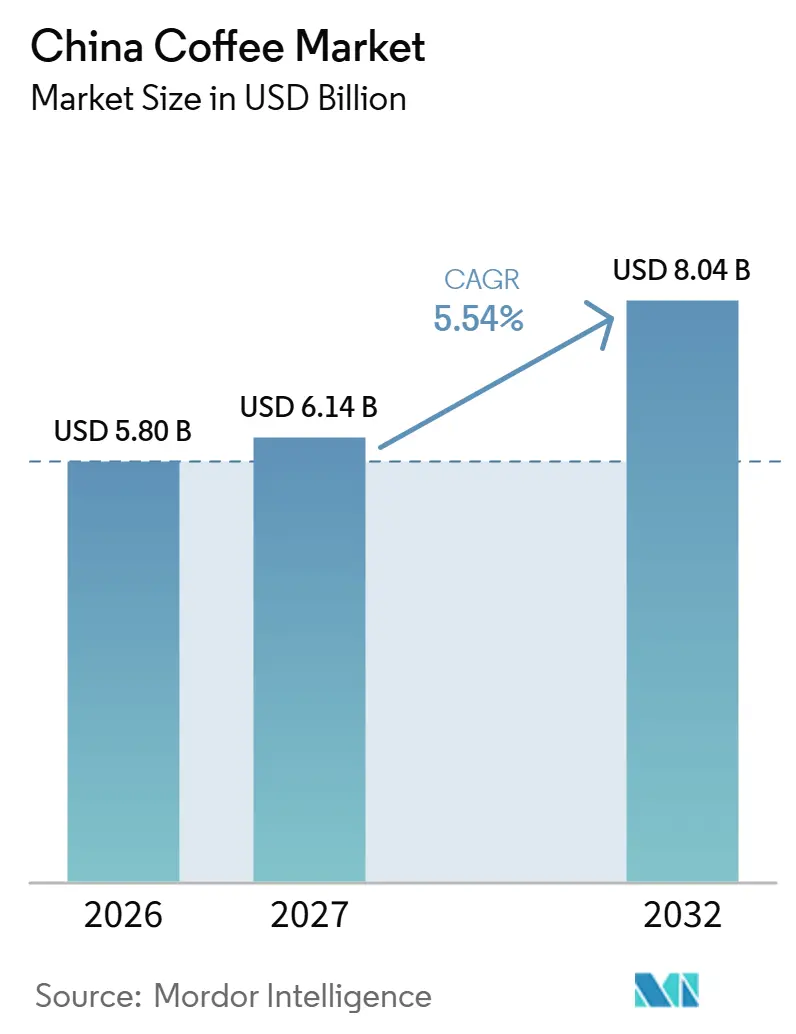
The China coffee market size is estimated at USD 5.8 billion in 2026 and is projected to be USD 6.14 billion in 2027, reaching USD 8.04 billion by 2032, growing at a CAGR of 5.54% from 2027 to 2032.
Chain café expansion and specialty preparation such as cold brew broaden coffee occasions in China, while homegrown brands extend local access. Rising bean costs increase the burden of supplying each cup, so café operators must turn additional transactions into enough revenue to absorb that exposure. Packaged ready-to-drink coffee offers a route to buyers outside cafés, but caffeine sensitivity limits additional consumption for some groups. For buyers limiting caffeine intake, an easier ready-to-drink purchase can replace a café occasion rather than add one, placing packaged suppliers and café operators in competition for the same limited consumption.
Key Report Takeaways
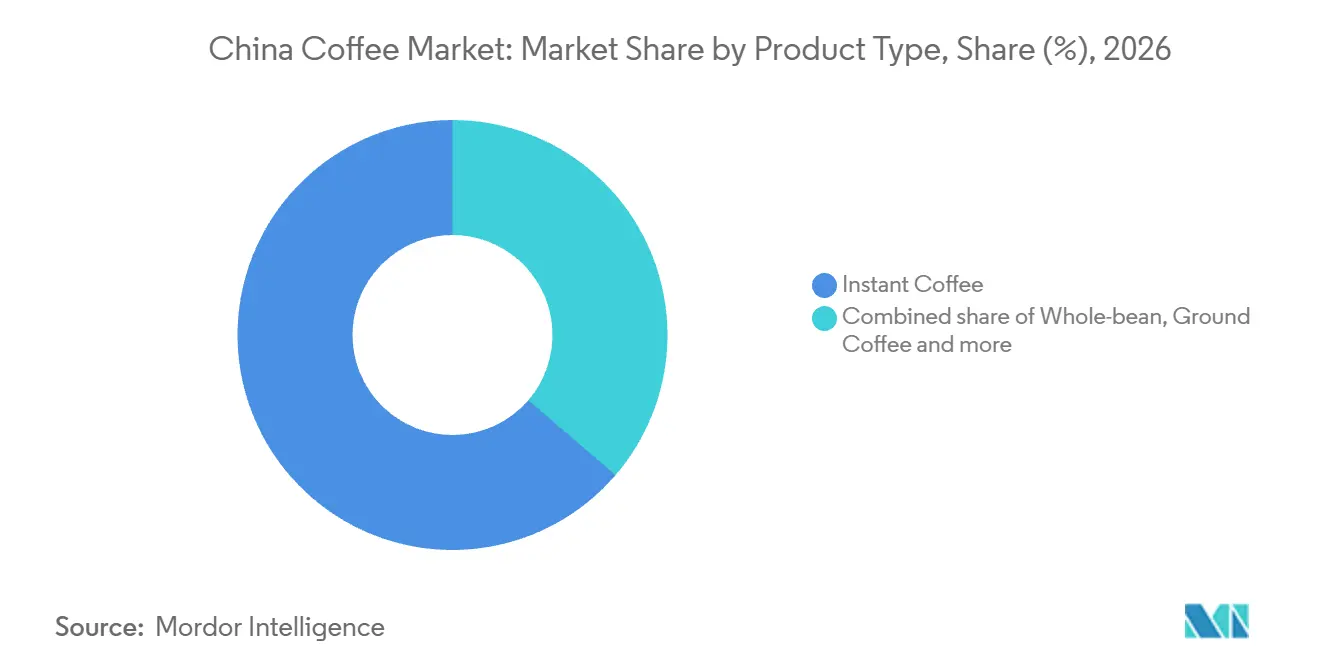
- By product type, instant coffee led with a 63.7% China coffee market share in 2026, while coffee pods and capsules are projected to grow fastest at a CAGR of 9.55% from 2027 to 2032.
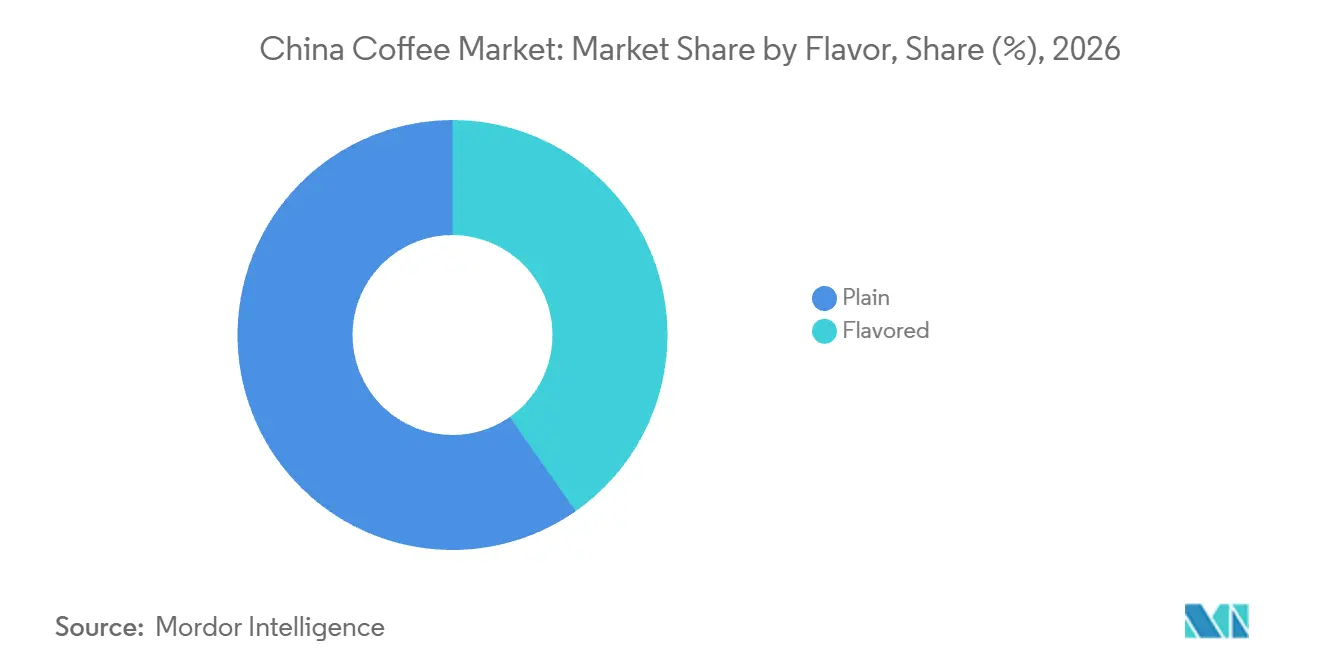
- Across flavors, plain coffee held a 59.71% share of the China coffee market size in 2026, and flavored coffee is the fastest-growing segment at a CAGR of 6.15% from 2027 to 2032.
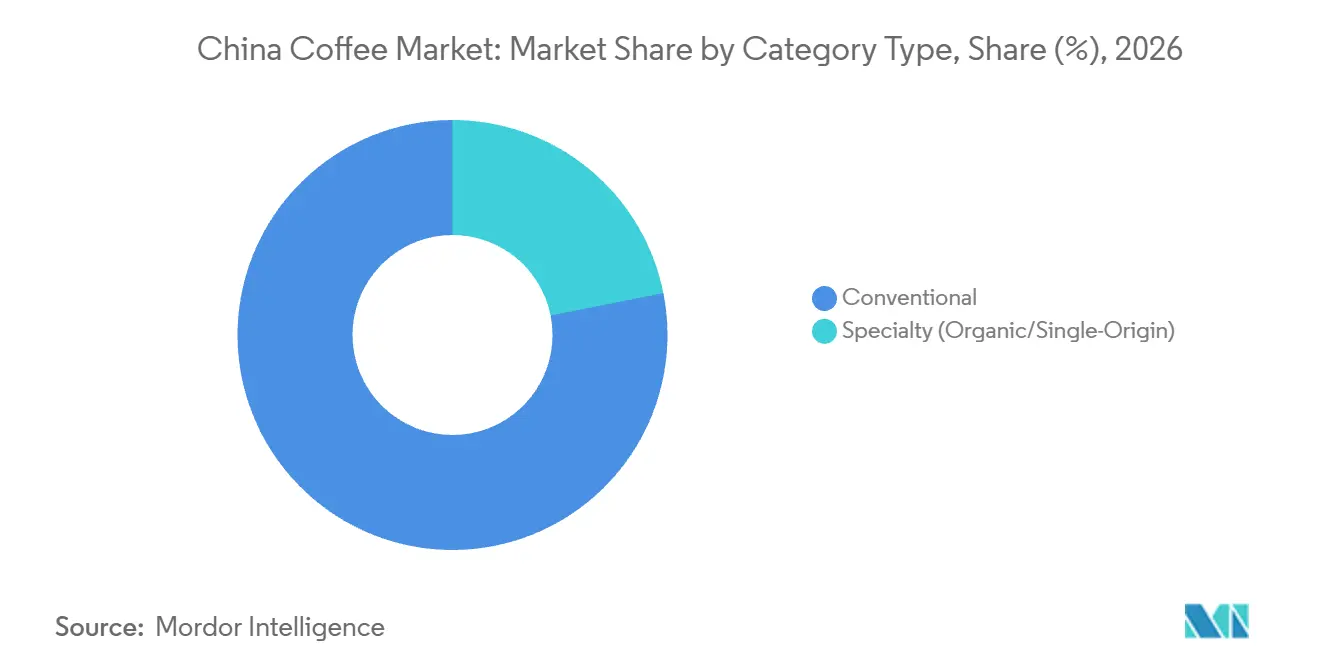
- Conventional coffee led the category mix with a 78.12% market share in 2026, while specialty (organic/single-origin) coffee is projected to grow fastest at a CAGR of 6.65% from 2027 to 2032.
- Among bean types, Arabica led with a 67.36% market share in 2026, while the others segment is projected to grow fastest at a CAGR of 5.7% from 2027 to 2032.
- By distribution channel, off-trade held an 82.85% market share in 2026, and on-trade is the fastest-growing segment at a CAGR of 6.45% from 2027 to 2032.
- Geographically, Eastern China held a 43.27% market share in 2026, while Northern China is projected to grow fastest at a CAGR of 5.8% from 2027 to 2032.
Note: Market numbers in this report are based on Mordor Intelligence's proprietary estimation framework, which combines nine months of actuals with Q4 projections for base year 2026.
Market Trends and Insights
Drivers Impact Analysis of China Coffee Market*
| Driver | (~) % Impact on CAGR Forecast | Geographic Relevance | Impact Timeline |
|---|---|---|---|
| Rising interest in specialty, gourmet, and artisanal coffee | +1.6% | Shanghai, Shenzhen, Hangzhou, Beijing, Nanjing and Wuhan | Medium term (2-4 years) |
| Expansion of café culture | +1.9% | Shanghai, Jiuzhaigou, Zhangye and Dunhuang | Medium term (2-4 years) |
| Increasing popularity of homegrown brands | +1.7% | Nationwide | Medium term (2-4 years) |
| Rising preference for convenience | +1.5% | Nationwide | Short term (≤ 2 years) |
| Government incentives for Yunnan coffee farming | +0.6% | Coffee farming areas in Yunnan | Long term (≥ 4 years) |
| Growing health and wellness trends | +0.5% | Nationwide | Medium term (2-4 years) |
| Source: Mordor Intelligence | |||
Rising interest in specialty, gourmet, and artisanal coffee
Specialty coffee operators can develop demand through distinctive preparation as well as a wider urban footprint. A March 2025 CBNData survey in Shanghai’s Jing’an District found above-average cold brew and pour-over preferences within its primarily student “Self-Expression” consumer cohort. On October 13, 2026, Blue Bottle Coffee had specialty cafés under renovation in Beijing, Nanjing and Wuhan. Its existing mainland network comprised 14 cafés in Shanghai, Shenzhen and Hangzhou at that date. The survey locates preparation-specific interest within one Shanghai district, while Blue Bottle’s renovation projects would extend specialty café access beyond its existing mainland cities.
Expansion of café culture
Café culture can expand through new consumption settings as well as additional outlets serving familiar routines. Starbucks China reported in July 2025 that it had recently opened stores in Jiuzhaigou, Zhangye and Dunhuang tourist destinations. These completed openings placed its café offer within travel settings, creating another route through which operators could serve coffee customers. For destination cafés, the commercial proposition can center on the visit itself, allowing a coffee purchase to accompany an activity outside the customer’s usual neighborhood. This gives café expansion a demand mechanism distinct from simply increasing the density of competing outlets along an established urban shopping street.
Increasing popularity of homegrown brands
Homegrown brands can broaden coffee demand by bringing a recognizable domestic offer into more local trading areas. Luckin Coffee recorded 2,668 net new store openings in China, including Hong Kong, in the second quarter of 2026.[1] Net openings subtract permanent closures from gross new stores opened during the period. For a domestic chain, that wider footprint creates more places to turn its coffee offer into a purchase, while each additional outlet must attract sufficient demand. The net count therefore captures retained domestic reach, making sustained access to local buyers a more useful expansion signal than gross opening activity alone.
Rising preference for convenience
Convenience can expand coffee demand when the offer fits an occasion with little time for ordering or preparation. For an instant-coffee supplier, the commercial task can be to make a routine coffee occasion easy to repeat without requiring a café visit. A ready-to-drink offer can instead target an occasion where the buyer wants the product already prepared, while café service can compete on ease of access. These routes address different parts of the same purchase decision, so convenience need not require every supplier to adopt the same format. Instant preparation leaves some work with the buyer, ready-to-drink coffee moves it into production, and cafés retain it in service, so the supplier’s format determines which time burden it must reduce.
Restraints Impact Analysis of China Coffee Market*
| Restraint | (~) % Impact on CAGR Forecast | Geographic Relevance | Impact Timeline |
|---|---|---|---|
| Fluctuations in global coffee bean prices | -1.2% | Nationwide | Short term (≤ 2 years) |
| Persistent health concerns over caffeine | -0.6% | Nationwide | Medium term (2-4 years) |
| Stringent food safety and regulatory compliance | -0.3% | Nationwide | Short term (≤ 2 years) |
| Strong cultural preference for tea in rural areas | -0.2% | Nationwide | Long term (≥ 4 years) |
| Source: Mordor Intelligence | |||
Fluctuations in global coffee bean prices
Bean-price volatility can constrain coffee demand indirectly by making the cost of supplying an affordable cup less predictable. In its 2025 annual report, Luckin Coffee Inc. said rising coffee bean prices had affected raw material costs. The company usually enters fixed-price supplier agreements lasting one year, but significant market fluctuations may lead to renegotiation. Contract coverage therefore cannot be treated as complete protection against a change in input economics. If costs rise after agreements expire or because of market fluctuations, Luckin says its business and operating results could be adversely affected. For coffee operators facing that exposure, maintaining an accessible selling price can leave less room to absorb higher bean costs.
Persistent health concerns over caffeine
Caffeine concerns can restrict the coffee occasions available to particular consumer groups, even when an offer is otherwise attractive. May 2026 Gansu Provincial CDC guidance from a Sichuan University West China Hospital nutritionist described caffeine-sensitive or slow-metabolizing people as more prone to palpitations, anxiety, insomnia or stomach discomfort, with palpitations usually temporary and harmless. In August 2026, a Xiamen University First Affiliated Hospital nutrition specialist advised pregnant and trying-to-conceive women to limit total caffeine to 200 mg daily. The specialist separately advised breastfeeding women to minimize or avoid coffee and symptom-prone people to reduce coffee intake. These consumption boundaries make product appeal and the scope for an additional coffee occasion separate commercial questions. The remaining demand constraint is the buyer’s intake decision, which a different flavor or faster service cannot resolve on its own.
*Our forecasts treat driver/restraint impacts as directional, not additive. The impact forecasts reflect baseline growth, mix effects, and variable interactions.
China Coffee Market Segment Analysis
By Product Type:
Industrial Scale Supports Instant CoffeeInstant coffee accounted for a 63.7% share of the China coffee market size in 2026, making it the largest segment. In March 2026, Hogood Coffee reported annual instant-coffee capacity of 25,000 metric tons. The company also claimed national leadership in industrial instant coffee powder production and sales volume. For brands developing an instant-coffee offer, that processing scale can provide an industrial foundation for supplying the product beyond individual coffeehouse locations. The commercial strength to develop is broad availability supported by manufacturing scale, giving instant coffee a route to buyers that does not require a café to prepare each purchase.
Coffee pods and capsules are the fastest-growing segment, with a projected CAGR of 9.55% from 2027 to 2032. By June 2026, Guangzhou Gelingfu Food Technology Co., Ltd. had established collaborations with China Southern Airlines and Jinlongyu. Its factory could produce 200,000 ambient coffee-liquid capsules daily at full production. For capsule suppliers, this example shows that named business collaborators and daily production capacity for a specific capsule format can matter alongside the coffee itself. Those relationships create a potential business-customer route for the format, with commercial value depending on converting production capability into a repeatable use for the coffee product.

By Flavor:
Plain Coffee Reaches Retailers as Flavored Series ExpandPlain coffee represented a 59.71% China coffee market share in 2026, making it the largest segment. In May 2025, Nongfu Spring launched TANBING’s 0.9-liter low-temperature, sugar-free ready-to-drink black coffee at Sam’s Club. The product topped the Sam’s Club app’s New Arrivals Popularity Chart upon launch. For a plain-coffee supplier, this example connects a specific black-coffee product with a named retail channel, providing a product identity beyond an added flavor claim. The commercial role of plain coffee can therefore include a defined retail pack and channel proposition, rather than only a flavor-neutral option on a café menu.
Flavored coffee is the fastest-growing segment, with a projected CAGR of 6.15% from 2027 to 2032. Luckin Coffee reported that its Coconut Milk Latte surpassed 1.9 billion cups in cumulative sales from its 2021 launch through the end of 2025. The company said it introduced new variations each year to expand this product series. This provides a product-development model in which a recognizable base drink can support additional variations within the same family. For flavored-coffee sellers, a named product family can connect innovation with an established purchase history, giving a new variation a commercial reference beyond its flavor alone.
By Category Type:
Everyday Demand Meets Specialty Quality UpgradingConventional coffee was the largest segment, accounting for 78.12% of the market in 2026. In February 2025, Mau Perez, purchasing manager for Shanghai Cooway Trading Company, said most Chinese consumers favored conventional everyday coffees over rare, competition-winning lots. That observation distinguishes everyday coffee from the highly selective proposition of an exceptional lot. For a conventional-coffee brand, product format and the drinking occasion can therefore take priority over making rarity the reason to buy. The commercial opening is a recognizable core coffee offer for regular use, with selective lots addressing a different buying decision rather than setting the terms for every product.
Specialty (organic/single-origin) coffee is the fastest-growing segment, with a projected CAGR of 6.65% from 2027 to 2032. Yunnan’s specialty-grade share of locally grown coffee beans rose from 8% in 2021 to 31.6% in 2025. This production-quality upgrading can broaden the supply foundation for roasters seeking a differentiated bean offer. For an origin-led product, the commercial case depends on translating quality into an identifiable coffee proposition rather than relying on the origin name alone. A stronger quality base can improve the sourcing proposition, but the premium offer must connect the bean’s attributes with a specific reason for the buyer to choose that coffee.
By Bean Type:
Arabica Supply Anchors a More Diverse OfferArabica was the largest segment, accounting for 67.36% of the market in 2026. A 2025 annual-report summary identified Arabica as China’s primary green-bean variety and placed most national production in Yunnan. For a roaster developing a domestic Arabica range, the national variety mix makes Yunnan a commercially relevant source region. The resulting sourcing proposition joins the bean type used in the product with the geographic production base on which the offer is developed. This gives Arabica positioning an upstream supply dimension, making the ability to work with a concentrated domestic origin relevant alongside the consumer-facing variety label.
The others category is the fastest-growing segment, with a projected CAGR of 5.7% from 2027 to 2032. In June 2026, Zhongmaogang Construction reported that Hainan Liberica cultivation covered more than 66.7 hectares. A June 2026 Haikou Daily report said visitors to Baishixi Waterfall in Haikou’s Dapo Town commonly ordered Hainan Liberica large-bean coffee at a nearby café. Robusta has a separate role as a lower-cost ingredient in commercial blends and a main source for instant coffee, according to the 2025 China Coffee Industry Report. For Liberica suppliers, the connection between a local crop and a visitor’s cup creates a concrete selling context beyond a bean-type label.
By Distribution Channel:
Packaged Reach and Transaction-Led Café DemandOff-trade was the largest segment, accounting for 82.85% of the market in 2026. Luckin Ready-to-Enjoy reported that its coffee-liquid products sold more than 400 million cups in 2025. That product-line measure illustrates a retail coffee proposition built around a packaged format rather than a single prepared-coffee counter. A packaged product can connect a brand with an occasion outside a café, widening the commercial use of its name. A packaged coffee line can therefore build branded sales across retail points of sale without requiring a corresponding café-service operation at every location where the product is purchased.
On-trade is the fastest-growing segment, with a projected CAGR of 6.45% from 2027 to 2032. In the 13-week fiscal quarter ended March 29, 2026, Starbucks China’s comparable-store sales rose 0.5% year over year, as comparable transactions increased 2.1% while average ticket fell 1.6%. The result shows how more transactions can support sales growth even when spending per transaction declines. For café operators, greater purchasing frequency can support revenue while placing more weight on the economics of serving each order. A commercially durable offer must therefore turn the additional transactions into enough revenue to support prepared-coffee service, rather than treating traffic alone as the objective.
Geography Analysis
Eastern China Coffee Market
Eastern China accounted for a 43.27% China coffee market share in 2026, making it the largest geography. Shanghai had 10,336 coffee outlets in 2025, compared with 9,115 in 2024, providing a substantial city-level service base within the region.[2] For roasters and café suppliers addressing this city, a large outlet base creates scope to serve multiple accounts through a concentrated commercial footprint. A supplier able to serve many nearby accounts can spread its commercial effort across an established urban customer base, making account depth an opportunity alongside expansion into new trading territories.
Northern China Coffee Market
Northern China is the fastest-growing geography, with a projected CAGR of 5.8% from 2027 to 2032. Beijing’s coffee-shop count reached 6,787 in 2025, 62% above 2022, according to Dianping data compiled by Black Valley Investment. Beijing’s share of national coffee outlets nevertheless fell, while the same report describes faster openings in lower-tier cities nationally. Against that national trend, reaching cities beyond Beijing offers chains and suppliers a potential route to expand coffee service within Northern China. The commercial opening is to extend coffee service beyond an established metropolitan base, with recurring purchases at new locations determining whether wider reach translates into sustained demand.
Southern China combines consumer-facing coffee channels with Guangzhou’s upstream trading infrastructure. In Guangdong, café operations require food-business licensing, while businesses selling only prepackaged food must file with county-level or higher food-safety regulators. This distinction makes the operating activity central to a supplier’s choice between packaged retail and prepared-drink service. The South China International Coffee Exchange was unveiled in Guangzhou on August 7, 2026, as an upstream spot-trading platform for domestic and international traders, roasters and brands. The exchange’s business-facing services can assist bean sourcing, while the licensing distinction determines the administrative route for reaching consumers through cafés or packaged products.
Regulatory Framework and Outlook
This comparison assesses selected jurisdictions from the perspective of coffee chains that prepare and serve drinks in China. National rules require food-business licenses for café service, while the exception for businesses selling only prepackaged food depends on that limited activity. Guangdong’s 2025 framework assigns provincial guidance and local implementation responsibilities for food-business licensing and filing. The relevant commercial lens is the work of establishing and maintaining a licensed prepared-drink operation.
Regulatory Table of China Coffee Market
| Decision factor | China | Guangdong province |
|---|---|---|
| Primary authority | State Administration for Market Regulation and local market-supervision departments | Guangdong Administration for Market Regulation for guidance; county-level or higher local market regulators for implementation |
| Key instruments or direction | National food-business licensing measures, Order 78 | Food Safety Regulations and 2025 food-business licensing and filing rule |
| Commercial effect | Café service requires licensing; sole prepackaged-food sales are exempt from licensing | Operations must stay within licensed scope; prior valid permits and filings retain their own validity periods |
| Current policy attractiveness | Medium | Medium |
| Future direction of policy attractiveness | No change | No change |
| Source: Mordor Intelligence | ||
Mandatory national café licensing and SAMR Order 104 support a Medium assessment for prepared-drink chains. China’s Food Labeling Supervision and Administration Measures take effect on March 16, 2027, and exclude restaurant-service freshly prepared foods.[3] Guangdong also merits Medium because local regulators implement licensing and filing, while the 2025 rule preserves prior permissions through their remaining validity periods. No change reflects licensing continuity and Order 104, effective December 1, 2025, requiring food-safety systems and documented checks for restaurant chains under unified management with one brand and at least 10 stores.
Value Chain Stages
The comparison follows cultivation, primary processing, roasted-bean supply, and prepared-coffee retail. Pu’er Wujin Coffee reported output exceeding 2,000 metric tons in the 2025-2026 crop season and annual processing capacity of 8,000 metric tons. Supplier earnings arise from sales of coffee crops, processed coffee or roasted beans, while the café business captures value through prepared-beverage sales.
Value Chain Analysis Table of China Coffee Market
| Primary activity | Key participants | Value capture | Bottleneck | Resilience response |
|---|---|---|---|---|
| Coffee cultivation | Integrated cultivators such as Dehong Hogood Coffee Co., Ltd. | Coffee-bean sales incorporating cultivation | Connecting crop availability with processing demand | Coordinate cultivation and downstream processing requirements |
| Primary processing | Coffee processors such as Pu’er Wujin Coffee and Dehong Hogood Coffee Co., Ltd. | Processed-coffee sales | Reported tight supply in Pu’er’s Munaihe Industrial Park in the 2024-2025 crop season | Align processing schedules with available seasonal supply |
| Roasting and B2B supply | Roasters and bean suppliers such as Guangzhou CHIEF Coffee Supply Chain Management Co., Ltd. | Roasted-bean sales | Serving distinct café, chain and roasting-studio requirements | Match roast and supply specifications to each buyer type |
| Coffee preparation and retail | Coffeehouse chains such as Luckin Coffee Inc. | Prepared-beverage sales | Converting outlet reach into recurring transactions | Tailor the store offer to its purchase occasions |
| Source: Mordor Intelligence | ||||
In July 2025, Starbucks China and Envision Group agreed to develop a digital carbon-management platform intended to cover all direct suppliers and important indirect procurement suppliers over 3 years. For primary processors and roasted-bean suppliers included in that intended coverage, participation would connect coffee supply with the information needed to calculate the buyer’s carbon footprint. Usable carbon records could therefore become part of serving this buyer, giving processors and roasters a potential service distinction alongside the beans they sell.
Competitive Landscape
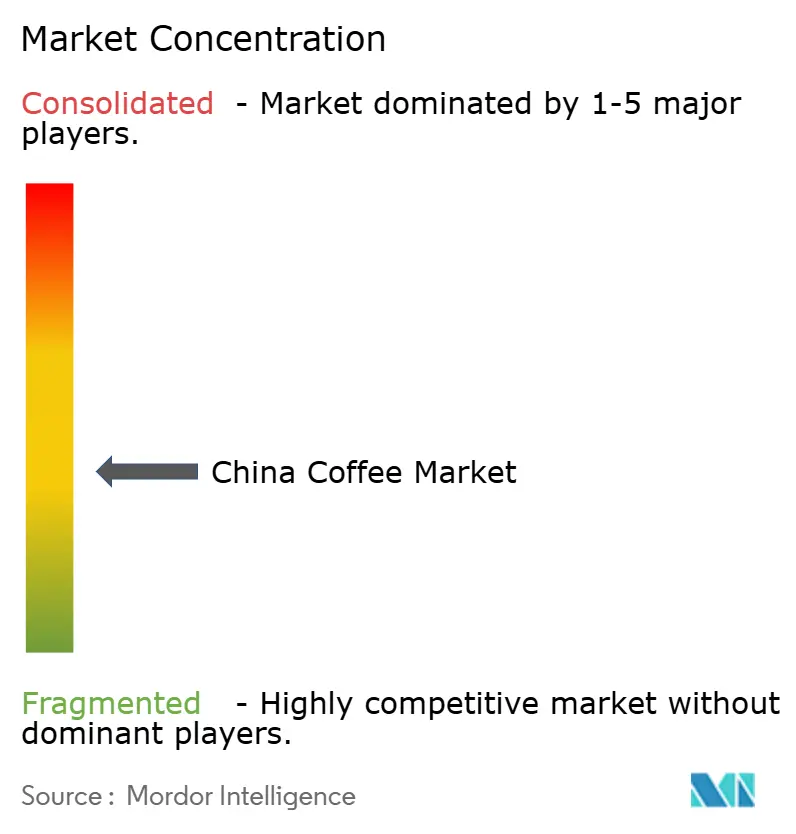
Competition is broad, combining coffee-product brands, distributors, and large coffeehouse networks. Major participants include Nestlé S.A., Starbucks Corporation through its China joint venture with Boyu Capital, Luckin Coffee Inc., Saturnbird Coffee, and illycaffè Shanghai Co. Ltd. Saturnbird sells Super Number and Express Coffee products, while illycaffè Shanghai was illycaffè S.p.A.’s China product-distribution subsidiary at year-end 2024. Luckin recorded 8,599 net new stores in China, including Hong Kong, during 2025. This breadth gives chains more consumer access points, while product brands and distributors can compete through different routes to the coffee buyer.
On March 30, 2026, Starbucks completed its China retail joint venture with Boyu Capital, which acquired 60%, while Starbucks retained 40%. The transaction converted 7,991 company-operated stores to licensed operations, with Starbucks continuing to own and license the brand and intellectual property. Starbucks shifted toward recording product sales, royalties, and its share of joint-venture income instead of consolidating the retail operation’s revenues and expenses. For competing chains, the arrangement illustrates how ownership of a coffee brand and direct ownership of its outlets create different economic positions even when both reach customers through branded stores.
Operational capacity adds a second dimension to competition, because reaching coffee buyers and supplying their coffee are separate commercial tasks. Luckin’s subsidiary, Luckin Coffee Food (Qingdao) Co., Ltd., began operating its Qingdao roasting center on April 22, 2026, with expected annual roasting capacity of 55,000 metric tons. Such a facility can support the production side of a coffeehouse network, giving the operator a capability that extends beyond adding retail locations. Under Order 104 of the State Administration for Market Regulation (SAMR), effective December 1, 2025, restaurant chains using one brand and unified management with at least 10 stores must designate a headquarters licensed for chain management and responsible for food safety. Reaching 10 stores under one brand and unified management therefore brings a challenger the same headquarters food-safety duties as Luckin, but does not itself confer Luckin’s in-group roasting capability.
China Coffee Industry Leaders
-
Nestlé S.A.
-
Starbucks Corporation
-
Luckin Coffee Inc.
-
Saturnbird Coffee
-
illycaffè Shanghai Co. Ltd.
- *Disclaimer: Major Players sorted in no particular order
China Coffee Market Companies Covered in this Report
- Nestlé S.A.
- Starbucks Corporation
- Luckin Coffee Inc.
- JAB Holding Company
- Luigi Lavazza S.p.A.
- TH International Limited (Tims China)
- Hainan Lisun Investment Co., Ltd.
- Dehong Hogood Coffee Co., Ltd.
- UCC Ueshima Coffee Co., Ltd.
- The Coca-Cola Company (Costa)
- Strauss Group Ltd.
- illycaffè Shanghai Co. Ltd.
- Trung Nguyen Coffee
- Zhejiang Lixing Technology Co., Ltd. (Nowwa Coffee)
- Saturnbird Coffee
- Pacific Coffee
- Cotti Coffee
- NOC Coffee Co
- Gloria Jean's Coffees
- PT Mayora Indah Tbk (Coffee)
Key Opportunities for Market Participants
The comparison covers coffee products with different default recipes and customization options, alongside origin-focused café offers. More than 53% of respondents to the 2026 China Freshly Made Beverage Health Trends Report said they requested less sugar, no milk foam, or plant-based milk when ordering high-sugar or high-fat freshly made beverages. More than 62% reported strong purchase interest when low-sugar, low-calorie, and refreshing formulations were the default for freshly made beverages. In February 2026, Luckin Coffee opened its first Origin Flagship in Shenzhen with a single-origin menu featuring coffees from Yunnan, Ethiopia and Mandheling.
Market Opportunities Table of China Coffee Market
| Opportunity | Why now | Buyer / lead segment | Recommended play | Main barrier | Likely beneficiaries |
|---|---|---|---|---|---|
| Lower-sugar default coffee drinks | Conditional formulation interest in the 2026 freshly made beverage report | Buyers choosing freshly prepared coffee | Build a defined coffee offer around low-sugar, low-calorie and refreshing defaults | Earning repeat demand for the standard recipe | Coffeehouse chains and coffee-product developers |
| Origin-focused café coffee in Shenzhen | Operating origin-menu example from February 2026 | Shenzhen café coffee buyers | Connect a specified coffee origin with a clear café proposition | Making the stated origin meaningful to the coffee buyer | Coffeehouse operators such as Luckin Coffee |
| Optional plant-milk coffee variants | Reported drink-modification requests in 2026 | Coffee buyers choosing a plant-milk option | Define an identifiable plant-milk coffee variant within the menu | Turning an optional modification into a repeatable coffee product | Café operators and coffee formulators |
| Source: Mordor Intelligence | |||||
Default recipes and requested modifications present different commercial choices for a coffee operator, because the former defines the standard offer and the latter adds an option. Testing a lower-sugar default coffee recipe would apply that broader freshly made beverage preference to the standard menu without requiring a customer to request each modification. The strongest opening is therefore a low-sugar, low-calorie, refreshing default coffee recipe, because the 2026 freshly made beverage findings link purchase interest to the standard formulation itself.
Recent Industry Developments in China Coffee Market
- Aug 2026: On August 18, SAMR sought comments on a proposed production-license review rule for cocoa and roasted coffee products in China, setting September 18, 2026, as the comment deadline.
- Apr 2026: Luckin Coffee Food (Qingdao) Co., Ltd., a Luckin Coffee subsidiary, began operating its Qingdao roasting center on April 22, with expected annual roasting capacity of 55,000 metric tons.
- Mar 2026: Starbucks completed the sale of a 60% interest in its China retail operations to Boyu Capital, converting 7,991 company-operated stores to licensed stores. Starbucks retained 40% and continued to own and license its brand and intellectual property.
China Coffee Market Report Scope and Research Methodology
Market Definition and Coverage
The China coffee market measures annual consumer spending on coffee products and prepared coffee beverages in China. Value is counted at the retail or foodservice sale to the end user.
Scope exclusions: Coffee shop equipment and vending machines, tea, cocoa, energy drinks and other non-coffee beverages, and unroasted green coffee sold as a raw input to a roaster or processor are excluded.
Segments Covered in This Report
- By Product Type
- Whole-bean
- Ground Coffee
- Instant Coffee
- Coffee Pods and Capsules
- Ready-to-Drink (RTD) Coffee
- By Flavor
- Plain
- Flavored
- By Category Type
- Conventional
- Specialty (Organic/Single-Origin)
- By Bean Type
- Arabica
- Robusta
- Others
- By Distribution Channel
- On-Trade
- Off-Trade
- Supermarkets/Hypermarkets
- Specialty Stores
- Convenience Stores
- Online Retail Stores
- Other Distribution Channels
- By Geography
- Eastern China
- Southern China
- Northern China
Data Sources, Market Sizing, and Validation
Desk Research
Public supply and trade context can draw on sources such as the Yunnan 2025 Statistical Communique, WITS trade data, the International Coffee Organization's statistics database, and Shanghai municipal reporting. The Yunnan communique tracks coffee output, WITS records China's unroasted coffee imports by value and volume, and Shanghai reporting adds port-level import context. The International Coffee Organization's historical series can help frame production, consumption, trade and stock movements against China's reported supply and import signals.
Company annual filings and investor materials can cross-check China store networks, product mix, selling prices and sales trends, while reputable business press can clarify dated channel and policy developments. Analysts can use these records alongside public statistics to test whether operating indicators align with end-user sales measures. These sources are illustrative, not exhaustive, and further sources inform collection, validation and clarification.
Primary Interviews and Surveys
Interviews and structured surveys can include China-based coffee roasters, packaged coffee suppliers, importers, retail buyers, café operators and foodservice managers who understand sales routes, pricing and consumer demand. Analysts can use their responses to check secondary evidence on product and channel coverage, operating indicators and regional patterns, then investigate material differences with the relevant respondent or source. Where a data point remains unavailable, the model can retain the closest directly observed indicator and test its effect against independent sales, trade and production signals.
Distribution of primary research fieldwork respondents
| Company type | Respondent position | Region |
|---|---|---|
| Top tier: 30% | CXOs: 20% | |
| Mid tier: 45% | Functional/Unit leaders: 35% | |
| Smaller Players: 25% | Managers: 45% |
Market-Sizing & Forecasting
The top-down model estimates China's annual end-user spending across packaged coffee purchases and prepared coffee sold through foodservice, then checks the result against selected channel and supplier evidence. Core indicators include coffee import volumes and values, Yunnan production, retail and menu prices, café outlet and transaction trends, and packaged-product sales. Because imported beans and Yunnan crops shape supply availability, analysts examine them alongside retail prices, outlet activity and purchase frequency to explain changes in consumer spending. Analysts can use sampled average selling prices with observed or reported volumes and selected supplier or channel roll-ups as bottom-up checks, reconciling differences in transaction stage and avoiding double counting between inputs and finished sales.
Multivariate regression can relate market value to the demand and price indicators, with scenario analysis for changes in affordability, café expansion and product mix. Evidence on product forms, flavor, category, bean, channel and regional sales can establish segment shares, which are checked against the total and against the reported mix of relevant suppliers and outlets. China-based market experts can review the role and direction of individual forecast variables and flag implausible category paths. When a sampled channel or supplier estimate has gaps, analysts compare it with the closest observed period and independent retail, trade or production indicators before incorporating it.
Data Validation & Update Cycle
Analysts triangulate public statistics, trade flows, company disclosures and channel evidence, then check totals, shares, growth rates and year-to-year changes for anomalies. A second review traces unusual variances to their source definitions and transaction stages, resolves them before sign-off, and prompts re-contact when a key input conflicts with another source or a material event changes the underlying indicator. The model is refreshed annually, updated between cycles when a material market event warrants it, and given a fresh pre-delivery review.
Mordor Intelligence's China Coffee Market Sizing Compared With Other Published Estimates
Published estimates can differ in the transactions and products they count and the inputs used to model demand. The China coffee market measures annual consumer spending on coffee products and prepared coffee beverages in China.
Key Gap Drivers include the study's defined coverage and market-specific modeling choices. Core indicators include coffee import volumes and values, Yunnan production, retail and menu prices, café outlet and transaction trends, and packaged-product sales.
Benchmark comparison
| Source | Market Size | Gaps in Research Methodology |
|---|---|---|
| Mordor Intelligence | USD 6.14 B (2027) | |
| Global Research Firm A | USD 3.26 B (2025) | At its 2025 base, this estimate is 46.9% below this report's 2027 value of USD 6.14 B, 2 years later. Its listed product and channel cuts do not separately identify prepared coffee sold at foodservice menu prices or packaged ready-to-drink coffee. |
| Global Research Firm B | USD 3 B (2024) | At its 2024 base, this estimate is 51.1% below this report's 2027 value of USD 6.14 B, 3 years later. Its stated retail product and channel coverage omits prepared café menu sales and ready-to-drink coffee. |
Mordor Intelligence's analysts triangulate public statistics, trade flows, company disclosures and channel evidence, then check totals, shares, growth rates and year-to-year changes for anomalies.
Key Questions Answered in the Report
What is the China coffee market size and growth outlook?
Estimated at USD 5.8 billion in 2026, the size is projected at USD 6.14 billion in 2027 and USD 8.04 billion by 2032, with a CAGR of 5.54% from 2027 to 2032.
What is supporting coffee demand in China?
Café expansion, homegrown brands, and specialty interest support demand. Luckin recorded 2,668 net new stores in China, including Hong Kong, in the second quarter of 2026.
Which coffee product type leads in China?
Instant coffee led with a 63.7% share in 2026, while coffee pods and capsules are forecast to grow fastest at a CAGR of 9.55% from 2027 to 2032.
Which companies compete in China’s coffee industry?
Major participants include Nestlé S.A., Starbucks Corporation through its China joint venture with Boyu Capital, Luckin Coffee Inc., Saturnbird Coffee, and illycaffè Shanghai Co. Ltd.
What could limit coffee industry growth in China?
Bean-price exposure and caffeine-related consumption constraints are key challenges. Luckin’s 2025 annual report linked rising bean prices to higher raw material costs and said further increases could adversely affect its business and results.
Which part of China leads coffee sales, and which is growing fastest?
Eastern China led with a 43.27% market share in 2026, while Northern China is forecast to grow fastest at a CAGR of 5.8% from 2027 to 2032.