
Market Overview
| Study Period | 2020 - 2031 |
|---|---|
| Forecast Data Period | 2026 - 2031 |
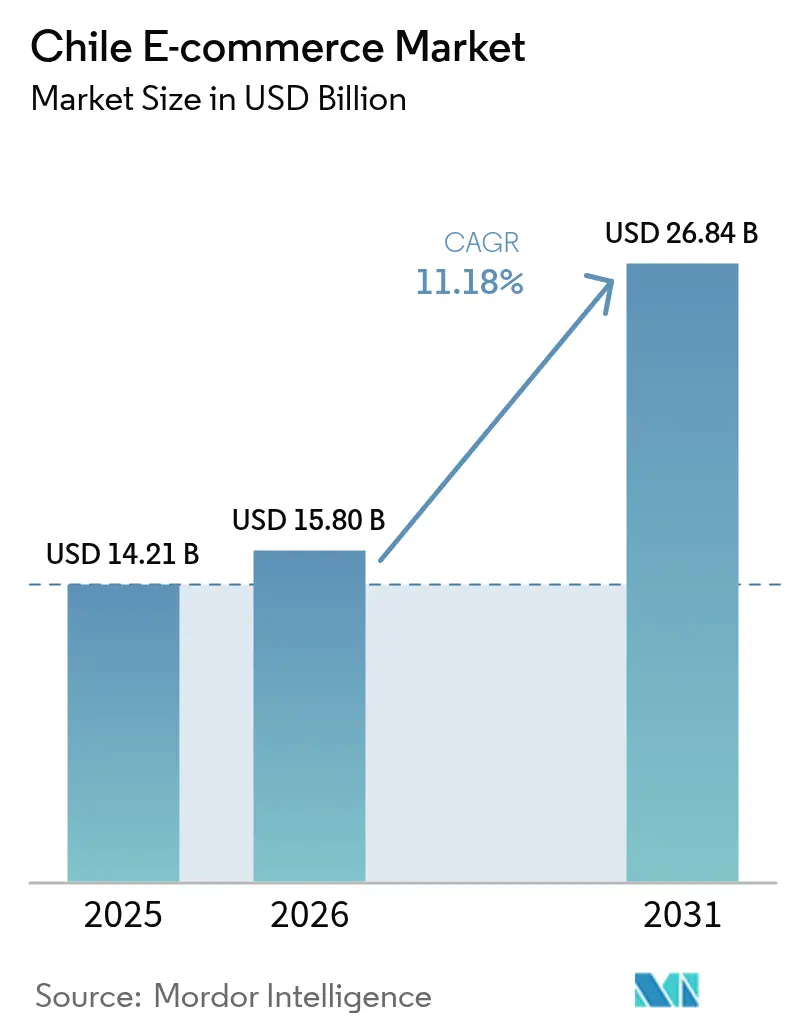
| Base Year Market Size (2025) | USD 14.21 Billion |
| Market Size (2026) | USD 15.8 Billion |
| Market Size (2031) | USD 26.84 Billion |
| Growth Rate (2026 - 2031) | 11.18 % |
| Market Concentration | Medium |
Major Players *Disclaimer: Major Players sorted in no particular order Image © Mordor Intelligence. Reuse requires attribution under CC BY 4.0. | |
Chile E-commerce Market Analysis by Mordor Intelligence
The Chile e-commerce market size in 2026 is estimated at USD 15.8 billion, growing from 2025 value of USD 14.21 billion with 2031 projections showing USD 26.84 billion, growing at 11.18% CAGR over 2026-2031. Chile’s 88.3% internet penetration, nationwide 4G coverage and rapid 5G deployment underpin this trajectory, positioning the country as Latin America’s most digitally advanced consumer market.[1] Government-backed fiber-optic expansion, strong banking penetration and a modernized payments ecosystem accelerate the migration from traditional retail to integrated omnichannel models. Continued foreign direct investment in telecommunications over USD 3 billion since 2024 creates a dense logistics and data-center grid that lowers fulfillment costs and enhances platform reliability. Rising smartphone adoption, now responsible for 66% of transactions, amplifies the reach of digital wallets such as WebPay and MACH, while new value-added tax (VAT) rules effective January 2025 increase compliance costs for cross-border merchants but level the playing field for domestic sellers. Despite currency volatility and rural delivery inefficiencies, the Chile e-commerce market continues to attract regional expansion by global platforms and local incumbents alike.
Key Report Takeaways
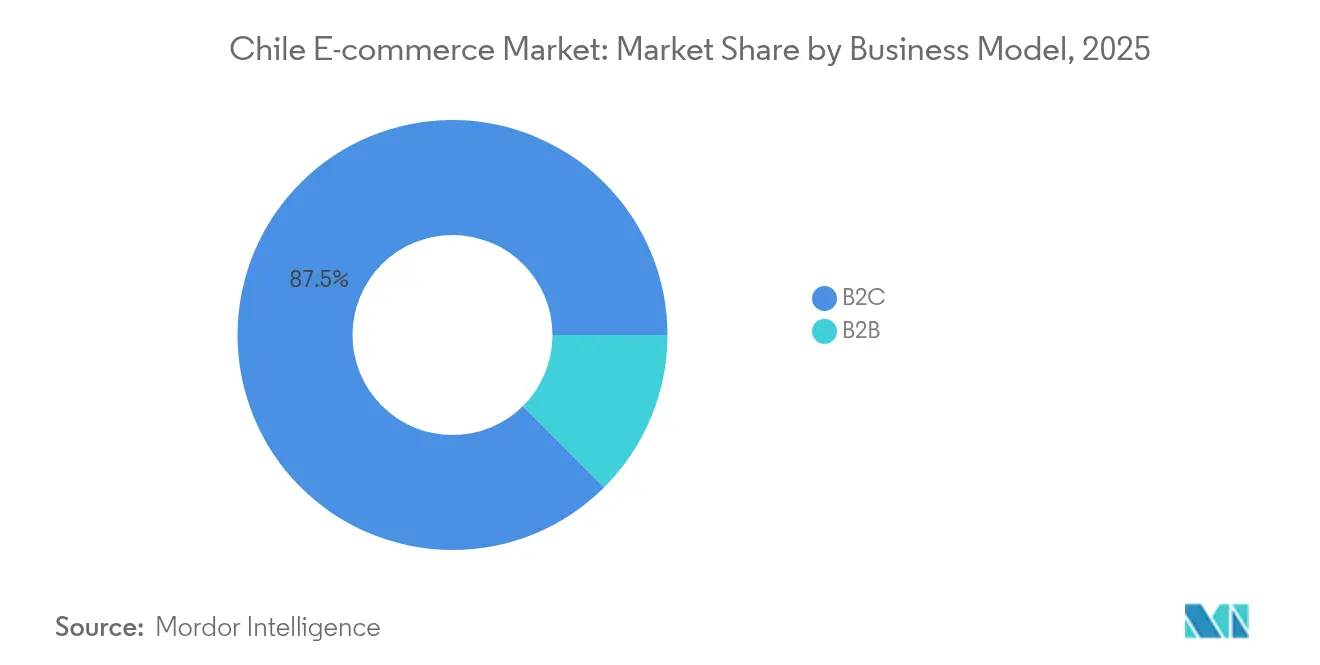
- By business model, the B2C segment held 87.45% of the Chile e-commerce market share in 2025, whereas B2B is set to grow at a 14.02% CAGR to 2031.
- By device type, smartphones and tablets captured 65.72% revenue share in 2025; desktop usage is declining while mobile sales are advancing at a 10.45% CAGR.
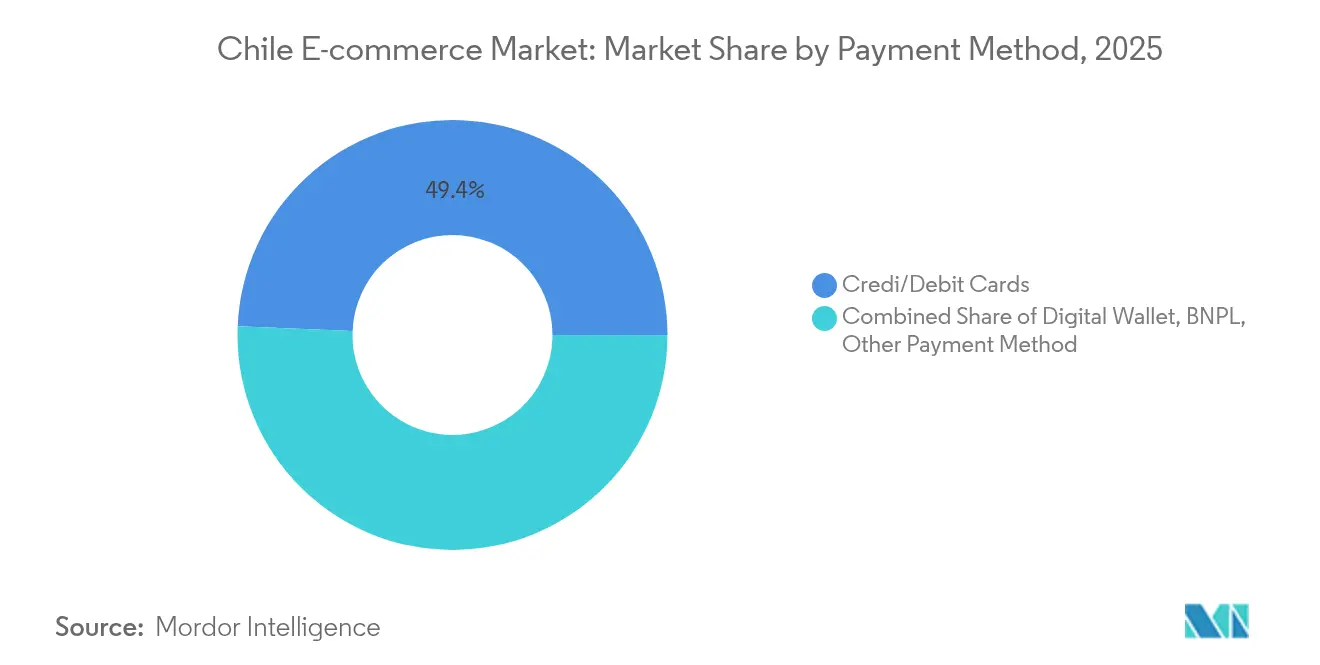
- By payment method, cards retained 49.35% of the Chile e-commerce market size in 2025, yet digital wallets are forecast to rise at a 16.05% CAGR through 2031.
- By product category, consumer electronics led with 21.35% revenue share in 2025; food and beverage is projected to expand at a 14.12% CAGR to 2031.
Note: Market size and forecast figures in this report are generated using Mordor Intelligence’s proprietary estimation framework, updated with the latest available data and insights as of 2026.
Chile E-commerce Market Trends and Insights
Drivers Impact Analysis*
| Driver | (~) % Impact on CAGR Forecast | Geographic Relevance | Impact Timeline |
|---|---|---|---|
| Rapid Expansion of WebPay-Enabled Digital Wallets | +2.8% | National, with early gains in Santiago, Valparaíso, Concepción | Medium term (2-4 years) |
| Omnichannel Push by Chile's Top-4 Brick-and-Mortar Retailers | +2.1% | National, concentrated in urban centers | Short term (≤ 2 years) |
| 5G Roll-out Boosting Mobile Checkout Speeds | +1.9% | National, prioritizing metropolitan areas | Medium term (2-4 years) |
| Government "Chile Digital 2035" Fiber-Backhaul Investments | +1.7% | National, targeting rural connectivity gaps | Long term (≥ 4 years) |
| Source: Mordor Intelligence | |||
Rapid Expansion of WebPay-Enabled Digital Wallets
WebPay is now integrated across all major marketplaces, eliminating legacy payment friction and lifting merchant conversion rates by double digits. MACH surpassed 4 million users in 2025 with 95% satisfaction, reflecting deepening financial inclusion amid 87% bank-account penetration.[2] Chile also became South America’s fourth-largest real-time payments market, processing 1.43 billion electronic transfers in 2024, which reduces cash handling and accelerates settlement cycles. As digital wallets layer loyalty, micro-credit and buy-now-pay-later (BNPL) functions onto their rails, platform stickiness rises and average order values climb. These network effects reinforce the Chile e-commerce market’s growth momentum and lower acquisition costs for both local and cross-border sellers.
Omnichannel Push by Chile’s Top-4 Brick-and-Mortar Retailers
Retail incumbents are converting stores into fulfillment nodes that shorten last-mile distances, raise same-day delivery coverage and boost click-and-collect traffic. Falabella’s Fulfillment By Falabella now supports 18% of marketplace sales with 90% post-purchase satisfaction.[3] Cencosud’s AI-enabled recommendation engine lifted online basket size by 12% in 2024, illustrating how data-driven personalization increases lifetime value. These initiatives also monetize idle store inventory and leverage established loyalty programs, creating high entry barriers for foreign pure-plays. Intensifying omnichannel competition forces marketplaces to differentiate through proprietary logistics, fintech add-ons and exclusive brand partnerships, thereby raising overall service standards in the Chile e-commerce market.
5G Roll-out Boosting Mobile Checkout Speeds
Telecom operators have earmarked USD 3 billion for 5G spectrum, fiber backhaul and edge nodes, promising latency below 20 milliseconds. Faster mobile sessions cut cart abandonment, especially for impulse buyers and flash-sale events. The Asia–South America Digital Gateway cable strengthens international bandwidth and lowers packet loss, encouraging cross-border purchases of high-value electronics and fashion. As video-rich product pages and AR try-on tools become mainstream, 5G enables fluid rendering on mid-range phones, driving up session duration and conversion.
Government “Chile Digital 2035” Fiber-Backhaul Investments
The initiative extends fiber spines into underserved communes, aiming to halve the rural connectivity gap by 2028. A newly established National Cybersecurity Agency coordinates threat-intel sharing, raising consumer confidence in storing card credentials online. Subsidized digital-skills programs help 55,000 SMEs adopt storefront plug-ins and cross-list on multiple marketplaces. Over the long haul, these measures are expected to unlock new seller cohorts and give the Chile e-commerce market an inclusive growth profile that balances urban scale with provincial reach.
Restraints Impact Analysis*
| Restraint | (~) % Impact on CAGR Forecast | Geographic Relevance | Impact Timeline |
|---|---|---|---|
| High Inter-change & Gateway Fees Concentrated in Two PSPs | -1.4% | National, affecting all digital transactions | Short term (≤ 2 years) |
| Rural Delivery Costs in Patagonia & Extreme North | -0.9% | Regional, concentrated in remote areas | Medium term (2-4 years) |
| Persistent Cash Usage in 45+ Age Cohort | -0.7% | National, with urban-rural variations | Long term (≥ 4 years) |
| Source: Mordor Intelligence | |||
High Inter-change & Gateway Fees Concentrated in Two PSPs
A duopoly in card acquiring keeps interchange fees around 1.9% per transaction, squeezing SME margins. Because the same processors also dominate wallet top-ups, fee opacity persists, limiting the scope for dynamic discounting and installment promotions. Draft Fintech Law decrees open-banking interfaces, yet compliance grace periods delay meaningful competition.
Rural Delivery Costs in Patagonia & Extreme North
Sparse road networks, weather volatility and low stop densities inflate per-parcel costs by 40% versus Santiago. Government transport subsidies of USD 87 million focus on passengers, not freight, so e-commerce logistics remain self-funded. Consequently, bulky categories such as home appliances see slower adoption, constraining total addressable demand even as fiber connectivity improves.
*Our forecasts treat driver/restraint impacts as directional, not additive. The impact forecasts reflect baseline growth, mix effects, and variable interactions.
Segment Analysis
By Business Model: B2B Platforms Accelerate Digital Transformation
The B2B slice of the Chile e-commerce market size is forecast to advance at a 14.02% CAGR to 2031, outpacing the consumer side that already controls 87.45% of 2025 sales. Procurement digitization mandates, cross-dock inventory hubs and embedded trade-credit tools attract manufacturers and distributors seeking cycle-time reductions. Large buyers favor closed-loop portals, but SME exporters migrate to public marketplaces to tap regional demand under the EU-Chile Interim Agreement.
The dominant B2C arena remains highly competitive, yet logistics density and gig-worker networks sustain profitable unit economics. Governance reforms under Law No 21.431 elevate delivery-partner costs, but platforms offset with dynamic routing and peak-pricing levers. Cross-border entrants accept lower margins to gain share, prompting domestic leaders to enhance loyalty perks and in-app financial products. These counter-moves maintain the Chile e-commerce market’s robust engagement metrics.

By Device Type: Mobile Commerce Dominance Reshapes User Experience
Smartphones and tablets represented 65.72% of 2025 gross merchandise value, and mobile revenue is growing at a 10.45% CAGR. This share gives handheld devices the largest Chile e-commerce market size contribution within hardware form factors. Desktop remains relevant for big-ticket B2B orders, but traffic shows a down-trend as responsive design, biometric login and one-click wallets simplify checkouts on smaller screens.
App-first players such as MercadoLibre record 72% active users transacting solely via mobile, reflecting UI investments like visual search and chat-based customer support. The 5G network roll-out accelerates adoption of video-rich, AR-enhanced browsing, further tipping the balance toward mobile interfaces. Kiosks and smart-TV commerce are experimental today, yet edge-device proliferation signals future multichannel contention.
By Payment Method: Digital Wallet Revolution Challenges Card Dominance
Cards held 49.35% of transaction value in 2025, but digital wallets are rising at a 16.05% CAGR. Wallets already represent 35.10% of the Chile e-commerce market size for payments, anchored by WebPay’s ubiquitous QR acceptance and MACH’s zero-fee peer transfers. This momentum shortens settlement cycles and curbs charge-backs.
BNPL remains marginal because credit scoring frameworks and interest-rate spreads deter usage. However, real-time payments infrastructure enables deferred debit products, and regulators are drafting disclosure rules to protect consumers. As interoperability APIs open, niche fintechs can overlay loyalty schemes onto wallet rails, eroding card preference and compressing interchange.
By B2C Product Category: Food & Beverage E-commerce Leads Growth Acceleration
Food and beverage is on track to log a 14.12% CAGR through 2031, the fastest among product lines. Aggregators like Rappi and Cornershop extend cold-chain coverage and micro-fulfillment nodes within supermarket premises, shrinking delivery windows to under 60 minutes. Consumer electronics retained a 21.35% revenue share in 2025, the largest Chile e-commerce market share at category level, buoyed by cross-border price arbitrage and brand launches timed around Cyber events.
Fashion, boosted by fast-fashion imports, draws shoppers with predictive sizing tools, while furniture growth is capped by volumetric shipping costs. Seasonal tourism in Patagonia supplements demand for sports gear and travel accessories yet remains volatile.
Geography Analysis
Metropolitan Santiago anchors over 53.60% of national GMV owing to dense population, same-day delivery coverage and the presence of key fulfillment centers along Route 68. Valparaíso and Concepción follow, leveraging port connectivity and university-driven consumer bases. Together, these corridors amplify the Chile e-commerce market’s urban concentration and support parcel drop densities exceeding 3,000 deliveries per sq km.
Northern macro-zones tied to copper mining display above-average disposable income, spurring luxury and electronics uptake. Nonetheless, logistical lead times reach 4-5 days, tempering impulse-buy categories. Patagonia and the Araucanía region illustrate the rural gap: fiber projects under Chile Digital 2035 broaden access, but road distance and weather idiosyncrasies elongate last-mile costs, limiting retailer promotional breadth.
Cross-border flows are increasingly routed through bonded warehouses in the Santiago Free Zone, enabling Chinese marketplaces to promise customs-cleared 7-day delivery. The EU-Chile Interim Agreement eliminates tariffs on 99.9% of EU imports, widening product assortments in cosmetics and premium food lines. Concurrently, January 2025 VAT reforms abolish the de minimis rule, obliging all inbound parcels to pay tax and thus narrowing the landed-cost advantage previously enjoyed by ultra-low-value shipments.
Regulatory Landscape
Chile regulates e-commerce through consumer-protection rules, platform conduct requirements, and tax obligations. The Ministerio de Economia issued the Reglamento de Comercio Electronico (Decreto No. 6, in force since 2021), which requires vendors and platforms to share clear pre-contract information (including full price and dispatch costs) and sets baseline disclosure duties for online transactions. SERNAC also enforces consumer rights under the consumer protection framework, including the 10-day right of retraction under Law No. 21.398.
Taxation has been a primary near-term compliance driver for platforms and cross-border flows. VAT changes implemented from January 2025 removed the de minimis relief for inbound parcels, and additional rules for low-value imported goods advanced in late 2025, extending VAT collection at point of sale for certain cross-border transactions. In February 2026, the Servicio de Impuestos Internos (SII) issued Resolution No. 23 (February 10, 2026), establishing formal registration requirements for digital intermediation platform operators to support VAT collection and reporting obligations tied to imported goods sold through platforms.
Value Chain Analysis
Chile e-commerce value creation begins with manufacturers, brand owners, and importers, then moves through first-party and third-party retail via hybrid platforms and marketplaces, including Mercado Libre and omnichannel retailers such as Falabella.com, Paris.cl (Cencosud), Ripley.com, and Mundo Lider (Walmart Chile). Payments are processed through card networks and acquirers, and through PSP and wallet rails such as WebPay and MACH in the market context, followed by order management, warehousing, and last-mile delivery using carrier networks and retailer-owned fulfillment nodes concentrated around Metropolitan Santiago. Cross-border orders add freight forwarding, bonded warehousing, and customs clearance steps, and the post-2025 VAT regime raises the need for tax determination and documentation at checkout.
Recent policy and infrastructure signals are changing how participants connect across the chain. SII obligations require marketplaces and payment facilitators to strengthen merchant onboarding and tax-status verification, which increases the importance of API integrations and data exchange with tax authorities. On the physical side, the Conecta Logistica/MTT Logistics Barometer (published in 2026 for 2025 performance) highlighted progress in digital traceability and systems integration (65% integration and 63% access to traceability systems), supporting faster exception management and returns processing. At the same time, labor and remote-delivery constraints outside the Santiago-Valparaiso-Concepcion corridor continue to raise costs.
Competitive Landscape
The Chile e-commerce market hosts a blend of retail stalwarts and digital-native challengers. MercadoLibre leverages its end-to-end ecosystem of marketplace, payments, credit and logistics; brand preference reached an all-time high in 2025 as monthly active fintech users grew 31%. Falabella reported a tripling of Q1 2025 profit, confirming the payoff from its logistics automation and loyalty-card integration.
Cencosud’s data-science engine drives product bundling and dynamic pricing, particularly in grocery, defending share against Rappi and Jumbo. International actors such as Shein exploit direct-from-factory supply chains to compress fashion lead times. AliExpress capitalizes on postal treaties and bonded warehousing to capture 42% of cross-border parcels, keeping ASPs low.
Strategic patterns center on three levers: 1) proprietary fulfillment that ensures service-level adherence during promotions, 2) captive wallets that turn payment data into cross-sell triggers and 3) regional alliances that diversify sourcing. Consolidation moves are plausible, yet antitrust thresholds remain vigilant. Given the top five players command about 55% of gross merchandise value, rivalry intensity remains moderate and encourages aggressive loyalty incentives rather than deep price wars.
Chile E-commerce Industry Leaders
-
Falabella
-
Ripley
-
Paris (Cencosud)
-
Walmart Chile (Lider)
-
MercadoLibre
- *Disclaimer: Major Players sorted in no particular order

Market Opportunities and Future Outlook
Regulatory and measurement initiatives are creating defined whitespace across platform operations, seller tooling, and compliance technology. In 2026, the Fiscalía Nacional Económica (FNE) published its market study work on e-commerce and recommended transparency standards for large platforms (referencing a 100,000 UF threshold), which increases demand for auditable seller-facing policies, search and ranking explanations, and dispute-handling workflows. In parallel, SII Resolution No. 23 (February 2026) formalizes registration and VAT compliance mechanics for digital intermediation platforms, supporting wider use of automated tax calculation, seller verification, and reporting across both marketplaces and payment facilitators.
Logistics and omnichannel execution also remain a tangible opportunity area, with visible investment signals. Mercado Libre announced a record USD 750 million investment plan for Chile in 2026, including a second large distribution center near Colina (Santiago), which reinforces the role of fulfillment density, inventory placement, and returns networks as competitive differentiators. Measurement has improved as well, with the Banco Central de Chile publishing the Online Retail Sales Index (IVOCM) in March 2026, giving retailers, platforms, and brands a benchmark to adjust category mix and promotion calendars (including Cyber events) while refining omnichannel service levels as e-commerce penetration and formal digital retail measurement expand.
Recent Industry Developments
- May 2026: Grupo Falabella reported Q1 2026 results with digital channel GMV up 21% year over year and third-party seller sales up 40%. The update points to faster marketplace participation inside a leading omnichannel ecosystem, raising the bar for seller services, fulfillment integration, and loyalty-linked conversion in Chile.
- March 2026: Mercado Libre announced a record USD 750 million investment plan in Chile for 2026 and outlined logistics expansion tied to that spend. The plan included adding a second distribution center near Colina (Santiago), reinforcing next-day coverage and inventory depth as core competitive levers for marketplace growth.
- October 2024: Chilean Congress approved a tax-compliance bill that tightened VAT enforcement on digital platforms. The change increased the importance of platform-led controls for invoicing, seller verification, and data reporting, raising compliance requirements for both domestic marketplaces and cross-border sellers.
Research Methodology Framework and Report Scope
Market Definition and Coverage
For this report, the market is the value of goods ordered through online channels by buyers in Chile, where an order is placed digitally and the purchase is delivered to an end user in the country (payment can happen online or on delivery).
Scope exclusions: We exclude peer to peer classifieds that do not have an integrated payment flow and in game virtual asset trades.
Segmentation Overview
- By Business Model
- B2C
- B2B
- By Device Type
- Smartphone / Mobile
- Desktop and Laptop
- Other Device Types
- By Payment Method
- Credit / Debit Cards
- Digital Wallets
- BNPL
- Other Payment Method
- By B2C Product Category
- Beauty and Personal Care
- Consumer Electronics
- Fashion and Apparel
- Food and Beverages
- Furniture and Home
- Toys, DIY and Media
- Other Product Categories
Data Sources, Market Sizing, and Validation
Desk Research
Desk work helped us set the guardrails for what should be counted, and it also gave trend lines that are hard to capture in interviews alone. We referred to public releases such as the Chilean Central Bank and national statistics, customs and trade indicators, telecom and connectivity trackers, and consumer and retail updates from bodies such as the Santiago Chamber of Commerce.
We also used company filings, investor presentations, and reputable press coverage to understand online sales exposure, delivery footprint, and payment mix changes. For certain checks, we used paid subscriptions focused on company financials and intelligence, plus news and financials, so the model assumptions stayed consistent over time. The sources listed here are illustrative only, and we used other public references to collect, validate, and clarify data points.
Primary Interviews and Surveys
Primary work was used to confirm what should be treated as an online transaction and to pressure test the assumptions behind spending per buyer and order frequency. We spoke with a balanced set of stakeholders, including marketplace and brand side teams, logistics and fulfillment specialists, payments and risk professionals, and sector observers, then checked alignment across major cities and secondary regions in Chile.
Distribution of primary research fieldwork respondents
| Company type | Respondent position |
|---|---|
| Top tier: 29% | CXOs: 14% |
| Mid tier: 54% | Functional/Unit leaders: 35% |
| Smaller Players: 17% | Managers: 51% |
Market-Sizing & Forecasting
The sizing started with a demand pool build that links the count of online buyers in Chile to how often they order and the average value per order, then adjusts for category mix changes and the share of transactions completed online versus cash on delivery. Once that top-down backbone was built, we corroborated totals with selective bottom-up checks, including rollups of a sample of disclosed online sales, comparisons with fulfillment capacity signals, and using sampled order value and volume patterns from channel discussions.
A few inputs drove most of the movement, including the number of online shoppers, smartphone and broadband reach, delivery lead time and last mile coverage, cross border share of purchases, and the inflation and FX path that affects ticket size in USD terms. Where the bottom-up view had gaps, for example smaller merchants with limited disclosures, we filled missing pieces using penetration style assumptions that were verified in interviews, and we kept the adjustment factor visible so it can be revisited.
For forecasting, we leaned on scenario analysis rather than a single curve fit, because spending and order frequency can change with consumer confidence, logistics constraints, and payment acceptance trends. Variables were moved forward using consensus ranges from experts, followed by sensitivity checks so the forecast stayed within realistic buyer and order behavior bounds.
Data Validation & Update Cycle
Outputs were cross checked against independent signals, including reported online retail growth rates, payments adoption indicators, and online sales references from credible industry bodies. When a metric moved out of range, we reopened the assumptions and re contacted relevant respondents to confirm whether the change was structural or temporary.
Before sign off, the model is reviewed in steps, starting with internal consistency checks, followed by variance review versus prior editions, and then a final analyst pass focused on unit logic and currency timing. Reports are refreshed annually, and interim updates are made when major market events materially shift demand, regulation, or the operating environment.
Mordor Intelligence's Chile Ecommerce Market Size Compared With Other Published Estimates
Published numbers for Chile e-commerce can look far apart, even when they are describing the same country and broadly similar online shopping behavior. The gaps usually come from what each publisher counts as e-commerce value, whether the figure is closer to retail sales value or a wider GMV style measure, and how currency conversion timing is handled.
The table also hints at another driver, where some estimates lean on payment or transaction volume series that include additional flows, while others stay closer to delivered merchandise value tied to the Chile end user demand pool. The table shows a lower 2026 value than some 2024 figures, and in Mordor Intelligence's model this happens because the market is counted as digitally initiated merchandise transactions delivered to end users in Chile, while excluding peer to peer classifieds without integrated payment and in game virtual assets, and then expressing the result in USD with a defined year conversion.
Benchmark comparison
| Source | Market Size | Gaps in Research Methodology |
|---|---|---|
| Mordor Intelligence | USD 15.80 B (2026) | |
| Government Trade Brief A | USD 11.50 B (2024) | Often reflects a narrower retail online sales view tied to local commerce reporting, and it may not align on whether cross border merchandise and all order and delivery conditions are fully counted the same way. |
| Payments Analytics Note B | USD 35.00 B (2024) | Typically reports a broader sales volume or GMV like metric that can include more transaction flows, and it can use different treatment of domestic versus cross border purchases and different FX timing for USD conversion. |
Across the three figures, the spread is mainly explained by scope and measurement choices, followed by differences in how USD values are translated for a given year. By anchoring the sizing to a clear buyer in country demand pool, checking the total against real world signals, and keeping assumptions editable, we can offer a number that is easier to trace and reuse for planning.
Key Questions Answered in the Report
What is the current value of the Chile e-commerce market?
The market is worth USD 15.8 billion in 2026 and is projected to reach USD 26.84 billion by 2031, implying an 11.18% CAGR.
Which business model is growing fastest in Chilean e-commerce?
B2B platforms are expanding at a 14.02% CAGR through 2031 as enterprises digitize procurement and export workflows.
How dominant is mobile commerce in Chile?
Smartphones and tablets account for 65.72% of transaction value, with mobile sales rising at a 10.45% CAGR through 2031 amid 5G roll-out.
What payment methods are gaining share?
Digital wallets are growing at a 16.05% CAGR, eating into the 49.35% share still held by credit and debit cards.
Which product category shows the fastest growth?
Food and beverage e-commerce leads with a 14.12% CAGR through 2031 due to rapid grocery-delivery platform expansion.
How will new VAT rules affect cross-border shopping?
From January 2025 all B2C imports incur VAT, narrowing the landed-cost advantage of low-value parcels and benefiting domestic sellers.