
Carrots And Turnips Market Size and Share
Carrots And Turnips Market Analysis by Mordor Intelligence
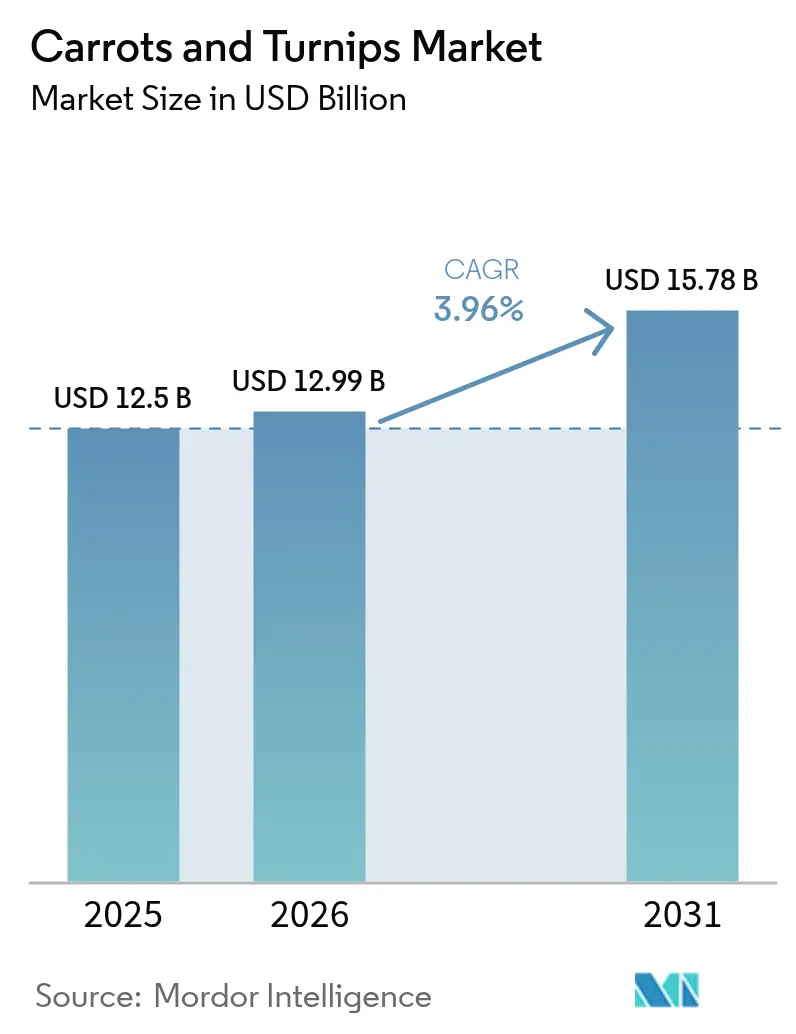
The carrots and turnips market size was valued at USD 12.5 billion in 2025 and estimated to grow from USD 12.99 billion in 2026 to reach USD 15.78 billion by 2031, at a CAGR of 3.96% during the forecast period (2026-2031). Steady demand for nutrient-dense foods, expanding regenerative agriculture acreage, and rapid improvements in precision farming technology provide a resilient growth platform. Producers are capitalizing on the popularity of ready-to-eat vegetable snacks, while investments in cold-chain infrastructure reduce post-harvest losses and expand export reach. Governments continue to shape the operating environment through evolving food-safety rules, and moderate competitive intensity encourages both scale expansion and niche innovation. Together, these factors support a healthy outlook for the carrots and turnips market over the next five years.
Key Report Takeaways
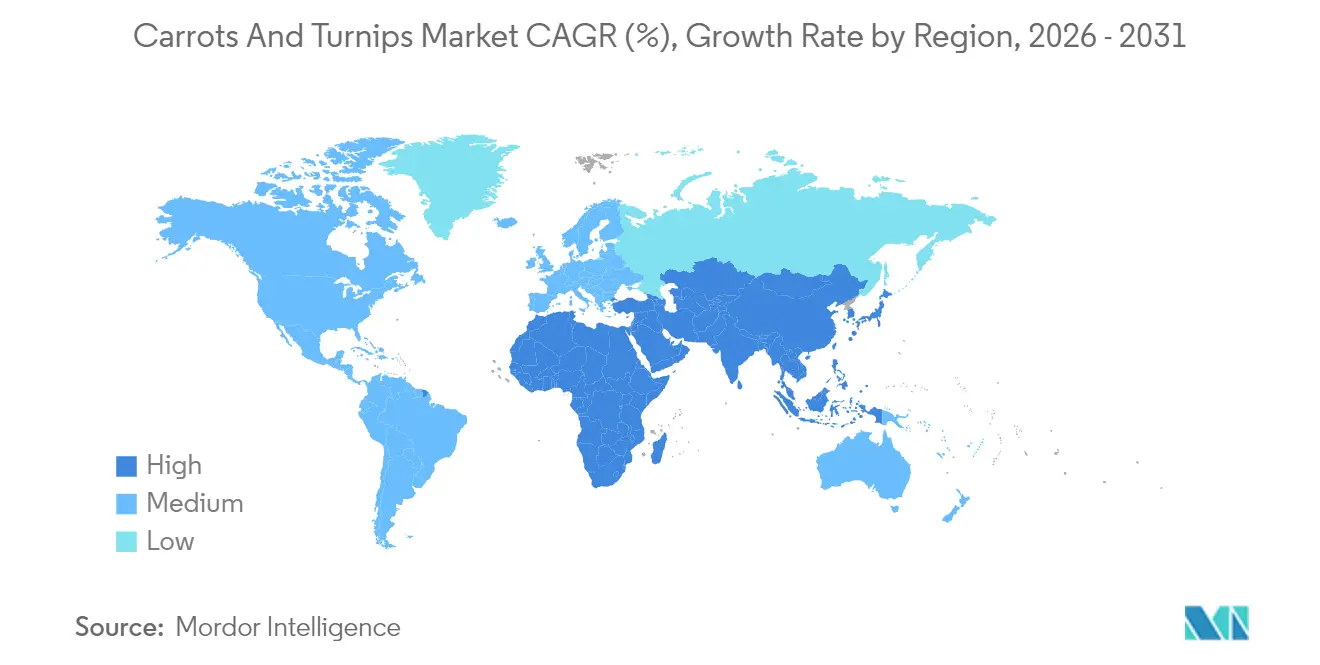
- Asia-Pacific contributed 42.05% of the carrots and turnips market size in 2025, the highest regional proportion recorded to date. Asia-Pacific is also projected to deliver the fastest regional growth, advancing at a 6.74% CAGR between 2026 and 2031.
Note: Market size and forecast figures in this report are generated using Mordor Intelligence’s proprietary estimation framework, updated with the latest available data and insights as of 2026.
Market Trends and Insights
Drivers Impact Analysis of Carrots And Turnips Market*
| Driver | (~) % Impact on CAGR Forecast | Geographic Relevance | Impact Timeline |
|---|---|---|---|
| Surging demand for convenient ready-to-eat vegetable snacks | +0.8% | Global, with a concentration in North America and Europe | Medium term (2-4 years) |
| Rapid adoption of regenerative agriculture improving root crop yields | +0.6% | North America and Europe, with expansion to the Asia-Pacific | Long term (≥ 4 years) |
| Expansion of cold-chain logistics in emerging markets | +0.9% | Asia-Pacific core, spill-over to Africa and South America | Medium term (2-4 years) |
| Shift toward immunity-boosting diets | +0.5% | Global, particularly post-pandemic recovery markets | Short term (≤ 2 years) |
| Growth in organic certification acreage for root vegetables | +0.4% | North America and Europe primarily | Long term (≥ 4 years) |
| Technological advances in precision irrigation for sandy soils | +0.3% | Global, with a focus on arid and semi-arid regions | Long term (≥ 4 years) |
| Source: Mordor Intelligence | |||
Surging Demand for Convenient Ready-to-Eat Vegetable Snacks
Walk-away produce cups, single-serve carrot sticks, and blended root-vegetable medleys have moved from specialty aisles into mainstream supermarkets. Foodservice operators now highlight vitamin-rich carrot and turnip snacks to meet consumer calls for immunity-supporting menus. Convenience formats command premium prices that offset higher processing costs, and high-barrier film packaging technologies extend shelf life without additives. Processors continue to automate cutting and portioning lines, reducing labor needs and boosting throughput. Marketing campaigns stress freshness and natural color to differentiate from fried or highly processed snacks. The shift effectively repositions root vegetables from traditional side dishes to impulse snack items, deepening household penetration in urban markets.
Rapid Adoption of Regenerative Agriculture Improving Root Crop Yields
Cover cropping, minimal tillage, and livestock integration underpin regenerative programs that have spread from pilot plots to commercial acreage. U.S. federal incentives under the Climate-Smart Commodities program reduce transition costs for growers who adopt soil-building practices[1]Source: Ambrook, “Elevated Foods Partnerships for Climate-Smart Commodities Guide,” ambrook.com. Early adopters report higher soil organic matter and lower synthetic-fertilizer bills within three seasons. Standards bodies in California are drafting formal definitions that could serve as blueprints for other jurisdictions, giving growers clarity on labeling claims. Seed companies are testing carrot and turnip cultivars that perform well in lower-nitrogen soils, further improving economic returns. The result is a virtuous cycle where healthier soils deliver higher yields and improved resilience to drought.
Expansion of Cold-Chain Logistics in Emerging Markets
Temperature-controlled warehouses, solar-powered packhouses, and reefer-equipped trucking fleets are proliferating across Asia-Pacific. Nigeria loses up to 50% of harvested produce because of inadequate cooling, highlighting the upside potential once infrastructure gaps are close. India’s SAMPADA program supports integrated cold-chain projects through subsidized loans, while private operators such as Maersk introduce end-to-end refrigerated corridors linking interior growing zones to export ports. Improved cold chains extend the viable shipping radius for root vegetables, enabling producers in tropical areas to serve distant urban centers without quality loss. Investment momentum remains strong as multilateral lenders channel climate-related funds into energy-efficient cooling.
Shift Toward Immunity-Boosting Diets
Public-health campaigns and scientific reporting on beta-carotene and vitamin C have raised consumer awareness of root-vegetable benefits. Retailers now feature “immune support” tags on fresh produce shelves, and menu engineers in restaurant chains add colorful carrot blends to grab-and-go salads. Premiums for organic and specialty varieties widened, allowing growers to realize higher margins. The trend is most pronounced in metropolitan areas where disposable income supports value-added offerings.
Restraints Impact Analysis of Carrots And Turnips Market*
| Restraint | (~) % Impact on CAGR Forecast | Geographic Relevance | Impact Timeline |
|---|---|---|---|
| Crop losses from soil-borne diseases | -0.7% | Global, particularly severe in the Asia-Pacific and tropical regions | Medium term (2-4 years) |
| Volatility in refrigerated trucking rates | -0.4% | North America and Europe primarily | Short term (≤ 2 years) |
| Labor shortages in thinning and harvest operations | -0.5% | Global, acute in developed markets | Medium term (2-4 years) |
| Price pressure from private-label retail contracts | -0.3% | Global, concentrated in mature retail markets | Short term (≤ 2 years) |
| Source: Mordor Intelligence | |||
Crop Losses from Soil-Borne Diseases
Fusarium wilt and Ralstonia solanacearum depress carrot and turnip yields by 10–20% in affected fields[2]Source: Surono, “Soil-Borne Pathogen Problems and Management Strategies,” fftc.org.tw. Continuous monocropping compounds pathogen buildup, forcing producers to adopt extended rotations or fumigation, both of which raise costs. Indonesian extension agencies subsidize biological antagonists, yet adoption hurdles persist where farmer cash flow is tight. In the United States, Phytophthora root rot emerged as a costly threat, prompting trials of resistant cultivars. Climate change adds complexity by widening the temperature range favorable to pathogens, creating moving targets for management strategies.
Volatility in Refrigerated Trucking Rates
Fuel price swings and constrained driver availability push spot reefer rates up or down sharply within weeks. U.S. carriers charged an average of USD 3.38 per mile in April 2024, 25% below pandemic-era peaks but still subject to seasonal spikes. Budgeting becomes difficult for shippers moving produce from the West Coast to Eastern distribution centers, especially when contracted capacity is limited. Some packers diversify into intermodal rail, but equipment availability and transit times limit widespread substitution.
*Our forecasts treat driver/restraint impacts as directional, not additive. The impact forecasts reflect baseline growth, mix effects, and variable interactions.
Geography Analysis
APAC Carrots and Turnips Market
Asia-Pacific generated 42.05% of global revenue in 2025, anchoring the carrots and turnips market size with robust domestic consumption and export surplus. The region’s cold-chain rollout and mechanization rates exceeding 95% in large-scale root-crop farms bolster export competitiveness. Rising urban incomes, greater snack diversification, and government support for regenerative practices sustain a 6.74% CAGR through 2031, making Asia-Pacific both the largest and the fastest-growing slice of the carrots and turnips market. Trade flows within the region are substantial, with Hong Kong importing USD 6.5 million worth of fresh carrots and turnips in 2023, primarily from Australia, China, and other Asian suppliers.
North America Carrots and Turnips Market
North America contributes a smaller share but commands higher average selling prices through premium organic and convenience formats. California’s dominance concentrates supply risk around water availability, yet robust cold-chain infrastructure maintains distribution reach. Stable food-service demand, coupled with expanding ready-to-eat offerings, positions North America for moderate growth despite labor cost pressure. Together, these dynamics underpin a geographically balanced carrots and turnips market size that supports global supply security.
Europe Carrots and Turnips Market
Europe balances production capacity with high regulatory costs. Labor shortages drive mechanization investment, and EU organic directives raise compliance thresholds. Political instability in Eastern Europe disrupts some supply chains, yet the bloc’s logistical efficiency and demand for certified produce support stable growth. Premium pricing for specialty varieties compensates for higher inputs, preserving margins for technology-oriented growers.


Regulatory Landscape
Trade and import controls for carrots and turnips are anchored in harmonized tariff and phytosanitary regimes, with most fresh and chilled product moving under HS heading 0706. The United Kingdoms Integrated Online Tariff lists 0% duty for heading 0706, while other markets apply duties by line item and origin, which pushes shippers to optimize preferential access where available.
Plant health compliance is a key operational variable for cross-border flows into Europe and other origin-specific programs. The EU import framework under Regulation (EU) 2016/2031 and Implementing Regulation (EU) 2019/2072 requires phytosanitary certification for regulated plant products. Commission Implementing Regulation (EU) 2026/1101 (effective May 2026) updated minimum identity and physical check frequencies at EU border control posts based on phytosanitary risk. In the Netherlands, the NVWA communicated that additional declarations for Regulated Non-Quarantine Pests (RNQP) on phytosanitary certificates become mandatory from July 6, 2026, which raises documentation and inspection readiness requirements for relevant imports.
Value Chain Analysis
The value chain for carrots and turnips runs from seed and crop-input suppliers (hybrid seed, fertilizers, crop protection, irrigation) through cultivation, harvest, and post-harvest handling (washing, grading, packing), then into cold storage, refrigerated transport, wholesalers, retail, and foodservice. A growing parallel channel also goes to processing for snack packs and baby-cut formats. China anchors global supply volume, and global production concentration increases the importance of robust export corridors and consistent quality specifications for large buyers.
Bottlenecks concentrate in post-harvest handling and temperature control, where inadequate cold-chain availability, compression damage in transport, and sanitation gaps during manual washing elevate shrink and food-safety risk. Recent operational signals from producing regions highlight the sensitivity of farm-gate economics to weather and logistics. In April 2026, Brazils 2025/2026 summer carrot season in Goias recorded positive margins after supply tightening tied to rainfall-related crop failure lifted prices sharply, reinforcing incentives for better storage, sorting, and scheduling. On the input side, trials and adoption of hybrid varieties (for example, Niagara in Tunisia) and agronomy packages (including bio-fertilizer optimization reported in 2026 research) support yield stability, but monetizing these gains depends on packhouse throughput, cold-chain access, and buyer contracts that reward consistent sizing and shelf life.
Market Opportunities and Future Outlook
Opportunities are concentrated in higher-value varieties and disease-management solutions that reduce reliance on restricted inputs, alongside infrastructure that protects quality through longer distribution chains. A concrete example is BASF Nunhems commercial rollout of Percyst brand carrots (announced in late 2025 and further highlighted in March 2026), positioned around nematode resistance as an alternative to chemical fumigation for fresh and baby-carrot processing specifications. This expands the toolkit for growers operating under tightening plant health and pesticide scrutiny, while supporting processors that need more consistent raw material supply.
A second opportunity cluster sits in region-specific varietal innovation and extension-led productivity gains. In January 2026, the Indian Council of Agricultural Research released Pusa Prateek (IPC-3), a tropical carrot variety maturing in 85 to 90 days and reported as yielding 19% higher than the national check, aligning with demand for dependable supply in warm climates and faster crop cycles. Demand-side whitespace is also emerging in convenience and functional formats already reflected in the market narrative, including ready-to-eat snack packs and fermented beverage applications such as turnip juice. Such expansion can diversify offtake beyond traditional fresh channels when it is paired with improved cold-chain corridors and packhouse capability upgrades.
Recent Industry Developments in Carrots And Turnips Market
- July 2026: USDA Agricultural Marketing Service reported wholesale availability at the Atlanta Terminal Market on July 15, 2026, including noted supply gaps for specific turnip offerings (California-origin purple top medium turnips). Such real-time gaps highlight how varietal availability and origin concentration can quickly tighten spot markets, reinforcing the value of diversified sourcing and cold-chain reliability for wholesalers and retailers.
- May 2026: Michigan State University Extension documented seasonal field activity for carrots and turnips in its May 6, 2026 vegetable crop report, confirming planting progress in a key US producing region. Timely planting windows and agronomic conditions remain central to supply timing, which affects pack schedules and contracted volumes for fresh and value-added channels.
- August 2024: Bolthouse Fresh Foods introduced new Modern Roots branding and packaging for its carrot offerings. The update supports differentiation in mature retail channels and aligns with the broader shift toward convenience-led merchandising where packaging and shelf-life performance influence velocity and pricing.


Carrots And Turnips Market Report Scope and Research Methodology
Market Definition and Coverage
This market covers the value generated from carrots and turnips as traded and consumed for food use, measured in USD, across major producing and consuming countries. We treat the market as the economic value tied to these two crops, supported by production, trade, and price movements.
Scope exclusions: It does not include downstream packaged foods where carrots or turnips are only minor ingredients, nor does it include farm equipment and inputs.
Segments Covered in This Report
- By Geography (Production Analysis (Volume), Consumption Analysis (Volume and Value), Import Market Analysis (Volume and Value), Export Market Analysis (Volume and Value), and Price Trend Analysis)
- North America
- United States
- Canada
- Europe
- Germany
- France
- Poland
- Ukraine
- United Kingdom
- Russia
- Asia-Pacific
- China
- Japan
- India
- Australia
- Indonesia
- Uzbekistan
- South America
- Argentina
- Chile
- Middle East
- Saudi Arabia
- United Arab Emirates
- Turkey
- Africa
- South Africa
- Egypt
- Nigeria
- North America
Data Sources, Market Sizing, and Validation
Desk Research
Desk work starts with building a clean fact base on volumes, trade flows, and price direction for carrots and turnips. We rely on public agriculture and trade statistics such as FAOSTAT, UN Comtrade, USDA, Eurostat, and national agriculture ministries, and then we align those series with customs releases and trade association updates where available.
To keep assumptions realistic, we also review company filings and investor presentations for large growers, processors, and produce distributors, along with reputable press coverage on acreage shifts, weather impacts, and cold chain capacity additions. Patent databases are checked for signals on seed traits and post-harvest handling that can influence yields and losses over time. The sources listed here are illustrative and not exhaustive, and many other references were also used for data collection, validation, and clarification.
Primary Interviews and Surveys
Primary work was used to pressure-test the model using real market behaviors that do not show up cleanly in public tables, such as farmgate to wholesale price spreads, typical loss rates, and how much trade is redirected through hubs. We spoke with a mix of growers, traders, cold chain operators, and buyers across the Americas, EMEA, and APAC, so regional seasonality and policy impacts could be reflected in a consistent way.
Distribution of primary research fieldwork respondents
| Company type | Respondent position | Region |
|---|---|---|
| Top tier: 37% | CXOs: 16% | APAC: 37% |
| Mid tier: 41% | Functional/Unit leaders: 27% | EMEA: 36% |
| Smaller Players: 22% | Managers: 57% | Americas: 27% |
Market-Sizing & Forecasting
Our core sizing logic is built from a top-down view where production, consumption, and trade statistics are reconstructed into a value pool using region-appropriate price series and conversion choices. The totals are then corroborated with selective bottom-up checks, such as sampled price times traded volume in key corridors, and supplier and channel conversations that help us correct for re-exports and reporting gaps.
Inputs that matter in this market include harvested area trends, yield per hectare patterns, import and export volumes, seasonal price movements, and post-harvest loss rates that change with storage and cold chain quality. We also track policy and phytosanitary changes that can shift cross-border flows, plus weather-linked volatility that affects output in major producing belts. For forecasting, scenario analysis is used around expected acreage, yield normalization, and trade friction, then those scenarios are converted into an annual value path that stays consistent with observed price and volume behavior. Where country-level data is missing or delayed, proxy indicators from similar producer markets and trade partner mirrors are used, and then rechecked through interviews before finalizing.
Data Validation & Update Cycle
Validation is done through repeated cross-checks between the model and independent signals, including global trade balances, production to consumption gaps, and the direction of reported wholesale prices in key markets. Any large variance triggers a deeper review of the assumed prices, the treatment of re-exports, and the timing of the underlying statistics, and then the assumptions are revised and re-tested.
Before sign-off, the work is reviewed in steps so that calculation errors and unusual jumps are caught early and corrected with supporting evidence. The report is refreshed annually, and interim updates are made when material events occur, such as major crop shocks or policy shifts that change trade flows. Right before delivery, we do a final pass to ensure the latest public releases are reflected in the narrative and numbers.
Mordor Intelligence's Carrots and Turnips Market Size Compared With Other Published Estimates
Published market sizes for carrots and turnips can look far apart, even when everyone is talking about the same crops, because the boundaries and conversion steps are rarely identical. Differences usually come from what price level is used, whether trade and re-exports are handled cleanly, and how fast older base-year inputs are refreshed.
Trade-balance checks, country production totals, and observed wholesale price ranges are the evidence points that keep Mordor Intelligence's estimate tied to traded crop value using consistent unit conversions and yearly price refreshes, instead of mixing in packaged-food value add or retail margins.
Benchmark comparison
| Source | Market Size | Gaps in Research Methodology |
|---|---|---|
| Mordor Intelligence | USD 12.99 B (2026) | |
| Industry Data Publisher A | USD 21.60 B (2024) | Uses a producer and importer revenue framing that can align closer to wholesale trade value pools, and the earlier year basis can shift totals when prices were moving. |
| Global Publisher B | USD 19.72 B (2024) | Expands coverage into additional forms and channel layers, which can blend fresh crop value with downstream value add, and the base-year and forecast window differ. |
Overall, the spread is mostly explained by price-layer selection and how processed or channel-level value is treated in the total. By keeping the sizing steps anchored to observable volume signals and cross-checking them with pricing evidence, the number stays traceable and repeatable when clients want to update assumptions.


Key Questions Answered in the Report
What is the current value of the global carrots and turnips market?
The carrots and turnips market size is USD 12.99 billion in 2026.
How fast is the carrots and turnips market projected to grow?
The market is projected to post a 3.96% CAGR, reaching USD 15.78 billion by 2031.
Which region holds the largest share in global trade?
Asia-Pacific accounts for 42.05% of global revenue and remains the fastest-growing region.
What key factor drives premium pricing in North America?
Convenience formats such as ready-to-eat carrot sticks command higher prices due to consumer demand for healthy snacks.
How are growers mitigating soil-borne diseases?
Strategies include longer crop rotations, biological control agents, and adoption of disease-resistant cultivars.
Why are refrigerated transport costs a major concern for producers?
Volatile fuel prices and driver shortages push reefer rates up or down quickly, complicating logistics budgeting.
Page last updated on:


 Your data is secure and never sold or shared.


