
Market Overview
| Study Period | 2020 - 2031 |
|---|---|
| Forecast Data Period | 2026 - 2031 |
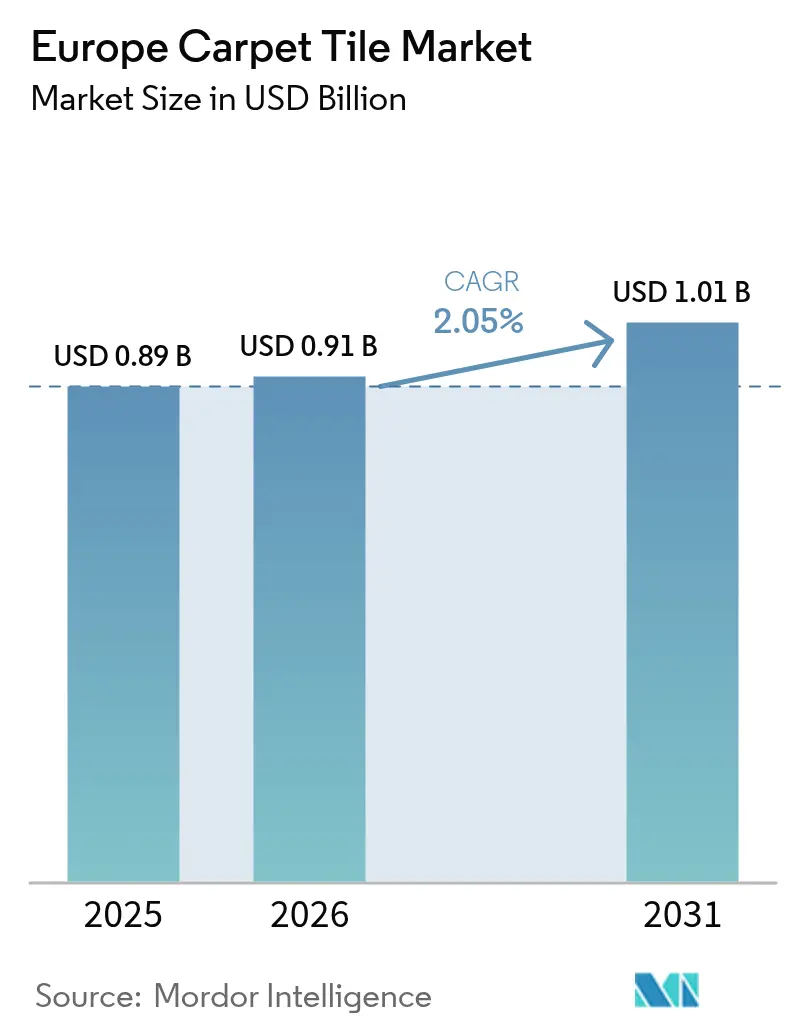
| Base Year Market Size (2025) | USD 0.89 Billion |
| Market Size (2026) | USD 0.91 Billion |
| Market Size (2031) | USD 1.01 Billion |
| Growth Rate (2026 - 2031) | 2.05 % |
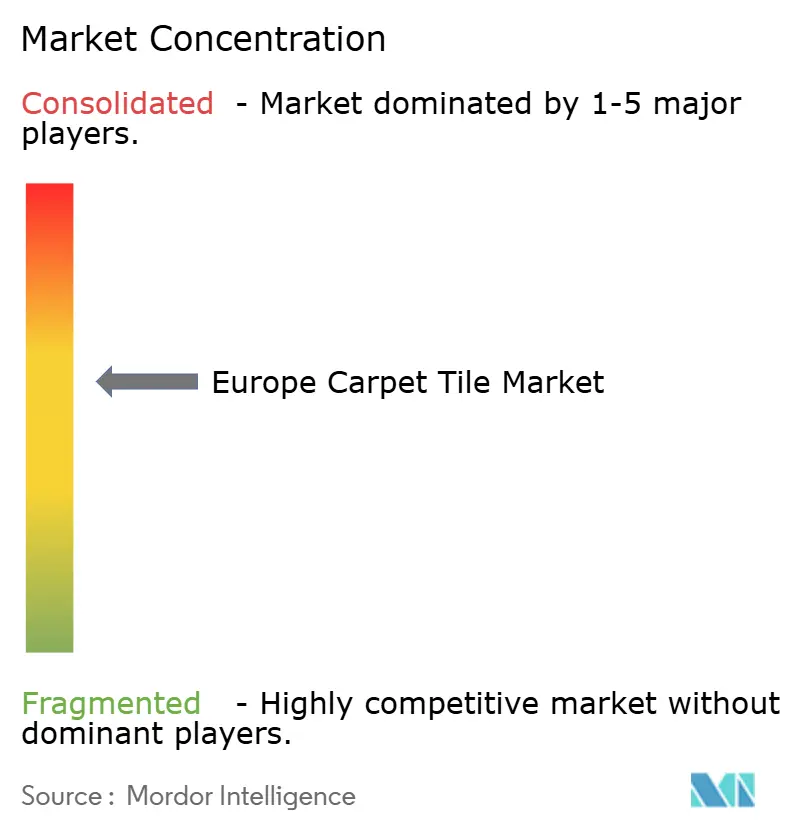
| Market Concentration | Medium |
Major Players *Disclaimer: Major Players sorted in no particular order Image © Mordor Intelligence. Reuse requires attribution under CC BY 4.0. | |
Europe Carpet Tile Market Analysis by Mordor Intelligence
The Europe carpet tile market size was valued at USD 0.89 billion in 2025 and estimated to grow from USD 0.91 billion in 2026 to reach USD 1.01 billion by 2031, at a CAGR of 2.05% during the forecast period (2026-2031). Maturation accompanies this steady trajectory as extended-producer-responsibility rules, healthy-building labels, and digital design tools reshape procurement patterns across the region. Commercial landlords favor modular flooring because selective tile replacement shortens vacancy periods and limits maintenance outlays, enhancing rental yields in a soft office market. Hybrid-workspace adoption also boosts demand for cushion-backed products that combine acoustic comfort with rapid installation, especially in the United Kingdom, Germany, and the Nordics. EU carbon-footprint disclosure has accelerated investment in recyclable backings such as Interface’s CQuest Bio and Tarkett’s EcoBase, giving suppliers with proven take-back schemes a pricing premium [1]Interface, “Modular Carpet Tile,” interface.com. . Meanwhile, digital dye-injection systems allow designers to order low-MOQ custom patterns for boutique hotels and co-working hubs, unlocking incremental revenue streams in the premium tier.
Key Report Takeaways
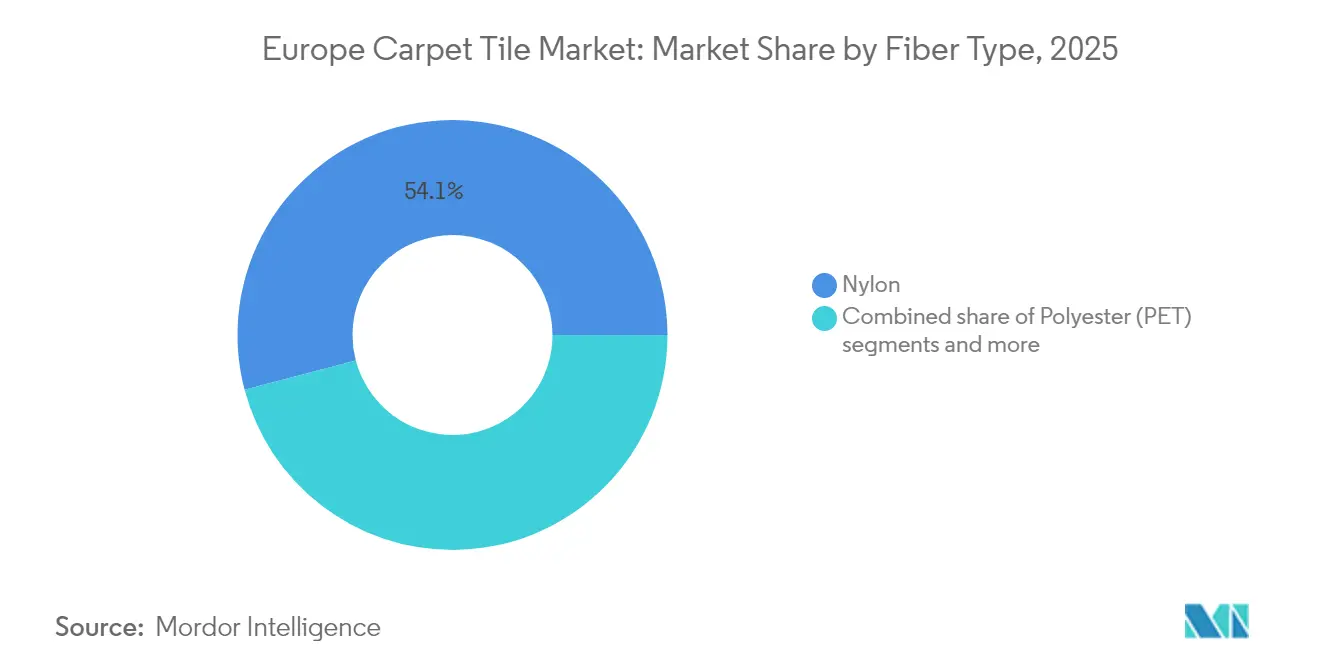
- By fiber type, nylon led with 54.10% of Europe carpet tile market share in 2025, bio-based fibers are projected to post the fastest 10.38% CAGR and lift their portion of the Europe carpet tile market size through 2031.
- By end user, the commercial segment accounted for 63.05% of Europe carpet tile market share in 2025, while hospitality and leisure are advancing at a 9.05% CAGR through 2031.
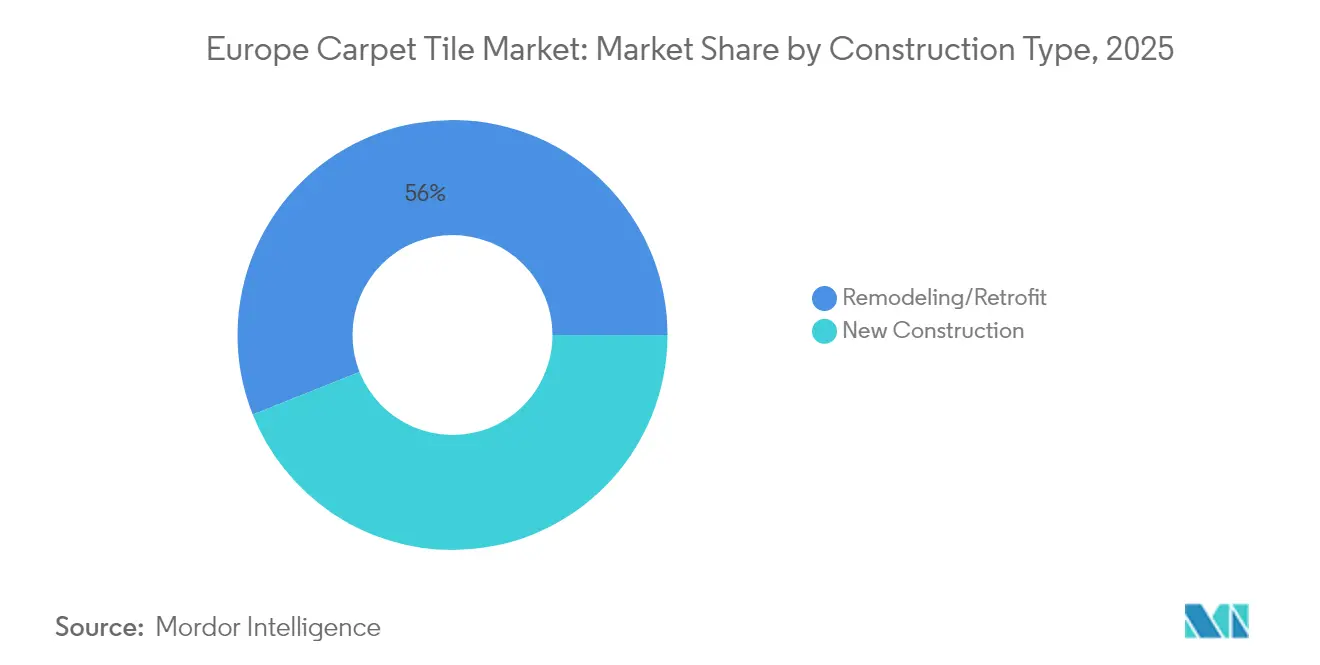
- By construction type, remodeling and retrofit projects held 56.02% of Europe carpet tile market share in 2025 while new construction is poised to register a 7.18% CAGR to 2031.
- By distribution channel, B2B contractors captured 51.10% of Europe carpet tile market share in 2025, yet online channels are on track for a 12.35% CAGR by 2031.
- By geography, the United Kingdom dominated with a 22.10% of Europe carpet tile market share in 2025; Spain is forecast to grow at 8.31% CAGR, the fastest within Europe carpet tile market dynamics.
Note: Market size and forecast figures in this report are generated using Mordor Intelligence’s proprietary estimation framework, updated with the latest available data and insights as of 2026.
Market Trends and Insights
Drivers Impact Analysis of Europe Carpet Tile Market*
| Driver | (~) % Impact on CAGR Forecast | Geographic Relevance | Impact Timeline |
|---|---|---|---|
| Growing preference for modular, low-maintenance flooring in commercial refurbishments | +0.8% | UK, Germany, France, Netherlands | Medium term (2-4 years) |
| Surge in post-pandemic office fit-outs & hybrid-workspace redesigns | +0.6% | Global, strongest in UK, Germany, Nordics | Short term (≤ 2 years) |
| EU-wide carbon footprint disclosure boosting demand for recyclable tile backings | +0.4% | EU-wide, particularly Germany, Netherlands, France | Long term (≥ 4 years) |
| Digital dye-injection enabling low-MOQ bespoke patterns for designers | +0.3% | UK, Germany, France, Italy, Spain | Medium term (2-4 years) |
| Accelerated shift toward healthy-building certifications requiring low-VOC materials | +0.2% | Global, strongest in Nordics, UK, Germany | Long term (≥ 4 years) |
| Expansion of flexible co-working chains across tier-2 European cities | +0.1% | Spain, Italy, Central & Eastern Europe | Medium term (2-4 years) |
| Source: Mordor Intelligence | |||
Growing Preference for Modular, Low-Maintenance Flooring in Commercial Refurbishments
Commercial landlords now specify carpet tiles to limit tenant disruption and keep maintenance budgets low. Interfaces that allow selective tile exchange mean high-traffic zones can be refreshed overnight, reducing downtime and improving tenant satisfaction. Tarkett indicated that carpet tiles represented more than 62% of its commercial carpet sales in 2025, with EcoBase-backed modules enabling up to 84% CO₂ savings compared with incineration. This operational flexibility has become a core value driver in lease negotiations, especially in jurisdictions where fit-out costs are borne by landlords. The Europe carpet tile market therefore benefits from a structural shift toward modularity as property owners align flooring decisions with portfolio yield management. Pre-cut tiles also generate less installation waste, further supporting ESG objectives under tightening EU disclosure rules [2]Carbonfact, “Overview of Textile EPR Laws,” carbonfact.com..
Surge in Post-Pandemic Office Fit-Outs & Hybrid-Workspace Redesigns
Hybrid-work adoption pushed firms to re-zone offices into collaboration clusters, quiet pods, and touchdown points. Carpet tiles offer acoustic attenuation and permit fast reconfiguration when occupancy patterns change. In Prague, 2024 fit-out budgets averaged EUR 1,235/m² (USD 1,350/m²), and developers increasingly chose tiles to compress installation schedules and limit labor costs [3]EurobuildCEE, “Office Fit-Out Costs in Prague,” eurobuildcee.com.. Hospitality venues mirrored this strategy by using modular flooring to flip meeting rooms into banquet spaces within hours. The flexibility theme has now entrenched itself in specification guides across corporate real-estate and facility-management teams, cementing a demand floor for Europe carpet tile market products over the next two years.
EU-Wide Carbon Footprint Disclosure Boosting Demand for Recyclable Tile Backings
From January 2025, the Waste Framework Directive obliges member states to arrange separate textile collection, while Extended Producer Responsibility schemes assign disposal costs to manufacturers. Interface’s CQuest Bio backing and Tarkett’s closed-loop EcoBase platform provide compliance head-starts, enabling price premiums in green-building projects. Hungary’s EPR framework now levies HUF 145/kg (USD 0.40/kg) fees on non-recyclable carpet products, sharpening the cost gap between conventional and circular designs. Manufacturers with reclamation sites, such as Tarkett’s Waalwijk plant, are better positioned to absorb logistics and processing expenses. As disclosure norms extend to carbon labeling on product data sheets, recycle able tiles gain additional pull through ESG-oriented procurement policies in Germany, France, and the Netherlands.
Digital Dye-Injection Enabling Low-MOQ Bespoke Patterns for Designers
High-resolution print heads now apply color directly onto tufted substrates, removing the minimum-order hurdle that once forced designers to compromise on aesthetics. Milliken’s PrintWorks platform supplies samples within four days and full orders inside three weeks, accelerating design-to-build cycles for boutique hotels and creative agencies. The technology complements Europe’s strong interior-design culture, letting small projects specify unique palettes without incurring surplus inventory. Manufacturers gain higher average selling prices by monetizing personalization, while distributors reduce inventory carrying costs. Digital print will likely lift premium-segment value in the Europe carpet tile market through 2030.
Restraints Impact Analysis of Europe Carpet Tile Market*
| Restraint | (~) % Impact on CAGR Forecast | Geographic Relevance | Impact Timeline |
|---|---|---|---|
| Higher upfront cost versus broadloom carpet | -0.3% | Price-sensitive markets, Central & Eastern Europe | Short term (≤ 2 years) |
| Volatility in crude-derived nylon & bitumen raw-material prices | -0.2% | Global, manufacturing-intensive regions | Medium term (2-4 years) |
| Take-back obligations raising reverse-logistics expenses | -0.25% | Western Europe, markets with circular mandates | Medium term (2–4 years) |
| Limited installer skill pool in Central & Eastern Europe | -0.15% | Central & Eastern Europe | Short term (≤ 2 years) |
| Source: Mordor Intelligence | |||
Higher Upfront Cost Versus Broadloom Carpet
Carpet tiles typically command 15-25% price premiums over equivalent broadloom installations, constraining adoption in cost-sensitive commercial segments and residential applications. This pricing gap persists despite lifecycle cost advantages from selective replacement capabilities and reduced installation waste. The premium reflects higher manufacturing complexity, specialized backing systems, and precision cutting requirements that increase production costs per square meter. Price-conscious specifiers in Central and Eastern European markets often default to broadloom solutions despite carpet tiles' operational benefits, particularly in large-scale installations where upfront budget constraints outweigh long-term maintenance considerations. However, manufacturers increasingly offer entry-level tile ranges with simplified backing systems to address price sensitivity while maintaining core modular benefits.
Volatility in Crude-Derived Nylon & Bitumen Raw-Material Prices
Nylon 6 and bitumen price fluctuations directly impact carpet tile manufacturing costs, with energy-intensive production processes amplifying raw material volatility. European manufacturers face additional pressure from reduced Russian energy supplies and carbon pricing mechanisms that increase production costs for petroleum-derived inputs. Shaw Industries, EF, and Mohawk implemented price increases of 5-15% in April 2022 due to inflationary pressures on raw materials, labor, and logistics costs. Supply chain diversification and alternative material development help mitigate these risks, with increasing adoption of recycled nylon fibers like ECONYL reducing dependency on virgin petroleum-derived inputs while supporting sustainability objectives.
*Our forecasts treat driver/restraint impacts as directional, not additive. The impact forecasts reflect baseline growth, mix effects, and variable interactions.
Europe Carpet Tile Market Segment Analysis
By Fiber Type:
Bio-Based Materials Drive InnovationNylon held a dominant 54.10% Europe carpet tile market share in 2025 owing to its durability and stain resistance. Bio-based fibers, however, are forecast to expand at a 10.38% CAGR, the highest among all fiber categories. This momentum stems from corporate carbon targets and regulatory pushes toward circularity. The Europe carpet tile market size for regenerated nylon is rising in parallel as Aquafil’s ECONYL, made from fishing nets and post-consumer carpet, now supplies more than half of the company’s fiber output.
Manufacturers also promote PET derived from recycled bottles and wool for boutique applications. These substitutions lower Scope 3 emissions and appeal to hotel brands pursuing eco-label differentiation. The ongoing materials shift requires supply-chain realignment but unlocks pricing headroom for premium sustainable SKUs, reinforcing top-line resilience even in low-growth macro environments.



By End User:
Hospitality Sector Leads GrowthCommercial premises commanded 63.05% of 2025 demand in the Europe carpet tile market. Offices, healthcare campuses, and education facilities collectively dominate through specifications that reward durability and acoustic performance. Hospitality and leisure are projected to log a 9.05% CAGR, the quickest among end-user groups. Hotel refurbishments postponed during lockdowns are now underway, and operators prefer carpet tiles for their speed of installation and design flexibility.
Corporate office briefs increasingly require zoning for collaboration, privacy, and social interaction, encouraging modular flooring that can be rearranged without full rip-outs. Education projects adopt cushion-backed tiles to tame reverberation in classrooms, while hospitals use low-VOC collections to support infection-control programs. The diversity of use cases cushions the Europe carpet tile market against cyclical shocks in any single vertical.
By Construction Type:
Retrofit Projects DominateRemodeling and retrofit activity represented 56.02% of 2025 revenue as Europe’s aging building stock demanded interior upgrades . Building owners favor renovation over demolition to cut embodied-carbon emissions and comply with taxonomy-aligned financing. The Europe carpet tile market size attached to new-construction projects will still grow at a solid 7.18% CAGR, buoyed by data-center builds, selective high-rise offices, and logistics warehouses.
In retrofits, carpet tiles’ peel-and-stick or adhesive-free formats reduce downtime. Builders avoid moisture barriers and minimize waste, supporting tenant retention and ESG metrics simultaneously. In new developments, specifiers integrate access-floor panels with modular tiles to future-proof layouts for technological upgrades, embedding carpet tiles into the core design language of modern workplaces.
By Distribution Channel:
Online Sales AccelerateB2B contractors and builders made up 51.10% of 2025 distribution, reflecting the project-driven character of flooring procurement. Digital channels are expected to post a 12.35% CAGR, the fastest across all sales routes. Manufacturers have deployed configurators that show 3D room renderings and instantly calculate bills of materials, cutting design lead times.
Dealers now operate hybrid showrooms where architects sample textures physically before finalizing colorways online. Direct-to-site logistics bypass regional warehouses, shrinking carbon footprints and transport costs. Online growth therefore complements, rather than cannibalizes, established contractor networks, expanding the overall reach of the Europe carpet tile market.
Geography Analysis
United Kingdom Carpet Tile Market
The United Kingdom led the Europe carpet tile market with a 22.10% share in 2025. Specifiers there emphasize BREEAM credits, driving demand for recyclable backings and low-VOC fibers that align with corporate ESG disclosure mandates. In London, employers use premium modular flooring to support hybrid-work fit-outs, and public-sector refurbishment programs add steady baseline volume.
Germany and France Carpet Tile Market
Germany ranks second, bolstered by a strong manufacturing base and stringent environmental laws that accelerate adoption of circular products. Producers operate regional reclamation hubs that recycle collected tiles into new backings, reducing carbon intensity. France maintains similar scale through ongoing corporate office renovations and accelerated hotel investment ahead of major sporting events.
Spain and Italy Carpet Tile Market
Spain outpaces all peers with an 8.31% forecast CAGR. Tier-2 cities welcome co-working chains that value swift installation and stylish customization. The hotel sector’s rebound also favors carpet tiles for speed of refurbishment between booking seasons. Italy follows with solid penetration in fashion-driven hospitality projects and corporate headquarters that demand high acoustic performance.
Broader European Markets
BENELUX countries benefit from policy incentives for material recovery and close access to Interface and Tarkett plants, creating short lead times and low freight emissions. Nordic nations, though smaller by volume, exert influence on product development through advanced health-based building criteria. Central and Eastern Europe, including Poland, Hungary, and Romania, show incremental uptake as quality-of-fit-out rises in new office towers and logistics hubs. Installer skill shortages and budget constraints still temper growth, but EU grant funding and foreign direct investment are narrowing the adoption gap each year.
Regulatory Landscape
Carpet tiles placed on the EU construction market fall under the Construction Products Regulation framework, updated by Regulation (EU) 2024/3110 (adopted 27 November 2024), which replaces Regulation (EU) No 305/2011 and resets how harmonised technical specifications and compliance documentation are handled for construction products. For textile floor coverings, CE marking remains a key route to market access in the EEA, typically shown against EN 14041 requirements, with supporting test regimes for fire classification (EN 13501-1), slip resistance, dimensional stability, and related performance declarations.
Manufacturers and importers must maintain factory production control and issue a Declaration of Performance and Conformity (DoPC) to place compliant product on the EU single market. Separately, from January 2025 the Waste Framework Directive requires member states to arrange separate collection of textiles, and Extended Producer Responsibility schemes are being implemented at national level. This shifts end-of-life cost and reporting obligations to producers, increasing scrutiny of backing recyclability and take-back logistics in markets such as Germany, France, the Netherlands, and parts of Central and Eastern Europe.
Value Chain Analysis
The Europe carpet tile value chain begins with petrochemical and recycled feedstocks for yarn (notably PA6/nylon and PET), plus backing and compound inputs such as bitumen, latex, fiberglass, and mineral fillers. Core manufacturing steps typically include yarn extrusion or sourcing, tufting into a primary backing, latex coating, lamination or application of secondary backing systems, then precision cutting, inspection, and packaging, with product performance and EPD documentation increasingly incorporated into specification and bid workflows.
Go-to-market is anchored in project channels, where manufacturers (Interface, Tarkett/Desso, Mohawk/IVC, Milliken, Forbo, Beaulieu/modulyss, Ege, and Fletco) sell through B2B contractors, dealers, and architect and designer networks, alongside growing online configuration and sampling tools. End-of-life collection and recycling are also becoming more formalized, supported by multi-stakeholder efforts such as the Circular Flooring project (approved April 2024, involving more than 50 partners including manufacturers and recyclers) and company-operated take-back schemes that add reverse logistics, sorting, and processing capacity as new cost and differentiation nodes under EPR-driven circularity requirements.
Competitive Landscape
In 2024, the Europe carpet tile market showed moderate concentration, with the five largest suppliers collectively generating the majority of total revenue. Interface led the market, driven by its carbon-negative CQuest Bio platform and its widely recognized Mission Zero sustainability milestones. Tarkett followed closely, capitalizing on its Desso brand and a closed-loop facility in Waalwijk that recycles used tiles into EcoBase backings. Shaw Industries also held a strong position, supported by its Patcraft and Shaw Contract labels, known for advanced acoustic cushion systems and extensive color offerings.
Competition increasingly centers on recycling infrastructure and bio-based content rather than traditional durability metrics. Smaller specialists focus on digital customization and secondary-market sales. Belgium-based Composil processes 250,000 m² of reclaimed tiles annually, repurposing them at roughly half the price of new products and extending the useful life of installed flooring. Rising compliance costs under Extended Producer Responsibility rules are driving consolidation, as illustrated by Beaulieu’s closures in Belgium and Poland in 2025.
Strategic moves highlight sustainability leadership. Interface marked 25 years of its i2 modular platform with new carbon-negative collections in February 2025. Tarkett unveiled an EU-funded Carpet Recycling Centre targeting 95-97% material recovery by 2028. Shaw inked a distribution deal with PPG to add resinous floors to its Patcraft channel, broadening cross-sell opportunities. These initiatives underscore a pivot toward cradle-to-cradle models and portfolio diversification, themes that will shape competitive advantage through the forecast horizon.
Europe Carpet Tile Industry Leaders
Interface, Inc.
Tarkett S.A.
Shaw Industries (Patcraft)
Mohawk Industries (IVC, Karastan
Milliken & Company
- *Disclaimer: Major Players sorted in no particular order
Europe Carpet Tile Market Companies Covered in this Report
- Interface, Inc.
- Tarkett S.A.
- Shaw Industries Group, Inc. (Patcraft)
- Mohawk Industries, Inc. (Karastan & IVC)
- Milliken & Company
- Forbo Holding AG
- Gerflor SAS
- Beaulieu International Group (modulyss)
- Ege Carpets A/S
- Bolon AB
- Paragon Carpet Tiles
- Burmatex Ltd.
- Fletco Carpets A/S
- Quadrant Carpet
- Object Carpet GmbH
- Amtico International
- Mannington Mills, Inc.
- Tai Ping Carpets
- Oriental Weavers
- Balta Group

Market Opportunities and Future Outlook
Compliance-led data transparency is creating opportunity for carpet tile producers to operationalize product-level traceability at scale. In March 2026, CEN published EN 18135:2026, which defines the structure and content of a product passport for textile and modular mechanically locked floor coverings. This moves manufacturers toward standardized material composition, circularity attributes, and environmental data that can be used across specification platforms and procurement workflows, especially where documentation is a bid gate.
Design-for-circularity and collection readiness also remain a near-term focus for modular formats where selective replacement and take-back are already part of the value proposition. Company programs such as Ege Carpets CircleBack and Associated Weavers recycled-backing efforts, along with mono-material approaches highlighted by Object Carpet DUO technology, point to product-development directions that reduce separation complexity and improve recovery yields. As member states implement textile separate-collection requirements from 2025 and tighten national EPR mechanics, products engineered for disassembly, backed by operational collection partnerships, gain traction in tenders for BREEAM/WELL-oriented office, education, and hospitality retrofits.
Recent Industry Developments in Europe Carpet Tile Market
- June 2026: Tarkett launched the iQ Motion homogeneous flooring collection in both tile sizes and rolls for heavy-traffic commercial environments. While not a carpet tile range, the launch reinforces Tarkett's focus on modular tile formats and maintenance-driven specifications that compete for the same commercial fit-out budgets in Europe. It also signals continued product investment in resilient, high-wear categories that can influence cross-category procurement decisions for large projects.
- April 2025: Interface announced integration of captured carbon as a raw material input for carpet tile manufacturing across Europe and the United States. This supports lower-embodied-carbon product claims that are increasingly requested in commercial tenders and ESG-driven procurement. It also strengthens differentiation around low-carbon backings and materials strategies alongside established take-back programs.
- September 2024: Interface expanded carpet tile recycling capabilities at its Scherpenzeel, Netherlands facility to enable immediate return of post-consumer carpet tile into the production cycle. The upgrade supports tighter local circular supply loops and reduces reliance on virgin inputs for European demand centers. It also improves serviceability of take-back commitments, an increasingly important requirement under emerging textile EPR schemes.


Europe Carpet Tile Market Report Scope and Research Methodology
Market Definition and Coverage
This market covers the value of carpet tiles sold across Europe, where modular textile flooring is supplied as separate tiles for installation in residential and commercial buildings.
Scope exclusions: We exclude broadloom carpet rolls, area rugs, and non-textile flooring such as resilient, wood, laminate, and ceramic tile products.
Segments Covered in This Report
- By Fiber Type
- Nylon
- Polyester (PET)
- Polypropylene
- Wool
- Bio-based Fibres
- Other Fiber Types
- By End User
- Residential
- Commercial
- Hospitality & Leisure
- Retail & Shopping Centers
- Healthcare Facilities
- Education
- Corporate Offices
- Public & Government Buildings
- Other Commercial Users
- By Construction Type
- New Construction
- Remodeling / Retrofit
- By Distribution Channel
- B2C / Retail Consumers
- Home Centers
- Specialty Flooring Stores
- Online
- Other Distribution Channels
- B2B / Contractors / Builders
- B2C / Retail Consumers
- By Country
- United Kingdom
- Germany
- France
- Spain
- Italy
- BENELUX (Belgium, Netherlands, Luxembourg)
- NORDICS (Denmark, Finland, Iceland, Norway, Sweden)
- Rest of Europe
Data Sources, Market Sizing, and Validation
Desk Research
Desk research was used to shape the demand pool and check that the assumptions align with what is happening in construction and interiors across Europe. We mainly relied on public statistical releases on building activity, renovation momentum, and trade flows, and then translated these signals into likely flooring spend and replacement cycles.
Common sources included government construction and housing statistics (such as Eurostat), national statistical offices for large European countries, and building permit and output indicators from public agencies. We also reviewed customs and trade statistics where useful, plus sustainability and materials guidance from standards bodies and industry associations (such as CEN and related EU policy sources), and peer-reviewed materials and indoor-environment research that explains performance expectations. Company annual reports, investor decks, and reputable press were used to cross-check product mix and channel shifts, and we also used paid subscriptions for company financials and news, plus an import-export shipment-level database when trade direction needed a clearer view. These examples are not exhaustive, and many other public and paid sources were consulted for data collection, validation, and research clarification.
Primary Interviews and Surveys
Primary work was done to pressure-test the assumptions that desk sources do not spell out clearly, especially around pricing, product mix, and how quickly tile formats are replacing other soft flooring in key end uses. We spoke with manufacturers, distributors, contractors, and commercial specifiers across major European markets, and then used their inputs to confirm adoption patterns, typical project sizes, and where demand is strongest by channel.
Distribution of primary research fieldwork respondents
| Company type | Respondent position |
|---|---|
| Top tier: 34% | CXOs: 12% |
| Mid tier: 48% | Functional/Unit leaders: 29% |
| Smaller Players: 18% | Managers: 59% |
Market-Sizing & Forecasting
Sizing starts with a top-down reconstruction of Europe demand, where construction output and renovation activity are translated into addressable floor area and typical flooring spend, and then narrowed to carpet tiles using adoption and replacement rates shared by industry participants. Once the total is formed, we validate it with selective bottom-up checks, such as sampled country rollups using channel splits and a price times volume sense-check for the most common tile formats.
Key inputs in the model include commercial refurbishment intensity, new non-residential completions, office and hospitality fit-out activity, and the split between hard flooring and soft flooring in specifications. We also track product-mix signals like square versus rectangle formats, the share of commercial versus residential demand, and offline versus online purchasing trends, because these affect both volume and realized pricing. Where country-level data is thin, gaps are handled through proxying from similar markets using building stock, construction spend, and confirmed distributor coverage, which are then corrected through interview feedback.
For forecasting, we relied mainly on scenario analysis that ties the outlook to renovation cycles, commercial space usage changes, and sustainability-driven replacement decisions, with a cautious base case aligned to what market participants expect over the next few years. The final forecast is checked for logical consistency against construction outlooks and price progression expectations discussed during primary research.
Data Validation & Update Cycle
Validation is done through stepwise cross-checks so the final number does not depend on a single data stream. We compare outputs against independent signals such as construction spending direction, renovation indicators, and trade movements, and then investigate any sharp changes at the country level before sign-off.
If a mismatch is found, assumptions are re-tested by re-contacting relevant experts, followed by an internal review that focuses on scope, unit consistency, and currency treatment. Reports are refreshed annually, and interim updates are made when major market events occur, such as sudden construction slowdowns or policy changes that affect materials. Before delivery, we run a fresh final pass so clients receive the latest updated view.
Mordor Intelligence's Carpet Tile Market Europe Market Size Measured Against Other Published Estimates
Published market sizes for Europe carpet tiles can look far apart because each publisher draws the line differently on what counts as a carpet tile sale, which countries are included, and how pricing is converted into US dollars for the base year. Differences also come from how strongly the model links demand to construction and renovation activity versus relying on broad flooring averages.
The largest gap usually comes from whether adjacent categories like broadloom carpet, carpet underlay, and installation services are counted inside the headline number, a choice that can lift the total quickly in commercial projects. Some estimates apply aggressive price growth or use older exchange rates, while others extend the geography to all of EMEA even when the title says Europe, which can distort comparisons. In Mordor Intelligence, carpet tiles are counted as modular tile product revenue only (square and rectangle formats) across the defined European country set, and the value is kept tied to commercial and residential demand signals that were re-checked through channel and contractor inputs.
Benchmark comparison
| Source | Market Size | Gaps in Research Methodology |
|---|---|---|
| Mordor Intelligence | USD 0.89 B (2025) | |
| Trade Data Bulletin A | USD 0.93 B (2025) | Typically leans on import value as a proxy and can overstate the market by not fully netting out intra-Europe trade and re-exports, while also assuming a uniform product mix across countries. |
| Industry Publisher B | USD 0.78 B (2025) | Often focuses on commercial office demand only and applies conservative refurbishment rates, which can undercount hospitality, education, and residential tile adoption, along with smaller online-led volumes. |
The table indicates that the spread is mostly driven by scope choices and how demand is connected back to construction and renovation realities. By keeping the count limited to carpet tile product revenue and checking adoption and pricing through interviews, our estimate stays traceable to clear variables that can be refreshed as market conditions change.


Key Questions Answered in the Report
How large is the Europe carpet tile market in 2026?
The market is valued at USD 0.91 billion in 2026 and is projected to reach USD 1.01 billion by 2031.
Which fiber type leads sales?
Nylon accounts for 54.10% of 2025 revenue due to durability and stain resistance.
Why are hospitality projects adopting carpet tiles quickly?
Hotels value modular tiles for rapid room turnover, acoustic comfort, and custom design options, supporting a 9.05% CAGR in this segment.
What regulation is shaping product design?
EU Extended Producer Responsibility schemes require textile take-back programs from 2025, pushing investment in recyclable backings.
Which country is growing fastest?
Spain is forecast to record an 8.31% CAGR through 2031, driven by co-working expansion and hotel refurbishments.
Page last updated on:


 Your data is secure and never sold or shared.


