
Market Overview
| Study Period | 2020 - 2031 |
|---|---|
| Market Size (2026) | USD 4.51 Billion |
| Market Size (2031) | USD 5.87 Billion |
| Growth Rate (2026 - 2031) | 5.42 % |
| Fastest Growing Market | Asia-Pacific |
| Largest Market | North America |
| Market Concentration | Medium |
Major Players *Disclaimer: Major Players sorted in no particular order Image © Mordor Intelligence. Reuse requires attribution under CC BY 4.0. | |
Carpet Tile Market Analysis by Mordor Intelligence
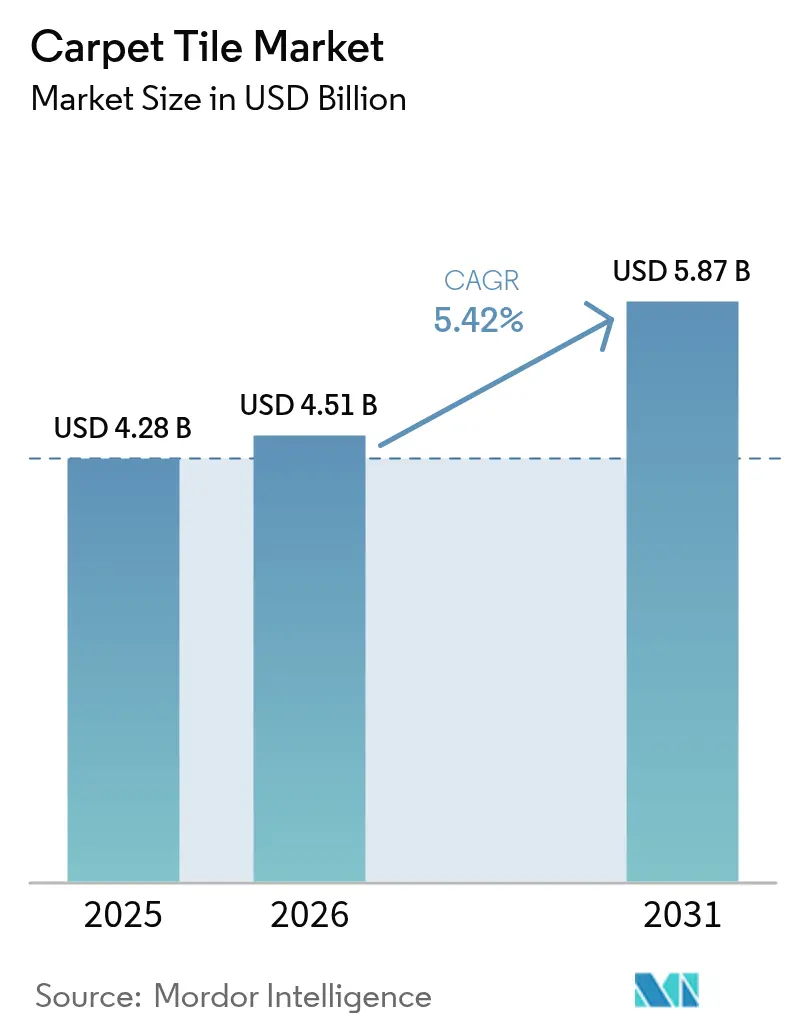
The carpet tile market size is expected to grow from USD 4.28 billion in 2025 to USD 4.51 billion in 2026 and is forecast to reach USD 5.87 billion by 2031 at 5.42% CAGR over 2026-2031. Growth arises from consistent corporate renovation spending, sustainability-driven specification shifts, and rising digital procurement, even as hard-surface flooring intensifies price competition. Carpet tiles now capture roughly 80% of commercial soft-surface specifications, underscoring their total-cost and reconfiguration advantages. [1] Source: Floor Covering Weekly, “Future Forecast,” floorcoveringweekly.com. North America retains the largest regional share, yet Asia-Pacific’s faster build-out of technology hubs and offices propels global demand. Nylon continues as the dominant fiber, though bio-based alternatives expand fastest as ESG mandates become embedded in real-estate procurement. Commercial applications anchor revenues, while peel-and-stick formats open new residential and small-business opportunities.
Key Report Takeaways
- By material, nylon led with 55.58% of carpet tile market share in 2025; bio-based fibers are projected to advance at a 6.78% CAGR through 2031.
- By end user, commercial installations accounted for 71.62% of the carpet tile market size in 2025, whereas residential demand is expected to increase at a 6.52% CAGR to 2031.
- By construction type, new construction accounted for 62.87% of the carpet tile market size in 2025, whereas remodeling/retrofit demand is expected to increase at a 6.15% CAGR to 2031.
- By distribution channel, direct B2B sales contributed 57.28% share of the carpet tile market size in 2025; online sales represent the fastest-growing channel at a 7.46% CAGR through 2031.
- By geography, North America held 33.62% revenue share in 2025; Asia-Pacific is set to expand at a 7.08% CAGR to 2031.
Note: Market size and forecast figures in this report are generated using Mordor Intelligence’s proprietary estimation framework, updated with the latest available data and insights as of 2026.
Market Trends and Insights
Drivers Impact Analysis of Carpet Tile Market*
| Driver | (~) % Impact on CAGR Forecast | Geographic Relevance | Impact Timeline |
|---|---|---|---|
| Sustainability-driven specification boom | +1.2% | Global, strongest in North America & EU | Medium term (2-4 years) |
| Commercial renovation cycle rebound | +0.9% | North America & Asia-Pacific | Short term (≤ 2 years) |
| Rapid-install peel-&-stick systems | +0.7% | Global | Short term (≤ 2 years) |
| Cost advantage over broadloom (life-cycle) | +0.8% | Global | Long term (≥ 4 years) |
| Modular office re-configuration demand | +0.6% | North America & EU, expanding to APAC | Medium term (2-4 years) |
| Static-control adoption in data centers | +0.4% | Global, concentrated in tech hubs | Long term (≥ 4 years) |
| Source: Mordor Intelligence | |||
Sustainability-driven Specification Boom
Corporate ESG targets have moved environmental metrics from nice-to-have to mandatory purchase criteria. Interface’s goal of carbon negativity by 2040 and Shaw’s carbon-neutral commercial production achieved in 2018 illustrate how climate commitments reposition product portfolios. Partnerships such as Tarkett–Mycocycle, which uses mycelia to detoxify construction waste, showcase the push toward regenerative cycles[2]Source: Commercial Tarkett, “Tarkett-Mycocycle Partnership,” commercial.tarkett.com.. Aquafil’s expansion of ECONYL recycled nylon derived from discarded carpet feeds closed-loop manufacturing and reduces dependency on virgin petrochemicals. Architect specifications increasingly reference cradle-to-cradle and embodied-carbon metrics, making recycled or bio-based content a procurement prerequisite. Peel-and-stick systems support waste minimization by eliminating wet adhesives and simplifying end-of-life reclamation.
Commercial Renovation Cycle Rebound
Deferred pandemic projects are resurfacing as occupiers reimagine workplaces for hybrid models. McKinsey notes offices are morphing into tech-enabled collaboration hubs, triggering flooring upgrades to support flexible layouts. CBRE’s 12% revenue increase in Q1-2025 aligns with rising fit-out demand, particularly in healthcare and technology verticals. Interface booked 17% order growth in the Americas and 18% education billings, confirming that renovation dollars translate directly into carpet tile orders[3]Source: Interface, “Q3-2024 Results,” interface.com.. JLL design reports spotlight adaptive reuse, while education facilities deploy stimulus funds to refresh floor coverings. These dynamics reinforce a steady replacement cadence that underpins the carpet tile market.
Rapid-install Peel-&-stick Systems
Installation efficiency has emerged as a critical competitive differentiator, with peel-and-stick systems addressing labor shortages while reducing project timelines. Interface's TacTiles innovation exemplifies this trend, enabling easier installation without traditional adhesives while maintaining performance standards. The labor shortage crisis affecting flooring installation creates urgency around self-adhesive solutions, particularly as contractors struggle to find skilled workers for complex projects. These systems also align with sustainability objectives by eliminating volatile organic compound emissions from wet adhesives and enabling easier end-of-life reclamation. The technology's maturation has overcome early performance concerns, with improved adhesive formulations providing comparable durability to traditional installation methods. Commercial tenants increasingly value the flexibility to reconfigure spaces without professional installation, making peel-and-stick systems attractive for dynamic work environments.
Cost Advantage Over Broadloom in Life-cycle Terms
Total cost of ownership calculations increasingly favor carpet tiles despite higher initial acquisition costs, driven by replacement flexibility and maintenance efficiencies. The ability to replace individual damaged tiles rather than entire installations creates compelling economic arguments, particularly in high-traffic commercial environments where wear patterns vary significantly across floor areas. Maintenance advantages extend beyond replacement to include easier cleaning access and the ability to rotate tiles to distribute wear patterns evenly. The modular approach also reduces waste during renovations, as undamaged tiles can be relocated or repurposed rather than discarded entirely. Insurance considerations further support the life-cycle cost advantage, as localized damage from floods or stains requires minimal replacement compared to broadloom installations. Corporate real estate managers increasingly recognize these operational benefits, with total cost models demonstrating 15-20% savings over typical commercial lease terms.
Restraints Impact Analysis of Carpet Tile Market*
| Restraint | (~) % Impact on CAGR Forecast | Geographic Relevance | Impact Timeline |
|---|---|---|---|
| Hard-surface (LVT) cannibalisation | -1.4% | Global, strongest in North America | Medium term (2-4 years) |
| Volatile nylon & bitumen prices | -0.8% | Global, manufacturing-intensive areas | Short term (≤ 2 years) |
| Recycling of mixed-fibre backings | -0.3% | EU & California regulatory focus | Long term (≥ 4 years) |
| Acoustic performance limitations in open offices | -0.2% | North America & Europe commercial | Medium term (2-4 years) |
| Source: Mordor Intelligence | |||
Hard-surface (LVT) Cannibalisation
Luxury vinyl tile (LVT) imports surged to an 81% penetration rate, outpacing all other flooring categories in the U.S. and drawing market share away from carpet tiles. In the wake of the pandemic, there's been a heightened emphasis on hygiene, leading to a preference for washable surfaces. Additionally, the rigid-core SPC formats of LVT have addressed previous denting concerns while remaining competitively priced. Designers in retail and hospitality highlight design versatility and a perceived ease of cleaning as key factors in their choices. Carpet tiles, however, emphasize their superior sound absorption, supported by data from the Carpet and Rug Institute, which demonstrates better sound coefficients compared to hard surfaces. Despite this advantage, carpet tiles face increasing challenges from price wars and the localization of LVT supply chains. These factors are putting pressure on the margin resilience of carpet tiles, further intensifying competition in the flooring market.
Volatile Nylon & Bitumen Prices
Nylon accounts for over half of carpet tile fiber volume, making the sector sensitive to petrochemical swings. Ascend Performance Materials’ 2024 bankruptcy amidst nylon 6,6 overcapacity and Chinese imports evidenced systemic vulnerability [4]Source: Chemical & Engineering News, “Ascend Bankruptcy,” cen.acs.org. Bitumen, used for backings, mirrors the undulations of oil prices, posing a significant procurement risk for projects with fixed bids. While manufacturers turn to multi-fiber platforms and recycled materials as a hedge, the associated R&D investments, coupled with the need for customer validation, extend the adoption cycles, making it a long-term endeavor. Additionally, short-term budgeting uncertainty can delay large-capex flooring decisions, further softening near-term order flows and impacting overall market stability.
*Our forecasts treat driver/restraint impacts as directional, not additive. The impact forecasts reflect baseline growth, mix effects, and variable interactions.
Carpet Tile Market Segment Analysis
By Fiber Type:
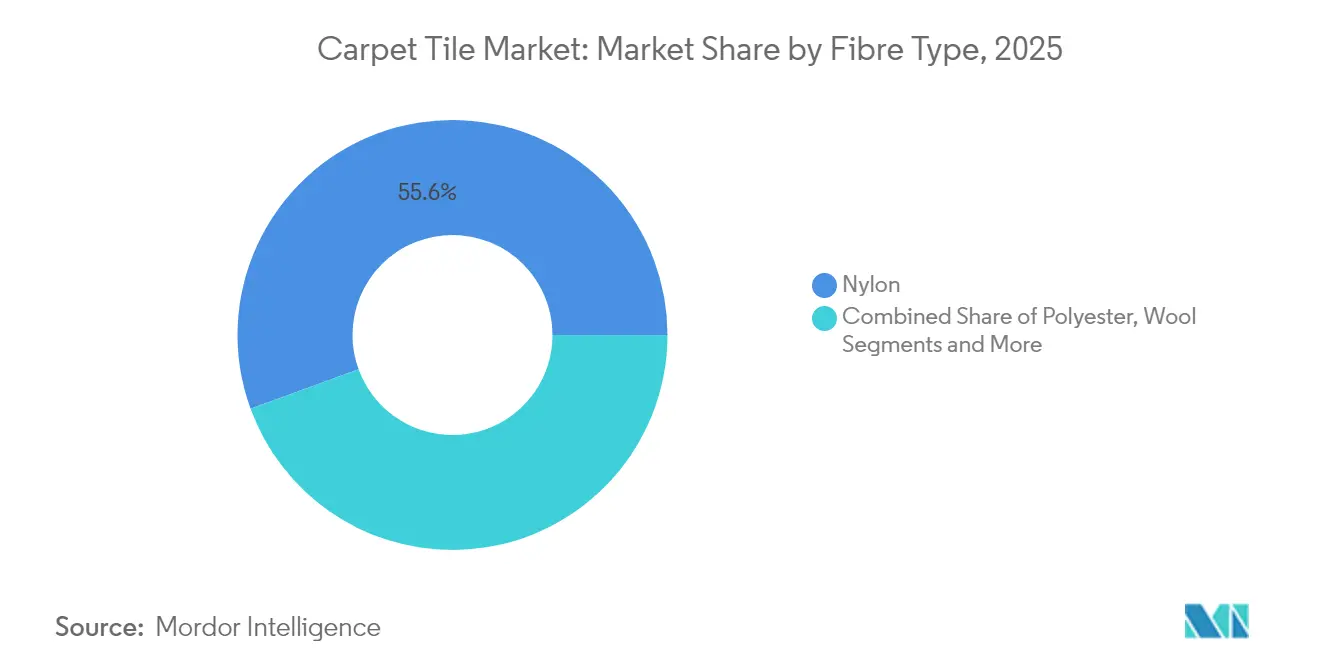
Bio-based Innovation Challenges Nylon DominanceBio-based fibers emerge as the fastest-growing segment at 6.78% CAGR through 2031, despite nylon maintaining 55.58% market share in 2025. This growth acceleration reflects corporate sustainability mandates and green building certification requirements that prioritize renewable material content. Polyester (PET) segments benefit from recycling infrastructure development, with Mohawk's EcoFlex ONE incorporating 76% recycled content and achieving 64% embodied carbon reduction compared to traditional options. Polypropylene applications expand in moisture-sensitive environments, while wool segments maintain premium positioning in hospitality applications despite higher costs.
Research into wool/PA56 blended yarns demonstrates enhanced moisture absorption and biodegradability characteristics, suggesting bio-based alternatives can match traditional fiber performance while reducing environmental impact. Nylon's market leadership faces pressure from volatile petroleum-based raw material costs and sustainability requirements, though superior durability and stain resistance maintain specification preference in high-traffic commercial applications. The fiber type segmentation increasingly reflects end-user sustainability priorities rather than pure performance considerations, with bio-based options gaining traction despite premium pricing.



By End User:
Residential Acceleration Contradicts Industry TrendsCommercial applications command 71.62% market share in 2025, yet residential segments drive growth momentum at 6.52% CAGR through 2031, contradicting broader soft surface flooring decline patterns. This residential acceleration stems from multifamily development adoption and DIY installation capabilities that differentiate carpet tiles from traditional broadloom products. Healthcare facilities represent a key commercial growth driver, with lifecycle cost analysis demonstrating modular carpet tiles provide superior financial value over 50-year service periods compared to hard surface alternatives. Education segments show particular strength, with Interface reporting 13% global billing growth in 2024 as deferred renovation projects materialize.
Hospitality applications benefit from Milliken's Modular Landscapes system, which delivers 25% cost savings compared to broadloom through simplified installation and selective replacement capabilities. Corporate offices increasingly specify carpet tiles for acoustic performance and employee wellness considerations, with Tarkett's DESSO SoundMaster achieving +8 dB impact sound insulation improvement.
By Construction Type:
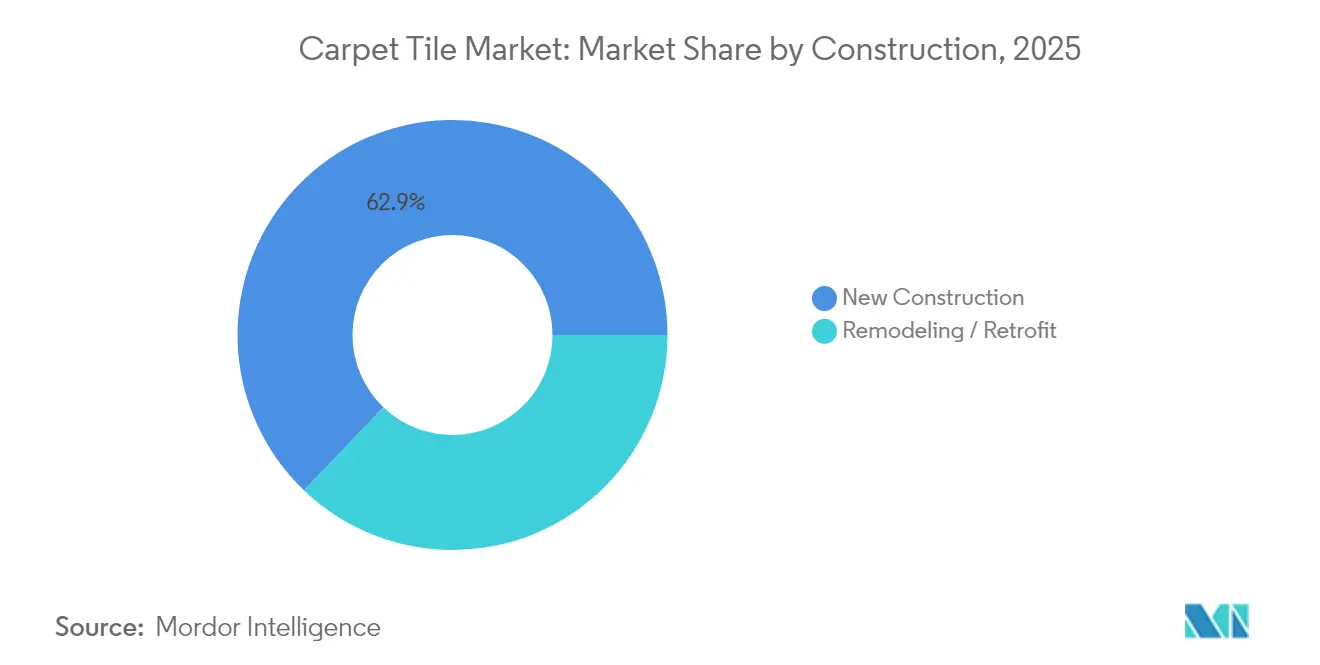
Retrofit Market Gains MomentumNew construction projects capture 62.87% of installation volume in 2025, while remodeling applications grow faster at 6.15% CAGR through 2031, reflecting deferred renovation cycles and workspace adaptation requirements. This retrofit acceleration benefits carpet tile manufacturers as modular systems reduce installation disruption compared to broadloom alternatives that require complete floor replacement. Commercial renovation projects increasingly prioritize rapid installation systems that minimize business interruption, with peel-and-stick technologies enabling overnight installation in occupied buildings.
The construction type segmentation reflects broader economic patterns, with new construction moderating from 20% growth in 2023 to 4% in 2024 according to American Institute of Architects forecasts. Retrofit applications benefit from carpet tiles' selective replacement capabilities, enabling facility managers to refresh high-traffic areas without disrupting entire floor systems. This advantage becomes particularly valuable in healthcare and education environments where operational continuity requirements limit renovation windows.
By Distribution Channel:
Retail Expansion Signals Market EvolutionDirect B2B sales maintain 57.28% market share in 2025, reflecting commercial market dominance, yet retail consumer channels expand rapidly at 7.46% CAGR through 2031, indicating residential market penetration acceleration. This channel evolution suggests carpet tiles are transitioning from purely commercial products to consumer-accessible solutions, driven by DIY installation capabilities and home center availability. Online distribution gains particular momentum as consumers research modular flooring options and compare lifecycle costs against traditional alternatives.
The B2C expansion reflects broader trends toward modular home improvement solutions that enable incremental renovation and design flexibility. This distribution channel diversification reduces manufacturer dependency on commercial construction cycles while creating new growth opportunities in residential renovation markets.
Geography Analysis
North America Carpet Tile Market
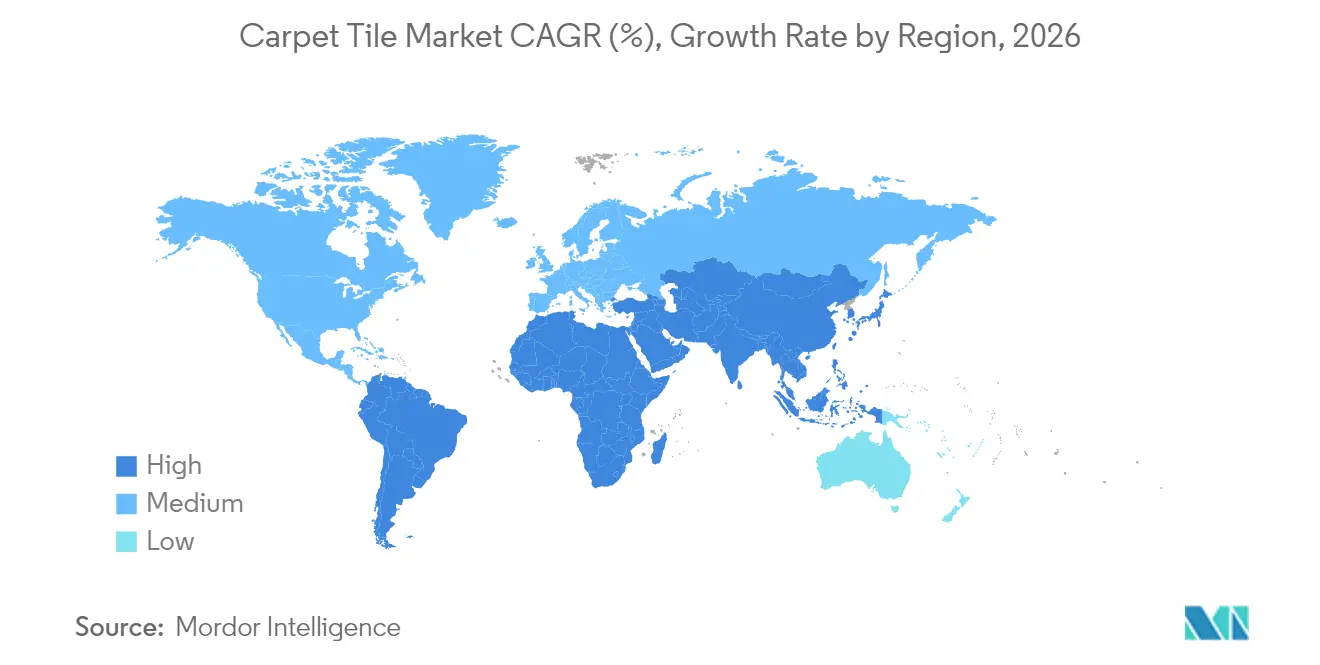
North America maintains leads the market with dominating share in 2025, driven by commercial renovation recovery and sustainability specification requirements, though growth moderates to 4.82% CAGR through 2031 as market maturity constrains expansion. The region benefits from domestic manufacturing capabilities that provide competitive advantages against tariff-affected imports, with companies like Shaw Industries expanding production capacity in Georgia to serve growing demand. U.S. General Services Administration P100 standards mandate performance-based requirements for federal buildings, creating specification stability for carpet tile manufacturers serving government segments. Canada and Mexico contribute to regional growth through construction activity recovery, though housing market softness constrains residential applications.
APAC Carpet Tile Market
Asia-Pacific emerges as the fastest-growing region through 2031, led by commercial construction expansion in India and China's urbanization trends. India accounts for over half of regional office space demand, with technology hubs like Bengaluru and Hyderabad driving specification activity. China's market development benefits from domestic manufacturing capabilities and growing corporate sustainability awareness, though regulatory complexity creates specification challenges for international manufacturers. Southeast Asian markets including Vietnam and Thailand contribute to regional growth through foreign direct investment and manufacturing facility expansion. Japan and Australia maintain steady demand patterns, with emphasis on acoustic performance and design flexibility in commercial applications.
EMEA and South America Carpet Tile Market
Europe demonstrates moderate growth patterns constrained by economic uncertainty and regulatory compliance requirements, with the EU's Ecodesign for Sustainable Products Regulation creating both opportunities and challenges for carpet tile manufacturers. Tarkett achieved EcoVadis Platinum rating, ranking in the top 1% of assessed companies, demonstrating how sustainability leadership creates competitive advantages in European markets. The region's focus on circular economy principles drives demand for recyclable carpet tile systems, with DESSO SoundMaster products featuring 80% recycled content and Cradle to Cradle certification. South America and Middle East/Africa regions contribute modest growth, with Brazil and UAE leading through commercial development projects and hospitality sector expansion.

Value Chain Analysis
The carpet tile value chain begins with petrochemical and recycled feedstocks converted into fibers (nylon 6/6,6, PET, polypropylene, and emerging bio-based options), alongside backing inputs such as bitumen or thermoplastic polymers, fiberglass stabilizers, fillers (including calcium carbonate), dyes, and installation systems (wet adhesives or glue-free formats). Manufacturing typically involves yarn preparation, tufting into a primary backing, precoating, building multi-layer backing constructions for dimensional stability and performance, then cutting and packaging into tile formats. Material availability and pricing, especially for nylon and bitumen, can transmit cost volatility into quotes for large commercial projects.
Downstream, specification and procurement are shaped by architects, designers, and facility managers, with the Carpet and Rug Institute (CRI) and third-party documentation (such as EPDs) influencing product eligibility in sustainability-led bids. Distribution is split between direct B2B sales into corporate, education, healthcare, and government projects and contractor-led channels, with an increasing online layer for smaller jobs. End-of-life collection and recycling remains a structural bottleneck, since mixed-material backings complicate standardized reclamation and reuse at scale, which increases the role of take-back programs and partners in supporting circular workflows.
Competitive Landscape
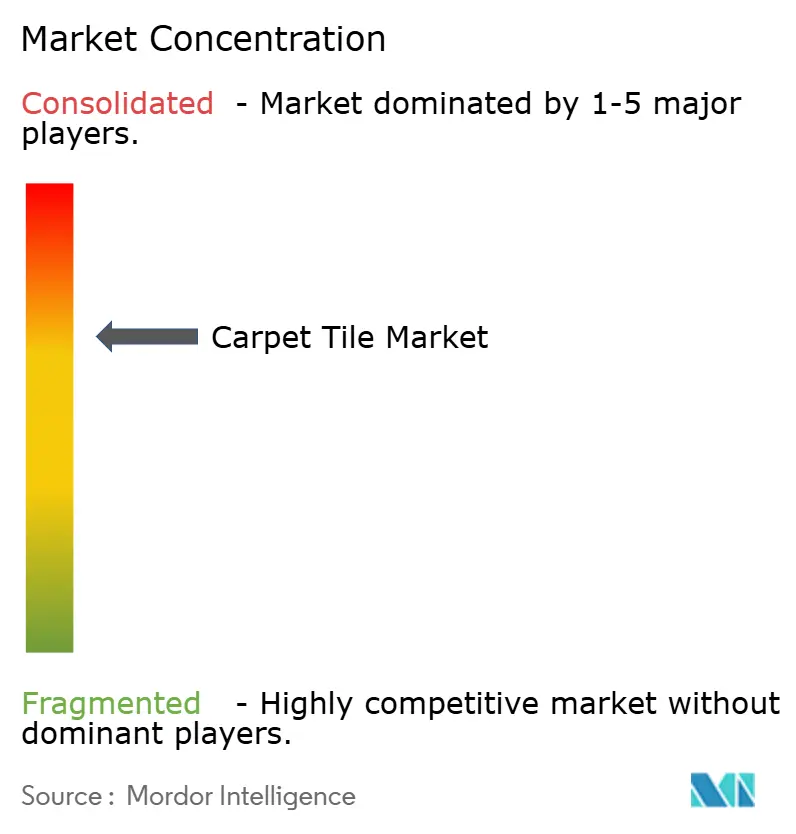
The carpet tile market is shaped by a handful of dominant players, reflecting a high level of consolidation. While major vendors hold significant influence, the landscape still offers room for emerging brands to innovate and capture specialized segments. Interface leads the pack, setting itself apart with a strong focus on sustainability, particularly through its carbon-negative product offerings, which appeal to environmentally driven clients and green building initiatives. The company’s commitment to reducing its environmental footprint has positioned it as a leader in the market, attracting customers who prioritize eco-friendly solutions.
Shaw follows as a close competitor, leveraging its scale and vertically integrated operations to ensure cost control, product consistency, and market breadth. By maintaining a robust supply chain and focusing on operational efficiency, Shaw has been able to strengthen its market presence and compete effectively. Mohawk advances eco-backing platforms such as EcoFlex ONE, which achieves a 64% reduction in embodied carbon, further solidifying its commitment to sustainability. This innovation underscores Mohawk’s dedication to addressing environmental concerns while meeting customer demands for sustainable products. Tarkett and Milliken round out leading positions through their design depth and expertise in ESD (electrostatic discharge) solutions, which cater to specific industry needs and enhance their competitive edge.
Strategic themes center on end-of-life take-back programs, the use of recycled content, and digitized customer engagement strategies. These initiatives reflect the industry’s focus on sustainability and customer-centric innovation. Capital investment focuses on expanding domestic manufacturing capabilities to mitigate tariff risks and enhance service responsiveness. By prioritizing local production, companies aim to reduce lead times and improve their ability to meet market demands efficiently. Emerging opportunities for market expansion include data-center ESD solutions, healthcare antimicrobial coatings, and bio-polymer fibers. These areas represent significant growth potential as they align with evolving customer needs and industry trends. Consolidation is likely to increase as medium-tier manufacturers pursue scale economies, mirroring moves like Lowe’s entry into professional installation networks. The carpet tile market, therefore, balances entrenched incumbency with innovation-led disruption, creating a dynamic environment for growth and competition. This balance between established players and new entrants fosters a competitive landscape that encourages continuous improvement and adaptation.
Carpet Tile Industry Leaders
Interface Inc.
Shaw Industries Group Inc.
Tarkett S.A.
Mohawk Industries Inc.
Milliken & Company
- *Disclaimer: Major Players sorted in no particular order
Carpet Tile Market Companies Covered in this Report
- Balsan
- Balta Group
- Beaulieu International Group
- Bentley Mills Inc.
- Brintons Carpets
- Dixie Group Inc.
- Engineered Floors LLC
- Ege Carpets
- Forbo Flooring Systems
- Gerflor Group
- Godfrey Hirst
- Huiton Carpet (China)
- Interface Inc.
- J+J Flooring Group
- Mannington Mills Inc.
- Milliken & Company
- Mohawk Industries Inc.
- Oriental Weavers
- Paragon Carpet Tiles
- Shaw Industries Group Inc.
- Tai Ping Carpets International
- Tarkett S.A.
- Victoria PLC

Market Opportunities and Future Outlook
Operational and supply-chain investments that lift throughput, customization, and packaging efficiency create room for growth in regions where lead times and logistics costs affect commercial fit-out decisions. Interface announced a multimillion-dollar investment at its Minto, New South Wales facility, adding a new packaging line and advanced yarn preparation system targeted to be operational in the first half of 2026, which highlights continued manufacturer focus on flexible, localized production. Upstream, B.I.G. Yarns announced a EUR 25 million investment in France to install advanced BCF lines for 1-step 3-ply yarn production, aligning fiber supply with performance and sustainability-driven specifications that increasingly influence carpet tile selection.
Decarbonized and circular material platforms are moving from marketing claims into manufacturing inputs, creating opportunities for differentiated premium specifications in corporate, education, and healthcare segments where buyers already lean on third-party verified disclosures. Interface has communicated plans to incorporate captured carbon into carpet tile manufacturing processes in the United States and Europe, and Bentley Mills began integrating Celanese VAE ECO-CC binder (derived from captured CO2) into commercial carpet tile production. Alongside glue-free installation systems that simplify removal and reclamation, these material shifts support closed-loop programs and product architectures designed for disassembly, particularly when buyers require EPD-backed embodied-carbon reporting and safer chemistry documentation as part of procurement.
Recent Industry Developments in Carpet Tile Market
- June 2026: Interface introduced new carpet tile collections, including Forest Within and Cut and Form, timed with Chicago Design Week. The launches reinforced the companys focus on biophilic design narratives for commercial interiors while keeping modularity central for reconfiguration and selective replacement.
- March 2025: Interface announced the incorporation of captured carbon into carpet tile manufacturing processes in the United States and Europe. This move expands low-carbon material options for specifications that require embodied-carbon documentation and supports differentiation beyond recycled content alone.
- June 2024: Tarkett partnered with Mycocycle through its ReStart program to apply mushroom mycelia to detoxify old flooring waste and create biobased raw materials. The initiative strengthens end-of-life pathways for flooring and aligns carpet tile portfolios with circular-economy procurement requirements.


Carpet Tile Market Report Scope and Research Methodology
Market Definition and Coverage
This market covers revenue generated from carpet tiles sold for floor covering use, across residential and commercial buyers, measured in current US dollars and tracked across major regions.
Scope exclusions: We exclude broadloom (roll) carpet, rugs, and hard-surface flooring (such as vinyl, laminate, wood, and ceramic).
Segments Covered in This Report
- By Fiber Type
- Nylon
- Polyester (PET)
- Polypropylene
- Wool
- Bio-based Fibres
- Other Fiber Types
- By End User
- Residential
- Commercial
- Hospitality & Leisure
- Retail & Shopping Centers
- Healthcare Facilities
- Education
- Corporate Offices
- Public & Government Buildings
- Other Commercial Users
- By Construction Type
- New Construction
- Remodeling / Retrofit
- By Distribution Channel
- B2C/Retail Consumers
- Home Centers
- Specialty Flooring Stores
- Online
- Other Distribution Channels
- B2B/Contractors/Builders
- B2C/Retail Consumers
- By Geography
- North America
- United States
- Canada
- Mexico
- South America
- Brazil
- Peru
- Chile
- Argentina
- Rest of South America
- Europe
- United Kingdom
- Germany
- France
- Spain
- Italy
- BENELUX
- NORDICS
- Rest of Europe
- Asia-Pacific
- India
- China
- Japan
- Australia
- South Korea
- South-East Asia
- Rest of Asia-Pacific
- Middle East and Africa
- United Arab Emirates
- Saudi Arabia
- South Africa
- Nigeria
- Rest of Middle East and Africa
- North America
Data Sources, Market Sizing, and Validation
Desk Research
Desk research was used to set market boundaries, build the initial demand picture, and align key assumptions to public signals. We used sources such as the US Census Bureau construction releases, USITC trade statistics, and Bureau of Labor Statistics price series that help track flooring-related cost movement, along with public building and construction indicators from groups such as the World Green Building Council.
For the industry structure and competitive context, we also reviewed company annual reports, investor presentations, and reputable business press coverage to understand product mix and channel focus for carpet tiles. In a few places, paid subscriptions were used only for company financials and intelligence, news and financials tracking, and patent databases to check modular flooring innovation activity. These desk sources are not exhaustive, and we also used additional public references to collect data, validate trends, and clarify gaps.
Primary Interviews and Surveys
Primary work was done through expert interviews and structured surveys with people involved in manufacturing, distribution, specification, and buying decisions for modular flooring. We spoke with commercial-facing stakeholders (contractors, facility teams, and project specifiers) and supplier-side teams to confirm demand drivers, pricing behavior, and the split between new construction and remodeling. Because this is a global market, our outreach was balanced across APAC, EMEA, and the Americas, so regional renovation cycles and building activity patterns could be checked consistently.
Distribution of primary research fieldwork respondents
| Company type | Respondent position | Region |
|---|---|---|
| Top tier: 36% | CXOs: 12% | APAC: 51% |
| Mid tier: 46% | Functional/Unit leaders: 35% | EMEA: 31% |
| Smaller Players: 18% | Managers: 53% | Americas: 18% |
Market-Sizing & Forecasting
Sizing started with a top-down build where construction and renovation activity was translated into addressable flooring demand, which was then narrowed to soft-surface usage and finally to the carpet tile share for key end uses. To keep totals grounded, the output was corroborated through selective bottom-up checks, including sampled price-per-square-meter ranges, distributor and contractor channel checks, and supplier revenue mix indications, followed by adjustments when the two views did not align.
The model used market-specific inputs such as commercial remodeling intensity, office and institutional fit-out trends, the split of new build versus retrofit projects, typical replacement cycles in high-traffic spaces, and price movement linked to key fibers and backing materials. When data gaps showed up in smaller countries, we used proxy indicators like construction spending direction and import patterns, then verified the implied demand with interview feedback. Forecasts were built using scenario analysis around building activity and renovation spending, followed by smoothing of short-term volatility so one-off project spikes did not distort the medium-term view.
Data Validation & Update Cycle
We validated outputs through triangulation across independent signals, and we also ran variance checks by region to catch outliers that did not match construction and renovation conditions. If a segment moved too sharply versus price or activity indicators, assumptions were revisited, and when needed, respondents were re-contacted to understand the change driver.
Before sign-off, the dataset and calculations go through multi-step analyst reviews, where inputs, conversions, and year-on-year movements are checked again for consistency. Reports refresh annually, with interim updates when material events occur that can move pricing, construction activity, or channel behavior. Before delivery, an analyst performs a fresh pass so clients receive the latest updated view.
Mordor Intelligence's Carpet Tile Market Estimate Compared With Other Published Estimates
Published market numbers for carpet tiles often diverge because each study sets its own boundary for what counts as a carpet tile sale, and they also differ on the year used for pricing and currency conversion. Differences in how commercial versus residential demand is handled can also create noticeable gaps, especially when renovation-led volumes are treated differently.
The table shows a spread that mainly comes from what gets included around modular flooring and how pricing is carried forward over the forecast window. In the Mordor Intelligence model, the value is counted for carpet tile products only, with demand anchored to end-use installation activity (new construction and remodeling) and then validated through channel feedback, rather than folding in adjacent categories like broadloom carpet or other modular soft-surface formats.
Benchmark comparison
| Source | Market Size | Gaps in Research Methodology |
|---|---|---|
| Mordor Intelligence | USD 4.28 B (2025) | |
| Trade Data Publisher A | USD 5.30 B (2025) | This estimate appears to apply a broader carpet tiles definition and may blend revenue and volume conventions across regions, which can pull in adjacent modular soft-surface products and inflate the total when converted to a single USD value. |
| Industry Research Portal B | USD 6.20 B (2025) | This figure likely uses a wider scope across applications and channels with more aggressive price progression, and it may rely more on supplier-reported revenue ranges without enough filtering by installation-led demand in end markets. |
Once scope boundaries and pricing logic are aligned, the gap between published values becomes easier to explain and to test. By tying the market to observable construction and renovation signals, and then stress-checking with channel and supplier-side inputs, we arrive at a value that can be replicated and updated with the same steps each year.


Key Questions Answered in the Report
What is the current global value of the carpet tile market?
The carpet tile market size is valued at USD 4.51 billion in 2026.
Which region is expanding fastest for carpet tiles?
Asia-Pacific leads growth with an 7.08% CAGR through 2031 driven by new office construction.
Which is the fastest growing region in Global Carpet Tile Market?
Asia-Pacific is estimated to grow at the highest CAGR over the forecast period (2026-2031).
Which fiber type dominates carpet tile production?
Nylon remains dominant, accounting for 55.58% of 2025 volume.
How quickly are B2C/Retail Consumers channel growing in carpet tile sales?
B2C/Retail Consumers distribution is rising at a 7.46% CAGR driven by design trends and increased home renovations.
What share do commercial applications hold in carpet tiles?
Commercial installations contribute 71.62% of 2025 revenue owing to office, healthcare, and education demand.
Page last updated on:


 Your data is secure and never sold or shared.


