
Burundi Telecom MNO Market Size and Share
Market Overview
| Study Period | 2019 - 2030 |
|---|---|
| Forecast Data Period | 2025 - 2030 |
| Historical Data Period | 2019 - 2023 |
| Market Size (2025) | USD 340.20 Million |
| Market Size (2030) | USD 442.20 Million |
| Growth Rate (2025 - 2030) | 5.38 % |
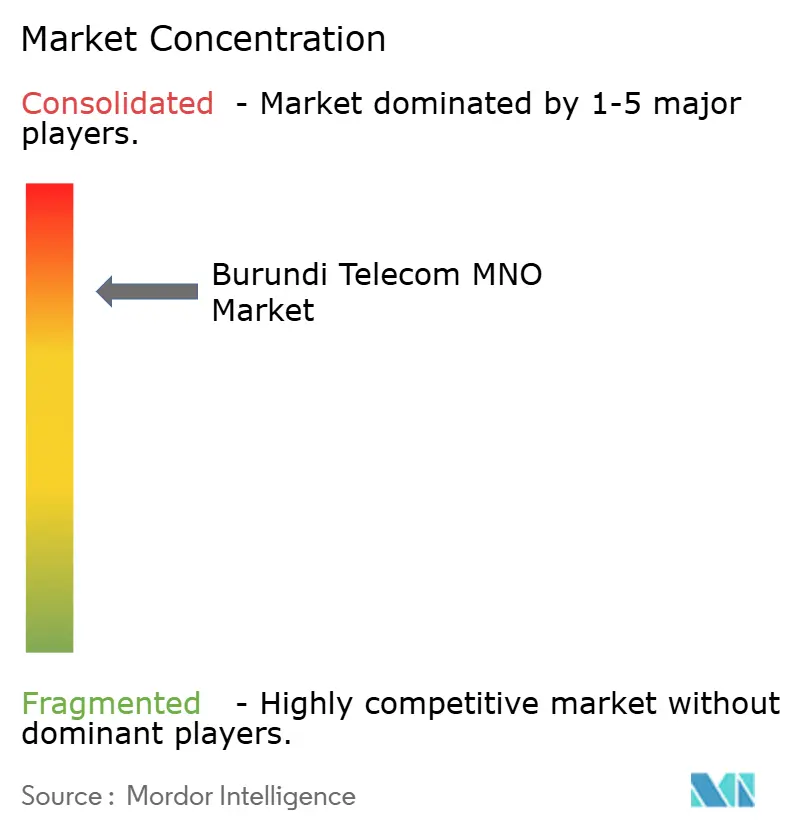
| Market Concentration | High |
Major Players *Disclaimer: Major Players sorted in no particular order Image © Mordor Intelligence. Reuse requires attribution under CC BY 4.0. | |
Burundi Telecom MNO Market Analysis by Mordor Intelligence
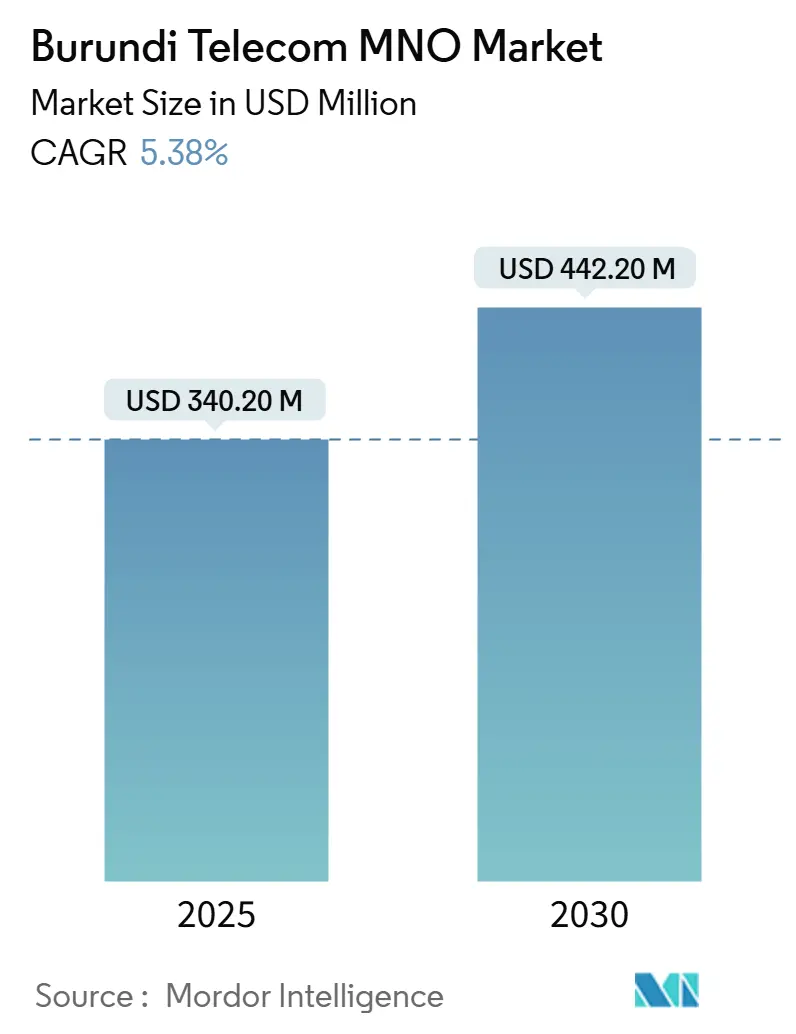
The Burundi telecom MNO market was worth USD 340.2 million in 2025 and is forecast to reach USD 442.2 million by 2030, reflecting a 5.38% CAGR. The growth trend stems from steady migration toward digital services, strong demand for mobile money, and continued network modernization. Viettel-backed Lumitel’s 55% revenue jump in 2024 and its expansion of 4G coverage to 97% of the territory underscore the market’s shift from basic voice toward data-centric offerings. Yet electricity access of barely 10% forces operators to bankroll solar arrays and diesel generators, pushing operating costs upward.[1]EBSCO Research Team, “Burundi Infrastructure and Energy Review,” EBSCOhost, ebsco.comSubmarine cable upgrades that quadrupled EASSy’s capacity to 36 Tbps in 2023 lowered wholesale bandwidth prices, supporting affordable retail data packages.
Key Report Takeaways
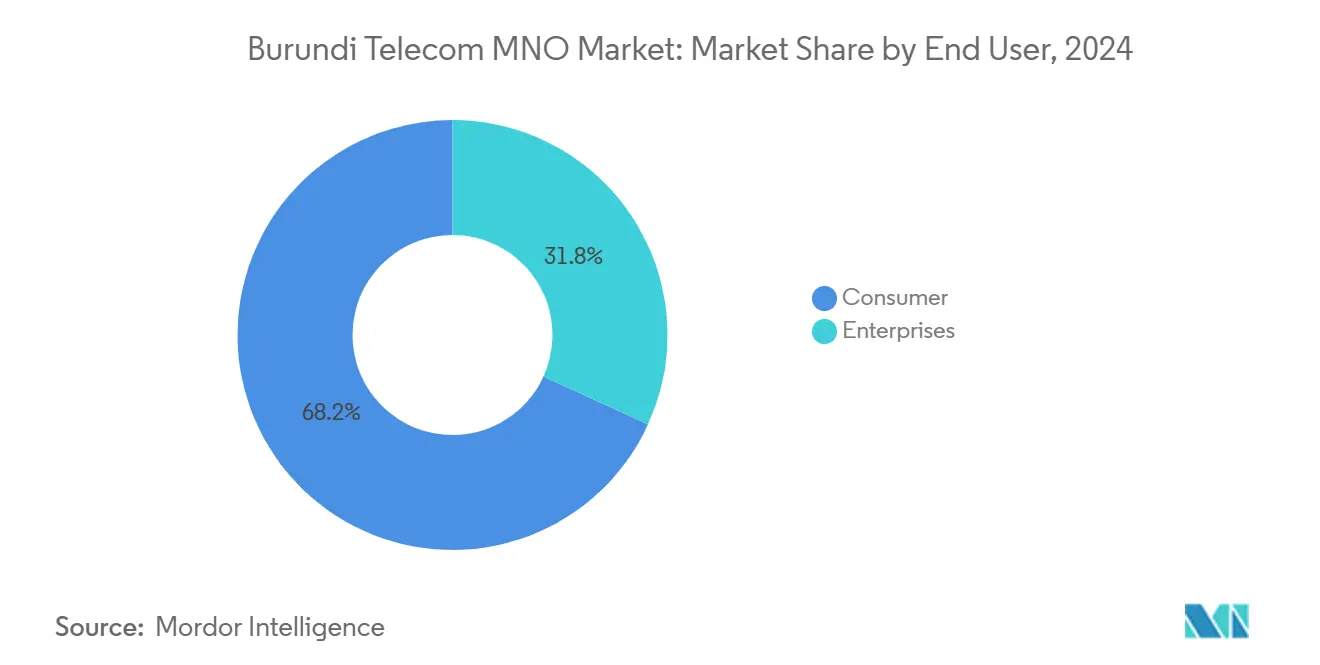
- By service type, data and internet services led with a 44.65% revenue share in 2024, while IoT and M2M services is projected to expand at a 4.83% CAGR to 2030.
- By end user, the consumer segment held 68.19% revenue share in 2024, whereas enterprise services are forecast to grow at 5.71% CAGR through 2030.
Burundi Telecom MNO Market Trends and Insights
Drivers Impact Analysis*
| Driver | (~) % Impact on CAGR Forecast | Geographic Relevance | Impact Timeline |
|---|---|---|---|
| Rising 4G rollout and pending 5G spectrum licensing | +0.8% | National, concentrated in Bujumbura and provincial capitals | Medium term (2-4 years) |
| National fibre backbone expansion and cross-border links | +0.6% | National corridors to Tanzania and Rwanda | Long term (≥ 4 years) |
| Smartphone adoption surge among youth | +0.5% | Urban-led, rural spill-over | Short term (≤ 2 years) |
| Mobile-money ecosystem deepening | +0.4% | Nationwide, strongest in commercial centers | Medium term (2-4 years) |
| Agriculture-IoT pilots boosting enterprise demand | +0.2% | Coffee and tea provinces | Long term (≥ 4 years) |
| Wholesale IP-transit cost decline via regional cables | +0.3% | National | Short term (≤ 2 years) |
| Source: Mordor Intelligence | |||
Rising 4G Rollout and Pending 5G Spectrum Licensing
Lumitel finished a nationwide 4G LTE build in 2018, laying 3,300 km of fiber and erecting 112 new towers, opening high-speed connectivity in rural communes once limited to EDGE. An ARCT decision in 2024 awarded the operator the first 5G license, positioning it to monetize enterprise IoT and streaming services as device costs fall. Econet Leo’s Bujumbura-based 4G launch in 2017 proved demand exists, but also highlighted the capital heft needed for national coverage. Sustained 4G quality has already lifted customer retention and blended ARPU, and power-efficient radios lower diesel usage at off-grid sites, further improving the Burundi telecom MNO market’s operating economics.
National Fiber Backbone Expansion and Cross-Border Links
The Burundi Backbone System has deployed 1,000 km of the planned 1,250 km network across nine provinces, cutting the historical reliance on costly satellite backhaul.[2]The East African Staff, “Burundi Backbone System Nears Completion,” The East African, theeastafrican.co.keA USD 5.9 million pact between TTCL and Burundi’s fibre company now pipes Tanzanian capacity inland, delivering route diversity that limits outages while driving wholesale rates down. Cross-border spurs toward Rwanda and the Democratic Republic of Congo further harden resilience. Target download speeds are forecast to leap from 135 Mbps to 2 Gbps within five years, enabling cloud, video, and fintech use cases that will broaden the Burundi telecom MNO market’s addressable revenue pools.
Smartphone Adoption Surge Among Youth
More than 65% of Burundians are below 25, and youth gravitate toward social video, messaging, and gaming. Cheap Android handsets and data bundles priced in micro-denominations have widened active smartphone subscriptions and shifted traffic from voice to data, with mobile data representing 61.24% of total data service revenue in 2024. Device proliferation triggers stronger uptake of mobile wallets and over-the-top media, raising effective ARPU even in low-income segments. Digital literacy projects by NGOs and schools expand adoption into peri-urban communes, reinforcing demand for ever-faster access and underpinning a broad base for upcoming 5G offerings in the Burundi telecom MNO market.
Mobile-Money Ecosystem Deepening
Lumitel Money commands a 60% share of e-wallet users with 1.4 million accounts and 16,800 agents that blanket 86% of the country. High cash-out velocity and fee revenue stabilize operator cash flow while broadening financial inclusion in a nation with sparse bank branches. Field studies show that households living within a 2 km radius of a mobile tower are disproportionately more likely to transact digitally. The ecosystem also underpins government-to-person payments and agricultural supply-chain finance, embedding telecom firms in critical economic workflows and anchoring subscriber stickiness.
Restraints Impact Analysis*
| Restraint | (~) % Impact on CAGR Forecast | Geographic Relevance | Impact Timeline |
|---|---|---|---|
| Low ARPU tied to widespread poverty | −0.7% | National, deepest in rural areas | Long term (≥ 4 years) |
| Regulatory and political uncertainty deterring FDI | −0.5% | Country-wide | Medium term (2-4 years) |
| Chronic power outages affecting network QoS | −0.4% | Grid zones | Short term (≤ 2 years) |
| Scarcity of foreign currency for cap-ex imports | −0.3% | Nationwide | Medium term (2-4 years) |
| Source: Mordor Intelligence | |||
Low ARPU Tied to Widespread Poverty
Burundi’s limited GDP per capita truncates spending on communications, forcing operators to price entry bundles close to marginal cost while still expanding coverage. The International Telecommunication Union notes that a 1 GB plan can consume a double-digit share of monthly income for the lowest quintile.[3]International Telecommunication Union, “Data Affordability Snapshot: Burundi,” ITU, itu.int Promotions, nano-top-ups, and zero-rated apps help retention but compress EBITDA margins across the Burundi telecom industry. Seasonality in rural cash flows, driven by agriculture, adds volatility to recharge behavior and complicates revenue forecasting.
Chronic Power Outages Affecting Network QoS
Annual generation of only 0.36 TWh against 4 TWh demand leaves 90% of households off-grid, compelling telecoms to install diesel gensets, solar hybrids, and battery systems to keep towers alive. Each new rural site requires a parallel power mini-grid, lifting cap-ex by up to 35% and inflating opex for fuel logistics. Quality of service dips during prolonged outages, and customer churn rises in blackout-prone districts. A USD 1.4 billion state-led electrification push aims to connect 9 million residents by 2030, but until grid reliability improves, self-generation will remain an unavoidable cost line that drags on the Burundi telecom MNO market’s profitability.
*Our forecasts treat driver/restraint impacts as directional, not additive. The impact forecasts reflect baseline growth, mix effects, and variable interactions.
Segment Analysis
By Service Type: Data and Internet Services Drive Digital Transformation
Data and internet services controlled 44.65% revenue in 2024, giving them the largest slice of the Burundi telecom MNO market share at the segment level. Mobile data dominates this mix owing to 4G ubiquity and a youthful user base, while fixed broadband is climbing on the back of backbone fiber rollouts. The Burundi telecom MNO market size for data services is projected to compound at 4.5% annually to 2030, buoyed by affordable smartphones and wholesale bandwidth deflation. IoT and M2M service revenues, though still modest, are expanding at a 4.83% CAGR as coffee estates deploy soil-sensor arrays and cold-chain trackers. Fixed data, catalyzed by urban fiber tap-offs, is forecast to outperform voice with a 5.01% CAGR, supporting cloud adoption by SMEs and public agencies. OTT streaming and gaming are in early stages yet already strain legacy microwave backhaul, pushing operators to accelerate metro-fiber densification. Voice services, while still relevant, face cannibalization from IP-based messaging; nonetheless, it retains 37.97% of segment spend as rural dwellers continue to rely on 2G handsets. Fixed voice declines persist under mobile substitution pressures and limited copper loops.
A second growth pillar for the Burundi telecom MNO market is video-driven data consumption. Operators bundle zero-rated social media to keep new adopters online, then upsell larger bundles as habits form. Education portals and tele-medicine pilots, supported by donor agencies, deepen use cases beyond entertainment. As spectrum refarming progresses, 4G capacity upgrades will accommodate traffic bursts during peri-urban festivals and agricultural market days. In parallel, early 5G field trials target enterprise verticals needing low-latency control loops, such as smart irrigation valves or real-time logistics telematics. Together, these shifts anchor a structural pivot toward data-first revenue models that diversify earnings away from price-sensitive voice minutes.



By End User: Consumer Segment Dominates Despite Enterprise Growth Potential
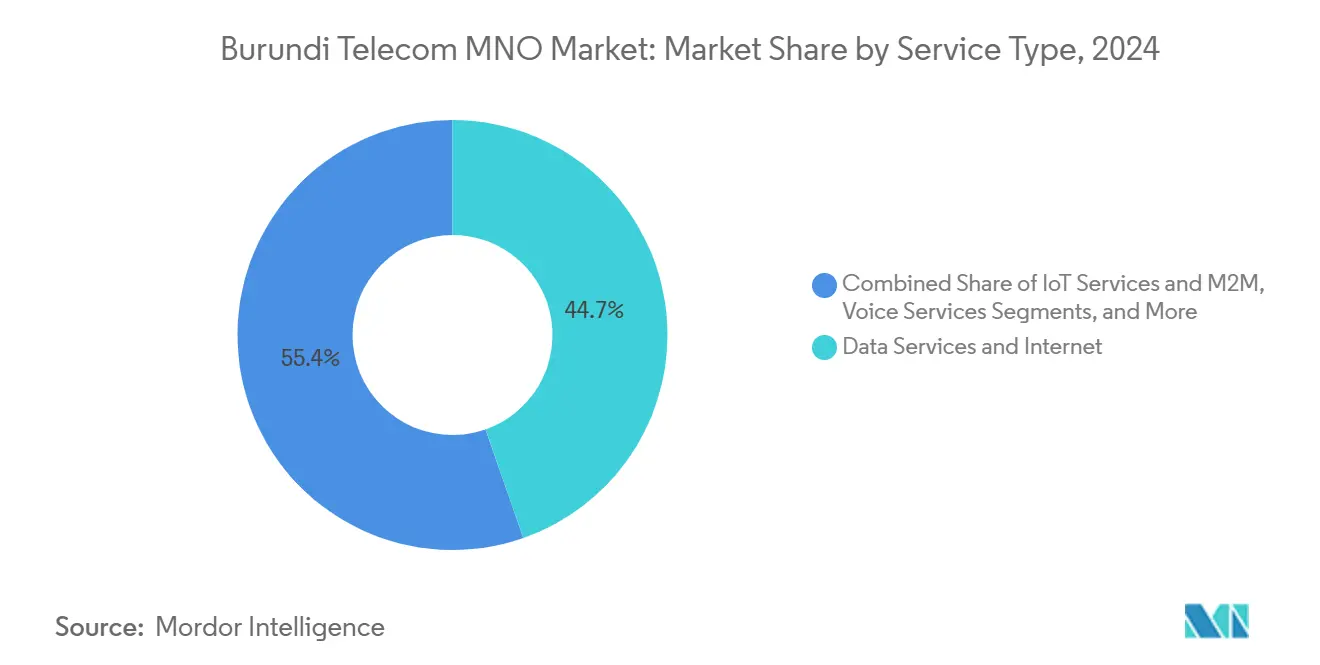
The consumer segment accounted for 68.19% of the overall 2024 revenue, making it the financial backbone of the Burundi telecom MNO market. Prepaid voice, micro-data bundles, and mobile wallets suit the country’s income volatility, enabling operators to drive scale without extending credit. Youth-heavy demographics and aggressive below-USD 20 smartphone imports from Shenzhen help sustain SIM penetration. The Burundi telecom MNO market size tied to consumers is anticipated to grow steadily but at a slower pace than enterprises, as saturation in urban areas caps net additions. Nevertheless, rising content consumption and financial-service cross-selling prolong ARPU uplift trajectories.
Enterprise services, currently a 31.81% slice, are on track for a 5.71% CAGR through 2030. Government digitization plans, such as e-tax filing and electronic land registries, require secure MPLS and cloud hosting that local operators can now supply via backbone fiber. Agribusinesses experiment with field-sensor IoT and drone imagery, creating subscription device management revenues. Banks and micro-finance institutions adopt leased lines and data-center colocation to comply with disaster-recovery mandates. International NGOs, long reliant on VSAT, migrate to terrestrial fiber when available, unlocking high-margin corporate IP transit. These dynamics should gradually rebalance the Burundi telecom industry toward a more diversified client mix that insulates cash flow from consumer spending shocks.
Geography Analysis
The Burundi telecom MNO market is inherently national in scope, yet usage patterns vary sharply among Bujumbura, provincial capitals, and rural communes. Bujumbura and Gitega together generate nearly half of the industry turnover owing to denser populations and better power grids. The Burundi telecom MNO market size for the Bujumbura district is estimated to have grown 6% in 2024 as 4G traffic surged after network densification. Provincial urban centers such as Ngozi and Muyinga recorded above-average data adoption once fiber rings came online, supporting small business e-commerce. Rural regions trail in ARPU but offer subscriber-base growth; operators therefore deploy solar-powered mini-sites to reduce diesel truck-rolls and to secure spectrum obligations.
Cross-border traffic influences usage in towns near Tanzania and Rwanda, where roaming agreements and dual-SIM devices are common. Fiber interconnects with Tanzania carry the bulk of international traffic, reinforcing the redundancy of the Burundi telecom MNO market’s external gateways. The recent upgrade of EASSy left sufficient headroom to support high-resolution video, cloud back-up, and regional content caches, trimming latency on popular platforms. Meanwhile, government universal-service funds prioritize base-station subsidies in energy-poor communes bordering the Congo River, aiming to narrow the digital divide and raise national data penetration beyond 15% by 2027.
Lake Tanganyika’s coastal stretch hosts ports and tourism sites that depend on broadband for reservation systems and digital payment acceptance. Seasonal spikes in tourist numbers strain backhaul during holiday peaks, pushing operators to pre-deploy temporary microwave hops or barge-based cell-on-wheels. Mountainous Kirundo, historically underserved, benefits from microwave trunk realignments and solarized repeaters that exploit elevation lines-of-sight. As grid expansion reaches these highlands by 2030, fibre over power-line installations could further cement connectivity, accepting that terrain makes trenching cost-prohibitive. These spatial strategies collectively ensure the Burundi telecom MNO market grows in a balanced, though economically sensitive, manner.
Competitive Landscape
Burundi’s telecom arena remains highly concentrated. Lumitel holds 67.5% subscriber share and leverages Viettel Global’s procurement scale to negotiate equipment at preferential pricing, lowering its cap-ex per LTE cell. Econet Leo, created via a 2015 merger, has 2.6 million customers and a revitalized 4G and fiber strategy, including fresh tower-sharing proposals to accelerate rural reach. The state operator ONAMOB retains valuable spectrum but lags technologically, still anchored to 2G circuits, limiting its relevance in data-centric segments. Spectrum scarcity and steep radio-licence fees limit new entrants, sustaining high barriers and reinforcing the Burundi telecom MNO market’s oligopolistic structure.
Competitive moves in 2024-2025 focused on network modernization and service diversification. Lumitel secured the nation’s first 5G concession and has begun trialling 3.5 GHz small cells in Bujumbura business districts. Econet Leo partnered with Chinese vendor ZTE to upgrade backhaul to 10 Gbps microwaves, preparing for increased data demand. Both players expanded mobile money footprints; yet Lumitel’s 16,800-agent network dwarfs Econet’s 7,200 agents, creating a formidable moat. Meanwhile, operators co-invest in the national fiber ring to reduce duplication and to access sovereign-backed development financing. Vendor financing from Huawei and ZTE mitigates hard-currency shortages that otherwise impede radio imports.
Strategic differentiation is emerging in enterprise verticals. Lumitel pitches end-to-end IoT bundles for agro-industries, bundling sensors, connectivity, and analytics dashboards. Econet Leo champions cloud services for NGOs using its Bujumbura data center, recently ISO 27001 certified. Both tout green-energy plays: Lumitel targets 30% solarised tower share by 2027, while Econet commits to diesel-hybrid smart-controller retrofits that cut fuel consumption by 25%. The top two firms also co-own fiber landing rights on the EASSy system, ensuring long-run control over international gateway economics. Such synergies help them defend their share against prospective entrants should the regulator auction additional spectrum blocks.
Burundi Telecom MNO Industry Leaders
Lumitel (Viettal)
Econet Wireless (Econet Global)
Onatel Burundi
- *Disclaimer: Major Players sorted in no particular order

Recent Industry Developments
- June 2025: Viettel Global reported 25% consolidated revenue growth for 2024 to VND 35.368 trillion (USD 1.4 billion), with Lumitel posting 55% revenue expansion and upholding 67.5% market share.
- April 2025: Lumitel became Burundi’s second-largest taxpayer, remitting USD 286.5 million while extending 4G coverage and obtaining a 5G license.
- February 2025: African Energy detailed how fuel shortages accelerated off-grid solar adoption for telecom base-stations.
- October 2024: Dabafinance outlined Burundi’s USD 1.4 billion grid expansion program, aiming for 9 million electrified residents by 2030.


Burundi Telecom MNO Market Report Scope
| Voice Services |
| Data and Internet Services |
| Messaging Services |
| IoT and M2M Services |
| OTT and PayTV Services |
| Other Services (VAS, Roaming & International Services, Enterprise and Wholesale Services, etc.) |
| Enterprises |
| Consumer |
| By Service Type | Voice Services |
| Data and Internet Services | |
| Messaging Services | |
| IoT and M2M Services | |
| OTT and PayTV Services | |
| Other Services (VAS, Roaming & International Services, Enterprise and Wholesale Services, etc.) | |
| By End-user | Enterprises |
| Consumer |


Key Questions Answered in the Report
What is the current size of the Burundi telecom MNO market?
The Burundi telecom MNO market was valued at USD 340.2 million in 2025 and is projected to reach USD 442.2 million by 2030, reflecting a 5.36% CAGR.
Which company leads the Burundi telecom industry?
Lumitel dominates with major subscriber share after extending 4G coverage to 97% of the country and securing the first national 5G license.
How important are data and internet services to revenue growth?
Data and internet services already contribute 44.65% of sector revenue and are projected to outpace voice, thanks to widespread smartphone adoption and cheaper international bandwidth.
What role does mobile money play in market expansion?
Mobile wallets generate multi-stream income; Lumitel Money alone holds a 60% share with 1.4 million users and 16,800 agents, deepening financial inclusion and boosting ARPU.
Why are power constraints a major challenge?
With 90% of households off-grid, operators spend heavily on diesel and solar power, raising opex and occasionally degrading network quality during outages.
How fast will enterprise telecom services grow?
The enterprise segment is forecast to expand at a 5.71% CAGR to 2030, driven by government digitization and agribusiness demand for sensor data.
Page last updated on:





