
Brake Lathe Machine Market Size and Share
Market Overview
| Study Period | 2020 - 2031 |
|---|---|
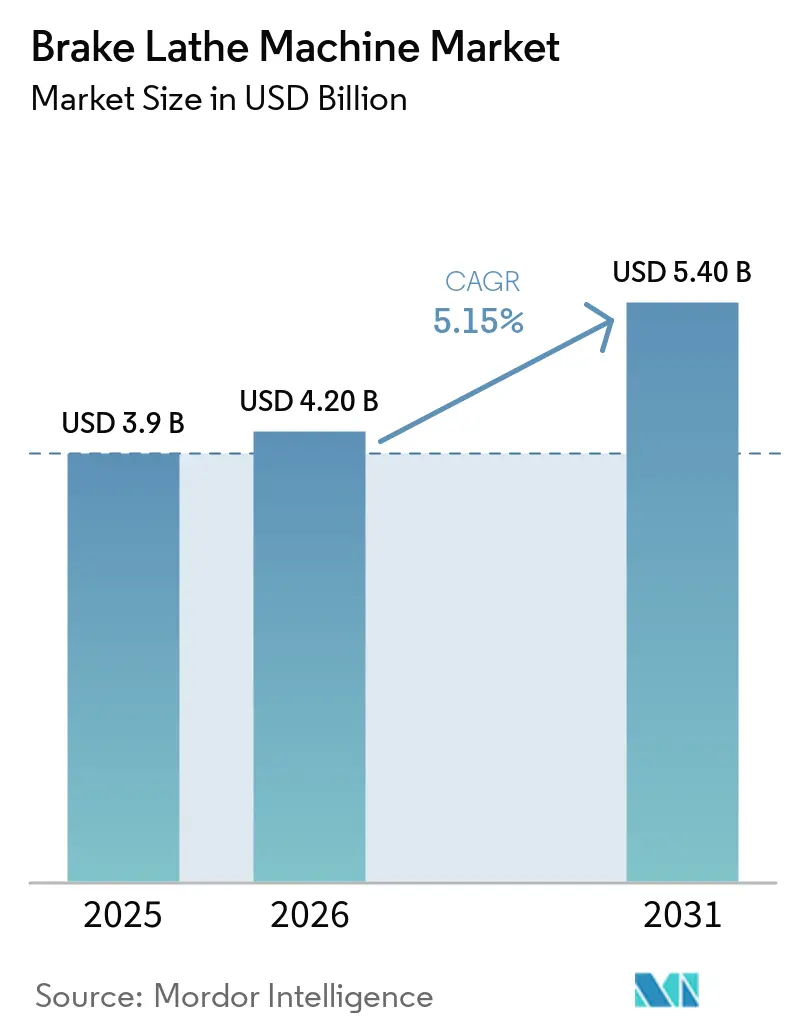
| Market Size (2026) | USD 4.20 Billion |
| Market Size (2031) | USD 5.40 Billion |
| Growth Rate (2026 - 2031) | 5.15 % |
| Fastest Growing Market | Asia-Pacific |
| Largest Market | Asia-Pacific |
| Market Concentration | Medium |
Major Players *Disclaimer: Major Players sorted in no particular order Image © Mordor Intelligence. Reuse requires attribution under CC BY 4.0. | |
Brake Lathe Machine Market Analysis by Mordor Intelligence
The Brake Lathe Machine Market size is projected to expand from USD 3.9 billion in 2025 and USD 4.20 billion in 2026 to USD 5.40 billion by 2031, registering a CAGR of 5.15% between 2026 to 2031.
The brake lathe market is supported by the clear cost advantage of rotor resurfacing over full replacement, especially as parts inflation raises the cost of new brake components. The same market is also benefiting from the steady spread of organized automotive service networks, which are standardizing brake-maintenance workflows and buying equipment at scale. Demand remains broad across mature and emerging service environments, from high-volume fleet depots in North America to small roadside workshops across South and Southeast Asia. Organized service chains increasingly adopt CNC systems, while independent garages continue to use manual bench lathes. This segmentation is expanding supplier product portfolios, shaping competition, pricing pressure, and the most credible expansion opportunities in the years ahead.
Key Report Takeaways
- By machine type, off-car brake lathe machines held 56.43% share of the brake lathe machine market size in 2026, while on-car machines are forecast to grow at 6.54% CAGR through 2031.
- By automation type, manual brake lathe machines accounted for 46.56% share of the brake lathe machine market size in 2026, while fully automatic and CNC systems are projected to grow at 7.5% CAGR through 2031.
- By geography, Asia-Pacific held 35.67% of the brake lathe machine market share in 2026 and is also projected to expand at 6.8% CAGR through 2031.
Note: Market size and forecast figures in this report are generated using Mordor Intelligence’s proprietary estimation framework, updated with the latest available data and insights as of January 2026.
Market Trends and Insights
Drivers Impact Analysis of Brake Lathe Machine Market*
| Driver | (~) % Impact on CAGR Forecast | Geographic Relevance | Impact Timeline |
|---|---|---|---|
| Expansion of Automotive Aftermarket Service Networks in Asia-Pacific | +1.8% | Asia-Pacific core, China, India, Southeast Asia, with spillover to Middle East and Africa | Short term (≤ 2 years) |
| Growth of Fleet Maintenance and Commercial Vehicle Servicing | +1.5% | North America and Europe, with emerging Asia-Pacific relevance | Medium term (2-4 years) |
| Technological Advancements in CNC and Automatic Brake Lathes | +1.2% | North America, Europe, Asia-Pacific | Medium term (2-4 years) |
| Rising Brake Rotor Replacement Costs Driving Resurfacing Adoption | +0.9% | North America, Europe, Asia-Pacific | Short term (≤ 2 years) |
| Increasing Adoption of On-Car Brake Lathes for NVH Reduction | +0.7% | North America, Europe, South Korea | Medium term (2-4 years) |
| Stricter Vehicle Safety Inspection Standards Supporting Brake Maintenance | +0.5% | North America and the European Union, with early traction in Germany, the United Kingdom, and Canada | Long term (≥ 4 years) |
| Source: Mordor Intelligence | |||
Expansion of Automotive Aftermarket Service Networks in Asia-Pacific
The brake lathe machine market is gaining direct support from the build-out of organized aftermarket service networks across Asia-Pacific. Japan continues to provide a stable service floor because its shaken inspection regime requires brake system checks every 24 months for most passenger vehicles. That requirement applies across a very large national vehicle base.[1]Ministry of Land, Infrastructure, Transport and Tourism, “Vehicle Registration and Inspection Statistics,” MLIT, mlit.go.jp China is also moving toward a more professional passenger-vehicle aftermarket, with industry participants describing 2025 as a turning point for broader development and stronger multi-brand service chain activity. As chains expand across cities and store formats, brake maintenance becomes less dependent on ad hoc workshop decisions and more tied to repeatable service protocols. That shift matters for the brake lathe machine market because standardized service menus make equipment purchases easier to justify at the network level. Bosch’s 2025 flagship Bosch Car Service opening in Indonesia also showed that large aftermarket brands were still investing in structured service footprints across Southeast Asia.
Growth of Fleet Maintenance and Commercial Vehicle Servicing
The brake lathe machine market also benefits from the recurring maintenance logic of fleet and commercial vehicle operations. The global medium- and heavy-duty truck fleet exceeded 85 million vehicles at the end of 2024, keeping the installed service base large even before replacement cycles are considered. In the United States, annual brake inspections are mandatory for commercial motor vehicles, and carriers must use brake inspectors who meet minimum qualification standards.[2]Federal Motor Carrier Safety Administration, “Inspection, Repair, and Maintenance for Motor Carriers of Passengers, Part 396,” FMCSA, fmcsa.dot.gov Brake Safety Week in 2025 found that 15.1% of 15,175 inspected commercial vehicles across 52 North American jurisdictions were placed out of service for brake-related violations, while Brake Safety Day found an 8.7% out-of-service rate among 4,569 inspected vehicles.[3]Commercial Vehicle Safety Alliance, “CVSA’s 2025 Brake Safety Day Results,” CVSA, cvsa.org Those failure rates show that brake remediation remains a persistent operating need rather than a discretionary event. For the brake lathe machine market, that means fleet depots and third-party maintenance sites continue to see resurfacing as a practical first step before moving to higher-cost replacement.
Technological Advancements in CNC and Automatic Brake Lathes
The market is shifting from manual equipment toward automated productivity solutions. Newer CNC and semi-automatic systems address a real labor problem because service operators need consistent results even when technician skill levels vary across sites. Hunter’s AutoComp Elite platform uses Anti-Chatter Technology to vary spindle speed, and the company states that the system can cut twice as fast as fixed-speed lathes while improving surface finish quality. That kind of performance matters in organized service networks where throughput, repeatability, and lower comeback rates all affect shop economics. Digital compensation systems, variable-speed drives, and battery-powered configurations are also making the resurfacing process easier to replicate across branches. As a result, the brake lathe machine market is increasingly tied to equipment upgrades that reduce skill dependency and support common operating procedures across franchise and fleet estates.
Rising Brake Rotor Replacement Costs Driving Resurfacing Adoption
Rising prices for brake components are reinforcing the economic case for the brake lathe market. The United States Producer Price Index for motor vehicle disc brake assemblies and parts reached 143.253 in March 2026, up from 139.899 in December 2025, which reflected a 2.4% increase in one quarter. When replacement parts become more expensive, resurfacing becomes easier to defend in both retail and fleet service settings. NHTSA has long noted that unnecessary or premature automotive part replacement adds meaningful cost to overall auto repair spending in the United States. That backdrop supports the brake lathe machine market because shops can present rotor resurfacing as a cost-saving intervention rather than a marginal service upsell. The value case is even stronger in heavy-duty and performance applications, where rotor replacement costs are high enough to turn a brake lathe into a quick-payback capital asset.
Restraints Impact Analysis of Brake Lathe Machine Market*
| Restraint | (~) % Impact on CAGR Forecast | Geographic Relevance | Impact Timeline |
|---|---|---|---|
| Growing EV Adoption Reducing Brake Wear Frequency | -0.8% | Global, led by China and the European Union, with early signals in North America | Long term (≥ 4 years) |
| Shift Toward Rotor Replacement Instead of Resurfacing in Low-Cost Passenger Vehicles | -0.6% | South and Southeast Asia, South America | Medium term (2-4 years) |
| High Initial Investment for CNC and Heavy-Duty Brake Lathes | -0.4% | Middle East and Africa, South America, emerging Asia-Pacific markets | Short term (≤ 2 years) |
| Increasing Use of Lightweight and Coated Brake Rotors Limiting Machining Cycles | -0.3% | Europe, East Asia | Long term (≥ 4 years) |
| Source: Mordor Intelligence | |||
Growing EV Adoption Reducing Brake Wear Frequency
The brake lathe market faces a structural challenge from battery-electric vehicles, as regenerative braking reduces reliance on friction brakes. A 2025 study by EIT Urban Mobility and Transport for London found that BEVs cut brake dust emissions by 83%, plug-in hybrids by 66%, and hybrid vehicles by 10% to 48% in the studied cities. Those reductions matter because they indicate fewer friction-brake events over the vehicle's service life. As electrification increases, rotor and pad service intervals can lengthen, gradually narrowing the pool of resurfacing jobs that justify owning a brake lathe. This does not remove near-term demand from the brake lathe machine market, because the global vehicle base still includes a large internal combustion and hybrid population. Even so, the long-run direction is clear, since a larger EV parc will reduce the recurring brake wear that has historically supported resurfacing volumes.
Shift Toward Rotor Replacement Instead of Resurfacing in Low-Cost Passenger Vehicles
A growing preference for outright rotor replacement in low-cost passenger vehicle segments also constrains the brake lathe machine market. In many price-sensitive markets, low-cost gray cast-iron rotors from Chinese supply chains are arriving at prices that make replacement competitive with a machining job once labor, setup time, and consumables are factored in. The issue is more pronounced on thin-section economy rotors, because the available machining margin is often very limited. U.S. regulation also reflects the broader principle that rotors must remain above the manufacturer’s minimum thickness limit, which can leave only one or no practical resurfacing cycles on some vehicle designs. In those cases, service shops may choose to replace immediately, especially when customer price sensitivity is high and turnaround time matters more than preserving the original rotor. This shift does not eliminate the brake lathe machine market. Still, it does push more of its durable demand toward fleets, commercial vehicles, and premium passenger applications where resurfacing economics remain stronger.
*Our forecasts treat driver/restraint impacts as directional, not additive. The impact forecasts reflect baseline growth, mix effects, and variable interactions.
Brake Lathe Machine Market Segment Analysis
By Machine Type:
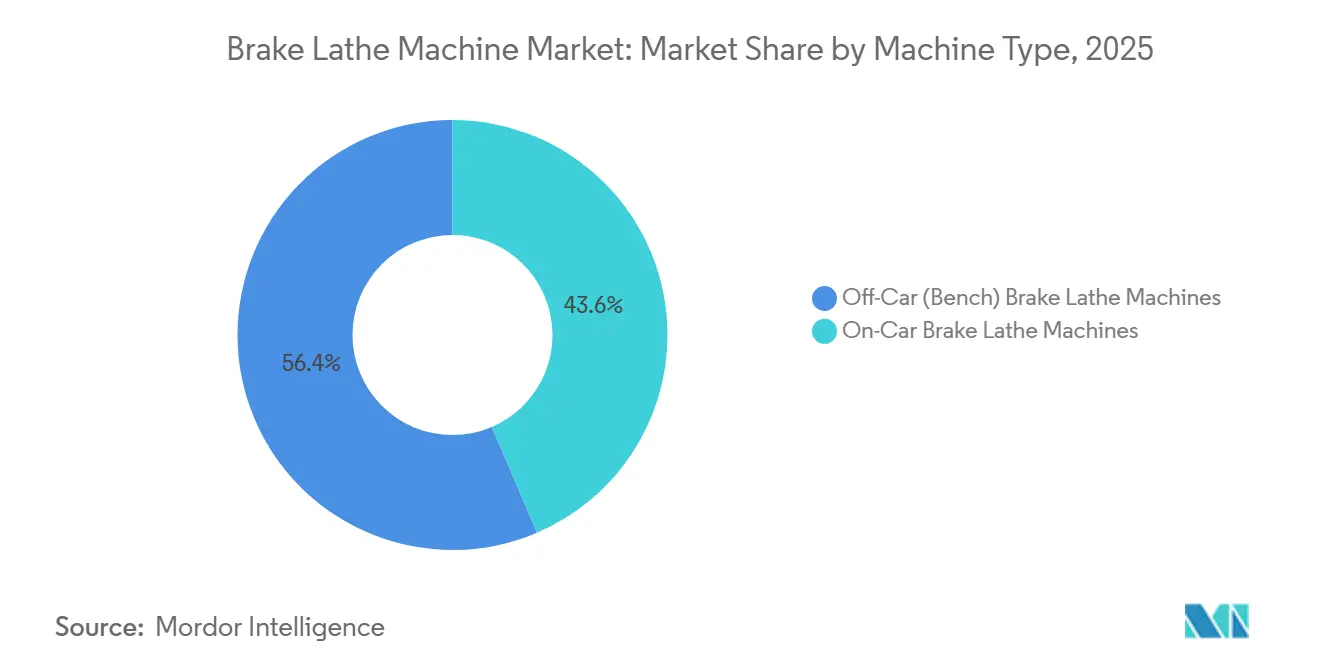
Commercial Fleets Anchor Off-Car Demand as On-Car Gains Precision EdgeOff-car brake lathe machines held 56.43% of the brake lathe market share in 2026, reflecting their long-established role in independent workshops and multi-brand service chains. Their broad fitment range supports work on many rotor and drum sizes, making them the default choice where workshops serve mixed vehicle populations rather than a narrow brand portfolio. This installed-base advantage still matters in the brake lathe machine market because bench units have lower acquisition costs, long service lives, and a well-understood operating model. On-car machines remain smaller by installed share, but the brake lathe machine market in that segment is forecast to grow at a 6.54% CAGR through 2031. That growth rate is supported by the technical benefit of machining the rotor on the vehicle hub, which helps correct lateral runout linked to hub and bearing geometry rather than relying only on adapters and setup accuracy.
The segment mix shows that the brake lathe machine market is moving from wide first-time adoption toward more selective replacement and upgrade demand. Historical growth from 2019 to 2025 ran ahead of the 2025 to 2031 forecast, indicating a more mature phase in which the replacement of aging manual equipment is becoming more important than net-new site creation. Within the off-car segment, high-throughput fleet depots still value durability and flexibility, especially when they service multiple vehicle classes in a single facility. Within the on-car segment, rising attention to pedal pulsation, noise, vibration, and harshness is pushing service operators toward equipment that can deliver better in-vehicle correction. The brake lathe machine industry is therefore dividing more clearly between legacy bench demand that remains broad and a higher-precision niche that is growing faster in organized service environments.



By Automation Type:
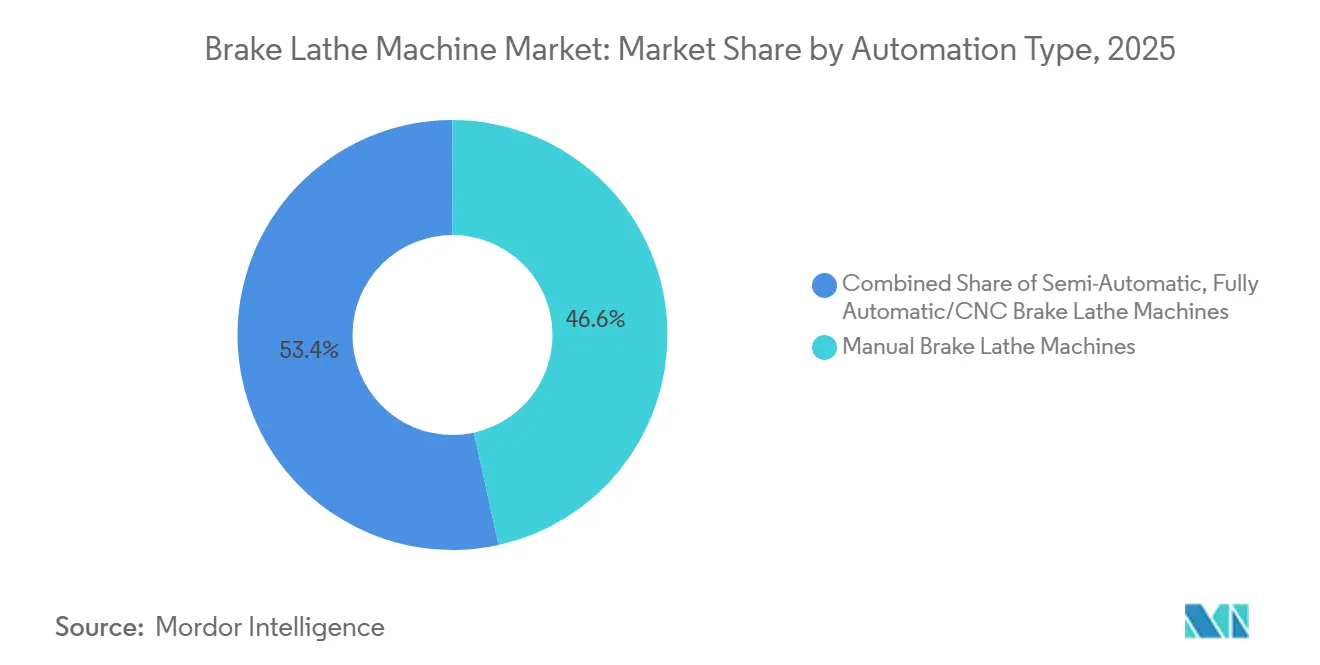
CNC Integration Reshapes Value Chain Above the MidmarketManual brake lathe machines accounted for 46.56% of the market in 2026, making them the largest automation segment in the brake lathe machine market. Their position remains strongest where low purchase cost, easy training, and mechanical simplicity matter more than software integration or advanced data capture. This is especially visible in independent workshops and in lower-cost operating environments where labor remains less expensive than automation. Semi-automatic systems sit in the middle of the range and are gaining relevance where service chains want better consistency without moving straight to full CNC investment. The brake lathe machine market for fully automatic and CNC systems is projected to grow at a 7.5% CAGR through 2031, making this the fastest-growing automation tier.
That faster growth is tied to productivity and process control rather than precision alone. The Technology & Maintenance Council noted improving shop productivity benchmarks in its 2025 Standard Repair Times report. That environment supports investment in tooling that enables operators to do more with fewer trained technicians. CNC platforms also allow rotor thickness, cut history, and tool-wear data to be captured in a more structured way, which helps connect brake service with fleet maintenance systems. Fleet operators increasingly integrate brake lathes into broader maintenance management systems. For the brake lathe machine industry, that shift is important because the greatest value creation is moving toward connected, standardized, and higher-throughput equipment rather than purely manual resurfacing.
Geography Analysis
APAC Brake Lathe Machine Market
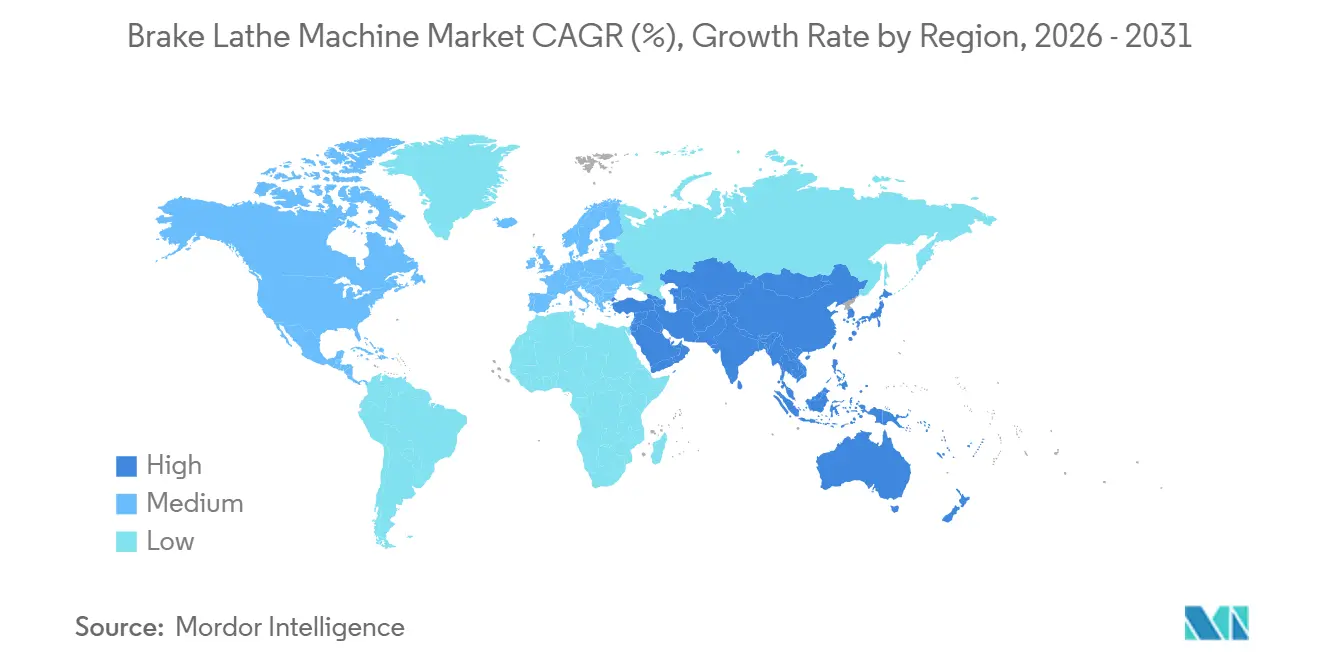
Asia-Pacific held 35.67% of the brake lathe machine market share in 2026 and is also the fastest-growing region, with 6.8% CAGR projected through 2031. The regional story is not uniform, as some markets are expanding on the back of organized service chain growth, while others are beginning to feel the long-term effects of higher EV penetration on friction-brake service demand. Japan remains structurally supportive because its mandatory shaken regime requires brake inspection at regular intervals across a very large vehicle population. India, Southeast Asia, and the Philippines offer the clearest runway for the brake lathe machine market because service formalization is advancing faster than the installed base of precision brake equipment.
North America and Europe Brake Lathe Machine Market
North America maintained the dominant revenue geography through 2025 and continues to represent the largest single market cluster in 2026, driven by its large commercial vehicle service base and strict brake inspection framework. The United States and Canada support a dense network of fleet depots, independent repair centers, and organized service operators that create repeat equipment demand across both replacement and upgrade cycles. CVSA’s 2025 inspection data still showed meaningful non-compliance levels, including 15.1% of inspected commercial vehicles being placed out of service during Brake Safety Week, which confirmed that brake remediation remained a recurring operational requirement. Europe held the second-largest share of the brake lathe market, driven by procurement demand in Germany, the United Kingdom, and France. The region combines mature installed bases with a technology shift toward lower-emission, more durable brake disc solutions, gradually changing the resurfacing opportunity in passenger vehicles.
MEA and South America Brake Lathe Machine Market
South America remains a moderate but growing part of the brake lathe market, with Brazil leading regional demand through its commercial trucking base and investment in logistics infrastructure. The region’s outlook is positive, but capital spending on workshop equipment remains tied to economic conditions and currency pressures. The Middle East and Africa present a mixed picture: Gulf markets are active in fleet management, while African demand remains concentrated in selected countries with deeper service networks. Manual and entry-level systems remain most relevant across much of MEA. At the same time, mining, construction, and fuel retail fleets are more likely to procure heavier-duty configurations for sustained commercial use.

Competitive Landscape
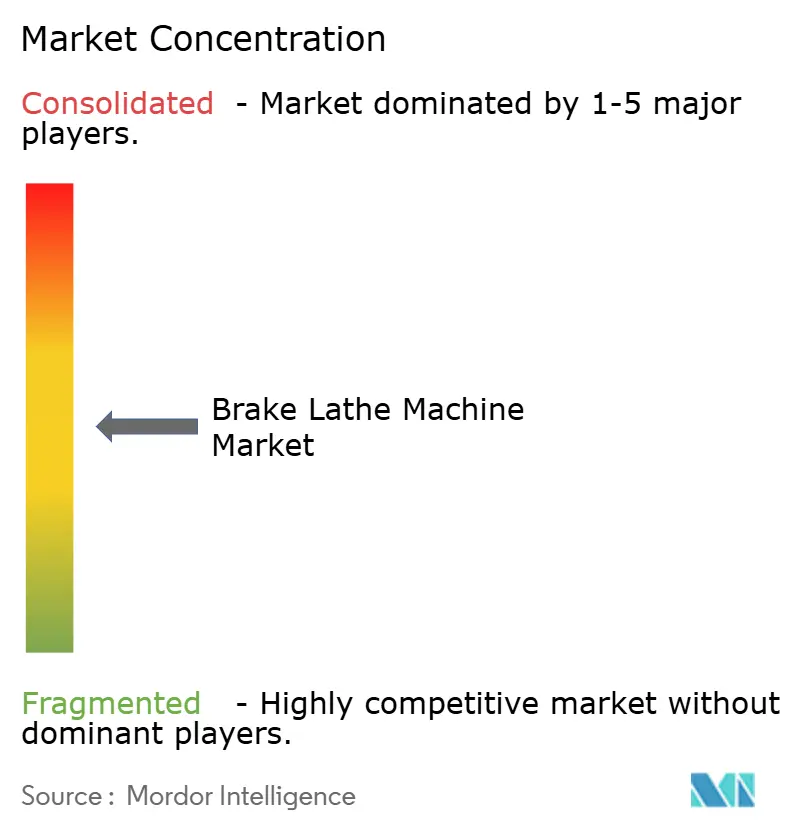
The brake lathe machine market is moderately fragmented, with established North American and European suppliers holding stronger positions in organized service networks. At the same time, regional and Chinese manufacturers compete more aggressively on price in cost-sensitive markets. This mix creates a layered structure in which premium buyers prioritize calibration support, repeatability, and network-wide standardization, while smaller workshops focus first on acquisition costs. That split has widened the product ladder in the brake lathe market and made service capability a stronger differentiator than hardware alone. Incumbents are responding by building more digital capabilities into their systems, including variable-speed drive control, compensation logic, and stronger integration with connected workshop processes. These additions raise switching costs for multi-location buyers because once a service network standardizes workflow and training around one platform, replacement decisions become less price-led.
Chinese suppliers are also moving beyond low-end manual configurations, putting pressure on the midmarket segment of the brake lathe market. Their progress in semi-automatic and CNC offerings is broadening access to the technology, but it is also compressing margins for long-established suppliers in Europe and North America. In response, incumbents are increasingly relying on calibration support, uptime assurance, and service responsiveness to retain customers. Strategic moves in 2025 and 2026 show this clearly, including Hunter Engineering’s expansion of its AutoComp Elite line into a heavy-duty variant for commercial fleet depots. Bosch also announced a partnership with multi-brand service chains in India as part of a regional aftermarket build-out, underscoring how equipment vendors are leveraging service-network relationships to secure downstream demand.
A clear white space remains in heavy-duty and off-road applications, where only a limited group of manufacturers offer solutions suited to multi-axle construction, mining, and specialized fleet vehicles. That niche is attractive because the cost of rotor replacement on such platforms can be high enough to protect the equipment supplier's margins. The brake lathe machine market is also beginning to see more attention paid to EV-compatible adapters and changing hub designs, even though EVs create a long-term drag on overall friction-brake service frequency. Suppliers that can combine compatibility, precision, and service support are likely to maintain their position as procurement becomes more selective. Overall, competition in the brake lathe machine market is intensifying. However, the most durable advantage still appears to come from installed-base relationships, service infrastructure, and the ability to support standardized maintenance across distributed workshop networks.
Brake Lathe Machine Industry Leaders
Hunter Engineering Company
AMMCO Tools
Comec Srl
Pro-Cut International LLC
Ranger Products
- *Disclaimer: Major Players sorted in no particular order
Brake Lathe Machine Market Companies Covered in this Report
- Hunter Engineering Company
- AMMCO Tools
- Comec Srl
- Pro-Cut International LLC
- Ranger Products
- John Bean Technologies Corporation
- Snap-on Incorporated
- Rotary Lift
- CEMB S.p.A.
- AUTOPSTENHOJ GmbH
- Mad Equipment
- Arcen Equipment
- Precision Brake Company
- KWIK-WAY Products Inc.
- COMEC USA
- ACDelco Tools
- Bosch Automotive Service Solutions
- Launch Tech Co. Ltd.
- Sunbright Equipment
- Xiangsheng Machine Tools Co. Ltd.

Recent Industry Developments in Brake Lathe Machine Market
- April 2026: Hunter Engineering Company expanded its AutoComp Elite on-car brake lathe line with a new heavy-duty variant targeting commercial fleet depots and bus rapid transit operators, incorporating a 48V variable-speed DC motor and integrated rotor-thickness logging compatible with cloud-based fleet maintenance management platforms.
- March 2026: Bosch Automotive Service Solutions announced a partnership with 3 multi-brand service chains across India to supply brake lathe machines and integrated shop-equipment packages as part of a regional aftermarket expansion initiative covering over 200 new service points in Tier-2 and Tier-3 cities.
- January 2026: Snap-on Incorporated completed the acquisition of a minority stake in a European brake-service equipment manufacturer, signaling intent to deepen its brake lathe product portfolio through direct IP integration rather than OEM sourcing.
- November 2025: John Bean Technologies Corporation launched a next-generation CNC bench brake lathe featuring integrated automatic compensation and a touchscreen programming interface, targeting fleet maintenance providers in North America seeking to reduce technician certification lead time for brake service operations.


Global Brake Lathe Machine Market Report Scope
The Brake Lathe Machine Market is Segmented by Machine Type (On-Car Brake Lathe Machines, Off-Car (Bench) Brake Lathe Machines), by Automation Type (Manual Brake Lathe Machines, Semi-Automatic Brake Lathe Machines, Fully Automatic/CNC Brake Lathe Machines), and by Geography (North America, South America, Europe, Asia-Pacific, Middle East and Africa). The Market Forecasts are Provided in Terms of Value (USD) and Volume (Tons).
| On-Car Brake Lathe Machines |
| Off-Car (Bench) Brake Lathe Machines |
| Manual Brake Lathe Machines |
| Semi-Automatic Brake Lathe Machines |
| Fully Automatic/CNC Brake Lathe Machines |
| North America | United States |
| Canada | |
| Mexico | |
| South America | Brazil |
| Argentina | |
| Chile | |
| Rest of South America | |
| Europe | Germany |
| United Kingdom | |
| France | |
| Italy | |
| Spain | |
| Russia | |
| BENELUX (Belgium, Netherlands, and Luxembourg) | |
| NORDICS (Denmark, Finland, Iceland, Norway, and Sweden) | |
| Rest of Europe | |
| Asia-Pacific | China |
| India | |
| Japan | |
| South Korea | |
| Australia | |
| Southeast Asia (Indonesia, Vietnam, Thailand, Malaysia, Philippines) | |
| Rest of Asia-Pacific | |
| Middle East & Africa | United Arab Emirates |
| Saudi Arabia | |
| Turkey | |
| Qatar | |
| South Africa | |
| Egypt | |
| Nigeria | |
| Rest of Middle East & Africa |
| By Machine Type | On-Car Brake Lathe Machines | |
| Off-Car (Bench) Brake Lathe Machines | ||
| By Automation Type | Manual Brake Lathe Machines | |
| Semi-Automatic Brake Lathe Machines | ||
| Fully Automatic/CNC Brake Lathe Machines | ||
| By Geography | North America | United States |
| Canada | ||
| Mexico | ||
| South America | Brazil | |
| Argentina | ||
| Chile | ||
| Rest of South America | ||
| Europe | Germany | |
| United Kingdom | ||
| France | ||
| Italy | ||
| Spain | ||
| Russia | ||
| BENELUX (Belgium, Netherlands, and Luxembourg) | ||
| NORDICS (Denmark, Finland, Iceland, Norway, and Sweden) | ||
| Rest of Europe | ||
| Asia-Pacific | China | |
| India | ||
| Japan | ||
| South Korea | ||
| Australia | ||
| Southeast Asia (Indonesia, Vietnam, Thailand, Malaysia, Philippines) | ||
| Rest of Asia-Pacific | ||
| Middle East & Africa | United Arab Emirates | |
| Saudi Arabia | ||
| Turkey | ||
| Qatar | ||
| South Africa | ||
| Egypt | ||
| Nigeria | ||
| Rest of Middle East & Africa | ||


Key Questions Answered in the Report
What is the current size of the brake lathe machine market?
The brake lathe machine market is valued at USD 4.20 billion in 2026 and is projected to reach USD 5.40 billion by 2031, growing at 5.15% CAGR over 2026-2031.
Which machine type leads demand for brake lathe equipment?
Off-car or bench brake lathe machines lead demand, with 56.43% share in 2026, because they are versatile, durable, and widely used across mixed-vehicle workshops.
Which automation segment is growing the fastest?
Fully automatic and CNC systems are growing the fastest, with 7.5% CAGR through 2031, as service operators prioritize throughput, repeatability, and lower skill dependency.
Which region offers the strongest growth outlook for brake lathe equipment?
Asia-Pacific offers the strongest growth outlook, with 35.67% share in 2026 and 6.8% CAGR through 2031, supported by organized service network expansion and under-equipped workshop bases.
Why are fleets still important for brake lathe demand?
Fleets face recurring inspection and compliance needs, especially in North America, where brake-related out-of-service rates remain material and make resurfacing a cost-effective first response.
What is the main long-term risk for brake lathe manufacturers?
The main long-term risk is EV adoption and the spread of coated or lightweight rotors, because both trends can reduce brake wear frequency or limit the number of safe resurfacing cycles.
Page last updated on:





