
Bluetooth LED Bulb Market Size and Share
Market Overview
| Study Period | 2020 - 2031 |
|---|---|
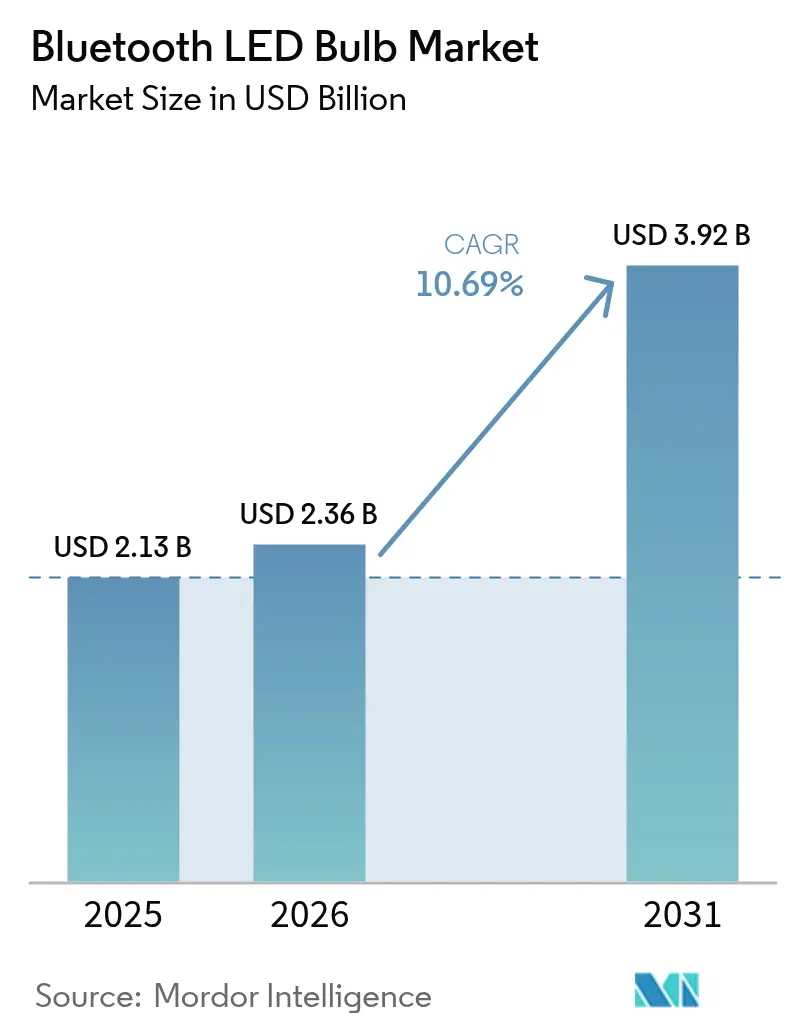
| Market Size (2026) | USD 2.36 Billion |
| Market Size (2031) | USD 3.92 Billion |
| Growth Rate (2026 - 2031) | 10.69 % |
| Fastest Growing Market | Asia Pacific |
| Largest Market | Asia Pacific |
| Market Concentration | Medium |
Major Players *Disclaimer: Major Players sorted in no particular order Image © Mordor Intelligence. Reuse requires attribution under CC BY 4.0. | |
Bluetooth LED Bulb Market Analysis by Mordor Intelligence
The Bluetooth LED bulb market size was valued at USD 2.13 billion in 2025 and estimated to grow from USD 2.36 billion in 2026 to reach USD 3.92 billion by 2031, at a CAGR of 10.69% during the forecast period (2026-2031). Momentum stems from efficiency mandates that have phased out incandescent and halogen lamps, a steady fall in LED and sensor costs, and the commercial launch of Bluetooth Mesh 1.1 networks supporting more than 32,000 nodes. Retailers are further accelerating uptake by packaging bulbs with smart speakers at discounted prices, capitalizing on Matter 1.3’s cross-platform interoperability. On the supply side, factories in China, India, and Vietnam have achieved annual declines of 12% in bill-of-materials costs, enabling sub-USD 10 Bluetooth bulbs that appeal to first-time buyers. Commercial facilities are pairing lighting data with HVAC controls to cut total energy use by 18% to 22%. Meanwhile, compliance with PSA Certified Level 2 security requirements is raising the bar for new entrants, yet also reassuring enterprise customers.
Key Report Takeaways
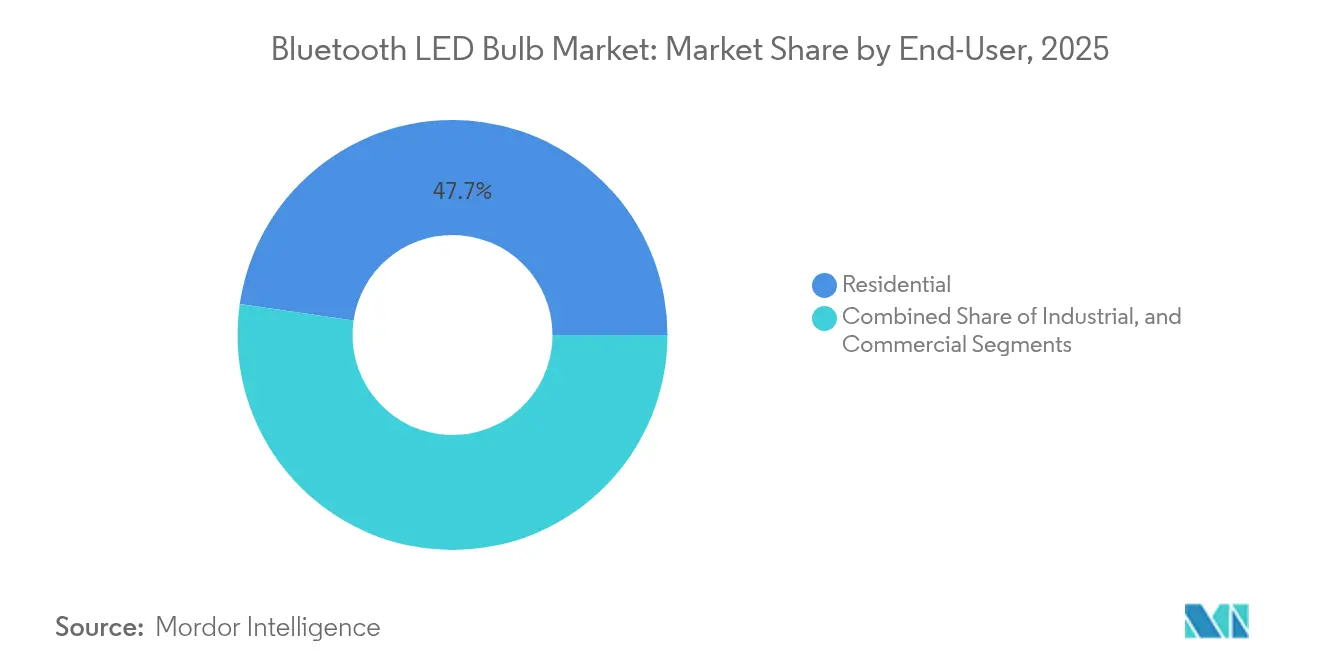
- By end-user, residential applications led with a 47.70% share of the Bluetooth LED bulb market size in 2025, whereas industrial facilities are expected to expand at a 11.68% CAGR through 2031.
- By bulb type, standard A19/A60 formats held 38.20% of the Bluetooth LED bulb market share in 2025, while reflector BR/PAR variants register the fastest 12.35% CAGR to 2031.
- By wattage, the 9 W to 14 W band accounted for 45.20% of the 2025 volume, but fixtures above 14 W are forecast to grow at a 11.55% CAGR.
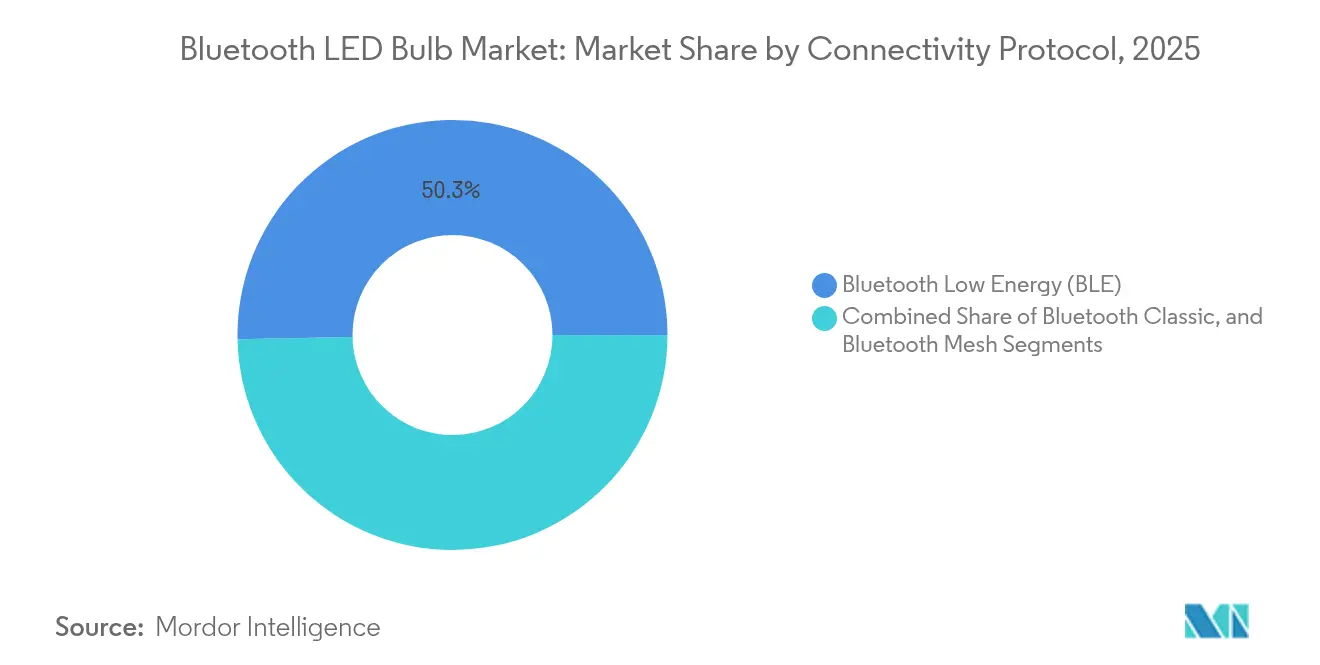
- By connectivity protocol, Bluetooth Low Energy captured 50.32% revenue in 2025; Bluetooth Mesh is poised for a 11.84% CAGR as large-scale networks proliferate.
- By distribution channel, online retail dominated with 58.40% of 2025 sales, while professional/OEM installers posted a 11.92% CAGR on the back of turnkey building-automation projects.
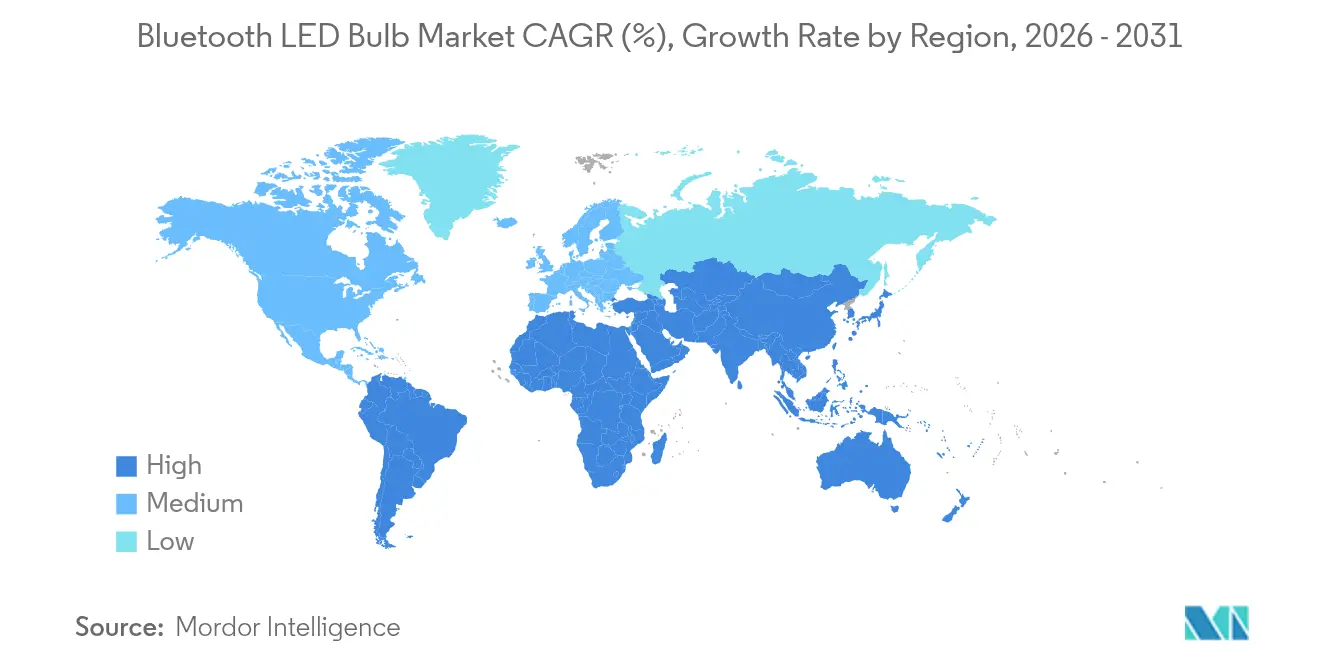
- By geography, Asia Pacific commanded 37.90% revenue in 2025 and is on track for a 12.28% CAGR, driven by manufacturing scale and fast-growing domestic demand.
Note: Market size and forecast figures in this report are generated using Mordor Intelligence’s proprietary estimation framework, updated with the latest available data and insights as of 2026.
Market Trends and Insights
Drivers Impact Analysis of Bluetooth LED Bulb Market*
| Driver | (~) % Impact on CAGR Forecast | Geographic Relevance | Impact Timeline |
|---|---|---|---|
| Increasing Demand for Energy-Efficient Lighting in Smart Homes | +2.8% | North America, Europe, global spillover | Medium term (2-4 years) |
| Proliferation of IoT and Smart Building Infrastructure | +2.5% | Asia Pacific, North America, global | Long term (≥ 4 years) |
| Declining LED and Sensor Component Prices | +1.9% | Manufacturing hubs in Asia Pacific, global rollout | Short term (≤ 2 years) |
| Government Incentives for Energy Conservation | +1.6% | North America, Europe, China, India | Medium term (2-4 years) |
| Emergence of Bluetooth Mesh 1.1 Enabling Large-Scale Networks | +1.4% | Commercial and industrial sites worldwide | Long term (≥ 4 years) |
| Retailers Bundling Bulbs with Voice Assistants | +1.2% | Urban centers in North America, Europe, Asia Pacific | Short term (≤ 2 years) |
| Source: Mordor Intelligence | |||
Increasing Demand for Energy-Efficient Lighting in Smart Homes
Voice-assistant ecosystems and utility rebates have doubled the number of connected luminaires per household, even as lighting’s share of residential electricity fell below 8% in 2024. Europe’s Ecodesign Directive banned halogen and linear fluorescent lamps, triggering a replacement wave that favors Bluetooth-enabled LEDs, which offer dimming and tunable white light without requiring neutral-wire rewiring.[1]European Commission, “Ecodesign Directive 2019/2020,” EC.EUROPA.EU. Germany and France, both posting renovation rates above 3%, now embed smart-ready panels in new wiring layouts. In the United States, rebates of USD 15–25 per connected bulb cut payback to under 12 months. Collectively, these measures secure residential leadership in the Bluetooth LED bulb market.
Proliferation of IoT and Smart Building Infrastructure
Developers view Bluetooth Mesh lighting as foundational infrastructure because luminaires double as distributed sensor platforms. The International Energy Agency measured savings of 18%–22% when occupancy data guided HVAC scheduling in retrofitted office towers. Factory ceilings above six meters require bulbs with outputs exceeding 14 W to meet 500-lux requirements, spurring demand for high-output models. Guangdong plants now operate Bluetooth Mesh networks with over 10,000 nodes and sub-50 ms latency, underscoring their scalability. As corporate ESG targets tighten, energy dashboards integrating lighting data will become mainstream.
Declining LED and Sensor Component Prices
Mid-power LED packages dropped 12% YoY in 2024 to USD 0.08 per lumen, while BLE SoC modules fell below USD 1.20 for 100 k-unit orders. Vietnamese and Indian firms leveraged these cuts to launch Matter-ready bulbs under USD 10, widening access in price-sensitive markets. Integrated power-supply modules streamline design, halving development cycles to nine months. Improved phosphors now deliver color-rendering indices above 95, unlocking previously reserved use cases in museums and healthcare, once exclusive to premium fixtures. Component deflation remains a catalyst for the Bluetooth LED bulb market. Vietnamese and Indian firms leveraged these cuts to launch Matter-ready bulbs under USD 10, widening access in price-sensitive markets. Integrated power-supply modules streamline design, halving development cycles to nine months. Improved phosphors now deliver color-rendering indices above 95, unlocking previously reserved use cases in museums and healthcare, once exclusive to premium fixtures. Component deflation remains a catalyst for the Bluetooth LED bulb market.
Emergence of Bluetooth Mesh 1.1 Enabling Large-Scale Lighting Networks
Bluetooth Mesh 1.1 introduced remote provisioning, directed forwarding, and AES-CCM encryption, reducing multi-hop latency by up to 60% in deployments over 1,000 nodes. Warehouses and airports that once capped networks at 200 luminaires now expand beyond 3,000 while maintaining sub-200 ms cloud-gateway round-trips. Security alignment with IEC 62443 eases procurement hurdles in critical-infrastructure tenders.[2]International Electrotechnical Commission, “IEC 62443 Industrial Cybersecurity,” IEC.CH.These upgrades embed resilience and scalability that differentiate Bluetooth Mesh from Zigbee and Wi-Fi alternatives.
Restraints Impact Analysis of Bluetooth LED Bulb Market*
| Restraint | (~) % Impact on CAGR Forecast | Geographic Relevance | Impact Timeline |
|---|---|---|---|
| High Initial Installation Cost Perceived by Consumers | -1.4% | More acute in emerging markets | Short term (≤ 2 years) |
| Interoperability Issues Across Lighting Ecosystems | -1.1% | North America, Europe | Medium term (2-4 years) |
| Bluetooth Bandwidth Congestion in Dense Urban Areas | -0.8% | High-rise complexes in Asia Pacific | Long term (≥ 4 years) |
| Rising Cybersecurity Certification Costs | -0.6% | Europe, North America, global | Medium term (2-4 years) |
| Source: Mordor Intelligence | |||
High Initial Installation Cost Perceived by Consumers
Bluetooth bulbs still carry a 150%–200% premium over non-connected LEDs. Surveys in the United Kingdom and Australia revealed that 48% of respondents identified upfront costs as the primary obstacle, despite three-year payback scenarios.[3]Government of the United Kingdom, “Consumer Smart Home Survey,” GOV.UK. In India and Brazil, monthly electricity bills under the USD 30 limit the savings potential, extending the payback period beyond five years. Older homes often require an electrician's labor for wiring adjustments, which can add USD 75–150 per room, making the do-it-yourself proposition less appealing. Until component prices fall further or rebates expand, price sensitivity will blunt near-term growth.
Interoperability Issues Across Lighting Ecosystems
Matter’s rollout has not fully resolved fragmentation. A CSA audit in March 2025 found that only 62% of bulbs marketed as Matter-ready passed all interoperability tests. Legacy products often require firmware or hardware upgrades that many vendors have not backported, prompting installers to opt for single-brand solutions that increase system costs. Overlapping Bluetooth Classic, BLE, and Mesh signals can also congest the 2.4 GHz band in apartment blocks, requiring manual channel tuning that falls beyond the comfort zone of average consumers.
*Our forecasts treat driver/restraint impacts as directional, not additive. The impact forecasts reflect baseline growth, mix effects, and variable interactions.
Bluetooth LED Bulb Market Segment Analysis
By End-User:
Industrial Demand Fuels the Fastest GrowthThe Residential segment secures the largest market share of 47.70%, while the industrial segment is projected to expand at a 11.68% CAGR, outpacing all other verticals in the Bluetooth LED bulb market. Automotive assembly plants in Germany and South Korea now dim high-wattage fixtures during changeovers, trimming electricity use by up to 30%. Commercial settings continue to retrofit downlights for occupancy-based control, achieving single-digit growth. Residential adoption remains sizable thanks to bundled deals that simplify first-time purchases.
Factories favor Bluetooth Mesh because directed forwarding guarantees sub-100 ms response even across 10,000-node networks. Predictive-maintenance alerts reach plant supervisors before lamp failure disrupts production. Hotels and retailers deploy lighting for way-finding and mood scenes, adding revenue opportunities beyond pure illumination.



By Bulb Type:
Reflector Variants Capture Commercial RetrofitsStandard A19/A60 models secured 38.20% share of Bluetooth LED bulb market in 2025, owing to their fit in Edison screw and bayonet sockets. Reflector BR/PAR bulbs, however, lead growth with a 12.35% CAGR as commercial clients pursue tunable-white for display accuracy. Hospitality venues shift between 2,700 K evenings and 5,000 K daytime profiles to influence guest comfort.
Decorative filament styles satisfy aesthetic preferences yet now incorporate RGB addressability. Specialty tubes occupy niche display cases where slim form factors outweigh lumen output. Across these types, integrated drivers trim weight and improve heat dissipation.
By Wattage:
High-Output Fixtures Gain Share in Industrial SettingsThe 9 W to 14 W class held a 45.20% share of Bluetooth LED bulb market in 2025, encompassing standard residential luminaires. Above-14 W units, however, are growing at an 11.55% CAGR as warehouses switch from 150 W metal-halide lamps to 40 W LED equivalents, delivering 150 lm/W. The payoff is annual savings of USD 12,000-18,000 per facility.
Below-9 W accent bulbs migrate into galleries where color fidelity exceeds CRI 95. New tunable-white models allow dynamic adjustment to match circadian patterns or highlight merchandise.
By Connectivity Protocol:
Bluetooth Mesh Scales Beyond 100-Node SitesBluetooth Low Energy accounted for 50.32% of the revenue in 2025, as smartphone control meets the needs of most single-room installations. Bluetooth Mesh is projected to achieve a 11.84% CAGR as large venues demand robust relay networks in the Bluetooth LED bulb market. A Mesh-to-DALI gateway standard published in 2025 links luminaires to legacy building systems, consolidating control dashboards.
Bluetooth Classic is declining as vendors phase in BLE 5.4, which doubles data throughput and extends range by four times while cutting idle power by 40%. Early adopters report that latency has been halved from 800 ms to sub-400 ms in convention centers, enabling instant scene changes during events.
By Distribution Channel:
Professional Installers AccelerateOnline portals such as Amazon and Alibaba captured 58.40% of 2025 sales. Yet, professional and OEM installers will grow fastest at a 11.92% CAGR, as rising network complexity prompts businesses to outsource design, commissioning, and training. Contractors now pre-commission networks before tenant handover, shortening the time to occupancy.
Brick-and-mortar outlets cater to DIY shoppers who value hands-on demonstrations. Endcap displays at Home Depot and Lowe’s walk buyers through voice-assistant pairing and scene programming. Volume contracts and extended warranties are making the professional channel increasingly attractive to commercial clients.
Geography Analysis
APAC Bluetooth LED Bulb Market
Asia Pacific generated 37.90% of 2025 revenue and is heading for a 12.28% CAGR. China produced 4.2 billion LED bulbs that year, 18% of which were Bluetooth-enabled, with Xiaomi, Yeelight, and Opple holding 60% domestic share. India’s UJALA-driven lamp base is now ripe for smart upgrades, and utilities in Australia shorten payback to under 18 months via time-of-use tariffs.
North America Bluetooth LED Bulb Market
North America accounted for approximately 28.10% of 2025 revenue. The United States mandated 45 lm/W efficacy, removing incandescent lamps from store shelves and thereby boosting demand for Bluetooth LED bulbs. Canadian rebates mirror U.S. incentives, while Mexico’s new housing boom fuels demand for sub-USD 8 bulbs imported from China.
EMEA Bluetooth LED Bulb Market
Europe accounted for approximately 23.80% of 2025 sales. The Ecodesign Directive banned halogen capsules in September 2024, prompting replacements that meet 45 lm/W and 25,000-hour life targets. Office parks in Moscow and Saint Petersburg utilize mesh lighting for ISO 50001 compliance, while cities in the Gulf Cooperation Council specify Bluetooth-enabled streetlights for predictive maintenance. In Sub-Saharan Africa, solar-powered smart bulbs address load-shedding and off-grid needs.

Regulatory Landscape
Bluetooth LED bulbs sit at the intersection of lighting safety rules and radio-equipment compliance. In the European Union, Bluetooth-enabled bulbs fall under the Radio Equipment Directive (RED) 2014/53/EU, and newer harmonized expectations for radio-integrated lighting are reflected in EN 50705:2023, which consolidates EMC, EMF, and safety considerations for luminaires with embedded wireless connectivity.
In the United States, Bluetooth LED bulbs are regulated as intentional radiators under FCC Part 15 Subpart C and also need to meet FCC Part 15 Subpart B limits for unintentional radiators. FCC KDB guidance (for RF LED lighting interference controls) is commonly used to align test setups and documentation. For suppliers selling into enterprise and industrial channels, radio-compliance work increasingly runs alongside cybersecurity and interoperability procurement screens referenced in this report (for example, PSA Certified Level 2 in tenders), which increases documentation and certification effort per product line.
Value Chain Analysis
The Bluetooth LED bulb value chain begins with upstream LED components (mid-power LED packages, optics, thermal materials) and power electronics (drivers and power-supply modules). The radio layer is then added through BLE/Bluetooth Mesh SoCs or modules (for example, Silicon Labs EFR32-series modules), supported by antenna design and RF test services. Bulb OEM/ODM manufacturing and final assembly remain concentrated in Asia, and the report context highlights production and cost-down momentum across China, India, and Vietnam, alongside a growing role for platform software and provisioning tools that simplify onboarding in multi-bulb deployments.
Downstream, routes to market split between direct-to-consumer e-commerce (a leading channel in the report) and professional/OEM installers for commercial and industrial retrofits that require network planning, commissioning, and gateways bridging Bluetooth Mesh to building controls. Standards and ecosystem bodies shape midstream design choices: Bluetooth Mesh 1.1 and associated Networked Lighting Control (NLC) profiles (including Basic Lightness Controller and Dimming Control) drive interoperability requirements, while Bluetooth SIG work on Mesh-to-DALI alignment supports integrator-led deployments that connect lighting networks with legacy building management systems.
Competitive Landscape
The Bluetooth LED bulb market is moderately concentrated, with the top five suppliers accounting for 45%-50% of the global revenue. Signify and Osram capitalize on their legacy distribution networks, yet they contend with consumer-electronics entrants such as Xiaomi and TP-Link that bypass intermediaries through direct e-commerce. Signify’s September 2025 rollout of Matter-over-Thread eliminated proprietary bridges and cut setup time, resolving a pain point for 40% of early adopters.
Nanoleaf and LIFX dominate design-forward niches by offering modular panels and addressable RGB strips, which command 2-3 times the price premium. At the value end, Indian and Vietnamese upstarts exploit falling component costs to ship Matter-ready bulbs under USD 10, expanding addressability in price-sensitive segments. Enterprise and government tenders increasingly require PSA Certified Level 2 and Common Criteria EAL4+ credentials, adding USD 50,000-100,000 compliance costs per product line and advantaging vertically integrated players.
Building-automation integrators seek turnkey bundles that bridge Bluetooth Mesh and legacy DALI or BACnet networks. The Bluetooth SIG’s 2025 Mesh-to-DALI specification meets this need, and first movers such as Acuity Brands now embed edge analytics for occupancy and air-quality on the fixture itself. White-space remains in mid-tier commercial retrofits where installers want zero-subscription local control paired with cloud-optional updates.
Bluetooth LED Bulb Industry Leaders
Signify N.V.
Acuity Brands Inc.
Savant Systems Inc.
Osram GmbH
Sengled Optoelectronics Co., Ltd.
- *Disclaimer: Major Players sorted in no particular order

Bluetooth LED Bulb Market Companies Covered in this Report
- Signify N.V.
- Acuity Brands Inc.
- Savant Systems Inc. (GE Lighting)
- Osram GmbH
- Sengled Optoelectronics Co., Ltd.
- Buddy Technologies Ltd. (LIFX Lighting)
- Nanoleaf Canada Ltd.
- Wyze Labs, Inc.
- IKEA Systems B.V.
- Xiaomi Corporation
- TP-Link Technologies Co., Ltd.
- Cree Lighting, a company of IDEAL INDUSTRIES, Inc.
- Yeelight Technology Co., Ltd.
- Opple Lighting Co., Ltd.
- Luceco plc
- Hubbell Incorporated
- Zumtobel Group AG
- Delta Light N.V.
- Eaton Corporation plc
- Ilumi Solutions Inc.

Market Opportunities and Future Outlook
Interoperability and multi-ecosystem participation remain a clear whitespace area as Matter, Thread, Zigbee, BLE, and Bluetooth Mesh coexist in residential and prosumer lighting. A concrete signal is Signify's June 2026 collaboration with Silicon Labs to enable concurrent multiprotocol support on select Philips Hue bulbs, targeting simultaneous Zigbee and Matter-over-Thread operation via updates; this approach reduces reliance on dedicated bridges and addresses friction tied to interoperability test pass rates cited in this report context.
On the commercial side, opportunities center on Bluetooth Mesh and NLC profile adoption for sensor-driven controls that link lighting to HVAC and space utilization analytics, consistent with the energy-management use cases in offices and factories. Component and subsystem vendors are also moving up the stack: Bridgelux's March 2026 release of DriveLux light engines integrating Casambi Bluetooth controls indicates growing availability of semi-integrated, control-ready modules that can shorten product development cycles for fixture and lamp makers. At the same time, installer demand for turnkey, locally controlled solutions supports Mesh-to-DALI/BACnet bridging, edge analytics on fixtures, and security-by-design implementations that align with enterprise procurement requirements.
Recent Industry Developments in Bluetooth LED Bulb Market
- June 2026: Signify announced a collaboration with Silicon Labs to enhance Philips Hue Matter support using concurrent multiprotocol technology on select bulbs, enabling simultaneous Zigbee and Matter-over-Thread operation. The collaboration targets smoother cross-ecosystem operation and reduces bridge dependency in mixed smart-home networks, directly addressing interoperability friction for connected lighting buyers.
- December 2025: GE Lighting, a Savant company, launched a refreshed Reveal bulb series and introduced new design-forward Light + Form bulbs. The update broadens SKUs aimed at residential ambient and decorative use cases, helping channel partners differentiate beyond basic connected on/off control.
- September 2024: Signify expanded Philips Hue light syncing for HDMI 2.1 and added new lighting and security integrations. By extending entertainment-linked lighting use cases and tightening ecosystem integration, the release supported higher attach rates for connected bulbs within broader smart-home bundles.


Bluetooth LED Bulb Market Report Scope and Research Methodology
Market Definition and Coverage
This market covers LED light bulbs that have built-in Bluetooth connectivity for lighting control, including switching, dimming, and scene settings, across home and non-home uses. Values are reported as revenue generated from the sale of these bulbs across the covered geographies.
Scope exclusions: It excludes non-Bluetooth smart bulbs that use only Wi-Fi, Zigbee, Z-Wave, or other wireless methods. It also excludes smart fixtures and controllers sold without a bulb.
Segments Covered in This Report
- By End-User
- Industrial
- Commercial
- Residential
- By Bulb Type
- Standard A19 / A60
- Reflector (BR / PAR)
- Candle and Decorative
- Others
- By Wattage
- Below 9 W
- 9 W - 14 W
- Above 14 W
- By Connectivity Protocol
- Bluetooth Classic
- Bluetooth Low Energy (BLE)
- Bluetooth Mesh
- By Distribution Channel
- Online Retail
- Offline Retail
- Professional / OEM Installers
- By Geography
- North America
- United States
- Canada
- Mexico
- South America
- Brazil
- Argentina
- Rest of South America
- Europe
- Germany
- United Kingdom
- France
- Italy
- Spain
- Russia
- Rest of Europe
- Asia Pacific
- China
- Japan
- India
- South Korea
- Australia
- Rest of Asia Pacific
- Middle East and Africa
- Middle East
- Saudi Arabia
- United Arab Emirates
- Turkey
- Rest of Middle East
- Africa
- South Africa
- Nigeria
- Egypt
- Rest of Africa
- Middle East
- North America
Data Sources, Market Sizing, and Validation
Desk Research
Desk work was used to set guardrails on what should be counted and what should not, then to build the first cut of demand and price assumptions. We relied on public references such as energy efficiency and lighting resources from the US Department of Energy, standards and publications from IEEE, guidance and rulemaking summaries from the European Commission, trade and tariff statistics from UN Comtrade, and import-side signals from customs authorities where available.
To translate those signals into a usable model, we also reviewed company filings, investor presentations, distributor and retailer catalogs, and trusted press coverage on connected lighting adoption and product launches. A paid subscription for company financials and a paid patent database were used selectively to confirm product focus and to avoid double counting adjacent smart lighting items. This list is not exhaustive, and many other public sources were checked during data collection, validation, and clarification.
Primary Interviews and Surveys
Primary discussions were used to pressure test the early model, especially Bluetooth mesh adoption, typical pricing by bulb type, and how sales split between online, offline retail, and professional installers. We spoke with manufacturers, component ecosystem participants, channel partners, and large buyers, and we kept coverage balanced across major demand regions so the assumptions could be corrected before final sizing.
Distribution of primary research fieldwork respondents
| Company type | Respondent position | Region |
|---|---|---|
| Top tier: 28% | CXOs: 20% | APAC: 53% |
| Mid tier: 51% | Functional/Unit leaders: 28% | EMEA: 29% |
| Smaller Players: 21% | Managers: 52% | Americas: 18% |
Market-Sizing & Forecasting
Sizing starts with a top-down demand pool build, where we reconstruct likely Bluetooth LED bulb consumption by region from connected lighting adoption, housing and commercial building activity, and the replacement cycle from legacy lamps to LEDs. Once the demand pool is shaped, it is split by bulb type, wattage band, connectivity protocol, and channel. Value is then calculated using region-specific average selling price ranges that were checked in catalogs and interviews.
To keep totals realistic, the outputs are corroborated with selective bottom-up approximations, such as sampled SKU price points multiplied by estimated unit volumes by channel. We then cross-check those results against plausible penetration inside broader LED bulb and smart lighting spend. In regions where detailed channel splits are not available, we use proxy indicators like online assortment depth, installer mix, and Bluetooth mesh deployment patterns, and we adjust these proxies after expert feedback.
For forecasting, scenario analysis is used because the market is sensitive to practical levers, such as Bluetooth mesh and BLE feature uptake, smart home penetration, price erosion for LED drivers and radios, energy efficiency policies that accelerate replacement, and the share of professional retrofits in commercial buildings. Assumptions for these variables were aligned to what primary respondents said they are planning for the next few years, and then the scenarios were blended into a central case.
Data Validation & Update Cycle
Validation is done through triangulation across independent signals. Modeled value is checked against adoption rates, channel behavior, and price bands visible in public catalogs and confirmed in interviews. Outliers are flagged early, and then a second analyst reviews the drivers, the math flow, and the scope boundaries before sign off.
If a material variance appears, such as a sudden price reset, a standards shift, or a sharp change in channel inventory, the team re-contacts sources to retest the assumptions and update model inputs. Reports are refreshed annually, and interim updates are made when events are large enough to move the forecast, followed by a final pre-delivery review so clients receive the latest view.
Mordor Intelligence's Bluetooth Led Bulb Market Size Compared Against Other Published Estimates
Published figures for Bluetooth LED bulbs often differ because the scope is not the same, and because the starting year used for the baseline is handled differently across studies. Differences also come from how pricing is treated, how quickly adoption is assumed to rise in each region, and whether fixtures and broader smart lighting categories are included in bulb-only revenue.
The benchmark table shows a wide spread that mainly tracks two choices, what is being counted as a Bluetooth LED bulb sale and how the current year is anchored for pricing and channel mix. In Mordor Intelligence's model, only Bluetooth-enabled LED bulbs are counted across the listed bulb types, wattage bands, protocols, and channels, while adjacent smart lighting items like fixtures or non-Bluetooth connectivity are not rolled into the number. This keeps the value tied to a repeatable demand pool.
Benchmark comparison
| Source | Market Size | Gaps in Research Methodology |
|---|---|---|
| Mordor Intelligence | USD 2.36 B (2026) | |
| Industry Publisher A | USD 2.90 B (2025) | Uses a different start year and appears to apply broader smart bulb assumptions where Bluetooth only bulbs may be blended with other smart bulb technologies, which can lift the 2025 value versus a Bluetooth-only count. |
| Market Publisher B | USD 1.46 B (2025) | Likely reflects a narrower revenue capture that leans on sampled vendor revenues and may undercount online retail and installer-led retrofits, which can compress the 2025 market total. |
Taken together, the comparison points to scope and anchoring as the biggest drivers of the differences, followed by how pricing and channel splits are updated. By keeping the model steps visible, tying demand to adoption and replacement signals, and then checking the outputs with channel and price reality checks, the final market value stays balanced and easier to replicate year after year.


Key Questions Answered in the Report
What is the projected value of global Bluetooth LED bulb sales by 2031?
Revenue is forecast to reach USD 3.92 billion by 2031, driven by a 10.69% CAGR.
Which region will expand fastest over the next five years?
The Asia Pacific is poised for a 12.28% CAGR, driven by large-scale manufacturing and increasing domestic demand.
Which connectivity protocol is gaining momentum in large venues?
Bluetooth Mesh is growing at a 11.84% CAGR because its relay topology scales to thousands of nodes without a hub.
Why are industrial facilities adopting high-wattage Bluetooth bulbs?
Above-14 W fixtures replace metal-halide lamps while enabling real-time dimming and predictive maintenance, cutting lighting costs by up to 30%.
Page last updated on:





