
UK LED Lighting Market Size and Share
Market Overview
| Study Period | 2020 - 2031 |
|---|---|
| Forecast Data Period | 2026 - 2031 |
| Base Year Market Size (2025) | USD 2.87 Billion |
| Market Size (2026) | USD 3.04 Billion |
| Market Size (2031) | USD 4.03 Billion |
| Growth Rate (2026 - 2031) | 5.83 % |
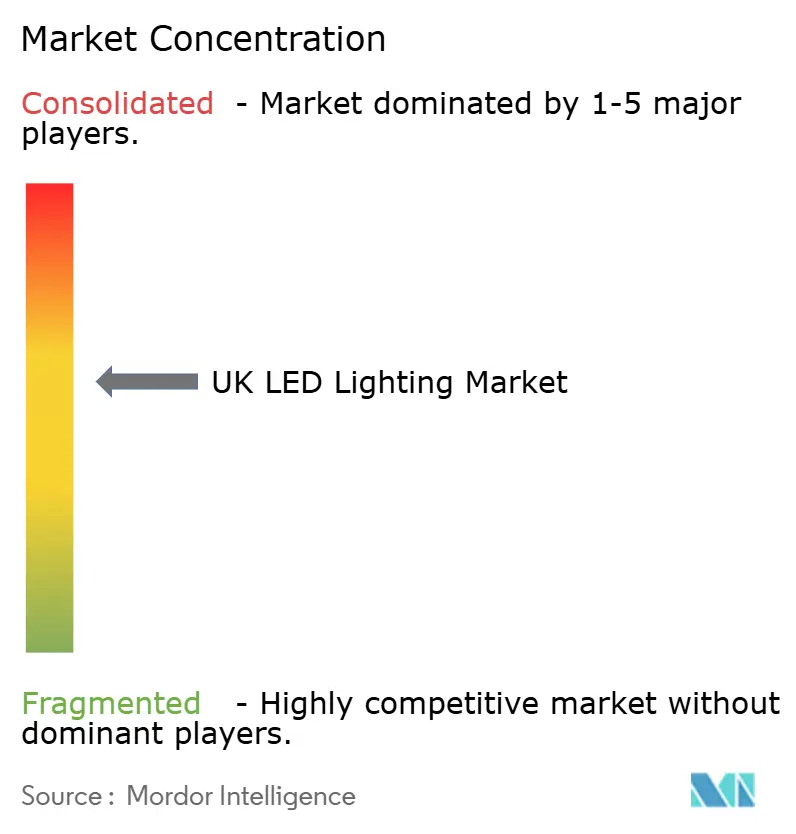
| Market Concentration | Medium |
Major Players *Disclaimer: Major Players sorted in no particular order Image © Mordor Intelligence. Reuse requires attribution under CC BY 4.0. | |
UK LED Lighting Market Analysis by Mordor Intelligence
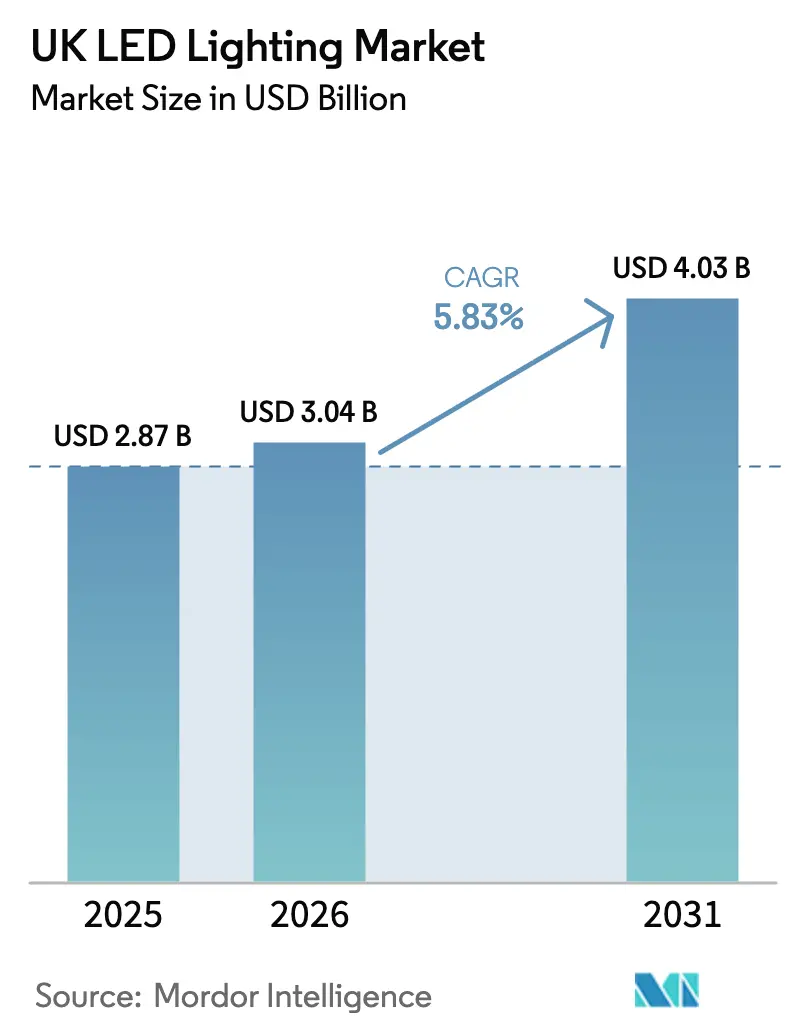
The United Kingdom's LED lighting market size in 2026 is estimated at USD 3.04 billion, growing from 2025 value of USD 2.87 billion with 2031 projections showing USD 4.03 billion, growing at 5.83% CAGR over 2026-2031. Sustained enforcement of energy-efficiency regulations, corporate net-zero programs, and rapidly shortening payback periods are combining to keep the United Kingdom's LED lighting market on a steady expansion path, even as product penetration nears saturation. February 2024 RoHS restrictions ended new sales of most fluorescent lamps, pulling forward retrofit demand across offices, retail, and homes. Post-Brexit industrial incentives are encouraging domestic driver and luminaire production, gradually easing component-sourcing risk.[1]Department for Environment, Food and Rural Affairs, “Exemption under RoHS regulations for mercury in discharge lamps,” gov.uk Municipal smart-city programs, such as Milton Keynes’ connected street-lighting upgrade, demonstrate how integrated controls can deliver energy savings of approximately 70% and annual operating cost reductions of USD 2.5 million. At the same time, rising electricity tariffs reduce simple-payback periods for commercial retrofits to just a few months, reinforcing the role of LED upgrades as a fast and low-disruption decarbonization measure for landlords and facility managers.
Key Report Takeaways
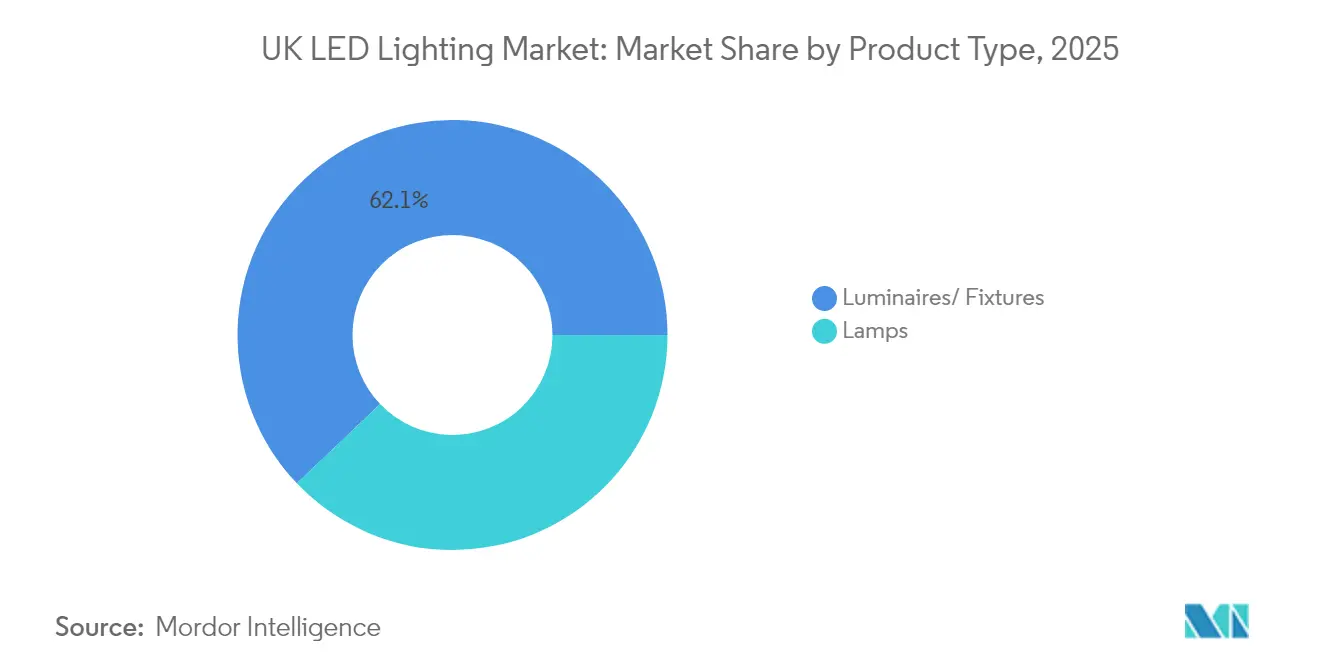
- By product category, luminaires and fixtures held 62.12% of the United Kingdom LED lighting market share in 2025, while lamps recorded the highest projected CAGR at 8.93% through 2031.
- By distribution channel, wholesale and retail captured a 54.05% revenue share in 2025; e-commerce is forecast to expand at a 7.35% CAGR through 2031.
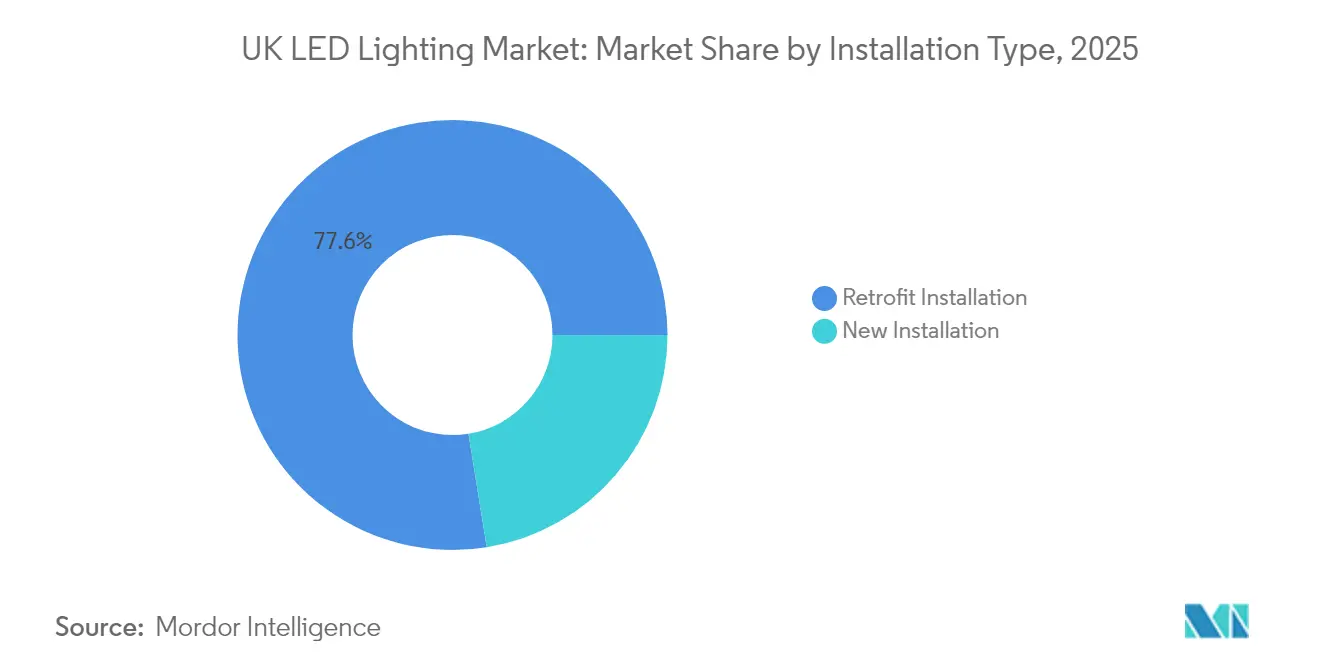
- By installation type, retrofit activity accounted for a 77.55% share of the United Kingdom's LED lighting market size in 2025, and new installations are projected to grow at an 7.95% CAGR through 2031.
- By application, residential lighting accounted for a 19.72% share in 2025, whereas highway and roadway projects are projected to grow at a 9.62% CAGR through 2031.
- By end user, indoor environments accounted for 62.75% of the United Kingdom's LED lighting market size in 2025, while outdoor projects are projected to rise at a 9.12% CAGR over the same horizon.
Note: Market size and forecast figures in this report are generated using Mordor Intelligence’s proprietary estimation framework, updated with the latest available data and insights as of 2026.
UK LED Lighting Market Trends and Insights
Drivers Impact Analysis*
| Driver | (~) % Impact on CAGR Forecast | Geographic Relevance | Impact Timeline |
|---|---|---|---|
| Energy-efficiency regulations are phasing out halogen and fluorescent lamps | +1.8% | National, with accelerated adoption in England and Wales | Short term (≤ 2 years) |
| Corporate decarbonisation targets are accelerating commercial retrofits | +1.2% | National, concentrated in major commercial centers | Medium term (2-4 years) |
| Rising electricity prices are improving LED payback periods | +0.9% | National, with a higher impact in industrial regions | Short term (≤ 2 years) |
| Post-BREXIT industrial policy incentives for green manufacturing | +0.7% | National, with a focus on manufacturing regions | Long term (≥ 4 years) |
| Growth in UK horticulture under controlled-environment farming | +0.5% | Regional, concentrated in agricultural areas | Medium term (2-4 years) |
| Rapid adoption of smart-city connected street-lighting platforms | +0.6% | Urban centers, expanding to smaller municipalities | Medium term (2-4 years) |
| Source: Mordor Intelligence | |||


Energy-Efficiency Regulations Phasing Out Halogen and Fluorescent Lamps
Since February 2024, the RoHS ban on most fluorescent tubes and compact fluorescent lamps has prompted building owners to opt for LED replacements as soon as their existing inventories are depleted. The rule affects large swathes of Britain’s pre-1919 building stock, prompting accelerated retrofit programs even in heritage properties once considered difficult to modernize. Department for Environment, Food and Rural Affairs modelling shows the phase-out will cut 1.26 million tonnes of carbon emissions every year, equivalent to removing more than 500,000 cars from UK roads. Stock-shortage pressures have also nudged distributors to rationalize lamp portfolios in favor of LED, effectively embedding the technology as the default across both commercial trade counters and consumer channels.
Corporate Decarbonization Targets Accelerating Commercial Retrofits
Tighter Minimum Energy Efficiency Standards (MEES) will transition from EPC E today to EPC C by 2028 and EPC B by 2030, putting a large proportion of the national office portfolio at risk of leasing or financing constraints. Boards view LED upgrades as a low-capital, high-visibility win that helps demonstrate progress against net-zero pledges. Lifecycle carbon assessments are increasingly driving procurement, favoring luminaires with long warranties, modular and replaceable drivers, and documented recyclability. Once installed, LEDs integrate seamlessly with building-management systems to provide the energy-tracking evidence required by ESG auditors. Green-loan products offered by major lenders further sweeten project economics by tying interest rebates to verified energy savings.
Rising Electricity Prices Improving LED Payback Periods
Wholesale energy prices peaked in late 2024, squeezing margins for manufacturers, retailers, and landlords alike. Even with the government’s planned 2027 relief that will trim bills for energy-intensive plants by up to USD 40 per MWh, today’s tariffs have already pushed LED retrofit paybacks down to roughly three months for fluorescent lamp swaps in office corridors.[2]Robus, “Fluorescent lighting ban – what you need to know,” robus.com Energy-as-a-service contracts now allow landlords to upgrade lighting without incurring upfront capital, instead sharing a portion of future savings with service providers who own, monitor, and maintain the fittings. The model is particularly attractive to logistics operators and supermarket chains operating 24-hour facilities, where dwell times result in significant kWh savings.
Rapid Adoption of Smart-City Connected Street-Lighting Platforms
Streetlighting budgets are shifting from pure maintenance toward data-enabled infrastructure. Milton Keynes illustrates the opportunity: 18,000 connected LED lanterns slashed energy use by 70%, cut annual lighting costs by USD 2.5 million, and laid the groundwork for sensor-based traffic and air-quality services. New BrightSites Broadband Luminaires transform poles into 60 GHz backhaul nodes, providing councils with a revenue stream from telecoms tenants while extending 5G coverage. Predictive-maintenance analytics reduce emergency call-outs, and adaptive-dimming algorithms strike a balance between safety and dark-sky compliance. Replicability is rising as more authorities tender for service contracts that bundle luminaires, controls, and cloud dashboards into turnkey offerings.
Restraints Impact Analysis*
| Restraint | (~) % Impact on CAGR Forecast | Geographic Relevance | Impact Timeline |
|---|---|---|---|
| Supply-chain volatility for LED drivers and chips | -0.8% | National, with a higher impact on manufacturing regions | Short term (≤ 2 years) |
| High upfront costs for heritage-building retrofits | -0.6% | National, concentrated in historic city centers | Medium term (2-4 years) |
| Skills shortage in qualified lighting designers and installers | -0.9% | National, with acute shortages in urban areas | Long term (≥ 4 years) |
| Consumer push-back on blue-light and light-pollution concerns | -0.4% | National, with a higher impact in residential applications | Medium term (2-4 years) |
| Source: Mordor Intelligence | |||
Supply-Chain Volatility for LED Drivers and Chips
Semiconductor shortages linger despite easing global logistics. Dialight’s USD 7.8 million dispute with its contract manufacturer underscored exposure to driver-board bottlenecks and excess material risks. China retains around 80% of the global gallium output, while its gallium-nitride wafer capacity is soaring, reinforcing dependence risks for UK brands that lack local die fabrication capabilities. Government grants supporting compound-semiconductor hubs in Cardiff and Southampton will improve resilience; however, these facilities will come online only gradually. In the meantime, price swings and lead times of eight to twelve weeks continue to disrupt tender pricing for public-sector lighting projects.
Skills Shortage in Qualified Lighting Designers and Installers
Roughly 170,000 electricians hold active registrations; however, workforce modeling indicates that the nation will need 104,000 additional professionals by 2032 to meet demand from electrification and lighting upgrades.[3]Optima Electrical Training, “The skills shortage crisis,” optima-ect.com The apprenticeship intake stands at around 7,500 per year, which is well below the 10,500 target required just to maintain the current headcount. The gap inflates labor fees and extends scheduling windows, particularly for projects requiring DALI commissioning, emergency lighting integration, or heritage-compliant cabling. In some city centers, installer backlogs now exceed four months, slowing roll-outs even when luminaires are in stock. Regional authorities are rolling out targeted training grants and modular upskilling programs, yet the pipeline effect will take several years to balance demand.
*Our forecasts treat driver/restraint impacts as directional, not additive. The impact forecasts reflect baseline growth, mix effects, and variable interactions.
Segment Analysis
By Product Type: Luminaires Anchor Value while Lamps Accelerate Volume
Integrated fixtures held 62.12% of the United Kingdom's LED lighting market value in 2025, largely because complete fitting replacements allow landlords to combine high-efficacy modules with sensors, emergency batteries, and IoT gateways in a single asset. Contractors also favor fixtures over lamps when dealing with legacy fluorescent troffers, as grid ceilings often require new form factors and diffusers to achieve modern lux levels and minimize glare. Connected-luminaire penetration is rising fastest in offices and logistics sheds where centralized dashboards justify premium upfront cost.
Lamp retrofits, however, post a 8.93% CAGR through 2031, reflecting late-cycle adopters seeking the cheapest compliance path as fluorescent inventory runs out. LED tube form factors have improved compatibility with magnetic and electronic gear, reducing installation time to minutes. In hospitality and retail, decorative filament lamps enable quick ambience upgrades without ceiling rework. As a result, lamp shipments now account for the majority of unit volumes, even though they remain the smaller revenue line within the United Kingdom's LED lighting market.


By Distribution Channel: Digital Platforms Erode Traditional Wholesale Lead
Electrical wholesalers still accounted for 54.05% of industry turnover in 2025, thanks to credit terms, technical counter advice, and same-day pickup availability, which are valued by trade installers. National chains have invested in online ordering portals, yet branch networks remain core for larger contractor frameworks specifying thousands of fittings per project.
E-commerce logs the strongest growth, advancing at a 7.35% CAGR through 2031 as small builders and consumers exploit price transparency and rapid parcel delivery. Manufacturer marketplaces and installer-focused apps, such as LumXpert, create hybrid journeys where project calculations, stock checks, and warranty registration occur within a single digital flow. Direct sales continue to serve mega-projects, such as connected highway corridors, where custom optics, poles, and network design require close collaboration with suppliers from concept to commissioning.
By Installation Type: Retrofit Dominates but New-Build Momentum Builds
Retrofit projects captured 77.55% of 2025 revenue as landlords rushed to remove obsolete fluorescent gear before lamp bans took full effect and before tighter MEES thresholds restricted leasing. Many simple lamp-for-lamp swaps now progress to full fixture replacements to unlock occupancy-sensor and daylight-harvesting features.
New installations are growing at an 7.95% CAGR, driven by commercial warehousing and mixed-use schemes, where lighting control narratives influence planning approvals. Building services consultants are increasingly designing “digital-ready” ceilings that feed data to wider smart-building platforms, ensuring LED is specified from the outset. The United Kingdom LED lighting market, therefore, straddles a mature retrofit wave and an embryonic smart-infrastructure build-out, each reinforcing the other as property owners benchmark performance.
By Application: Highway and Roadway Lighting Jumps Ahead
Residential dwellings still account for 19.72% of market revenue, yet many homes have already completed their primary LED conversion, leaving future gains to connected downlight upgrades and circadian white-tuning niches. In contrast, highway and roadway projects are forecast to grow at a 9.62% CAGR to 2031 as councils pursue carbon budgets and utilize lampposts as telecoms and environmental sensor assets.
Commercial offices remain an evergreen opportunity given looming EPC milestones, while industrial estates value glare-free high-bay LEDs that slash maintenance intervals in tall racks. Niche growth originates from horticulture, where full-spectrum fixtures power vertical farms within former warehouses; Jones Food Company’s Gloucestershire site serves as a prominent example.
By End User: Outdoor Platforms Capture Share from Saturated Indoor Stock
Indoor environments accounted for 62.75% of market spending in 2025, following a decade of ceiling and wall-mounted LED replacements in offices, supermarkets, and schools. Attention now pivots to asset-management software that ensures installed fleets stay optimized through driver forecasts and luminaire health scores.
Outdoor systems are growing at a 9.12% CAGR, thanks to large-scale roadway upgrades, car-park overhauls, and sports-pitch contracts that bundle motion detection and acoustic sensors. Wider awareness of dark-sky principles prompts use of warmer CCTs and adaptive dimming, helping pacify community concerns over glare and ecology. Automotive headlamp applications are currently under regulatory review, with the Department for Transport examining glare thresholds following a surge in driver complaints.
Geography Analysis
London, Manchester, Birmingham, and Edinburgh represent the most active clusters within the United Kingdom LED lighting market, driven by dense commercial property stock, pilot funding for smart-city projects, and proximity to skilled labor pools. Greater London alone accounted for an estimated one-quarter of the 2025 retrofit value, buoyed by corporate headquarters racing to align with Science-Based Targets. Scotland benefits from targeted grants that offset electricity costs for energy-intensive industries and underwrite domestic semiconductor initiatives, creating a budding supply-side hub around Glasgow and Dundee.
Wales demonstrates notable activity in heritage retrofits for listed housing stock, supported by devolved building standards guidance optimized for conservation-grade LED fittings. Northern Ireland participates in UK-wide product standards yet faces unique cross-border logistics factors that tilt procurement toward distributors able to serve both Belfast and Dublin efficiently.
Rural counties continue to struggle with electrician shortages; apprenticeship uptake in remote areas lags behind urban centers by as much as 8:1, hindering the rollout speed for both domestic and municipal lighting programs. Nonetheless, smaller authorities are adopting dim-on-demand roadway schemes that shut off selected lanterns after midnight, demonstrating that even low-density areas contribute to outdoor segment growth. Coastal regions leveraging offshore wind capacity present compelling testbeds for net-zero public lighting corridors that utilize 100% renewable electricity and bidirectional EV-charging street furniture.
Competitive Landscape
Competition in the United Kingdom LED lighting market is moderately concentrated. Signify leads the professional and consumer segments, reporting that 93% of 2024 global revenue was derived from LED products and that it now manages 144 million connected light points worldwide.[4]Signify, “Ecolink brand launch,” signify.com Zumtobel, Osram, FW Thorpe’s Thorlux unit, and domestic specialist Dialight follow, each leveraging niches from industrial high-bays to safety-critical fittings. Market movers are increasingly differentiating themselves through software ecosystems that encompass remote device management, API integration, and energy-report dashboards, surrounding their hardware portfolios.
Vertical integration is accelerating: leading players design in-house drivers, commission regional electronics assembly, and bundle cloud subscriptions. Signify’s 2024 launch of the Ecolink installer-oriented label underscores a channel-segmentation push aimed at price-sensitive trade counters without eroding premium Philips-branded lines. Heritage-grade LED suppliers such as Tamlite and Collingwood, meanwhile, compete on bespoke optics and antique-look housings that satisfy conservation officers.
Component security and local content gain strategic weight as councils embed resilience criteria into procurement to shield against future chip shortages. Cardiff’s compound-semiconductor corridor and Hampshire’s silicon-photonics pilot lines position UK vendors to claim a larger slice of the driver and control board chain by the late decade. Still, Asian OEM dominance in mid-power LED packages keeps global leaders tied to multi-continent sourcing strategies, preserving a level playing field for nimble importers and private-label entrants.
UK LED Lighting Industry Leaders
Signify UK Ltd.
Osram Lighting Ltd.
LEDVANCE Ltd.
Dialight plc
Aurora Lighting Group
- *Disclaimer: Major Players sorted in no particular order

Recent Industry Developments
- April 2025: East Riding of Yorkshire Council began a 12-month trial switching off 600 streetlights on major roads, pairing reflective road-markings and AI monitoring to validate safety and energy outcomes.
- March 2025: The Ministry of Housing, Communities and Local Government updated building-regulation calculation methodologies, raising minimum lighting-efficacy baselines for new builds and major refurbishments.
- January 2025: Signify reported that 93% of global sales are now LED-based, with 144 million connected light points under management, underscoring strategic focus on data-centric services.
- September 2024: Dialight won a USD 7.8 million jury award in a supply-chain dispute with Sanmina, highlighting ongoing component-sourcing volatility.


UK LED Lighting Market Report Scope
Agricultural Lighting, Commercial, Industrial and Warehouse, Residential are covered as segments by Indoor Lighting. Public Places, Streets and Roadways, Others are covered as segments by Outdoor Lighting. Daytime Running Lights (DRL), Directional Signal Lights, Headlights, Reverse Light, Stop Light, Tail Light, Others are covered as segments by Automotive Utility Lighting. 2 Wheelers, Commercial Vehicles, Passenger Cars are covered as segments by Automotive Vehicle Lighting.| Lamps |
| Luminaires / Fixtures |
| Direct Sales |
| Wholesale Retail |
| E-commerce |
| New Installation |
| Retrofit Installation |
| Commercial Offices |
| Retail Stores |
| Hospitality |
| Industrial |
| Highway and Roadway |
| Architectural |
| Public Places |
| Hospitals |
| Horticulture Gardens |
| Residential |
| Automotive |
| Others (Chemicals, Oil and Gas, Agriculture) |
| Indoor |
| Outdoor |
| Automotive |
| By Product Type | Lamps |
| Luminaires / Fixtures | |
| By Distribution Channel | Direct Sales |
| Wholesale Retail | |
| E-commerce | |
| By Installation Type | New Installation |
| Retrofit Installation | |
| By Application | Commercial Offices |
| Retail Stores | |
| Hospitality | |
| Industrial | |
| Highway and Roadway | |
| Architectural | |
| Public Places | |
| Hospitals | |
| Horticulture Gardens | |
| Residential | |
| Automotive | |
| Others (Chemicals, Oil and Gas, Agriculture) | |
| By End User | Indoor |
| Outdoor | |
| Automotive |


Market Definition
- INDOOR LIGHTING - It incorporates all LED based lamps and fixtures/luminaire that are used to illuminate indoor section of residential, commercial, industrial buildings and agricultural lighting. LED offers efficient brightness with higher durability in comparison to other lighting technology.
- OUTDOOR LIGHTING - It incorporates the LED lighting fixtures that is used for illumination for exterior/outdoor illumination. For instance, LED lighting fixtures used to illuminate streets and highways, transport hubs, stadiums and other public places such as parking spaces.
- AUTOMOTIVE LIGHTING - It refers to the lighting fixtures installed for illumination and signaling purposes. It is used in both exterior and interior lighting of the vehicle. Headlamps, fog lamp, daytime running light (DRLs) are examples of exterior light whereas cabin light are interior lights.
- END USER - It refers to the end use application area where the LED fixture will be installed. For instance, in terms of indoor lighting, we have residential, commercial and industrial as end user category. For automotive lighting, primary end user considered are automotive manufacturers and aftermarket sale
| Keyword | Definition |
|---|---|
| Lumen | Lumen is a unit of luminous flux in the International System of Units that is equal to the amount of light given out through a solid angle by a source of one-candela intensity radiating equally in all directions. |
| Footcandle | A foot-candle (or foot-candle, fc, lm/ft2, or ft-c) is a measurement of light intensity. One foot-candle is defined as enough light to saturate a one-foot square with one lumen of light. |
| Colour Rendering Index (CRI) | Color Rendering Index (CRI) is a measurement of how natural colors render under an artificial white light source when compared with sunlight. The index is measured from 0-100, with a perfect 100 indicating that colors of objects under the light source appear the same as they would under natural sunlight. |
| Luminous flux | Luminous flux is a measure of the power of visible light produced by a light source or light fitting. It is measured in lumens (lm). |
| Annual Energy Cost | Annual Energy Cost means the average daily energy consumption multiplied by 365 (days per year), expressed in kilowatt hour per year (kWh/a). |
| Constant voltage drivers | Constant voltage drivers are designed for a single direct current (DC) output voltage. Most common constant voltage drivers (or Power Supplies) are 12VDC or 24VDC. An LED light that is rated for constant voltage usually specifies the amount of input voltage it needs to operate correctly. |
| Constant Current Driver | Constant current LED drivers are designed for a designated range of output voltages and a fixed output current (mA). LEDs that are rated to operate on a constant current driver require a designated supply of current usually specified in milliamps (mA) or amps (A). These drivers vary the voltage along an electronic circuit which allows current to remain constant throughout the LED system. |
| Minimum Energy Performance Standards (MEPS) | Minimum Energy Performance Standards specify the minimum level of energy performance that appliances and equipment must meet or exceed before they can supply or used for commercial purposes. |
| Luminous Efficacy | Luminous efficacy is a measurement commonly used in the lighting industry that indicates the ability of a light source to emit visible light using a given amount of power. |
| Solid State Lighting | Solid-state lighting (SSL) is a type of lighting that uses semiconductor light-emitting diodes (LEDs), organic light-emitting diodes (OLED), or polymer light-emitting diodes (PLED) as sources of illumination rather than electrical filaments, plasma (used in arc lamps such as fluorescent lamps), or gas. |
| Rated Lamp Life | Lamp life, also referred to as rated life, is the time in hours a lamp will last before a percentage of lamps will burn out. |
| Color Temperature | Colour temperature is a scale that measures how ‘warm’ (yellow) or ‘cool’ (blue) the light from a particular source is. It is measured in degrees of the Kelvin scale (abbreviated to K), and the higher the number, the ‘cooler’ the light. The lower the ‘K’ number, the ‘warmer’ the light. |
| Ingress Protection rating (IP rating) | The IP (Ingress Protection) rating of a bulb or light fixture declares the level of protection it has against dirt and water. |
| Fidelity Index | The general colour fidelity index, Rf, represents how closely the colour appearances of the entire sample set are reproduced (rendered) on average by a test light as compared to those under a reference illuminant. |
| Gamut Index | The gamut area is defined as “the area enclosed by a set of test color samples illuminated by a light source, in a two-dimensional chromaticity diagram or a plane of color space.”1 Within a defined color space, a “gamut” describes the subset of colors that can be perceived under specific lighting conditions. |
| Binning | In the lighting industry, the act of "binning" of LEDs is the process of sorting LEDs by certain characteristics, such as color, voltage, and brightness. |
| Accent lighting | Accent lighting, also called highlighting, emphasizes objects by focusing light directly on them. Accent lighting is used inside and outside the home to feature locations such as an entrance or to create dramatic effects. |
| Dimmable driver | A dimming driver has two functions: As a driver, it converts the 230V AC mains input to a low voltage DC output. As a dimmer, it reduces the amount of electrical energy flowing to the LEDs, thereby causing them to dim. |
| Flicker | Flicker is the repeated and frequent variation in the output of a light source over time. |
| Fluorescent | A property of materials defined as the ability to emit light after absorbing electromagnetic radiation such as visible or UV light. |
| Candela | The candela is the unit of luminous intensity in the International System of Units. It measures the light output per unit solid angle emitted from a light source in a specific direction. |
| LUX | Lux is used to measure the amount of light output in a given area - one lux is equal to one lumen per square meter. It enables us to measure the total "amount" of visible light present and the intensity of the illumination on a surface. |
| Uniformity (U0) | The uniformity of lighting has significant effects on visual performance in both indoor and outdoor areas. Uniformity (represented as U0) value can be found by dividing the minimum brightness (Emin) resulting from calculations according to the current lighting order, to the average brightness value (Eavg). |
| Visible Light Spectrum | The visible light spectrum is the segment of the electromagnetic spectrum that the human eye can view. More simply, this range of wavelengths is called visible light. Typically, the human eye can detect wavelengths from 380 to 700 nanometers. |
| Ambient Temperature | Ambient Temperature is the temperature of the air surrounding an electrical enclosure. |
| Current-controlled dimming control | Current-controlled dimming controls LED brightness by varying the applied current using a 0-10V dimmer. Current-controlled dimming is smooth and HD-video friendly. It can only dim to a minimum of 5% of light output. |
| Design Light Consortium | It is a partnership of energy efficiency stakeholders in the United States and Canada to “promote quality, performance and energy efficient lighting solutions for the commercial sector”. |
| Pulse Width Modulation | Pulse-width modulation, or pulse-duration modulation, is a method of controlling the average power delivered by an electrical signal. |
| Surface Mounted Device | A surface mount device (SMD) is an electronic device whose components are mounted or placed directly on the surface of a printed circuit board. |
| Alternating Current | Alternating current is an electric current which periodically reverses direction and changes its magnitude continuously with time, in contrast to direct current, which flows only in one direction. |
| Direct Current | Direct current (DC) is an electric current that is uni-directional, so the flow of charge is always in the same direction. |
| Beam Angle | Beam angle (also called beam spread) is a measure of how light is distributed. On any plane perpendicular to the centerline of the light, the beam angle is the angle between two rays where the light intensity is 50% of the maximum light intensity. |
| LED Based Solar High Mast Lighting Systems | A Solar LED High Mast Light is a raised source of High illumination lights (6~8 lights) and with high intensity on the middle of major junctions (Ring roads, Outer Ring roads), turned on or lit automatically in the absence of light (at specified timings or at periodic times, every night). |
| Surface Mounted Diode (SMD) LEDs | A surface mount diode is a type that emits light and is flat mounted and soldered onto a circuit board. |
| Chip on Board (COB) LEDs | A COB LED is basically multiple LED chips (usually 9 or more) glued directly onto a substrate by the manufacturer to form a single module. |
| Dual In-Line Package (DIP) LEDs | A dual in-line package (DIP or DIL) is an electronic component package with a rectangular case and two parallel rows of electrical connector pins. |
| Graphene LED Lights | A graphene LED light bulb is simply an LED light bulb where the filament has been coated in graphene. A graphene LED bulb is reported to be 10% more efficient than regular LED light bulbs and they are cheaper to manufacture and buy. |
| LED Corn Bulbs | LED Corn lights are designed as an energy efficient alternative to high intensity discharge (HID) and SON lamps. It uses a large number of LEDs on a metal structure to provide sufficient light. This arrangement of LEDs looks a lot like a corn cob, hence the name "corn light". |
| Per Capita Income | Per capita income or total income measures the average income earned per person in a given area in a specified year. It is calculated by dividing the area's total income by its total population. Per capita income is national income divided by population size. |
| Charging Stations | A charging station, also known as a charging station or electric vehicle utility, is a power supply that provides electrical energy for charging plug-in electric vehicles. |
| Headlight | A headlight is a light that is mounted on the front of a car and illuminates the road in front of it. Low beam and high beam LED headlights are additional categories for these LED headlights. |
| Day Time Running Light (DRLs) | A daytime running lamp is a white, yellow, or amber lighting device mounted on the front of a road-going motor vehicle or bicycle. |
| Directional Signal Light | Directional signal lights are the front and rear lights on an automobile that flash to show the direction of a turn. |
| Stop Light | A red light that is mounted to the back of a car and turns on when the brakes are used to show that the car is stopped. |
| Reverse Light | The reverse light is at the back of the vehicle to indicate its backward motion. |
| Tail Light | A red light that can be seen in the dark is mounted on the rear of a road vehicle. Stop, reverse, and directional signal lights are all part of it. |
| Fog Light | Bright lights in automobiles used to increase visibility on the road in foggy conditions or to warn other drivers of the presence of the vehicle. |
| Passenger Vehicle | A passenger vehicle is a road vehicle, other than a moped or a motorcycle, intended for the transportation of people and designed for up to 8 to 9 seats. |
| Commercial Vehicle | A commercial vehicle (Bus, Truck, Van) is any type of motor vehicle used to transport goods or pay passengers. |
| Two Wheelers (2W) | A two-wheeler is a vehicle that runs on two wheels. |
| Streets & Roadways | Both roads and streets refer to hard, flat surfaces on the ground on which vehicles, people, and animals can travel. Since streetways are usually in cities and towns, they often have houses and buildings on both sides. The roadway is in the countryside and sometimes passes through forests and fields |
| Horticulture Lighting | Horticulture is the science and art of sustainably growing, producing, marketing and using high quality, intensively cultivated food and ornamental plants. |


Research Methodology
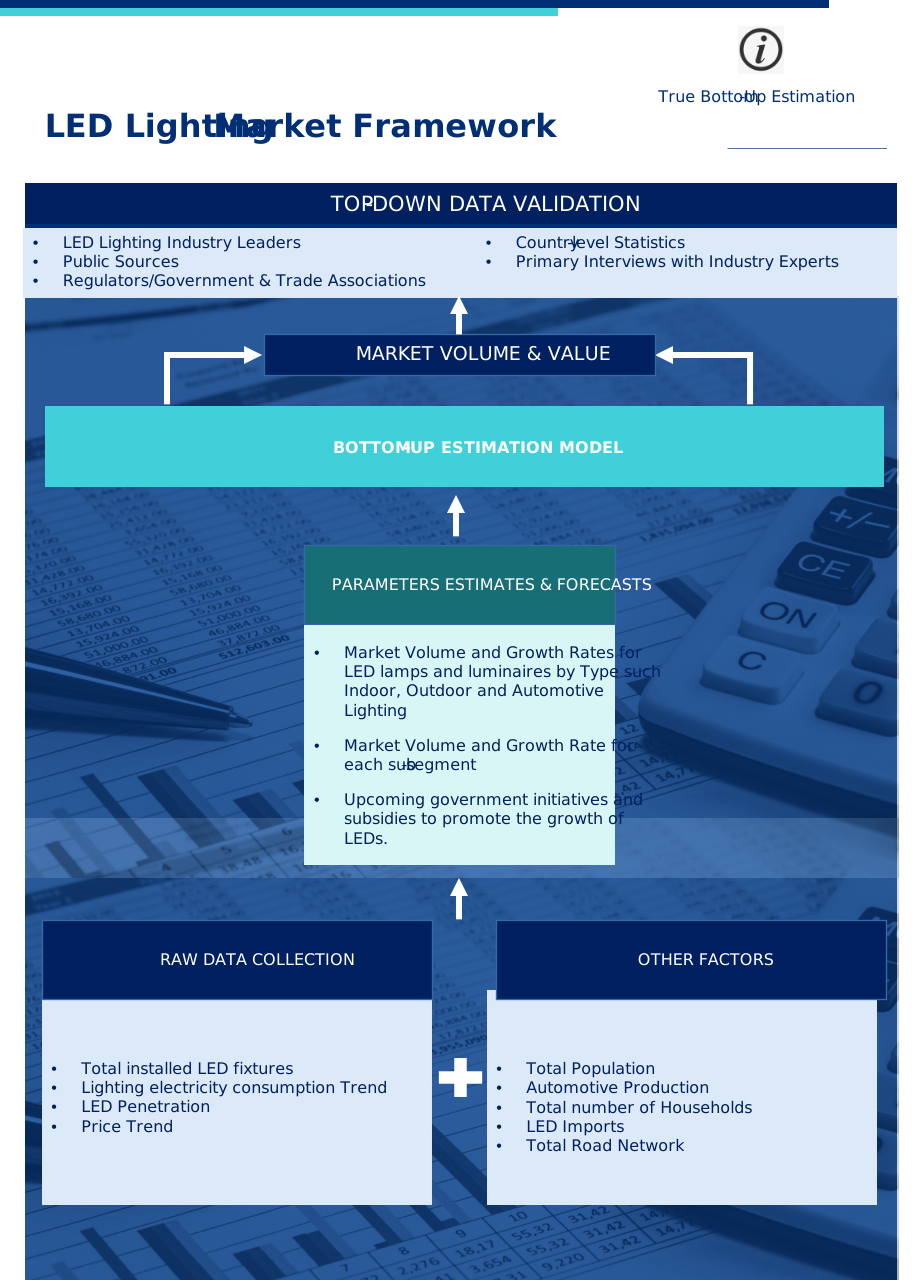
Mordor Intelligence has followed the following methodology in all our data center reports.
- Step 1: Raw Data Collection: To understand the market, initially, all crtical data points were identified. Critical information about countries and regions of interest including Per-capita Income, Population, Automotive Production, Interest rate on Auto-Loans, Number of Automobiles on Road, Total LED Import, Lighting Electricity Consumption among others were recorded or estimated based on internal calculations.
- Step 2: Identify Key Variables: To build a robust forecasting model, key variables such as Number of Households, Automotive Production, Road Networks among others were identified. Through an iterative process, the variables required for the market forecast were set, and the model was built using these variables.
- Step 3: Build a Market Model: Based on data and critical industry trend data (variables), including LED pricing, LED penetration rate, and project macro and micor economic factors were utilized for building the market forecasting.
- Step 4: Validate and Finalize: In this crucial step, all market numbers and variables derived through an internal mathematical model were validated through an extensive network of primary research experts from all the markets studied. The respondents are selected across levels and functions to generate a holistic picture of the market studied.
- Step 5: Research Outputs: Syndicated Reports, Custom Consulting Assignments, Databases & Subscription Platforms





 Your data is secure and never sold or shared.


