
Biologics Contract Manufacturing Market Size and Share
| Study Period | 2019 - 2030 |
| Market Size (2025) | USD 35.27 Billion |
| Market Size (2030) | USD 57.48 Billion |
| CAGR (2025 - 2030) | 10.50% |
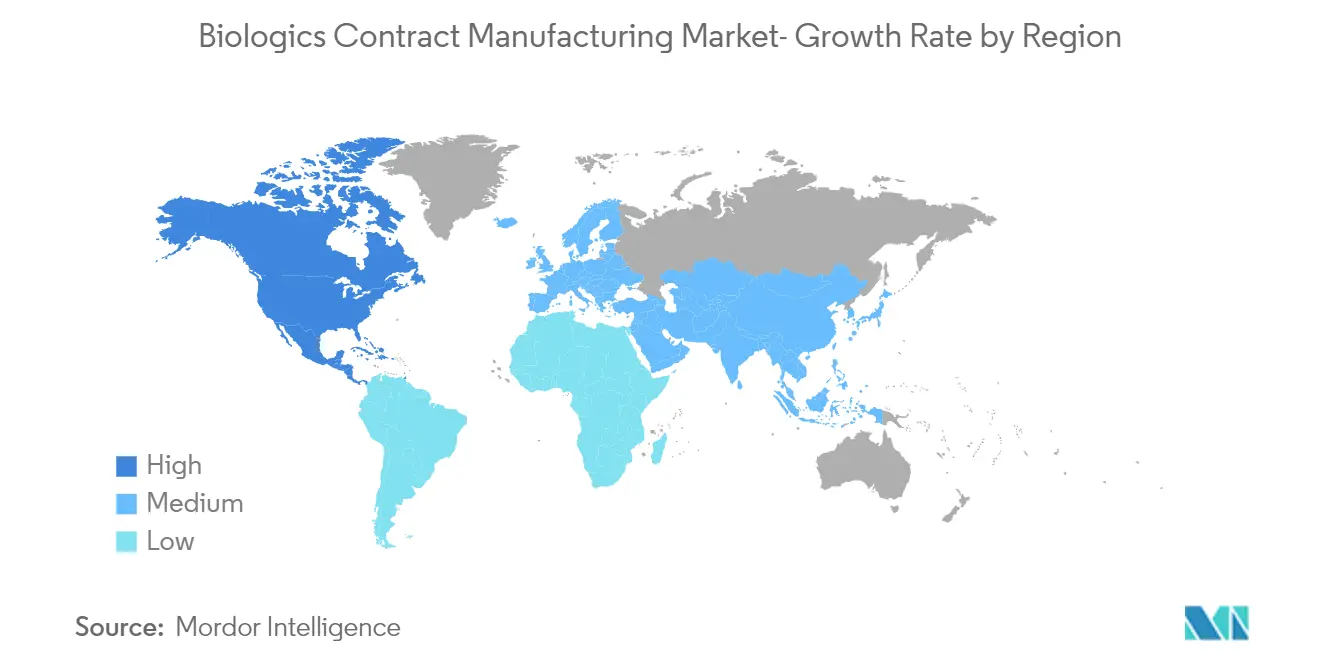
| Fastest Growing Market | Asia Pacific |
| Largest Market | North America |
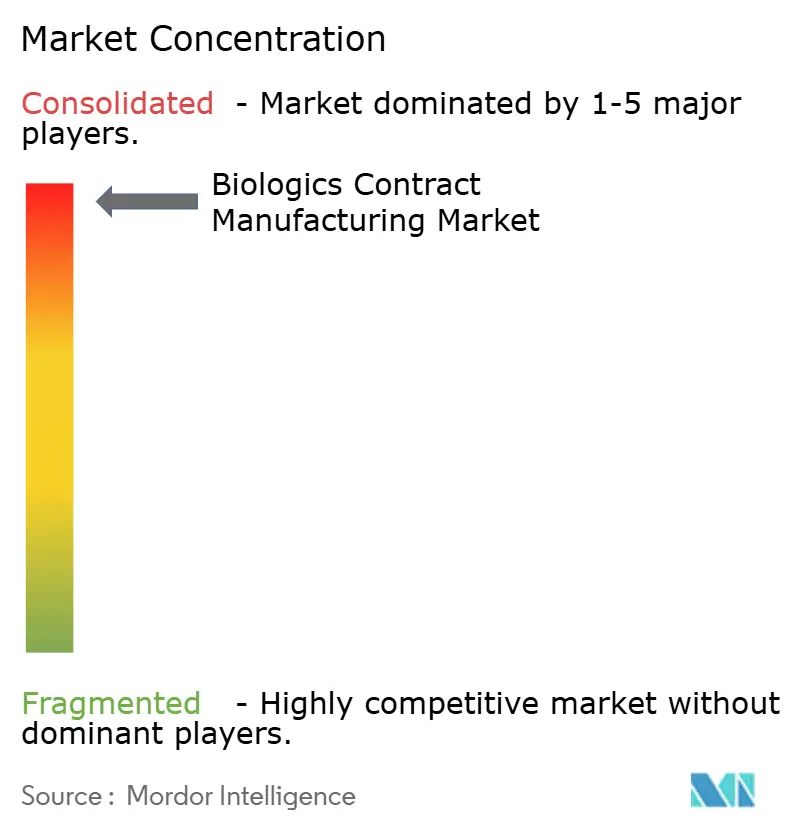
| Market Concentration | High |
Major Players *Disclaimer: Major Players sorted in no particular order |
Biologics Contract Manufacturing Market Analysis by Mordor Intelligence
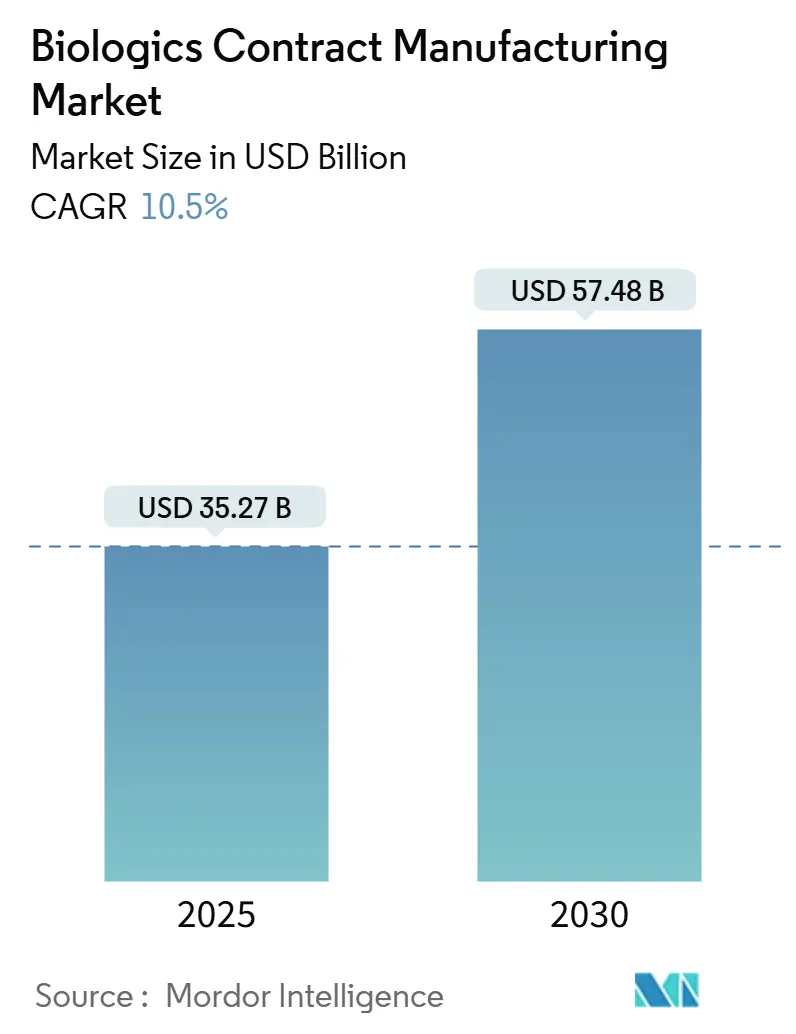
The Biologics Contract Manufacturing Market size is estimated at USD 35.27 billion in 2025, and is expected to reach USD 57.48 billion by 2030, at a CAGR of 10.5% during the forecast period (2025-2030).
Several factors, such as the increasing prevalence of chronic diseases, increasing product approvals, and rising investments in manufacturing facilities, are expected to drive biologics contract manufacturing market growth over the forecast period.
Furthermore, the rising prevalence of chronic diseases is significantly impacting market growth. The increasing burden of these diseases is driving the demand for innovative biologics to address unmet medical needs. For instance, in September 2024, a report from the British Heart Association revealed that approximately 640 million people, or 1 in 12 globally, suffer from heart or circulatory diseases. Additionally, in May 2024, the World Health Organization (WHO) highlighted that cardiovascular diseases (CVDs) dominate as the leading cause of disability. Notably, men face a risk nearly 2.5 times greater than women. Furthermore, individuals aged 30-69 in Eastern Europe and Central Asia grapple with a risk that’s nearly fivefold higher than their peers in Western Europe. Furthermore, the rising number of approvals for novel drugs and treatments is expected to contribute significantly to the market's growth. For instance, in 2024, the US Food and Drug Administration (FDA) Center for Drug Evaluation and Research (CDER) authorized 50 new molecular entities (NMEs), comprising 32 new chemical entities (NCEs) and 18 biological entities (NBEs). The growing need for innovative biologics and regulatory approvals is expected to sustain the market's upward trajectory.
In addition, investments in the biologics contract manufacturing market are accelerating, underscoring its essential role in advancing innovative therapies. For instance, in October 2024, Johnson & Johnson committed over USD 2 billion to establish a state-of-the-art biologics manufacturing facility in North Carolina, United States. This facility aims to enhance the production of the company's innovative biologics, aligning with its goal of launching over 70 new therapies and products by 2030. With a focus on oncology, immunology, and neuroscience, the facility will utilize advanced technologies to optimize and streamline manufacturing operations. This development reflects the growing importance of biologics contract manufacturing in meeting future healthcare demands.
Therefore, owing to factors such as the increasing prevalence of chronic diseases, increasing product approvals for biologics, and rising investments in biologics manufacturing facilities, the biologics contract manufacturing market is anticipated to witness growth over the forecast period. However, the high initial investment & manufacturing costs, as well as challenges associated with biologics manufacturing, are expected to restrain market growth.
Global Biologics Contract Manufacturing Market Trends and Insights
The Monoclonal Antibodies (mAbs) Segment is Expected to Witness Significant Growth Over the Forecast Period.
The therapeutic applications of monoclonal antibodies include treatments for asthma, autoimmune diseases, cancer, poisoning, septicemia, substance abuse, and viral infections. Moreover, the increasing prevalence of cancer and the rising demand for effective therapies, strategic investments and government initiatives, and increasing demand for biologics are expected to create substantial opportunities for market players over the forecast period. Moreover, the biologics contract manufacturing market is witnessing significant growth, driven by the increasing prevalence of cancer and the rising demand for effective treatments.
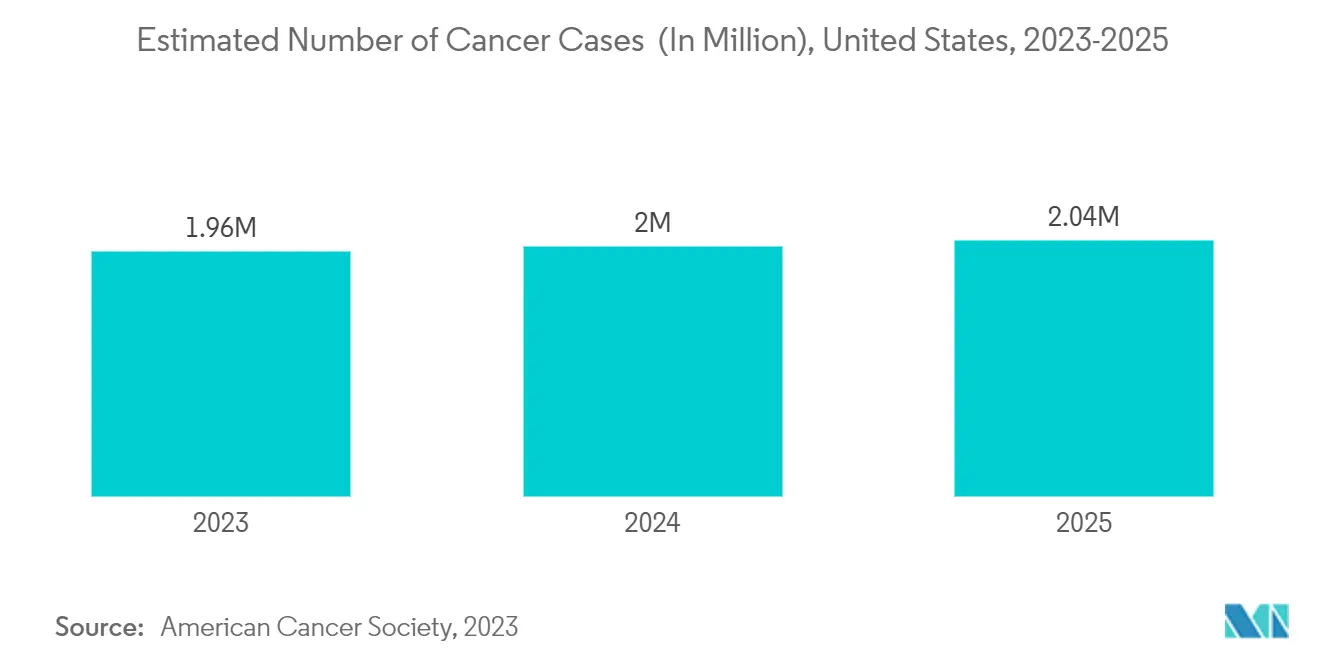
Moreover, the monoclonal antibodies (mAbs) segment is witnessing significant growth, driven by the increasing prevalence of cancer and the rising demand for effective treatments. For instance, a study by the American Cancer Society estimated approximately 1.96 million new cancer cases in the United States in 2023. Additionally, they estimate around 89,100 new lymphoma diagnoses in 2024. This high prevalence of cancer is fueling the need for targeted therapies, thereby driving segment growth over the forecast period. Furthermore, a December 2023 article published in the Cells Journal highlighted advancements in cancer treatment. It reported the development of a series of monoclonal antibodies with therapeutic potential against cancer. Of these, 91 were utilized in clinical settings, either as standalone treatments or in combination with chemotherapeutic agents or other antibodies, including immune checkpoint inhibitors.
In addition, rising research and development activities in the development of monoclonal antibodies are fueling the expansion of the segment. For instance, in March 2023, Catalent Inc. signed a licensing agreement with Bhami Research Laboratory (BRL). This collaboration enables Catalent to leverage BRL's advanced formulation technology, which is designed for the subcutaneous delivery of high-concentration biologics. Through this partnership, Catalent aims to enhance product delivery efficiency and reduce the viscosity of biological formulations. BRL's technology is highly adaptable, supporting a broad range of monoclonal antibodies and fusion proteins. This strategic move underscores the growing importance of innovation in biologics manufacturing.
Additionally, strategic investments and government initiatives are enabling companies to expand their capabilities to address the growing demand, driving segment growth over the anticipated period. For instance, in September 2024, Eurofins CDMO Alphora Inc. unveiled plans to develop a cutting-edge GMP Biologics manufacturing facility in Ontario, Canada. This initiative aims to strengthen the company's position in the biologics contract manufacturing market. The new facility, spanning 50,000 sq ft, will focus on producing monoclonal antibodies (mAbs) and protein therapies for both clinical and commercial applications. With substantial support from the Federal Government of Canada and funding from the Strategic Initiative Fund (SIF), the facility is expected to enhance Canada's biomanufacturing capabilities, with completion targeted for April 2026. This development underscores the market's ongoing evolution and potential growth.
Furthermore, contract manufacturing organizations are expanding their capabilities to meet the increasing demand for biologics and provide efficient manufacturing solutions for pharmaceutical companies. For instance, in June 2023, AGC Biologics launched AGCellerate, a program that offers IND-ready GMP material for biopharmaceutical developers. The program specifies guaranteed quantities with fixed timelines and costs to support project advancement through the development and clinical phases. AGC Biologics offers the mAb program and plans to expand to other modalities in the coming year. The program uses the company's proprietary Chef-1 platform, which has received approval from the FDA (Food and Drug Administration) and EMA (European Medicines Agency). This platform has been implemented in four commercial products and currently supports 54 molecules in various stages of clinical development. These developments indicate a significant expansion in the segment, driven by increasing demands from the pharmaceutical industry.
Hence, due to the abovementioned factors, the monoclonal antibodies (mAbs) segment is expected to witness significant growth in the upcoming years.


North America is Expected to Dominate the Market Over the Forecast Period
North America is expected to dominate the market owing to factors such as increasing investments in research and development activities aimed at biologics innovation. The adoption of advanced production technologies and the growing demand for specialized expertise and cutting-edge manufacturing facilities are further propelling market expansion. These factors are enabling companies to meet the rising demand for biologics while maintaining cost efficiency and scalability.
Moreover, companies are enhancing their biologics manufacturing capabilities by advancing specialized expertise and facilities to address the growing demand for emerging therapeutic modalities. For instance, in June 2024, Bionova Scientific, the United States subsidiary of Asahi Kasei Medical, launched a new service line focused on plasmid DNA. To support this expansion, the company set up a dedicated facility in Texas, United States. Bionova, recognized for its expertise in next-generation antibody-drug process development, is expanding into the high-growth cell and gene therapy markets. Leveraging its manufacturing expertise, GMP capabilities, and industry connections, the company aims to advance these innovative therapies. Its new Texas facility will focus on plasmid process development and GMP manufacturing. Service operations for process development were scheduled to begin in Q1 2025, with GMP manufacturing commencing later in the year. Such developments enable key market players to address evolving industry demands effectively.
Furthermore, increased investments in research and development activities are significantly contributing to the expansion of the market during the forecast period. These investments are enabling advancements in biologics manufacturing processes, driving innovation, and addressing the growing demand for biologics. For instance, in November 2024, AstraZeneca revealed a significant USD 3.5 billion investment in the United States to enhance its research and manufacturing capabilities by the end of 2026. This expansion includes the establishment of a state-of-the-art R&D center in Kendall Square, Cambridge, Massachusetts; a next-generation biologics manufacturing facility in Maryland; cell therapy manufacturing capacities on both the West and East Coasts; and specialized manufacturing operations in Texas. Such strategic initiatives are expected to strengthen the market's growth trajectory.
Additionally, significant investments in advanced infrastructure and state-of-the-art production technologies are driving notable growth in the biologics contract manufacturing market in this country. For instance, in July 2024, BeiGene, Ltd. launched its flagship United States facility at the Princeton West Innovation Campus in New Jersey, United States. This state-of-the-art facility integrates advanced biologics manufacturing capabilities with a dedicated clinical research and development center. With a pipeline of over 30 molecules in clinical or commercial stages, BeiGene's expansive 42-acre site is designed to scale production for its innovative medicines. This USD 800 million investment, marking the culmination of a three-year initiative, strengthens BeiGene's integrated manufacturing and R&D presence in the United States. The market is expected to continue benefiting from such strategic investments.
Therefore, owing to the factors mentioned above, such as the growing need for specialized expertise and facilities, increasing research and development investments, and rising advanced infrastructure and innovative production technologies, the North American region is set to witness significant growth in the biologics contract manufacturing market.

Competitive Landscape
The biologics contract manufacturing market is consolidated due to the presence of several companies operating globally and regionally. Leading companies shaping the market include both global players and notable local firms. Key participants were Wuxi Biologics, Boehringer Ingelheim International GmbH, Lonza, FUJIFILM Diosynth Biotechnologies, and Samsung Biologics, among others.
Biologics Contract Manufacturing Industry Leaders
Wuxi Biologics
Boehringer Ingelheim International GmbH
Lonza
FUJIFILM Diosynth Biotechnologies
Samsung Biologics
- *Disclaimer: Major Players sorted in no particular order

Recent Industry Developments
- January 2025: Samsung Biologics signed a contract manufacturing agreement worth over USD 1.4 billion with an undisclosed European pharmaceutical company. The deal, set to run through December 2030, will involve production at the company’s Songdo, South Korea, facility. By April 2025, Samsung plans to complete its fifth biomanufacturing plant at the new Bio Campus II, increasing its global capacity by 180,000 L to 784,000 L. To address growing biologics demand, the company is also considering a sixth plant, which would raise capacity to 964,000 L, pending board approval. The company expanded its services to include antibody-drug conjugates (ADCs), leveraging its expertise in large-scale antibody manufacturing and process engineering. These services cover late-stage discovery, development, and conjugation.
- November 2024: FUJIFILM Diosynth Biotechnologies entered into a multi-year manufacturing supply agreement with TG Therapeutics, Inc. for BRIUMVI (ublitiximab-xiiy), a United States FDA-approved therapy for relapsing forms of multiple sclerosis (RMS). Under the agreement, FUJIFILM Diosynth Biotechnologies managed the secondary manufacturing supply of BRIUMVI at its advanced biopharmaceutical facility in North Carolina, United States, which was scheduled to become fully operational in 2025.


Global Biologics Contract Manufacturing Market Report Scope
Biologics contract manufacturing (BCM) refers to pharmaceutical companies outsourcing the production of biological drugs to specialized contract development and manufacturing organizations (CDMOs). This allows companies to focus on core activities like research and commercialization. At the same time, CDMOs handle complex processes such as upstream and downstream processing, quality control, regulatory compliance, and supply chain management, providing end-to-end support throughout the drug development lifecycle.
The biologics contract manufacturing market is segmented into molecule, application, source, and geography. By molecule, the market is segmented into monoclonal antibodies (mAbs), recombinant hormones/proteins, cell & gene-based biologics, vaccines, antisense and molecular therapy, and others. The other molecules include antibody-drug conjugates (ADCs), RNAi, and therapeutic peptides, among others. By application, the market is segmented into oncology, cardiovascular diseases, autoimmune diseases, metabolic diseases, infectious diseases, and others. The other applications include genetic diseases and neurological diseases, among others. By source, the market is segmented into mammalian and non-mammalian. By geography, the market is segmented into North America, Europe, Asia-Pacific, South America, Middle East and Africa. For each segment, the market sizing and forecasts have been done based on revenue (USD).
| Monoclonal Antibodies (mAbs) |
| Recombinant Hormones/Proteins |
| Cell & Gene-based Biologics |
| Vaccines |
| Antisense and Molecular Therapy |
| Others |
| Oncology |
| Cardiovascular Diseases |
| Autoimmune Diseases |
| Metabolic Diseases |
| Infectious Diseases |
| Others |
| Mammalian |
| Non-mammalian |
| North America | United States |
| Canada | |
| Mexico | |
| Europe | Germany |
| United Kingdom | |
| France | |
| Italy | |
| Spain | |
| Rest of Europe | |
| Asia Pacific | China |
| Japan | |
| India | |
| Australia | |
| South Korea | |
| Rest of Asia-Pacific | |
| Middle East and Africa | GCC |
| South Africa | |
| Rest of Middle East and Africa | |
| South America | Brazil |
| Argentina | |
| Rest of South America |
| By Molecule | Monoclonal Antibodies (mAbs) | |
| Recombinant Hormones/Proteins | ||
| Cell & Gene-based Biologics | ||
| Vaccines | ||
| Antisense and Molecular Therapy | ||
| Others | ||
| By Application | Oncology | |
| Cardiovascular Diseases | ||
| Autoimmune Diseases | ||
| Metabolic Diseases | ||
| Infectious Diseases | ||
| Others | ||
| By Source | Mammalian | |
| Non-mammalian | ||
| Geography | North America | United States |
| Canada | ||
| Mexico | ||
| Europe | Germany | |
| United Kingdom | ||
| France | ||
| Italy | ||
| Spain | ||
| Rest of Europe | ||
| Asia Pacific | China | |
| Japan | ||
| India | ||
| Australia | ||
| South Korea | ||
| Rest of Asia-Pacific | ||
| Middle East and Africa | GCC | |
| South Africa | ||
| Rest of Middle East and Africa | ||
| South America | Brazil | |
| Argentina | ||
| Rest of South America | ||


Key Questions Answered in the Report
How big is the Biologics Contract Manufacturing Market?
The Biologics Contract Manufacturing Market size is expected to reach USD 35.27 billion in 2025 and grow at a CAGR of 10.5% to reach USD 57.48 billion by 2030.
What is the current Biologics Contract Manufacturing Market size?
In 2025, the Biologics Contract Manufacturing Market size is expected to reach USD 35.27 billion.
Who are the key players in Biologics Contract Manufacturing Market?
Wuxi Biologics, Boehringer Ingelheim International GmbH, Lonza, FUJIFILM Diosynth Biotechnologies and Samsung Biologics are the major companies operating in the Biologics Contract Manufacturing Market.
Which is the fastest growing region in Biologics Contract Manufacturing Market?
Asia Pacific is estimated to grow at the highest CAGR over the forecast period (2025-2030).
Which region has the biggest share in Biologics Contract Manufacturing Market?
In 2025, the North America accounts for the largest market share in Biologics Contract Manufacturing Market.
What years does this Biologics Contract Manufacturing Market cover, and what was the market size in 2024?
In 2024, the Biologics Contract Manufacturing Market size was estimated at USD 31.57 billion. The report covers the Biologics Contract Manufacturing Market historical market size for years: 2019, 2020, 2021, 2022, 2023 and 2024. The report also forecasts the Biologics Contract Manufacturing Market size for years: 2025, 2026, 2027, 2028, 2029 and 2030.
Page last updated on:
Biologics Contract Manufacturing Market Report
Statistics for the 2025 Biologics Contract Manufacturing market share, size and revenue growth rate, created by Mordor Intelligence™ Industry Reports. Biologics Contract Manufacturing analysis includes a market forecast outlook for 2025 to 2030 and historical overview. Get a sample of this industry analysis as a free report PDF download.


 Your data is secure and never sold or shared.


