
Biobank Equipment Market Size and Share
Market Overview
| Study Period | 2020 - 2031 |
|---|---|
| Market Size (2026) | USD 39.18 Billion |
| Market Size (2031) | USD 47.85 Billion |
| Growth Rate (2026 - 2031) | 4.08 % |
| Fastest Growing Market | Asia Pacific |
| Largest Market | North America |
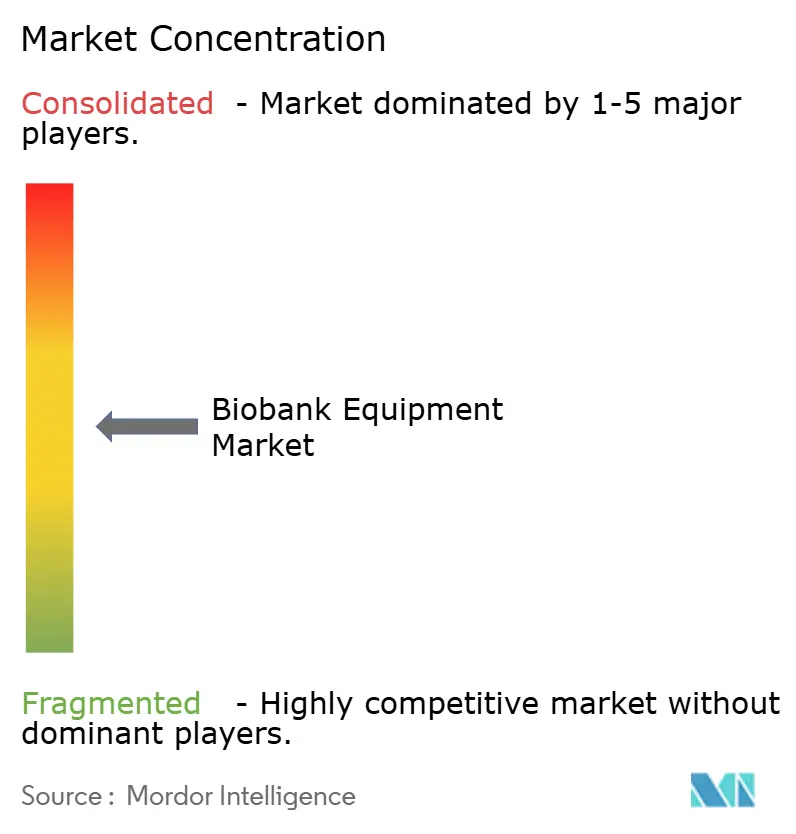
| Market Concentration | Medium |
Major Players *Disclaimer: Major Players sorted in no particular order Image © Mordor Intelligence. Reuse requires attribution under CC BY 4.0. | |
Biobank Equipment Market Analysis by Mordor Intelligence
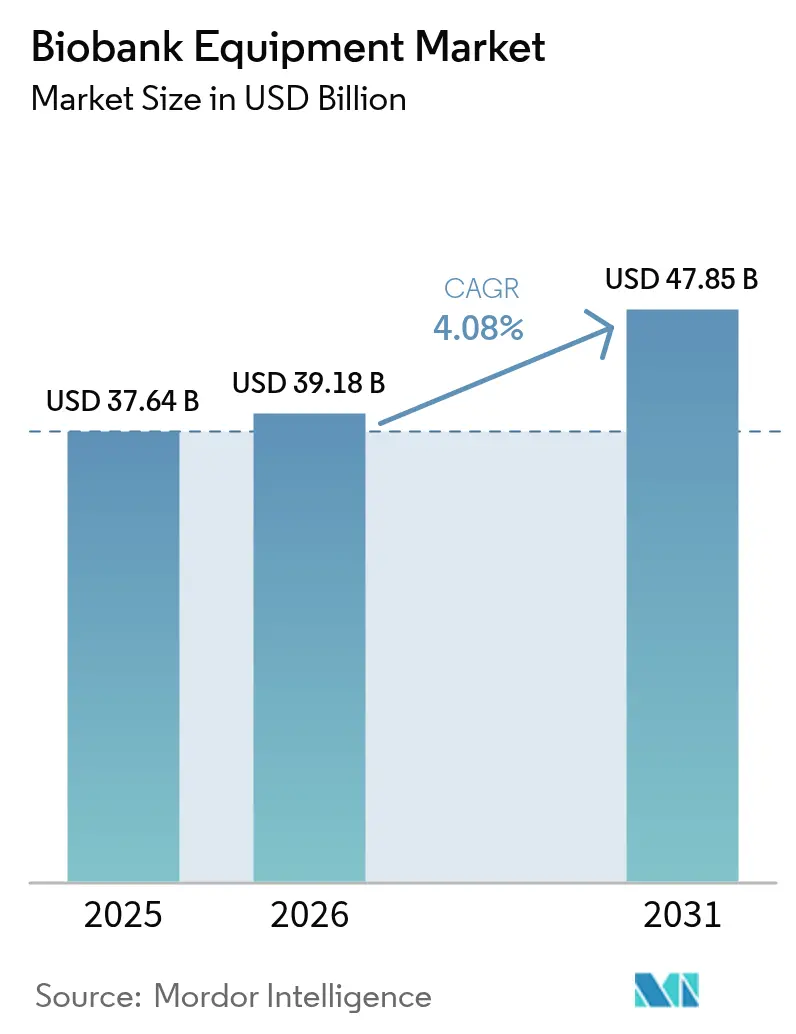
The Biobank Equipment Market size was valued at USD 37.64 billion in 2025 and estimated to grow from USD 39.18 billion in 2026 to reach USD 47.85 billion by 2031, at a CAGR of 4.08% during the forecast period (2026-2031).
Demand concentrates on ultra-low temperature systems that hold 52.58% share in 2024, reflecting their role in preserving advanced-therapy samples. Growth also comes from alarm and monitoring platforms that secure distributed biorepositories, the rise of regenerative-medicine pipelines, and regulatory moves that standardize quality across borders. North America leads spending, but Asia-Pacific shows the strongest momentum as regional reforms ease genetic-resource controls and boost precision-medicine programs. Competitive dynamics hinge on energy-efficient designs, AI-driven inventory tools, and acquisition campaigns by global suppliers that want scale and regulatory depth.
Key Report Takeaways
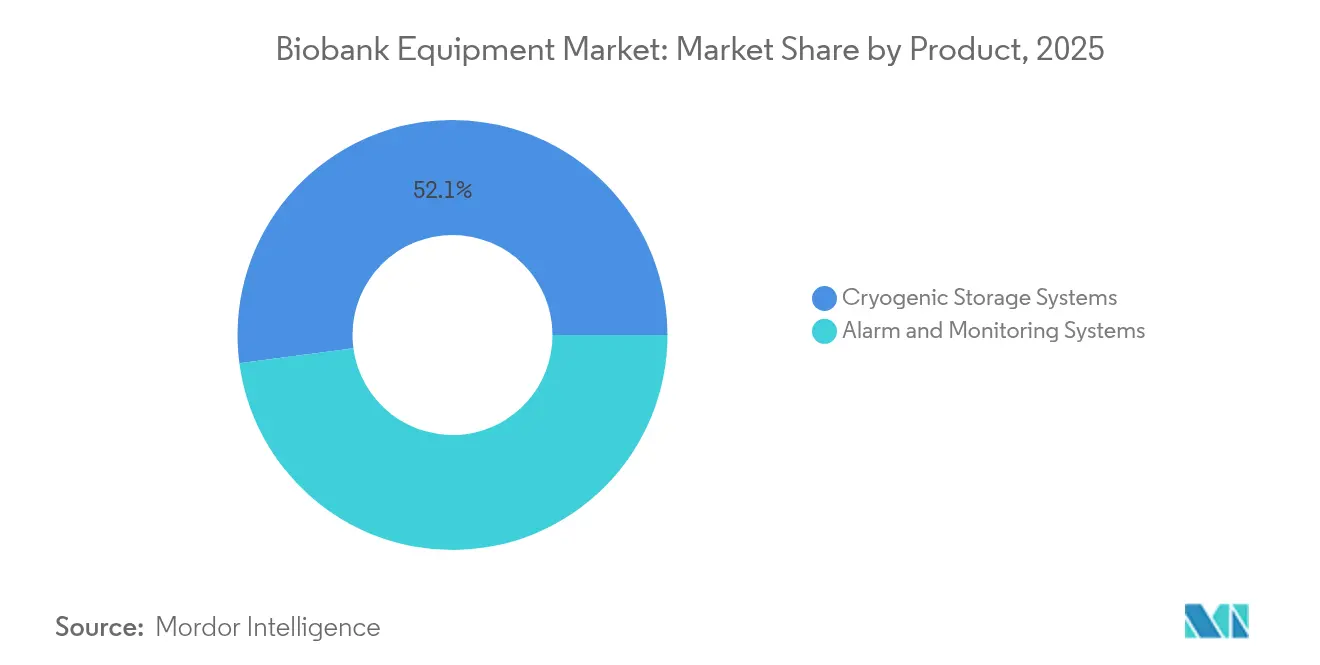
- By product, cryogenic storage systems held 52.10% of the biobank equipment market share in 2025, while freezers are projected to expand at a 5.45% CAGR to 2031.
- By application, regenerative medicine had a 36.20% share of the biobank equipment market in 2025 and is advancing at a 6.12% CAGR through 2031.
- By end user, biobanks and biorepositories led with a 44.10% share in 2025, whereas hospitals and diagnostic centers are set to grow at a 4.95% CAGR to 2031.
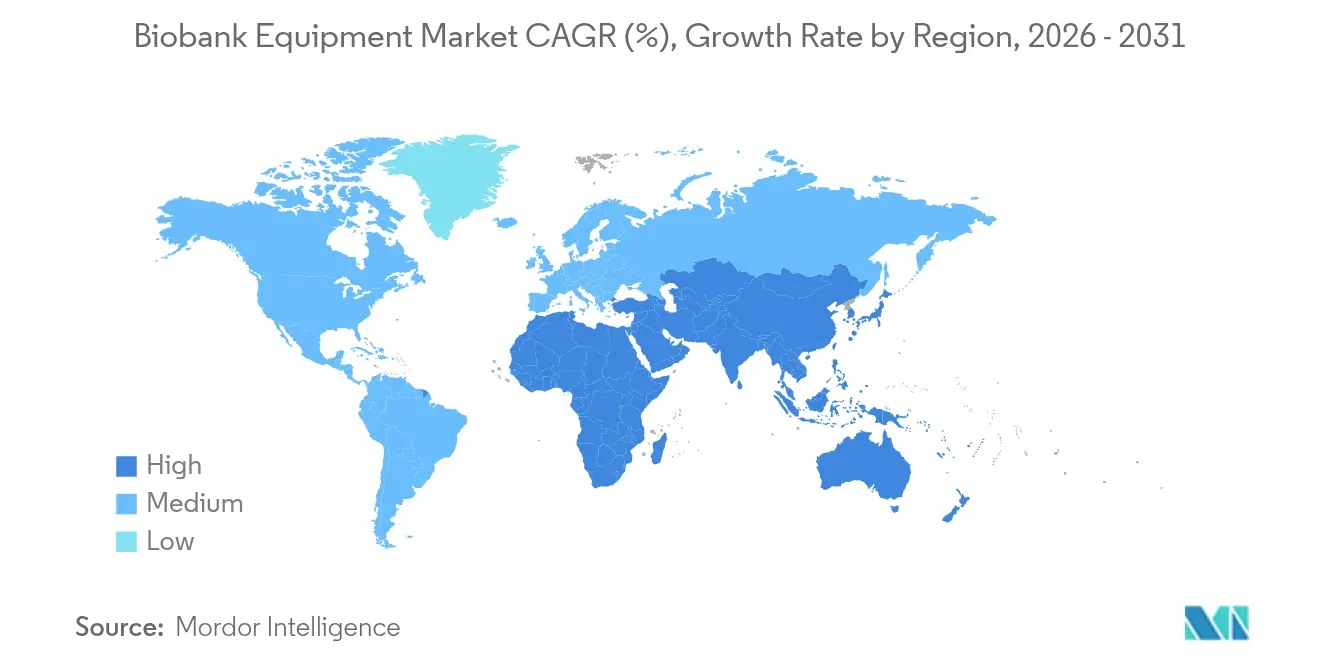
- By geography, North America commanded 37.20% of the biobank equipment market in 2025, but Asia-Pacific is forecast to post the fastest 7.05% CAGR to 2031.
Note: Market size and forecast figures in this report are generated using Mordor Intelligence’s proprietary estimation framework, updated with the latest available data and insights as of 2026.
Market Trends and Insights
Drivers Impact Analysis of Biobank Equipment Market*
| Driver | (~) % Impact on CAGR Forecast | Geographic Relevance | Impact Timeline |
|---|---|---|---|
| Progress in Stem-Cell and Regenerative Medicine | +1.2% | Global, with concentration in North America & EU | Medium term (2-4 years) |
| Rising Prevalence of Chronic Diseases | +0.8% | Global, with higher impact in aging populations | Long term (≥ 4 years) |
| Increased Funding from Governments and NGOs | +0.7% | North America, EU, and emerging APAC markets | Short term (≤ 2 years) |
| Growing Demand for Precision-Medicine Samples | +0.9% | North America & EU primarily, expanding to APAC | Medium term (2-4 years) |
| Expansion of Decentralized and Near-Patient Biobanks | +0.6% | Global, with early adoption in developed markets | Long term (≥ 4 years) |
| AI-Enhanced Inventory and Access Management | +0.4% | Developed markets initially, scaling globally | Medium term (2-4 years) |
| Source: Mordor Intelligence | |||
Progress in Stem-Cell and Regenerative Medicine
Regulatory approvals for CAR-T and other cell therapies are lifting the bar for storage precision, prompting biobank operators to adopt ultra-low freezers able to hold viability over extended timelines.[1]Thermo Fisher Scientific, “Proteomics Collaboration with UK Biobank,” thermofisher.com Projects such as the UK Biobank’s proteomics study, which profiles 5,400 proteins from 600,000 samples, confirm the volume and diversity of material now entering repositories. Manufacturers respond with integrated systems that bundle temperature control, automated pick-and-place robotics, and audit-ready data footprints. The shift from research-grade to GMP-compliant storage widens margins for suppliers that combine hardware and software into a single validated package. As commercial cell-therapy plants scale, demand for redundant power and monitoring also rises, locking in multi-year service contracts.
Rising Prevalence of Chronic Diseases
Longitudinal diabetes, oncology, and cardiovascular cohorts require archiving of millions of aliquots for multi-omics tracking, visible in India’s first diabetes biobank launched in Chennai. The model favours modular equipment that expands capacity without disturbing legacy samples. IoT sensors now flag micro-temperature drifts to protect metabolomic integrity, while predictive maintenance reduces unplanned downtime. Suppliers that offer flexible racking, rapid LN₂ refill, and cloud dashboards gain preference among public-health programs tasked with decades-long follow-up. The trend also supports regional-satellite banks that shorten sample transport times and lower cold-chain risk.
Increased Funding from Governments and NGOs
Public investments, such as Australia’s USD 500.1 million Genomics Health Futures Mission, ring-fence budgets for biorepository upgrades.[2]Australian Government Department of Health and Aged Care, “Genomics Health Futures Mission,” health.gov.au The NIH All of Us program continues toward its 1 million-participant target, sustaining orders for high-density freezers and automated archives. Grant criteria increasingly score on energy footprint, pushing vendors to publish ACT labels and adopt natural-refrigerant compressors. Procurement teams prefer suppliers with established ISO-certifications and global service hubs, driving consolidation through M&A as market leaders race to scale compliance capabilities.
Growing Demand for Precision-Medicine Samples
Multi-omics consortia need storage that preserves DNA, RNA, proteins, and metabolites in a single workflow, elevating traceability and chain-of-custody. The NIH Multi-Omics for Health and Disease Consortium sets standard operating parameters that biobanks must meet for data harmonization.[3]National Human Genome Research Institute, “Multi-Omics for Health and Disease,” genome.govAutomated cap-labelling and barcode validation cut error rates, while AI-guided picking software speeds retrieval for time-sensitive assays. Equipment makers now bundle smart racks, RFID lids, and LIMS connectors as a turnkey project, unlocking recurring revenue from analytics subscriptions.
Restraints Impact Analysis of Biobank Equipment Market*
| Restraint | (~) % Impact on CAGR Forecast | Geographic Relevance | Impact Timeline |
|---|---|---|---|
| Complex & Divergent Regulations | -0.6% | Global, with highest impact in multi-jurisdictional operations | Short term (≤ 2 years) |
| High Capex for Ultra-Low Temperature Assets | -0.8% | Emerging markets primarily, moderate impact in developed regions | Medium term (2-4 years) |
| Environmental Regulations And F-Gas Phase-Down Mandates | -0.9% | North America & EU primarily, expanding globally | Short term (≤ 2 years) |
| Lack of Data Standardization and LIMS Interoperability | -0.4% | Global, with higher impact in fragmented markets | Long term (≥ 4 years) |
| Source: Mordor Intelligence | |||
Complex & Divergent Regulations
Operators managing cross-border repositories face inconsistent consent rules, biosample export limits, and refrigeration safety codes. China’s relaxation of genetic-resource controls, while positive long-term, forces a near-term compliance overhaul for multinational studies. Meanwhile, FDA enforcement actions against device makers illustrate the penalties for quality lapses. Smaller suppliers struggle to finance the documentation and auditing workload, favouring incumbents with dedicated regulatory affairs staff. Fragmented rules also delay roll-outs of innovative low-GWP refrigerants because certification pathways differ by region.
Environmental Regulations and F-Gas Phase-Down Mandates
The US EPA now requires leak-detection systems on units with high-GWP refrigerants, escalating retrofit costs for legacy fleets. Parallel EU measures accelerate the shift to hydrocarbon or CO₂ designs, but lab managers fear performance trade-offs, extending purchase cycles. Manufacturers must redesign compressors, sensors, and insulation while preserving uniformity at –80 °C. R&D budgets rise and shorten product life cycles, which feeds into price premiums that some emerging-market buyers cannot absorb. Those able to supply validated natural-refrigerant platforms gain an early-mover edge, though certification queues lengthen lead times.
*Our forecasts treat driver/restraint impacts as directional, not additive. The impact forecasts reflect baseline growth, mix effects, and variable interactions.
Biobank Equipment Market Segment Analysis
By Product:
Cryogenic Systems Drive Market EvolutionCryogenic storage systems captured 52.10% of the biobank equipment market in 2025, underscoring their centrality to advanced-therapy preservation. Demand centres on ultra-low freezers that balance –80 °C stability with 20% lower power draw, reducing operating expense at scale. The PHC VIP ECO SMART line illustrates this shift through variable-speed compressors and cloud telemetry that log every door opening. Freezers also lead growth at a 5.45% CAGR to 2031 as contract development and manufacturing organizations multiply satellite repositories near manufacturing suites. Refrigerators maintain traction for short-cycle sample prep, while ice machines remain niche tools for transport pods. Alarm and monitoring modules rise in parallel, winning orders from operators that retrofit compliance capability onto installed fleets.
Energy legislation is shaping design, prompting vendors to adopt natural refrigerants and foam-in-place insulation that boosts hold-time during power outages. Haier Biomedical’s CryoBio series layers dual controllers and RFID-tagged racks to enhance redundancy. Vendors also modularize hardware so that users can swap compressors or add cameras without disrupting storage. Integration with laboratory information-management systems creates data continuity, letting researchers query inventory in real time. Service contracts now bundle annual calibration, firmware updates, and energy audits, expanding annuity revenue streams. Suppliers that deliver open APIs and cybersecurity certification win preference from hospital IT teams seeking single-pane-of-glass oversight.



By Application:
Regenerative Medicine Leads Growth TrajectoryRegenerative-medicine workflows accounted for 36.20% share in 2025 and are forecast to climb 6.12% per year to 2031, reflecting the commercial launch of stem-cell and gene-edited therapies. The biobank equipment market size for this segment benefits from GMP mandates that specify tight thermal tolerances and validated cleaning protocols. Drug-discovery labs sustain steady orders as high-throughput screening depends on well-characterized bioarchives. Large population studies, such as the NIH All of Us cohort, keep epidemiology banks scaling capacity.
Multi-omics explorations spur demand for freezers that preserve nucleic acids, proteins, and metabolites side-by-side. The UK Biobank’s 600,000-sample proteomics initiative highlights the importance of rapid pick rates and sample-level barcode traceability. Automated handling mitigates freeze–thaw cycles, protecting molecular signatures vital for biomarker validation. Vendors add HEPA-filtered chambers and UV-C decontamination to uphold sterility between batches. Co-developed consumables, such as low-binding cryovials and dual-temper sealer films, complement hardware sales and lock customers into proprietary ecosystems. The result is higher lifetime value per installed freezer.
By End User:
Hospitals Drive Decentralization TrendHospitals and diagnostic centers are projected to grow 4.95% annually, mirroring a pivot toward near-patient specimen banking that supports rapid clinical decisions. Smaller-footprint freezers with 120-v power and plug-and-play LIMS connectors enable local storage without specialized infrastructure. The biobank equipment market share remains led by centralized biobanks at 44.10% in 2025, yet their role evolves toward long-term archiving and overflow management. Pharmaceutical and biotech companies outsource more storage to contract providers, freeing capital for R&D.
Academic institutes continue as early adopters of automation, illustrated by the Azenta agreement for a 16 million-sample expansion using the BioArc Ultra platform capable of 9 million picks annually. Hybrid models emerge in which hospital nodes collect and pre-process samples before shipping to national repositories for deep-freeze archiving. Equipment vendors therefore create standardized modules that can be replicated across dozens of hospital basements yet remain connected to a central monitoring portal. Training and certification services become differentiators, ensuring uniform SOPs across distributed networks.

Geography Analysis
North America Biobank Equipment Market
North America commanded 37.20% of the biobank equipment market in 2025 as established NIH and FDA frameworks reward suppliers that meet rigorous validation rules. Programs such as All of Us keep freezer procurement steady, while Canada’s cell-therapy corridor around Hamilton attracts investment in liquid-nitrogen repositories. US climate-policy shifts also accelerate upgrades toward low-GWP platforms, favouring vendors with natural-refrigerant portfolios. Mexico’s growing pharmaceutical export base sparks demand for mid-scale biobanks that support batch release testing, though infrastructure gaps still limit automation uptake.
Europe Biobank Equipment Market
Europe records consistent expansion on the back of cross-border data-sharing initiatives that push standardization. The UK Biobank remains a flagship customer, trialling robotic picker arms and AI-powered inventory analytics. Germany’s life-sciences clusters, such as North Rhine-Westphalia, create showroom demand, evidenced by Bio-Techne’s new Düsseldorf experience centre opening in 2026. EU Green Deal targets reinforce purchases of energy-efficient freezers, and regional grant calls now award extra points to ACT-labelled units.
APAC Biobank Equipment Market
Asia-Pacific is the fastest-growing region at 7.05% CAGR through 2031 as precision-medicine pilots scale. China’s relaxation of genetic-resource approvals unlocks foreign sourcing of hardware while local factories ramp up production of consumables. Australia’s Genomics Health Futures Mission injects long-term capital into national biobanking capacity, boosting orders for automated archives. India’s disease-specific repositories, starting with diabetes, push suppliers to develop rugged, power-stable systems for tier-2 cities. Mature markets in Japan and South Korea sustain replacement cycles and favour equipment that integrates with advanced hospital IT stacks.

Regulatory Landscape
Quality and accreditation requirements for biobanking operations increasingly anchor equipment specifications around internationally recognized standards. In Europe, EN ISO 20387:2020/A11:2024 was approved by CEN on June 12, 2024 and was to be adopted nationally by members by January 2025, reinforcing accreditation-driven demand for validated temperature control, documented maintenance, and traceable handling workflows aligned with Regulation (EC) No 765/2008. Alongside this, ISO is progressing the revision track for biobanking competence requirements, with ISO/DIS 20387 reaching a late enquiry stage and voting closed in January 2026, pointing to another compliance refresh cycle for global operators and their equipment suppliers.
In the United States, policy updates are tightening expectations around biospecimen governance and security in federally funded environments. The National Cancer Institute published the 4th Edition of Best Practices for Biospecimen Resources (2026), incorporating updates tied to human-subject protections (45 CFR part 46) and considerations for genomic-technology risk management. In practice, this raises requirements for auditable monitoring, controlled access, and standardized SOP execution in storage environments. Separately, NIH implemented a Biospecimens Security Policy for NIH-funded organizations (aligned to EO 14117 and 28 CFR Part 202), increasing the need for equipment-integrated traceability and cybersecurity-ready monitoring where biospecimens and associated data move across distributed biorepositories.
Competitive Landscape
The biobank equipment market is moderately consolidated, with global leaders leveraging M&A, R&D, and regulatory muscle. Thermo Fisher plans to acquire USD 40–50 billion in acquisitions to deepen its integrated portfolio. It recently won the UK Biobank proteomics contract, underscoring scale advantages. PHC Corporation differentiates through energy-smart compressors, while Haier Biomedical pushes dual-controller devices to meet uptime guarantees. Cytiva partners with Cellular Origins to automate cell-therapy manufacturing, signalling convergence between storage and processing lines.
Environmental compliance becomes a wedge issue. Vendors that certify natural-refrigerant freezers ahead of regulation gain early share, whereas firms slow to transition face customer hesitancy. AI-enabled dashboards that forecast failure and optimize batch retrieval add sticky software revenues. BD’s decision to spin out Biosciences and Diagnostic Solutions in 2025 illustrates how strategic refocusing can unlock shareholder value and sharpen go-to-market around growth niches. New entrants target modular smart-monitoring sensors, but hardware incumbents quickly bundle similar features, preserving their installed-base moat.
Opportunistic partnerships surface in emerging markets where government grants require local assembly. Joint ventures help multinationals navigate local content rules yet maintain global quality. Overall, switching costs remain high due to sample-integrity risk, anchoring customer relationships for 10-plus years and reinforcing incumbency.
Biobank Equipment Industry Leaders
Becton, Dickinson and Company
Hamilton Company
Merck KGaA
Thermo Fisher Scientific
Azenta Life Sciences (Brooks)
- *Disclaimer: Major Players sorted in no particular order
Biobank Equipment Market Companies Covered in this Report
- Azenta Life Sciences (Brooks)
- Thermo Fisher Scientific
- Hamilton Company
- PHC
- Beckton Dickinson
- Merck
- Lonza Group
- Bio-Techne
- QIAGEN
- Stem Cell Technologies
- Tecan Group
- Eppendorf
- Haier Biomedical
- Cryoport Inc.
- Chart Industries
- BioLife Solutions
- BioCision
- Micronic BV
- So-Low Environmental
- Taylor-Wharton

Market Opportunities and Future Outlook
Large-capacity, automation-forward biobanking infrastructure projects are expanding the addressable whitespace for high-throughput cryogenic storage, robotics, and fleetwide monitoring platforms. In March 2026, the Heidelberg Cell and Liquid Biobank (CLB) inaugurated a large-scale facility in Heidelberg, Germany, with capacity to store over five million patient samples using automated cryopreservation at minus 196 and minus 80 degrees Celsius. The project highlights a shift toward multi-temperature, automated designs that can support both long-term archiving and rapid retrieval. The UK Biobank also advanced fit-out activities at Manchester Science Park in May 2026 with early access to laboratory areas for installing automated liquid handling and robotic storage systems, reinforcing demand for integrated hardware combined with data-logging and access control.
National precision-health initiatives and cohort studies are also creating openings for suppliers that can deliver standardized, audit-ready equipment packages across multiple sites. Abu Dhabi Biobank inaugurated a new facility in Masdar City in April 2026 with stated capacity for five million human samples and 100,000 cord blood units, while a Beijing-based national database project initiated by the Chinese Institute for Brain Research targets collection of blood and DNA samples from 33,000 children. Both initiatives increase the emphasis on scalable cold storage, sample traceability, and reliable alarm and monitoring coverage. Sustainability-driven replacement and new-build specifications, including transitions to lower-GWP refrigeration and more energy-efficient ultra-low temperature systems, further support demand for vendors that can combine validated cold-chain performance with compliance-ready monitoring and service capabilities.
Recent Industry Developments in Biobank Equipment Market
- April 2026: Thermo Fisher Scientific collaborated with Precision Health Research, Singapore (PRECISE) to support the PRECISE-SG100K population-scale biobank study using an integrated proteomics approach built around Olink PEA platforms and Orbitrap Astral mass spectrometry systems. The collaboration links biospecimen collections with large-scale, standardized proteomics readouts and increases demand for biobank platforms that connect storage, sample tracking, and downstream analytical workflows.
- January 2025: Thermo Fisher Scientific reported its Olink platform was selected for the UK Biobank Pharma Proteomics Project to analyze proteins across 600,000 samples. The selection reinforces the importance of high-integrity sample preservation and chain-of-custody, supporting adoption of ultra-low temperature systems, automation, and compliance-oriented monitoring across large cohort repositories.
- April 2024: Thermo Fisher Scientific launched TSX Universal Series ultra-low temperature freezers with ENERGY STAR certification and an ISO Class 5.5 cleanroom designation. The release points to procurement decisions increasingly factoring in energy efficiency and contamination-control requirements for biobanks and adjacent clinical and research facilities.


Biobank Equipment Market Report Scope and Research Methodology
Market Definition and Coverage
This market covers equipment used to store, protect, monitor, and retrieve biological samples inside biobanks and biorepositories, including controlled cold storage and related monitoring hardware used to keep sample integrity.
Scope exclusions: We exclude biobank consumables (tubes, vials, reagents, kits) and laboratory information-management software from this equipment-only market value.
Segments Covered in This Report
- By Product
- Cryogenic Storage Systems
- Refrigerators
- Freezers
- Ice Machines
- Alarm & Monitoring Systems
- Cryogenic Storage Systems
- By Application
- Regenerative Medicine
- Drug Discovery
- Disease & Epidemiology Research
- Life-Science & Genomic Research
- By End User
- Biobanks & Biorepositories
- Pharma & Biotech Companies
- Academic & Research Institutes
- Hospitals & Diagnostic Centres
- By Geography
- North America
- United States
- Canada
- Mexico
- Europe
- Germany
- United Kingdom
- France
- Italy
- Spain
- Rest of Europe
- Asia-Pacific
- China
- Japan
- India
- Australia
- South Korea
- Rest of Asia-Pacific
- Middle East & Africa
- GCC
- South Africa
- Rest of Middle East & Africa
- South America
- Brazil
- Argentina
- Rest of South America
- North America
Data Sources, Market Sizing, and Validation
Desk Research
Desk work starts by grounding the demand pool and installed base for sample storage and handling equipment across countries. We pull supporting signals from public and official sources such as the US CDC, the US FDA, Eurostat, OECD health statistics, and WHO datasets, which help us anchor broader healthcare and research activity levels.
Next, we review manufacturer catalogs, product documentation, investor presentations, and audited filings to understand how equipment is priced and sold across end users. Patent databases are also checked to track automation and cryogenic storage innovation over time, and an import-export shipment-level database is used selectively to sanity-check cross-border movement for cold storage equipment where trade visibility is meaningful. These examples are not exhaustive, and other public sources were used as well to collect data, validate assumptions, and clarify open questions.
Primary Interviews and Surveys
Primary work focuses on conversations and structured surveys with equipment manufacturers, distributors, service engineers, and procurement teams at biobanks, hospitals, and research labs. The respondent input is used to confirm which equipment types are purchased together, typical replacement cycles, and how automation adoption is changing across major regions, and then we recheck any weak assumptions before finalizing the model.
Distribution of primary research fieldwork respondents
| Company type | Respondent position | Region |
|---|---|---|
| Top tier: 33% | CXOs: 13% | APAC: 46% |
| Mid tier: 50% | Functional/Unit leaders: 33% | EMEA: 29% |
| Smaller Players: 17% | Managers: 54% | Americas: 25% |
Market-Sizing & Forecasting
Sizing starts with a top-down approach where the addressable cold storage and biorepository equipment pool is reconstructed using healthcare and research spend signals, biobank footprint indicators, and procurement patterns for sample integrity equipment. To keep the totals realistic, we corroborate the output with selective bottom-up checks, such as sampled average selling price times unit volumes for freezers and cryogenic systems, and channel discussions on automation attach rates.
In practice, the model is guided by variables such as ultra-low temperature freezer and cryogenic storage penetration in biorepositories, typical equipment refresh cycles, automation share in sample retrieval workflows, service and monitoring hardware attach rates, and regional lab infrastructure expansion. Where unit or price data is missing for smaller countries, we proxy using comparable markets and then adjust with primary feedback on procurement mix.
For forecasting, we apply scenario analysis supported by a light multivariate regression on research activity growth, capacity additions in biorepositories, and capital spending trends shared by interviewees. Assumptions are refreshed each cycle for pricing drift and replacement timing so the forecast stays tied to how equipment budgets are planned.
Data Validation & Update Cycle
Outputs are checked through multiple passes so the totals align with independent market signals, not just one dataset. We compare results against import patterns where relevant, public funding and research volume indicators, and the implied equipment replacement cadence, then investigate any variances that look out of line for a region or year.
Before sign-off, another analyst reviews the inputs, formulas, and year-over-year movements, followed by targeted re-contacts if a key assumption moved beyond an expected range. Reports are refreshed annually, with interim updates when material events change demand or pricing, and a final pre-delivery review is completed so clients receive the latest view.
Mordor Intelligence's Biobank Equipment Market Sizing Compared With Other Published Estimates
It is normal to see different market sizes for biobank equipment because publishers do not always count the same equipment set, revenue level, and reporting year, even when the title looks identical.
Some published figures fold in a broader lab equipment basket or use manufacturer factory-gate revenue with related services, which changes the value meaningfully. In Mordor Intelligence, the number is limited to biobank-focused capital equipment used for cold storage, monitoring, and controlled retrieval, and it excludes consumables and standalone lab information-management software so the total stays tied to equipment purchasing budgets.
Benchmark comparison
| Source | Market Size | Gaps in Research Methodology |
|---|---|---|
| Mordor Intelligence | USD 39.18 B (2026) | |
| Global Consultancy A | USD 4.18 B (2025) | Uses factory-gate values and a narrower equipment grouping, and it may treat services and downstream channel economics differently, which compresses the total versus an end-market equipment spend view. |
| Industry Publisher B | USD 4.13 B (2026) | Often sized around core storage equipment with higher growth assumptions for automation, and country coverage and average selling price progression can be simplified, which shifts the total away from procurement-mix based modeling. |
The spread in the table mainly comes from scope and revenue treatment, followed by differences in how pricing and refresh cycles are applied across regions. By keeping the inputs tied to observable procurement signals like replacement cadence and automation attach rates, the estimate remains traceable to clear steps that another analyst can reproduce.


Key Questions Answered in the Report
What is the current size of the biobank equipment market?
The biobank equipment market is valued at USD 39.18 billion in 2026 and is projected to rise to USD 47.85 billion by 2031.
Which product segment is growing fastest?
Freezers, particularly ultra-low temperature models, are expanding at a 5.45% CAGR through 2031 as regenerative-medicine plants scale production needs.
Why is Asia-Pacific the fastest-growing regional market?
Regulatory reforms in China, large-scale genomics funding in Australia, and disease-specific banks in India drive a 7.05% CAGR for Asia-Pacific through 2031.
How are environmental regulations influencing purchasing decisions?
US and EU F-gas rules push buyers toward natural-refrigerant freezers with leak-detection systems, prompting accelerated equipment replacement cycles.
Which application area holds the largest market share?
Regenerative medicine leads with 36.20% share in 2025 thanks to commercial roll-out of cell and gene therapies.
What competitive strategies dominate the market?
Global leaders pursue large-scale acquisitions, embed AI-driven monitoring, and certify low-GWP technologies to meet evolving regulatory standards and secure long-term service contracts.
Page last updated on:





