
Belgium Mobile Virtual Network Operator (MVNO) Market Size and Share
Market Overview
| Study Period | 2019 - 2030 |
|---|---|
| Forecast Data Period | 2025 - 2030 |
| Historical Data Period | 2019 - 2023 |
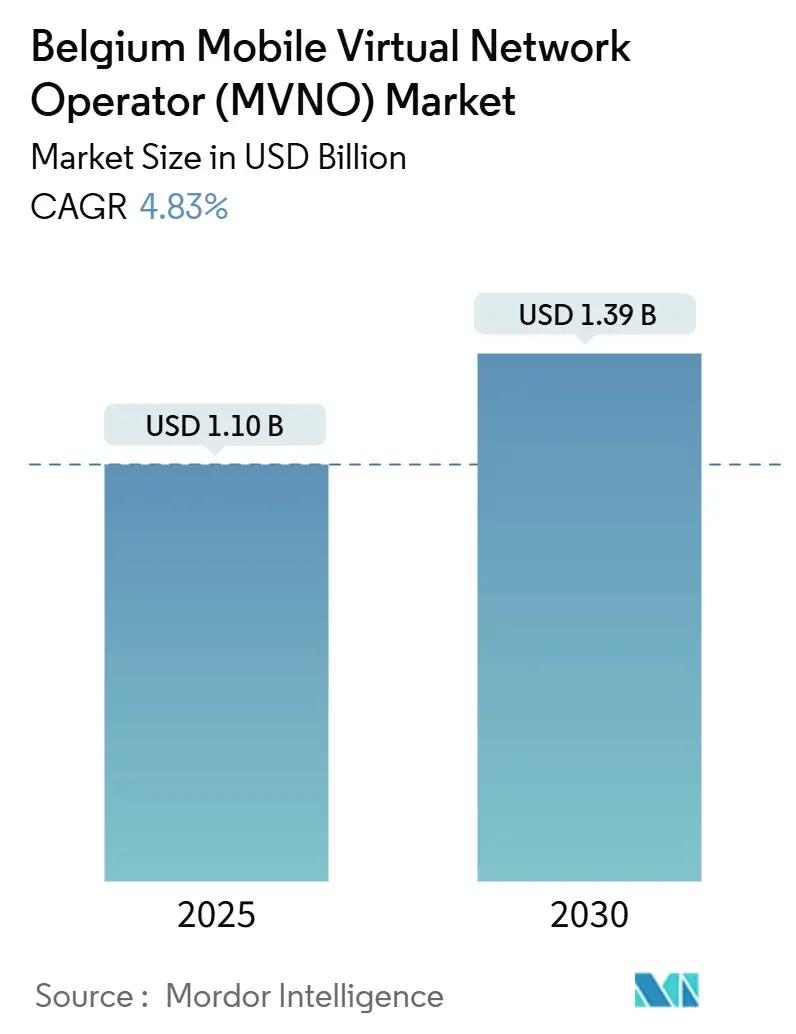
| Market Size (2025) | USD 1.10 Billion |
| Market Size (2030) | USD 1.39 Billion |
| Growth Rate (2025 - 2030) | 4.83 % |
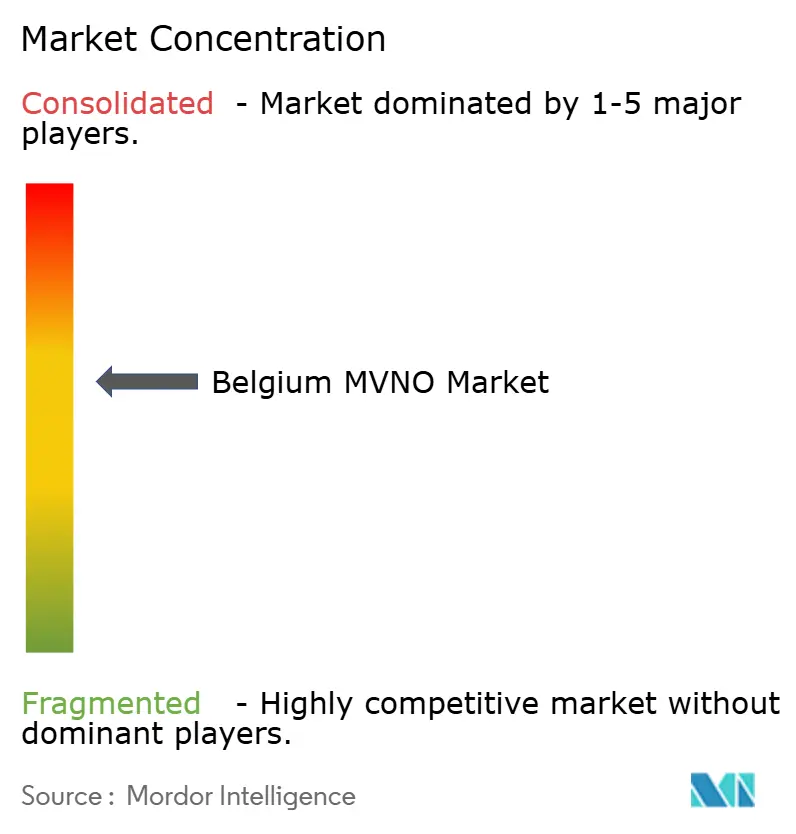
| Market Concentration | Medium |
Major Players *Disclaimer: Major Players sorted in no particular order Image © Mordor Intelligence. Reuse requires attribution under CC BY 4.0. | |
Belgium Mobile Virtual Network Operator (MVNO) Market Analysis by Mordor Intelligence
The Belgium MVNO Market size is estimated at USD 1.10 billion in 2025, and is expected to reach USD 1.39 billion by 2030, at a CAGR of 4.83% during the forecast period (2025-2030). In terms of subscriber volume, the market is expected to grow from 1.17 million subscribers in 2025 to 1.39 million subscribers by 2030, at a CAGR of 3.54% during the forecast period (2025-2030). The topline growth hides an ongoing shift from basic resale toward cloud-native, service-orchestrated business models that let operators tailor digital propositions for tightly defined customer niches. Aggressive wholesale pricing under the BIPT-supervised framework, the availability of network-slicing on Proximus and Orange Belgium, and the rapid uptake of eSIM activation collectively underpin the momentum of the Belgium MVNO market [1]Belgian Institute for Postal Services and Telecommunications, “Roaming,” bipt.be. Cloud platforms shorten launch cycles and reduce capital intensity, while IoT-specific connections and satellite backup links open incremental revenue streams beyond conventional consumer voice and data. Competitive pressure escalated after DIGI Belgium introduced a EUR 5 plan in early 2025, forcing incumbent MVNOs and flanker brands to tighten tariffs and sharpen their digital care strategies [2]Test-Aankoop, “Prijsbreker DIGI Belgium is de nieuwste telecomspeler,” test-aankoop.be.
Key Report Takeaways
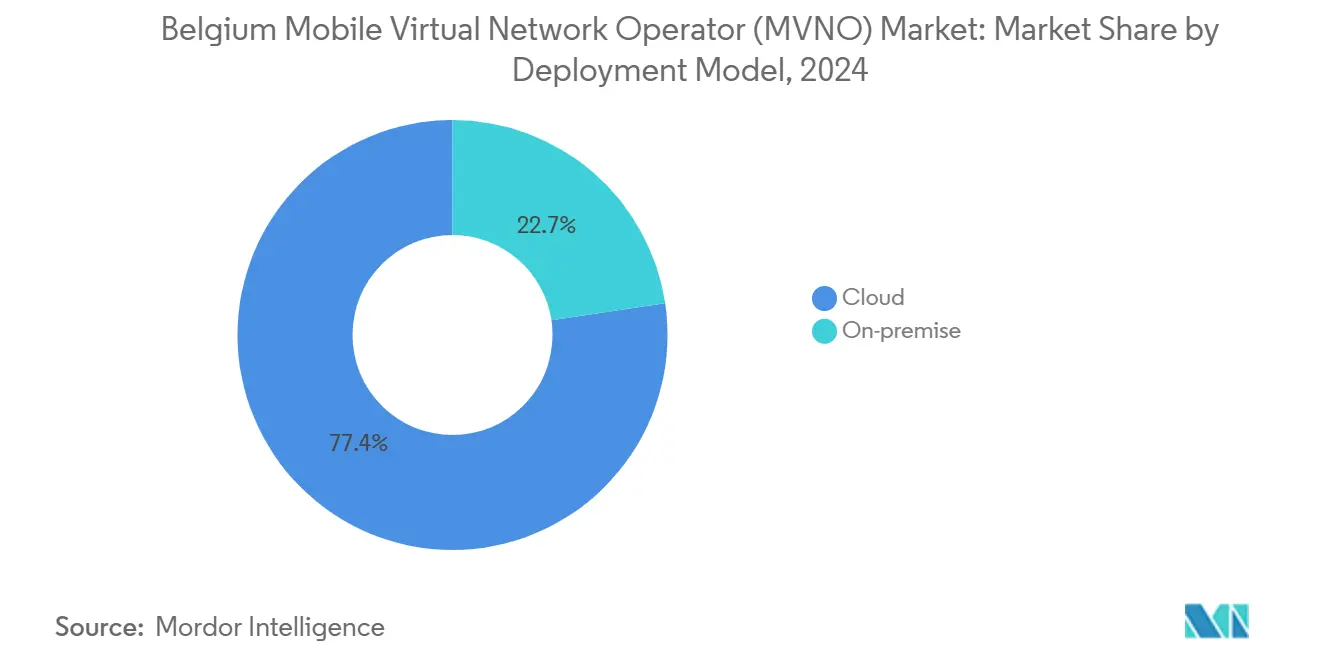
- By deployment model, cloud infrastructure held 77.35% of the Belgium MVNO market share in 2024 and is rising at a 7.91% CAGR through 2030.
- By operational mode, reseller/light/brand MVNOs commanded 59.66% share of the Belgium MVNO market size in 2024, while full MVNOs are expanding at a 21.15% CAGR through 2030.
- By subscriber type, consumer accounts represented 80.83% of the Belgium MVNO market in 2024; IoT-specific services are forecast to grow at a 21.86% CAGR to 2030.
- By application, other application segments held 43.54% of the Belgium MVNO market share in 2024, and cellular M2M is forecast to grow at an 18.51% CAGR to 2030.
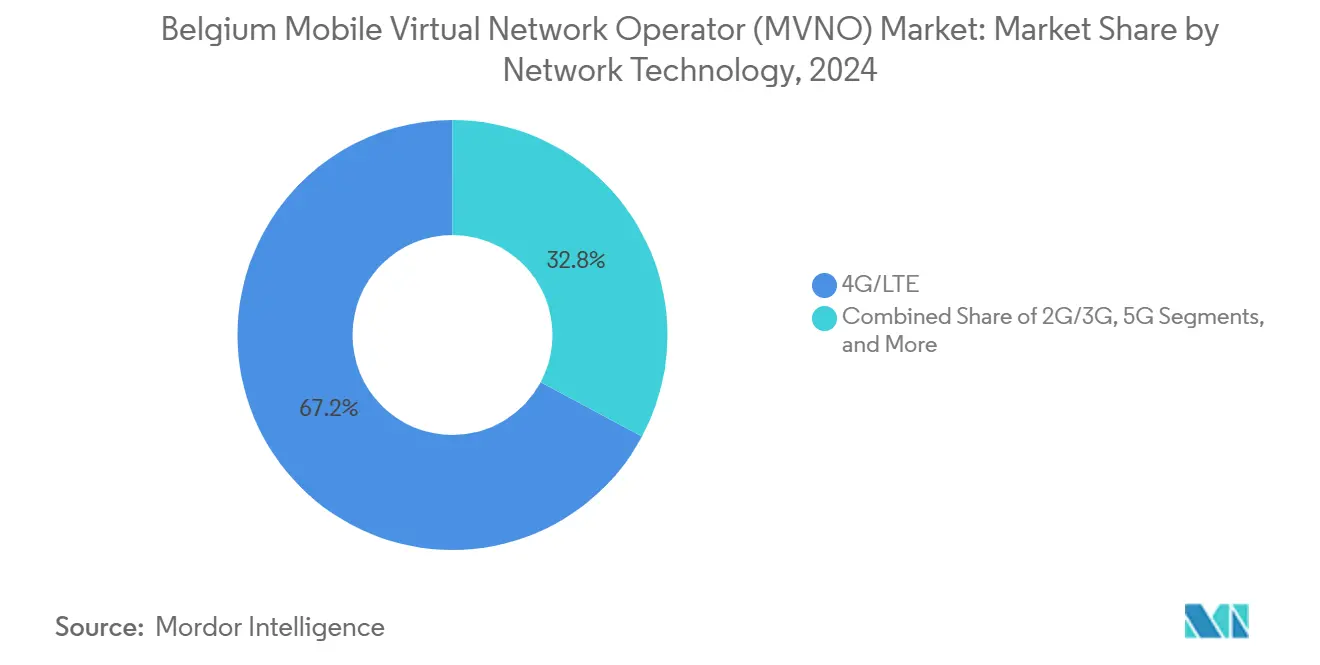
- By network technology, 4G/LTE led with 67.18% Belgium MVNO market share in 2024; satellite/NTN connectivity is set to surge at a 99.57% CAGR through 2030.
- By distribution channel, online and digital-only operations secured 59.58% of the Belgium MVNO market size in 2024 and are rising at a 7.72% CAGR through 2030.
Belgium Mobile Virtual Network Operator (MVNO) Market Trends and Insights
Drivers Impact Analysis*
| Driver | (~) % Impact on CAGR Forecast | Geographic Relevance | Impact Timeline |
|---|---|---|---|
| Wholesale‐only 5G network slicing opens differentiated B2B propositions | +1.2% | Belgium, spillover to EU | Medium term (2-4 years) |
| EU-mandated intra-EU roaming price caps protect MVNO gross margins | +0.8% | EU, focused on cross-border Belgian users | Long term (≥ 4 years) |
| Rising demand for low-ARPU digital-only brands among Gen Z immigrants | +0.6% | Brussels, Antwerp | Short term (≤ 2 years) |
| Enterprise eSIM uptake in logistics and port automation (Antwerp-Bruges) | +0.4% | Antwerp-Bruges corridor | Medium term (2-4 years) |
| Smart-meter roll-out by Fluvius drives long-tail IoT SIM volumes | +0.3% | Flanders, Wallonia potential | Long term (≥ 4 years) |
| B2B hybrid-cloud adoption accelerates need for private-label UCaaS bundles | +0.2% | National | Medium term (2-4 years) |
| Source: Mordor Intelligence | |||
Wholesale-only 5G network slicing opens differentiated B2B propositions
Dedicated virtual network slices allow MVNOs to deliver latency-critical services such as autonomous container shuttling at the Port of Antwerp-Bruges, turning connectivity into an SLA-driven value proposition rather than a commodity resale business [3]Proximus, “Performance Indicator,” proximus.be. The architecture prevents MNOs from cannibalizing their own wholesale customers, letting digital brands specialize around vertical expertise and monetize premium quality of service guarantees.
EU-mandated intra-EU roaming price caps protect MVNO gross margins
Roam-like-at-home rules stabilize wholesale costs and reassure enterprise clients headquartered in Brussels that their mobile spend will not spike during travel across the single market. Predictable roaming outlays remove a historical margin squeeze and encourage MVNOs to bid aggressively for multinational accounts.
Rising demand for low-ARPU digital-only brands among Gen Z immigrants
DIGI Belgium’s EUR 5 launch triggered immediate price cuts from Orange’s hey! Telecom, providing price transparency and app-only onboarding, resonates with younger, mobile-first residents in multicultural districts. The segment rewards lean operators that optimize for self-service support and eSIM fulfillment.
Enterprise eSIM uptake in logistics and port automation
Private 5G in the Antwerp-Bruges port uses embedded connectivity to orchestrate cranes and AGVs, and MVNOs supplying eSIM profiles can bundle device analytics and lifecycle APIs, capturing higher value than simple data bundles [4]5G Observatory, “Belgian new entrant Digi to launch in the Summer,” 5gobservatory.eu.
Restraints Impact Analysis*
| Restraint | (~) % Impact on CAGR Forecast | Geographic Relevance | Impact Timeline |
|---|---|---|---|
| National roaming fees linked to Proximus/Orange 4G legacy contracts | -0.7% | National, rural-heavy | Medium term (2-4 years) |
| Saturation of prepaid consumer base limits addressable migration pool | -0.5% | Urban low-income segments | Long term (≥ 4 years) |
| BCE’s strict SIM-registration laws raise onboarding friction for brands | -0.3% | National, digital brands | Short term (≤ 2 years) |
| Tight spectrum refarming timelines delay standalone 5G MVNO launches | -0.2% | National | Long term (≥ 4 years) |
| Source: Mordor Intelligence | |||
National roaming fees linked to Proximus and Orange 4G legacy contracts
With 3G sunsets concluded in 2024, all MVNO traffic rides 4G/5G links priced under outdated volume tiers, inflating the cost of goods sold just as data demand spikes. Renewal cycles lag network upgrades, compressing margins for data-heavy propositions until fresh wholesale terms are signed.
Saturation of the prepaid consumer base limits migration pool
Prepaid penetration already exceeds 35%, leaving a residual cohort that is fiercely price-sensitive. Acquisition costs to flip these users often exceed the lifetime value unless an operator can cross-sell broadband or energy bundles, limiting mass-market upside for new entrants.
*Our forecasts treat driver/restraint impacts as directional, not additive. The impact forecasts reflect baseline growth, mix effects, and variable interactions.
Segment Analysis
By Deployment Model: Cloud infrastructure drives operational agility
Cloud-hosted cores accounted for 77.35% of the Belgium MVNO market in 2024, reflecting the preference for opex-light scaling and instant feature deployment. The Belgium MVNO market size attributed to cloud deployments is projected to grow at a 7.91% CAGR through 2030 as turnkey MVNE stacks de-risk launches and slash time-to-revenue. Platform partners such as KORE Wireless shift legacy MVNOs to multi-tenant environments without subscriber disruption. On-premise builds persist only where data residency or sub-10 ms latency is contractual.
Cloud elasticity lets operators spin rugged IoT profiles for a meter rollout today and consumer social bundles tomorrow on the same core, underscoring why the Belgium MVNO market gravitates toward cloud. Investors view the model favorably because working capital aligns with subscriber intake rather than sunk costs.


By Operational Mode: Full MVNOs emerge despite complexity
Reseller and light brands still led with 59.66% Belgium MVNO market share in 2024, but a 21.15% CAGR expected for full MVNOs signals a structural pivot. Operators taking ownership of HLR/HSS assets can promise enterprise SLAs, tailor roaming footprints, and monetize sponsored data events, capabilities impossible under pure resale. DIGI Belgium illustrates the playbook: piggyback on Proximus for immediate reach while building an independent 5G core that will support differentiated slices in 2026.
Service-operator hybrids bridge the gap for brands scaling customer experience and billing control before shouldering full network elements. As the Belgium MVNO market moves toward B2B verticals, ownership of core functions becomes a prerequisite for margin expansion.
By Subscriber Type: IoT growth transforms revenue models
Consumers still dominate the Belgium MVNO market size with 80.83% of lines in 2024, yet IoT SIMs will post a 21.86% CAGR to 2030 owing to Fluvius rolling out 3.97 million smart meters across Flanders. Enterprises demand pooled billing and policy control, feeding a mid-single-digit growth runway as remote employees and expense-managed fleets expand.
IoT’s high-volume low-ARPU economics favor operators that excel in automation. API-driven life-cycle management and over-the-air credential swaps underpin new monetization avenues that elevate the Belgium MVNO market beyond SIM resale.
By Application: Cellular M2M drives specialized service development
Cellular M2M connections accounted for 18.51% of the Belgium MVNO market size and will climb at an identical CAGR through 2030, as factories, commercial real estate, and logistics corridors digitize assets. BICS leverages its global roaming mesh to keep Belgian-originated devices online in 200+ countries, a value proposition local MVNOs integrate via white-label APIs.
Discount voice-centric bundles remain important for budget consumers, but average revenue per user trends flat. Business applications, including UCaaS and split billing, provide uplift yet hinge on employers’ hybrid-work policies. The M2M curve, however, shows uninterrupted ascent.
By Network Technology: Satellite/NTN connectivity explodes
4G/LTE still carries 67.18% of traffic, but satellite/NTN links will rocket at 99.57% CAGR after Orange Belgium’s December 2024 launch of a Ka-band service to backstop enterprise continuity. The Belgium MVNO market responds by bundling satellite fail-over into critical infrastructure SLAs, fuel depots, water utilities, and health campuses, where downtime is not tolerable. 5G slices stay reserved for latency-sensitive use cases, and 2G sunsets will phase out legacy M2M by 2028.

By Distribution Channel: Digital-only models dominate growth
Digital channels held a 59.58% share of the Belgium MVNO market in 2024 and are progressing at a 7.72% CAGR, propelled by eSIM, which removes the last physical hurdle to instant activation. Telenet’s TADAAM introduced an all-online, unlimited data offer in April 2025, proving that an MVNO can scale nationwide without a single store. Physical retail persists for handset financing and elderly care, but cost-to-serve skews decisively toward app-based journeys.
Self-service account management reduces churn triggers and supports cross-sell of ancillary OTT media and energy bundles, reinforcing why digital-first will continue to expand its footprint in the Belgium MVNO market.
Geography Analysis
The Belgium MVNO market derives unique scale from Brussels, where EU institutions anchor a multinational workforce requiring predictable intra-EU roaming. Flanders, anchored by the Antwerp-Bruges port, concentrates industrial IoT demand for real-time cargo, crane, and AGV oversight. Wallonia trails in fiber penetration, so MVNOs pairing mobile with fixed-wireless access can upsell convergence there. BIPT enforces open access duties obliging Proximus, Orange, and Telenet/BASE to wholesale capacity across all provinces, letting digital brands reach 99% population coverage from day one.
The Antwerp-Bruges logistics axis is the proving ground for network-sliced private 5G, enabling MVNOs to charge per-device plus analytics, a model exportable to Ghent’s bio-cluster once maturity hits. Rural Limburg and Namur host agri-tech pilots: moisture sensors, herd trackers, and autonomous tractors that lean on LPWAN-over-LTE. Operators leveraging shared spectrum and NTN can blanket farms where macro coverage falters.
The Belgium MVNO market thus splits into three opportunity zones: EU governance and expats in Brussels, industrial IoT and port automation in Flanders, and rural smart-agriculture in Wallonia. Brands that segment propositions geographically capture outsized lifetime value.
Competitive Landscape
The Belgium MVNO market presents the market concentration as moderate. Mobile Vikings secures loyalty via unlimited social-app zero-rating and ranked first in Test-Aankoop satisfaction for the second consecutive year. DIGI Belgium disrupts on price and is concurrently building its own RAN, foreshadowing a migration from wholesale to infrastructure-light MOCN with Proximus.
Incumbents counter with flanker digital brands: Orange’s hey! Telecom and Telenet’s TADAAM adopt lean cost structures and eSIM to meet low-ARPU demand without cannibalizing premium flagship lines. Strategic alliances proliferate, Ericsson supplies Radio Dot indoor coverage to Proximus, indirectly enhancing MVNO QoS commitments to enterprise campuses.
IoT-focused providers attach device management revenue, satellite integrators target critical infrastructure, and immigrant-community players rely on OTT voice bundles integrated in multiple languages. The Belgium MVNO market rewards operators able to pair digital self-service with vertical know-how.
Belgium Mobile Virtual Network Operator (MVNO) Industry Leaders
Lycamobile Belgium BV
Carrefour Belgium SA (Carrefour Mobile)
Scarlet Belgium NV
Mobile Vikings NV
Youfone Belgium NV
- *Disclaimer: Major Players sorted in no particular order

Recent Industry Developments
- April 2025: Ericsson and Proximus partnered to install Radio Dot small cells for enhanced indoor 4G/5G coverage across Belgian enterprise sites.
- January 2025: Telenet launched TADAAM mobile with unlimited calls, SMS, and data via eSIM-only onboarding, billed at EUR 25 per month.
- April 2024: Youfone completed a rebrand to Yoin, unveiling a refreshed digital identity aimed at value-conscious subscribers.


Belgium Mobile Virtual Network Operator (MVNO) Market Report Scope
| Cloud |
| On-premise |
| Reseller / Light / Brand MVNO |
| Service Operator |
| Full MVNO |
| Consumer |
| Enterprise |
| IoT-specific |
| Discount |
| Business |
| Cellular M2M |
| Others |
| 2G/3G |
| 4G/LTE |
| 5G |
| Satellite/NTN |
| Online/Digital-only |
| Traditional Retail Stores |
| Carrier Sub-brand Stores |
| Third-Party/Wholesale |
| By Deployment Model | Cloud |
| On-premise | |
| By Operational Mode | Reseller / Light / Brand MVNO |
| Service Operator | |
| Full MVNO | |
| By Subscriber Type | Consumer |
| Enterprise | |
| IoT-specific | |
| By Application | Discount |
| Business | |
| Cellular M2M | |
| Others | |
| By Network Technology | 2G/3G |
| 4G/LTE | |
| 5G | |
| Satellite/NTN | |
| By Distribution Channel | Online/Digital-only |
| Traditional Retail Stores | |
| Carrier Sub-brand Stores | |
| Third-Party/Wholesale |


Key Questions Answered in the Report
What revenue does the Belgium MVNO market generate in 2025?
It generates USD 1.10 billion and is forecast to reach USD 1.39 billion by 2030.
Which deployment model leads in Belgium for MVNOs?
Cloud cores lead with 77.35% share and are expanding at a 7.91% CAGR.
How fast will IoT-specific MVNO connections grow?
IoT SIMs are projected to rise at a 21.86% CAGR from 2025-2030, driven by smart-meter rollouts and industrial automation.
Which network technology is growing the quickest?
Satellite/NTN connectivity shows the highest growth at a 99.57% CAGR due to enterprise demand for backup links.
What competitive move intensified pricing pressure in 2025?
DIGI Belgium’s EUR 5 plan triggered immediate tariff cuts from rival brands, escalating a price war.
Why are MVNOs interested in 5G network slicing?
Slices allow them to guarantee QoS for sectors like port automation, transforming them into service-level-driven providers.
Page last updated on:


 Your data is secure and never sold or shared.


