
Bangladesh Automotive Engine Oils Market Size and Share
Market Overview
| Study Period | 2019 - 2030 |
|---|---|
| Forecast Data Period | 2025 - 2030 |
| Historical Data Period | 2019 - 2023 |
| Market Volume (2025) | 82.27 Million liters |
| Market Volume (2030) | 92.13 Million liters |
| Growth Rate (2025 - 2030) | 2.29 % |
| Market Concentration | Medium |
Major Players *Disclaimer: Major Players sorted in no particular order Image © Mordor Intelligence. Reuse requires attribution under CC BY 4.0. | |

Bangladesh Automotive Engine Oils Market Analysis by Mordor Intelligence
Bangladesh Automotive Engine Oils Market Analysis by Mordor Intelligence
The Bangladesh automotive engine oils market size is estimated at 82.27 million liters in 2025 and is expected to reach 92.13 by 2030, at a CAGR of 2.29% during the forecast period (2025-2030). Stable growth reflects a gradual shift from volume-led expansion to value-led premiumization, as end-users migrate to synthetic grades despite muted vehicle registrations. Lubricant demand remains resilient because owners keep vehicles in service longer, schedule more frequent maintenance, and prefer high-performance fluids that trim downtime costs. Rapid urban logistics growth fuels intensive duty cycles for motorcycles and light vans, even as new-vehicle sales soften, lifting consumption. OEM warranty clauses that require certified synthetic or semi-synthetic oils reinforce the shift toward higher-margin products, giving suppliers room to widen price spreads while preserving volumes. Currency swings and dependence on imported base oil, however, compress margins for smaller blenders that lack hedging capacity and leverage in procurement.
Key Report Takeaways
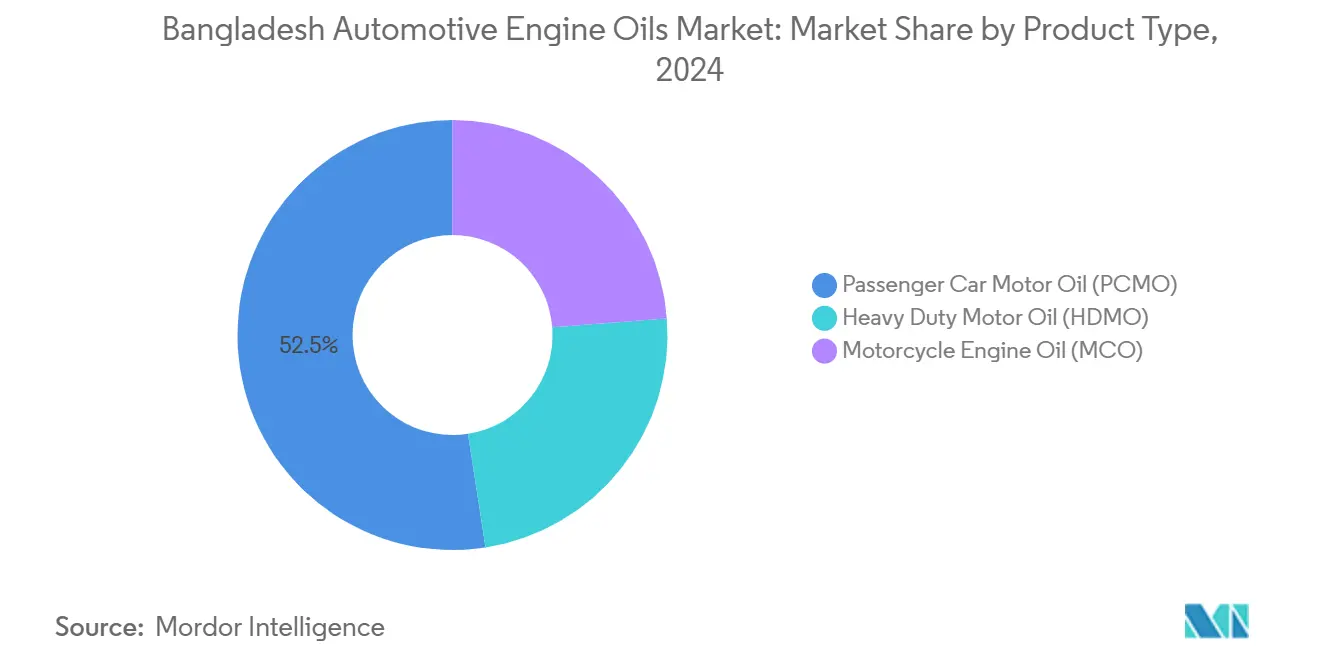
- By product type, passenger car motor oil led the Bangladesh automotive engine oils market with a 52.46% share in 2024; motorcycle engine oil is projected to advance at a 2.38% CAGR through 2030.
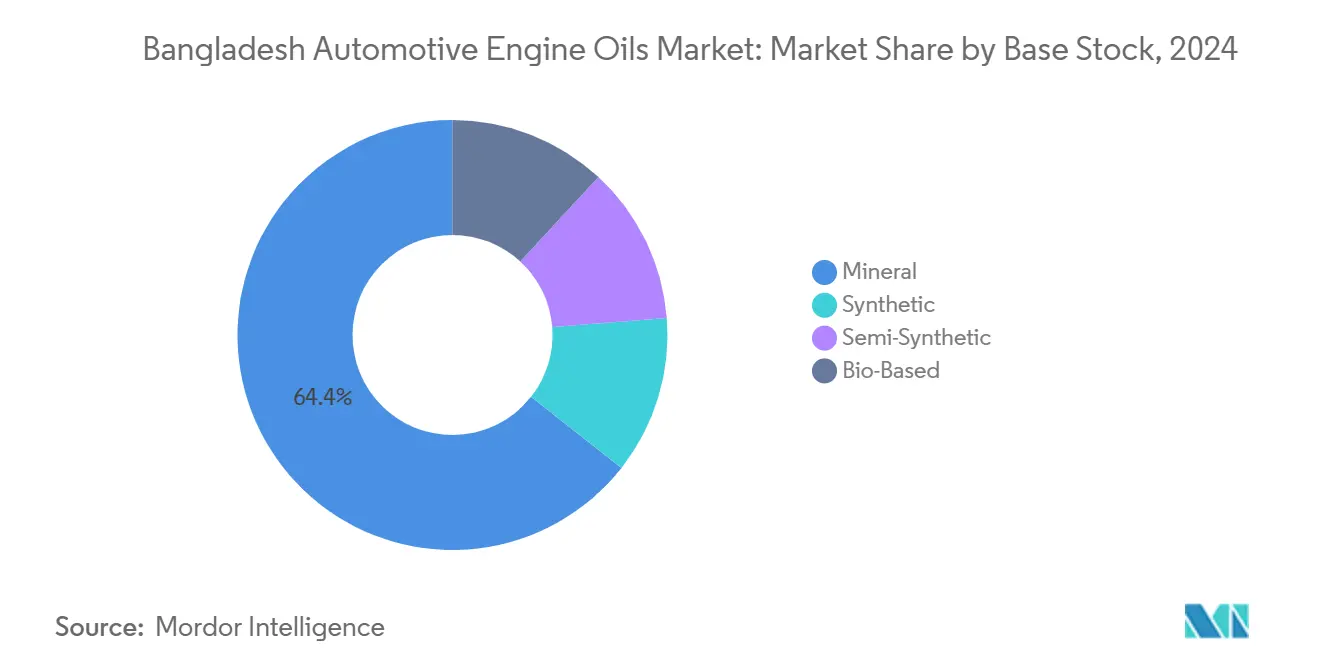
- By base stock, mineral oils captured 64.38% share of the Bangladesh automotive engine oils market size in 2024, while synthetic oils are forecast to expand at a 2.45% CAGR between 2025 and 2030.
Bangladesh Automotive Engine Oils Market Trends and Insights
Drivers Impact Analysis*
| Drivers | (~) % Impact on CAGR Forecast | Geographic Relevance | Impact Timeline |
|---|---|---|---|
| Rising passenger-vehicle and two-wheeler parc expansion | +0.8% | Dhaka and Chittagong metropolitan areas | Medium term (2-4 years) |
| Surge in CNG three-wheelers creating niche lube demand | +0.4% | Urban centers such as Dhaka, Chittagong, Sylhet | Short term (≤ 2 years) |
| Expansion of light-commercial fleets for last-mile logistics | +0.5% | Dhaka, Chittagong, Rajshahi and national trade corridors | Medium term (2-4 years) |
| Infrastructure boom boosting off-road and construction equipment oil use | +0.3% | Mega-project corridors nationwide | Long term (≥ 4 years) |
| Growth in urban motorcycle delivery services | +0.2% | Metropolitan areas and tier-2 cities | Short term (≤ 2 years) |
| Source: Mordor Intelligence | |||
Rising Passenger-Vehicle and Two-Wheeler Parc Expansion
Annual lubricant demand grows steadily because an aging parc requires more frequent servicing, a pattern that cushions the Bangladesh automotive engine oils market against fluctuations in new-vehicle sales. Average retention periods exceed regional norms, so each in-service car or bike continues to generate repeat oil changes at fixed mileage intervals. MJL Bangladesh recorded a 28% revenue growth in Q1 2024, attributing the increase primarily to higher maintenance visits by existing owners, rather than incremental units sold[1]. Wide workshop coverage in Dhaka and Chittagong ensures ready access to branded lubricants, giving established distributors predictable volume flows even during economic slowdowns.
Surge in CNG Three-Wheelers Creating Niche Lube Demand
Roughly one million CNG three-wheelers rely on high-temperature, low-ash engine oils that earn price premiums over standard gasoline grades. More than 525 CNG stations serve these fleets daily, anchoring a stable aftermarket that persists until vehicles retire at statutory end-of-life thresholds. Policymakers plan to phase in electric three-wheelers only when current registrations expire, so suppliers can safely forecast a multi-year window of CNG-specific lubricant sales. Sporadic gas-supply bottlenecks also encourage operators to extend drain intervals through higher-quality oils, lifting per-vehicle consumption value.
Expansion of Light-Commercial Fleets for Last-Mile Logistics
E-commerce penetration and new bridges such as Padma Bridge extend delivery catchments beyond Dhaka, prompting courier companies to enlarge light-van and mini-truck fleets. High daily mileage shortens oil-change intervals, raising annual lubricant demand per vehicle. Operators prefer synthetic or semi-synthetic fluids that cut downtime and fuel burn, even if upfront prices exceed mineral alternatives. Digital fleet-management tools schedule predictive maintenance, tightening adherence to service calendars and smoothing demand visibility for suppliers.
Infrastructure Boom Boosting Off-Road and Construction Equipment Oil Use
Multi-billion-dollar projects, including the Bangabandhu Tunnel and elevated expressways, generate steady demand for heavy-duty hydraulic fluids and gear oils that can withstand dust, heat, and prolonged operating hours. Equipment contractors enter into supply agreements with branded lubricant firms to secure on-site technical support and oil-analysis services, a differentiator that small importers often struggle to match. Stable public-sector funding pipelines add visibility to volume planning through 2030.
Restraints Impact Analysis*
| Restraints | (~) % Impact on CAGR Forecast | Geographic Relevance | Impact Timeline |
|---|---|---|---|
| Accelerating EV and e-2W pilot roll-outs | -0.6% | Dhaka and Chittagong urban centers | Long term (≥ 4 years) |
| Extended-drain synthetic oils lowering per-vehicle consumption | -0.3% | Higher adoption in major cities | Medium term (2-4 years) |
| High import dependence for base oils and additives | -0.2% | Nationwide impact on all blenders | Short term (≤ 2 years) |
| Source: Mordor Intelligence | |||
Accelerating EV and e-2W Pilot Rollouts in Major Cities
Government incentives aim for 30% electric penetration by 2030, including five-year VAT exemptions on e-bikes and lower customs duties on battery inputs. More than 1,000 battery-swap stations are already operational, supporting at least 1.4 million registered battery-powered auto-rickshaws and an even larger unregistered base. As electric motorcycles gain popularity, conventional motorcycle engine oil volumes are expected to decline, particularly in densely populated urban areas where charging infrastructure is most readily available.
Extended-Drain Synthetic Oils Lowering Per-Vehicle Consumption
Premium synthetics stretch service intervals from 5,000 km to as high as 15,000 km, cutting annual oil usage per vehicle by up to 70%. Petronas Nexta’s December 2024 debut introduced entry-level synthetics that meet OEM warranties, appealing to price-conscious drivers[2]. Although revenue per liter rises, total liters sold may decline, compelling mineral-focused blenders to diversify upward or risk losing share.
*Our forecasts treat driver/restraint impacts as directional, not additive. The impact forecasts reflect baseline growth, mix effects, and variable interactions.
Segment Analysis
By Product Type: PCMO Strength With MCO Acceleration
In 2024, passenger car motor oil commanded a dominant 52.46% share of Bangladesh's automotive engine oil market. This surge is attributed to a burgeoning middle class that increasingly favors branded oils, especially those that meet OEM viscosity standards. Even with a recent 15% decline in nationwide vehicle registrations, the existing fleet remains on a consistent servicing schedule, bolstering strong aftermarket sales. Synthetic PCMO blends are gaining favor among ride-sharing drivers who rack up daily mileage and appreciate 10,000-km drain intervals that reduce downtime. Heavy-duty motor oil consumption remains consistent because logistics fleets and construction contractors maintain strict maintenance regimes to protect asset uptime.
Motorcycle engine oil is the fastest-growing sub-segment, forecasted to grow at a 2.38% CAGR through 2030. Gig-economy couriers in Dhaka and Chittagong average more than 120 km per day, prompting two to three oil changes per quarter. The Bangladesh automotive engine oils market size for motorcycle oils is projected to grow rapidly as TotalEnergies, BP, and Petronas introduce racing-grade SKUs with brand-heavy marketing focused on fuel economy gains. Promotional tie-ups with food-delivery platforms incentivize riders to upgrade from no-name mineral oils to branded synthetics, accelerating the cycle of premiumization.
By Base Stock: Mineral Price Appeal Versus Synthetic Performance Upswing
Mineral oils maintained a 64.38% share of the Bangladesh automotive engine oils market size in 2024, reflecting entrenched price sensitivity and widespread availability through corner workshops. Bulk importers bring Group I cargoes via Chittagong Port, repack them domestically, and distribute them through more than 20,000 informal retailers. Mineral grades satisfy older vehicles operating at moderate temperatures and low compression, keeping volumes high among legacy fleets.
Yet, synthetic formulations are growing at the fastest rate, with a 2.45% CAGR, because OEMs are increasingly stipulating API SP or ACEA C3 specifications for warranty retention. Importantly, the synthetic sales mix is tilting toward affordable semi-synthetics, which bridge the price gap for first-time upgraders. As distributors expand cold-chain and covered storage, they reduce spoilage risk and extend shelf life, making higher-value synthetics viable even in secondary cities. Regulatory oversight by BSTI reinforces consumer trust by certifying viscosity and performance claims, thereby accelerating the migration from mineral to synthetic oils.
Geography Analysis
Dhaka division consumes the largest share of Bangladesh's automotive engine oils market volumes because it houses the country’s densest vehicle concentration, a critical mass of franchised service centers, and headquarters for nearly every major lubricant marketer. Chittagong follows, leveraging its port for base-oil arrivals and its expanding industrial belt, including large garment factories that maintain sizable vehicle and generator fleets. Mature distribution channels in these cities enable same-day deliveries of high-margin synthetics, keeping competition intense and margins tight.
Secondary divisions, such as Sylhet, Rajshahi, and Rangpur, register faster growth, helped by highway upgrades like the Padma Bridge, which slash transit times. New economic zones along these corridors attract logistics operators who require reliable lubricant supplies for light commercial vans. Agricultural mechanization schemes create a niche demand for tractor and irrigation-pump oils, prompting blenders to tailor viscosities to local duty cycles. As branded players build rural stockist networks, they defend price premiums through mechanical training and micro-influencer programs that demonstrate drain-interval savings.
Coastal districts grapple with salt-laden humidity that accelerates corrosion and oil oxidation. Suppliers respond with marine-grade dispersant packages and rust-inhibitor additives, commanding premium prices among fishing fleets and port-haul equipment operators. Seasonal monsoon flooding heightens water ingress risks, so distributors stock water-resistant greases and gear oils, further diversifying the Bangladesh automotive engine oils market. Regional differentiation, therefore, rewards firms that segment not only by vehicle type but also by climatic stress factors.
Competitive Landscape
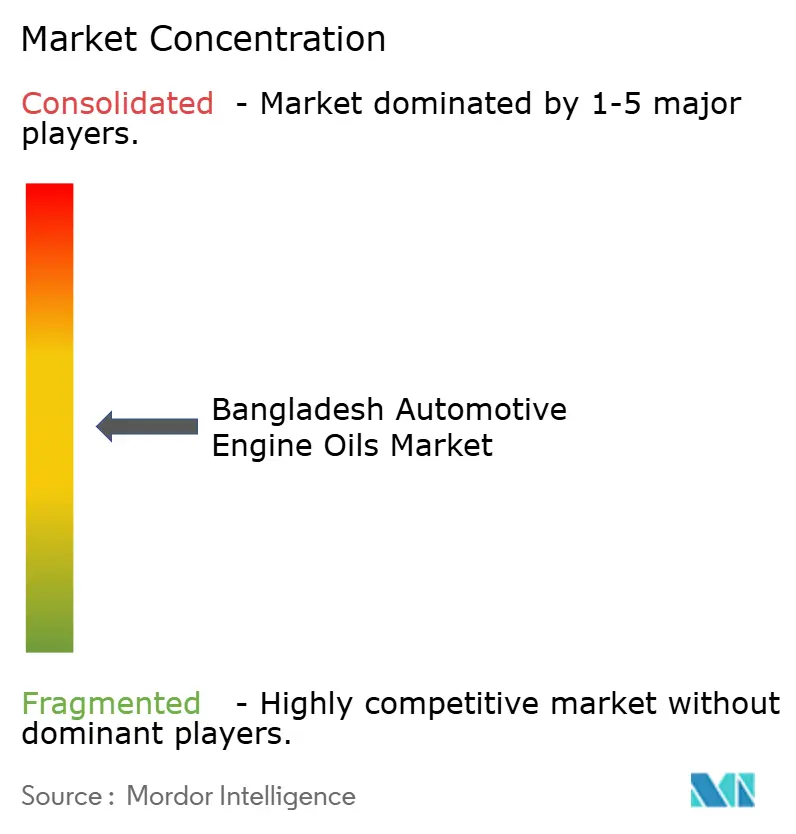
The Bangladesh automotive engine oils market is moderately fragmented. MJL Bangladesh sells Mobil-branded grades through nearly 700 retail points and has long-term base-oil import contracts that anchor cost advantages. BP leverages regional Castrol blending hubs to introduce premium synthetics quickly, using cricket sponsorships to build brand recall. TotalEnergies trusts its ELF motorsport heritage to win market share in the two-wheeler segment. Local independents focus on mineral products priced 15-25% below those of multinational brands, thriving in rural areas where informal workshops often prefer cash transactions and extended credit terms. However, tighter BSTI enforcement on quality forces some smaller players to invest in lab upgrades or exit the market. New entrants like Petronas Nexta pursue a hybrid model, importing base stocks, blending locally, and distributing synthetics priced just above mineral benchmarks to tempt first-time switchers.
Bangladesh Automotive Engine Oils Industry Leaders
-
MJL Bangladesh Limited
-
BP p.l.c.
-
TotalEnergies
-
FUCHS
-
Shell plc
- *Disclaimer: Major Players sorted in no particular order
Recent Industry Developments
- June 2025: TotalEnergies Marketing Asia Pacific and Middle East has signed an exclusive agreement with Asian Petroleum Limited to launch ELF lubricants across Bangladesh, broadening access to premium products in both motorcycle and passenger-car channels.
- December 2024: Petronas Nexta began local blending through United Lube Oil Limited, rolling out affordable synthetic oils positioned between mineral and premium tiers.
Bangladesh Automotive Engine Oils Market Report Scope
| Passenger Car Motor Oil (PCMO) | 0W-XX |
| 5W-XX | |
| 10W-XX | |
| 15W-XX | |
| Monogrades | |
| Other Grades | |
| Heavy Duty Motor Oil (HDMO) | 0W-XX |
| 5W-XX | |
| 10W-XX | |
| 15W-XX | |
| Monogrades | |
| Other Grades | |
| Motorcycle Engine Oil (MCO) | 0W-XX |
| 5W-XX | |
| 10W-XX | |
| 15W-XX | |
| Monogrades | |
| Other Grades |
| Mineral |
| Synthetic |
| Semi-Synthetic |
| Bio-Based |
| By Resin Type | Passenger Car Motor Oil (PCMO) | 0W-XX |
| 5W-XX | ||
| 10W-XX | ||
| 15W-XX | ||
| Monogrades | ||
| Other Grades | ||
| Heavy Duty Motor Oil (HDMO) | 0W-XX | |
| 5W-XX | ||
| 10W-XX | ||
| 15W-XX | ||
| Monogrades | ||
| Other Grades | ||
| Motorcycle Engine Oil (MCO) | 0W-XX | |
| 5W-XX | ||
| 10W-XX | ||
| 15W-XX | ||
| Monogrades | ||
| Other Grades | ||
| By Base Stock | Mineral | |
| Synthetic | ||
| Semi-Synthetic | ||
| Bio-Based | ||
Key Questions Answered in the Report
How large is Bangladesh’s automotive engine oils consumption in 2025?
Total volume reached 82.27 million liters, and it is projected at 92.13 million liters by 2030.
Which product category contributes most to national automotive engine oils volumes?
Passenger car motor oil leads with 52.46% share, reflecting a sizable passenger-vehicle parc.
What growth outlook exists for motorcycle engine oils?
The sub-segment is forecast to rise at a 2.38% CAGR through 2030, supported by urban delivery fleets.
Why are synthetic lubricants gaining traction despite higher prices?
Extended drain intervals, OEM warranty requirements, and lower lifetime operating costs outweigh the initial premium.
How will electric vehicle adoption affect lubricant demand?
Rising e-2W and EV penetration in major cities could trim conventional lubricant volumes, reducing overall CAGR by an estimated 0.6 percentage points long term.