
Azerbaijan Telecom MNO Market Size and Share
Market Overview
| Study Period | 2019 - 2030 |
|---|---|
| Forecast Data Period | 2025 - 2030 |
| Historical Data Period | 2019 - 2023 |
| Market Size (2025) | USD 0.88 Billion |
| Market Size (2030) | USD 1.02 Billion |
| Growth Rate (2025 - 2030) | 2.82 % |
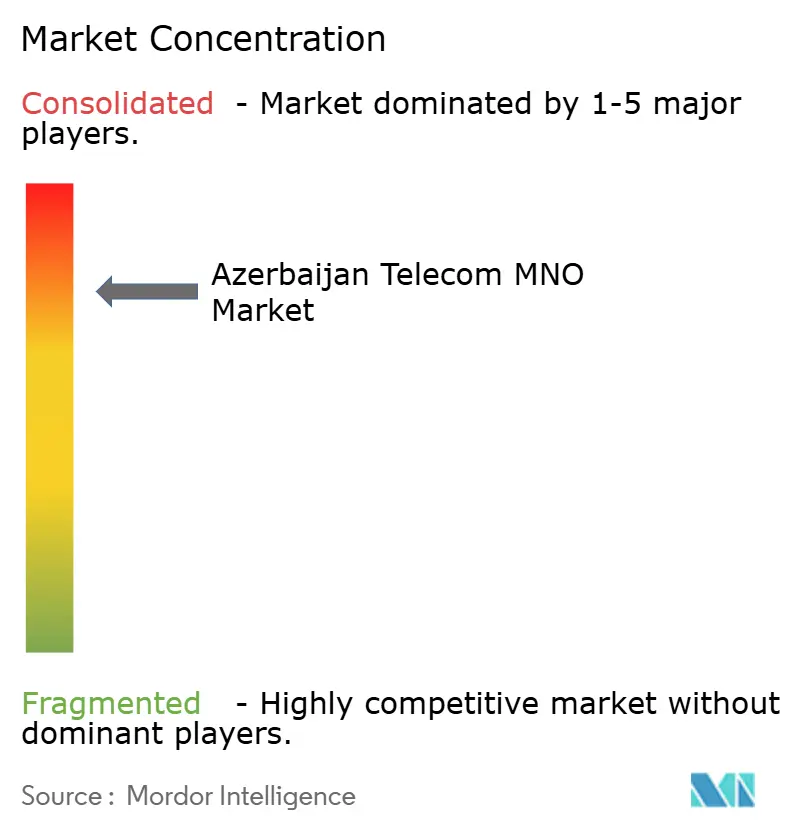
| Market Concentration | High |
Major Players *Disclaimer: Major Players sorted in no particular order Image © Mordor Intelligence. Reuse requires attribution under CC BY 4.0. | |
Azerbaijan Telecom MNO Market Analysis by Mordor Intelligence
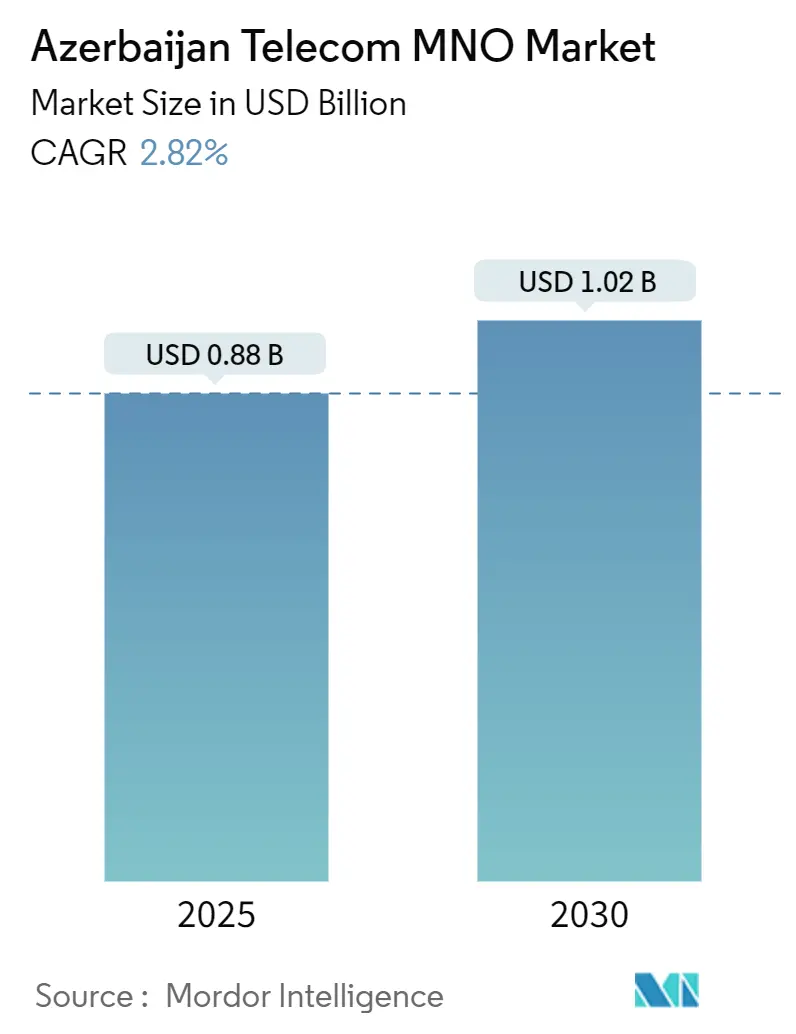
The Azerbaijan Telecom MNO Market size is estimated at USD 0.88 billion in 2025, and is expected to reach USD 1.02 billion by 2030, at a CAGR of 2.82% during the forecast period (2025-2030). In terms of subscriber volume, the market is expected to grow from 10.80 million subscribers in 2025 to 12.20 million subscribers by 2030, at a CAGR of 2.23% during the forecast period (2025-2030).
Mobile penetration reached 100% in 2011 and subscriber growth has plateaued, so operators are shifting toward revenue optimization, premium data services, and enterprise solutions. Government fiber investments and the Trans-Caspian Digital Silk Way cable strengthen Azerbaijan’s role as a data transit hub, opening fresh wholesale revenue streams. Satellite entrants such as Starlink are creating alternative connectivity paths that push terrestrial operators to refine value propositions. Intensifying demand for OTT video, IoT solutions, and low-latency enterprise connectivity underpins steady top-line expansion even as traditional voice revenues shrink.
Key Report Takeaways
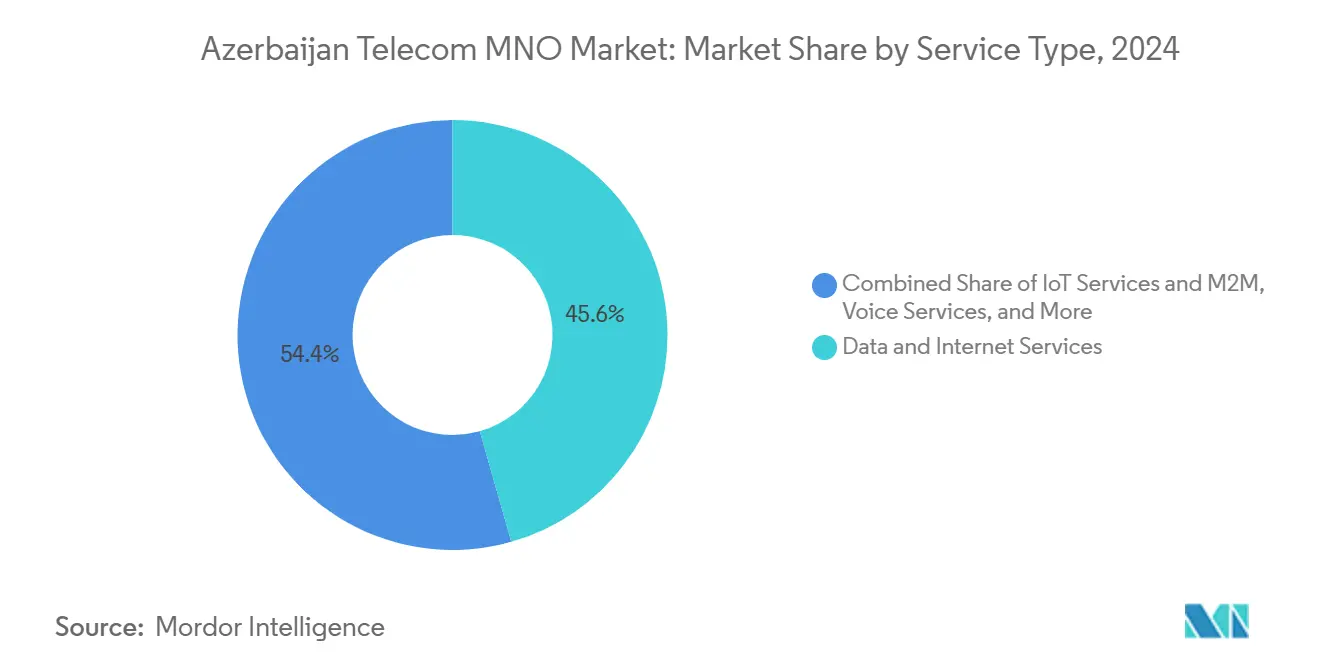
- By service type, data and internet services led with 46.05% of the Azerbaijan telecom MNO market share in 2024. OTT and PayTV services are forecast to post the fastest 2.86% CAGR to 2030.
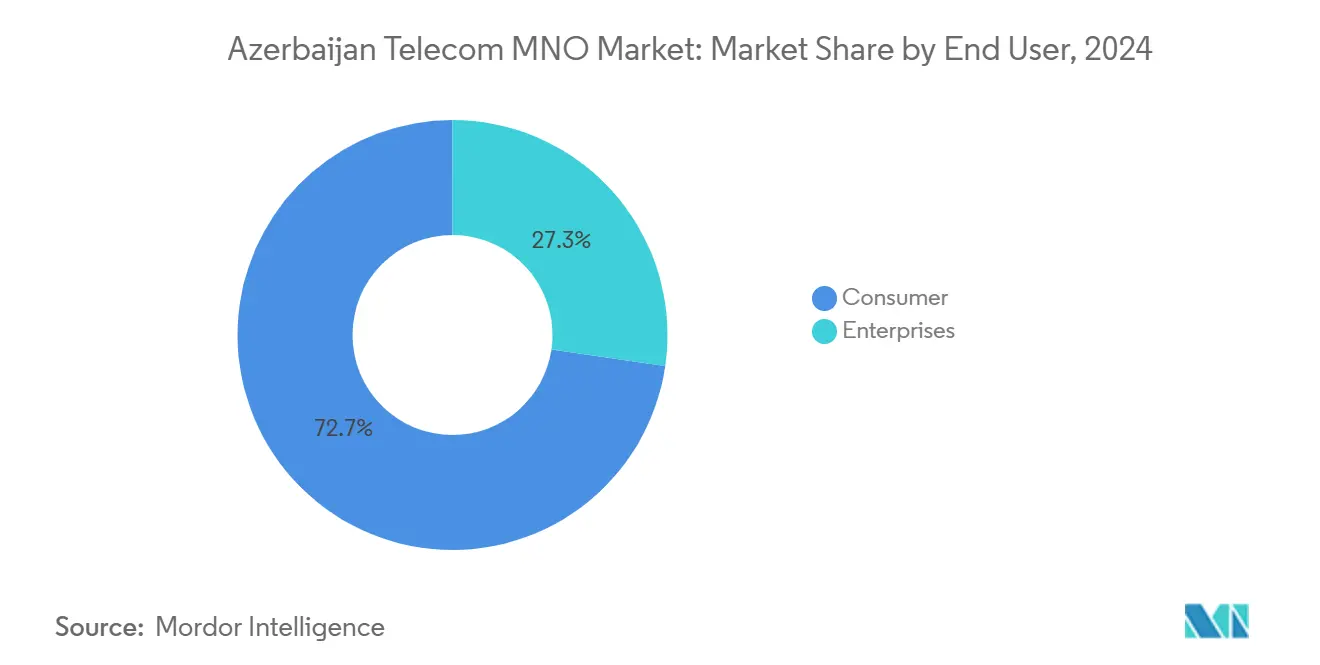
- By end user, consumer subscriptions accounted for 72.69% of the Azerbaijan telecom MNO market size in 2024. Enterprise connections are projected to rise at a 3.19% CAGR between 2025 and 2030.
Azerbaijan Telecom MNO Market Trends and Insights
Drivers Impact Analysis*
| Driver | (~) % Impact on CAGR Forecast | Geographic Relevance | Impact Timeline |
|---|---|---|---|
| Rising mobile-data usage and smartphone penetration | +0.8% | National urban hubs | Medium term (2-4 years) |
| Government-funded nationwide fiber backbone rollout | +0.6% | Rural and suburban areas | Long term (≥ 4 years) |
| 5G spectrum awards and pilot deployments | +0.4% | Major cities first | Medium term (2-4 years) |
| Growing enterprise demand for IoT/M2M connectivity | +0.3% | Industrial zones, Alat FEZ | Long term (≥ 4 years) |
| Trans-Caspian Digital Silk Way cable boosting transit traffic | +0.5% | Nationwide | Long term (≥ 4 years) |
| Alat Free Economic Zone catalyzing data-center and telecom spend | +0.2% | Alat FEZ | Long term (≥ 4 years) |
| Source: Mordor Intelligence | |||
Rising Mobile-Data Usage and Smartphone Penetration
Mobile data traffic expanded more than 30% in 2024 as subscribers consumed video, gaming, and social apps at higher bitrates. Average mobile download speeds of 45.45 Mbps in Baku make bandwidth-heavy services practical for most users.[1]TelecomTalk, “Azerbaijan Data Revenues Surge on Policy Traffic Switch,” telecomtalk.info Operators exploit the surge by offering app-specific data bundles; Bakcell’s zero-rating for WhatsApp and Facebook helped lift ARPU in key youth segments. Elevating data monetization is now the primary growth engine for the Azerbaijan telecom MNO market. Intensified smartphone adoption in regions beyond Baku will sustain this momentum over the medium term.
Government-Funded Nationwide Fiber Backbone Rollout
The “Online Azerbaijan” program has connected 2.29 million households, achieving 78% national broadband coverage in 2025. State-run Aztelecom extended GPON links to Masally and Shabran, offering 30 Mbps to 100 Mbps plans that upgrade the customer experience. CAPEX sharing with the public sector lowers private operator costs, enabling quicker rural 4G upgrades and fostering service-layer competition. Fiber infrastructure underpins future 5G backhaul and cloud services that elevate the Azerbaijan telecom MNO market size. This state–industry partnership aligns with economic diversification goals that reduce reliance on hydrocarbons.[2]Ministry of Digital Development and Transport, “Online Azerbaijan Project Progress Report 2025,” mincom.gov.az
5G Spectrum Awards and Pilot Deployments
Azercell switched on a 5G pilot in Baku’s downtown business district, proving throughput above 1 Gbps in live trials. The regulator is drafting auction rules that are expected to release 3.5 GHz and 6 GHz bands within two years. Commercial rollouts will first target corporate campuses and smart-city zones where low latency and network slicing justify premiums. Demonstration projects such as the Aghali Smart Village use 5G sensors for energy and crop management, signaling demand beyond consumer mobility. Early adoption will reinforce the Azerbaijan telecom MNO market as a test-bed for regional 5G innovation.
Growing Enterprise Demand for IoT/M2M Connectivity
Azercosmos partnered with DynaSys to launch satellite IoT links supporting agriculture and environmental telemetry nationwide. Industrial groups in the Alat Free Economic Zone require secure VPNs, NB-IoT modules, and cloud gateways that create high-margin opportunities. Operators package managed connectivity, analytics, and edge services as turnkey solutions, elevating enterprise ARPU faster than consumer revenues. As factories automate and logistics corridors digitize, the Azerbaijan telecom MNO market will tap incremental revenue streams that diversify away from saturated voice segments.
Restraints Impact Analysis*
| Restraint | (~) % Impact on CAGR Forecast | Geographic Relevance | Impact Timeline |
|---|---|---|---|
| Small addressable population limiting scale economies | -0.4% | Nationwide | Long term (≥ 4 years) |
| Heavy CAPEX burden for nationwide 5G and fiber upgrades | -0.3% | Nationwide | Medium term (2-4 years) |
| Geopolitical tensions heightening network-damage risk | -0.2% | Border districts | Short term (≤ 2 years) |
| Legacy fixed-line monopoly slowing last-mile liberalization | -0.3% | National fixed plant | Medium term (2-4 years) |
| Source: Mordor Intelligence | |||
Small Addressable Population Limiting Scale Economies
Azerbaijan hosts 10.44 million residents, capping volume-driven growth possibilities. With mobile penetration already at 100%, subscriber additions generate little uplift. The demographic ceiling reduces ROI on nationwide 5G and fiber unless operators push ARPU higher through premium content, B2B services, and cross-border ventures. NEQSOL Holding’s USD 734 million acquisition of Vodafone Ukraine exemplifies geographic diversification needed to offset domestic saturation. Absent similar expansion, scale diseconomies could narrow margins for local carriers.[3]Budde Communications, “Azerbaijan – Telecoms, Mobile and Broadband – Statistics and Analyses,” budde.com
Heavy CAPEX Burden for Nationwide 5G and Fiber Upgrades
Azercell invested USD 88.5 million in 2024 to expand LTE to 3,124 sites, reaching 94.6% land coverage. Transitioning to dense 5G grids and universal fiber access demands much higher outlays while revenue grows modestly. Global carriers lean toward CAPEX discipline, so Azerbaijani MNOs must ration spending or share infrastructure to keep EBITDA stable. Government grants lower cost of rural backbone builds, yet last-mile fiber still strains budgets, especially where customer density is low. This financial pressure tempers the Azerbaijan telecom MNO market growth trajectory through the medium term.
*Our forecasts treat driver/restraint impacts as directional, not additive. The impact forecasts reflect baseline growth, mix effects, and variable interactions.
Segment Analysis
By Service Type: Data Services Drive Revenue Transformation
Data and internet services secured a 46.05% Azerbaijan telecom MNO market share in 2024 as subscribers migrated to 4G bundles with larger quotas. OTT and PayTV revenues are forecast to climb at 2.86% CAGR, supported by local content libraries and improved payment systems. Voice minutes show mid-single-digit declines, yet unlimited talk add-ons maintain customer loyalty. Messaging revenue continues to erode under pressure from WhatsApp and Telegram. IoT and M2M contracts, presently nascent, gain momentum in logistics, agriculture, and utilities, lifting the Azerbaijan telecom MNO market size gradually over the forecast horizon. Operators enhance margins by bundling security, cloud storage, and fintech micro-services that deepen customer stickiness.
The shift toward application-specific tariffs, such as Bakcell’s zero-rating for social media, improves segmentation and price elasticity. Satellite backhaul for remote villages lets carriers extend LTE without fiber, filling white spots and capturing incremental data ARPU. Wholesale international transit, enabled by the Digital Silk Way cable, supplements top-line growth without large customer-acquisition costs. As a result, operators anchor capital allocation on capacity upgrades that align with surging data demand while steering clear of price wars.



By End User: Enterprise Digitalization Accelerates Growth
The consumer segment remained dominant with 72.69% Azerbaijan telecom MNO market share in 2024, but enterprises contribute the highest incremental revenue at 3.19% CAGR. Corporates deploy SD-WAN, NB-IoT sensors, and private LTE for plant automation, driving higher-value contracts. Government e-services expansion also lifts bandwidth requirements for schools and clinics. Smart-city pilots, including the Aghali Smart Village, showcase integrated governance platforms that rely on 4G/5G backbones.
Demand for cybersecurity, managed cloud, and unified communications packages prompts operators to create specialist enterprise divisions. Bundled offerings that include mobile, fixed, and satellite connectivity allow companies in resource regions to maintain uptime. The IT Hub Azerbaijan initiative builds digital skills that raise enterprise ICT spend, enlarging the Azerbaijan telecom MNO market size among business customers. Over the next five years, the mix shift towards enterprise lines should ease competitive pressure in the saturated consumer arena.
Geography Analysis
Baku and its metropolitan area account for the bulk of traffic and revenues, underpinned by 45 Mbps median mobile download speeds and near-ubiquitous LTE coverage. Rural deployment benefited from the “Online Azerbaijan” fiber backbone, which pushed household broadband availability to 78% in 2025. The liberated territories, including Shusha, now feature 4G cells that accelerate socio-economic reintegration.
Transit corridors connecting the Digital Silk Way fiber carry regional traffic to Georgia, Turkey, and the wider Caucasus, giving Azerbaijan leverage as a wholesale hub. Secondary cities like Ganja and Sumqayit are scheduled for 5G in the second deployment wave as spectrum auctions finalize. Industrial clusters in the Alat Free Economic Zone attract private networks and edge data centers that broaden the Azerbaijan telecom MNO market footprint.
Border provinces confront service-reliability risks from geopolitical tensions, yet they also profit from backhaul transits and roaming revenues. Government grants mitigate operator CAPEX for tower hardening and fiber redundancies. As rural GPON expands, mobile substitution declines, leading to more balanced traffic patterns nationwide. The evolving geographic reach ensures that broadband benefits distribute more evenly across Azerbaijan’s 10.44 million residents.
Competitive Landscape
Azercell led with 48.2% subscriber share and 5 million customers in 2024. Bakcell followed with roughly 2 million users, while Azerfon held the remainder. Market entry barriers remain high due to spectrum scarcity and entrenched retail networks, preserving a triopolistic structure. Carriers now focus on value-added differentiation rather than aggressive price competition because acquisition costs outstrip marginal returns.
Technology leadership is front-and-center: Azercell piloted 5G and rolled out big-data analytics that pre-empt churn through micro-segmented promotions. Bakcell invested in Sandvine policy controls that allow thematic bundles such as unlimited social-media streaming, appealing to youth demographics. Azerfon concentrates on rural LTE expansion and affordable packs allied with lifestyle content to defend share.
Satellite newcomers like Starlink registered a local subsidiary in June 2025, offering low-earth-orbit broadband that competes on latency in remote zones. The April 2024 legal amendment enabling privatization of satellite assets could invite fresh capital and service models. International partnerships, such as Vodafone’s consultancy agreement with Azerconnect, suggest knowledge transfers that may accelerate digitization. Overall, the Azerbaijan telecom MNO market favors incumbents with robust cash flow yet pressures them to innovate to hedge against nascent disruptive entrants.
Azerbaijan Telecom MNO Industry Leaders
Azercell Telecom LLC
Bakcell
Azerfon LLC
- *Disclaimer: Major Players sorted in no particular order

Recent Industry Developments
- March 2025: Viasat and Azercosmos announced a partnership to expand satellite connectivity services.
- January 2025: Starlink Azerbaijan LLC received official registration from the ICT Agency, enabling nationwide satellite broadband.
- January 2025: Azercosmos launched IoT services via Azerspace-1 with DynaSys Networks.
- May 2024: Baktelecom deployed XGS-PON services to enhance fiber speeds.


Azerbaijan Telecom MNO Market Report Scope
| Voice Services |
| Data and Internet Services |
| Messaging Services |
| IoT and M2M Services |
| OTT and PayTV Services |
| Other Services (VAS, Roaming and International Services, Enterprise and Wholesale Services, etc.) |
| Enterprises |
| Consumer |
| Service Type | Voice Services |
| Data and Internet Services | |
| Messaging Services | |
| IoT and M2M Services | |
| OTT and PayTV Services | |
| Other Services (VAS, Roaming and International Services, Enterprise and Wholesale Services, etc.) | |
| End-User | Enterprises |
| Consumer |


Key Questions Answered in the Report
How large is voice service revenue compared with data in Azerbaijan telecom?
Voice continues to decline, while data and internet already hold 46.05% of total revenue, underscoring the dominant role of data services.
What CAGR is forecast for Azerbaijan’s enterprise mobile connections?
Enterprise lines are projected to grow at 3.19% CAGR between 2025 and 2030 as IoT and cloud adoption accelerate.
Which operator leads the subscriber market?
Azercell leads with 48.2% share and 5 million users, far ahead of Bakcell and Azerfon.
When will nationwide 5G be commercial in Azerbaijan?
Commercial 5G is expected after spectrum auctions conclude within two years, with early coverage focused on Baku and industrial zones.
What is the main infrastructure program supporting rural broadband?
The government-backed “Online Azerbaijan” initiative has extended GPON fiber to 78% of households, reducing the urban-rural digital gap.
How is satellite broadband shaping the competitive landscape?
Starlink’s entry in 2025 and Viasat-Azercosmos cooperation add low-earth-orbit capacity that pressures terrestrial MNOs to enhance service quality.
Page last updated on:





