
Autonomous Incident Response Platforms Market Size and Share
Market Overview
| Study Period | 2020 - 2031 |
|---|---|
| Market Size (2026) | USD 3.43 Billion |
| Market Size (2031) | USD 11.42 Billion |
| Growth Rate (2026 - 2031) | 27.20 % |
| Fastest Growing Market | Asia-Pacific |
| Largest Market | North America |
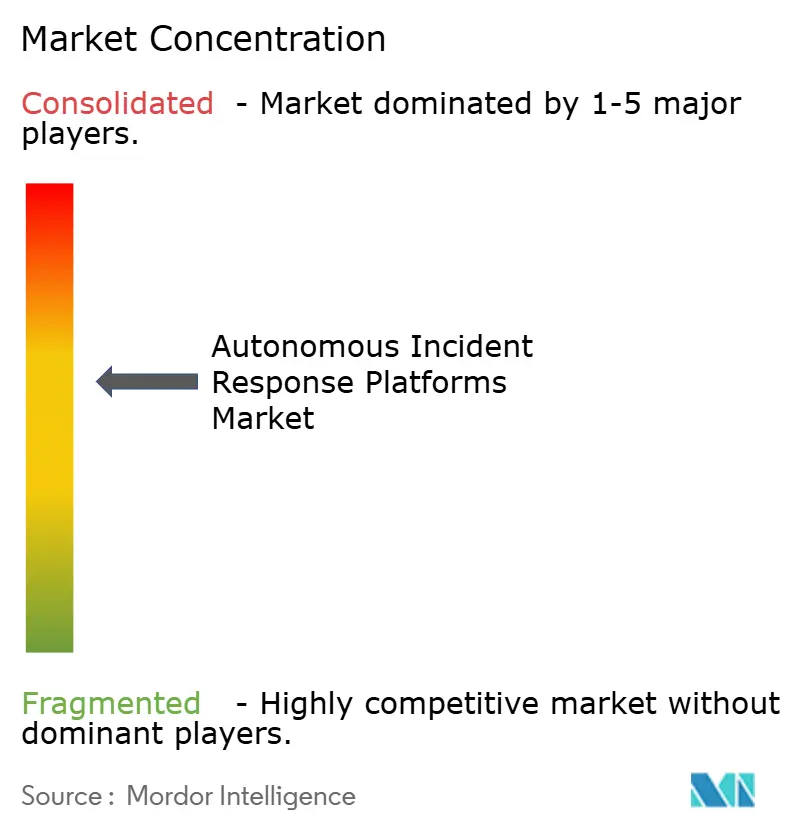
| Market Concentration | Medium |
Major Players *Disclaimer: Major Players sorted in no particular order Image © Mordor Intelligence. Reuse requires attribution under CC BY 4.0. | |
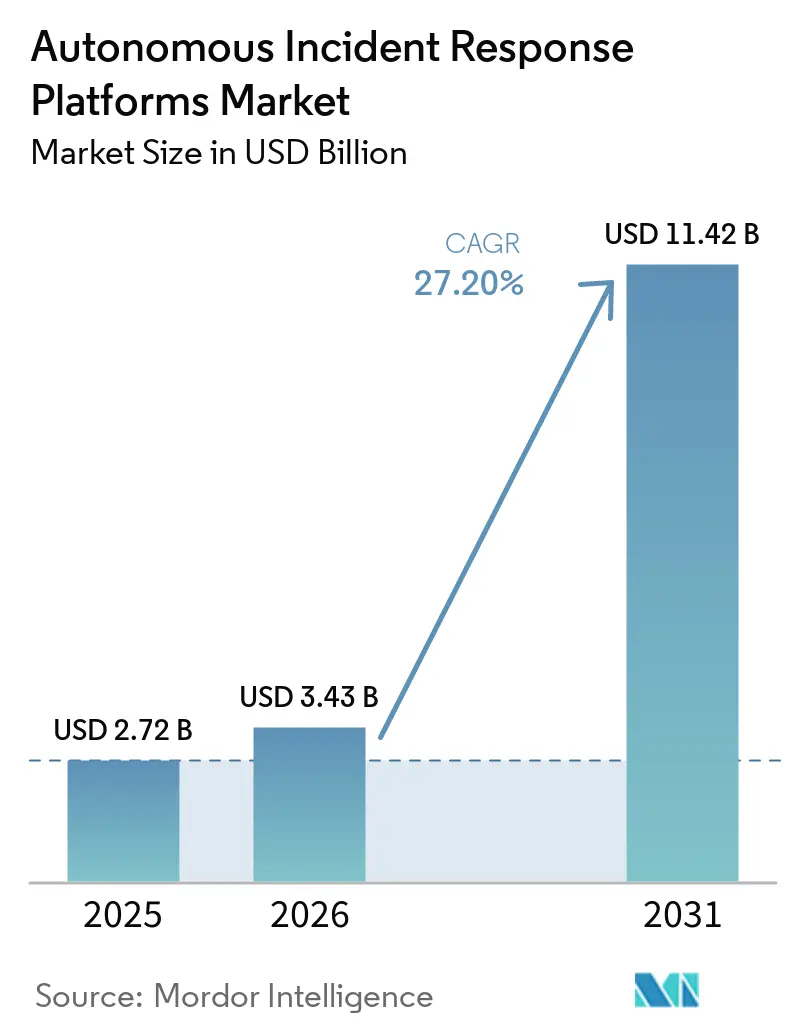
Autonomous Incident Response Platforms Market Analysis by Mordor Intelligence
The Autonomous Incident Response Platforms Market size is expected to grow from USD 2.76 billion in 2025 to USD 3.43 billion in 2026 and is forecast to reach USD 11.42 billion by 2031 at 27.20% CAGR over 2026-2031. The autonomous incident response platforms market is expanding as attackers move faster, leaving less time for analysts to review and escalate alerts before damage spreads. The autonomous incident response platforms market is also gaining support from security team fatigue, as enterprises need tools that can absorb repetitive triage work and keep skilled staff focused on higher-risk events. The autonomous incident response platforms market is shifting toward broader platform buying, as leading vendors are folding autonomous response into EDR, SIEM, and XDR suites and placing more pressure on standalone SOAR tools. The autonomous incident response platforms market still faces slower rollout in some accounts because buyers remain cautious about false positives, integration limits in older security stacks, and data residency rules. North America held the largest share in 2025, while Asia-Pacific is set to post the fastest growth through 2031 as regional cyber mandates and local technology expansion continue to support adoption.
Key Report Takeaways
- By offering solutions that held a 72.12% share in 2025, while services are projected to expand at a 28.31% CAGR through 2031 in the autonomous incident response platforms market.
- By deployment, cloud captured 54.92% of the market in 2025, while hybrid is projected to record the fastest 28.42% CAGR through 2031.
- By enterprise size, large enterprises accounted for 59.84% of the market share in 2025, while SMEs are expected to grow at a 28.53% CAGR through 2031.
- By end-user industry, BFSI held 17.26% share in 2025, while healthcare and life sciences are projected to expand at 28.64% CAGR through 2031.
- By geography, North America led the autonomous incident response platforms market with a 32.41% share in 2025, while Asia-Pacific is projected to grow at a 28.75% CAGR through 2031.
Note: Market size and forecast figures in this report are generated using Mordor Intelligence’s proprietary estimation framework, updated with the latest available data and insights as of January 2026.
Market Trends and Insights
Drivers Impact Analysis of Autonomous Incident Response Platforms Market*
| Driver | (~) % Impact on CAGR Forecast | Geographic Relevance | Impact Timeline |
|---|---|---|---|
| Rising Ransomware Autonomy Demands Machine-Speed Containment | +6.2% | Global | Short term (≤ 2 years) |
| Security Team Fatigue is Driving Autonomous Triage Adoption | +4.8% | Global, with concentrated pressure in North America and Europe | Medium term (2-4 years) |
| Regulatory Breach-Notification Pressure is Compressing Response Windows | +4.3% | EU, North America, emerging pressure in APAC | Medium term (2-4 years) |
| AI-Native Security Stacks are Reducing Resistance to Automated Remediation | +3.5% | Global, with early adoption concentration in North America and APAC | Long term (≥ 4 years) |
| Identity-Centric Attack Paths are Expanding the Scope of Autonomous Response | +2.3% | North America and EU, with spillover to APAC core | Medium term (2-4 years) |
| Board-Level Cyber Resilience Metrics are Increasing Budget Allocation for Automation | +1.5% | Global, with emphasis on Fortune 500 and FTSE 350 organizations | Long term (≥ 4 years) |
| Source: Mordor Intelligence | |||
Rising Ransomware Autonomy Demands Machine-Speed Containment
The autonomous incident response platforms market is rising because ransomware crews are now operating at a pace that manual response queues struggle to keep up with. CrowdStrike reported that the average adversary breakout time fell to 29 minutes in 2025, sharply reducing the time defenders had to verify and escalate activity.[1] The same report showed that AI-enabled adversary activity rose 89% year over year, further pressuring already stretched security teams. Check Point Research recorded 2,122 new victims across active leak sites in Q1 2026 alone, confirming that ransomware pressure remained elevated across sectors. As a result, buyers are giving more weight to tools that can isolate endpoints, stop lateral movement, and protect backup paths before a case waits for human review.
Security Team Fatigue Is Driving Autonomous Triage Adoption
The autonomous incident response platforms market is also benefiting from a staffing problem that many security teams have not been able to solve with hiring alone. Cisco found in May 2025 that 52% of SOC professionals had considered leaving cybersecurity because of workload stress.[2] That level of strain matters because security programs lose environment-specific knowledge when experienced analysts leave. Enterprises are therefore placing greater value on platforms that can automatically resolve high-confidence benign alerts and keep senior staff focused on material incidents. This demand pattern supports steady adoption of autonomous triage across large SOC environments that need better coverage without continuous headcount expansion.
Regulatory Breach-Notification Pressure is Compressing Response Windows
The autonomous incident response platforms market is gaining support from compliance rules that are making slow response programs harder to defend. The EU NIS2 Directive requires a 24-hour early warning and a 72-hour incident notification window, leaving little room for delays in detection, containment, and record-keeping.[3] In January 2026, the European Commission proposed targeted amendments to NIS2 intended to streamline compliance for 28,700 companies, including 6,200 micro and small enterprises. This broader compliance footprint increases the appeal of platforms that can automate containment logs, response steps, and reporting records as events unfold. It also gives vendors an opening to position autonomous response as a practical way to reduce documentation pressure after a serious incident.[4]
AI-Native Security Stacks Are Reducing Resistance to Automated Remediation
The autonomous incident response platforms market is being helped by a wider shift from AI-assisted workflows to AI-native security operations. IBM reported in 2025 that organizations using AI and automation in security operations faced an average breach cost of USD 3.62 million, compared with USD 5.52 million for those without those capabilities. That cost gap has made automation easier to justify in budget discussions, especially when teams are already struggling with alert volume and response time. In 2026, major vendors continued to roll out agentic SOC features that tied triage, investigation, and response into a single operating flow. This pattern is lowering resistance to automated remediation because buyers are encountering autonomous functions as part of broader security platforms rather than as isolated experiments.
Restraints Impact Analysis of Autonomous Incident Response Platforms Market*
| Restraint | (~) % Impact on CAGR Forecast | Geographic Relevance | Impact Timeline |
|---|---|---|---|
| False-Positive Risk Slows Autonomous Containment Approval | -4.1% | Global | Short term (≤ 2 years) |
| Integration Debt Across Legacy Security Tools Limits Full Automation | -3.2% | North America and Europe, legacy-heavy markets | Medium term (2-4 years) |
| Data Residency and Telemetry Privacy Constraints Reduce Model Coverage | -1.8% | EU, APAC, especially Japan and South Korea | Long term (≥ 4 years) |
| Vendor Trust Gaps Around Explainability and Override Controls Limit Adoption | -1.3% | Global, particularly in regulated sectors | Medium term (2-4 years) |
| Source: Mordor Intelligence | |||
False-Positive Risk Slows Autonomous Containment Approval
The autonomous incident response platforms market still faces a trust hurdle because buyers worry that an incorrect automated action could disrupt business operations. The 2025 SANS SOC Survey found that 73% of security teams were seeing rising false-positive volumes, which already strained analyst capacity before full automation was considered. That backdrop makes buyers cautious about giving a platform direct authority to isolate systems or terminate processes without a long testing period. The concern is stronger in production environments where a false action against legitimate administrative work can trigger downtime, internal resistance, and liability concerns. Vendors are therefore still spending time proving accuracy, tightening guardrails, and offering staged autonomy before customers allow broader containment authority.
Integration Debt Across Legacy Security Tools Limits Full Automation
The age and complexity of installed security stacks also hold back the autonomous incident response platforms market. Many enterprises still rely on SIEM, ticketing, and endpoint tools that were added over time and do not support the real-time, bidirectional integrations needed for full orchestration. Elastic identified legacy integration hurdles as one of the main barriers to moving beyond enrichment into action execution. This problem is more acute in mid-sized organizations that lack the engineering depth to rebuild workflows while keeping operations live. As a result, vendors with broad connector libraries and lower deployment friction have a near-term advantage over providers that assume customers can redesign the stack first.
*Our forecasts treat driver/restraint impacts as directional, not additive. The impact forecasts reflect baseline growth, mix effects, and variable interactions.
Autonomous Incident Response Platforms Market Segment Analysis
By Offering:
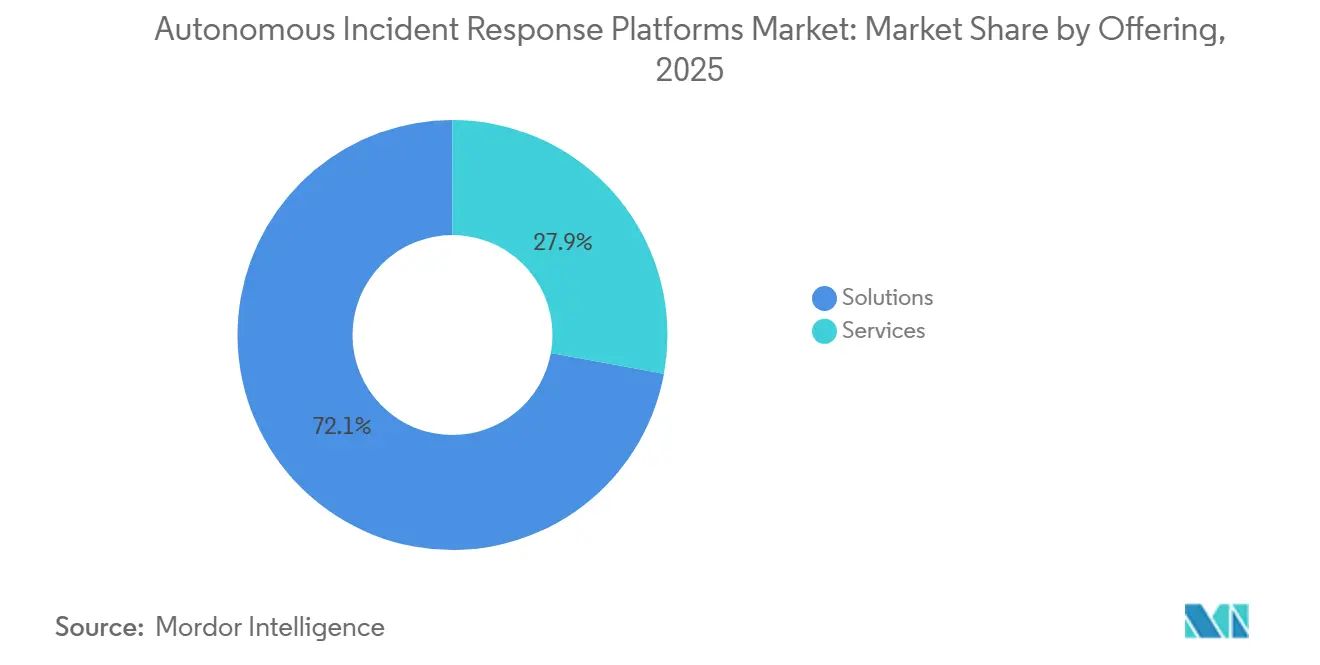
Solutions Hold The Revenue Base While Services Expand FasterSolutions held 72.12% of the autonomous incident response platforms market share in 2025, which kept the largest revenue pool in the solutions bucket. That result reflected demand for autonomous detection and response platforms, SOAR tools, AI security copilots, automated remediation platforms, and security decision intelligence products that can work together inside the SOC. CrowdStrike expanded this direction in March 2026 when it launched Agentic MDR with NVIDIA Nemotron AI models, and the company said internal benchmarking showed up to 5x faster investigations and more than 3x higher triage accuracy in benign classifications. The category remains large because many buyers still enter through software purchases before they widen autonomy across the response chain.
Services are projected to grow at a 28.31% CAGR through 2031, making them the fastest-growing part of the segment mix. This growth is tied to organizations that want autonomous response outcomes but lack the internal staff to configure, tune, and govern their workflows. Arctic Wolf reinforced that model in March 2026, when it launched the Aurora Superintelligence Platform across a base of more than 10,000 customers, with over 300 specialized agents, and a deployment timeline as short as 10 days. The autonomous incident response platforms industry is therefore moving toward service-led buying in parts of the market where buyers value response outcomes more than direct platform administration.
By Deployment:
Cloud Leads Today While Hybrid Fits Complex EstatesCloud deployment accounted for 54.92% of the autonomous incident response platforms market in 2025, giving it the largest share among deployment models. Cloud platforms fit this use case well because they support large telemetry flows, shared intelligence updates, and fast execution across distributed environments. They also reduce the delay that can appear when teams must maintain and tune local infrastructure before automation can scale. This helps explain why the cloud has led to early adoption in enterprises with modern API-based environments and large volumes of security data.
Hybrid deployment is projected to grow at a 28.42% CAGR through 2031, indicating that most enterprise estates still span cloud workloads and on-premises systems. Buyers in regulated sectors often need a single control layer to coordinate both environments without forcing all telemetry into a single jurisdiction. That becomes more important in Europe and the Asia-Pacific, where data processing and oversight requirements can limit a cloud-only rollout. The autonomous incident response platforms industry is therefore rewarding vendors that can bridge older systems and newer workloads without requiring a major architectural reset.
By Enterprise Size:
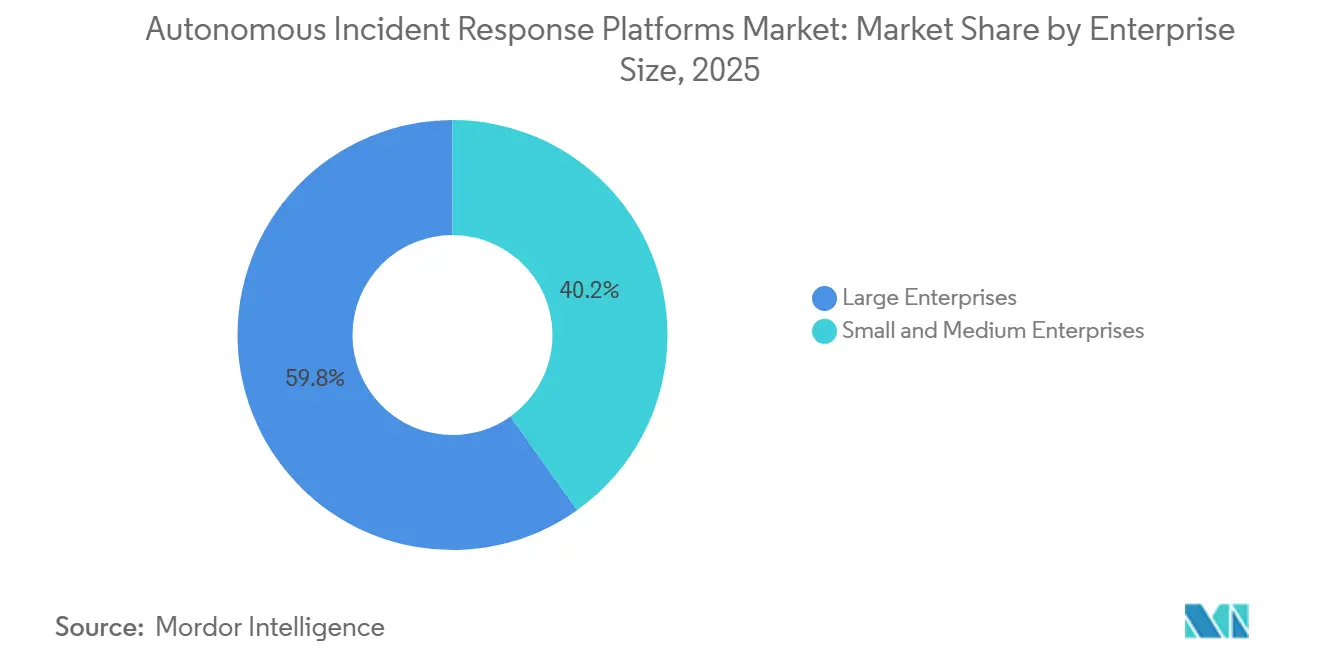
Large Enterprises Lead Spending While SMEs Catch UpLarge enterprises accounted for 59.84% of the autonomous incident response platforms market in 2025, keeping the revenue base tilted toward organizations with mature SOC operations. These buyers have generally been able to add autonomous workflows into existing toolchains rather than replace the full stack. CrowdStrike supported that path in April 2025 with Charlotte AI Agentic Response and related agentic workflows in Falcon, which enabled buyers to add autonomous reasoning and action across first- and third-party data. The segment remained large because deployment, tuning, and governance still favor enterprises that can assign specialized staff to operate the system over time.
SMEs are projected to expand at a 28.53% CAGR through 2031, making them the fastest-growing buyer group. Managed delivery models are widening access because smaller organizations can now purchase containment outcomes without building a full in-house SOC. ReliaQuest said its autonomous self-learning AI agent could automate 98% of security alerts and reduce mean time to contain threats to under 5 minutes inside the GreyMatter platform. This shift is opening the autonomous incident response platforms market to smaller buyers in retail, e-commerce, and healthcare-adjacent services that face compliance pressure but cannot support large analyst teams.
By End-User Industry:
BFSI Leads While Healthcare And Life Sciences Grows FasterHealthcare and life sciences are projected to grow at a 28.64% CAGR through 2031, making it the fastest-growing end-user vertical in the autonomous incident response platforms market. Canada’s National Cyber Threat Assessment for 2025-2026 said ransomware incidents in healthcare had nearly doubled since 2022, which showed how quickly pressure has built on the sector. In January 2025, the European Commission also published an action plan for the cybersecurity of hospitals and healthcare providers, including an early warning service through ENISA and support for rapid response measures. Healthcare is moving faster because downtime in clinical systems has direct operating consequences, which increases the value of automated containment that can act before a local team can intervene.
BFSI accounted for 17.26% of the autonomous incident response platforms market in 2025, making it the largest end-user segment by revenue. The U.S. Office of the Comptroller of the Currency highlighted 24/7 incident response capability as a supervisory priority for national banks in its 2025 report on cybersecurity and financial system resilience. Information technology and telecom, retail and e-commerce, industrial manufacturing, and government and public sector also hold meaningful positions across the revenue mix. Industrial manufacturing remains a special case because response workflows in OT and ICS environments must respect physical process safety, which leaves room for vendors that can support process-aware containment.
Geography Analysis
The Americas Autonomous Incident Response Platforms Market
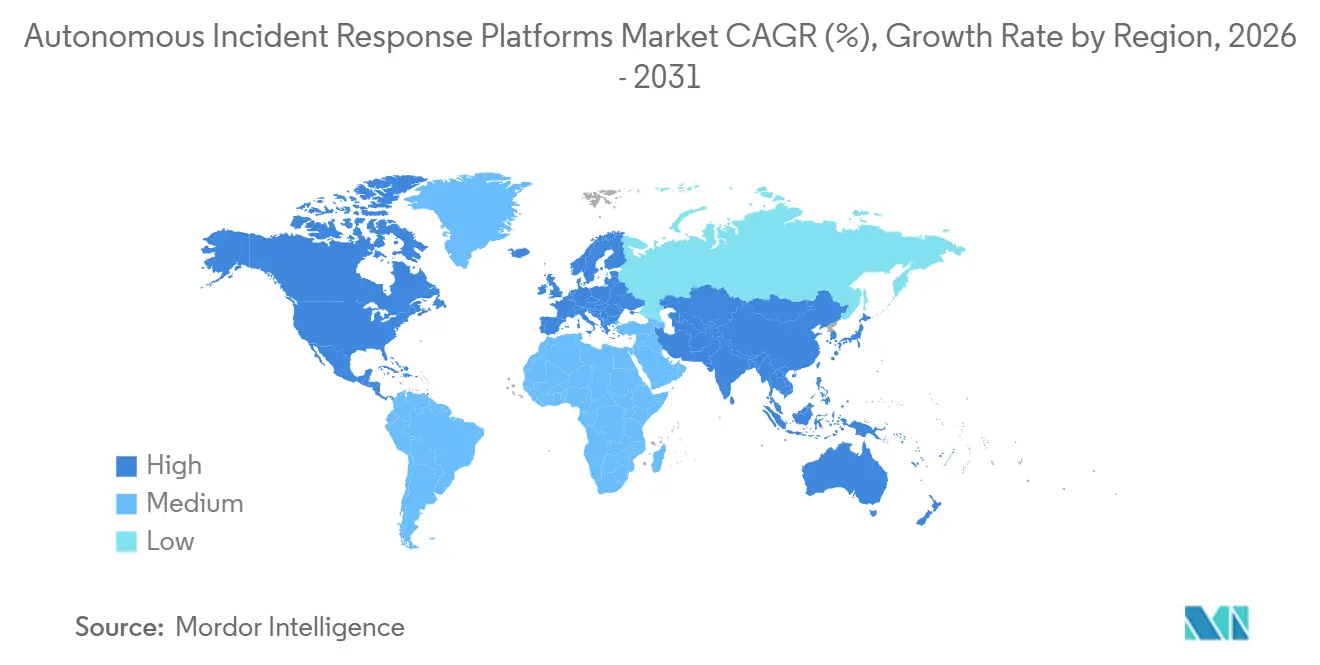
North America accounted for 32.41% of the autonomous incident response platforms market share in 2025, making it the leading regional contributor. The United States supports that position through a high concentration of cloud-native enterprises, a dense vendor base, and active federal cybersecurity requirements that maintain high response readiness. Canada also contributes to the region’s demand profile, as its 2025-2026 National Cyber Threat Assessment noted that ransomware remained the leading cyber threat to Canadian organizations. South America is still smaller in absolute terms, but Brazil and Argentina are seeing stronger interest from financial services and energy operators as digital exposure rises. Mexico is also benefiting from its link to North American technology supply chains, although tighter budgets still slow deployment compared with the wider region.
Europe Autonomous Incident Response Platforms Market
Europe’s position in the autonomous incident response platforms market is being shaped more directly by compliance than most other regions. NIS2 introduced a 24-hour early warning and a 72-hour notification structure, which raises the cost of slow detection and weak documentation during incidents. The EU AI Act is also influencing deployment design by requiring human oversight and audit logging for high-risk AI use cases, which gives hybrid, controllable architectures a clearer path in regulated settings. The PHOENI²X program adds further momentum by supporting AI-assisted incident response orchestration for operators of essential services across member states.
APAC and MEA Autonomous Incident Response Platforms Market
Asia-Pacific is projected to grow at a 28.75% CAGR through 2031 in the autonomous incident response platforms market, making it the fastest-growing regional segment. Japan is a key demand node because public policy and enterprise adoption are moving in the same direction. In May 2026, the Japanese government released Project YATA-Shield, which prioritized AI-assisted security operations across critical information infrastructure sectors. China is also building domestic capability for autonomous security operations, while South Korea and Australia continue to strengthen their response capabilities in critical sectors. The Middle East and Africa are advancing through regulated demand in Saudi Arabia and the UAE, and South Africa remains an important adopter among BFSI institutions with cross-border exposure.
Competitive Landscape
The autonomous incident response platforms market is moderately consolidated, with CrowdStrike, SentinelOne, Palo Alto Networks, Microsoft, and IBM forming the main platform-led competitive tier. These vendors are using installed EDR, SIEM, and XDR solutions to bundle autonomous response into broader security operations contracts, making standalone point tools harder to defend on budget and integration grounds. Palo Alto Networks reinforced that strategy in February 2026, when it launched Unit 42 Managed XSIAM 2.0, offering 24/7 monitoring, a breach response guarantee, and full-cycle remediation under a single managed service. IBM took a similar step in June 2026, joining the OpenAI Daybreak Cyber Partner Program to extend frontier AI access into cyber defense workflows. As competition matures, buyers are increasingly treating governance controls, override features, and audit trails as minimum requirements rather than premium extras.
The autonomous incident response platforms market still leaves room for specialists, especially in managed delivery for smaller organizations, OT and ICS environments, and hybrid deployments where sovereign data handling matters. Darktrace moved to deepen telemetry in July 2025, when it acquired Mira Security to improve visibility into encrypted traffic and expand decryption support for regulated customers. ReliaQuest has also set a clear operational benchmark with its claim that the GreyMatter agent can automate 98% of alerts and bring the mean time to contain to below 5 minutes. These moves matter because buyers are comparing platform breadth against real operating outcomes, not just feature lists. That keeps pressure on larger vendors to prove that bundled automation can match the speed and precision that specialist providers advertise.
No single vendor holds a dominant share in the autonomous incident response platforms market, which keeps switching decisions open in accounts that are still early in their deployment path. Platform-native vendors have a scale advantage because they can expand through existing contracts and existing telemetry estates. Specialist providers still matter because they often move faster in managed response, domain-specific automation, and difficult integration settings. This balance supports ongoing product launches, service bundling, and selective acquisitions rather than a market structure controlled by one or two firms.
Autonomous Incident Response Platforms Industry Leaders
-
CrowdStrike Holdings, Inc.
-
Palo Alto Networks, Inc.
-
SentinelOne, Inc.
-
Microsoft Corporation
-
International Business Machines Corporation
- *Disclaimer: Major Players sorted in no particular order
Autonomous Incident Response Platforms Market Companies Covered in this Report
- CrowdStrike Holdings, Inc.
- SentinelOne, Inc.
- Palo Alto Networks, Inc.
- Microsoft Corporation
- International Business Machines Corporation
- Elastic N.V.
- Rapid7, Inc.
- Fortinet, Inc.
- Cisco Systems, Inc.
- Exabeam, Inc.
- Securonix, Inc.
- ReliaQuest, LLC
- Tines Software Ltd.
- Torq Technologies, Inc.
- D3 Security Management Systems Inc.
- Swimlane, Inc.
- Vectra AI, Inc.
- Cybereason Inc.
- Darktrace Holdings Limited
- Arctic Wolf Networks, Inc.
Recent Industry Developments in Autonomous Incident Response Platforms Market
- June 2026: IBM and OpenAI announced a collaboration under the OpenAI Daybreak Cyber Partner Program, launching a new application security service that integrates OpenAI's frontier AI model capabilities to help organizations identify and validate software vulnerabilities with greater speed and precision. The partnership extends IBM's IBM Autonomous Security multi-agent service with external AI capability sourcing, enabling enterprises to counter machine-speed threats through coordinated AI-agent decision-making and containment.
- June 2026: Fortinet launched FortiSOC, a cloud-delivered unified SOC platform integrating SIEM, SOAR, threat intelligence, and behavioral and identity threat detection into a single SaaS experience. Powered by FortiAI agentic capabilities and FortiGuard Labs threat intelligence, FortiSOC autonomously investigates and correlates alerts across assets and identities, then recommends or executes response actions under analyst oversight, moving organizations from alert to investigation to response with fewer operational silos.
- June 2026: SentinelOne opened Purple AI Agentic Investigation to all customers and introduced Singularity Credits, a unified currency for running AI-powered work across the Singularity Platform. The zero-click autonomous investigation capability detects, investigates, verifies, and responds to threats without human dependencies when a threat crosses a defined threshold, while analysts retain full visibility and control throughout the containment sequence.
- April 2026: SentinelOne unveiled Wayfinder Frontier AI Services, a new offensive-defensive offering built in partnership with Anthropic's Claude to deliver continuous attack surface discovery, threat prioritization, and guided remediation across customers' full attack surfaces. The service extends the Wayfinder portfolio, which already covers threat hunting, MDR essentials, MDR elite, and incident readiness, into proactive AI-accelerated exposure management.
Global Autonomous Incident Response Platforms Market Report Scope
The Autonomous Incident Response Platforms market encompasses solutions and services that use artificial intelligence, automation, and advanced analytics to detect, investigate, and respond to cybersecurity incidents with minimal human intervention. It includes autonomous detection and response systems, SOAR platforms, AI security copilots, automated remediation tools, and decision intelligence solutions that streamline triage and accelerate response times. Driven by increasingly sophisticated cyber threats, a shortage of skilled professionals, and the need for faster incident management across industries like BFSI, healthcare, IT, manufacturing, and government, these platforms reduce alert fatigue, enhance efficiency, and strengthen resilience. The core objective of the market is to enable organizations to build adaptive, intelligence-driven security infrastructures that minimize risk exposure, ensure compliance, and safeguard digital assets through proactive, automated, and scalable incident response capabilities.
The Autonomous Incident Response Platforms market report is segmented by Offering (Solutions, [Autonomous Detection and Response Platforms, SOAR Platforms, AI Security Copilot Platforms, Threat Investigation and Triage Solutions, Automated Remediation Platforms, Security Decision Intelligence Platforms], and Services), Deployment (Cloud, On-Premises, and Hybrid), Enterprise Size (Large Enterprises, and Small and Medium Enterprises), End-user Industry (BFSI, Healthcare and Life Sciences, Information Technology and Telecom, Retail and E-commerce, Industrial Manufacturing, Government and Public Sector, and Other End-user Industries), and Geography (North America, South America, Europe, Asia-Pacific, Middle East, and Africa). The Market Forecasts are Provided in Terms of Value (USD).
Segmentation Overview
| Solutions | Autonomous Detection and Response Platforms |
| SOAR Platforms | |
| AI Security Copilot Platforms | |
| Threat Investigation and Triage Solutions | |
| Automated Remediation Platforms | |
| Security Decision Intelligence Platforms | |
| Services |
| Cloud |
| On-Premises |
| Hybrid |
| Large Enterprises |
| Small and Medium Enterprises |
| BFSI |
| Healthcare and Life Sciences |
| Information Technology and Telecom |
| Retail and E-commerce |
| Industrial Manufacturing |
| Government and Public Sector |
| Other End-user Industries |
| North America | United States | |
| Canada | ||
| Mexico | ||
| South America | Brazil | |
| Argentina | ||
| Rest of South America | ||
| Europe | Germany | |
| United Kingdom | ||
| France | ||
| Italy | ||
| Spain | ||
| Russia | ||
| Rest of Europe | ||
| Asia-Pacific | China | |
| India | ||
| Japan | ||
| South Korea | ||
| Australia | ||
| Rest of Asia-Pacific | ||
| Middle East and Africa | Middle East | Saudi Arabia |
| United Arab Emirates | ||
| Rest of Middle East | ||
| Africa | South Africa | |
| Nigeria | ||
| Rest of Africa | ||
| By Offering | Solutions | Autonomous Detection and Response Platforms | |
| SOAR Platforms | |||
| AI Security Copilot Platforms | |||
| Threat Investigation and Triage Solutions | |||
| Automated Remediation Platforms | |||
| Security Decision Intelligence Platforms | |||
| Services | |||
| By Deployment | Cloud | ||
| On-Premises | |||
| Hybrid | |||
| By Enterprise Size | Large Enterprises | ||
| Small and Medium Enterprises | |||
| By End-user Industry | BFSI | ||
| Healthcare and Life Sciences | |||
| Information Technology and Telecom | |||
| Retail and E-commerce | |||
| Industrial Manufacturing | |||
| Government and Public Sector | |||
| Other End-user Industries | |||
| By Geography | North America | United States | |
| Canada | |||
| Mexico | |||
| South America | Brazil | ||
| Argentina | |||
| Rest of South America | |||
| Europe | Germany | ||
| United Kingdom | |||
| France | |||
| Italy | |||
| Spain | |||
| Russia | |||
| Rest of Europe | |||
| Asia-Pacific | China | ||
| India | |||
| Japan | |||
| South Korea | |||
| Australia | |||
| Rest of Asia-Pacific | |||
| Middle East and Africa | Middle East | Saudi Arabia | |
| United Arab Emirates | |||
| Rest of Middle East | |||
| Africa | South Africa | ||
| Nigeria | |||
| Rest of Africa | |||
Key Questions Answered in the Report
What is the current size of the autonomous incident response platforms space?
It was valued at USD 2.76 billion in 2025, stood at USD 3.43 billion in 2026, and is forecast to reach USD 11.42 billion by 2031 at a 27.20% CAGR.
Which region leads adoption right now?
North America led in 2025 with a 32.41% share, supported by strong enterprise demand, a dense vendor base, and active cybersecurity mandates.
Which region is growing the fastest through 2031?
Asia-Pacific is projected to record the fastest growth at 28.75% CAGR, helped by government mandates and local platform development.
Which deployment model is most widely used?
Cloud led in 2025 with a 54.92% share because it supports large telemetry flows, shared intelligence updates, and fast execution across distributed environments.
Which end-user group is expanding the fastest?
Healthcare and life sciences is projected to grow at 28.64% CAGR through 2031 because ransomware pressure and downtime risk are pushing faster containment adoption.
Why are enterprises investing more in autonomous response platforms?
The main reasons are faster attacker breakout times, security team fatigue, tighter reporting obligations, and the wider shift toward AI-native security operations.