
Automotive Powertrain Systems Market Size and Share
Market Overview
| Study Period | 2020 - 2031 |
|---|---|
| Market Size (2026) | USD 0.51 Trillion |
| Market Size (2031) | USD 0.73 Trillion |
| Growth Rate (2026 - 2031) | 7.52 % |
| Fastest Growing Market | Asia Pacific |
| Largest Market | Asia Pacific |
| Market Concentration | Medium |
Major Players *Disclaimer: Major Players sorted in no particular order Image © Mordor Intelligence. Reuse requires attribution under CC BY 4.0. | |
Automotive Powertrain Systems Market Analysis by Mordor Intelligence
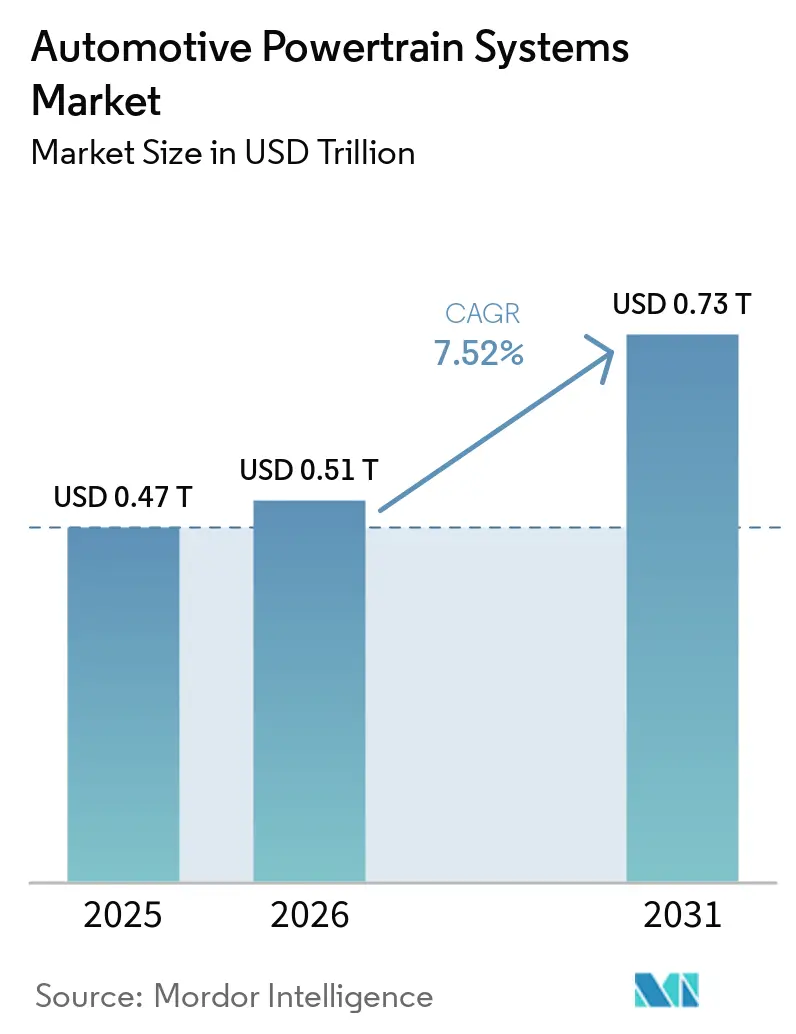
The automotive powertrain systems market size is expected to grow from USD 0.47 trillion in 2025 to USD 0.51 trillion in 2026 and is forecast to reach USD 0.73 trillion by 2031 at 7.52% CAGR over 2026-2031. This expansion stems from tightening emissions rules, the rapid decline in battery costs, and a pronounced shift by automakers toward dedicated electric platforms. Even though internal-combustion engines (ICEs) retain considerable scale advantages, their technology roadmap now focuses on efficiency tweaks rather than breakthrough innovation, while electric powertrains absorb the bulk of new capital outlays. Suppliers are coping with shorter product cycles, a higher software content per unit, and volatile raw-material prices that disproportionately impact battery-centric designs. Competitive intensity is sharpening as OEMs vertically integrate e-axles and control software, squeezing traditional Tier-1 margins and spurring alliances among smaller specialists.
Key Report Takeaways
- By component, engines commanded 41.63% of the automotive powertrain systems market size in 2025, whereas the “Others” basket—chiefly e-drive units—will rise at a 9.43% CAGR over 2026-2031.
- By propulsion type, internal-combustion engines held 78.28% of the automotive powertrain systems market share in 2025; electric powertrains are projected to expand at a 10.18% CAGR through 2031.
- By drive type, front-wheel drive led with a 46.78% slice of 2025 revenue, while all-wheel drive systems show the highest 8.23% CAGR to 2031.
- By vehicle type, passenger vehicles accounted for a 71.94% share of 2025 sales and will register an 8.61% CAGR through 2031.
- By sales channel, OEM routes generated 86.88% of 2025 demand, yet the aftermarket is poised for a 8.79% CAGR thanks to AI-enabled predictive-maintenance services.
- By geography, Asia-Pacific captured 48.86% of 2025 revenue, while the same region is forecast to post the fastest 7.94% CAGR to 2031.
Note: Market size and forecast figures in this report are generated using Mordor Intelligence’s proprietary estimation framework, updated with the latest available data and insights as of 2026.
Market Trends and Insights
Drivers Impact Analysis of Automotive Powertrain Systems Market*
| Driver | (~) % Impact on CAGR Forecast | Geographic Relevance | Impact Timeline |
|---|---|---|---|
| Rapid Battery-Cost Decline | +2.1% | Asia-Pacific core, spill-over to North America and the EU | Short term (≤ 2 years) |
| Tightening Global CO2 Rules | +1.8% | Global, led by the EU and China | Medium term (2-4 years) |
| OEM Shift to EV Platforms | +1.5% | Global, clustered in major auto hubs | Medium term (2-4 years) |
| Commercial Fleet Electrification | +1.2% | North America and the EU, spreading to Asia-Pacific cities | Long term (≥ 4 years) |
| Emergence of Sodium-Ion | +0.9% | Asia-Pacific core, chiefly China and India | Medium term (2-4 years) |
| AI-Driven Predictive Maintenance | +0.8% | Global, with early uptake in developed markets | Short term (≤ 2 years) |
| Source: Mordor Intelligence | |||
Rapid Battery-Cost Decline Enabling Affordable E-Powertrains
In 2024, average battery pack prices experienced a significant decline compared to earlier levels. Projections suggest prices will continue to decrease in the coming years. Scale advantages at plants operated by CATL and BYD, plus lithium-iron-phosphate chemistries that deliver near-par energy density at lower cost, help battery-electric vehicles (BEVs) undercut ICE total-cost-of-ownership earlier than forecast. Lower pack prices enable high-voltage, bi-directional charging designs that create new revenue streams for fleet operators who can resell stored energy to the grid. Commercial BEV payback periods now fall inside three years on high-utilization city routes, speeding fleet conversion.
Tightening Global CO₂ and Fuel-Economy Regulations
Regulators in Europe, China, and select states in the United States are enforcing stricter fleet-average CO₂ caps that push automakers to mainstream electric powertrains. The Euro 7 framework imposes fines for CO₂ on every vehicle an OEM registers, making non-compliance financially untenable [1]. China’s dual-credit scheme requires a notable share of electric or hybrid sales by 2030 and ties license-plate quotas to progress, accelerating powertrain shifts among domestic brands. California’s Advanced Clean Cars II program extends zero-emission targets to medium-duty trucks, compelling fleet operators to re-evaluate asset lifecycles. These converging rules shrink the addressable market for future ICE launches and compel suppliers to retool for high-volume e-axle production.
OEM Pivot to Dedicated EV Platforms and In-House E-Axles (Scale Economics)
Global brands are abandoning multi-energy “skateboards” in favor of purpose-built EV architectures, supporting the development of electric vehicle powertrain systems. General Motors’ Ultium and Volkswagen’s MEB each receive significant investment in combined tooling and supplier re-qualification outlays. Dedicated layouts free designers from legacy tunnel and firewall constraints, cut wiring complexity, and allow battery packs to become structural elements. Automakers such as Ford now build e-axles internally, re-shaping make-versus-buy decisions and shifting significant cost of content per vehicle away from external Tier-1 suppliers. The trend compresses margins in the traditional supplier base while opening space for niche integrators of software-heavy power electronics.
Commercial-Fleet Electrification Mandates (Last-Mile, HD-Truck Corridors)
Government procurement and zero-emission zones give commercial BEV programs guaranteed volume. London, Paris, and Amsterdam restrict diesel vans during daylight hours, prompting logistics firms to secure charging depots near city centers to maintain service windows. Amazon’s 100,000-unit order with Rivian highlights how large operators leverage scale to lock battery supply and infrastructure concessions, anchoring demand for e-axles through 2030.
Restraints Impact Analysis of Automotive Powertrain Systems Market*
| Restraint | (~) % Impact on CAGR Forecast | Geographic Relevance | Impact Timeline |
|---|---|---|---|
| Critical Mineral Price Swings | −1.4% | Global, the highest exposure in battery-dependent regions | Short term (≤ 2 years) |
| OEM Vertical Integration Squeezing | −0.9% | Global, clustered in legacy automotive hubs | Medium term (2-4 years) |
| Slow Rollout of Charging | −0.7% | North America and the EU, muted effect in Asia-Pacific | Long term (≥ 4 years) |
| Consumer Range Anxiety | −0.6% | Asia-Pacific emerging economies, the Middle East & Africa, and parts of South America | Medium term (2-4 years) |
| Source: Mordor Intelligence | |||
Critical-Mineral Supply-Chain Volatility and Price Swings
Between 2022 and 2024, lithium carbonate prices experienced significant fluctuations. This volatility compelled battery makers to adjust their contracts quarterly, disrupting their cost forecasts. Mining concentration in Chile, Australia, and China, plus a significant Chinese share of refining capacity, exposes OEMs to geopolitical shocks. Ford’s USD 3.5 billion investment in Michigan refining aims to localize a slice of the chain, yet start-up timelines stretch to 2026, limiting short-term relief.
OEM Vertical-Integration Squeezing Tier-1 ICE Suppliers’ Addressable Market
BorgWarner reported a significant revenue slide in legacy engine components as automakers insourced e-axle programs and trimmed ICE options per platform. BEV drivetrains carry one-quarter the moving parts of ICE assemblies, shrinking aftermarket filters, gaskets, and fluids demand. Suppliers scramble to fund acquisitions in power electronics while balancing cash flow from a shrinking ICE base, pressuring free-cash conversion and credit metrics.
*Our forecasts treat driver/restraint impacts as directional, not additive. The impact forecasts reflect baseline growth, mix effects, and variable interactions.
Automotive Powertrain Systems Market Segment Analysis
By Component:
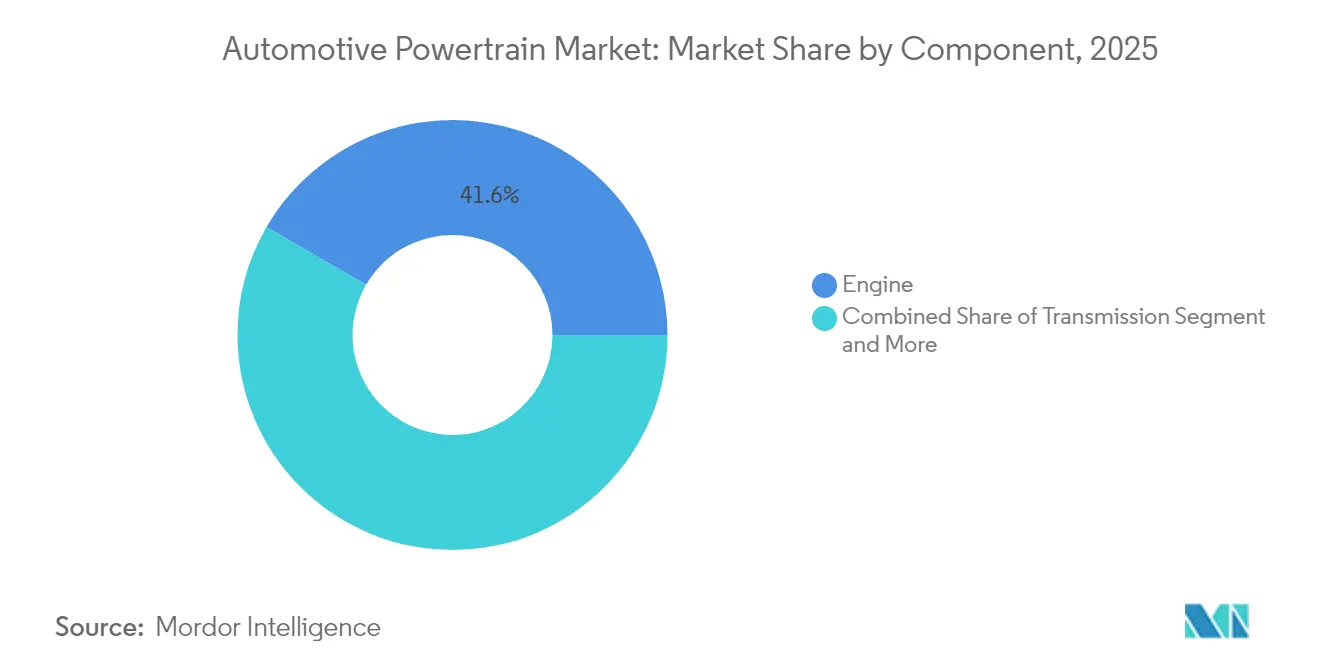
E-Drive Integration Reshapes Traditional HierarchiesEngines generated the largest slice of the automotive powertrain systems market size with 41.63% share in 2025, as automakers wind down fresh ICE programs. Conversely, the “Others” basket—chiefly final drives and compact e-drive units—will outpace all peers at a 9.43% CAGR through 2031, taking advantage of integrated motor-inverter packages that cut weight and assembly steps. Transmissions cede share because most BEVs require a single reduction gear, although multi-speed boxes gain relevance for 40-ton trucks seeking highway efficiency. Differential suppliers pivot to electronic torque-vectoring modules synced with software controls rather than mechanical, limited-slip clutches .
Lightweight composite drive shafts and embedded vibration sensors turn once-passive parts into data nodes for predictive diagnostics, harmonizing with the AI-maintenance driver outlined earlier. As e-drive uptake scales, Tier-1 firms with both motor winding and power-module competencies win new-business awards, while pure mechanical specialists risk margin erosion. Overall, the component mix migrates toward fewer, higher-value assemblies governed by power-electronics IP rather than machining know-how.

By Propulsion Type:
ICE Dominance Masks Electrification VelocityICE systems still represent 78.28% of 2025 revenue but might decline significantly by 2031, losing notable percentage points of share annually as BEVs sprint ahead. The electric vehicle segment is projected to expand at a 10.18% CAGR. Battery-electric powertrains achieve notable growth because falling pack costs intersect with punitive emissions penalties.
Plug-in hybrids act as transitional bridges in regions where charging infrastructure lags. Fuel-cell electric vehicles remain niche, limited to heavy-duty fleets along hydrogen corridors in Europe and California. Regional splits persist: China aims to significantly increase the adoption of plug-in vehicles among new cars, whereas India and parts of ASEAN still rely on Euro 6-plus ICE optimizations until public charging density improves.
By Drive Type:
AWD Systems Capitalize on Electric AdvantagesFront-wheel drive retains leadership with 46.78% share in 2025, propelled by small-car platforms. Yet dual-motor BEVs elevate all-wheel drive to the fastest 8.23% CAGR because software torque vectoring enhances traction without mechanical shafts. Rear-wheel drive enjoys a modest revival in premium sports sedans, where under-floor batteries free the front axle for steering purity.
Electric AWD units integrate inverter, motor, and reduction gear into a sub-75 kg package, unlocking skateboard flexibility and enabling over-the-air performance upgrades that consumers can purchase post-sale. As vehicle architectures evolve toward electrification, the automotive drivetrain market is increasingly shaped by integrated e-axles, electric drive units, and software-controlled torque distribution across FWD, RWD, and AWD configurations. The change shifts value from cast-iron differentials to silicon-carbide MOSFET stacks and firmware algorithms.
By Vehicle Type:
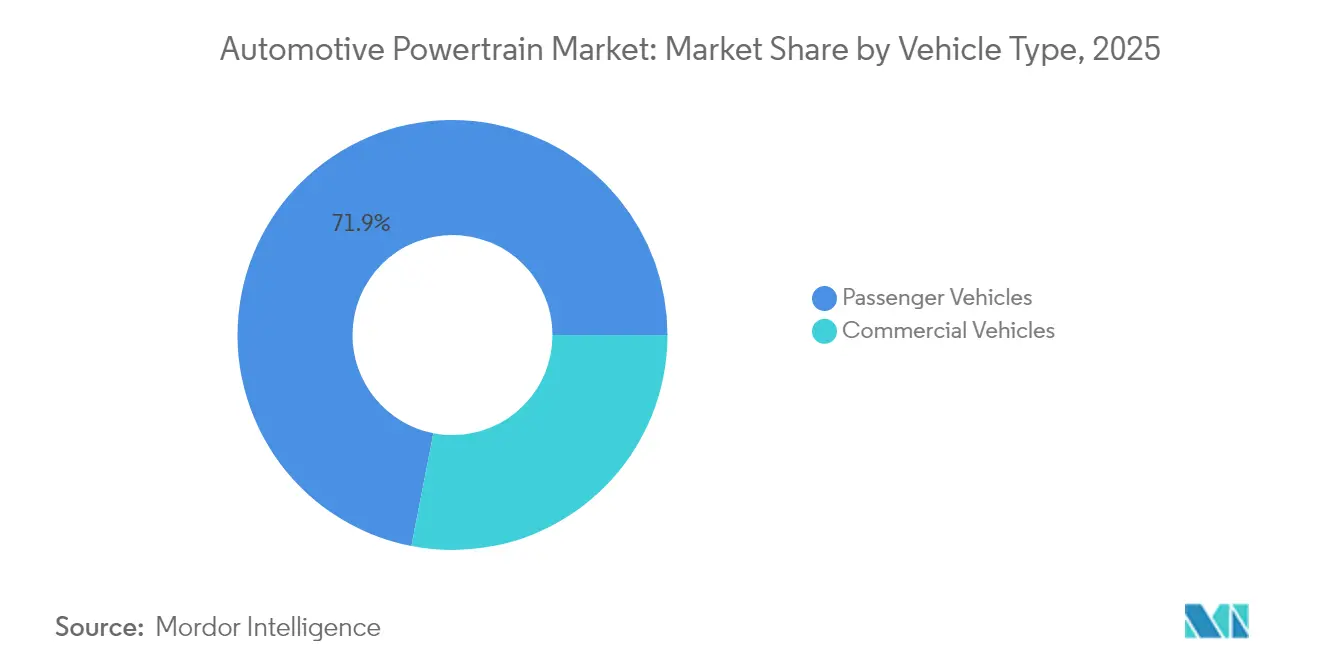
Commercial Electrification Accelerates Fleet TransformationPassenger vehicles account for most unit volume with a 71.94% in 2025, thanks to diverse price points and brand loyalty. Commercial vehicles will post an 8.61% CAGR as delivery-van and city-bus operators seek predictable running costs and urban-access compliance.
Fleets leverage depot charging to achieve notable overnight top-offs using discounted off-peak electricity, achieving fuel savings versus diesel benchmarks. Rising e-bus penetration in India, South America, and Southeast Asia accelerates pack capacity expansion at regional cell-assembly plants, shortening supply chains and reducing tariff exposure.
By Sales Channel:
Aftermarket Services Transform Through Digital IntegrationOEM sales channels held 86.88% share in 2025, reflecting factory-installed powertrain deliveries. The aftermarket, though smaller, grows at 8.79% as cloud analytics open fee-for-service models. Independent garages purchase subscription access to OEM data lakes, enabling just-in-time part stocking.
For BEVs, revenue centers shift from oil changes to battery health checks, thermal-management retrofits, and software unlocks that raise torque caps. Predictive algorithms cut unplanned downtime, an especially valuable metric for ride-hailing and last-mile fleets.
Geography Analysis
APAC Automotive Powertrain Systems Market
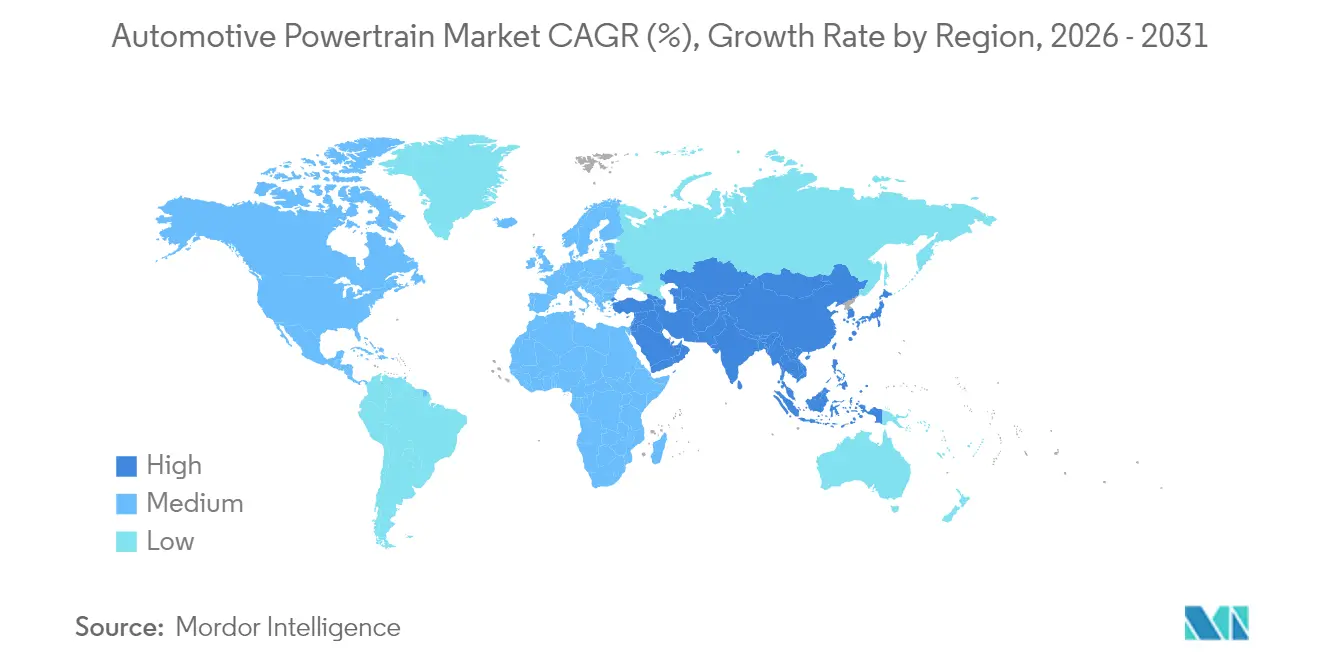
The Asia-Pacific dominated the automotive powertrain systems market with a 48.86% share in 2025 and is expected to maintain an 7.94% CAGR to 2031. China’s dual-credit program and generous EV subsidies spur domestic demand and export expansion, while India’s Faster Adoption and Manufacturing of Electric Vehicles (FAME) incentives extend commercial-vehicle electrification to tier-2 cities. Japan refines hybrid technologies, and South Korea excels in battery innovation, though growth slows relative to China’s surge.
North America Automotive Powertrain Systems Market
North America registers significant growth, buoyed by the Inflation Reduction Act’s clean-technology credits that encourage localized battery supply chains . Commercial fleets benefit from federal procurement mandates and utility rebates for depot chargers, yet sparse rural infrastructure tempers private BEV adoption. Mexico’s cost-competitive parts plants satisfy domestic-content thresholds, reinforcing regional integration.
Europe Automotive Powertrain Systems Market
Europe leverages the European Green Deal’s 2050 climate neutrality aims to maintain a sizeable piece of the automotive powertrain systems market. Germany’s premium brands channel R&D into 800-volt architectures, while Eastern European nations attract final-assembly lines seeking lower labor expenses. High energy prices and reliance on Asian battery imports challenge economics, but recycling mandates spawn secondary-use and material-recovery ventures that may offset cost headwinds. Lightweight materials and compact packaging are advancing, yet a near-term cost gap persists, slowing uptake in the automotive energy recovery systems market.
Regulatory Landscape
Powertrain design and sourcing decisions are increasingly shaped by diverging emissions and safety rules across major auto regions. In the European Union, Euro 7 (Regulation (EU) 2024/1257) sets common technical requirements covering pollutant emissions, CO2-related compliance pressures, and battery durability. From 29 November 2026, type-approval authorities must refuse approvals for vehicles that do not meet Euro 7. In parallel, UNECE WP.29 activity in June 2026 (World Forum for Harmonization of Vehicle Regulations) included scheduled adoption work on new UN regulations covering topics such as tyre abrasion and liquid hydrogen, and updates to real-driving emissions requirements are progressing through UN regulation amendments.
In the United States, the federal trajectory referenced in recent EPA actions includes a major policy shift in early 2026, alongside a May 2026 Federal Register proposal to modify the phase-in schedule for Tier 4 criteria pollutant standards by extending Tier 3 applicability for certain vehicles into model years 2027 and 2028, with Tier 4 requirements starting in model year 2029. EU tightening around the Euro 7 timeline and UNECE harmonization, alongside the evolving US federal framework, increases the need for OEMs and Tier-1 suppliers to keep regionalized calibrations, certification strategies, and product mixes across ICE, hybrid, and electric powertrains.
Value Chain Analysis
The automotive powertrain systems value chain runs from raw materials and semiconductor inputs to mechanical and electro-mechanical subcomponents, system integration, OEM assembly, and service and aftermarket support. Upstream, critical inputs include steel and aluminum for housings and gears, copper for motors, and power semiconductors (IGBT and silicon carbide) for inverters and integrated e-axles, with supply risk heightened by volatile mineral and electronics lead times. Midstream, Tier-1 and specialized suppliers design and manufacture engines, transmissions, differentials, and increasingly integrated e-drive units (motor, inverter, reduction gear). As torque vectoring and over-the-air updates expand, software and controls are taking on greater weight, shifting differentiation away from machining toward electronics and firmware.
Recent partnerships point to a chain reshuffle around electrification and localization. Onsemi expanded collaboration with Geely Auto Group in April 2026 to integrate silicon carbide power technologies into Geely SEA-S 900V architectures, while UNT partnered with Horse Powertrain in February 2026 to co-develop IGBT and SiC power modules for hybrid systems. Manufacturing ecosystems are also getting denser, including Minda Corp and Turntide forming a joint venture in March 2026 for EV powertrain components in India, which supports localization goals while tightening links between component makers, electronics suppliers, and OEM platform roadmaps.
Competitive Landscape
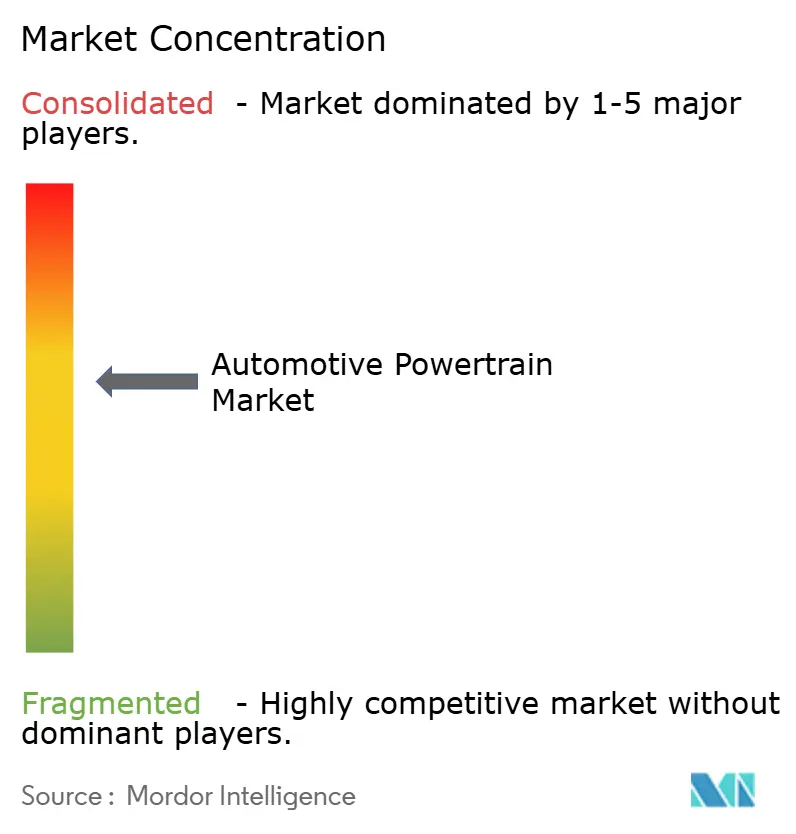
The sector exhibits moderate fragmentation. Traditional engine and gearbox leaders—Toyota Industries, Aisin, and ZF—still capture sizeable ICE volumes, yet face secular decline. Bosch, Valeo, and BorgWarner acquire inverter specialists and silicon-carbide start-ups to protect content per vehicle. New entrants such as CATL, BYD, and Foxconn bundle cells, BMS, and e-drives, leveraging consumer-electronics supply-chain agility to undercut legacy pricing.
Tesla’s vertically integrated approach combines motor design, power electronics, and control firmware, enabling over-the-air upgrades that differentiate performance tiers without physical hardware changes. Strategic collaboration intensifies: Magna partners with LG Energy Solution on e-axles, while Stellantis co-invests in solid-state battery ventures to secure next-gen chemistry access.
Regulatory compliance favors scale, prompting M&A among mid-tier specialists lacking the balance-sheet strength for simultaneous ICE optimization and BEV expansion. Software capability emerges as the decisive battleground, with suppliers racing to deploy standardized middleware that orchestrates propulsion, battery, and charging functions across multi-brand portfolios.
Automotive Powertrain Systems Industry Leaders
-
Robert Bosch GmbH
-
Denso Corporation
-
ZF Friedrichshafen AG
-
Magna International Inc.
-
Aisin Corporation
- *Disclaimer: Major Players sorted in no particular order
Automotive Powertrain Systems Market Companies Covered in this Report
- Robert Bosch GmbH
- Denso Corporation
- ZF Friedrichshafen AG
- Magna International Inc.
- Aisin Corporation
- BorgWarner Inc.
- Vitesco Technologies Group AG (Continental AG)
- Hyundai Transys
- Schaeffler AG
- GKN Automotive
- Allison Transmission, Inc.
- Dana Incorporated
- Valeo SA
- JTEKT Corporation
- Cummins Inc.
- Mahle GmbH
- BYD Auto Co., Ltd.
- Tesla, Inc.
Market Opportunities and Future Outlook
One opportunity area is the build-out of localized, scalable electrified powertrain manufacturing and its enabling electronics. Governments and companies are funding capacity additions that expand supply for e-drive units, hybrid transmissions, and power semiconductors. In India, Uno Minda approved a greenfield facility in May 2026 for 4W electric powertrain systems, including Electric Drive Units (EDU) and Dedicated Hybrid Transmission (DHT) systems. In February 2026, Mahindra and Mahindra announced a large integrated automotive and tractor manufacturing investment in Nagpur that spans ICE, EV, and future powertrain platforms and is supported by a supplier park concept. Together, these moves highlight whitespace for Tier-1s and specialists that can industrialize integrated e-drive assemblies locally while meeting OEM cost targets and sourcing requirements.
Another opportunity sits in the electrified power electronics layer, where silicon carbide capacity and packaging know-how support higher-voltage architectures and more compact e-axle integration. In July 2026, Bosch signed a definitive agreement with the US Department of Commerce for up to USD 225 million in direct funding under the CHIPS Program Office to support a USD 2 billion investment in Roseville, California for silicon carbide semiconductor production, with sample production initiated. This capacity addition supports broader adoption of SiC-based inverter designs and creates openings for power module suppliers, thermal management specialists, and test and validation providers to shorten qualification cycles across global OEM platforms.
Recent Industry Developments in Automotive Powertrain Systems Market
- May 2026: DENSO Corporation and Aisin Corporation commenced supply of e-axle systems for Daihatsu Motor Co., Ltd. for the e-Hijet Cargo and e-Atrai electric micro commercial vehicles. The start of supply underscores how integrated drive units are moving into high-volume, cost-sensitive commercial segments, reinforcing demand for compact e-axle architectures and localized assembly footprints.
- April 2026: Robert Bosch GmbH signed a framework agreement with Chery Automobile to develop and mass-produce a new-generation 48V vehicle architecture. The collaboration strengthens the 48V pathway as a mass-market electrification lever, keeping suppliers engaged in hybridized powertrain content even where full BEV adoption varies by region.
- September 2024: HORSE agreed to deliver 12,000 HR10 range-extender engines annually to Brazilian start-up Lecar for flex-fuel EV applications. The deal highlights continued investment in range-extender and hybrid-compatible ICE programs in markets prioritizing fuel flexibility, sustaining demand for specialized engine, controls, and integration capabilities alongside electrified drivetrains.
Automotive Powertrain Systems Market Report Scope and Research Methodology
Market Definition and Coverage
For this study, the automotive powertrain systems market covers the set of systems and major assemblies that create propulsion and deliver torque to the wheels in passenger and commercial vehicles, across ICE, hybrid, and electric powertrains, measured in market value.
Scope exclusions: We do not count non-powertrain vehicle systems such as chassis, body electronics, infotainment, tires, and general interior components.
Segments Covered in This Report
- By Component
- Engine
- Transmission
- Differentials
- Drive Shafts
- Others (Final Drive, E-Drive Unit)
- By Propulsion Type
- Internal Combustion Engine (ICE)
- Electric Vehicle (EV)
- Hybrid (HEV/PHEV)
- By Drive Type
- Front-Wheel Drive (FWD)
- Rear-Wheel Drive (RWD)
- All-Wheel Drive (AWD)
- By Vehicle Type
- Passenger Vehicles
- Commercial Vehicles
- By Sales Channel
- OEM
- Aftermarket
- By Geography
- North America
- United States
- Canada
- Rest of North America
- South America
- Brazil
- Argentina
- Rest of South America
- Europe
- Germany
- United Kingdom
- France
- Italy
- Spain
- Rest of Europe
- Asia-Pacific
- China
- India
- Japan
- South Korea
- Rest of Asia-Pacific
- Middle East and Africa
- United Arab Emirates
- Saudi Arabia
- South Africa
- Turkey
- Rest of Middle East and Africa
- North America
Data Sources, Market Sizing, and Validation
Desk Research
Desk research was used to build the market structure and to anchor external reference points that are hard to estimate from interviews alone. We relied on public sources such as vehicle production and registration statistics from government transport agencies, customs and trade dashboards for major powertrain components, and technical publications from bodies such as SAE International and the International Organization of Motor Vehicle Manufacturers (OICA). We also used energy and emissions publications from agencies such as the International Energy Agency (IEA) to understand the pace of electrification, which shifts the powertrain mix over time.
On the supply side, we reviewed annual reports, 10-K style filings, investor presentations, and product catalogs to clarify what is shipped as a powertrain system versus a standalone component. Patent databases were referenced to track directional change in e-axles, multi-speed EV transmissions, and efficiency upgrades, which then informed assumptions used in the model. In addition, we used paid subscriptions for company financials and intelligence, plus news and financials, mainly to cross-check reported revenues and to time major plant, program, and regulatory events. The sources listed here are illustrative, and many other public documents and datasets were also used for data collection, validation, and clarification.
Primary Interviews and Surveys
Primary interviews and surveys focused on validating system boundaries, mix shifts, and pricing logic by speaking with people who track powertrain decisions closely, including OEM-facing product leads, engineering and program managers, and channel stakeholders in service and replacement. These interviews also helped confirm regional patterns across APAC, EMEA, and the Americas, since production footprints and electrification timing differ by geography.
Distribution of primary research fieldwork respondents
| Company type | Respondent position | Region |
|---|---|---|
| Top tier: 31% | CXOs: 14% | APAC: 43% |
| Mid tier: 48% | Functional/Unit leaders: 42% | EMEA: 33% |
| Smaller Players: 21% | Managers: 44% | Americas: 24% |
Market-Sizing & Forecasting
Sizing was built using a top-down approach where vehicle production by region and powertrain mix were reconstructed, then translated into system demand, followed by value conversion using average system pricing. To keep the totals realistic, the outputs were checked using selective bottom-up approximations, such as sampled supplier revenue roll-ups, channel checks on typical system content per vehicle, and targeted volume times ASP spot checks for engines, transmissions, and e-drive modules.
The model uses market fingerprints that can be explained and re-created with limited data, including global and regional light vehicle and commercial vehicle production, BEV and hybrid penetration, average powertrain content shifts (for example, ICE downsizing versus added hybrid modules), transmission take rates (including multi-speed EV cases where relevant), and pricing movement tied to material and electronics content. Where direct pricing data was uneven, gaps were handled by using proxy ranges from interviews and then normalizing them against publicly visible cost and inflation indicators, before totals were finalized.
Forecasting was done using scenario analysis supported by expert consensus on the pace of electrification, emissions compliance timing, and capacity ramp-ups. When assumptions had high uncertainty, a base case was selected and then stress tested against alternative paths for BEV share and system ASP progression, which helped avoid overly aggressive curves.
Data Validation & Update Cycle
Model results were validated through triangulation across independent signals, such as production trends, announced platform launches, and observed mix shifts between ICE, hybrid, and electric systems. Variance checks were run at the region and vehicle-type level, and outliers were reviewed in a second analyst pass so that one unusual assumption does not distort the full market.
If a key input moved meaningfully, such as a regulatory change, a major production disruption, or a faster than expected EV mix shift, respondents were re-contacted to confirm whether the change was temporary or structural. Reports are refreshed annually, and interim updates are made when material events impact volumes or pricing. Before delivery, a final update sweep is run to ensure the market view reflects the latest public signals and the most recent primary feedback.
Mordor Intelligence's Automotive Powertrain Systems Market Sizing Compared With Other Published Estimates
Published market values for automotive powertrain systems can vary a lot because firms set different system boundaries, pick different base years, and apply different price and mix assumptions as electrification increases. Currency conversion timing and whether aftermarket is counted can also change the total, even when the industry story sounds similar.
Key gap drivers in this market usually come down to what is treated as a full powertrain system versus an adjacent driveline or electronics set, and whether values are built from vehicle production and powertrain mix, or from broad revenue pools that can double count overlapping components. Differences also show up when one estimate assumes a steep, uniform price increase across the forecast window, or when the mix shift to e-drive units is applied too early without checking actual platform ramps by region.
Benchmark comparison
| Source | Market Size | Gaps in Research Methodology |
|---|---|---|
| Mordor Intelligence | USD 0.51 T (2026) | |
| Global Consultancy A | USD 0.97 T (2025) | Uses a broader component basket and older powertrain type splits, which can pull in adjacent driveline and non-system content and inflate totals when summed across vehicle types. |
| Industry Publisher B | USD 1.01 T (2025) | Applies a higher long-range growth profile and mixes position and engine type splits without clear reconciliation to vehicle production by region, which can overstate value when electrification accelerates. |
The table shows a wide spread, and in Mordor Intelligence's model the total is tied to powertrain system demand reconstructed from vehicle production and propulsion mix, with pricing checked against interview ranges and regional reality checks. When the system boundary is kept consistent and overlaps are screened out, the market value becomes easier to trace back to clear volumes, mix, and ASP steps, which makes updates more repeatable year to year.
Key Questions Answered in the Report
What is the current value of the automotive powertrain market?
The sector stands at USD 0.51 trillion in 2026.
How fast will the market expand through 2031?
Revenue is projected to rise at a 7.52% CAGR, reaching USD 0.73 trillion.
Which region leads both size and growth?
Asia-Pacific holds 48.86% of 2025 revenue and shows the highest 7.94% CAGR.
What component segment grows the quickest?
E-drive units inside the “Others” basket advance at a 9.43% CAGR.