
Market Overview
| Study Period | 2020 - 2031 |
|---|---|
| Market Size (2026) | USD 23.39 Billion |
| Market Size (2031) | USD 30.53 Billion |
| Growth Rate (2026 - 2031) | 5.44 % |
| Fastest Growing Market | Asia Pacific |
| Largest Market | Asia Pacific |
| Market Concentration | Medium |
Major Players *Disclaimer: Major Players sorted in no particular order Image © Mordor Intelligence. Reuse requires attribution under CC BY 4.0. | |
Automotive Actuators Market Analysis by Mordor Intelligence
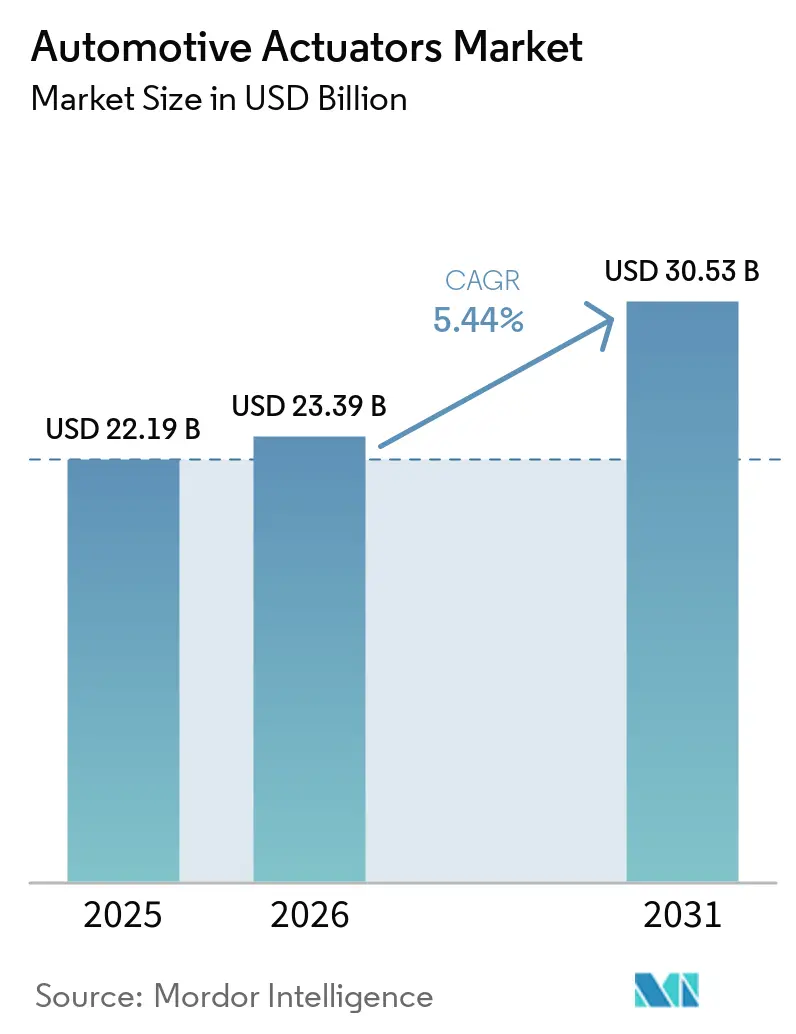
The automotive actuators market size was valued at USD 22.19 billion in 2025 and estimated to grow from USD 23.39 billion in 2026 to reach USD 30.53 billion by 2031, at a CAGR of 5.44% during the forecast period (2026-2031). Heightened emissions and safety regulations, rising electric-vehicle (EV) volumes, and the shift from mechanical linkages to software-defined controls collectively underpin sustained demand for intelligent actuation across powertrain, chassis, and body domains. Automakers must embed precise, responsive actuators to meet the European Union’s General Safety Regulation II mandate for advanced driver-assistance systems (ADAS) in all new vehicles starting July 2024[1]. Competitive intensity is growing as Tier-1s pivot toward brake-by-wire, e-axle, and shape-memory-alloy (SMA) solutions that boost functional integration yet lower weight and energy consumption.
Key Report Takeaways
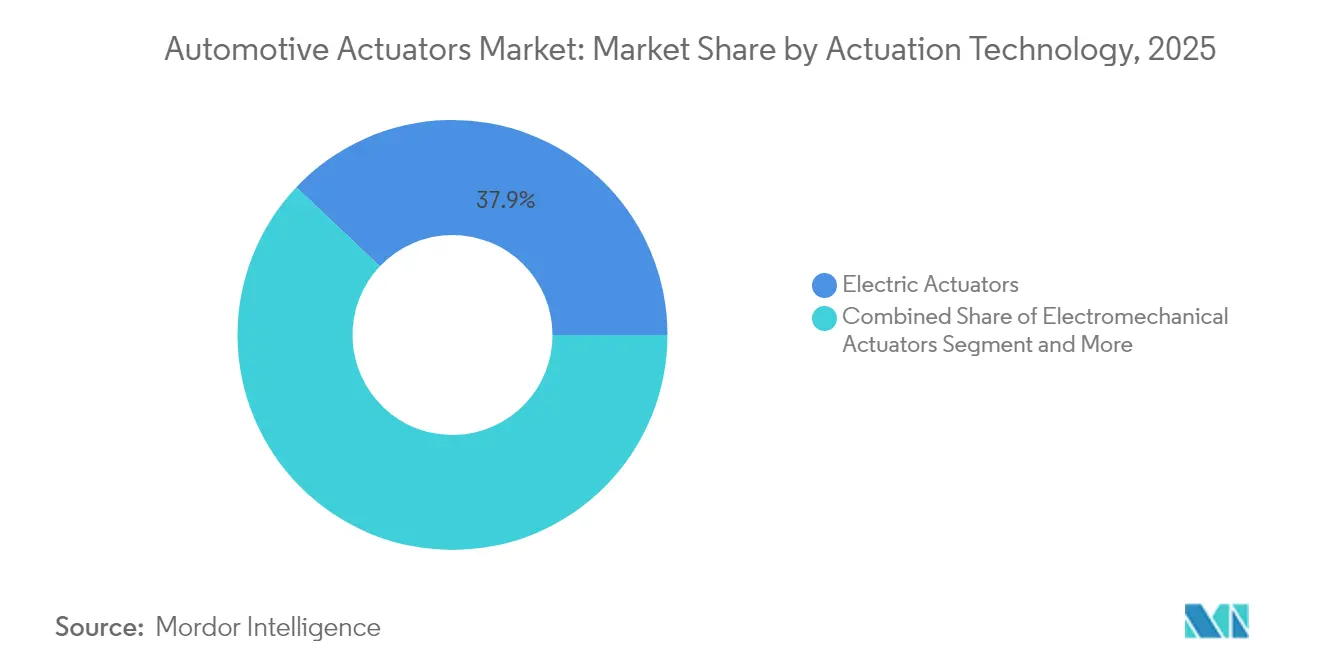
- By actuation technology, electric actuators led with 37.94% of automotive actuators market share in 2025, whereas shape-memory-alloy devices are expanding fastest at a 9.60% CAGR through 2031.
- By motion type, linear systems commanded 62.01% of the automotive actuators market size in 2025, while rotary designs are tracking the highest 7.72% CAGR to 2031.
- By application, throttle units retained a 24.28% share of the automotive actuators market size in 2025, yet suspension and chassis actuators are advancing at a 7.43% CAGR to 2031.
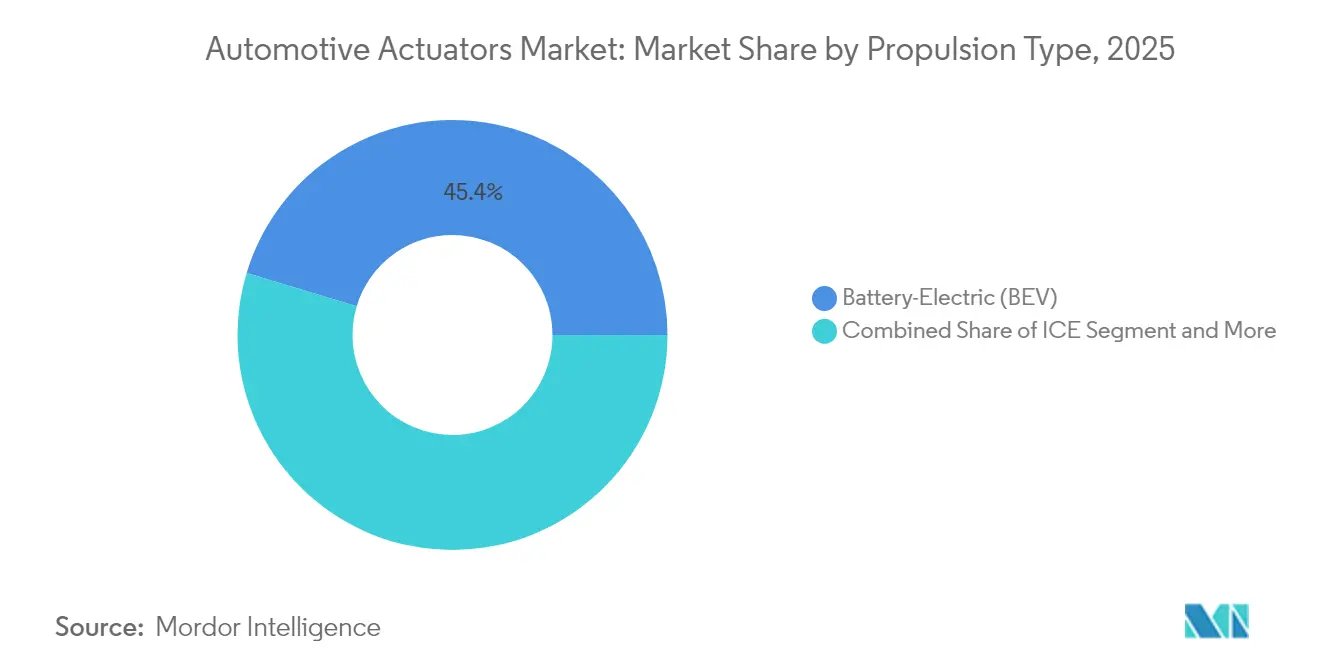
- By propulsion, battery-electric vehicles captured 45.35% of the automotive actuators market share in 2025 and are projected to grow at a 9.41% CAGR by 2031.
- By vehicle type, passenger cars held 70.85% of the automotive actuators market size in 2025, whereas buses represent the fastest-growing segment at a 9.39% CAGR through 2031.
- By sales channel, OEMs accounted for 80.11% of the automotive actuators market share in 2025, with aftermarket revenues lagging yet posting an 8.51% CAGR through 2031.
- Asia-Pacific dominated with a 41.86% slice of the automotive actuators market size in 2025 and will post an 8.48% CAGR to 2031.
Note: Market size and forecast figures in this report are generated using Mordor Intelligence’s proprietary estimation framework, updated with the latest available data and insights as of 2026.
Global Automotive Actuators Market Trends and Insights
Drivers Impact Analysis*
| Driver | (~) % Impact on CAGR Forecast | Geographic Relevance | Impact Timeline |
|---|---|---|---|
| Rising Demand for Advanced Safety and Comfort Features | +1.2% | EU, North America, global spill-over | Medium term (2-4 years) |
| Surge in Vehicle Electrification and EV Production | +1.8% | Asia-Pacific core; North America and EU follow | Long term (≥4 years) |
| Stricter Global Emission / Fuel-Efficiency Regulations | +0.9% | Global | Short term (≤2 years) |
| Ramp-Up of Passenger-Car Output in Asia-Pacific | +0.7% | Asia-Pacific; indirect global supply-chain impact | Medium term (2-4 years) |
| Shape-Memory-Alloy and Piezo Micro-Actuators Unlock Interior Space | +0.4% | Global, premium segment first | Long term (≥4 years) |
| OTA-calibrated “software-defined” Actuators Reduce Downtime | +0.3% | North America, EU early; Asia-Pacific follows | Medium term (2-4 years) |
| Source: Mordor Intelligence | |||
Rising Demand for Advanced Safety and Comfort Features
Global ADAS mandates continue to embed actuators in steering, braking, and suspension assemblies. The EU General Safety Regulation II requires intelligent speed assistance, autonomous emergency braking, and lane-keeping support in every new model launched after July 2024, locking in multi-year volume for precision actuators. In the United States, NHTSA updated its New Car Assessment Program to include four additional ADAS technologies that will remain test criteria through 2033 [2]. Consumers' willingness to pay for open-source safety solutions, signaling purchasing headroom for advanced actuation. The annual surge in camera production at Continental showcases a remarkable trend: as sensor output expands, the implementation of actuators rises in tandem. The innovative fusion of haptic sensors breathes new life into traditional electromechanical systems, effectively narrowing the perception gaps that often challenge autonomous driving. This exciting integration promises to enhance the sensory experience, creating a more intuitive interaction between vehicles and their surroundings.
Ramp-Up of Passenger-Car Output in Asia-Pacific
In 2024, China achieved a remarkable production milestone by rolling out an impressive 31.436 million vehicles, solidifying its position as a global automotive powerhouse. Meanwhile, the ASEAN region is on a determined path to reach an annual vehicle output of nearly 6 million units by the mid-2030s, fueled by enticing incentives from Thailand and Indonesia. Thailand's innovative EV3.5 program is at the forefront, promoting localized component production and encouraging the development of regional supply chains for steering actuators.
As Chinese original equipment manufacturers (OEMs) embrace vertical integration, they are not only streamlining their cost structures but also fostering a swift exchange of specialized manufacturing expertise across borders. This dynamic evolution is further shaped by China's dominance in the rare-earth minerals market, which significantly influences global design strategies, steering them toward the development of magnet-free vehicle architectures.
Shape-Memory-Alloy and Piezo Micro-Actuators Unlock Interior Space
Cu-Al-Mn SMA delivers high work output at cryogenic and elevated temperatures, making it ideal for compact HVAC shutters and active-aero flaps. Piezoelectrics such as TDK’s PowerHap reach sub-microsecond response for haptic feedback, satisfying next-gen cockpit UX requirements. Micro-structured sheet-metal transducers embedded with piezoceramic fibers allow real-time structural-health monitoring, adding predictive-maintenance value. Johnson Electric’s Solligence rotary actuator marries embedded AI with bistable operation to cut power draw while hitting 5-μs switch times. These material breakthroughs reduce component count, free cabin volume, and support design freedom in software-defined vehicles.
OTA-Calibrated “Software-Defined” Actuators Reduce Downtime
By 2030, it is anticipated that a transformative wave of internet-connected vehicles will revolutionize the automotive landscape, acting as a vital framework for remote calibration and drastically reducing the need for dealership visits. Tesla’s strategic approach to feature releases showcases the immense potential of over-the-air (OTA) updates to enhance vehicle value, a trend that is quickly being mirrored by Chinese manufacturers eager to capitalize on this innovative model.
To safeguard these advancements, secure in-vehicle networks paired with sophisticated cryptographic entity authentication effectively mitigate cyber risks, paving the way for the safe rollout of actuator firmware. At the heart of this technological evolution lies ZF’s ProAI supercomputer, which harnesses the power of edge AI for precise motion control, seamlessly coordinating cloud-based algorithms with distributed actuators across the vehicle.
Additionally, the introduction of subscription-based actuator features, ranging from luxurious enhanced seat massage options to advanced adaptive damping systems, offers manufacturers a novel revenue stream. However, this shift necessitates rigorous data governance and smooth integration with legacy systems to ensure a harmonious transition and maintain the integrity of the driving experience.
Restraints Impact Analysis*
| Restraint | (~) % Impact on CAGR Forecast | Geographic Relevance | Impact Timeline |
|---|---|---|---|
| Rare-earth Magnet Supply Volatility Inflates Costs | -0.9% | North America, EU most exposed | Short term (≤2 years) |
| High BOM Cost of Next-Gen Smart Actuators | -0.8% | Global, premium segment first | Short term (≤2 years) |
| Solid-State e-drivetrains Cutting Actuator Counts | -0.6% | Asia-Pacific, EU leading adoption | Long term (≥4 years) |
| Reliability Concerns in High-temperature Duty cycles | -0.5% | Global, extreme climate regions | Medium term (2-4 years) |
| Source: Mordor Intelligence | |||
Rare-Earth Magnet Supply Volatility Inflates Costs
China dominates the rare-earth processing market with a staggering 90% share, and the recent imposition of stricter export licensing has begun to ripple across the industry. Major manufacturers, like Ford, have already been compelled to halt production of their Explorer EV line in Europe, highlighting the fragility of the supply chain.
The Alliance for Automotive Innovation has issued a stark warning: if supply constraints worsen, North American operations could face significant shutdowns, casting a shadow over the future of the automotive sector. ZF’s efficient separatively excited synchronous motor eliminates heavy rare-earth content but demands new tooling and validation. Rising neodymium and dysprosium demand through 2040 sustains price pressure, compelling R&D into Sm₂Fe₁₇N₃ and Fe₁₆N₂ compounds, albeit with longer development cycles. Suppliers hedge with dual-sourcing and recycled magnets, yet complete diversification remains years away.
High BOM Cost of Next-Gen Smart Actuators
The value of semiconductors per vehicle is poised to soar, doubling by 2030 as AI-ready control units become ubiquitous, significantly elevating the costs associated with the actuator bill of materials. The automotive semiconductor landscape is on the brink of substantial expansion by 2032, with actuator electronic control units (ECUs) carving out a noteworthy share of this growth. While sleek and space-efficient, Smart Material Actuators (SMA) are laden with high-end raw materials and intricate processing expenses, which currently limit their deployment to premium luxury vehicles.
The integration of artificial intelligence for self-diagnostics amplifies both hardware and software costs, creating an added layer of financial complexity. Original Equipment Manufacturers (OEMs) are faced with the crucial challenge of assessing customer willingness to invest against the backdrop of affordability, especially in sensitive emerging markets where budget constraints are paramount.
*Our forecasts treat driver/restraint impacts as directional, not additive. The impact forecasts reflect baseline growth, mix effects, and variable interactions.
Segment Analysis
By Actuation Technology: Electric Dominance Drives Innovation
Electric actuators captured 37.94% of the automotive actuators market size in 2025 as OEMs favored their controllability and seamless integration with centralized E/E architectures. Electromechanical units remain default choices for hybrid powertrains that require a mechanical fail-safe, whereas hydraulics decline outside heavy trucks due to weight and maintenance drawbacks. SMA actuators are advancing at a 9.60% CAGR, leveraging high force-to-mass ratios to replace bulky motors in seat, vent, and latch functions, thus unlocking cabin space savings. Piezo drives address microsecond precision needs in fuel injectors and haptic dashboards, while pneumatic solutions linger in niche commercial segments where onboard air systems already exist.
Growth prospects hinge on AI-enabled self-tuning firmware that prolongs life and cuts calibration time. Electric actuators now incorporate embedded condition-monitoring chips that predict failure modes, lowering warranty costs. SMA suppliers partner with Tier-1s to scale sintering techniques that bring unit cost parity closer. Piezo vendors push automotive-grade reliability at wide temperature bands to secure cockpit HMI wins. As OTA expands, firmware modularity lets OEMs roll out new actuation profiles without hardware changes, reinforcing the automotive actuators market’s shift toward software-defined functionality.

By Motion Type: Linear Systems Lead Market
Linear mechanisms accounted for 62.01% of the automotive actuators market size in 2025, underpinned by door closers, seat rails, and active dampers. OEM sustainability goals favor electric linear devices that consume 20% less energy than hydraulic equivalents and integrate easily into 48 V power nets. Predictive-maintenance dashboards originating from cloud-captured stroke data reduce unexpected collapses in adaptive suspension, enhancing ride comfort.
While smaller in volume, rotary actuators are essential for steer-by-wire systems and active roll control. Additionally, rotary designs are projected to gain the highest CAGR at 7.72% through 2031. Advanced chassis programs such as ZF’s sMOTION deliver 80 mm lift in 0.5 s, demonstrating how high-torque rotary modules enhance dynamic handling. Next-generation rotary drives employ compact magnets or rare-earth-free architectures to sidestep supply risks while sustaining torque density. Suppliers integrate edge-AI chips that log micro-vibration signatures, allowing in-life recalibration, a feature well-suited to the automotive actuators market’s growing service-based revenue models
By Application Type: Throttle Leadership Faces Disruption
Throttle bodies still enjoy a 24.28% of the automotive actuators market share in 2025, owing to the large internal combustion engine vehicle parc, yet BEV momentum removes traditional air-management needs. To stay relevant, throttle suppliers embed smart controllers that interface with ADAS for speed-limit compliance and emissions mapping. They also diversify into hydrogen fuel-cell stack metering valves.
Suspension and chassis actuators, expanding at a 7.43% CAGR during the forecast period, benefit from active ride systems in premium EVs that mask battery weight. Magnetorheological dampers respond within milliseconds to sensor inputs, smoothing harshness on uneven roads. Brake actuators ride the brake-by-wire wave; ZF’s latest project marks a pivotal order as light vehicles cut hydraulic plumbing. Seat-adjust mechanisms migrate to lightweight SMA cables, and door systems adopt soft-close modules linked to smartphone keys. Thermal-management actuators scale quickly in EVs, modulating coolant loops for battery longevity.
By Vehicle Propulsion: BEV Segment Accelerates Growth
Battery-electric vehicles held 45.35% of the automotive actuators market share in 2025, growing at a 9.41% CAGR since they require precise thermal, brake, and drivetrain actuation for efficiency and safety. Centralized software stacks in BEVs allow cross-domain coordination, e.g., integrating regenerative brake torque with damper firmness for energy harvest.
The demand for internal combustion engine actuators is undergoing a contraction, yet it continues to hold steady, particularly in emerging markets where reliance on internal combustion remains strong. Innovative technologies like advanced exhaust-gas-recirculation systems and turbo-geometry actuators play a pivotal role in navigating increasingly stringent environmental regulations, helping manufacturers comply with rules that are gradually creeping toward phase-out dates.
Meanwhile, hybrid vehicles serve as a vital bridge in this transition, incorporating sophisticated components such as e-clutches and motor-cooling actuators. These additions significantly increase the overall count of units required, showcasing a blend of tradition and innovation.
Fuel Cell Electric Vehicles (FCEVs), although still a minor player in today's market, utilize cutting-edge technologies like high-pressure hydrogen valves and humidifier flaps. These niche applications are expected to see considerable growth, particularly within heavy-duty fleets, by 2031, heralding a transformative shift in the automotive landscape.
By Vehicle Type: Passenger Cars Drive Volume
In 2025, passenger cars commanded an impressive 70.85% of the automotive actuators market, fueled by a growing consumer desire for enhanced comfort features. Luxurious elements like power-adjustable seats, hands-free entry systems, and sophisticated zonal climate control vents have become essential, transforming the driving experience into one of utmost convenience. Additionally, the implementation of mandatory Advanced Driver Assistance Systems (ADAS) significantly boosts the number of actuators integrated into each vehicle, ensuring that modern cars are not only comfortable but also equipped with cutting-edge technology.
Buses record the strongest 9.39% CAGR as cities electrify fleets. Low-floor accessibility and kneeling-bus mechanisms boost linear-actuator volumes, while thermal-management loops mitigate battery heat under urban duty cycles.
Light commercial vehicles sustain growth on e-commerce demand, integrating smart actuators for autonomous loading doors. Heavy trucks embrace advanced brake, steering, and suspension actuators to meet safety rules and pave the way to Level 4 autonomy in logistics hubs.
By Sales Channel: OEM Dominance Shapes Innovation
OEMs absorbed 80.11% of the automotive actuators market share in 2025 because integration complexity locks suppliers into multi-year platform contracts. Tier-1s co-develop e-axles, brake-by-wire, and zonal actuators that embed cybersecurity and functional-safety firmware from inception.
The aftermarket is experiencing a robust CAGR of 8.51% projected through 2031. This vibrant sector plays a crucial role in supplying replacement parts for essential vehicle components such as door motors, window lifts, and HVAC flaps, especially as vehicle fleets continue to age. Notable industry players like Standard Motor Products and Continental are expanding their electronic parking-brake offerings, demonstrating that even the most advanced automotive systems can find their place in the aftermarket arena. Furthermore, the advent of over-the-air (OTA) updates is creating a dynamic hybrid marketplace where original equipment manufacturers (OEMs) can directly offer feature enhancements to vehicle owners, seamlessly merging traditional retail boundaries and revolutionizing how consumers interact with their vehicles.
Geography Analysis
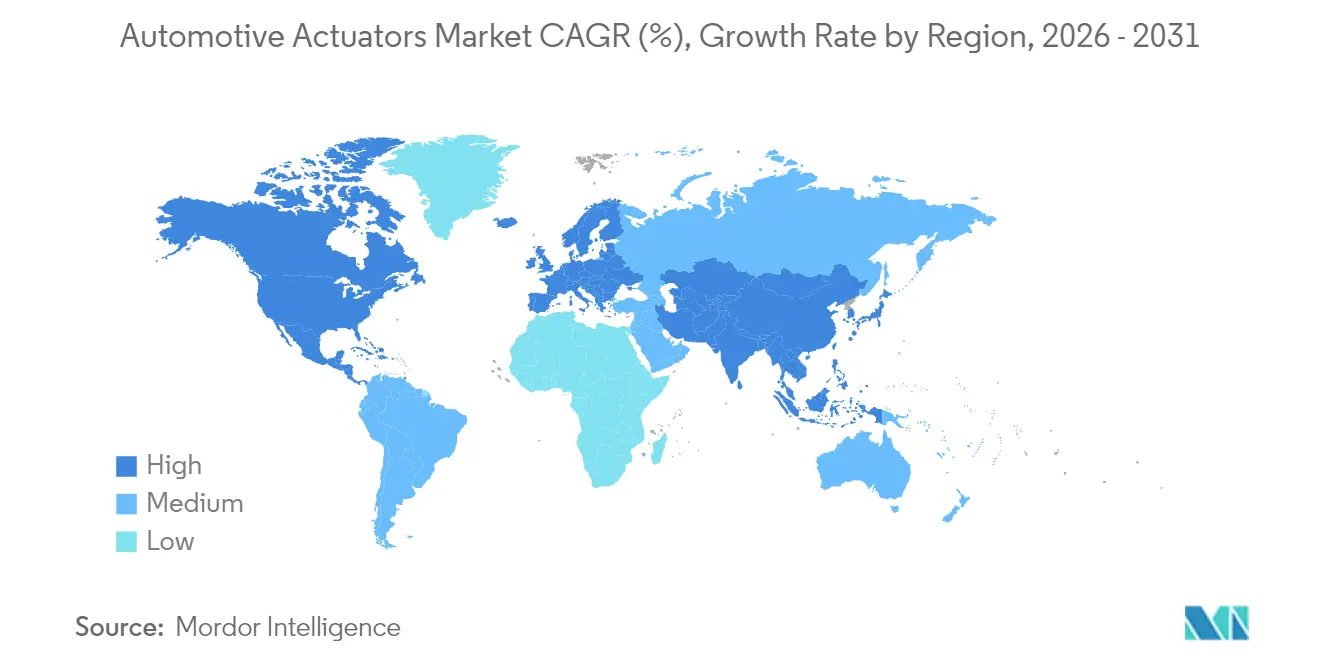
Asia-Pacific held 41.86% of the automotive actuators market size in 2025 and will grow 8.48% CAGR through 2031. China's boost in electric vehicle production is increasing regional demand, supported by state subsidies and large-scale manufacturing. ASEAN’s six million-unit production target in the mid-to-next decade offers secondary hubs that attract Tier-1 factories, buffering geopolitical risk. Japan and South Korea leverage electronics expertise to export high-precision actuators, while India ramps up cost-efficient production for domestic and export markets.
North America is expanding steadily in terms of regulatory compliance and re-shoring incentives. The EPA’s multi-pollutant rule compels new combustion-engine actuators, whereas the Inflation Reduction Act supports EV supply-chain localization.
Europe remains technologically advanced but supply-chain-constrained by rare-earth exposure. The Euro 7 directive and General Safety Regulation II sustain actuator demand in both powertrain and ADAS. Continental’s 10-million-camera production and ZF’s brake-by-wire wins illustrate Continental's leadership, yet raw-material hedging and energy costs challenge profitability. Middle East & Africa and South America lag in regulations but present long-term whitespace once affordability matches smart-actuator cost curves.
Regulatory Landscape
Safety and automation rules are increasing actuator content per vehicle, especially in braking, steering, and chassis domains. In the European Union, General Safety Regulation II (GSR II) requires several ADAS functions in all new vehicles from July 2024 onward, pushing OEMs toward more precise and diagnosable actuators integrated with centralized E/E architectures. Global functional-safety expectations are also anchored by ISO 26262 (2018 edition), which continues to shape development and validation practices for actuator ECUs, sensors, and software.
Cybersecurity and automated-driving rules are tightening requirements for in-vehicle networks that command and update actuators. UNECE WP.29 continues to advance provisions affecting by-wire and automated driving system safety cases and in-service monitoring, reinforcing the need for secure and updatable actuator controls. In the United States, the Section 232 framework places a 25% tariff on specified automobile parts, and in 2026 reopened an inclusions window process for petitions, adding compliance and documentation workload for importers while encouraging some actuator and subcomponent supply chains to regionalize.
Value Chain Analysis
The automotive actuators value chain runs from upstream materials and electronics (rare-earth magnets, steel, copper, sensors, and automotive-grade MCUs) through precision component manufacturing (gears, bearings, stators/rotors, housings), then to Tier-1 integration of mechatronic modules with embedded software, and finally OEM installation on vehicle platforms. Tier-1s increasingly co-design actuators with OEMs to meet functional-safety and cybersecurity expectations, and they often co-locate production near OEM plants to support just-in-sequence logistics and reduce line-side inventory.
Key pinch points include long OEM validation cycles (commonly 12 to 24 months), constrained high-precision machining capacity, and periodic disruptions in automotive-grade semiconductors that can stall actuator ECU builds. Rare-earth sourcing concentration amplifies both cost and continuity risk for motor-driven actuators, which is pushing design moves toward rare-earth-lean or magnet-free architectures alongside recycled-magnet strategies. Recent program activity shows value shifting toward integrated, electronically controlled systems, including ZF starting series production of its OptiRide electronically controlled air suspension for Hyundai (June 2025) and Schaeffler reporting a volume production launch of a smart rear-wheel steering system for a German OEM in early 2026.
Competitive Landscape
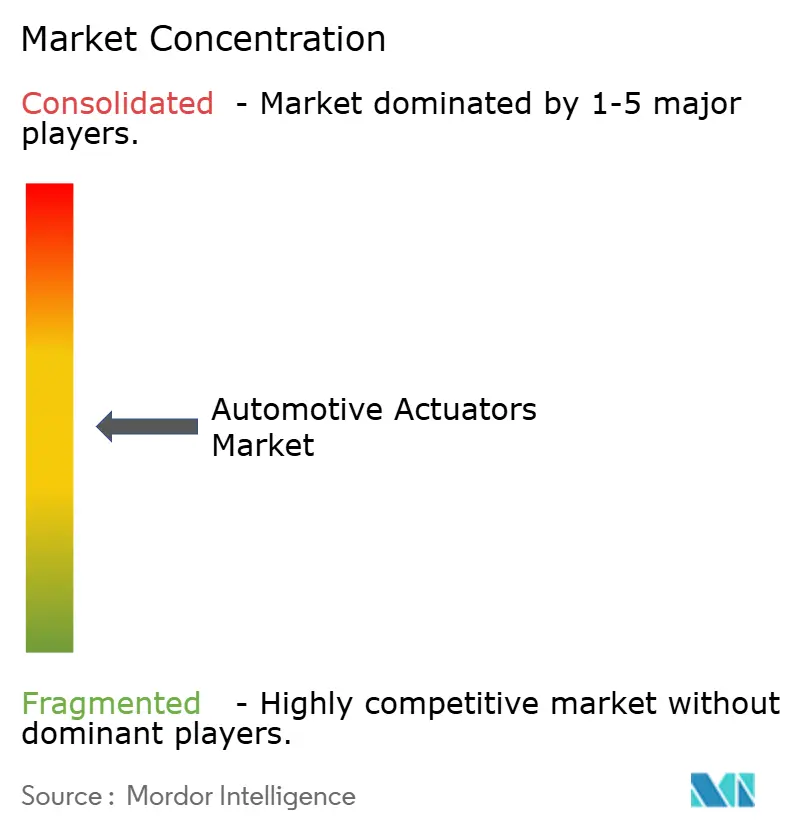
The automotive actuators market is moderately consolidated. Bosch, Denso, and Continental span chemical, mechanical, and software expertise, maintaining scale advantages. BorgWarner will target USD 10 billion eProduct revenue in 2027 via high-voltage hairpin motors and electric cross differentials that bundle actuator functionality[3]. ZF’s sizable brake-by-wire contract demonstrates OEM confidence in full-electronic safety systems, eroding hydraulic incumbency.
Johnson Electric’s Solligence actuator exemplifies intelligent solutions combining AI diagnostics with bistable mechanics for energy savings. SMA specialists partner with Tier-1s to embed compact drives in luxury interiors, widening supplier diversification. Rare-earth scarcity paves the way for magnet-free startups, whereas big players invest in recycling loops and dual sourcing. Joint ventures such as AISIN-BMW e-axle and Honda-Nissan-Mitsubishi collaborations illustrate consolidating platform strategies that spread R&D cost. Compliance with ISO 26262 and UNECE cybersecurity rules raises entry barriers, preserving incumbent leverage but not immune to software-centric newcomers.
Automotive Actuators Industry Leaders
-
Robert Bosch GmbH
-
Denso Corporation
-
Mitsubishi Electric Corporation
-
BorgWarner Inc.
-
Johnson Electric Holdings Limited
- *Disclaimer: Major Players sorted in no particular order
Market Opportunities and Future Outlook
The shift toward software-defined vehicles and electrified platforms is creating whitespace for actuators that pair mechatronics with embedded diagnostics and secure update capability, particularly in chassis, braking, and closure systems. One visible opportunity is the move from passive to fully active suspension in new energy vehicle programs, supported by new capacity and industrialization actions such as Tenneco (Monroe) completing a fully automated production line for fully active suspension actuators at its Suzhou facility (June 2026) and reported acceptance of a domestic active suspension actuator production line in China with independent intellectual property (June 2026). Taken together, these steps point to scaling beyond premium niches and expand the addressable fitment base for higher-value linear and rotary actuators.
Comfort and access functions are also migrating toward electromechanical systems that can be integrated into central controllers and feature activation models. Stabilus has positioned electromechanical door control systems as a growth field and published an estimate that the global market for electromechanical door actuators expands from about one million units in 2025 to five million units by 2029, reinforcing demand for compact, quiet, and low-power actuation solutions. Manufacturing localization is another opportunity vector: investments in actuator-adjacent motor and mechatronics production, including Nidec India breaking ground in Neemrana for automotive motors and park lock actuators (with completion planned for September 2026) and MCE Holdings launching the MCE Auto Hub in Serendah, Malaysia (RM50 million, July 2026), support regional supply resilience and faster OEM program responsiveness.
Recent Industry Developments
- April 2026: BorgWarner secured three electric motor awards in China and South Korea, including a generator motor for a three-speed hybrid transmission using ultra-short hairpin winding technology. The wins tie motor and actuator-adjacent content to electrified drivetrain platforms and reinforce Tier-1 demand for higher power density and manufacturing scalability as production launches progress.
- April 2025: Continental launched Aumovio as a spin-off brand focused on software-defined vehicles, pairing sensors and electronics with actuator-centric motion and control solutions. The move supports deeper integration between actuation hardware and centralized software stacks, aligning supplier roadmaps with OEM architectures that emphasize diagnostics and updateability.
- April 2025: Standard Motor Products expanded its Electronic Parking Brake Actuator program for a broader range of import and domestic vehicles. Wider catalog coverage strengthens aftermarket availability for safety-critical electromechanical actuators and improves service continuity as electronic parking brakes proliferate across vehicle platforms.
Research Methodology Framework and Report Scope
Market Definition and Coverage
For this study, the automotive actuators market covers the value of actuators used in road vehicles to convert electrical, hydraulic, or pneumatic energy into controlled motion for vehicle functions.
Scope exclusions: We exclude non-automotive industrial actuators and actuator use in off-highway equipment unless it is supplied as an automotive-grade fitment.
Segmentation Overview
- By Actuation Technology
- Electric Actuators
- Electromechanical Actuators
- Hydraulic Actuators
- Pneumatic Actuators
- Piezoelectric Actuators
- Shape-Memory-Alloy Actuators
- By Motion Type
- Linear
- Rotary
- By Application Type
- Throttle
- Brake
- Transmission / Drivetrain
- Seat Adjustment
- Door / Closure
- HVAC & Thermal
- Suspension & Chassis
- Mirror & Lighting
- By Vehicle Propulsion
- Internal Combustion Engine (ICE)
- Hybrid Electric Vehicles (HEV)
- Battery-Electric (BEV)
- Plug-in Hybrid Electric Vehicles (PHEV)
- Fuel-Cell Electric (FCEV)
- By Vehicle Type
- Passenger Cars
- Light Commercial Vehicles
- Heavy Commercial Vehicles
- Off-Highway & Special-Purpose
- By Sales Channel
- Original Equipment Manufacturers (OEM)
- Aftermarket
- By Geography
- North America
- United States
- Canada
- Rest of North America
- South America
- Brazil
- Argentina
- Rest of South America
- Europe
- Germany
- France
- United Kingdom
- Italy
- Spain
- Russia
- Rest of Europe
- Asia-Pacific
- China
- Japan
- India
- South Korea
- Vietnam
- Indonesia
- Philippines
- Thailand
- Australia
- Rest of Asia-Pacific
- Middle-East and Africa
- United Arab Emirates
- Saudi Arabia
- Turkey
- Egypt
- South Africa
- Rest of Middle-East and Africa
- North America
Data Sources, Market Sizing, and Validation
Desk Research
Desk work started by building a fact base using vehicle production, parc, and trade flows that directly influence actuator demand and pricing. Public sources such as OICA production statistics, UNECE pages, US DOT safety rulemaking pages, IEA electrification indicators, and national customs trade portals were used to map how the content-per-vehicle changes across regions and where volume trends are shifting.
Next, we reviewed company annual reports, investor presentations, and automotive trade press to track product mix changes, for instance electric actuation replacing hydraulic in selected functions. A paid subscription focused on company financials and news helped cross-check revenue direction for actuator-heavy suppliers, and a patent database was used to gauge where design activity is rising (for example in braking, closure, and thermal management). The sources listed here are illustrative only, and many other public references were used to collect data, validate assumptions, and clarify open points.
Primary Interviews and Surveys
Primary calls and short surveys were conducted with actuator suppliers, component distributors, and vehicle system specialists, then supplemented with input from engineering and purchasing roles at OEM-adjacent teams. Because this is a global market, we ensured feedback covered the main vehicle-producing hubs as well as regions where regulatory adoption and electrification timelines can quickly change actuator content and ASP assumptions.
Distribution of primary research fieldwork respondents
| Company type | Respondent position | Region |
|---|---|---|
| Top tier: 30% | CXOs: 16% | APAC: 49% |
| Mid tier: 54% | Functional/Unit leaders: 32% | EMEA: 33% |
| Smaller Players: 16% | Managers: 52% | Americas: 18% |
Market-Sizing & Forecasting
Sizing was built using a top-down demand pool reconstruction that starts from vehicle production by region and powertrain mix, then applies actuator content-per-vehicle by function to reach total unit demand. To keep the model grounded, we used inputs such as passenger versus commercial splits, feature adoption that adds actuators (power seats, power liftgates, electronic throttle, brake-by-wire progress), electrified vehicle share, and replacement intensity for high-movement applications.
We corroborated the totals with selective bottom-up approximations, mainly sampled ASP times volume checks for key applications, plus supplier revenue direction checks. When an application had limited public visibility, we closed gaps with conservative ranges. For forecasting, we used scenario analysis so different paths for electrification pace, safety regulation adoption, and actuator technology substitution can be represented without forcing one straight-line curve. Assumptions were finalized only after they were pressure-tested with primary respondents who track platform changes and sourcing cycles.
Data Validation & Update Cycle
Before sign-off, model outputs are triangulated against independent signals such as vehicle build plans, regional production totals, and observable shifts in feature penetration that directly change actuator counts. Variance checks are run across regions and across major applications so unusual jumps are flagged, investigated, and corrected, and a second analyst review is completed to confirm formulas and assumptions.
If any major mismatch shows up, or if an external change alters demand expectations, for example a regulation shift or a sharp production revision, respondents are re-contacted to recheck the key drivers. Reports are refreshed annually, with interim updates triggered for material developments. Right before delivery, we do a final pass so clients receive the most current view supported by the latest available data.
Mordor Intelligence's Automotive Actuators Market Size Versus Other Published Estimates
Published market sizes for automotive actuators can appear far apart, even when the topic name sounds identical. The gap usually comes from differences in the year used for sizing, what each study counts as an actuator, and how feature penetration and pricing are treated across regions.
Vehicle production totals, application-level content-per-vehicle checks, and cross-validation against supplier revenue direction are the evidence points that keep Mordor Intelligence's estimate aligned with the installed demand pool for automotive-grade actuators rather than adjacent industrial motion components. A further driver is forecast stance, because some publications embed electrification and feature adoption assumptions without rechecking whether those features are standard-fit or optional-fit in each vehicle class. Currency timing and inflation handling can also move the headline value.
Benchmark comparison
| Source | Market Size | Gaps in Research Methodology |
|---|---|---|
| Mordor Intelligence | USD 23.39 B (2026) | |
| Global Consultancy A | USD 27.90 B (2024) | Uses an earlier sizing year and can expand scope through broader segment cuts that may capture actuator-related modules and a wider EV feature set, which can lift the total even before the forecast begins. |
| Industry Publisher B | USD 23.40 B (2024) | Pairs a similar headline value with a different base year and a higher long-term growth path, which suggests more aggressive assumptions for electrification-led actuator substitution and faster ASP progression over time. |
Looking across the table, most of the spread is explained by base-year alignment and what each study counts inside the actuator boundary, followed by how fast content and pricing are assumed to climb. By anchoring the model to repeatable vehicle and feature signals, the result stays traceable to a clear demand build that can be rechecked during updates.
Key Questions Answered in the Report
What is the current value of the automotive actuators market?
The automotive actuators market size is USD 23.39 billion in 2026.
How fast will demand expand over the next five years?
Revenue is forecast to grow at a 5.44% CAGR, reaching USD 30.53 billion in 2031.
Which application segment is advancing most quickly?
Suspension and chassis actuators show the fastest 7.43% CAGR as active ride systems proliferate.
Why are shape-memory-alloy actuators gaining attention?
SMA devices deliver high force in compact packages, supporting interior space optimization and lowering weight.
How will rare-earth shortages affect suppliers?
Material volatility encourages magnet-free motor designs and recycled content, raising R&D costs but lowering dependency risks.