
Automotive Fintech Market Size and Share
Market Overview
| Study Period | 2020 - 2031 |
|---|---|
| Market Size (2026) | USD 9.89 Billion |
| Market Size (2031) | USD 21.29 Billion |
| Growth Rate (2026 - 2031) | 16.57 % |
| Fastest Growing Market | Asia-Pacific |
| Largest Market | Asia-Pacific |
| Market Concentration | Medium |
Major Players *Disclaimer: Major Players sorted in no particular order Image © Mordor Intelligence. Reuse requires attribution under CC BY 4.0. | |
Automotive Fintech Market Analysis by Mordor Intelligence
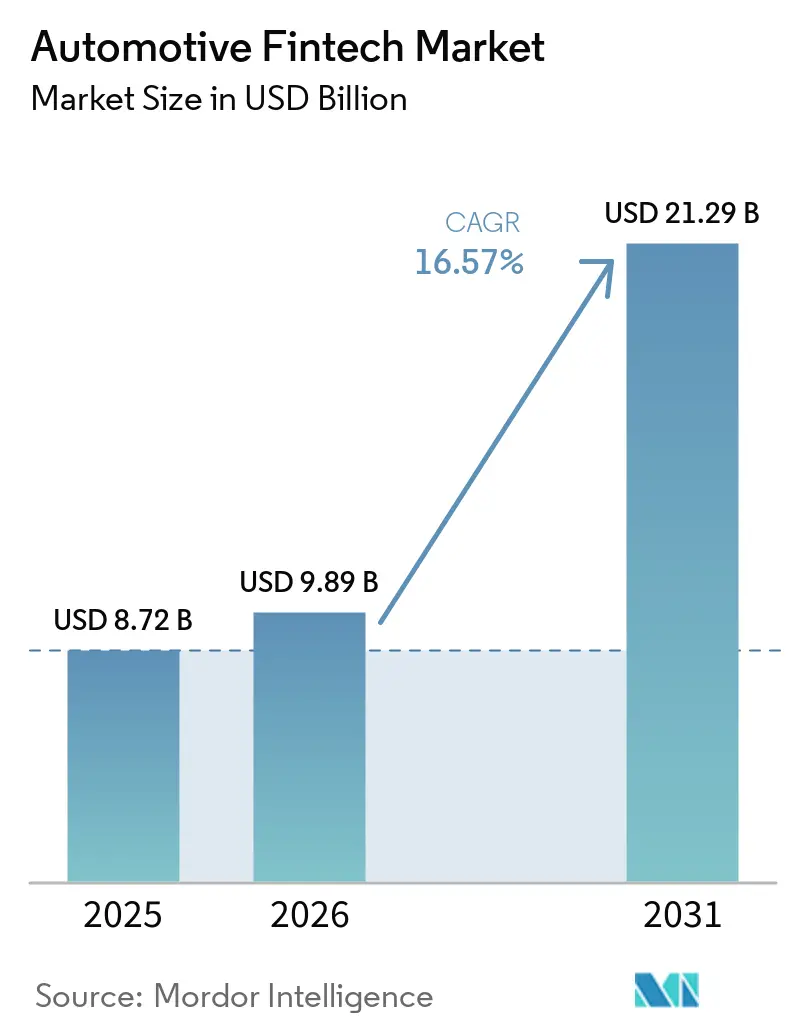
The Automotive Fintech Market size was valued at USD 8.72 billion in 2025 and is estimated to grow from USD 9.89 billion in 2026 to reach USD 21.29 billion by 2031, at a CAGR of 16.57% during the forecast period (2026-2031).
The automotive fintech market is expanding as software-defined vehicles are turning financing, insurance, and payments into digital functions that can be placed directly inside the vehicle buying and ownership journey. The automotive fintech market is also benefiting from the entry of non-bank technology firms that are widening auto credit access and changing how origination is distributed across dealer, OEM, and platform channels. Electric vehicle adoption is adding a separate layer of demand because many buyers and fleet operators now need financing structures that fit batteries, charging, subscriptions, and service bundles rather than standard auto loans. The automotive fintech market is becoming more competitive because captive finance units no longer control the full origination path, while BaaS platforms and AI-led lenders are building direct access to customers through dealer systems and digital touchpoints. Regulatory fragmentation and weaker borrower credit quality remain real constraints, but they are also forcing stronger underwriting, servicing, and compliance capabilities that can support durable scale.
Key Report Takeaways
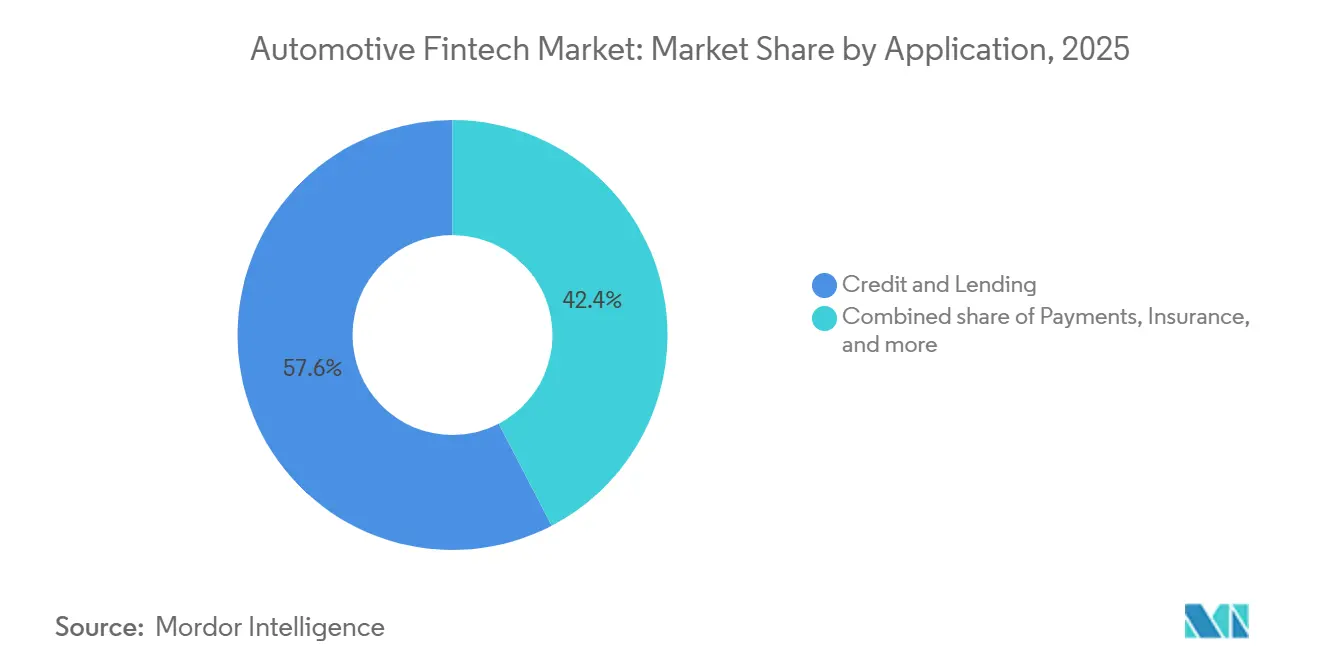
- By application, credit and lending accounted for 57.6% of the automotive fintech market share in 2025, while payments are projected to grow at 21.1% CAGR through 2031.
- By vehicle type, passenger cars captured 68.3% of the automotive fintech market share in 2025, while commercial vehicles are projected to grow at 19.4% CAGR through 2031.
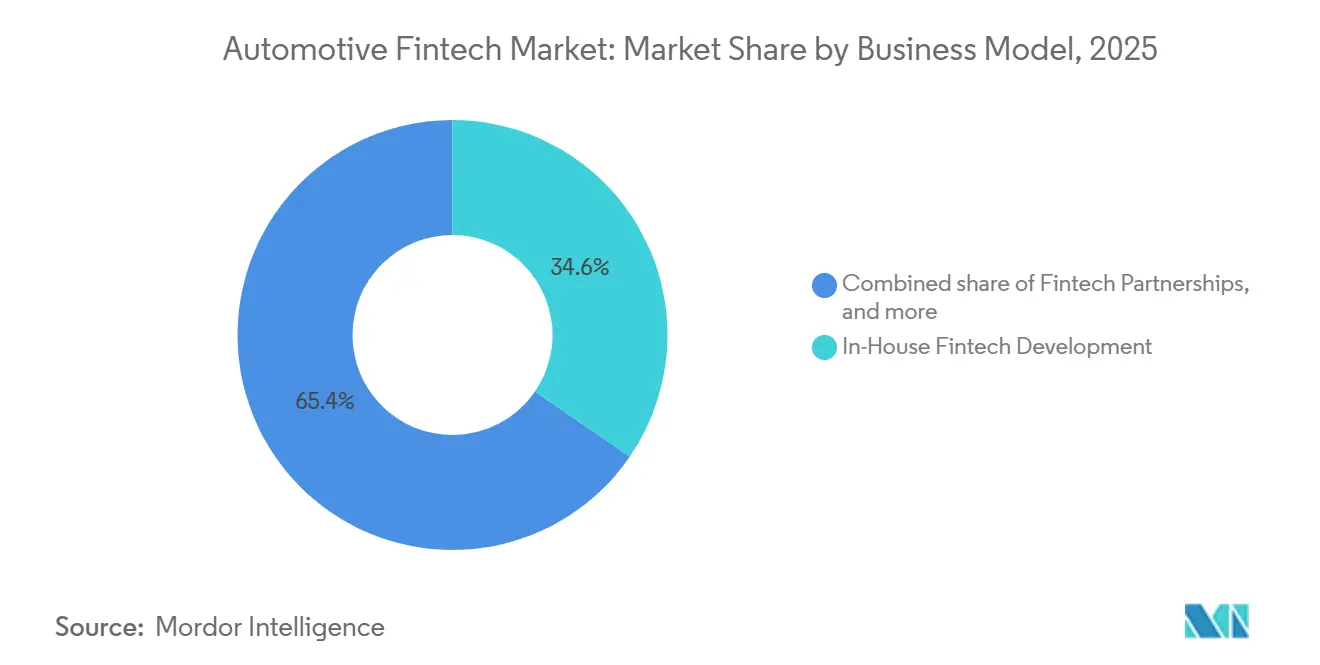
- By business model, in-house fintech development held 34.6% of the automotive fintech market share in 2025, while banking-as-a-service is forecast to expand at 22.3% CAGR through 2031.
- By end user, retail consumers accounted for 52.9% of the automotive fintech market share in 2025, while fleet operators and logistics companies are projected to grow at 20.7% CAGR through 2031.
- By geography, Asia-Pacific accounted for 37.5% of the automotive fintech market share in 2025 and is forecast to grow at an 18.9% CAGR through 2031.
Note: Market size and forecast figures in this report are generated using Mordor Intelligence’s proprietary estimation framework, updated with the latest available data and insights as of January 2026.
Market Trends and Insights
Drivers Impact Analysis of Automotive Fintech Market*
| Driver | (~) % Impact on CAGR Forecast | Geographic Relevance | Impact Timeline |
|---|---|---|---|
| Rising Demand for Embedded Vehicle Finance | +3.5% | Global, concentrated in North America and the Asia-Pacific | Medium term (2-4 years) |
| Expansion of Digital Dealer and OEM Financing Ecosystems | +3.0% | North America, Europe, Asia-Pacific | Medium term (2-4 years) |
| Growth of Usage-Based Insurance and Telematics-Priced Products | +2.5% | North America, Europe, India | Medium term (2-4 years) |
| AI-Led Credit Underwriting and Fraud Reduction | +2.0% | Global | Short term (≤ 2 years) |
| EV-Centric Financing and Subscription Bundling | +2.0% | Asia-Pacific, Europe, North America | Long term (≥ 4 years) |
| Cross-Platform Identity, KYC, and Consent Architecture Fragmentation | +1.5% | Global, with early gains in North America and the EU | Short term (≤ 2 years) |
| Source: Mordor Intelligence | |||
Rising Demand for Embedded Vehicle Finance
The automotive fintech market is moving financing from a separate dealership step into the wider digital vehicle journey. Pre-approved offers are increasingly being placed inside OEM configurators, dealer mobile apps, and connected mobility interfaces, which changes where the first credit decision is made. This matters because the customer can now see terms earlier in the purchase path, before the traditional finance office becomes the main point of influence. That shift reduces pricing power for lenders that still depend on dealership-led origination and rewards platforms that can reach consumers at the first sign of purchase intent. The automotive fintech market is therefore seeing distribution value shift toward firms that control digital touchpoints rather than those that control only loan books.
Expansion of Digital Dealer and OEM Financing Ecosystems
The automotive fintech market is gaining support from OEMs and banks that are building wider digital financing ecosystems around dealership and brand platforms. Volkswagen Group Mobility signed 11.5 million new financing, leasing, service, and insurance contracts in 2025, and its penetration rate rose to 37.2% from 34.1% in 2024, showing that digital finance integration is boosting conversion across the ownership cycle[1]. Honda and Crédit Agricole Personal Finance & Mobility announced a pan-European financing partnership in February 2026 covering 8 countries under a white-label Honda Financial Services model, which shows how OEMs without a captive can still scale embedded finance across multiple markets. These arrangements improve brands' ability to standardize credit, leasing, service, and insurance offers across channels. The automotive fintech market is therefore becoming more platform-led, with data ownership and interface control carrying more strategic weight than branch or dealer presence alone.
Growth of Usage-Based Insurance and Telematics-Priced Products
The automotive fintech market is also being lifted by usage-based insurance and telematics-priced financial products that connect underwriting to real driving behavior. Roadzen reported that its DrivebuddyAI platform had surpassed 1.8 billion kilometers of driving data by June 2026 and that client fleets reduced accident rates by over 72%, which strengthens the case for telematics-linked pricing and safety-based risk models[2]. India’s AIS184 regulation took effect in April 2026 for commercial vehicles, and that requirement is expanding the installed base of driver monitoring and safety systems that can feed insurance and credit models. The Coalition Against Insurance Fraud states that fraud costs the United States insurance industry USD 80 billion each year, which explains why carriers are more willing to adopt AI and telematics tools that cut false claims and improve policy performance. As loss ratios improve, insurers and mobility platforms gain more room to bundle protection into monthly offers and make insurance part of a recurring mobility package rather than a separate annual purchase.
AI-Led Credit Underwriting and Fraud Reduction
The automotive fintech market is widening its addressable borrower base through AI-led underwriting that looks beyond traditional credit scores. Lendbuzz disclosed in its SEC filings that revenue grew 38% in the first half of 2025, and its AIRA platform uses alternative data to evaluate thin-file and no-file borrowers in a United States market that includes 119 million consumers with limited conventional credit history[3]. The company also completed a USD 266 million auto loan securitization, which indicates that institutional investors are willing to fund portfolios built on AI-supported credit selection. Capital One added another layer to this shift by deploying Chat Concierge on dealer websites in 2026 to combine vehicle discovery, comparison, scheduling, and financing pre-qualification into a single digital interaction. The automotive fintech market is therefore using AI not only to expand loan access but also to shorten approval cycles, improve fraud control, and move financing decisions closer to the start of the customer journey.
Restraints Impact Analysis of Automotive Fintech Market*
| Restraint | (~) % Impact on CAGR Forecast | Geographic Relevance | Impact Timeline |
|---|---|---|---|
| Regulatory Complexity Across Lending, Insurance, and Payments | -1.5% | North America, Europe, Asia-Pacific | Medium term (2-4 years) |
| Integration Friction With Legacy Dealer Management Systems | -1.2% | North America, Europe | Short term (≤ 2 years) |
| Thin Monetization in Low-Margin, Low-Ticket Service-Payment Use Cases | -0.8% | Global | Long term (≥ 4 years) |
| Data Rights and Liability Risk Around Vehicle, Driver, and Telematics Data | -0.7% | Europe, North America | Medium term (2-4 years) |
| Source: Mordor Intelligence | |||
Regulatory Complexity Across Lending, Insurance, and Payments
The automotive fintech market faces a regulatory burden that is becoming more fragmented across lending, insurance, and payments. In the United States, the CFPB proposed in August 2025 to raise the larger-participant threshold in automobile financing to as many as 1.05 million aggregate annual originations, which could reshape the federal supervision perimeter for many providers. At the same time, state-level disclosure and financing requirements are becoming less uniform, which increases the cost of building a single national compliance model for lenders, dealers, and embedded platforms. Europe is also moving toward tighter payment rules through the PSD3 and PSR framework, which means automotive payment layers will need stronger authentication, API performance, and control standards as rules are implemented. The automotive fintech market is, therefore, rewarding larger institutions that can more easily absorb legal, operational, and audit costs than mid-sized platforms.
Integration Friction with Legacy Dealer Management Systems
The automotive fintech market still relies on dealership system integration, which remains a major execution barrier. eLEND Solutions reported in early 2025 that most United States auto dealerships experienced data gaps between their CRM, DMS, and finance management systems more than 25% of the time, while improved API integrations could lift dealership efficiency by at least 20%. These gaps slow application flow, increase manual work, and weaken the customer experience at a time when financing needs to feel immediate and simple. AutoFi has sought to reduce that friction through its integration with CDK Global’s Fortellis marketplace, which helps route credit applications into dealer workflows and provides stronger lender connectivity. The automotive fintech market is therefore scaling fastest in areas where dealer groups have the budget and internal support to modernize interfaces, while many independent dealerships remain tied to older, less flexible systems.
*Our forecasts treat driver/restraint impacts as directional, not additive. The impact forecasts reflect baseline growth, mix effects, and variable interactions.
Automotive Fintech Market Segment Analysis
By Application:
Credit Dominates but Payment Rails Define the Next CycleCredit and Lending accounted for 57.6% of the Automotive fintech market in 2025, making it the largest application. This lead reflects the high value of auto financing transactions and the central role of loans in vehicle acquisition across both developed and emerging markets. Credit products also remain the easiest starting point for fintech integration because they already sit close to dealer sales processes, OEM programs, and consumer purchase decisions. AI-based underwriting is broadening lenders' reach into near-prime and thin-file borrower groups, helping raise origination volumes without requiring a matching increase in physical distribution. The automotive fintech market continues to rely on credit as its main revenue source because loans still account for the highest transaction volume and offer the clearest path to cross-selling insurance and service products.
Payments is the fastest-growing application, with a projected 21.1% CAGR from 2026 to 2031, which shows that the next phase of the automotive fintech market is moving beyond financing into transaction infrastructure. Element Fleet Management announced its acquisition of Car IQ in December 2025 to create a scaled platform for vehicle-initiated, card-free payments, and Element then reported record Q1 2026 revenue of USD 324 million, up 17% year on year. This direction matters because open-loop, tokenized, and vehicle-native payments can link fuel, charging, tolling, parking, and maintenance into the same transaction layer. Insurance remains the third-largest application and is becoming more tightly connected with credit and payments as providers bundle protection into broader mobility finance offers. The automotive fintech industry is therefore shifting from single-product delivery toward connected financial stacks where lending, insurance, and payments reinforce each other inside one ownership experience.
By Vehicle Type:
Passenger Cars Lead by Volume, Commercial Fleets Set the Fintech AgendaPassenger Cars accounted for 68.3% of the automotive fintech market in 2025, making them the volume driver across financing, insurance, and in-vehicle payments. This position reflects the scale of personal auto loan demand and the broad reach of digital sales, pre-qualification, and insurance bundling in consumer channels. Passenger cars also remain the most important base for OEM-led finance, as brand captives, dealer networks, and connected vehicle services are already well developed in this category. The share lead does not mean product innovation is concentrated only here, but it does show where the largest revenue pool still sits today. The automotive fintech market continues to depend on passenger car financing volumes to support the economics of broader platform expansion.
Commercial Vehicles are forecast to grow at a 19.4% CAGR from 2026 to 2031, positioning them at the center of the next product cycle in the automotive fintech market. Fleet assets generate richer streams of data on utilization, route behavior, safety, and downtime, which gives lenders and insurers better inputs for dynamic pricing and repayment models. Roadzen’s DrivebuddyAI received certification under AIS184 in December 2024, and the April 2026 mandate for commercial vehicle safety systems in India is expanding the data environment that fleet finance products can use. Two-Wheelers remain smaller by value, but they continue to show strong product experimentation in emerging markets where EV financing, dealer-led distribution, and lower-ticket loan structures are important. The automotive fintech industry is therefore likely to see commercial fleets set the pace for telematics-linked underwriting even while passenger cars remain the largest revenue contributor.
By Business Model:
In-House Stacks Defend Scale, BaaS Disrupts at the MarginIn-House Fintech Development held 34.6% of the automotive fintech market in 2025, indicating that established players still value platform control and proprietary data ownership. OEM captives and large lenders often prefer in-house stacks because they allow tighter control over customer interfaces, pricing, servicing, and cross-sell opportunities. These players also have existing dealer, brand, and balance sheet advantages that make a fully owned architecture easier to justify. The result is a business model structure in which scale incumbents remain defensive about the parts of the finance journey that generate the strongest customer data. The automotive fintech market still gives a clear advantage to firms that can tie origination, servicing, and user data into a single, controlled system.
Banking-as-a-Service is projected to grow at a 22.3% CAGR from 2026 to 2031, making it the fastest-growing business model in the automotive fintech market. BaaS shortens launch timelines for OEMs, fleet operators, and mobility providers that want to offer loans, cards, or insurance without building their own regulated banking core. It also lowers entry barriers for firms that want to white-label financial products and focus on distribution, customer experience, and product design. Partnerships and third-party integration models benefit when market participants can access external underwriting, payments, and compliance capabilities without giving up the full customer relationship. The automotive fintech market is therefore moving toward a split structure where large incumbents protect scale with in-house systems while newer entrants use BaaS and partnership models to gain speed and flexibility.
By End User:
Retail Volume Anchors the Base, Fleet Operators Drive Product InnovationRetail Consumers accounted for 52.9% of demand in 2025, making them the largest end-user group in the automotive fintech market. This reflects the continued weight of personal auto loans, direct-to-consumer pre-qualification, vehicle insurance, and growing interest in digital payment features tied to everyday vehicle ownership. Consumer demand also supports the broadest distribution footprint, as dealers, OEM portals, and lender websites compete for the same financing interactions. That scale makes retail the primary base for volume even as newer use cases emerge around fleets, charging, and subscription models. The automotive fintech market remains anchored by consumer volume because individual vehicle purchases still generate the largest combined pool of financing and protection demand.
Fleet Operators and Logistics Companies are expected to grow at a 20.7% CAGR from 2026 to 2031, making them the most dynamic end-user segment in the automotive fintech market. C.H. Robinson launched LoadPay in January 2025 to provide instant-access cash advances for carriers, combining payments and working capital support on a single platform for logistics operators. This direction reflects a wider move toward real-time fleet expense management, embedded liquidity tools, and payment systems that connect directly with transport operations. Automotive manufacturers are also shifting toward platform roles as embedded finance becomes part of the vehicle offer, while dealers remain the most contested physical and digital distribution point. The automotive fintech market is therefore using fleet and logistics demand as a test bed for products that can later be rolled out across other commercial mobility categories.
Geography Analysis
North America Automotive Fintech Market
North America accounted for a substantial share of the automotive fintech market in 2025, supported by deep auto credit infrastructure, strong digital origination practices, and mature dealer software ecosystems. Ally Financial reported that Q2 2025 auto loan originations rose 12.2% year on year to USD 11 billion, while full-year 2025 insurance written premiums reached USD 1.5 billion, the highest annual figure since its IPO. Capital One also expanded the digital front end in 2026 with Chat Concierge, which brings comparison, scheduling, and financing pre-qualification into a single dealer website experience. Canada and Mexico add regional depth, especially in fleet and logistics payment use cases that depend on cross-border operations. The automotive fintech market in North America remains attractive because scale, data access, and customer readiness are strong, even as compliance obligations are becoming more stringent.
APAC Automotive Fintech Market
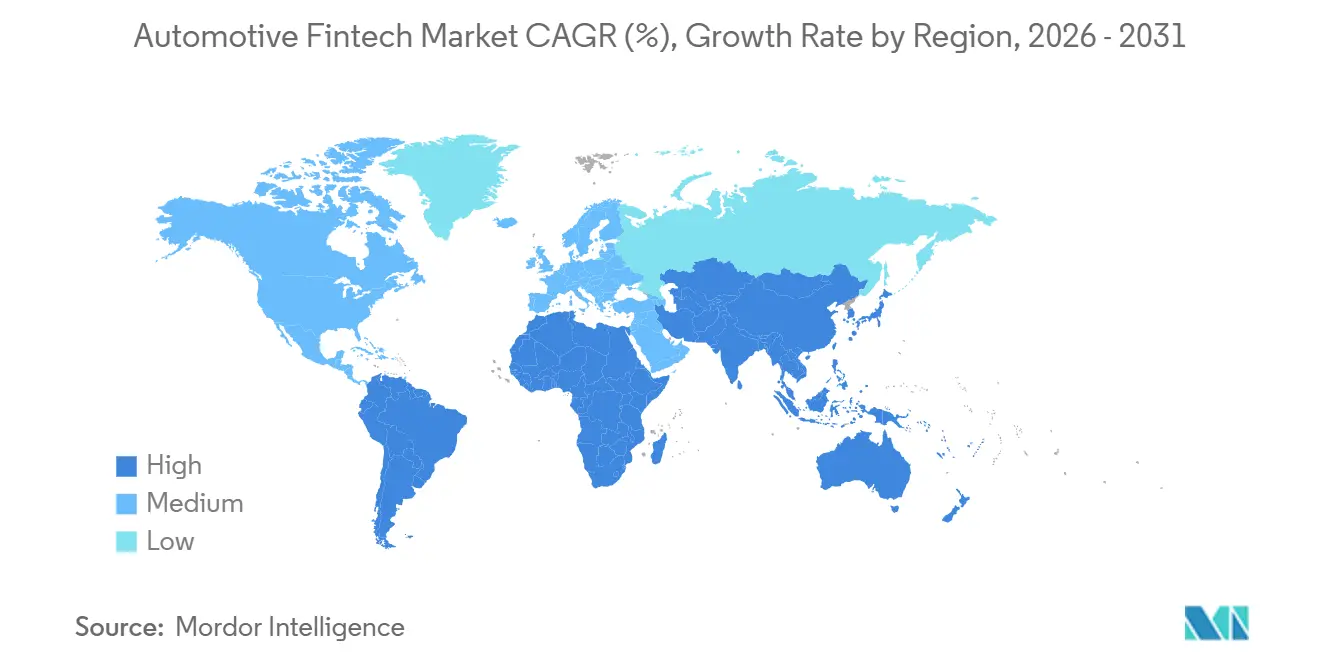
Asia-Pacific held 37.5% of the Automotive fintech market share in 2025 and is also the fastest-growing regional automotive fintech market at 18.9% CAGR through 2031. China remains important because of its large digital lending and platform finance base, while India is accelerating through EV lending, NBFC activity, and deeper reach into non-metro locations. AMU reported average 60% revenue growth across FY24-25 and FY25-26 and a 45% increase in managed AUM, showing how EV finance demand is widening beyond major Indian cities. South Korea, Japan, and Australia continue to build around digital leasing and subscription finance, while ASEAN markets are maturing through OEM-bank cooperation and broader digital credit access. The automotive fintech market in Asia-Pacific is therefore expanding from several different starting points, but all are moving toward stronger digital finance integration.
EMEA and South America Automotive Fintech Market
Europe represented an established automotive fintech market with strong momentum in OEM-embedded finance and platform-led service integration. Volkswagen Group Mobility reported a higher 2025 penetration rate of 37.2% and a portfolio of around 30 million active contracts, which shows the scale of embedded finance already operating across the region. Honda’s February 2026 agreement with Crédit Agricole Personal Finance & Mobility adds a cross-country white-label model that can help standardize financing delivery for an OEM without its own captive infrastructure. South America continues to show demand for non-bank credit and digital payment infrastructure, especially where traditional banking reach is more limited. Middle East and Africa are building a medium-term pipeline through BaaS sandboxes and regulated fintech infrastructure, which positions the automotive fintech market for broader expansion once vehicle finance and payment layers become more deeply localized.
Competitive Landscape
The automotive fintech market remains moderately fragmented, with OEM captive finance arms, large banks, and digital-native lenders all competing across different parts of the value chain. BMW Financial Services, Volkswagen Financial Services, Toyota Financial Services, Ford Motor Credit, and GM Financial keep an advantage through OEM data access, dealer relationships, and the ability to attach finance products directly to vehicle sales. BMW Group recorded around 1.73 million new financing and leasing contracts in 2025, while the share of new BMW vehicles financed by the captive rose to 46.6%, which shows strong customer attachment to embedded brand finance. Volkswagen Group Mobility also reported strong 2025 operating performance and a large active contract base, confirming that scale incumbents still control important distribution and servicing advantages. The automotive fintech market does not yet show a single dominant structure, as incumbents lead in scale while fintech challengers continue to find openings in underwriting, payments, and user experience.
Large bank lenders such as Ally Financial, Capital One, Wells Fargo, and Santander Consumer USA compete through origination capacity and dealer coverage, but the competitive center is moving away from pricing alone. Capital One’s 2026 launch of Chat Concierge shows how digital engagement tools can become part of the finance funnel rather than a separate marketing layer. Lendbuzz represents the opposite end of the model because it focuses on borrowers underserved by traditional scorecards and showed capital-market support through a USD 266 million securitization. The automotive fintech market is therefore differentiating participants by infrastructure, borrower data, and workflow control rather than solely by loan pricing. That shift is widening the gap between firms that simply provide funding and firms that also own the digital path from application to servicing.
Payments and integration capabilities are becoming a separate layer of competition within the automotive fintech market. Element Fleet Management’s agreement to acquire Car IQ in December 2025 created a scaled platform for vehicle-initiated, card-free payments, which gives Element a direct position in connected fleet transactions. AutoFi competes through dealer workflow integration and lender routing, turning DMS connectivity into a structural operating advantage rather than a back-end technical feature. Security credentials are also becoming increasingly important because OEMs and fleets need greater confidence in vehicle, driver, and payment data before choosing a platform partner. The automotive fintech market is therefore likely to remain fragmented in terms of ownership while becoming more selective, favoring firms that can combine funding, software integration, and secure data handling.
Automotive Fintech Industry Leaders
-
Ally Financial Inc.
-
AutoFi, Inc.
-
BMW Financial Services
-
Bumper International Limited
-
Capital One Financial Corporation
- *Disclaimer: Major Players sorted in no particular order

Automotive Fintech Market Companies Covered in this Report
- Ally Financial Inc.
- AutoFi, Inc.
- BMW Financial Services
- Bumper International Limited
- Capital One Financial Corporation
- Carvana Co.
- CDK Global, LLC
- Clearcover, Inc.
- Cox Automotive, Inc.
- Credit Acceptance Corporation
- Ford Motor Credit Company LLC
- General Motors Financial Company, Inc.
- Honda Financial Services
- Lendbuzz, Inc.
- RouteOne LLC
- Santander Consumer USA Holdings Inc.
- Toyota Financial Services
- TrueCar, Inc.
- Volkswagen Financial Services AG
- Wells Fargo and Company
Recent Industry Developments in Automotive Fintech Market
- May 2026: Roadzen's DrivebuddyAI surpassed 1.8 billion kilometers of driving data, enabling client fleets to reduce accident rates by over 72%. The milestone strengthens Roadzen's telematics data advantage as India's AIS184 commercial vehicle safety mandate takes full effect.
- March 2026: Hyundai launched the MOCEAN x IONITY subscription bundle in Germany, the first car subscription to include a flat-rate EV charging plan combining 1,000 km monthly mileage with 250 kWh charging at IONITY stations. The bundle shows how OEM subscription models are evolving into all-inclusive mobility finance products.
- February 2026: Honda and Crédit Agricole Personal Finance & Mobility announced a pan-European financing partnership covering 8 countries, with Crédit Agricole operating under a "Honda Financial Services" white-label brand backed by EUR 122.5 billion in managed outstandings
- December 2025: Element Fleet Management announced a definitive agreement to acquire Car IQ, creating the fleet industry's first scaled platform for vehicle-initiated, card-free payments. Element's Q1 2026 results subsequently showed record revenue of USD 324 million, up 17% year-on-year.
Global Automotive Fintech Market Report Scope
Segmentation Overview
| Payments |
| Credit and Lending |
| Insurance |
| Other Applications |
| Passenger Cars |
| Commercial Vehicles |
| Two-Wheelers |
| Banking-as-a-Service (BaaS) |
| Fintech Partnerships |
| In-House Fintech Development |
| Third-Party Integration |
| Retail Consumers |
| Automotive Manufacturers |
| Fleet Operators and Logistics Companies |
| Insurance Companies |
| Mobility Service Providers |
| Dealers and Distributors |
| North America | United States |
| Canada | |
| Mexico | |
| South America | Brazil |
| Argentina | |
| Rest of South America | |
| Europe | United Kingdom |
| Germany | |
| France | |
| Italy | |
| Spain | |
| Rest of Europe | |
| Asia-Pacific | India |
| China | |
| Japan | |
| Australia | |
| South Korea | |
| South East Asia (Singapore, Malaysia, Thailand, Indonesia, Vietnam, and Philippines) | |
| Rest of Asia-Pacific | |
| Middle East and Africa | United Arab Emirates |
| Saudi Arabia | |
| South Africa | |
| Nigeria | |
| Rest of Middle East and Africa |
| By Application | Payments | |
| Credit and Lending | ||
| Insurance | ||
| Other Applications | ||
| By Vehicle Type | Passenger Cars | |
| Commercial Vehicles | ||
| Two-Wheelers | ||
| By Business Model | Banking-as-a-Service (BaaS) | |
| Fintech Partnerships | ||
| In-House Fintech Development | ||
| Third-Party Integration | ||
| By End User | Retail Consumers | |
| Automotive Manufacturers | ||
| Fleet Operators and Logistics Companies | ||
| Insurance Companies | ||
| Mobility Service Providers | ||
| Dealers and Distributors | ||
| By Geography | North America | United States |
| Canada | ||
| Mexico | ||
| South America | Brazil | |
| Argentina | ||
| Rest of South America | ||
| Europe | United Kingdom | |
| Germany | ||
| France | ||
| Italy | ||
| Spain | ||
| Rest of Europe | ||
| Asia-Pacific | India | |
| China | ||
| Japan | ||
| Australia | ||
| South Korea | ||
| South East Asia (Singapore, Malaysia, Thailand, Indonesia, Vietnam, and Philippines) | ||
| Rest of Asia-Pacific | ||
| Middle East and Africa | United Arab Emirates | |
| Saudi Arabia | ||
| South Africa | ||
| Nigeria | ||
| Rest of Middle East and Africa | ||
Key Questions Answered in the Report
What is driving growth in automotive fintech through 2031?
Growth is being supported by embedded vehicle finance, AI-led underwriting, digital OEM financing ecosystems, and telematics-linked insurance and payment models. The market is projected to reach USD 21.3 billion by 2031 at a 16.6% CAGR.
Which application area currently leads revenue generation?
Credit and Lending remains the largest application, with 57.6% share in 2025. It stays central because auto financing continues to anchor vehicle purchases across most regions.
Which application is expanding the fastest?
Payments is the fastest-growing application, with a projected 21.1% CAGR from 2026 to 2031. Vehicle-initiated and tokenized payments are widening the role of fintech beyond lending.
Which vehicle category is creating the strongest new product opportunity?
Commercial Vehicles are projected to grow at 19.4% CAGR through 2031. Fleet data, telematics, and operating-payment needs make this segment important for dynamic pricing and embedded financial products.
Which region leads global demand and growth?
Asia-Pacific led with 37.5% share in 2025 and is also the fastest-growing region at 18.9% CAGR through 2031. China, India, and ASEAN are all moving toward wider digital finance integration from different starting points.
What is the main risk for participants in this space?
Regulatory fragmentation remains the main risk because providers must manage different rules across lending, insurance, and payments. Legacy dealer system integration also continues to slow rollouts and raise execution costs.