
Austria HVAC Market Size and Share
| Study Period | 2019 - 2030 |
| Forecast Data Period | 2025 - 2030 |
| Historical Data Period | 2019 - 2023 |
| Market Size (2025) | USD 1.03 Billion |
| Market Size (2030) | USD 1.18 Billion |
| CAGR (2025 - 2030) | 2.80% |
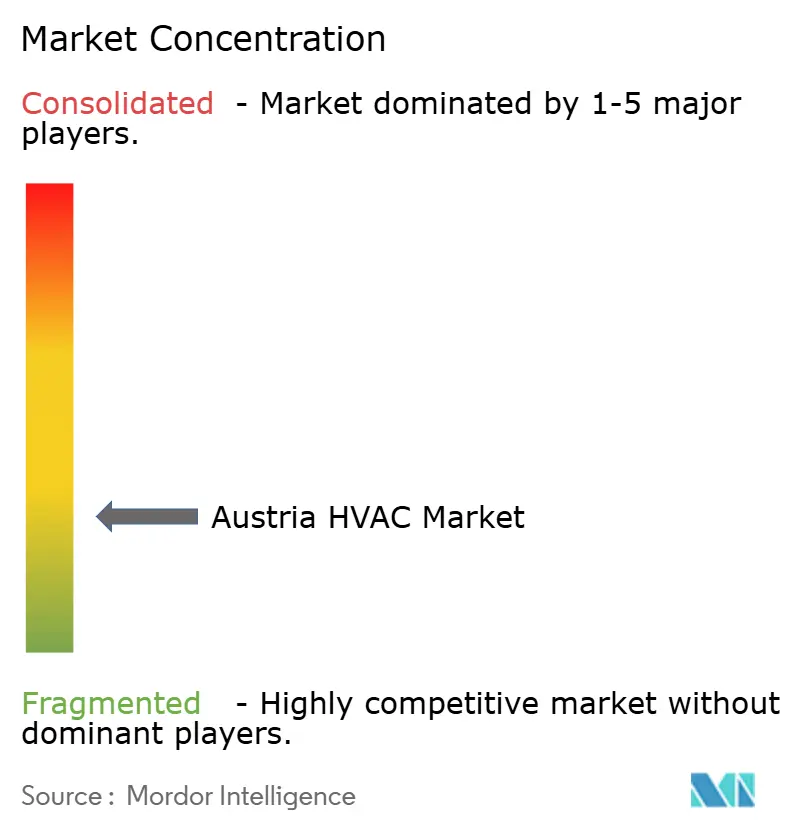
| Market Concentration | Low |
Major Players *Disclaimer: Major Players sorted in no particular order |
Austria HVAC Market Analysis by Mordor Intelligence
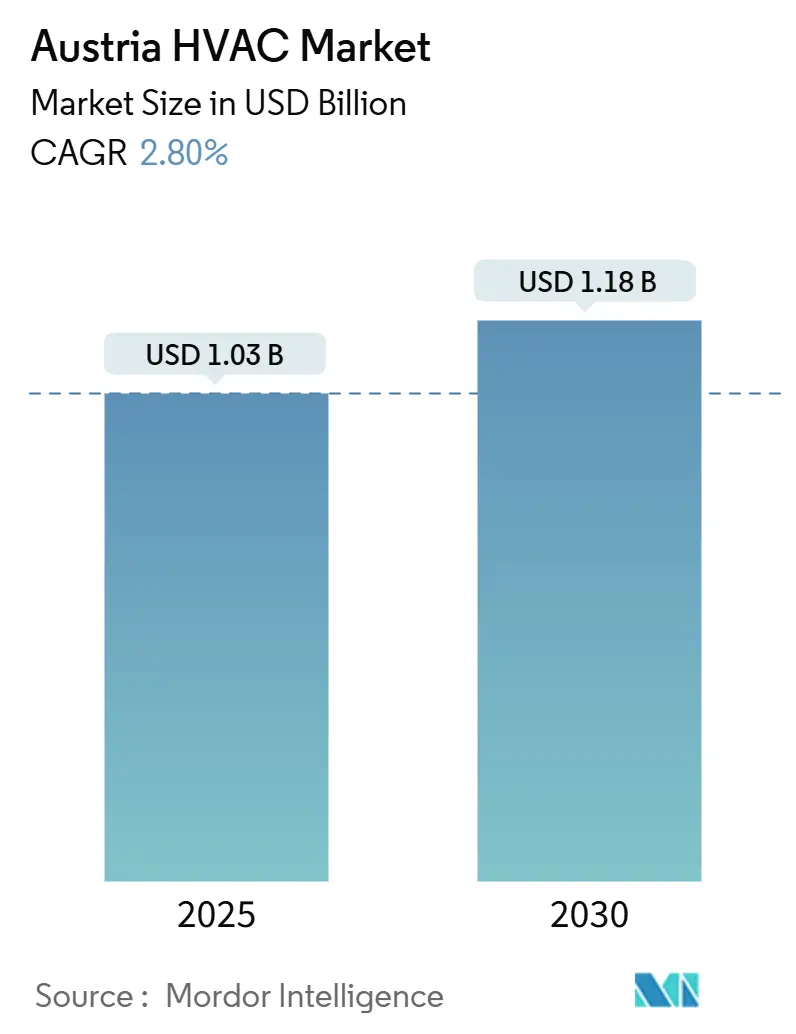
The Austria HVAC Market size is estimated at USD 1.03 billion in 2025, and is expected to reach USD 1.18 billion by 2030, at a CAGR of 2.80% during the forecast period (2025-2030).
- Austria's HVAC market is on a steady growth trajectory, fueled by a surging demand for energy-efficient solutions, tightening environmental regulations, and breakthroughs in smart HVAC technologies. As a frontrunner in Europe's green HVAC solutions arena, Austria is also witnessing a transformative influence from the burgeoning smart building technologies and automation trends.
- Austria's government is aggressively pushing for a greener future, rolling out stringent environmental policies to cut carbon emissions and champion energy-efficient HVAC systems. They've sweetened the deal with incentives, urging both businesses and homeowners to pivot towards renewable heating solutions, like heat pumps and district heating. Thanks to these efforts, Austria is rapidly emerging as a beacon of green innovation in the HVAC realm.
- Austria's cities are bustling with growth, leading to a boom in both residential and commercial construction. With urban expansion comes a heightened demand for modern HVAC systems, essential for efficient climate control and air quality. The surge in constructing office spaces, shopping malls, and industrial facilities has propelled the widespread adoption of these technologies.
- The market is witnessing a revolution with the rise of IoT-enabled HVAC systems. These innovations empower users to fine-tune energy consumption and keep a close watch on indoor air quality. Features like smart thermostats, automated climate control, and AI-driven predictive maintenance are swiftly becoming the norm in both commercial and residential spaces. Beyond just boosting efficiency, these technologies promise significant cost savings, making them a hit among consumers and businesses. The allure of controlling HVAC systems remotely through mobile apps and AI automation is further fueling their popularity.
- Yet, the journey to widespread adoption isn't without hurdles. Despite the clear advantages of energy-efficient HVAC systems, the steep initial investment and ongoing maintenance costs pose significant challenges. Technologies like geothermal heating and advanced climate control systems demand hefty upfront capital, often putting them out of reach for smaller businesses and budget-conscious households. Coupled with the financial strain of regular maintenance and servicing, these challenges dampen the enthusiasm for broader adoption.
Austria HVAC Market Trends and Insights
Increasing Urbanization and Rising Disposable Income is Expected to Drive the Market
- Austria's urban centers are witnessing a surge in development, with new residential complexes, office spaces, and commercial buildings springing up to cater to the burgeoning population. As these cities expand, the demand for modern HVAC systems—essential for efficient heating, cooling, and ventilation—has intensified. Developers are increasingly prioritizing energy-efficient solutions, not only to meet sustainability standards but also to curtail long-term operational costs. This construction boom is fueling a heightened demand for advanced HVAC technologies, which promise enhanced indoor comfort and optimized energy consumption.
- Bolstered by robust economic growth, Austrians are enjoying rising disposable incomes, paving the way for investments in high-quality HVAC systems. Both homeowners and businesses are gravitating towards premium air conditioning and heating solutions, valuing their superior comfort and energy efficiency.
- Per the Austrian National Bank, Austria's economy, having faced a recession in 2023, is on a path to gradual recovery in 2024 and 2025. Projections indicate a GDP growth rate of 0.3% in 2024, escalating to 1.8% in 2025, buoyed by strong real consumption growth and a more favorable external environment. Inflation rates are set to ease, with the Harmonized Index of Consumer Prices (HICP) inflation rate forecasted at 3.4% in 2024 and dipping further to 2.7% in 2025. Additionally, rising nominal wages are bolstering household incomes, further propelling consumption growth.
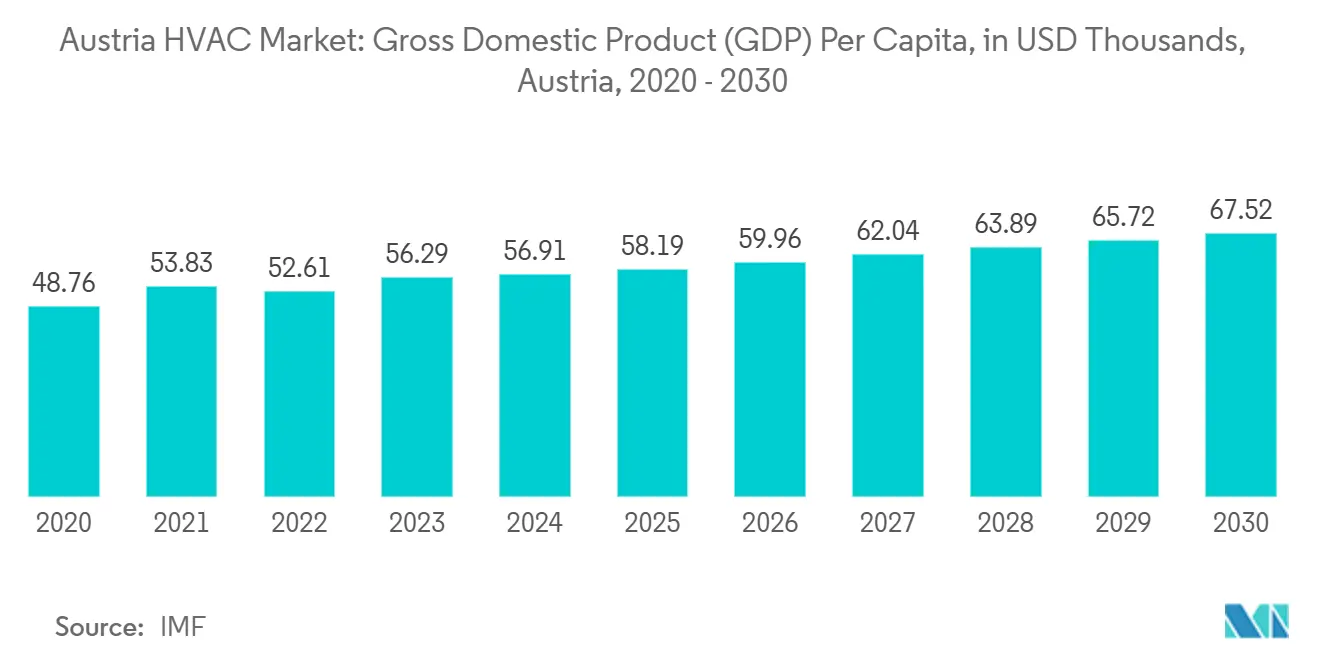
- Forecasts from the International Monetary Fund (IMF) project Austria's GDP per capita to reach around USD 67.52 thousand by 2030. This marks an increase of about USD 9.33 thousand from the 2025 figure of roughly USD 58.19 thousand, highlighting a consistent upward trajectory.
- Austria's stringent environmental regulations and government incentives actively promote the adoption of energy-efficient HVAC systems. In June 2024, bolstered by funding from NextGenerationEU, Austria enhanced its national heating conversion scheme, aiding households in transitioning to biomass heaters, heat pumps, and district heating. Additionally, the Klimabonus program, which incentivizes sustainable living, remained in effect in 2024, offering financial payouts between EUR 145 (~USD 165.30) and EUR 290 (~USD 330.60) per adult, contingent on location.
Commercial Sector is Expected to Hold the Largest Share
- Austria's urban centers, especially Vienna, Graz, and Linz, are witnessing a boom in commercial real estate. The rise of modern office buildings, coworking spaces, and bustling business districts has fueled a heightened demand for HVAC systems, ensuring top-notch indoor air quality and temperature control.
- For instance, CBRE reports a steady uptick in supply in Linz. Meanwhile, the office markets in Graz and Salzburg are on the upswing. New projects, primarily situated in peripheral yet well-connected locations, are bolstering the supply of contemporary office spaces.
- For instance, 2024 saw the debut of a new production and office building for XAL Lighting Technology in Graz. This multifunctional structure not only expands warehouse capacities but also introduces new office spaces and a state-of-the-art production facility, underscoring Graz's burgeoning commercial landscape.
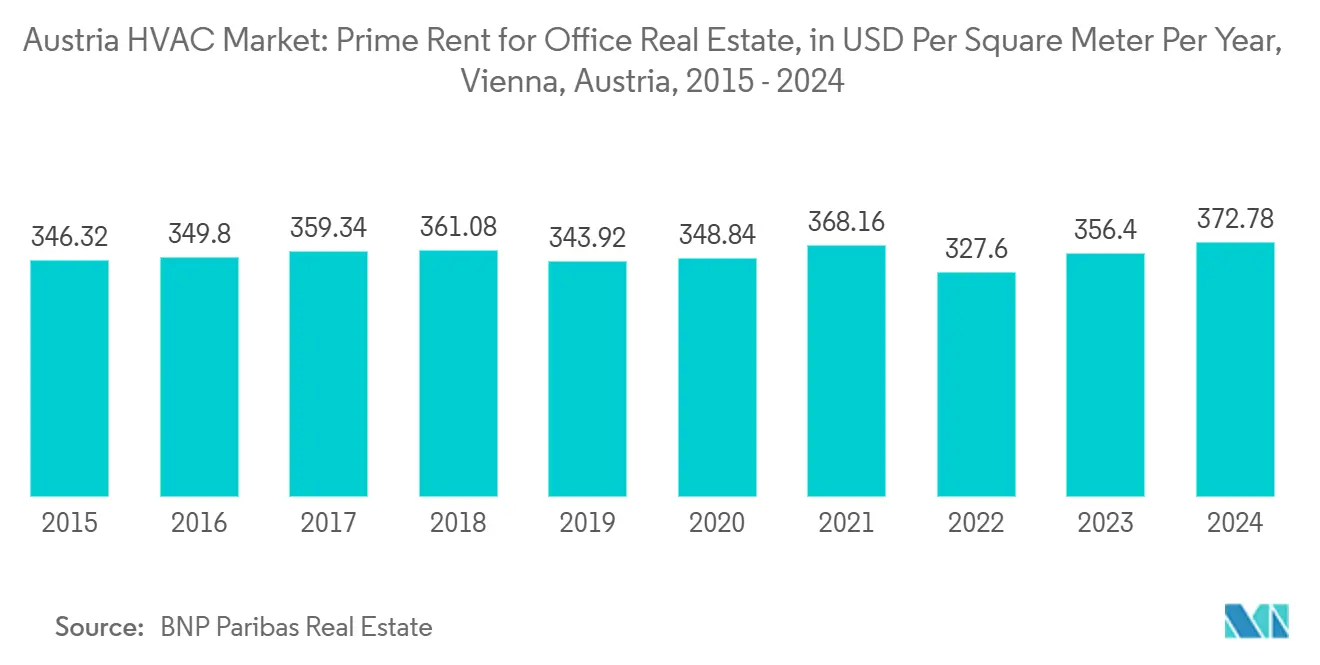
- Since 2013, prime office rents in Vienna, Austria, have seen a modest uptick. In both 2021 and 2022, the annual rent for top-tier office space stood at EUR 312 (USD 356) per square meter. By 2024, this average rental rate surged to a peak of EUR 342 (USD 390) per square meter, marking an increase from EUR 306 (USD 349) per square meter in 2013. Rising office rents often signal a buoyant HVAC market in the region. Such increases in office rents typically indicate low vacancy rates and heightened demand for commercial real estate, spurring new office developments and expansions.
- Austria's climate swings from cold winters to warm summers, underscoring the necessity of HVAC systems for year-round comfort. As climate change introduces unpredictability to seasonal temperatures, the demand for versatile HVAC solutions has surged. Both businesses and homeowners are now turning to dual-function heating and cooling systems, ensuring efficient indoor temperature regulation amidst these seasonal shifts.
Competitive Landscape
The Austria HVAC market is fragmented, with specialized players and regional conglomerates operating across various segments. While multiple large multinational companies dominate certain high-value segments, numerous regional and niche players contribute to the overall competition, making the market highly diverse. This competition is driven by the wide range of applications for HVAC equipment, allowing both small and large companies to coexist and thrive in the market.
Several leading companies in the Austria HVAC market include Mitsubishi Electric Corporation, LG Electronics Inc., Daikin Industries, Ltd., and many others. With strong brand recognition and extensive regional operations, these companies command a significant market share. Their strengths include innovation, a broad solutions portfolio, and robust distribution networks. To maintain their competitive edge and broaden their market reach, these leaders frequently pursue strategic acquisitions and partnerships.
In the Austria HVAC market, companies that prioritize innovation in heating, ventilation, and air conditioning equipment are more likely to succeed. As industries increasingly seek advanced solutions, HVAC equipment is set to become a key differentiator. Additionally, expanding service offerings and enhancing customer support will be essential for building long-term relationships and securing repeat business. Firms that invest in emerging markets and tailor their products to regional needs can gain a competitive advantage in this fragmented landscape.
Austria HVAC Industry Leaders
-
ETHERMA Elektrowärme GmbH
-
York (Johnson Controls)
-
Mitsubishi Electric Corporation
-
Daikin Industries, Ltd.
-
LG Electronics Inc.
- *Disclaimer: Major Players sorted in no particular order
Recent Industry Developments
- May 2025: Daikin has unveiled a new concealed floor-standing unit, the latest in its VRV 5 Heat Pump range, bolstering the company's already extensive R-32 portfolio. This cutting-edge unit aims to deliver a flexible and efficient heating and cooling solution, playing a pivotal role in the decarbonization of commercial buildings.
- June 2024: In a collaborative effort, AIT Austrian Institute of Technology and KTH Royal Institute of Technology in Sweden have unveiled a joint PhD programme aimed at advancing heat pump technologies in urban settings. The programme will pinpoint the ideal design for heat pumps, considering both technical and economic factors across multiple system levels. Additionally, it will emphasize pioneering methods to deliver digital services for heat pump systems.
Austria HVAC Market Report Scope
HVAC is a comprehensive system designed to create and maintain comfortable indoor environmental conditions in residential, commercial, and industrial spaces. Heating is the first component, which involves warming interior spaces during cold weather through various methods such as furnaces, heat pumps, and radiant heating systems. These technologies convert energy into heat, distributing warmth evenly throughout a building to ensure occupant comfort and prevent temperature-related issues.
Ventilation represents the critical process of exchanging indoor and outdoor air, ensuring proper air circulation, removing pollutants, controlling humidity, and maintaining air quality. This aspect of HVAC involves mechanical and natural ventilation techniques that introduce fresh air, filter contaminants, and regulate oxygen levels. Proper ventilation is essential for preventing the buildup of harmful gases, reducing moisture-related problems, and creating a healthy indoor environment.
Air Conditioning focuses on cooling and dehumidifying interior spaces during warm weather. Modern air conditioning systems use refrigeration cycles to remove heat and moisture from the air, creating a comfortable and controlled climate. These systems range from central air conditioning units to ductless mini-splits, providing precise temperature management and improving overall indoor comfort. The integration of these three components- heating, ventilation, and air conditioning- creates a sophisticated environmental control system that adapts to changing weather conditions and occupant needs.
The study tracks the revenue accrued through the sale of HVAC product types by various players in Austria. The study also tracks the key market parameters, underlying growth influencers, and major vendors operating in the industry, which supports the market estimations and growth rates over the forecast period. The study further analyses the overall impact of macroeconomic factors on the market. The report's scope encompasses market sizing and forecasts for the various market segments.
The Austria HVAC Market is Segmented by product type (heating equipment [heat pumps (air source, ground source), furnaces (gas, electric, oil), boilers (condensing, non-condensing), unit heaters, and others (radiators & baseboard heaters, solar water heating systems)], ventilation equipment [air handling units (AHUs), energy recovery ventilators (ERVs)/heat recovery, ventilators (HRVs), exhaust and supply fans, dehumidifiers/humidifiers], air conditioning equipment [unitary air conditioners, variable refrigerant flow (VRF) systems, chillers (air-cooled, water-cooled), fan coil units (FCUs), and others (window and portable air conditioners)]) and end-user industry (residential, commercial, and industrial). The market sizes and forecasts are provided in terms of value (USD) for all the above segments.
| Heating Equipment | Heat Pumps (Air Source, Ground Source) | |
| Furnaces (Gas, Electric, Oil) | ||
| Boilers (Condensing, Non-condensing) | ||
| Unit Heaters | ||
| Others (Radiators & Baseboard Heaters, Solar Water Heating Systems) | ||
| Ventilation Equipment | Air Handling Units (AHUs) | |
| Energy Recovery Ventilators (ERVs) / Heat Recovery Ventilators (HRVs) | ||
| Exhaust and Supply Fans | ||
| Dehumidifiers / Humidifiers | ||
| Air Conditioning Equipment | Unitary Air Conditioners | Split Air Conditioners |
| Packaged Terminal ACs (PTACs) | ||
| Rooftop Packaged Units (RTUs) | ||
| Variable Refrigerant Flow (VRF) Systems | ||
| Chillers (Air-Cooled, Water-Cooled) | ||
| Fan Coil Units (FCUs) | ||
| Others (Window and Portable Air Conditioners) | ||
| Residential |
| Commercial |
| Industrial |
| By Product Type | Heating Equipment | Heat Pumps (Air Source, Ground Source) | |
| Furnaces (Gas, Electric, Oil) | |||
| Boilers (Condensing, Non-condensing) | |||
| Unit Heaters | |||
| Others (Radiators & Baseboard Heaters, Solar Water Heating Systems) | |||
| Ventilation Equipment | Air Handling Units (AHUs) | ||
| Energy Recovery Ventilators (ERVs) / Heat Recovery Ventilators (HRVs) | |||
| Exhaust and Supply Fans | |||
| Dehumidifiers / Humidifiers | |||
| Air Conditioning Equipment | Unitary Air Conditioners | Split Air Conditioners | |
| Packaged Terminal ACs (PTACs) | |||
| Rooftop Packaged Units (RTUs) | |||
| Variable Refrigerant Flow (VRF) Systems | |||
| Chillers (Air-Cooled, Water-Cooled) | |||
| Fan Coil Units (FCUs) | |||
| Others (Window and Portable Air Conditioners) | |||
| By End-User Industry | Residential | ||
| Commercial | |||
| Industrial | |||
Key Questions Answered in the Report
How big is the Austria HVAC Market?
The Austria HVAC Market size is expected to reach USD 1.03 billion in 2025 and grow at a CAGR of 2.80% to reach USD 1.18 billion by 2030.
What is the current Austria HVAC Market size?
In 2025, the Austria HVAC Market size is expected to reach USD 1.03 billion.
Who are the key players in Austria HVAC Market?
ETHERMA Elektrowärme GmbH, York (Johnson Controls), Mitsubishi Electric Corporation, Daikin Industries, Ltd. and LG Electronics Inc. are the major companies operating in the Austria HVAC Market.
What years does this Austria HVAC Market cover, and what was the market size in 2024?
In 2024, the Austria HVAC Market size was estimated at USD 1.00 billion. The report covers the Austria HVAC Market historical market size for years: 2019, 2020, 2021, 2022, 2023 and 2024. The report also forecasts the Austria HVAC Market size for years: 2025, 2026, 2027, 2028, 2029 and 2030.
Austria HVAC Market Report
Statistics for the 2025 Austria HVAC market share, size and revenue growth rate, created by Mordor Intelligence™ Industry Reports. Austria HVAC analysis includes a market forecast outlook for 2025 to 2030 and historical overview. Get a sample of this industry analysis as a free report PDF download.