
Market Overview
| Study Period | 2021 - 2031 |
|---|---|
| Forecast Data Period | 2026 - 2031 |
| Base Year Market Size (2025) | USD 9.71 Billion |
| Market Size (2026) | USD 10.04 Billion |
| Market Size (2031) | USD 12.28 Billion |
| Growth Rate (2026 - 2031) | 4.12 % |
| Market Concentration | Low |
Major Players *Disclaimer: Major Players sorted in no particular order Image © Mordor Intelligence. Reuse requires attribution under CC BY 4.0. | |
Asia-Pacific Toothpaste Market Analysis by Mordor Intelligence
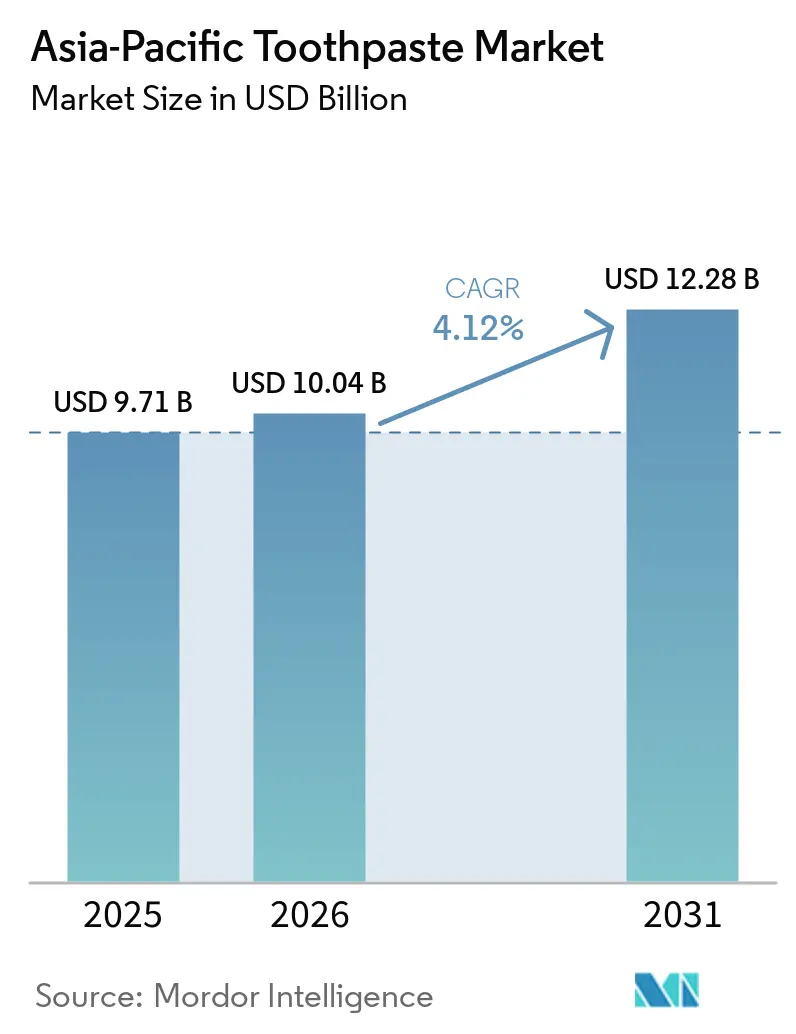
The Asia-Pacific toothpaste market size was valued at USD 9.71 billion in 2025 and is projected to reach USD 10.04 billion by 2026 and USD 12.28 billion by 2031, growing at a CAGR of 4.12% from 2026 to 2031. The Asia-Pacific toothpaste market is supported by the need for preventive oral care in a region where oral diseases affect a large population. The World Health Organization has called for stronger oral health action and universal coverage across South-East Asia by 2030, which places prevention higher on public-health agendas [1]. Rising household spending in China, India, and Southeast Asian countries is widening access to both standard and specialized products. Manufacturers are responding with clinically positioned formulas, herbal products, whitening formats, and child-focused ranges. The Asia-Pacific toothpaste market also faces more demanding product rules, counterfeit risks, and established consumer loyalty, which favor companies with trusted brands, formal distribution, and compliance capabilities.
Key Report Takeaways
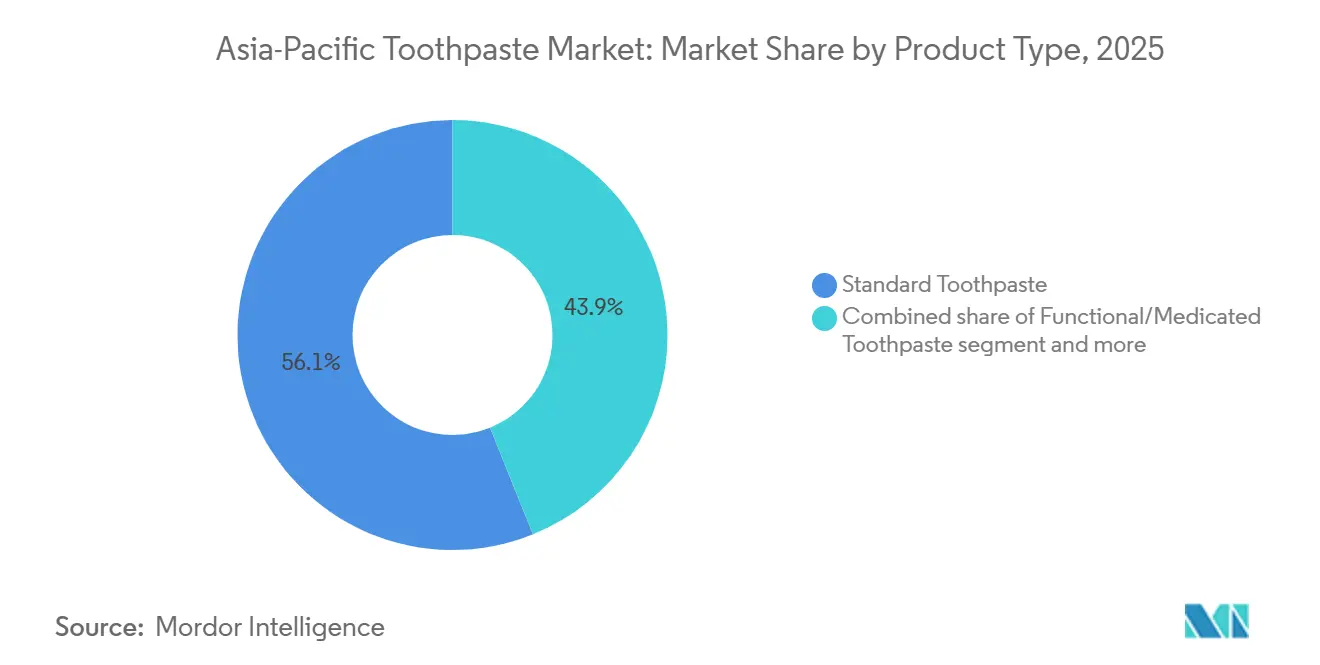
- By product type, standard toothpaste held 56.11% of the Asia-Pacific toothpaste market share in 2025, while functional and medicated toothpaste is forecast to expand at a 4.75% CAGR through 2031.
- By category, conventional toothpaste held 74.51% of the Asia-Pacific toothpaste market share in 2025, while natural/organic toothpaste is forecast to grow at a 5.11% CAGR through 2031.
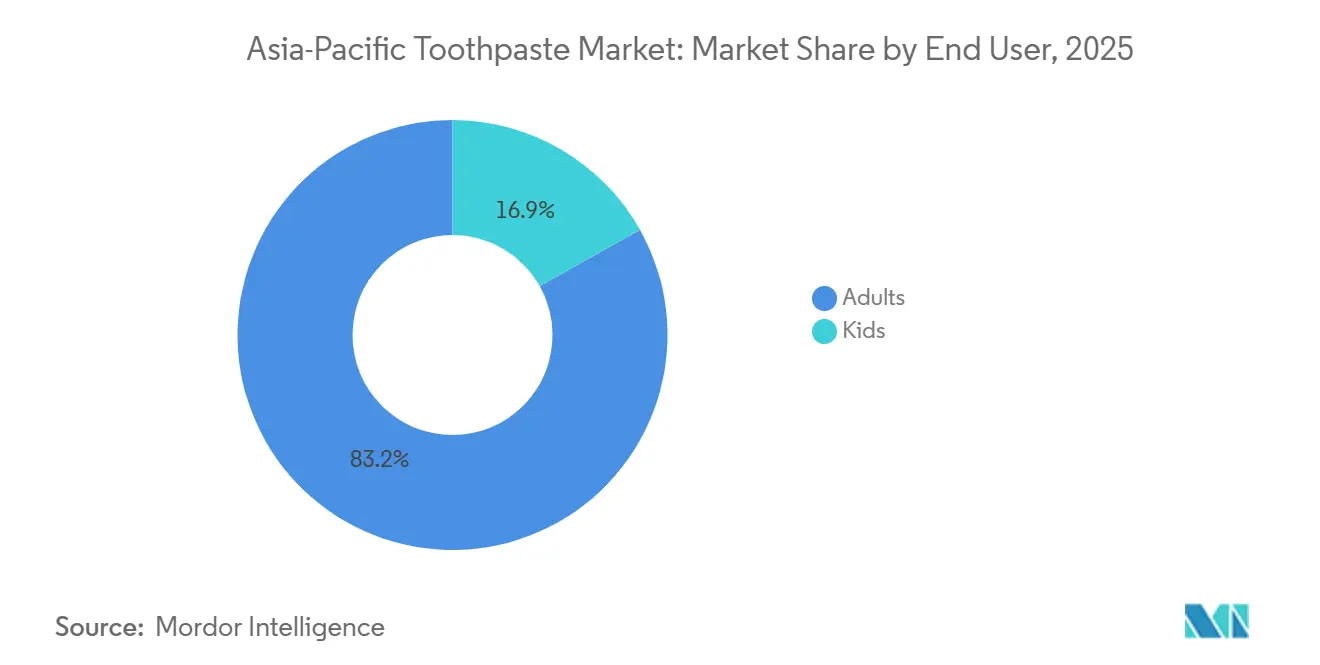
- By end user, adults accounted for 83.15% of the Asia-Pacific toothpaste market size in 2025, while kids toothpaste is forecast to grow at a 5.62% CAGR through 2031.
- By distribution channel, supermarkets and hypermarkets held 32.14% of the Asia-Pacific toothpaste market share in 2025, while online retail stores are forecast to grow at a 6.37% CAGR through 2031.
- By geography, China held 33.95% of the Asia-Pacific toothpaste market share in 2025, while India is forecast to grow at a 6.28% CAGR through 2031.
Note: Market size and forecast figures in this report are generated using Mordor Intelligence’s proprietary estimation framework, updated with the latest available data and insights as of 2026.
Market Trends and Insights
Drivers Impact Analysis of Asia-Pacific Toothpaste Market*
| Drivers | (~) % Impact on CAGR Forecast | Geographic Relevance | Impact Timeline |
|---|---|---|---|
| Rising Awareness of Oral Hygiene and Prevention | +1.1% | India, Indonesia, Thailand | Medium term (2-4 years) |
| Growing Demand for Herbal and Ayurvedic Formulations | +0.8% | India, Southeast Asia, China | Long term (≥ 4 years) |
| Increasing Prevalence of Dental Sensitivity Concerns | +0.7% | China, India, Japan, South Korea | Medium term (2-4 years) |
| Expanding Demand for Whitening and Specialty Toothpaste | +0.5% | China, South Korea, Japan, Australia | Short term (≤ 2 years) |
| Rising Demand for Children’s Oral Care Products | +0.4% | China, India, Indonesia, Southeast Asia | Long term (≥ 4 years) |
| Increasing Investment in Oral Health Awareness Campaigns | +0.3% | South-East Asia, India, Asia-Pacific | Medium term (2-4 years) |
| Source: Mordor Intelligence | |||
Rising Awareness of Oral Hygiene and Prevention
Oral hygiene awareness is strengthening demand for regular toothpaste use across the Asia-Pacific toothpaste market. Oral diseases affect an estimated 3.5 billion people worldwide, and the World Health Organization identifies oral health as part of broader health and well-being. The WHO South-East Asia action plan calls for universal oral health coverage by 2030 and gives national programs a practical framework for prevention. This direction gives health agencies, schools, and dental professionals a larger role in promoting daily oral care. It also reduces reliance on brand advertising alone because prevention messages reach consumers through public-health channels. Awareness campaigns are especially relevant in India, Indonesia, Thailand, and other Southeast Asian markets where routine oral-care habits continue to develop.
Growing Demand for Herbal and Ayurvedic Formulations
Herbal, Ayurvedic, and child-focused products are expanding the range of needs addressed by the Asia-Pacific toothpaste market. Dabur reported that its toothpaste business grew by 10% year over year in the third quarter of fiscal year 2025 to 2026, while herbal variants outgrew non-herbal variants by 530 basis points. The result shows that ingredient heritage can support growth when it is paired with recognizable product performance. Neem, clove, miswak, and triphala remain relevant to consumers who associate these ingredients with familiar oral-care practices. Child-focused products also benefit from parental attention to safety, flavors, and formulations intended for children. School dental programs in China and expanding mother-and-baby retail channels further support demand for products made for younger users.
Increasing Prevalence of Dental Sensitivity Concerns
Dental sensitivity is moving beyond a narrow clinical need and is becoming a daily-use concern in the Asia-Pacific toothpaste market. Acidic drinks, processed foods, and whitening routines are linked in the supplied material to greater concern about enamel and gum care among urban consumers. Haleon announced a GBP 65 million investment in an oral-health manufacturing facility in Shanghai in March 2026 to support expansion of Sensodyne and Parodontax in China. Lion launched Dent Health Medicated Toothpaste DX Premium in September 2025 with tranexamic acid and isopropyl methylphenol for periodontitis care. Lion also introduced an improved SYSTEMA Haguki Plus PREMIUM Toothpaste in April 2026 with dipotassium glycyrrhizinate for gum inflammation care. These actions indicate that brands are using formulation specificity and professional credibility to compete for consumers seeking sensitivity and gum-care solutions.
Expanding Demand for Whitening and Specialty Toothpaste
Whitening and specialty formats are creating additional purchase reasons within the Asia-Pacific toothpaste market. Colgate-Palmolive launched Colgate Optic White Vitamin C across Asia-Pacific in August 2026, with 95% pure stabilized vitamin C and a campaign featuring j-hope. Colgate also introduced Visible White Purple Serum in India in November 2025, using color-correction positioning in a toothpaste serum format. These launches place tooth whitening closer to personal-care and beauty routines for some consumers. Specialty brands require visibility in e-commerce and beauty-oriented retail as well as conventional oral-care shelves. The category therefore gives established and newer brands a route to higher-value products without moving away from daily toothpaste use.
Restraints Impact Analysis of Asia-Pacific Toothpaste Market*
| Restraint | (~) % Impact on CAGR Forecast | Geographic Relevance | Impact Timeline |
|---|---|---|---|
| Strict Requirements for Product Claims and Labeling | -0.5% | China, Thailand, Australia, with spillover across Asia-Pacific | Medium term (2-4 years) |
| Strong Consumer Loyalty to Established Toothpaste Brands | -0.4% | India, China, South Korea | Long term (≥ 4 years) |
| Counterfeit Products Undermining Consumer Trust in Brands | -0.3% | India, including metro and tier 2 markets, and Southeast Asia | Short term (≤ 2 years) |
| Consumer Concerns Regarding Synthetic Chemical Ingredients | -0.2% | India, South Korea, Australia, and urban premium segments in China | Long term (≥ 4 years) |
| Source: Mordor Intelligence | |||
Strict Requirements for Product Claims and Labeling
Product claims, labeling requirements, and concerns about synthetic ingredients create a significant restraint for the Asia-Pacific toothpaste market. China’s Provisions for Toothpaste Regulation require filing for domestic and imported toothpaste and set expectations for safety assessment, efficacy support, and ingredient information [2]. The supplied material states that seven additional mandatory test methods, including hard-particle testing, apply from March 2026. Thailand’s draft fluoride toothpaste labeling revisions in 2025 also point to closer scrutiny of product presentation and claims. Larger companies can spread compliance costs across broader portfolios, while smaller companies may struggle to meet testing and documentation requirements. Consumers who question synthetic ingredients add pressure for clearer formulas and more direct communication about product safety.
Counterfeit Products Undermining Consumer Trust in Brands
Counterfeit products can limit the ability of new suppliers to grow in the Asia-Pacific toothpaste market. Established brands benefit from repeated purchase habits and long-standing distribution relationships in India, China, and South Korea. Counterfeit products create a separate problem because they can weaken trust in genuine brands and create price pressure without contributing to legitimate sales. India Today reported in October 2025 that authorities in Delhi dismantled a factory producing adulterated toothpaste and other products. Informal channels in smaller cities and local markets can make product traceability more difficult. Brands are responding through packaging verification tools, stronger retailer controls, and e-commerce seller checks, although these measures require ongoing investment.
*Our forecasts treat driver/restraint impacts as directional, not additive. The impact forecasts reflect baseline growth, mix effects, and variable interactions.
Asia-Pacific Toothpaste Market Segment Analysis
By Product Type:
Standard Toothpaste Anchors Volume as Medicated Variants GrowStandard toothpaste held 56.11% of the Asia-Pacific toothpaste market size in 2025, while functional and medicated toothpaste is projected to grow at a 4.75% CAGR through 2031. Standard products retain their position because they address routine household needs across large, price-sensitive consumer groups. Functional products are gaining attention because consumers increasingly seek support for sensitivity, plaque, stains, and gum care. China’s draft toothpaste classification catalogs identified 8 efficacy categories, including anti-dentin hypersensitivity, plaque inhibition, stain removal, and gum care, according to the supplied material. Clearer category definitions can make it easier for companies to develop and substantiate differentiated offerings. This can also make claims more comparable for consumers evaluating products with different benefits.
Medicated toothpaste is becoming more relevant to everyday retail rather than being confined to specialist use. Lion launched Dent Health DX Double Anti-Inflammatory and Dent Health DX Multi-Function in Japan in October 2026 for consumers with periodontal concerns. Haleon has engaged more than 40,000 dentists in China and distributed 2.4 million parodontax samples since its 2024 China launch, according to the supplied material. Lion also launched CLINICA PRO plus Periodontal Barrier Toothpaste in March 2025 with dextranase enzyme as an active plaque-care ingredient. Japan’s pharmaceutical rules and South Korea’s MFDS framework support the use of formal standards for clinically positioned products. Brands that can communicate credible benefits without overstating claims are likely to be better placed in this segment.



By Category:
Conventional Products Lead as Natural and Organic Options GainConventional toothpaste accounted for 74.51% of the Asia-Pacific toothpaste market size in 2025, while natural and organic toothpaste is projected to grow at a 5.11% CAGR through 2031. Conventional products remain important in Indonesia, the Philippines, rural India, and rural China because they offer broad availability and accessible prices. Natural and organic alternatives are growing as ingredient transparency becomes more relevant to consumers in the middle market. Dabur reported that herbal toothpaste variants outgrew non-herbal variants by 530 basis points during the third quarter of fiscal year 2025 to 2026. This gap indicates that demand for herbal positioning is extending beyond premium urban consumers. Malaysia and Indonesia add another demand base through halal-related requirements for transparent ingredients and product assurance.
The boundary between conventional and natural products is becoming less distinct. Brands can combine familiar active ingredients with plant-based flavors, botanicals, and gentler sensory cues. I-ne introduced GWHITE in Japan in December 2025 as an abrasive-free medicinal whitening toothpaste using Gold Micro Silica technology, according to the supplied material. The launch shows that enamel-care positioning can appeal to consumers seeking gentler options without requiring full natural certification. The joi brand, launched with Watsons Malaysia, was described in the supplied material as a fluoride-free hydroxyapatite toothpaste with natural positioning and science-oriented ingredient support. Products that balance efficacy, ingredient clarity, and reasonable pricing can compete across the category divide. This approach gives suppliers a way to respond to natural-product demand while retaining the performance language expected by many consumers.
By End User:
Adults Drive Value as Kids Toothpaste AcceleratesAdults represented 83.15% of the Asia-Pacific toothpaste market size in 2025, while kids' toothpaste is expected to grow at a 5.62% CAGR through 2031. Adult demand remains central because adult consumers purchase for personal use and often make household oral-care decisions. Whitening, gum care, sensitivity care, and cosmetic positioning have expanded the number of reasons adults may choose premium products. Colgate’s Visible White Purple Serum in India and Optic White Vitamin C campaign across Asia-Pacific show how adult toothpaste is being positioned around appearance as well as hygiene. Unilever introduced Pepsodent Ultra White at Jakarta Fashion Week in October 2025, placing whitening in a premium personal-care setting. These examples show why adult products still generate the broadest value pool for the category.
The kids segment is supported by greater parental awareness of childhood dental care and by products designed for younger users. Himalaya Wellness Company’s KIDS Toothpaste uses neem, pomegranate, and xylitol in fluoride-free variants, according to the supplied material. Such products respond to parental concern about ingredient safety and incidental ingestion. China’s school dental check-up requirements and its growing mother-and-baby retail network support demand for children’s oral-care products. Hydroxyapatite and herbal variants can provide additional points of distinction in markets with rising health awareness. Companies need to support safety claims with clear documentation and appropriate communication. A child-focused product can establish early household brand familiarity, but it must also meet the expectations of parents who are making the purchase.

By Distribution Channel:
Physical Retail Leads as Online Retail Gains PaceSupermarkets and hypermarkets held 32.14% of the Asia-Pacific toothpaste market size in 2025, while online retail stores are forecast to grow at a 6.37% CAGR through 2031. Large-format stores continue to be key locations for household discovery, comparison, and repeat purchase. Convenience stores, grocery stores, pharmacies, and traditional trade remain important where modern retail access is uneven. Pharmacy placement can support a clinical perception for functional toothpaste in Japan, South Korea, and Australia. Lion, Sunstar, and Haleon use professional engagement to strengthen this connection, according to the supplied material. Physical distribution therefore remains important for both everyday availability and product credibility.
Online retail is reshaping how specialty products reach consumers in the Asia-Pacific toothpaste market. The supplied material notes that Colgate India has identified quick-commerce oral-care growth as faster than conventional e-commerce growth. Rapid delivery can turn routine replenishment into an occasion for premium product selection. Digital-first brands can use Douyin, TikTok Shop, Tmall, JD.com, Shopee, and similar channels to introduce specialized products without some of the listing costs associated with large retail chains. Subscription models on Chinese platforms may support repeat sales and more predictable demand. Online channels also make consumer education, reviews, and product demonstration more accessible for unfamiliar formats. Their growth does not remove the need for physical retail, but it changes the balance of spending required to win visibility and trial.
Geography Analysis
China Toothpaste Market
China held 33.95% of the Asia-Pacific toothpaste market share in 2025 and remains the region’s largest national opportunity. Yunnan Baiyao's Health Products Business Group recorded CNY 3.442 billion in revenue in the first half of 2025, according to the supplied financial disclosure. Haleon’s parodontax became the biggest-selling gum-health brand in Sam’s Club stores within 3 months of its China launch, according to the supplied material. Haleon’s March 2026 Shanghai investment is intended to support the expansion of Sensodyne and parodontax, including parodontax distribution across 30 cities by the end of 2027. China’s NMPA rules, including filing requirements and safety expectations, raise the value of regulatory capability for domestic and international suppliers. Douyin, JD.com, and Tmall give both established companies and challengers ways to reach urban consumers interested in premium products.
India Toothpaste Market
India is projected to record the fastest geographic growth, at a 6.28% CAGR through 2031. Dabur reported 10% toothpaste growth in the third quarter of fiscal year 2025 to 2026, with herbal variants growing faster than non-herbal options. The company also broke ground on a INR 400 crore manufacturing facility in Tindivanam, Tamil Nadu, with toothpaste as the primary phase 1 product and planned capacity of 11,000 MT. Patanjali, Himalaya Wellness, and Vicco Laboratories give the country a strong group of herbal-focused competitors. The formalization of Ayurvedic product standards can improve consistency and support the credibility of locally rooted products. India’s mix of herbal preference, expanding modern retail, and growing digital commerce provides several routes for companies to reach different income groups.
APAC Toothpaste Market
Japan, South Korea, Australia, Indonesia, Thailand, and Singapore provide different forms of opportunity for the Asia-Pacific toothpaste market. Japan has mature volume demand, but its premium products continue to evolve through formulation and format innovation. Kao introduced Pureora Carbonated Toothpaste Floating Whitening in July 2026, extending the brand into whitening, according to the supplied material. South Korea uses beauty-oriented product concepts and formal claims frameworks to support premium oral-care positioning. Indonesia and Thailand benefit from modern retail expansion and social-commerce adoption, while Thailand’s 2025 draft fluoride-labeling rules indicate a more formal compliance environment [3]. Australia’s therapeutic product rules can support clinically positioned toothpaste claims. Together, these markets show that regional growth comes from a mix of premiumization, formal retail development, product regulation, and online engagement rather than a single consumer pattern.
Competitive Landscape
Market Concentration
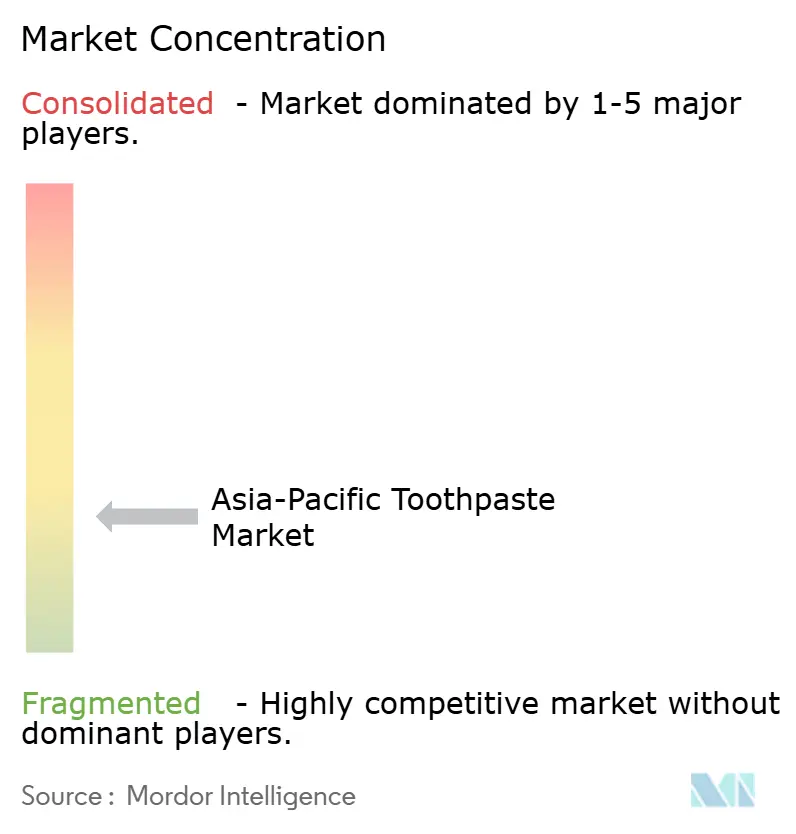
The Asia-Pacific toothpaste market includes Colgate-Palmolive, Unilever, Haleon, and Procter & Gamble, which compete with regional specialists that have strong local recognition. Yunnan Baiyao draws on traditional Chinese medicine heritage in China, while Dabur and Patanjali use Ayurvedic positioning in India. Lion Corporation and Kao Corporation have established positions in Japan through product development and local distribution. Multinational companies use research capabilities, clinical messaging, and cross-border brand platforms. Domestic companies often have advantages in local ingredient familiarity, informal retail reach, and country-specific consumer trust.
Several recent moves show how companies are adapting their strategies. Haleon completed the acquisition of its TSKF joint venture for GBP 700 million in June 2025, giving it direct operational control of its over-the-counter healthcare business in China. Haleon also announced its Shanghai manufacturing investment in March 2026, linking local production to the expansion of Sensodyne and Parodontax. Colgate has expanded whitening concepts through its India serum format and regional vitamin C campaign. Unilever’s Pepsodent Expert range and Ultra White launch demonstrate the value of combining dental-expert messaging with beauty positioning. These moves indicate that regional relevance increasingly depends on product positioning, local operating presence, and credible channels for consumer education.
Competition is also developing through new product formats and digital commerce. Guangzhou Weimeizi’s Saky brand represents the digital-first challenger group that uses platform launches and live-streaming commerce in China, according to the supplied material. SANGI’s APAGARD SERENA entered the Hall of Fame at the @cosme Best Cosmetics Awards 2025 in the Best Oral Care category. The recognition shows how a hydroxyapatite whitening product can build standing in both beauty and oral-care channels. Newer brands can lower some entry costs through online launches, but established companies retain advantages in compliance, distribution, and brand recognition. Medicated products require clinical credibility, while whitening products benefit from more lifestyle-oriented communication. Companies that can meet both needs are likely to compete more effectively across the region.
Asia-Pacific Toothpaste Industry Leaders
-
Colgate-Palmolive Company
-
Unilever
-
The Procter & Gamble Company
-
Himalaya Wellness Company
-
Patanjali Ayurved Limited
- *Disclaimer: Major Players sorted in no particular order
Asia-Pacific Toothpaste Market Companies Covered in this Report
- The Procter & Gamble Company
- Unilever
- Colgate-Palmolive Company
- Haleon plc
- Lion Corporation
- Dabur India Limited
- Church & Dwight Co., Inc.
- Sunstar Group
- Yunnan Baiyao Group Co., Ltd.
- Vicco Laboratories
- Himalaya Wellness Company
- Kao Corporation
- Amway Corporation
- Patanjali Ayurved Limited
- LG Household & Health Care Ltd.
- Hawley & Hazel (BVI) Co. Ltd.
- Guangzhou Weimeizi Industrial Co., Ltd.
- Amorepacific Corporation
- GC Corporation
- Dr. Bronner's Magic Soaps
Recent Industry Developments in Asia-Pacific Toothpaste Market
- October 2026: Lion restaged the Dent Health Medicated Toothpaste range with 2 new variants, DX Double Anti-Inflammatory and DX Multi-Function, launched across Japan on October 7, 2026, targeting consumers with periodontal concerns. The restage represents a systematic deepening of Lion’s medicated oral-care leadership, with updated formulations addressing swelling, bleeding, and bad breath concurrently.
- August 2026: Colgate launched Optic White Vitamin C, featuring 95% pure stabilized Vitamin C and clinically proven to deliver 7 years of stain removal in 7 days, across Asia-Pacific, with a regional campaign featuring BTS member j-hope as brand ambassador. The campaign integrates entertainment marketing with clinically validated whitening, positioning oral care within the APAC personal beauty economy.
- July 2026: Kao launched Pureora Carbonated Toothpaste Floating Whitening on July 11, 2026, extending a bestselling carbonated toothpaste format, which surpassed 5 million units sold, into the stain-removal and whitening sub-segment. The product uses carbonation-driven fizzing action to lift accumulated stains and directly competes with abrasive-whitening alternatives.
Asia-Pacific Toothpaste Market Report Scope
Toothpaste is a paste- or gel-based oral cleanser applied to teeth with a toothbrush to clean and maintain their appearance and health. The Asia-Pacific Toothpaste Market is Segmented by Product Type (Standard Toothpaste and Functional/Medicated Toothpaste), Category (Conventional and Natural/Organic), End User (Adults and Kids), Distribution Channel (Supermarkets/ Hypermarkets, Convenience Stores, Pharmacies/Drug Stores, Online Retail Stores, Other Distribution Channels), and Geography (China, India, Japan, Australia, Indonesia, South Korea, Thailand, Singapore, Rest of Asia-Pacific). The Market Size and Forecasts are Provided in Terms of Value (USD) for all the Above Segments.
Segmentation Overview
By Product Type
| Standard Toothpaste |
| Functional/Medicated Toothpaste |
By Category
| Conventional |
| Natural/Organic |
By End User
| Adult |
| Kids |
By Distribution Channel
| Supermarkets/Hypermarkets |
| Convenience/Grocery Stores |
| Pharmacies/Drug Stores |
| Online Retail Stores |
| Other Distribution Channels |
By Geography
| China |
| India |
| Japan |
| Australia |
| Indonesia |
| South Korea |
| Thailand |
| Singapore |
| Rest of Asia-Pacific |
| By Product Type | Standard Toothpaste |
| Functional/Medicated Toothpaste | |
| By Category | Conventional |
| Natural/Organic | |
| By End User | Adult |
| Kids | |
| By Distribution Channel | Supermarkets/Hypermarkets |
| Convenience/Grocery Stores | |
| Pharmacies/Drug Stores | |
| Online Retail Stores | |
| Other Distribution Channels | |
| By Geography | China |
| India | |
| Japan | |
| Australia | |
| Indonesia | |
| South Korea | |
| Thailand | |
| Singapore | |
| Rest of Asia-Pacific |
Key Questions Answered in the Report
What is the forecast for toothpaste sales in Asia-Pacific?
The Asia-Pacific toothpaste market is projected to grow from USD 9.71 billion in 2025 to USD 12.28 billion by 2031 at a 4.12% CAGR.
Which Asia-Pacific country has the largest toothpaste demand?
China is the largest country market in the supplied data, with a 33.95% regional share in 2025.
Which country is expected to grow fastest in regional toothpaste sales?
India is projected to grow at a 6.28% CAGR through 2031, supported by herbal preferences, wider retail access, and digital channels.
Why are online toothpaste sales growing in Asia-Pacific?
Online retail stores are forecast to grow at a 6.37% CAGR through 2031 as social commerce, quick commerce, and platform-led product launches expand consumer access.