
Market Overview
| Study Period | 2020 - 2031 |
|---|---|
| Forecast Data Period | 2026 - 2031 |
| Base Year Market Size (2025) | USD 8.87 Billion |
| Market Size (2026) | USD 9.71 Billion |
| Market Size (2031) | USD 13.92 Billion |
| Growth Rate (2026 - 2031) | 7.47 % |
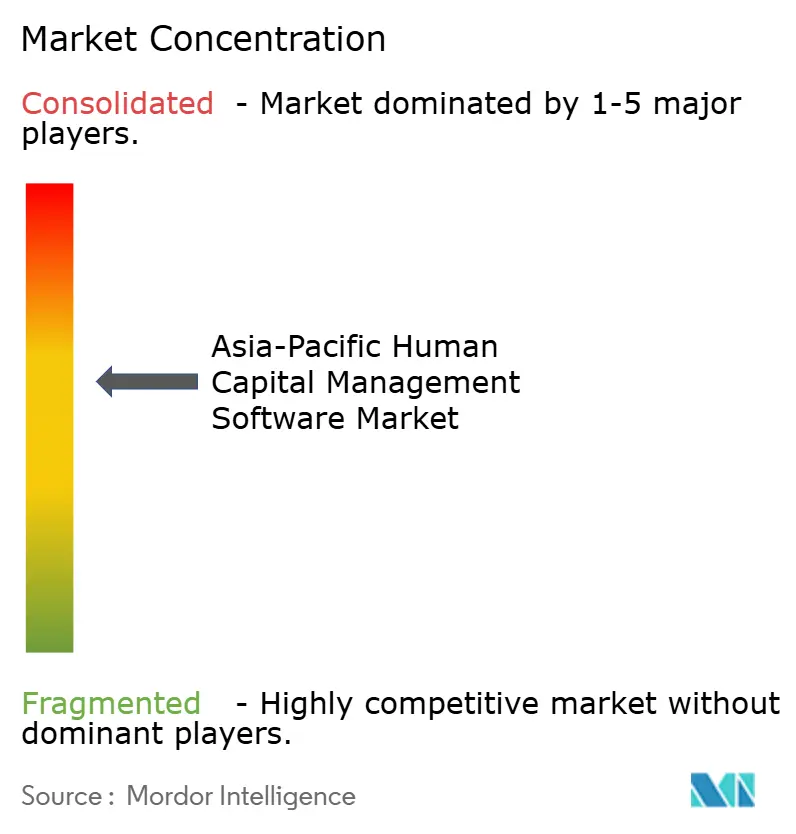
| Market Concentration | Medium |
Major Players *Disclaimer: Major Players sorted in no particular order Image © Mordor Intelligence. Reuse requires attribution under CC BY 4.0. | |
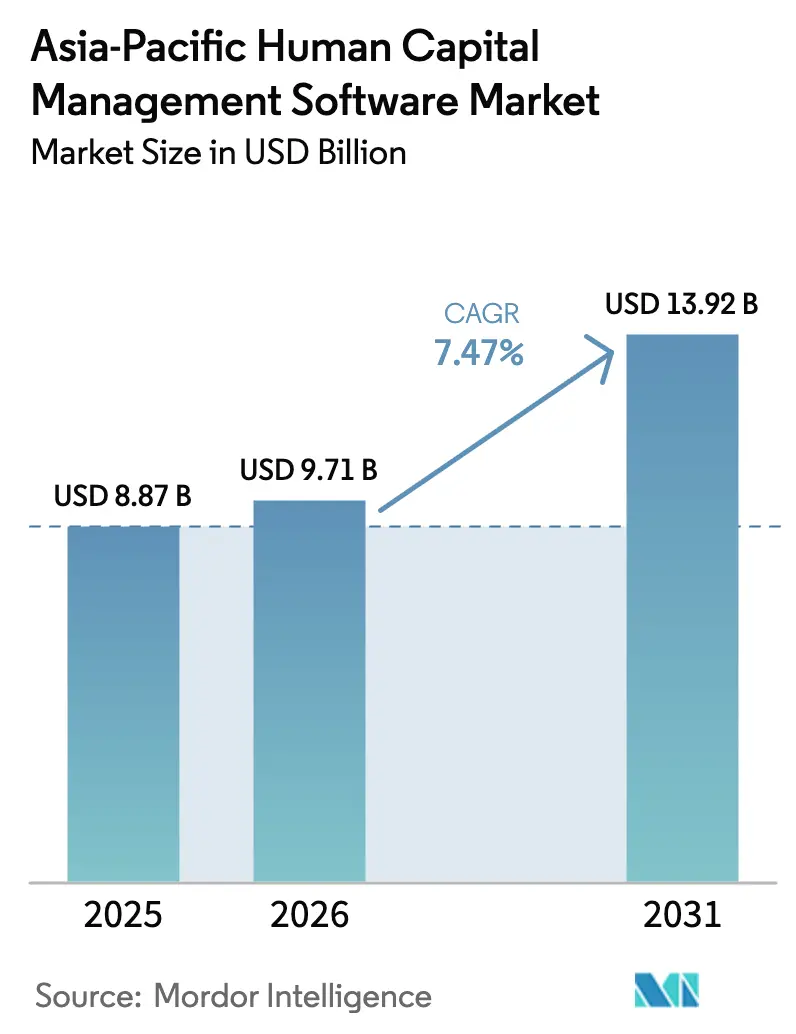
Asia-Pacific Human Capital Management Software Market Analysis by Mordor Intelligence
The Asia-Pacific human capital management software market size is expected to grow from USD 8.87 billion in 2025 to USD 9.71 billion in 2026 and is forecast to reach USD 13.92 billion by 2031 at 7.47% CAGR over 2026-2031. Cloud-first strategies, fast regulatory change, and skills shortages are prompting enterprises to modernize HR platforms, while venture funding gives local vendors the balance-sheet strength to challenge global incumbents. Skills-based talent models, payroll digitalization mandates, and AI-powered employee-service chatbots are expanding demand beyond core HR into adjacent talent and analytics modules. At the same time, privacy rules that require in-country data storage are reshaping data-center footprints, fueling incremental spending on secure cloud regions. Competitive intensity remains moderate as regional specialists gain share by shipping statutory updates faster than monolithic global suites.
Key Report Takeaways
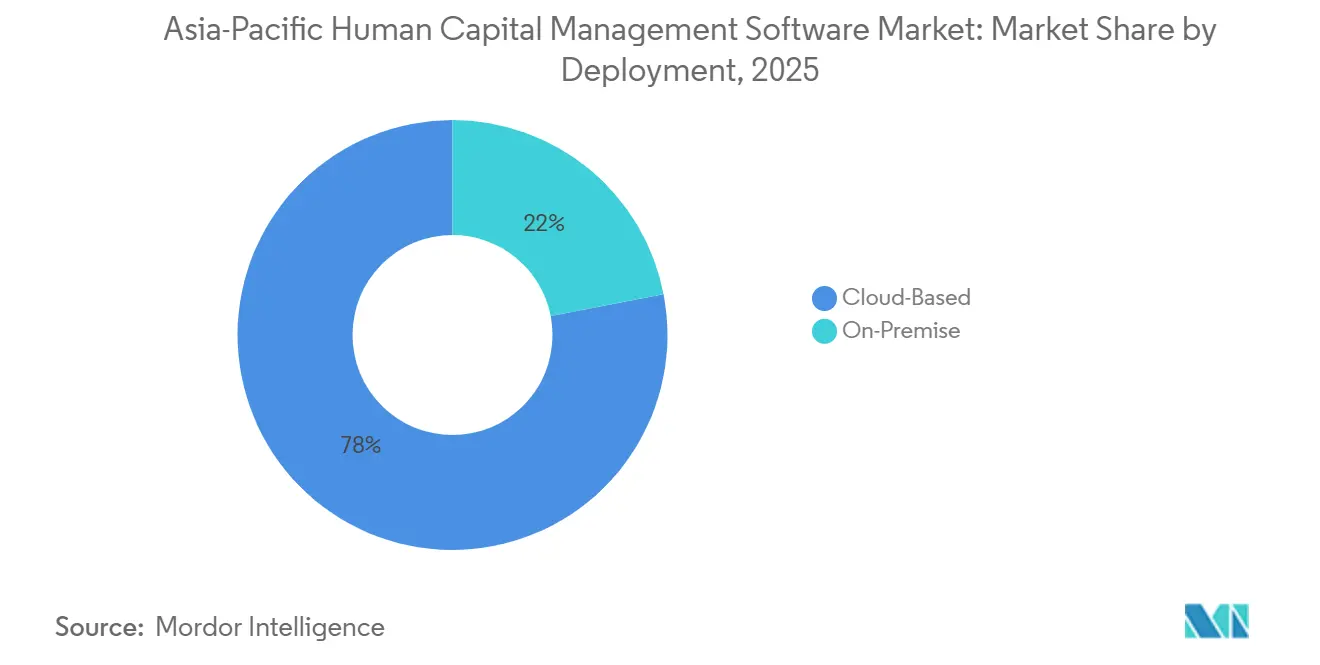
- By deployment, cloud-based solutions captured 78.03% share of Asia-Pacific human capital management software market's 2025 revenue, and this share is widening as the model advances at 7.51% CAGR through 2031.
- By organization size, large enterprises held 63.89% share of Asia-Pacific human capital management (HCM) software market's 2025 revenue, yet small and medium-sized enterprises are expanding the fastest at 7.91% CAGR to 2031.
- By application, core HR generated 29.77% of Asia-Pacific HCM software market's 2025 sales, while performance and talent management is the fastest-growing module at 7.84% CAGR through 2031.
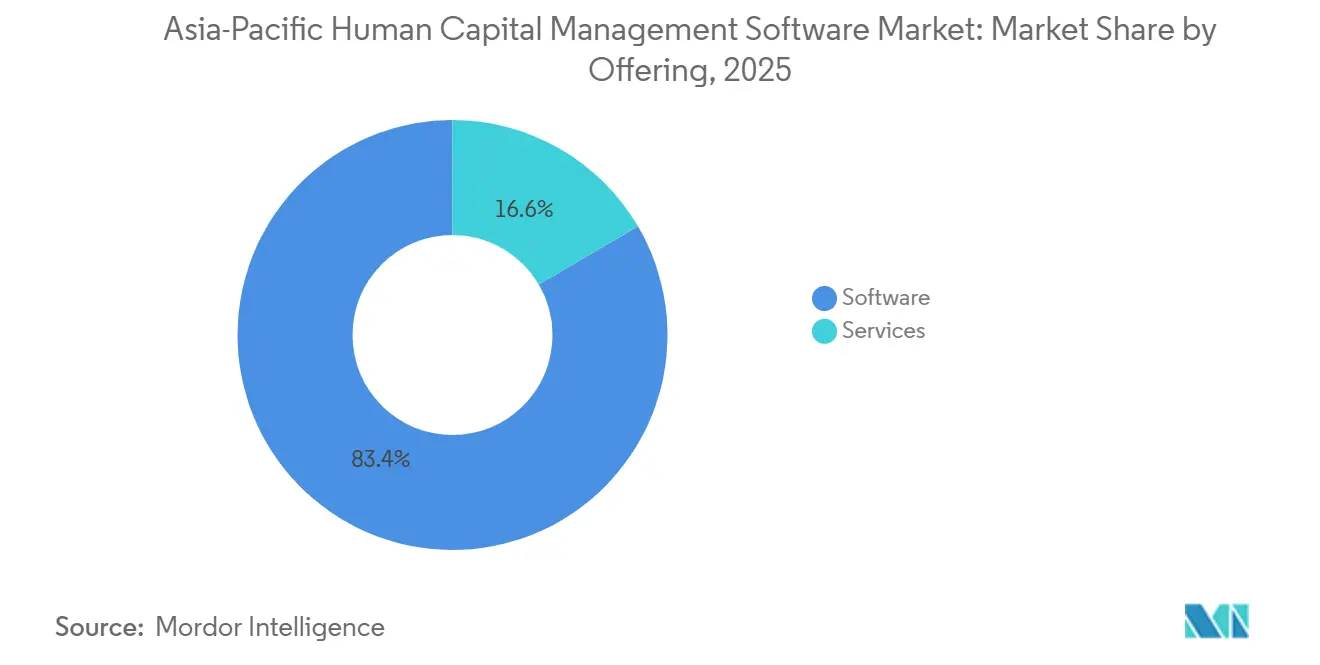
- By offering, software platforms represented 83.43% of 2025 spending, but services revenue is accelerating at 8.13% CAGR on the back of implementation demand.
- By end-user industry, banking, financial services, and insurance commanded 28.17% share in 2025, whereas retail and e-commerce will post the highest growth at 8.07% CAGR to 2031.
- By geography, China accounted for 31.23% of regional sales of APAC HCM Software amrket in 2025, yet India is the fastest-expanding market at 8.12% CAGR through 2031.
Note: Market size and forecast figures in this report are generated using Mordor Intelligence’s proprietary estimation framework, updated with the latest available data and insights as of 2026.
Asia-Pacific Human Capital Management Software Market Trends and Insights
Drivers Impact Analysis*
| Driver | (~) % Impact on CAGR Forecast | Geographic Relevance | Impact Timeline |
|---|---|---|---|
| Accelerated Cloud Adoption Across Asia-Pacific Enterprises | +1.8% | APAC core, Indonesia, Malaysia | Short term (≤ 2 years) |
| Growing Demand for Mobile HCM Applications | +1.2% | Singapore, Australia, Japan | Short term (≤ 2 years) |
| Regulatory Mandates for Digital Payroll Compliance | +1.3% | China, India, Japan, Australia, Singapore | Medium term (2-4 years) |
| Increase in Demand for Talent Mobility | +1.0% | China, India, Singapore | Medium term (2-4 years) |
| Localization of AI-Driven Multilingual HR Chatbots for Mid-Market Firms | +0.9% | India, Japan, South Korea, Southeast Asia | Medium term (2-4 years) |
| Integration of Cross-Border Gig-Workforce Platforms | +0.7% | Singapore, Hong Kong, Malaysia | Long term (≥ 4 years) |
| Source: Mordor Intelligence | |||
Accelerated Cloud Adoption Across Asia-Pacific Enterprises
Enterprises are replacing capital-intensive on-premise systems with subscription-priced cloud suites to reduce total cost of ownership and accelerate innovation cycles. Regional data-center expansions in Sydney, Singapore, Tokyo, and Mumbai allow vendors to address strict residency rules while offering modern micro-services architectures that shorten release cadences.[1]Workday Newsroom, “Workday Opens New Data Centers Across Asia Pacific,” workday.com Mid-market buyers benefit most because cloud deployments remove the need for dedicated IT staff and server rooms, supporting scale-as-you-grow head-count models. Even regulated industries that once demanded air-gapped environments now pilot hybrid stacks that pin sensitive master data on-premise but run analytics in the cloud. The ability to toggle workloads between private and public clouds without re-platforming has become a key selection criterion, favoring vendors with containerized services and stateless integration gateways.
Regulatory Mandates for Digital Payroll Compliance
Rapid-fire statutory changes, from Indonesia’s CORETAX rollout to Vietnam’s electronic social-insurance books, require payroll engines that ship quarterly content packs rather than annual upgrades.[2]Forvis Mazars, “APAC Payroll Newsletter 2025 Issue 1,” forvismazars.com Vendors with in-house compliance teams and country-specific roadmaps differentiate by offering “day-one readiness” whenever governments revise brackets, allowances, or contribution formulas. Hong Kong’s eMPF platform, launching in phases through 2025, is a case in point: providers must embed contribution-submission APIs and portfolio-switch workflows or risk client attrition. As more tax authorities demand real-time payroll reporting, cloud architectures that support micro-batch submissions and audit-quality data trails gain further momentum.
Localization of AI-Driven Multilingual HR Chatbots for Mid-Market Firms
Conversational agents that speak Mandarin, Japanese, Bahasa, and Hindi now resolve routine HR queries and process leave requests, cutting service-center workload by up to 70% in early pilots.[3]OCBC Bank, “OCBC Launches AI-Powered HR Chatbot,” ocbc.com Pre-trained language models, fine-tuned on regional HR policies, allow vendors to sell plug-and-play chatbots without costly client-side training data. OCBC’s deployment proves the model at enterprise scale, while Zoho and Darwinbox are productizing stripped-down assistants that target firms with fewer than 500 employees. Integration with core HR ensures that the bot can surface personalized balances and policy eligibility in real time. Wider adoption hinges on robust back-end security because the chatbot touches sensitive data, prompting vendors to certify ISO 27001 controls to clear procurement hurdles.
Integration of Cross-Border Gig-Workforce Platforms
The region’s platforms must now classify drivers, riders, and freelancers as employees in several jurisdictions, forcing enterprises to unify contingent-labor management on a single system of record. SAP Fieldglass and similar tools now ship jurisdiction-specific pay templates, audit trails, and algorithmic scheduling that comply with Australia’s new minimum-standards regime.[4]SAP SE, “SAP Fieldglass Vendor Management System,” sap.com For regional headquarters orchestrating talent across Hong Kong and Singapore, a harmonized contractor ledger reduces misclassification risk and simplifies cost allocations. Vendors that surface consolidated dashboards for employees, contractors, and platform workers create a compelling value proposition as hybrid workforces become the norm.
Restraints Impact Analysis*
| Restraint | (~) % Impact on CAGR Forecast | Geographic Relevance | Impact Timeline |
|---|---|---|---|
| Privacy and Security Concerns | -0.8% | China, India, Singapore, Japan, Australia | Short term (≤ 2 years) |
| Integration Complexity with Legacy ERP Stacks | -1.1% | Large enterprises across APAC, China SOEs | Medium term (2-4 years) |
| Fragmented Asia-Pacific Labor-Law Landscape | -0.6% | Multi-country operators, regional HQs | Long term (≥ 4 years) |
| Scarcity of HR-Analytics Talent Pool | -0.4% | India, Southeast Asia | Medium term (2-4 years) |
| Source: Mordor Intelligence | |||
Integration Complexity with Legacy ERP Stacks
Many banks and manufacturers run heavily customized SAP ECC or Oracle E-Business Suite instances that cannot be retired overnight. Synchronizing organizational hierarchies, cost centers, and custom payroll logic with a next-generation cloud suite often requires middleware, data-clean-up, and staged rollouts that stretch beyond 18 months. While Workday and SAP SuccessFactors publish starter connectors, niche local payroll engines and government submission portals still demand bespoke APIs, inflating project scope. Consulting-heavy engagements raise the total cost of ownership, deterring budget-constrained clients and slowing overall market conversion. Vendors that bundle migration accelerators and pre-mapped data models reduce this friction, but legacy complexity remains the single biggest drag on implementation velocity.
Privacy and Security Concerns
China’s Personal Information Protection Law and India’s Digital Personal Data Protection Act require in-country storage and stringent cross-border transfer approvals, restricting multinational roll-outs that rely on centralized data hubs. Breach-notification windows of 72 hours in Singapore and Japan compel platforms to embed real-time intrusion detection, encryption at rest, and immutable audit logs. Vendors lacking regional data centers face procurement disqualification in banking and healthcare tenders, limiting addressable market until they establish local points of presence. Compliance investments therefore divert resources that could fund new product innovation, moderating near-term margin expansion.
*Our forecasts treat driver/restraint impacts as directional, not additive. The impact forecasts reflect baseline growth, mix effects, and variable interactions.
Segment Analysis
By Deployment: Cloud Infrastructure Drives Scalability
Cloud-based solutions held 78.03% revenue share of the Asia-Pacific human capital management software market in 2025, and the segment is expanding at 7.51% CAGR through 2031. Vendors are adding sovereign cloud regions to satisfy residency laws, which removes the historical barrier that once forced sensitive industries to remain on-premise. Large banks still keep certain payroll engines inside regulated data centers, yet they increasingly pair this core with cloud analytics to model compensation scenarios in near real time. On-premise and hybrid footprints remain relevant, but their road-maps now emphasize API gateways that allow phased migration rather than full-stack upgrades.
Mid-market firms are the biggest beneficiaries because subscription pricing converts fixed hardware cost into variable operating expense, freeing budget for analytics and learning modules. Zoho’s expansion across the Gulf Cooperation Council and Darwinbox’s template-driven roll-outs in Southeast Asia demonstrate that pre-configured cloud stacks can go live in weeks instead of quarters. Vendors that offer single-tenant options for highly regulated entities while keeping a multi-tenant core for everyone else capture divergent buyer preferences within one code base, a strategy expected to propel cloud’s Asia-Pacific human capital management software market share beyond 80% by 2031.


By Application: Skills-Based Talent Systems Gain Traction
Core HR generated 29.77% of 2025 application revenue as every deployment begins with an employee master file and compliance workflows. Performance and talent management is set to be the fastest-growing application at 7.84% CAGR, driven by the pivot from job grids to skills graphs. Internal talent marketplaces built on Workday Skills Cloud or SAP Opportunity Marketplace let CFOs redeploy engineers to high-priority projects without external hiring fees, accelerating pay-back periods.
Payroll remains a regulatory must-have, but differentiation is shifting to adjacent analytics that predict overtime spikes or pay-equity gaps. Workforce-management modules integrate scheduling with point-of-sale data in retail, while learning stacks now embed micro-credentialing to verify upskilling ROI. As these formerly siloed applications converge on a common data model, the Asia-Pacific human capital management software market size allocated to best-of-breed point solutions is expected to shrink, consolidating spend inside unified suites.
By Organization Size: Mid-Market Acceleration Reshapes Buyer Mix
Large enterprises controlled 63.89% of 2025 revenue because complex hierarchies, global scale, and audit overlays necessitate full-function suites integrated with ERP and CRM backbones. However, small and medium-sized enterprises are expanding at a brisk 7.91% CAGR thanks to cloud pricing below USD 10 per employee per month and localized statutory rules that remove the need for in-house payroll experts.
Regional specialists such as SmartHR in Japan and Beisen in China tailor user interfaces and compliance packs for local buyers, lowering change-management friction and raising win rates against global mega-suites. As SMEs scale, they often add modules rather than re-platform, locking in lifetime value for vendors that sell modular licenses. This twin-track dynamic positions the Asia-Pacific human capital management software industry to diversify revenue across both enterprise and mid-market cohorts without cannibalization.
By Offering: Services Revenue Accelerates Amid Implementation Demand
Software still dominates at 83.43% of 2025 spending, yet services are on track to post the highest growth at 8.13% CAGR as clients seek data migration, change management, and ongoing statutory maintenance. System integrators such as Accenture and Infosys bundle accelerators that cut test-cycle time, while payroll outsourcers like Ramco guarantee touchless processing compliance, winning multiple 2025 HR Vendor of the Year awards.
Outcome-based contracts aligned to head-count or payslip volumes are replacing billable-hour arrangements, giving buyers predictable cost and vendors sticky, recurring revenue. As multi-country payroll consolidation projects proliferate, the Asia-Pacific human capital management software market size attributable to managed services is projected to rise, especially among mid-market firms lacking in-house compliance expertise.
By End-User Industry: Retail Automation Outpaces Financial Services
Banking, financial services, and insurance accounted for 28.17% of 2025 revenue because regulators mandate robust audit trails and certified workflow segregation. Retail and e-commerce, however, will clock the fastest expansion at 8.07% CAGR as omnichannel operators grapple with volatile seasonal hiring and gig-worker scheduling.
Manufacturers emphasize workforce-safety analytics and overtime controls, while healthcare providers adopt modules for credential tracking and shift bidding to combat nurse shortages. Government bodies remain cautious cloud adopters given sovereignty rules but increasingly pilot hybrid deployments for learning management. Vendors offering vertical templates shorten blueprint phases, capturing domain-specific demand without starting from scratch each time.
Geography Analysis
China led the Asia-Pacific human capital management software market with 31.23% revenue in 2025, anchored by large state-owned enterprises and technology firms digitizing HR at scale. Beisen’s launch of AI Family 2.0 embeds generative screening and competency assessment, giving domestic buyers a locally hosted, AI-native alternative to global suites. Beijing’s data-sovereignty regime forces foreign vendors to partner with Chinese cloud providers or establish joint ventures, raising both compliance cost and time-to-market. The phased extension of retirement ages that started in 2025 further boosts upgrade cycles as firms must recalibrate pension eligibility across millions of workers.
India, forecast to grow at 8.12% CAGR, is the most dynamic sub-market. Rapid formalization, digital payroll mandates, and venture-backed challengers such as Darwinbox are accelerating adoption, particularly among companies with 200-2,000 employees. The Digital Personal Data Protection Act elevates localization requirements, prompting global vendors to spin up Mumbai or Hyderabad data centers to stay in large-enterprise tenders. Ongoing debate over standing-orders regulations in Karnataka signals more legislative churn ahead, sustaining demand for platforms that ship compliance updates within weeks, not quarters.
Japan’s market is distinctive for its high SaaS penetration yet dominant local champion: SmartHR holds 45.8% share and is now pushing up-market into enterprises with AI-powered talent analytics funded by its USD 96 million November 2025 raise. Expanded social-insurance coverage for part-time staff effective October 2024 has already triggered fresh configurations across payroll engines. South Korea, Australia, Singapore, and the emerging group of Indonesia, Malaysia, and Thailand represent the next wave of high-growth jurisdictions as each introduces gig-worker protections, right-to-disconnect rules, and progressive wage frameworks that alter payroll logic.
Regulatory Landscape
Regulation in Asia-Pacific HCM software is shaped by digital-government mandates and tighter data protection rules that affect payroll reporting, identity verification, and hosting decisions. Cross-border compliance pressure is rising alongside regional coordination, including the ASEAN Digital Master Plan 2030 finalized in 2026, which highlights digital governance and interoperability building blocks such as cross-border data verification and digital ID standards.
At the country level, programs are moving from guidance to operational requirements that vendors need to embed in workflows. Japan's Digital Agency continues to advance a cabinet-approved Priority Plan for the Advancement of a Digital Society anchored in BPR and a Cloud-by-Default approach for public administration, while Vietnam expanded its digital-government roadmap through Decision No. 2629/QD-TTg (December 2025) and added an effective 1 July 2026 requirement that electronic labor contracts be processed through an eContract system managed by the Ministry of Home Affairs. The Philippines' Republic Act No. 12254 (E-Governance Act) institutionalizes digitization and interoperability of government processes, reinforcing demand for API-based reporting, audit trails, and master-data controls in HCM deployments.
Value Chain Analysis
The value chain covers cloud infrastructure and platform engineering, statutory content and localization, implementation and integration, and ongoing managed services for compliance operations. Data-residency requirements tied to laws such as India's Digital Personal Data Protection Act are pushing global and regional vendors to expand in-country hosting zones, while also increasing the importance of security controls, encryption, and audit logging that procurement teams can evidence in regulated verticals.
In Asia-Pacific, go-to-market increasingly runs through systems integrators and payroll specialists that combine software selection with multi-country rollouts, integration to legacy ERP, and recurring compliance maintenance, particularly in hubs such as Singapore, Hong Kong, and India. This channel structure raises the bar for pre-built connectors, localized tax and contribution libraries, and government-submission APIs, and it supports continued downstream services attachment as enterprises consolidate core HR with local payroll engines or outsource payroll processing to specialist providers.
Competitive Landscape
The market shows moderate concentration, with Workday, SAP, Oracle, ADP, and UKG forming the global top tier, while Darwinbox, SmartHR, Beisen, Ramco, and Zoho anchor the regional tier. Workday’s four new Asia-Pacific cloud regions and embedded Skills Cloud amplify its value proposition of secure residency plus AI-driven talent insights. Oracle is bundling hire-to-retire workflows inside its ME Cloud to cross-sell into its large financials install base, and the 25A release adds generative agents for onboarding and performance.
Regional specialists differentiate by rapid localization and mid-market pricing. SmartHR automates Japan’s complex social-insurance enrollment and has begun building enterprise-grade analytics with its November 2025 funding. Darwinbox, buoyed by USD 140 million from Partners Group and KKR, is rolling out pre-configured payroll packs across Southeast Asia, winning accounts that global suites previously ignored. Beisen’s profitability milestone in 2026 demonstrates that scale and localization can coexist, enabling sustained R&D on AI modules.
Disruptors such as HiBob, Rippling, and Gusto are entering via Singapore and Australia with cloud-native architectures that promise implementation in days, not months. ISG’s 2025 HRMS guide ranks these challengers high on user experience innovation, though they lack deep statutory packs outside English-speaking markets. Mergers and acquisitions are expected as private equity seeks roll-ups to build pan-regional scale, targeting firms that combine 40%+ growth with double-digit operating margins.
Asia-Pacific Human Capital Management Software Industry Leaders
Workday Inc.
SAP SE
Oracle Corporation
Automatic Data Processing, Inc. (ADP)
UKG Inc.
- *Disclaimer: Major Players sorted in no particular order

Market Opportunities and Future Outlook
Regulatory digitalization programs create whitespace for vendors that can operationalize government-facing workflows beyond classic HR administration, especially where policy standardizes identity, interoperability, and digital-by-default processes. This is visible in the Philippines' E-Governance Act (Republic Act No. 12254) and Vietnam's move to centralized digital processing of employment artifacts, including the 1 July 2026 requirement for electronic labor contracts to be handled through a Ministry of Home Affairs-managed eContract system. In practice, these shifts favor HCM platforms and payroll engines that ship statutory updates quickly and support API-first compliance submissions, immutable audit trails, and configurable retention policies.
Cloud localization and mid-market packaging also remain practical entry points for incremental adoption in Australia, New Zealand, and Southeast Asian markets where buyers want faster time-to-value without heavy HRIT staffing. Workday's expansion of Workday GO to Australia and New Zealand (May 2026) reflects a partner-led approach for midsize deployments, while ADP's rollout of ADP Lyric HCM in Australia and New Zealand (December 2025) underlines demand for unified HR and payroll experiences in English-speaking APAC. Opportunity is similarly tied to services, including multi-country payroll outsourcing and integration-heavy modernization for enterprises with legacy ERP stacks, with consolidation among payroll specialists such as AscentHR's acquisition of OS HRS (July 2026) aimed at broadening APAC coverage.
Recent Industry Developments
- July 2026: AscentHR completed the acquisition of OS HRS to expand multi-country payroll outsourcing coverage across Asia-Pacific markets including India, Japan, China, Malaysia, Singapore, and South Korea. The deal strengthens regional delivery capacity for employers running complex, multi-jurisdiction payroll operations and increases competitive pressure on standalone payroll bureaus and smaller managed-service providers.
- May 2026: Workday announced the expansion of Workday GO for midsize organizations to Australia and New Zealand, supported by a partner network that includes Datacom, Echo, Intecrowd, Kainos, Kliqtek, Mivada, and Synergy Group. The company broadened its addressable base in ANZ by relying on implementation partners to compress deployment cycles and localization effort for mid-market buyers.
- December 2025: ADP rolled out ADP Lyric HCM in Australia and New Zealand, positioning a unified ecosystem across payroll, HR, and employee experience. This adds another large-vendor option for organizations prioritizing integrated HR and payroll workflows and raises expectations for local providers around user experience and ecosystem integration.


Research Methodology Framework and Report Scope
Market Definition and Coverage
For this report, the market covers spending on human capital management software used by organizations in Asia-Pacific to run core HR, payroll, workforce, talent, learning, recruiting, and related governance and compliance workflows, across cloud and on-premises deployments.
Scope exclusions: This sizing does not count outsourced HR business process services, staffing and recruitment agency revenue, or standalone IT infrastructure spend that is not sold as HCM software.
Segmentation Overview
- By Deployment
- Cloud-Based
- On-Premise
- By Application
- Core HR
- Payroll Management
- Compensation Management
- Workforce Management
- Performance and Talent Management
- E-Learning and E-Recruiting
- Enterprise GRC (eGRC)
- By Organization Size
- Small and Medium-Sized Enterprises (SMEs)
- Large Enterprises
- By Offering
- Software
- Core Platforms
- Point Solutions and Add-Ons
- Services
- Implementation and Integration
- Support and Maintenance
- Software
- By End-User Industry
- Banking, Financial Services, and Insurance (BFSI)
- IT and Telecom
- Retail and E-Commerce
- Manufacturing
- Healthcare and Life-Sciences
- Government and Public Sector
- Other End-User Industries
- By Geography
- China
- Japan
- India
- South Korea
- Australia
- Singapore
- Indonesia
- Malaysia
- Rest of Asia-Pacific
Data Sources, Market Sizing, and Validation
Desk Research
Desk research was used to set the market boundary, build the country level demand drivers, and cross-check the direction of spend across HR technology. We leaned on public sources such as the International Labour Organization (ILO), World Bank, OECD, and national statistics agencies in Asia-Pacific for employment, wage, and enterprise counts that act as demand pool anchors.
We also reviewed policy and compliance signals that influence payroll and HR system refresh needs, using sources such as government labor departments, data protection regulators, and public consultation papers, and then triangulated them with company filings, annual reports, investor presentations, and reputable business press. Where available, paid subscriptions for company financials and intelligence, news and financials, and patent databases were used to standardize vendor disclosures and track product direction. These listed sources are illustrative only, and many other references were used for data collection, validation, and clarification during the research.
Primary Interviews and Surveys
Primary work focused on validating what buyers actually pay for HCM software across major Asia-Pacific economies, and how pricing shifts with deployment model, module mix, and compliance complexity. We spoke with HR and IT decision makers, implementation partners, and product specialists across APAC so assumptions on adoption timing, renewal cycles, and country specific payroll update intensity could be stress-tested and refined across sub-regions.
Distribution of primary research fieldwork respondents
| Company type | Respondent position |
|---|---|
| Top tier: 31% | CXOs: 13% |
| Mid tier: 51% | Functional/Unit leaders: 36% |
| Smaller Players: 18% | Managers: 51% |
Market-Sizing & Forecasting
Sizing starts from a top-down build where the addressable employer base and workforce scale in Asia-Pacific are translated into an HCM software demand pool, followed by applying adoption and spend intensity factors that differ by country maturity. To keep the totals realistic, results are then corroborated with selective bottom-up approximations, such as sampled subscription and license price points by module, channel checks on implementation led deals, and a roll-up of disclosed software revenue shares for a tracked set of suppliers.
Inputs that materially shaped the model include enterprise counts by size band, formal employment and wage trends, cloud adoption pace in enterprise applications, payroll statutory change frequency by country, and observed renewal and upgrade cycles for HR platforms. Since pricing can move quickly with bundling and seat-based models, average selling price progression is modeled using scenario analysis, then stress-tested with interview feedback on discounting, multi-year contract structures, and migration timing from on-premises to cloud. Where supplier revenue visibility is limited in some countries, we use proxy ratios from comparable markets and then adjust them back to local conditions through buyer spend checks.
Data Validation & Update Cycle
We validate outputs by comparing the modeled spend per employee and spend per enterprise with independent signals, including public IT spending indicators, hiring activity trends, and compliance driven payroll update intensity. Outliers are reviewed at the country level first, and then revisited at the regional roll-up, so a single large economy does not distort the regional total.
Before sign-off, estimates go through a multi-step analyst review, and follow-up calls are triggered when pricing, contract length, or adoption timing assumptions show wide variance between sources. Reports are refreshed annually, with interim updates when major policy changes, currency swings, or notable demand shifts occur, and a final pre-delivery check is completed so the client receives the most current view.
Mordor Intelligence's Asia Pacific Human Capital Management Software Market Sizing Compared With Other Published Estimates
Published market sizes for APAC HCM software often differ because each publisher makes its own choices on what modules count, how cloud subscriptions are annualized, and whether services are mixed into the same total. In practice, even small differences in currency timing and renewal treatment can shift a regional total by a noticeable amount.
Key gap drivers typically include how payroll and compliance related modules are grouped, whether enterprise GRC features are counted as part of HCM or excluded, and how multi-country bundles are split across regions. Another common driver is refresh cadence, where updated exchange rates and re-checked ASP assumptions based on current contracting behavior tighten the estimate, a step applied by Mordor Intelligence.
Benchmark comparison
| Source | Market Size | Gaps in Research Methodology |
|---|---|---|
| Mordor Intelligence | USD 8.87 B (2025) | |
| Trade Journal A | USD 6.41 B (2024) | Often reported as a broader HR technology bucket for APAC, which can exclude deeper HCM modules or treat payroll and talent spend differently, and it also anchors to a prior-year USD conversion. |
| Industry Publisher B | USD 8.70 B (2026) | Uses a forward-year snapshot and may assume faster ASP expansion into the forecast year, which can lift the stated size versus a base-year view that normalizes renewals and discounting patterns. |
The spread in the table is mostly explained by timing and category boundaries rather than pure demand disagreement. When scope is kept tightly on HCM software revenue in Asia-Pacific and the pricing and currency assumptions are refreshed in line with current contracting, the resulting market size stays easier to reconcile to observable buyer spend drivers.


Key Questions Answered in the Report
How large will the Asia-Pacific human capital management software market be by 2031?
The market is forecast to reach USD 13.92 billion by 2031, expanding at 7.47% CAGR from 2026-2031.
Which deployment model is gaining the most traction in Asia-Pacific?
Cloud-based platforms held 78.03% share in 2025 and continue to outpace on-premise options thanks to lower upfront cost and regulatory-compliant data centers.
What is the fastest-growing application area for HCM suites?
Performance and talent management is advancing at 7.84% CAGR as firms pivot to skills-based workforce strategies.
Why are small and medium-sized enterprises adopting HCM software more quickly now?
Subscription pricing, localized statutory packs, and pre-configured workflows remove the need for in-house HRIT expertise, supporting a 7.91% CAGR through 2031.
Which country offers the highest growth outlook?
India is projected to lead regional growth at 8.12% CAGR due to digital-payroll mandates and strong mid-market demand.
How are vendors addressing privacy regulations across Asia-Pacific?
Leading platforms now operate multiple in-region data centers, embed encryption and role-based access controls, and provide geo-fencing features to meet data-localization laws.
Page last updated on:


 Your data is secure and never sold or shared.


