
Market Overview
| Study Period | 2020 - 2031 |
|---|---|
| Forecast Data Period | 2026 - 2031 |
| Base Year Market Size (2025) | USD 61.65 Billion |
| Market Size (2026) | USD 73.59 Billion |
| Market Size (2031) | USD 178.16 Billion |
| Growth Rate (2026 - 2031) | 19.36 % |
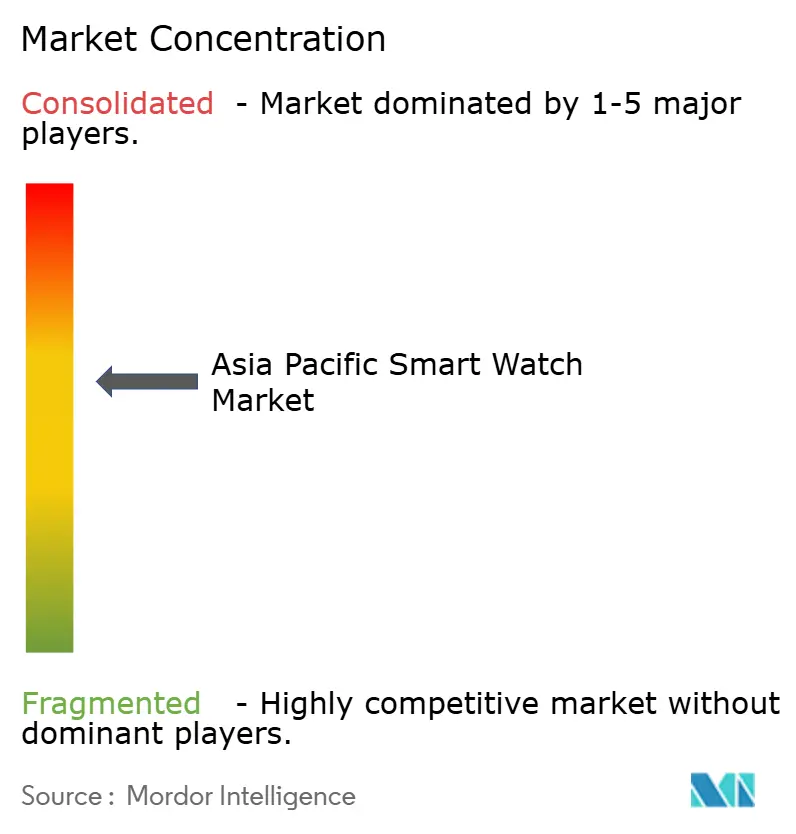
| Market Concentration | Medium |
Major Players *Disclaimer: Major Players sorted in no particular order Image © Mordor Intelligence. Reuse requires attribution under CC BY 4.0. | |
Asia Pacific Smart Watch Market Analysis by Mordor Intelligence
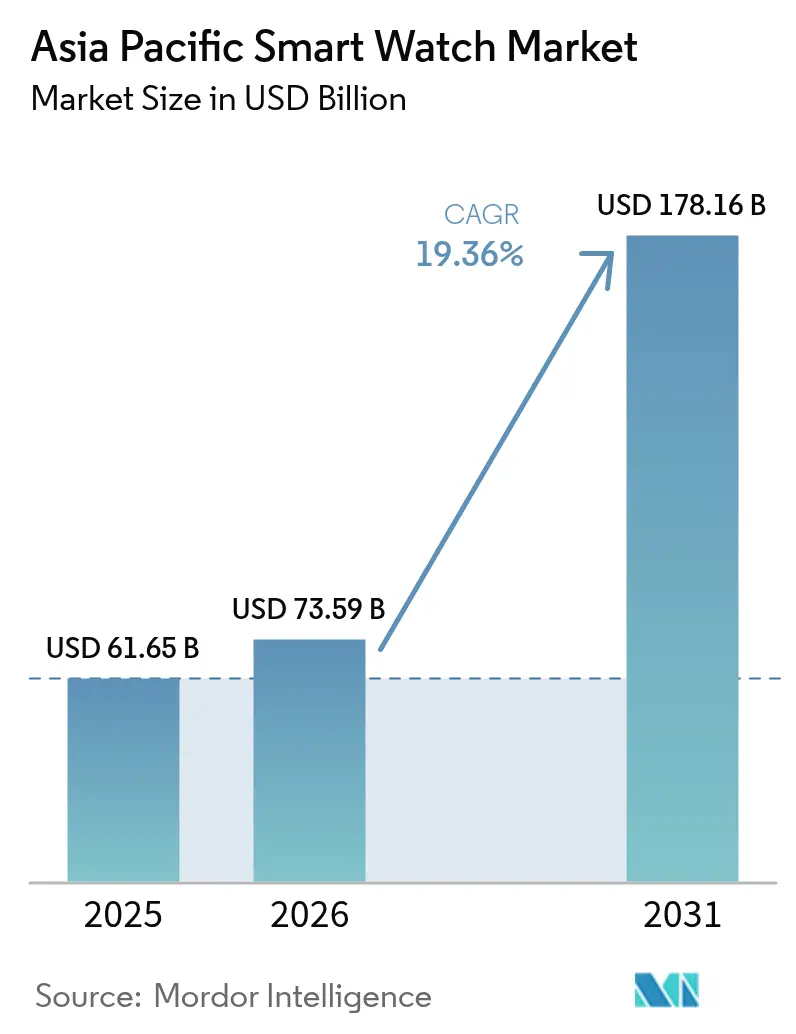
Asia Pacific Smart Watch market size in 2026 is estimated at USD 73.59 billion, growing from 2025 value of USD 61.65 billion with 2031 projections showing USD 178.16 billion, growing at 19.36% CAGR over 2026-2031. Robust consumer adoption, vertically integrated manufacturing hubs, and growing health-monitoring awareness underpin this acceleration. China leads shipments and value creation on the back of expansive supply chains, while India’s electronics-manufacturing push and aggressive insurance incentives are catalyzing the region’s fastest unit growth. Rapid 5G rollout, rising penetration of premium AMOLED displays, and ecosystem lock-in strategies by major smartphone vendors widen feature sets, deepen user engagement, and elevate replacement demand. Component tariffs, battery-life constraints, and emerging e-waste regulations temper the trajectory but have not derailed investment momentum across the Asia Pacific smart watch market.
Key Report Takeaways
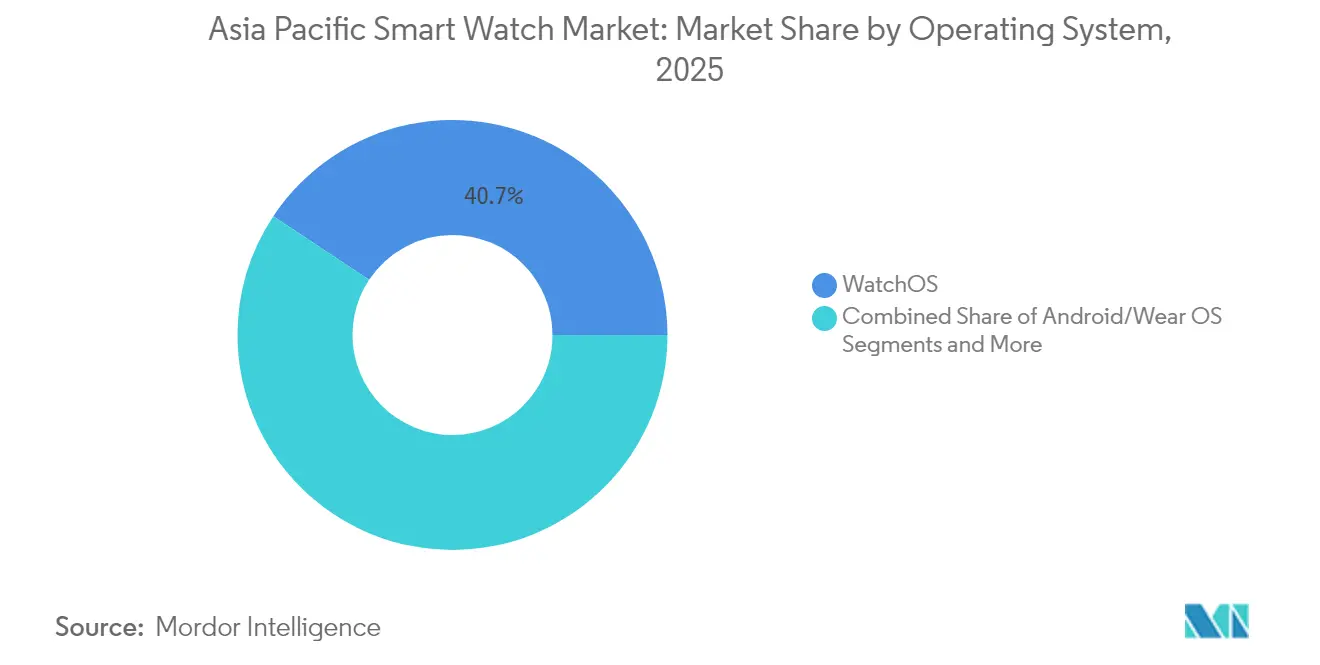
- By operating system, WatchOS retained 40.68% of the Asia Pacific smartwatch market share in 2025, while RTOS platforms are advancing at 19.65% CAGR through 2031.
- By display technology, AMOLED captured 51.97% of the Asia Pacific smartwatch market size in 2025, whereas PMOLED displays are forecast to post a 19.72% CAGR from 2026 to 2031, making them the most rapidly expanding display category.
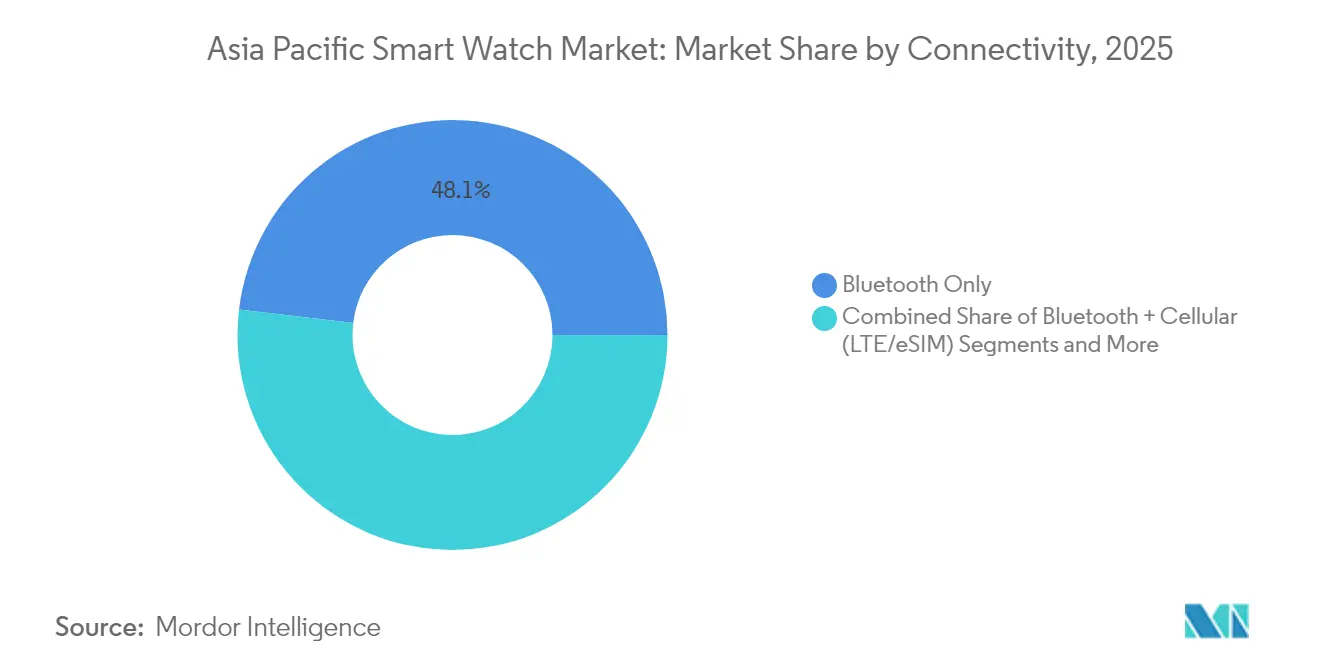
- By connectivity, Bluetooth-only models accounted for 48.10% shipments in 2025, while 5G Standalone connectivity is projected to scale at 20.52% CAGR through 2031.
- By application, sports and fitness held 36.21% revenue share in 2025; medical and health monitoring is on track for the highest 21.12% CAGR to 2031.
- By country, China commanded a 39.10% share of the Asia Pacific smart watch market in 2025, whereas India is anticipated to log a 21.45% CAGR to 2031.
Note: Market size and forecast figures in this report are generated using Mordor Intelligence’s proprietary estimation framework, updated with the latest available data and insights as of 2026.
Market Trends and Insights
Drivers Impact Analysis of Asia Pacific Smart Watch Market*
| Driver | (~) % Impact on CAGR Forecast | Geographic Relevance | Impact Timeline |
|---|---|---|---|
| Proliferation of health and fitness sensors in affordable smart watches | +3.5% | China, India, Southeast Asia | Medium term (2-4 years) |
| Ecosystem lock-in strategies by smartphone OEMs | +2.1% | Global; strongest in China and Japan | Long term (≥4 years) |
| Rapid 5G rollout enabling always-connected features | +1.8% | Japan, South Korea, urban China | Short term (≤2 years) |
| Insurance-linked wellness premium discounts | +0.9% | India, Australia, emerging Southeast Asia | Medium term (2-4 years) |
| Local contract-manufacturing incentives in India and Vietnam | +0.7% | India, Vietnam, regional spillover | Long term (≥4 years) |
| Integration of eSIM and contactless payment raising daily utility | +0.4% | Japan, South Korea, urban APAC | Short term (≤2 years) |
| Source: Mordor Intelligence | |||
Proliferation of Health and Fitness Sensors in Affordable Smart Watches
Sensor miniaturization has transformed entry-level units into full health dashboards that track heart rate, SpO2, and stress indicators. Huawei’s Watch GT 5 debuted at JPY 1,488 (USD 207) in China and EUR 249 (USD 279) in Europe with TruSense analytics, pushing sophisticated biometrics into mid-price tiers [1]. China consequently recorded 18.7% year-over-year shipment growth to 11.1 million units in Q2 2024. Samsung’s Galaxy Watch8 adds AI-driven sleep and vascular-load insights to mainstream models. Blood-pressure and glucose-trend features now enter mass-market price points, expanding demand beyond fitness enthusiasts into chronic-disease management cohorts.
Ecosystem Lock-in Strategies by Smartphone OEMs
Proprietary integration heightens switching costs. Apple links iPhone hydration-tracking IP with WatchOS health data, encouraging brand loyalty within Japan, where iOS holds 59% mobile OS share. Samsung interlocks Galaxy handsets, watches, and Samsung Health for unified user journeys. Huawei’s HarmonyOS secures top global wrist-worn market share for two straight quarters. Consumers increasingly prioritize compatibility over individual hardware specs when selecting devices, reshaping the competitive contours of the Asia Pacific smart watch market.
Rapid 5G Rollout Enabling Always-Connected Features
Near-ubiquitous 5G in Japan and advanced standalone deployments in South Korea push smart watches toward full independence from smartphones. RedCap technology delivers 150 Mbps downlink with lower power draw, mitigating battery-life trade-offs [2]. NTT Docomo’s One Number service lets Galaxy Watch8 share a mobile number with an existing plan, streamlining consumer costs. Emerging enterprise use cases in healthcare and manufacturing further elevate networked-wearable value propositions across the Asia Pacific smart watch market.
Insurance-Linked Wellness Premium Discounts
Care Health Insurance offers up to 30% policy savings for Indian customers who actively log smartwatch health data, turning wearables into financially sensible purchases [3]. This model links daily activity to tangible monetary upside, encourages consistent device usage, and fuels accelerated growth in cost-conscious markets. Privacy regulations such as China’s Network Data Security Management Regulations, effective January 2025, favor well-capitalized vendors that can meet stringent localization and protection requirements.
Restraints Impact Analysis of Asia Pacific Smart Watch Market*
| Restraint | (~) % Impact on CAGR Forecast | Geographic Relevance | Impact Timeline |
|---|---|---|---|
| Short replacement cycles driving e-waste regulation | -1.2% | South Korea, Japan, China, India | Medium term (2-4 years) |
| Battery-life limitations in advanced displays | -0.8% | Global; AMOLED-heavy segments | Short term (≤2 years) |
| Tightening data-privacy laws in China and India | -1.1% | China, India, Vietnam | Short term (≤2 years) |
| High tariffs on imported components | -0.6% | Australia, South Korea | Medium term (2-4 years) |
| Source: Mordor Intelligence | |||
Short Replacement Cycles Driving E-waste Regulation
Smart watches average two- to three-year lifespans, half that of smartphones, amplifying electronic waste volumes. South Korea’s expanded RoHS and Extended Producer Responsibility requirements now encompass wearables and will fully apply by 2028. India’s E-Waste Management Rules set escalating collection targets, compelling OEMs to fund take-back logistics that erode margins. Compliance favors vendors with robust reverse-supply chains and may consolidate shares within the Asia Pacific smart watch market.
Battery-Life Limitations in Advanced Displays
AMOLED panels, while commanding a 52.67% share, consume up to 30% more power than PMOLED during active use. Feature-rich models integrating AI and 5G exacerbate drain, often pushing users toward daily charging. Micro-LED promises relief but remains cost-prohibitive for mass-market adoption. Battery degradation over multi-year ownership cycles can diminish satisfaction and extend decision times for upgrade, restraining high-end replacement momentum.
*Our forecasts treat driver/restraint impacts as directional, not additive. The impact forecasts reflect baseline growth, mix effects, and variable interactions.
Asia Pacific Smart Watch Market Segment Analysis
By Operating System:
WatchOS Retains Pole Position while RTOS Scales FastWatchOS secured 40.68% of the Asia Pacific smart watch market share in 2025 on seamless iPhone integration amid Apple’s 18% Q4 shipment decline. The Asia Pacific smart watch market size tied to WatchOS is forecast to expand in lockstep with premium handset upgrades despite intensifying regional price competition. Android/Wear OS rebounds through Samsung’s Galaxy Watch8, which embeds on-device Gemini AI, while Huawei continues HarmonyOS diversification.
Real-Time Operating Systems are climbing at 19.65% CAGR as industrial, medical, and ultra-long-life use cases demand deterministic performance. RTOS solutions often forego expansive app libraries for predictable latency and extended battery profiles. Regulatory data-localization mandates in China and India further catalyze domestic OS innovation, ensuring a pluralistic software landscape inside the Asia Pacific smart watch market.

By Display Technology:
AMOLED Dominates Yet Faces Efficiency PressureAMOLED comprised 51.97% revenue across the Asia Pacific smart watch market in 2025, driven by Samsung’s vertical integration and pixel-level illumination benefits that sustain always-on modes without excessive drain. Elevated brightness and wide color gamuts enhance medical imaging readability and outdoor fitness visibility.
PMOLED’s 19.72% CAGR underscores its resonance in entry-level tiers where affordability and low-power traits resonate. TFT LCD maintains relevance in cost-sensitive Southeast Asian markets. Micro-LED prototypes showcase AMOLED-grade visuals with lower energy usage but carry premium price tags, signaling a potential inflection point later in the decade for the Asia Pacific smart watch industry.
By Connectivity:
Bluetooth Prevails but Standalone 5G EmergesBluetooth-only options held 48.10% shipment weighting in 2025, balancing power draw and cost by leveraging paired smartphones for connectivity. This approach sustains dominance in price-sensitive segments and battery-life-minded user cohorts.
The Asia Pacific smart watch market size attributed to 5G Standalone modules is projected to post a 20.52% CAGR, propelled by nationwide 5G coverage in Japan and South Korea, and by RedCap chipset rollouts. Operators such as NTT Docomo now bundle watch connectivity under single-number plans, lowering subscription friction and positioning cellular watches as independent safety and productivity tools.
By Application:
Medical Monitoring Disrupts Fitness PrimacySports and fitness functions accounted for 36.21% value in 2025, reflecting enduring consumer interest in activity metrics and personalized coaching. High-end GPS, VO₂ max estimation, and athlete-grade ruggedization sustain differentiation for specialist brands.
Yet medical and health monitoring will expand at 21.12% CAGR as regulatory clearances pave the way for blood-pressure, ECG, and glucose-trend capabilities. FDA authorization of Google Pixel Watch 3’s loss-of-pulse feature exemplifies the clinical validation trend. Insurance incentives and aging demographics collectively move smart watches from lifestyle accessories to preventive-health necessities within the Asia Pacific smart watch market.
Geography Analysis
China Smart Watch Market
China commanded 39.10% of the Asia Pacific smart watch market share in 2025 and posted 29% year-over-year shipment growth in Q4 2024. Domestic champions Huawei and Xiaomi exploit Guangdong’s deep component clusters to accelerate design iterations and undercut imported rivals. The Network Data Security Management Regulations implemented in 2025 elevate local hosting requirements, nudging foreign brands toward joint-venture models or localized cloud infrastructure.
India Smart Watch Market
India, with a forecast 21.45% CAGR, benefits from Production-Linked Incentive schemes and a USD 18.2 billion semiconductor mission that stimulates component self-sufficiency. Contract manufacturers such as Dixon partner with Chinese IP holders to deliver regionally priced offerings. Insurance-linked 30% premium discounts unlock new buyer cohorts, reinforcing volume gains across the Asia Pacific smart watch market.
APAC and Oceania Smart Watch Market
Japan, South Korea, Australia, and New Zealand represent saturation-stage environments where nearly universal 5G and affluent consumer bases support premium, always-connected devices. NTT Docomo’s shared-number services ease recurring-fee anxiety, spurring incremental upgrades. Conversely, Southeast Asia and the rest of the Asia Pacific see uptake linked to rising disposable income and digital-payment adoption, with eSIM features lowering cross-border roaming hassles in tourism-heavy economies.
Regulatory Landscape
The Asia Pacific wearable sector operates under a patchwork of radio, electrical safety, cybersecurity, and health-data regimes that vary by country, with rules increasingly written for connected wearables, including smartwatches. Australia implemented the Cyber Security (Security Standards for Smart Devices) Rules 2025 under the Cyber Security Act 2024, extending baseline device security and vulnerability disclosure obligations to consumer IoT categories that include smartwatches.
China has advanced wrist-worn safety rules via YD/T 4875-2024 and GB 46859-2025, and its Network Data Security Management Regulations took effect in 2025, adding health-data localization and cross-border transfer controls. India is tightening its safety baseline by transitioning to IS/IEC 62368-1:2023 for ICT and wearable equipment, with BIS compliance and wireless-type approvals (WPC) shaping domestic access. Indonesia updated RF exposure compliance for connected wearables through KEPMEN No. 197 of 2026, adding country-specific certification planning for vendors shipping across ASEAN.
Value Chain Analysis
In APAC, smartwatch value creation covers component supply (SoCs, displays, sensors, batteries, mechanicals), device design and integration (ID and firmware, sensor fusion and health algorithms), assembly and testing, and downstream distribution through operator channels, electronics retail, and OEM direct-to-consumer ecosystems. Shenzhen remains a core hub for rapid prototyping, ODM/OEM development, and dense component sourcing, which supports short design-to-production cycles and frequent model refreshes.
Upstream dependencies remain concentrated in advanced semiconductor fabrication and packaging, where leading-edge smartwatch SoCs are produced at TSMC in Taiwan and Samsung Foundry in Korea, and multi-die SiP packaging and foundry capacity can gate launch timelines. To reduce tariff and geopolitical exposure while keeping scale, final assembly and packaging are diversifying into ASEAN and other regional locations; for example, Luxshare-ICT completed an investment project in Nghe An, Vietnam in 2024, with designed annual capacity including 6.2 million watches, supporting production programs across Apple Watch and Huami. Logistics and after-sales service, including battery replacement and warranty handling, increasingly connect to reverse logistics and take-back requirements as e-waste rules tighten in several markets, making compliant service networks part of the smartwatch value chain in Asia Pacific.
Competitive Landscape
Market concentration is moderate as entrenched global brands confront agile regional entrants. Apple remains the global revenue leader. Huawei has secured a significant global wrist-worn share for two consecutive quarters by combining extended battery life with medical-grade sensors. Samsung differentiates through proprietary AMOLED fabrication and ecosystem breadth, embedding Gemini AI in Galaxy Watch8 to solidify high-end mindshare.
Chinese challengers Xiaomi, OPPO, and BBK subsidiaries plus Indian disruptors Noise and boAt deploy aggressive pricing and rapid feature catch-up to erode incumbents’ gaps. Masimo’s collaboration with Google and Qualcomm on Wear OS reference designs compresses ODM development cycles and could widen vendor participation. Supply-chain realignment toward India and Vietnam diversifies risk away from tariff-exposed Chinese exports, yet established players still leverage economies of scale and R&D heft to defend premium tiers inside the Asia Pacific smart watch market.
Asia Pacific Smart Watch Industry Leaders
-
Samsung Electronics Co., Ltd.
-
Huawei Technologies Co., Ltd.
-
Apple Inc.
-
BBK Electronics Industry Co., Ltd.
-
Garmin Ltd.
- *Disclaimer: Major Players sorted in no particular order
Asia Pacific Smart Watch Market Companies Covered in this Report
- Apple Inc.
- Samsung Electronics Co., Ltd.
- Huawei Technologies Co., Ltd.
- Xiaomi Corporation
- OPPO Co. Ltd.
- BBK Electronics Industry Co., Ltd.
- Garmin Ltd.
- Fitbit, Inc. (Google LLC)
- Zepp Health Corporation
- Fossil Group Inc.
- Sony Group Corporation
- LG Electronics Inc.
- Lenovo Group Limited
- Titan Company Ltd. (Fastrack Smart)
- Noise (Nexxbase Marketing Private Limited)
- boAt (Imagine Marketing Ltd.)
- Polar Electro OY
- Suunto Oy (Anta Sports)
- Mobvoi Information Technology Co., Ltd.
Market Opportunities and Future Outlook
Medical and health monitoring is shifting from a feature differentiator toward compliance-driven product and go-to-market discipline, creating room for vendors that can bundle sensors, algorithms, and software lifecycle plans into regulator-ready offerings. Country frameworks for software-based medical functionality and digital health programs lay out specific routes: Australia’s Therapeutic Goods Administration regulates software-based medical devices under Essential Principles, and Singapore’s Health Sciences Authority maintains a digital health and SaMD framework, including updates to guidance such as GL-04 for software medical devices in December 2025 that highlight cybersecurity and operating system end-of-life considerations. China has also formalized health-monitoring equipment expectations, including the implementation of T/ACCEM 859-2026 (smart wearable health monitoring equipment) dated February 5, 2026, which supports standardized product claims and testing approaches for wrist-worn health functions.
Connectivity, channel innovation, and localized manufacturing programs widen addressable segments beyond basic wearables. Operator plans such as NTT Docomo One Number style offerings reduce friction for cellular watches in Japan, while India-specific wellness discounts tied to smartwatch health-data logging provide an economic hook that can increase usage. On the supply side, India and Vietnam manufacturing incentives and contract manufacturing scale-ups complement regional hubs, and the move toward secure-by-design consumer devices, including Australia’s 2025 smart-device security rules, creates room for brands that can operationalize secure boot, encryption, vulnerability handling, and longer software support as part of mainstream product positioning.
Recent Industry Developments in Asia Pacific Smart Watch Market
- June 2026: Samsung Electronics announced a Samsung Health app update rolling out from June 8, 2026, aimed at highlighting AI-powered health features aligned with its upcoming Galaxy Watch lineup. The release underscores software-led differentiation in a category where sensor parity is rising, and it increases the emphasis on sustained OS and app support for user retention across APAC ecosystems.
- May 2026: Samsung Electronics announced a major capacity expansion for Galaxy Watch component manufacturing in Vietnam and South Korea, enabling higher-volume production for APAC markets. The expansion diversifies production geography and strengthens supply chain resilience for wearable devices in the region.
- July 2025: Samsung introduced the Galaxy Watch8 series in Japan through NTT Docomo, pairing the launch with One Number plan support and promotional discounts. The operator-led rollout supports cellular smartwatch adoption by lowering subscription friction and ties device upgrades to carrier distribution leverage in a mature 5G market.
Asia Pacific Smart Watch Market Report Scope and Research Methodology
Market Definition and Coverage
This market covers revenue from smart watches sold across Asia-Pacific, including models that pair with phones and those with cellular connectivity. It counts device value at the point of sale and includes the common use cases buyers pay for, like notifications, fitness, and health tracking.
Scope exclusions: The sizing excludes basic digital watches and analog watches that do not run smart watch software, as well as accessories and standalone service subscriptions.
Segments Covered in This Report
- By Operating System
- WatchOS
- Android/Wear OS
- Real-Time Operating Systems (RTOS)
- Other Operating Systems
- By Display Technology
- AMOLED
- PMOLED
- TFT LCD
- By Connectivity
- Bluetooth Only
- Bluetooth + Cellular (LTE/eSIM)
- 5G Standalone
- By Application
- Personal Assistance
- Medical and Health Monitoring
- Sports and Fitness
- Other Applications (Kids and Elderly Safety, etc.)
- By Country
- China
- India
- Japan
- South Korea
- Australia and New Zealand
- South East Asia
- Rest of Asia Pacific
Data Sources, Market Sizing, and Validation
Desk Research
Desk research is used to set the factual base for the model and to avoid building assumptions in a vacuum. We review public trade and production signals, device shipment commentary, and policy updates that can affect pricing or availability across Asia-Pacific.
Sources consulted include, for example, national statistics offices in key countries, customs and trade portals for import-export trends, telecom regulator releases on eSIM and LTE readiness, standards and spectrum documents, and peer-reviewed papers on wearable sensors and health monitoring use cases. We also rely on company annual reports, earnings decks, official brand announcements, and reputed press coverage, plus a paid subscription used for company financials and broad news tracking, and a paid patent database to verify feature directions. These desk sources are not exhaustive, and we used additional public references to collect, cross-check, and clarify data points.
Primary Interviews and Surveys
Primary work was used to pressure-test the desk view and turn it into a workable sizing model for Asia-Pacific. We spoke with executives, product and channel leaders, and managers across device brands, component ecosystem participants, distributors, and retail-focused stakeholders, then used follow-up questions to close gaps around pricing, mix shifts, and demand seasonality by country.
To keep assumptions realistic, inputs were validated across key countries (including China, India, Japan, and South Korea) and the rest of Asia-Pacific, where the results are sensitive to volumes and price bands.
Distribution of primary research fieldwork respondents
| Company type | Respondent position |
|---|---|
| Top tier: 34% | CXOs: 13% |
| Mid tier: 48% | Functional/Unit leaders: 40% |
| Smaller Players: 18% | Managers: 47% |
Market-Sizing & Forecasting
Market sizing was built using a top-down and bottom-up combined logic, where regional demand is reconstructed from country-level adoption and replacement patterns, then reconciled against observable supply and pricing signals. The top-down side starts from an addressable pool of connected device users and wearable adoption in Asia-Pacific, then applies country mix and use-case weights to arrive at smart watch demand.
Those totals are checked with selective bottom-up approximations, such as sampled average selling price bands by country, channel mix splits, and sanity checks against shipment and retail trend commentary, which are then used to adjust outliers. Key inputs that moved the model included smartphone penetration trends, LTE and eSIM availability, average selling price progression by tier, seasonality around major online shopping events, and changes in feature mix like AMOLED share and health sensor adoption.
For forecasting, scenario analysis was used so the model can reflect different macro and discretionary spending paths across Asia-Pacific without forcing one straight-line curve. Growth rates were aligned to expert feedback on replacement cycles, connectivity take-up, and price compression. Where data was thinner in smaller countries, proxies from similar income and channel structures were applied, and results were rechecked at the regional level.
Data Validation & Update Cycle
Validation is done in several passes so the final number is not driven by one dataset or one assumption. Model outputs are compared against independent signals like country growth expectations, device launch cadence, price movements, and connectivity readiness, and then variances are investigated before sign-off.
If a country shows an unusual jump or drop, we re-check the inputs and, when needed, reconnect with interviewees to confirm whether it is a temporary promotion effect, a channel inventory shift, or a true demand change. Reports are refreshed annually, with interim updates triggered by material events like policy changes, sharp currency moves, or major platform shifts, and a final pre-delivery review is completed so clients receive the latest view.
Mordor Intelligence's Asia Pacific Smart Watch Market Sizing Compared With Other Published Estimates
Published market sizes for smart watches in Asia-Pacific often do not match, even when the same years are quoted, because the scope and the counting method are not always aligned. Differences typically come from whether values represent retail revenue or shipments, which countries are included in Asia-Pacific, and how pricing is handled across low-cost versus premium devices.
The table shows a wide spread, and in Mordor Intelligence's model the 2026 value is anchored to device revenue across the full regional country set and cross-checked using OS, display, connectivity, and application mix splits so adjacent items like basic digital watches and accessories sit outside scope.
Benchmark comparison
| Source | Market Size | Gaps in Research Methodology |
|---|---|---|
| Mordor Intelligence | USD 73.59 B (2026) | |
| Industry Databook A | USD 9.47 B (2022) | Uses a 2022 base and a price-tier revenue view, which can stay narrower if the country coverage and device definition do not expand to reflect newer multi-function smart watch demand and connectivity mixes. |
| Global Consultancy B | USD 10.87 B (2025) | Often reflects a different regional roll-up and may apply conservative ASP progressions tied to selected countries, which can understate uplift from faster volume growth in large markets and the shift to higher feature models. |
Overall, the spread is mainly explained by what is counted and how inputs like country mix, ASP movement, and connectivity take-up are refreshed. When the scope is kept consistent and assumptions are tied back to adoption, replacement, and price bands by country, the resulting market size is easier to reproduce and defend in planning discussions.
Key Questions Answered in the Report
How large is the Asia Pacific smart watch market in 2026?
The Asia Pacific smart watch market size is USD 73.59 billion in 2026.
What is the projected CAGR for smart-watch sales in Asia Pacific through 2031?
Regional revenue is forecast to rise at a 19.36% CAGR from 2026 to 2031.
Which operating-system segment is expanding the fastest across Asia Pacific?
Real-Time Operating Systems are registering the highest 19.65% CAGR.
Why is India emerging as the fastest-growing geography?
Production incentives, contract-manufacturing growth, and insurance-linked premium discounts are driving a 21.45% CAGR in India.
What connectivity trend is reshaping product design?
Standalone 5G modules are scaling at 20.52% CAGR, enabling watches to operate independently of smartphones.
How do e-waste regulations affect smartwatch vendors?
Extended Producer Responsibility rules in markets such as South Korea force brands to finance collection and recycling, adding cost and favoring companies with mature reverse-logistics networks.