
Asia-Pacific Healthcare Cold Chain Logistics Market Size and Share
Market Overview
| Study Period | 2020 - 2031 |
|---|---|
| Forecast Data Period | 2026 - 2031 |
| Base Year Market Size (2025) | USD 31.91 Billion |
| Market Size (2026) | USD 33.47 Billion |
| Market Size (2031) | USD 42.5 Billion |
| Growth Rate (2026 - 2031) | 4.89 % |
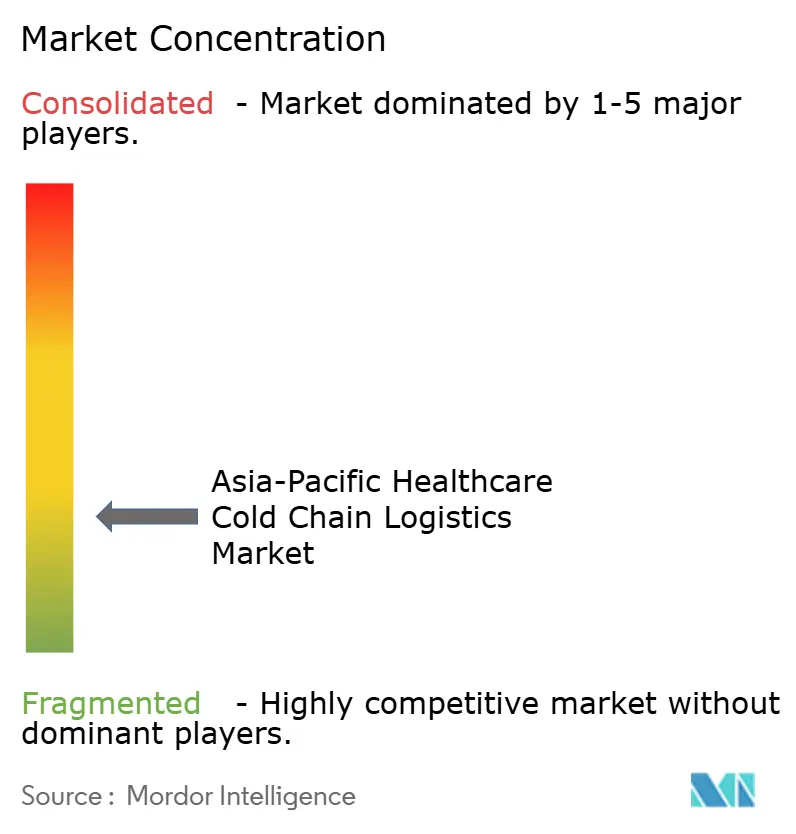
| Market Concentration | Low |
Major Players *Disclaimer: Major Players sorted in no particular order Image © Mordor Intelligence. Reuse requires attribution under CC BY 4.0. | |
Asia-Pacific Healthcare Cold Chain Logistics Market Analysis by Mordor Intelligence
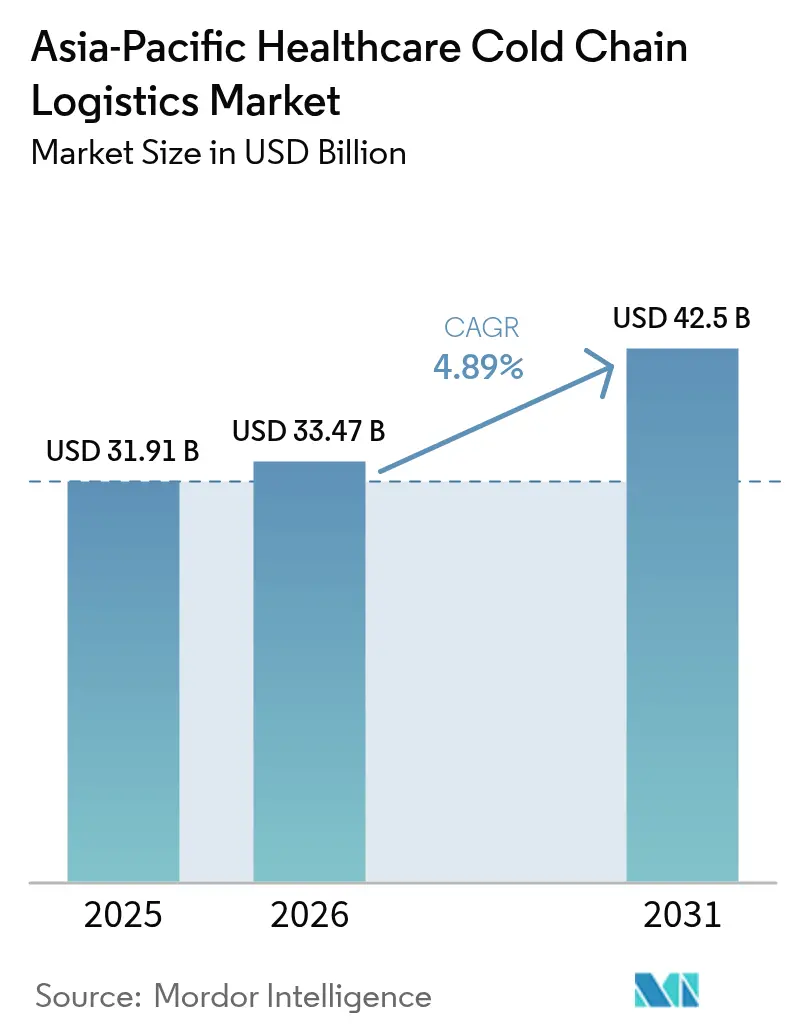
The Asia-Pacific Healthcare Cold Chain Logistics Market size is expected to grow from USD 31.91 billion in 2025 to USD 33.47 billion in 2026 and is forecast to reach USD 42.5 billion by 2031 at 4.89% CAGR over 2026-2031.
Demand gains stem from biologics expansion, post-pandemic vaccine roll-outs, and government-backed supply-chain resilience programs. Rising therapeutic complexity in cell and gene therapy, the ongoing GLP-1 drug boom, and stricter Good Distribution Practice (GDP) rules are set to keep capacity tight and pricing firm across transport modes. Stakeholders also capitalize on AI-enabled lane-risk modeling that trims temperature excursions, while sovereign health-security agendas accelerate infrastructure spending in China, India, and Southeast Asia.
Key Report Takeaways
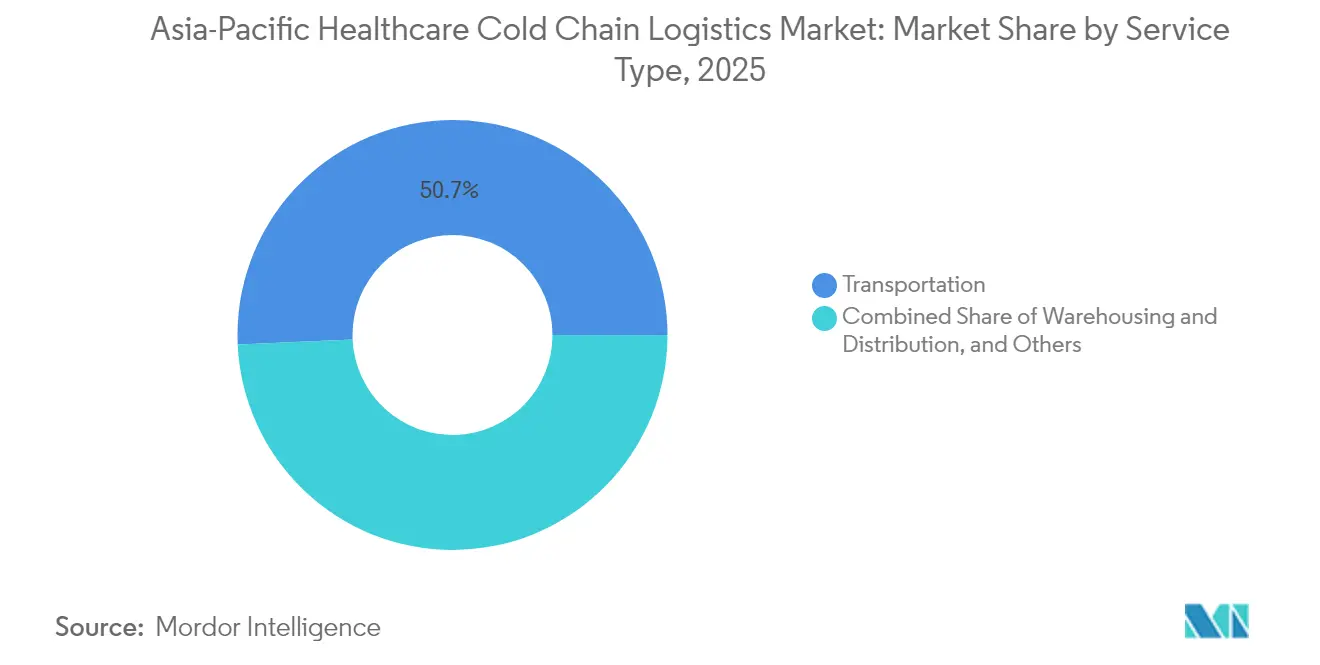
- By services, transportation held 50.70% of Asia Pacific healthcare cold chain logistics market share in 2025, while value-added services are projected to post the fastest 4.95% CAGR to 2031.
- By temperature type, chilled storage controlled 40.60% of Asia Pacific healthcare cold chain logistics market size in 2025; deep-frozen and ultra-low solutions are forecast to expand at a 4.12% CAGR through 2031.
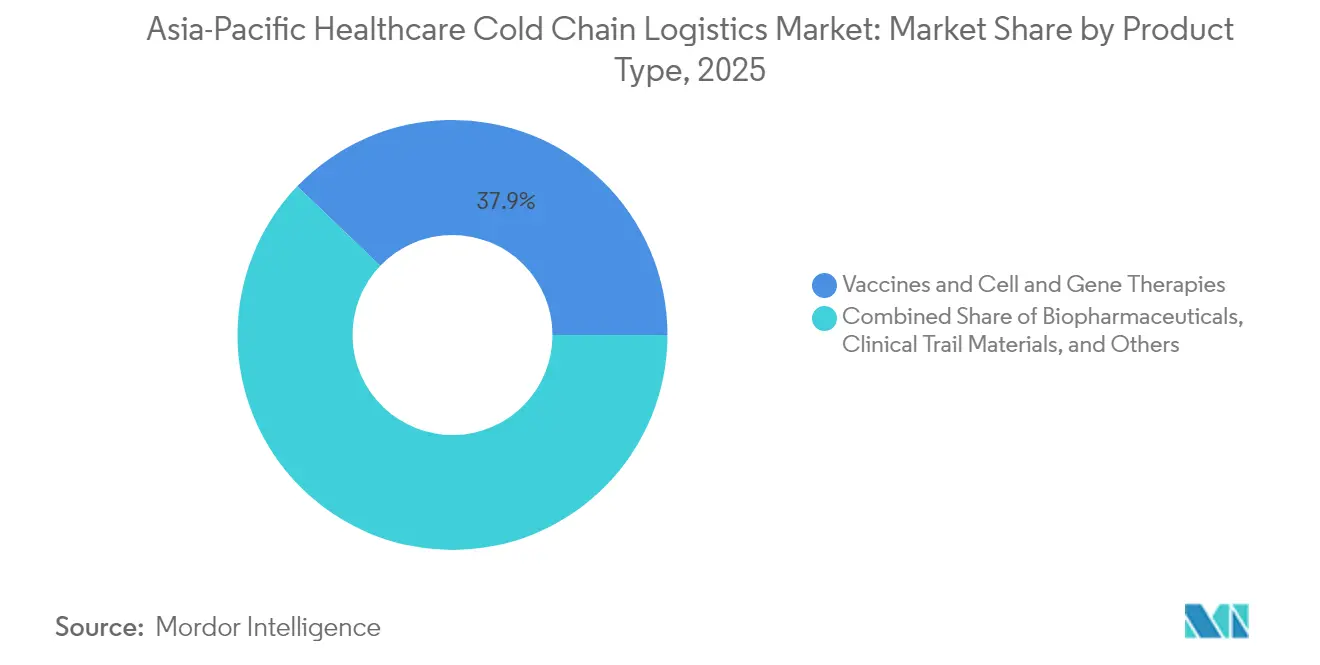
- By product, vaccines plus cell & gene therapies combined for 37.85% of Asia Pacific healthcare cold chain logistics market share in 2025, with cell & gene therapies alone advancing at a 5.62% CAGR between 2026-2031.
- By geography, China accounted for a dominant 38.70% share in 2025, whereas India is slated for the swiftest 5.99% CAGR to 2031.
Note: Market size and forecast figures in this report are generated using Mordor Intelligence’s proprietary estimation framework, updated with the latest available data and insights as of 2026.
Worldwide, activity is shaped by contributions from multiple regions, with Asia representing one of the more structurally developed among them. The global report on healthcare cold chain logistics market by Mordor Intelligence reflects how these regional layers combine into a single system.
Market Trends and Insights
Drivers Impact Analysis of Asia-Pacific Healthcare Cold Chain Logistics Market*
| Driver | % Impact on CAGR Forecast | Geographic Relevance | Impact Timeline |
|---|---|---|---|
| Strong vaccine immunization programs post-COVID-19 | +0.8% | Global APAC, with concentration in India, Indonesia, Philippines | Medium term (2-4 years) |
| Accelerated biologics & cell-/gene-therapy pipelines | +0.9% | Japan, South Korea, Singapore, Australia core markets | Long term (≥ 4 years) |
| Government mandates on GDP-compliant distribution | +0.6% | China, India, Thailand regulatory-driven adoption | Medium term (2-4 years) |
| Expansion of GDP-certified pharma hubs | +0.5% | Singapore, Malaysia, Vietnam emerging hubs | Long term (≥ 4 years) |
| AI-enabled lane-risk modelling for shipment integrity | +0.4% | China, Japan, South Korea technology leaders | Short term (≤ 2 years) |
| Rapid GLP-1 drug boom needing 2-8 °C logistics | +0.7% | Global APAC with premium markets first adoption | Medium term (2-4 years) |
| Source: Mordor Intelligence | |||
Strong Vaccine-Immunization Programs Post-COVID-19
Cold chain infrastructure built for pandemic vaccines is now redeployed for routine pharmaceuticals across the Asia Pacific healthcare cold chain logistics market. India targets USD 17 billion in vaccine revenue for 2025 amid bioeconomy expansion, supported by new vial-handling hubs, GDP-certified cross-docks, and large-scale fill-finish lines[1]. The Philippines’ Clark Freeport zone attracts more than USD 1 billion in logistics capital, providing dual-use freezer capacity for routine immunization drives and future outbreak response[2]. DHL’s global EUR 2 billion (USD 2.20 billion) healthcare program allocates 25% to Asia Pacific, underscoring corporate confidence in sustained biologics flow. These investments ensure predictive temperature monitoring, lane qualification, and redundancy, anchoring service reliability for vaccines, insulin, and specialty injectables. Governments, meanwhile, lock in long-term procurement contracts that stabilize volume demand and drive network density.
Accelerated Biologics & Cell/Gene-Therapy Pipelines
Japan cleared 43 new drugs in 2025, several being gene therapies that require below--20 °C storage, spurring specialized capacity additions at port-adjacent warehouses and express courier depots. South Korea’s KoBIA supports export-ready biologics clusters near Incheon, pairing GMP manufacturing with GDP-compliant distribution corridors. Singapore’s clinical-trial ecosystem relies on same-day “white-glove” transport for autologous CAR-T cells, pushing providers to integrate cryogenic dewars, data loggers, and chain-of-identity blockchain tags. Australia leverages its proximity to Asian pharma hubs, rerouting long-haul biologics freight through Sydney and Melbourne for time-critical last-mile dispatch. Collectively, these shifts elevate demand for ultra-low pallets, passive PCM packaging, and validated dry-shipper fleets, reinforcing the Asia Pacific healthcare cold chain logistics market.
Government Mandates on GDP-Compliant Distribution
Regulators tighten oversight to curb temperature excursions and counterfeit risk, reshaping competitive dynamics in the Asia Pacific healthcare cold chain logistics market. China’s revised GDP code compels fleet retrofits, warehouse mapping, and digital audit trails, prompting consolidation among smaller 3PLs. Thailand harmonizes with PIC/S standards, catalyzing multinational investment in Bangkok-based pharma hubs. India ties export incentives to documented GDP compliance, nudging logistics partners toward ISO 23412 certification and real-time IoT telemetry. These mandates raise entry barriers but offer margin upside to incumbents able to absorb capital outlays for multi-temperature vehicles, redundant power, and 24/7 control-tower visibility.
AI-Enabled Lane-Risk Modeling for Shipment Integrity
Platform providers harness AI to predict route-specific hazards such as customs delays, tarmac dwell, and micro-climate shifts, reducing spoilage and insurance claims. Chinese integrators deploy digital twins of cross-border lanes, while Japanese forwarders install machine-learning engines in warehouse management systems to refine pick-cycle timing. South Korea outfits reefer trucks with edge-computing gateways that flag compressor anomalies before failure, enabling pre-emptive maintenance. Early adopters report temperature excursion cuts of 15-20%, translating into higher service-level attainment and preference among biotech shippers. The technology trend narrows performance gaps and sets new baselines for evaluations inside tender processes across the Asia Pacific healthcare cold chain logistics market.
Restraints Impact Analysis of Asia-Pacific Healthcare Cold Chain Logistics Market*
| Restraint | % Impact on CAGR Forecast | Geographic Relevance | Impact Timeline |
|---|---|---|---|
| Shortage of GDP-qualified reefer drivers in ASEAN | -0.4% | Indonesia, Thailand, Philippines, Vietnam | Short term (≤ 2 years) |
| High inter-island freight costs in archipelagic nations | -0.3% | Indonesia, Philippines primary impact | Medium term (2-4 years) |
| China's fluorocarbon-phase-out raising CAPEX | -0.3% | China domestic, spillover to regional suppliers | Long term (≥ 4 years) |
| Vial-level e-pedigree compliance inflating costs | -0.2% | Global APAC with premium markets leading adoption | Medium term (2-4 years) |
| Source: Mordor Intelligence | |||
Shortage of GDP-Qualified Reefer Drivers in ASEAN
Indonesia and Thailand expand paved road length yet struggle to staff trailers with GDP-trained personnel, creating a skills gap that constrains capacity during peak vaccine seasons. Certification courses demand mastery of SOPs for temperature mapping, data-logger handling, and deviation reporting, lengthening onboarding cycles compared to dry-van trucking. The Philippine market mirrors the challenge even as Clark Freeport adds modern docks; higher wages lure drivers into e-commerce, leaving fewer for pharma. Logistics firms therefore invest in accelerated training, telematics-enabled driver coaching, and retention bonuses, but near-term tightness persists, shaving throughput and damping the Asia Pacific healthcare cold chain logistics market’s potential.
High Inter-Island Freight Costs in Archipelagic Nations
Moving a 2-8 °C pallet from Jakarta to Manado can be 40% costlier than a similar mainland lane because of feeder vessel hand-offs, scarce reefer plugs, and limited back-haul. The Philippines faces analogous hurdles, with multi-leg barge-truck chains raising landed costs for temperature-controlled medicines. Governments pledge port upgrades and cabotage reforms, yet timelines stretch, leaving pharmaceutical importers reliant on premium airfreight. Elevated logistics spend squeezes smaller generics firms and complicates public-sector tender budgets, muting growth in peripheral provinces of the Asia Pacific healthcare cold chain logistics market.
*Our forecasts treat driver/restraint impacts as directional, not additive. The impact forecasts reflect baseline growth, mix effects, and variable interactions.
Asia-Pacific Healthcare Cold Chain Logistics Market Segment Analysis
By Services:
Transportation Dominates Amid Value-Added GrowthTransportation commanded 50.70% of Asia Pacific healthcare cold chain logistics market share in 2025, reflecting the indispensability of road, air, sea, and rail movement across 35,000 kilometers of maritime and land borders. Airfreight retains primacy for time-critical biologics, with Korean Air alone holding 6% of global temperature-sensitive air cargo lift. Sea logistics cater to bulk vaccines and IV solutions moving from Chinese or Indian factories to ASEAN buyers, while China’s burgeoning high-speed rail corridors support 24-hour domestic pharma transits. Warehousing and distribution underpin long-haul nodes, yet value-added services temperature-validated packaging, regulatory paperwork, and control-tower analytics are slated to outpace at a 4.95% CAGR, capturing share as shippers outsource non-core compliance tasks.
Provider differentiation hinges on multimodal orchestration, GDP op-ex discipline, and tech-enabled visibility. UPS expanded cold-chain capacity by 22,000 square meters across Singapore and Australia in 2024, embedding on-site labs for pre-conditioned parcel packs. DHL integrates lane-risk dashboards into its mySupplyChain portal, delivering predictive ETA and excursion alerts. Start-ups supply SaaS overlays that consolidate passive and active tag data, enabling real-time interventions a service tier increasingly demanded across the Asia Pacific healthcare cold chain logistics market.

By Temperature Type:
Chilled Storage Leads Ultra-Low ExpansionChilled solutions between 0 °C and 5 °C represented 40.60% of Asia Pacific healthcare cold chain logistics market size in 2025, driven by the dominance of vaccines, insulin, and GLP-1 agonists that require narrow 2-8 °C ranges. Frozen products at –18 °C to 0 °C continue serving classical biologics, yet the ultra-low sub-segment below –20 °C registers a brisk 4.12% CAGR through 2031, propelled by cell and gene therapy clinical trial volumes. Cryoport’s dry-shipper technology, which maintains –150 °C for 10 days, is in wide adoption among CAR-T sponsors shipping patient-specific doses.
Facility upgrades focus on redundant power, low-GWP refrigerants, and modular blast freezers to handle batch variability. China’s refrigerant phase-out inflates CAPEX, yet accelerates adoption of R32 and CO2 trans-critical systems that offer lower energy intensity, aligning with ESG goals. Across the Asia Pacific healthcare cold chain logistics market, providers balance CAPEX efficiency with stringent mapping, pushing partnerships with OEMs for smart compressor analytics and rapid defrost cycles that preserve shelf life integrity.
By Product:
Vaccines Lead While Cell & Gene Therapies SurgeVaccines and cell-plus-gene therapies together held 37.85% of Asia Pacific healthcare cold chain logistics market share in 2025, reflecting residual immunization runs and the rise of personalized medicine. Within that, cell & gene therapies alone are expected to log a leading 5.62% CAGR, necessitating validated cryo-packaging, GPS sensors, and chain-of-identity protocols. Biopharmaceuticals, including monoclonal antibodies and biosimilars, retain the largest absolute revenue slice, sustained by patent-cliff dynamics that trigger biosimilar launches through 2030.
Clinical trial materials grow on the back of 2,500 ongoing Phase III studies in Asia-Pacific sites, each demanding comparator drugs, placebo returns, and depot management. Diagnostic reagents leverage chilled networks expanded during COVID-19, while blood products require compliance with hemovigilance rules, driving specialized insulated totes. Collectively, product diversification increases lane complexity, fueling demand for integrated 4PL orchestration in the Asia Pacific healthcare cold chain logistics market.
By End User:
Hospitals Drive Growth, Biotech AcceleratesHospitals and retail pharmacies together accounted for 28.60% of Asia Pacific healthcare cold chain logistics market size in 2025 as the primary dispensing points for temperature-sensitive drugs. The group’s cold storage footprints expand as outpatient infusions spread beyond tertiary centers into suburban clinics. Biotech and biosimilar manufacturers, however, are projected to register the fastest 5.03% CAGR on surging outsourcing needs for time-critical export lanes and return-logistics of clinical samples. India now hosts more than 800 biotech firms requiring validated packaging and customs-bonded freezers along the Delhi-Mumbai corridors.
Distributors and wholesalers consolidate to capture volume across fragmented ASEAN channels, adopting RFID-based FIFO picking for GDP compliance. Pharmaceutical manufacturers maintain dedicated captive fleets for high-margin blockbuster biologics, yet even they turn to 3PL partners for end-market last-mile coverage in remote islands. This multiplicity of end-user profiles intensifies service customization in the Asia Pacific healthcare cold chain logistics market.
Geography Analysis
China Healthcare Cold Chain Logistics Market
China owned 38.70% of Asia Pacific healthcare cold chain logistics market share in 2025, reflecting unmatched manufacturing scale and GDP-rule enforcement that fosters consolidation among 15,000 licensed pharma carriers. Domestic providers adopt AI-powered route optimization and AGV-enabled warehouses to offset rising labor costs, while R32 refrigerant prices that more than doubled in 2025 incentivize greener cascade systems. Mandatory electronic pedigree serialization extends traceability, setting a benchmark later mirrored by ASEAN states.
India Healthcare Cold Chain Logistics Market
India delivers the region’s fastest 5.99% CAGR through 2031, supported by a bioeconomy projected to reach USD 300 billion, of which vaccines alone aim for USD 17 billion in 2025 revenue. Production-linked incentives channel capital into new fill-finish lines and associated GDP warehouses near Hyderabad, Ahmedabad, and Pune. The U.S. Biosecure Act redirects biologics outsourcing from Chinese entities toward Indian CDMOs, requiring export-grade cryo-logistics corridors with redundant last-mile monitoring.
APAC Healthcare Cold Chain Logistics Market
Japan, South Korea, and Australia collectively command a quarter of Asia Pacific healthcare cold chain logistics market size. Japan’s approval of 43 novel drugs in 2025 includes four gene therapies, catalyzing cryogenic build-outs at Narita and Kansai airports. South Korea’s KoBIA maps a national “Bio Cold Chain Belt” linking Seoul, Incheon, and Busan via multi-temperature railcars, readying for CAR-T scale-out. Australia exploits time-zone overlap between U.S. West Coast and Asia supply chains, positioning Sydney as a trans-shipment hub with 24/7 pharma-devoted airside coolers.
Southeast Asian markets add vibrancy yet complexity. Singapore’s Changi pharma corridors achieve CEIV Pharma recertification and attract regional cross-docks, while Vietnam ramps up GDP adoption to underpin vaccine import programs. Archipelagic constraints in Indonesia and the Philippines elevate per-unit cold chain costs by up to 40%, steering logistics strategies toward regional consolidation hubs in Jakarta and Calamba. Government port and road investments gradually narrow the gap but will only partly alleviate cost headwinds through 2030 across the Asia Pacific healthcare cold chain logistics market.
Mordor Intelligence provides coverage of the healthcare cold chain logistics market across other key regional markets, including Europe, each with their regulatory frameworks and demand patterns.
Regulatory Landscape
Regulation across the Asia-Pacific healthcare cold chain logistics market is tightening around GDP/GSP compliance, with a parallel push toward digital traceability and equipment performance qualification. In China, national standards implemented in 2025, including GB/T 34399-2025 (performance qualification for temperature-control facilities) and GB/T 46204-2025 (cold chain traceability management), reinforce audit-ready validation for cold rooms, vehicles, and monitoring records, which is lifting expectations for carriers and warehouse operators.
In ASEAN, regulatory alignment continues under ASEAN frameworks such as the ASEAN Pharmaceutical Regulatory Policy (APRP) and related technical requirements, although enforcement remains country-specific. Vietnam issued Circular 11/2025/TT-BYT to amend GSP/GDP requirements for vaccine and biological storage, while Malaysia's NPRA updated its Guidance Document for Biological Lot Release in April 2025, requiring electronic data logging monitors for international cold-chain shipping cartons or pallets. This is accelerating adoption of digital temperature evidence across cross-border shipments.
Value Chain Analysis
The value chain covers biopharma and vaccine manufacturing, qualified packaging and conditioning, GDP-compliant primary transport (road, air, sea, rail), airport- and port-adjacent cold storage, and last-mile delivery into hospitals, pharmacies, and clinical sites. Upstream inputs include validated shippers, phase-change materials, data loggers/IoT telemetry, and specialized ultra-low solutions for advanced therapies. Downstream services increasingly bundle documentation, lot-level traceability, and deviation management as shippers outsource compliance tasks.
Gateways and certified nodes are becoming the organizing layer for the region's networks. Kuala Lumpur International Airport added a dual-certified cold-chain facility (IATA CEIV Pharma and Air GxP) in August 2025, while Singapore and Australia continue to attract GDP-grade capacity additions. Government programs are also shaping flows through localized resilience incentives: in December 2025, Taiwan's Executive Yuan approved a four-year NT$24 billion pharmaceutical supply chain project that includes cold chain infrastructure upgrades. Along the chain, China's GB/T 46204-2025 traceability requirements are pushing providers and shippers toward standardized digital data capture and retrieval, increasing the need for systems integration between manufacturers, 3PLs, and distributors.
Competitive Landscape
Competition remains moderately fragmented as global giants vie with agile regional specialists. DHL, UPS, and FedEx wield vast networks, but local champions such as SF Express, Yusen, and Kerry Logistics leverage domestic customs fluency and short-notice fleet redeployment. DHL earmarked EUR 2 billion (USD 2.20 billion) for healthcare globally by 2030, dedicating a quarter to Asia Pacific for new GDP hubs, multi-modal connectors, and embedded control towers. UPS complements its Singapore and Sydney expansions with Hyderabad’s cross-dock that offers +2 °C to +8 °C and +15 °C to +25 °C zones in one roof, improving lane density toward South Asia[3].
Acquisitions fast-track vertical integration: UPS bought Andlauer Healthcare for USD 1.6 billion, securing Canadian vaccine expertise now imported into Asia route designs; DHL absorbed CRYOPDP for USD 2.2 billion to access ultra-low know-how. Meanwhile, tech-centric entrants deploy blockchain-time-stamping and drone-assisted last mile, aiming to disrupt high-margin specialty lanes. Yet GDP compliance costs, rising refrigerant CAPEX, and trained-driver scarcity protect scale incumbents and deter pure digital challengers.
Strategic thrusts revolve around ESG compliance, automation, and risk management. Providers retrofit fleets with solar-assisted reefer units, install RFID beacons for 100% pallet visibility, and hedge against fuel volatility through optimized multimodal meshes. Regional white-space remains in archipelagic navigation, AI-based preventive maintenance, and integrated cold-chain-financial insurance offerings. Such innovation pipelines ensure healthy rivalry but no single player exceeds 15% regional share, keeping the Asia Pacific healthcare cold chain logistics market competitively balanced.
Asia-Pacific Healthcare Cold Chain Logistics Industry Leaders
-
DHL Group
-
Yusen Logistics
-
SF Express
-
JWD Group
-
Nippon Express
- *Disclaimer: Major Players sorted in no particular order
Asia-Pacific Healthcare Cold Chain Logistics Market Companies Covered in this Report
- DHL Group
- Yusen Logistics
- SF Express
- JWD Group
- Nippon Express
- Kerry Logistics
- Nichirei Logistics Group
- Kintetsu World Express
- YCH Group
- Sinotrans
- Sagawa Express Co., Ltd.
- Itochu Logistics Corp.
- JD Logistics
- Kuehne + Nagel
- UPS
- CEVA Logistics
- DSV
- Yamato Holdings Co., Ltd.
- Mitsubishi Logistics
- F2 Logistics Philippines
Read Analysis of Asia-Pacific Healthcare Cold Chain Logistics Companies
Market Opportunities and Future Outlook
White space is concentrating in two areas: national medicine-security programs that centralize oversight and require auditable cold-chain performance, and multi-temperature hubs that can handle biologics alongside ultra-low temperature products. In the Philippines, the Department of Health proposed creating a Supply Chain Management Bureau in March 2026 to centralize logistics, forecasting, and cold chain oversight, which increases demand for operators that can deliver control-tower visibility and compliant distribution across dispersed geographies. Indonesia's enactment of Permenkes 5/2026 in May 2026, introducing buffer stock requirements and early warning reporting for potential shortages, raises the value of inventory-aware warehousing, serialization-ready traceability, and time-definite replenishment lanes.
Network investment and modal redesign create near-term lanes for service differentiation. In India, Kuehne+Nagel opened a temperature-controlled airfreight cross-dock in Hyderabad in May 2026, and A.P. Moller - Maersk and CONCOR launched a weekly pharmaceutical reefer rail corridor from Hyderabad to Jawaharlal Nehru Port in June 2026, supporting more reliable export routing into gateway ports. Capacity additions for ultra-low handling are also emerging, including DHL Supply Chain Korea completing a Health Logistics Hub in Icheon in June 2026 with cold-chain storage and -80 C freezers, which aligns with requirements for advanced therapies and higher-value specialty pharmaceuticals.
Recent Industry Developments in Asia-Pacific Healthcare Cold Chain Logistics Market
- February 2026: DHL Health Logistics expanded capabilities in Singapore with a new pharmaceutical hub near Tuas Biomedical Park, supported by an announced EUR 10 million investment. The site strengthens GDP-grade storage and handling capacity close to key biomedical manufacturing clusters, tightening DHL's control over temperature integrity and service levels for high-value healthcare flows across Southeast Asia.
- December 2025: Yusen Logistics Group completed the acquisition of Walden Health, including Movianto and Eurotranspharma, expanding its global healthcare logistics platform. The deal broadens Yusen's specialized capabilities and network depth, improving its ability to offer standardized, compliant solutions to multinational healthcare shippers operating across Asia-Pacific lanes.
- June 2024: SF Express Hong Kong launched a one-stop cold chain logistics service covering airport pickup, multi-temperature storage, and temperature-controlled delivery. This expanded B2B cold chain coverage in a major regional air cargo gateway, supporting tighter handling requirements for pharmaceuticals and other temperature-sensitive shipments.
Asia-Pacific Healthcare Cold Chain Logistics Market Report Scope and Research Methodology
Market Definition and Coverage
This market covers paid logistics services used to store, handle, and move temperature-sensitive healthcare products across Asia-Pacific under controlled conditions, from origin pickup through warehousing and last-mile delivery. Revenues are counted for cold storage, temperature-controlled transportation, and supporting service work tied to compliance.
Scope exclusions: We exclude the manufacturing value of drugs and devices, along with non-healthcare cold chain activities such as food and general perishables.
Segments Covered in This Report
- By Services
- Transportation
- Road
- Air
- Sea
- Rail
- Warehousing and Distribution
- Value-added Services and Others
- Transportation
- By Temperature Type
- Chilled (0-5 °C)
- Frozen (-18-0 °C)
- Ambient
- Deep-Frozen / Ultra-Low (less than-20 °C)
- By Product
- Biopharmaceuticals
- Vaccines and Cell and Gene Therapies
- Clinical Trial Materials
- Diagnostic and Laboratory Products
- Blood and Blood Products
- Others
- By End User
- Pharmaceutical Manufacturers
- Biotech and Biosimilar Manufacturers
- Hospitals and Retail Pharmacies
- Healthcare Distributors and Wholesalers
- Others
- By Country (Value)
- China
- Japan
- India
- South Korea
- Australia
- Thailand
- Indonesia
- Singapore
- Vietnam
- Rest of ASEAN
Data Sources, Market Sizing, and Validation
Desk Research
Desk work started with mapping the healthcare cold chain flow in Asia-Pacific and listing where value is created, then converting those points into measurable drivers. We used public sources such as national health ministries, customs and trade statistics portals, the World Health Organization, the World Bank, and UN Comtrade to anchor country-level demand signals and trade movement patterns for temperature-sensitive products.
To translate demand into service revenue, we also reviewed company annual reports, investor presentations, and publications from logistics and healthcare associations, which help clarify capacity additions, network footprints, and service mix shifts. Patent databases and paid company financials and intelligence subscriptions were used selectively to cross-check technology adoption and segment exposure where disclosures were limited. These desk sources are not exhaustive, and other documents were also used for data collection, validation, and research clarification.
Primary Interviews and Surveys
Primary interviews and surveys were used to confirm how service pricing is set, how temperature bands are billed, and where utilization or compliance costs are rising faster than volumes. We spoke with cold storage operators, specialized transport providers, freight forwarders with pharma handling, and shippers such as pharmaceutical and biopharma supply chain teams across major Asia-Pacific lanes and hub countries, then used that feedback to close data gaps and test assumptions.
Distribution of primary research fieldwork respondents
| Company type | Respondent position |
|---|---|
| Top tier: 28% | CXOs: 12% |
| Mid tier: 55% | Functional/Unit leaders: 28% |
| Smaller Players: 17% | Managers: 60% |
Market-Sizing & Forecasting
For sizing, we mainly used the top-down and bottom-up combination, where healthcare trade and distribution activity is reconstructed into a cold chain addressable pool by country, then filtered by the share that requires controlled temperature handling. Those totals were corroborated with selective bottom-up checks, such as sample price-per-kg or price-per-pallet ranges for storage and transport, multiplied by estimated throughput, and then adjusted when the implied utilization looked unrealistic.
Inputs that mattered most included shipment mix across refrigerated and frozen ranges, vaccine and biologics demand trends, cold storage capacity additions at key hubs, compliance-driven handling requirements (including validated packaging and monitoring), and lane-level freight rate direction for temperature-controlled moves. Forecasts were produced using scenario analysis supported by expert views on capacity ramp-ups, ASP progression, and policy or funding changes that affect healthcare distribution. Where country disclosures were thin, we filled gaps using proxy ratios from similar markets and then rechecked the results against primary feedback before locking the final shares.
Data Validation & Update Cycle
Validation was done through stepwise checks where we compared model outputs against independent signals, such as capacity announcements, trade momentum, and observed pricing movement for controlled services. If a country result moved outside a plausible range, it was sent back for assumption review, and respondents were re-contacted when a single driver was influencing the outcome too heavily.
Before sign-off, an analyst review is completed to ensure that definitions, conversions, and country rollups are consistent, and that the final totals reconcile across service and end-use cuts. Reports are refreshed annually, and interim updates are made when material events occur, such as large capacity additions, regulatory changes, or major disruptions. Right before delivery, we run a last pass so clients receive the most current view available.
Mordor Intelligence's Asia Pacific Healthcare Cold Chain Logistics Market Size Compared Against Other Published Estimates
Published market sizes for Asia-Pacific healthcare cold chain logistics can differ even when the topic label looks identical, because the boundaries of what counts as cold chain services are not always aligned. Differences often come from which temperature-controlled services are included, how pricing is converted into USD, and how the base year is refreshed when freight rates and energy costs move quickly.
A refresh-led gap shows up when currency timing and ASP updates are handled differently across studies, especially for markets that bill in local currency and reprice contracts over the year. In this work, exchange-rate timing is kept consistent and pricing is revalidated against temperature-specific service quotes and utilization checks before the rollup is finalized, which is why the 2025 value differs in Mordor Intelligence.
Benchmark comparison
| Source | Market Size | Gaps in Research Methodology |
|---|---|---|
| Mordor Intelligence | USD 31.91 B (2025) | |
| Trade Journal A | USD 14.45 B (2025) | This estimate appears to apply a narrower service boundary that emphasizes core refrigerated transport and storage, and it may undercount higher-value packaging, labeling, and monitoring services that raise revenue per shipment. |
| Regional Consultancy B | USD 18.70 B (2026) | The number is likely based on a different base year and a different price escalation path, and it can also reflect a tighter country list within Asia-Pacific or a different currency conversion window that shifts the USD total. |
Looking across the table, the spread is mainly explained by what is counted as paid cold chain service revenue and how quickly pricing and exchange-rate assumptions are refreshed. Our approach keeps the size traceable to clear demand and capacity signals, then validates it with practical pricing checks so the final total stays usable for planning.
Key Questions Answered in the Report
How large is the Asia Pacific healthcare cold chain logistics market in 2026?
The Asia Pacific healthcare cold chain logistics market size is USD 33.47 billion in 2026 and is projected to reach USD 42.5 billion by 2031.
What CAGR is expected for the sector through 2031?
The market is set to register a 4.89% CAGR between 2026 and 2031.
Which service segment has the greatest share across Asia Pacific?
Transportation services hold 50.70% of regional share owing to essential road, air, sea, and rail movements.
Why is India forecast to grow faster than other countries?
India’s biosimilar manufacturing expansion, vaccine export ambitions, and incentives under national schemes drive a 5.99% CAGR through 2031.
What temperature segment is expanding most rapidly?
Deep-frozen and ultra-low logistics below –20 °C are growing at 4.12% CAGR, propelled by cell and gene therapy pipelines.
Which product category is the most dynamic?
Cell & gene therapies post the highest 5.62% CAGR as personalized medicine adoption accelerates.