
Market Overview
| Study Period | 2020 - 2031 |
|---|---|
| Forecast Data Period | 2026 - 2031 |
| Base Year Market Size (2025) | USD 9.37 Billion |
| Market Size (2026) | USD 9.75 Billion |
| Market Size (2031) | USD 11.87 Billion |
| Growth Rate (2026 - 2031) | 4.02 % |
| Market Concentration | Low |
Major Players *Disclaimer: Major Players sorted in no particular order Image © Mordor Intelligence. Reuse requires attribution under CC BY 4.0. | |
United Kingdom Cold Chain Logistics Market Analysis by Mordor Intelligence
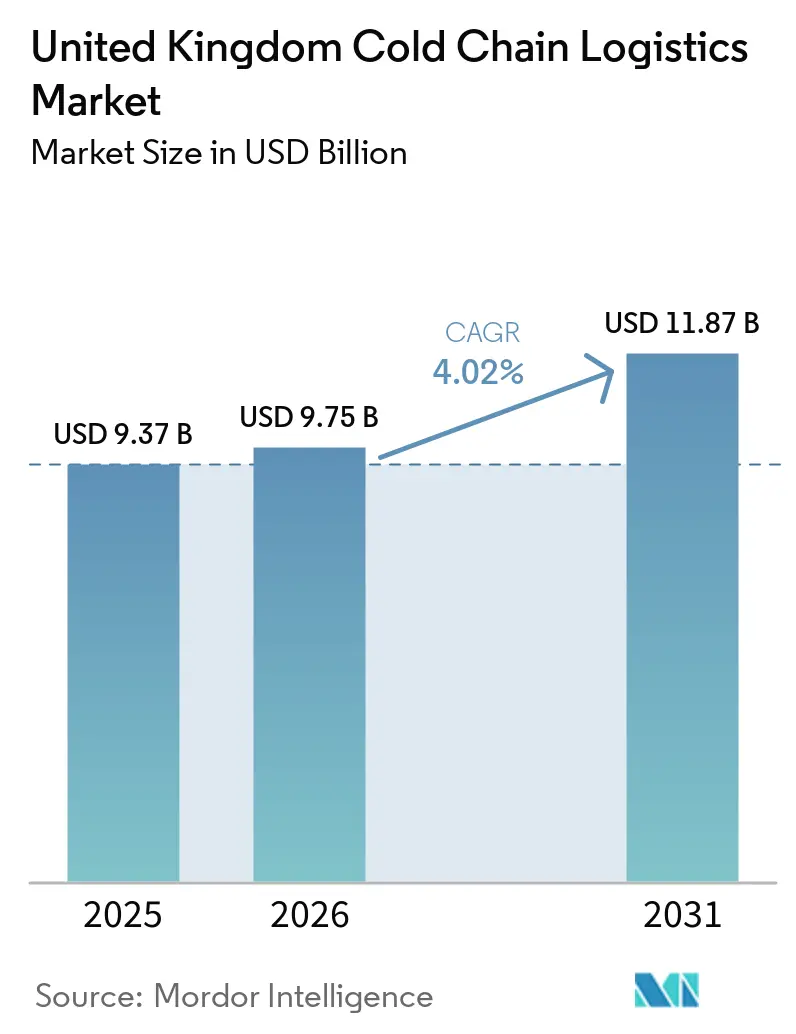
The United Kingdom Cold Chain Logistics Market size was valued at USD 9.37 billion in 2025 and estimated to grow from USD 9.75 billion in 2026 to reach USD 11.87 billion by 2031, at a CAGR of 4.02% during the forecast period (2026-2031).
The market size growth is driven by rising pharmaceutical exports, stricter food-safety laws, and a steady shift toward e-grocery purchases. Consolidation among third-party logistics providers adds scale efficiencies, while sustainability mandates accelerate investment in energy-efficient warehouses and low-emission fleets. Regulatory clarity after Brexit has lengthened customs lead-times but also compelled operators to upgrade traceability systems, reinforcing service demand in the United Kingdom cold chain logistics market. Technology adoption, especially IoT sensors and digital twins, enhances temperature compliance and cost visibility across the supply chain.
Key Report Takeaways
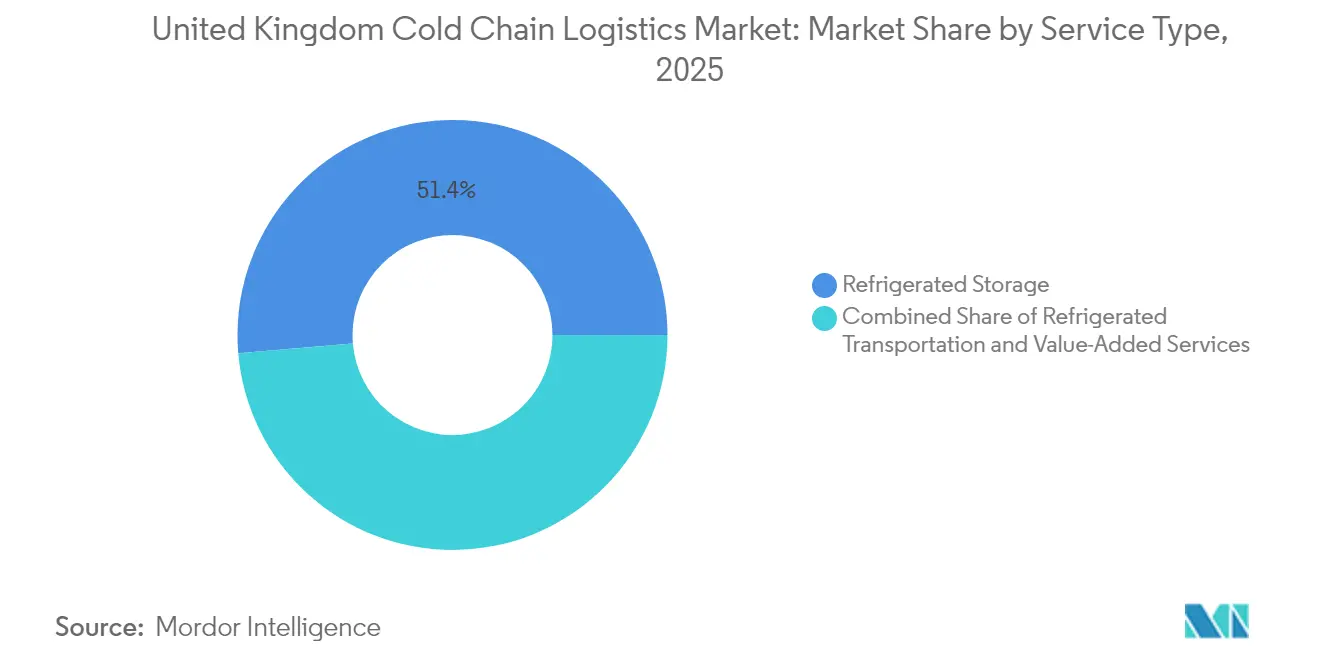
- By service type, refrigerated storage held 51.35% of United Kingdom cold chain logistics market share in 2025; value-added services are projected to expand at a 4.37% CAGR through 2031.
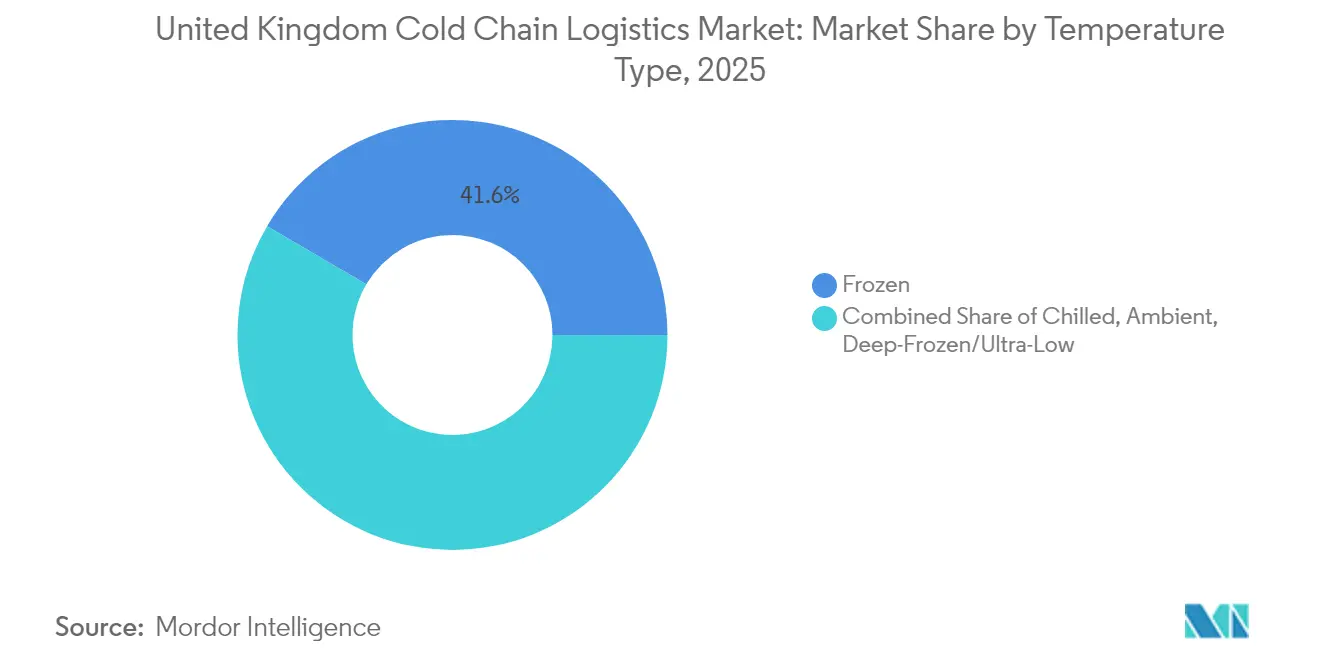
- By temperature type, frozen applications accounted for 41.55% share of the United Kingdom cold chain logistics market size in 2025, while chilled services are poised to grow at a 4.08% CAGR over 2026-2031.
- By application, meat and poultry controlled 23.65% of the United Kingdom cold chain logistics market share in 2025; pharmaceuticals and biologics exhibit the fastest trajectory at 5.26% CAGR to 2031.
- By geography, the South East corridor that includes Dover and London Gateway handled 47.60% of inbound temperature-sensitive import volumes in 2025 and is advancing at a 4.05% CAGR through 2031.
Note: Market size and forecast figures in this report are generated using Mordor Intelligence’s proprietary estimation framework, updated with the latest available data and insights as of 2026.
Market Trends and Insights
Drivers Impact Analysis of United Kingdom Cold Chain Logistics Market*
| Driver | % Impact on CAGR Forecast | Geographic Relevance | Impact Timeline |
|---|---|---|---|
| Surge in online grocery and meal-kit demand | +0.8% | London, Manchester, Birmingham, Edinburgh | Medium term (2-4 years) |
| Expansion of pharmaceutical and biotech exports | +0.7% | Clusters in Cambridge, Oxford, London | Long term (≥ 4 years) |
| Stricter UK food-safety and traceability rules | +0.5% | National, reinforced at border control posts | Short term (≤ 2 years) |
| Rising frozen and convenience-food consumption | +0.4% | Metropolitan regions nationwide | Medium term (2-4 years) |
| On-site renewable-energy microgrids cut OPEX | +0.3% | Industrial estates across the country | Long term (≥ 4 years) |
| Urban micro-fulfilment cold hubs | +0.6% | Major urban centers | Medium term (2-4 years) |
| Source: Mordor Intelligence | |||
Surge in online grocery and meal-kit demand
Post-pandemic purchasing habits have cemented double-digit e-grocery penetration. Large retailers widened distribution footprints, and dark-store conversions inside existing supermarkets reduced capital intensity while sustaining rapid fulfilment. Purpose-built hubs such as a 500,000 sq ft warehouse opened by a leading frozen specialist streamline last-mile chilled delivery[1]. Sensor-driven stock-monitoring platforms further improve accuracy and minimize spoilage, reinforcing service uptake within the United Kingdom cold chain logistics market. These developments are also strengthening demand for food logistics in UK.
Expansion of pharmaceutical and biotech exports
Government backing of GBP 1 billion (USD 1.3 billion) for life-sciences innovation and a sustained 22% rise in temperature-controlled airfreight volumes underscore the export opportunity. Advanced packaging that maintains 2-8 °C or ultra-low parameters for 36 hours without polystyrene positions the United Kingdom cold chain logistics market as a preferred hub for biologics distribution.
Stricter UK food-safety and traceability rules
The Border Target Operating Model mandates health certificates and pre-notifications for medium-risk imports, triggering investment in blockchain-ready traceability platforms able to process 207 transactions per second without data discrepancies. Enhanced compliance costs favor operators with digital capacity, fostering market consolidation.
Rising frozen and convenience-food consumption
Energy-efficient initiatives, including raising freezer settings from −18 °C to −15 °C, lower electricity use by 10-11% while keeping food safe. These savings amplify profitability for frozen storage providers and support steady demand in the United Kingdom cold chain logistics market.
Restraints Impact Analysis of United Kingdom Cold Chain Logistics Market*
| Restraint | % Impact on CAGR Forecast | Geographic Relevance | Impact Timeline |
|---|---|---|---|
| High CAPEX and energy costs of facilities | -0.9% | Nationwide, acute where power prices are highest | Short term (≤ 2 years) |
| HGV and reefer-driver labor shortage | -0.7% | Main logistics corridors and ports | Medium term (2-4 years) |
| Limited electric-vehicle charging infrastructure | -0.5% | Predominantly outside major urban areas | Medium term (2-4 years) |
| Supply bottlenecks for refrigeration equipment | -0.4% | National, most severe at new build projects | Short term (≤ 2 years) |
| Source: Mordor Intelligence | |||
High CAPEX and energy costs of facilities
Cold storage consumes 1.54 kWh per cubic foot annually and electricity accounts for 70% of a warehouse’s total energy bill. Reaching best-practice intensity of 10 kWh/m³/yr in a 100,000 m³ site requires automation and heat-recovery systems, inflating upfront budgets. Grid volatility during the renewable transition exposes operators to price spikes, yet liquid-air energy storage due online near Manchester in 2026 promises long-duration backup, reducing exposure to curtailments.
HGV and reefer-driver labor shortage
A deficit of 50,000 qualified drivers elevates transport wages and jeopardizes on-time deliveries. Median hourly pay climbed to GBP 15.00 (USD 19.5) in 2025 but demographics remain skewed; half the workforce is over 50 years old and female representation is 2%. Government grants of GBP 100 million (USD 130 million) fund roadside amenities and training, yet annual demand for 40,000 new licenses through 2029 keeps pressure on recruitment pipelines[2].
*Our forecasts treat driver/restraint impacts as directional, not additive. The impact forecasts reflect baseline growth, mix effects, and variable interactions.
United Kingdom Cold Chain Logistics Market Segment Analysis
By Service Type:
Storage Dominates, Services AccelerateRefrigerated storage generated 51.35% of the United Kingdom cold chain logistics market size in 2025, underpinning import-heavy food and pharmaceutical flows. Investments such as a GBP 2 million (USD 2.6 million) chilled consolidation center add capacity close to retail distribution hubs. Over 2026-2031, value-added services grow at 4.37% CAGR as shippers seek integrated customs clearance, repacking, and temperature validation in a single contract. Sensor networks and digital twins cut stock-holding days, lifting return on invested capital for service providers.
A wave of mergers, including a USD 719 million takeover of Wincanton, enables scale purchasing of renewable electricity and advanced warehouse automation. The resulting footprint allows firms to flex space between frozen and chilled slots, an advantage as the United Kingdom cold chain logistics market absorbs shifting consumer demand.

By Temperature Type:
Frozen Leads, Chilled AcceleratesFrozen logistics maintained 41.55% share of the United Kingdom cold chain logistics market in 2025, supported by stable protein imports and national frozen-food brands. Innovations such as variable-speed compressors and high-efficiency insulation reduce per-pallet energy draw, sustaining margins.
Chilled services register the quickest expansion at 4.08% CAGR, buoyed by fresh meal solutions and biologic medicines. Radiopharmaceutical exports that require deep-frozen holding spur niche demand for -70 °C capacity compliant with Good Distribution Practice. Recyclable fiber-based boxes that safeguard 2-8 °C payloads for 36 hours enhance sustainability credentials while minimizing landfill.
By Application:
Meat Dominates, Pharma SurgesMeat and poultry retained 23.65% of United Kingdom cold chain logistics market share in 2025 due to steady domestic consumption and EU sourcing rules. Customs documentation now involves advance veterinary certification, making real-time data platforms critical for just-in-time delivery.
Pharmaceuticals and biologics lead growth at 5.26% CAGR. A government-backed GMP cluster across Cambridge and Oxford elevates export volumes of cell-and-gene therapies that must remain at cryogenic temperatures. Airlines and freight forwarders partner on lane-specific monitoring tools that alert shippers when deviations exceed 0.5 °C, protecting high-value cargo.
Geography Analysis
The South East corridor, anchored by Dover, Felixstowe, and London Gateway, processed almost half of inbound temperature-sensitive EU goods in 2025 and is projected to log a 4.05% CAGR through 2031. New border control posts equipped with on-site refrigeration limit dwell-time increases to under 8 hours even as paperwork expands.
The Midlands leverage central positioning and motorway connectivity, allowing next-day coverage of 90% of UK postcodes. Automated campuses in Northampton and Leicester use renewable-powered microgrids to cut grid draw by 30% in peak summer. Scotland advances with seafood exports and whiskey maturation requiring bonded cold rooms; investments in port chilled tunnels at Grangemouth shorten clearance for live shellfish.
Wales and Northern Ireland remain smaller but strategic. The Windsor Framework permits qualifying goods to move from Northern Ireland to Great Britain without extra animal-health declarations, sustaining cold-store throughput. Local EV Infrastructure Fund support of GBP 381 million (USD 495.3 million) prioritizes high-capacity chargers at Cardiff, Swansea, and Belfast to prepare for mandatory zero-emission heavy vehicles by 2035.
Regulatory Landscape
The United Kingdom cold chain operates under national food hygiene rules enforced by bodies such as the Food Standards Agency (FSA). Under the Food Safety and Hygiene (England) Regulations 2013, food that can support pathogen growth must generally be kept at or below 8 C, which shapes warehouse setpoints, transport SOPs, and the temperature monitoring requirements used in chilled distribution.
For cross-border movements, the ATP Agreement governs the international carriage of perishable foodstuffs in road vehicles and requires appropriate insulated equipment and certificates of compliance, affecting fleet renewal and inspection cadence. On the import side, the Official Controls (Import of High-Risk Food and Feed of Non-Animal Origin) (Amendment) Regulations 2025 came into force on January 1, 2026, updating controls for specified high-risk consignments and reinforcing the need for robust documentation, pre-notification discipline, and compliant handling at border and inland facilities.
Value Chain Analysis
The value chain starts with producers and brand owners, including food processors, meat and seafood suppliers, and pharmaceutical manufacturers, which specify temperature bands and validation requirements. Packaging and pre-cool or blast-freeze steps follow, and the flow then moves through refrigerated transport operators, cold store owners (public and private), freight forwarders and customs intermediaries, plus port and airport handlers. Throughput is concentrated around key gateways and inland consolidation nodes connected to supermarket and wholesaler DC networks.
Border processes and compliance systems sit midstream, where documentary checks and official controls affect dwell times and the mix of services purchased, including customs support, relabeling, temperature verification, and quarantine handling when required. Downstream, retailers, foodservice wholesalers, meal-kit and e-grocery operators, and hospitals and pharmacies draw inventory into multi-temperature distribution, with last-mile execution increasingly supported by tightly scheduled trunking into urban micro-fulfilment cold hubs. Across the chain, energy and grid connectivity have become structural constraints for cold stores, and the availability of qualified HGV and reefer drivers is pushing operators toward automation, higher-bay density, and tighter telematics and temperature-logging integration.
Competitive Landscape
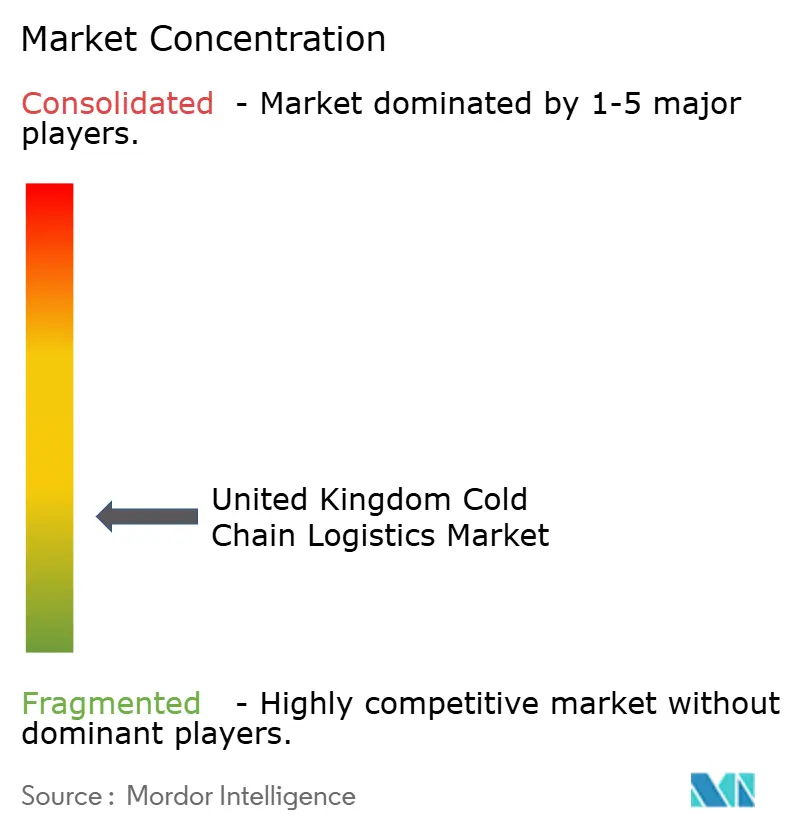
The market remains moderately fragmented, yet recent M&A signals accelerating consolidation. DSV closed a EUR 14.3 billion (USD 15.78 billion) purchase of DB Schenker, adding capacity in pharmaceuticals and life-science handling. CMA CGM’s logistics arm acquired Wincanton for USD 719 million, securing access to 8 million sq ft of chilled warehousing.
Lineage Logistics and Americold expand via automation, employing high-bay cranes and shuttle systems that raise pallet density by 30%. Lineage’s USD 18 billion IPO valuation evidences investor appetite for scalable cold storage networks. Smaller operators differentiate with renewable-energy retrofits, winning contracts from retailers that pledge carbon-neutral deliveries by 2030.
Technology adoption is a primary battleground. Operators deploy IoT nodes every 10 meters inside trailers to report temperature and door status in real time. Blockchain pilots with meat processors confirm provenance within 2 seconds, reducing fraud risk. Companies occupying the top five revenue positions jointly held 46% share in 2024, indicating moderate concentration in the United Kingdom cold chain logistics market.
United Kingdom Cold Chain Logistics Industry Leaders
-
Lineage Logistics
-
Culina Group
-
Reed Boardall
-
NewCold
-
Gist Ltd
- *Disclaimer: Major Players sorted in no particular order
United Kingdom Cold Chain Logistics Market Companies Covered in this Report
- Lineage Logistics
- Culina Group
- NewCold
- Gist Ltd
- Reed Boardall
- DHL Supply Chain
- Americold Logistics
- Turners (Soham) Ltd
- FreshLinc Group
- McCulla Refrigerated Transport
- Constellation Cold Logistics
- Magnavale
- Fowler Welch
- DFDS Logistics
- Kuehne + Nagel
- XPO Logistics
- Chiltern Cold Storage Group
- Fresh Logistics
- Matthews International Transport
- Cool Cargo UK
Read Analysis of United Kingdom Cold Chain Logistics Companies
Market Opportunities and Future Outlook
Automation-led capacity additions and hub consolidation are creating room for multi-temperature, high-throughput campuses near motorway junctions and major consumption centers. Recent investments make the direction visible: Magnavale opened a 101,000-pallet automated cold store in Easton (Lincolnshire) in March 2025, Swisslog was selected in March 2026 for automation on a new 90,000-pallet frozen facility near the M4/M5 junction (Bristol), and Oakland International started development in May 2026 of a 6,000-pallet cold store at Bardon, described as a roughly 30% lift in its network frozen capacity.
Value-added services also have an expansion path as shippers face tighter documentation and auditability requirements across food and pharmaceuticals, particularly around import controls and chain-of-custody. Industry actions point to infrastructure and energy-related opportunity areas as well: the Cold Chain Federation has pushed for cold chain infrastructure to be recognized as Critical National Infrastructure, and its 2026 positioning around grid planning and resilience aligns with operator moves toward on-site renewables, thermal storage, and demand management that do not compromise product integrity. On the demand side, network redesign programs such as Arla Foods and XPO Logistics announcing a new central distribution center at Prologis RFI DIRFT (Northamptonshire) in January 2026 support continued appetite for centralized chilled operations that reduce handling steps and improve temperature compliance visibility.
Recent Industry Developments in United Kingdom Cold Chain Logistics Market
- May 2026: NewCold highlighted operational scaling in the UK, reporting annual pallet throughput of 4,680,000 across its Corby and Wakefield sites and indicating roughly 20,000 additional pallet positions planned to open at Wakefield by year-end. The update shows how automated, high-density networks are being used to relieve capacity constraints and support higher-volume frozen flows.
- April 2025: DSV finalized its EUR 14.3 billion takeover of DB Schenker, expanding its ability to offer integrated logistics services, including temperature-controlled solutions, to UK shippers. The combination strengthens end-to-end service breadth for pharma and food customers that want single-provider coverage across transport, warehousing, and cross-border management.
- September 2024: Medlog, MSC’s inland-logistics arm, acquired Maritime Transport, a major UK haulier with a fleet exceeding 2,500 vehicles. The acquisition links port-centric logistics with inland distribution capacity, supporting smoother onward movement for temperature-sensitive imports through key UK gateways.
United Kingdom Cold Chain Logistics Market Report Scope and Research Methodology
Market Definition and Coverage
For this methodology, the United Kingdom cold chain logistics market covers paid services that keep temperature sensitive goods within a controlled range during storage, handling, and transport, from origin pickup through delivery to the next supply chain node.
Scope exclusions: We exclude the value of the goods themselves, in-house logistics run by shippers for their own needs, and packaging equipment sales that are not sold as logistics services.
Segments Covered in This Report
- By Service Type
- Refrigerated Storage
- Public Warehousing
- Private Warehousing
- Refrigerated Transportation
- Road
- Rail
- Sea
- Air
- Value-Added Services
- Refrigerated Storage
- By Temperature Type
- Chilled (0-5°C)
- Frozen (-18-0°C)
- Ambient
- Deep-Frozen/Ultra-Low (less than -20°C)
- By Application
- Fruits and Vegetables
- Meat and Poultry
- Fish and Seafood
- Dairy and Frozen Desserts
- Bakery and Confectionery
- Ready-to-Eat Meals
- Pharmaceuticals and Biologics
- Vaccines and Clinical Trial Materials
- Chemicals and Specialty Materials
- Other Perishables
Data Sources, Market Sizing, and Validation
Desk Research
Desk work started with mapping where demand comes from and how it moves through the UK supply chain. We relied on public statistics and guidance such as UK Department for Environment, Food and Rural Affairs materials for food supply indicators, Office for National Statistics releases for output and trade series, and HM Revenue and Customs sources for import and export context. For life science temperature flows, we also referenced materials such as the Medicines and Healthcare products Regulatory Agency and National Health Service publications where relevant.
To convert activity into revenue, we reviewed public information such as company annual reports, investor decks, and press coverage on capacity additions, site openings, and network changes. Patent databases were checked to understand the pace of monitoring and refrigeration technology adoption, and an import and export shipment-level database was used selectively to sense-check lanes where refrigerated movements are concentrated. These desk sources are not exhaustive, and we also used other public documents and datasets to collect, verify, and clarify data points during the work.
Primary Interviews and Surveys
Primary interviews and surveys were used to confirm how services are priced and bundled in the UK (warehousing, refrigerated transport, and value-added handling), and to test volume and utilization assumptions that are not clearly visible in public data. We spoke with a mix of logistics operators, cold storage managers, fleet and operations teams, and shipper-side supply chain leaders across food and beverage and healthcare. This helped us close gaps from desk inputs with realistic ranges for service mix and utilization.
Distribution of primary research fieldwork respondents
| Company type | Respondent position |
|---|---|
| Top tier: 34% | CXOs: 14% |
| Mid tier: 44% | Functional/Unit leaders: 40% |
| Smaller Players: 22% | Managers: 46% |
Market-Sizing & Forecasting
Sizing began with a top-down build that reconstructs UK cold chain service revenue using demand pools for temperature-controlled distribution, and then converts those pools into spend by applying service mix and pricing logic. The model was subsequently checked with selective bottom-up approximations, such as sampled site capacity and utilization multiplied by storage rate ranges, plus lane-level transport checks using typical loads, trip frequency, and rate bands, before totals were adjusted.
In practice, a few inputs drove most of the model weight, including refrigerated warehouse capacity additions, utilization and throughput patterns, the chilled versus frozen activity split, and shipment intensity linked to grocery and foodservice replenishment cycles. On the healthcare side, cold handling requirements and compliance-led handling steps were used to reflect higher service intensity for certain products. Forecasting was done using scenario analysis supported by light multivariate regression on drivers like food consumption and import mix, warehousing capacity growth, fuel and energy cost direction, and the adoption pace of monitoring and traceability. Where operator reporting was uneven, we handled gaps by using peer ranges and re-testing them in interviews until the implied revenues aligned with observed operating realities.
Data Validation & Update Cycle
Outputs were cross-checked against independent signals, including capacity growth announcements, trade flow direction, and reported utilization and pricing trends gathered from interviews. When outliers appeared, we revisited assumptions and re-checked the underlying data trail, and we triggered follow-up calls if a driver looked inconsistent with what operators were seeing.
Before sign-off, the model and key assumptions go through multi-step internal reviews, with variance checks at the service level so totals do not rely on one single driver. Reports are refreshed annually, and interim updates are made when material events occur, such as major capacity changes, policy shifts, or sharp cost moves. Right before delivery, a fresh analyst pass is completed to ensure the view reflects the latest available public and primary inputs.
Mordor Intelligence's United Kingdom Cold Chain Logistics Market Size Measured Against Other Published Estimates
Different published market values for UK cold chain logistics can vary because the scope is not always the same, and because pricing and utilization assumptions are updated at different times. Some publishers also mix service revenue with adjacent items, which can push totals up without it being obvious to the reader.
The biggest gaps usually come from what is counted as a logistics service and how quickly pricing is refreshed when energy, labor, and transport costs move. Some estimates also apply aggressive utilization ramps for new cold storage capacity or use a single average price per pallet or per trip across the country, which tends to miss the chilled versus frozen split and value-added handling charges. Separating contracted storage and transport revenue from asset values, and using interview-checked utilization ranges, explains much of the spread seen in the table. This modeling approach is consistent with how Mordor Intelligence treats service-only revenue.
Benchmark comparison
| Source | Market Size | Gaps in Research Methodology |
|---|---|---|
| Mordor Intelligence | USD 9.37 B (2025) | |
| Trade Journal A | USD 10.65 B (2025) | This estimate appears to include wider cold chain activity beyond outsourced logistics, and it likely blends operator service revenue with broader cold storage industry value, which inflates the total versus a service-only view. |
| Regional Consultancy B | USD 12.30 B (2026) | The higher figure is consistent with faster price step-ups and a higher assumed ramp in utilization for added capacity, and it may also use a single national rate assumption without separating chilled, frozen, and value-added handling intensity. |
Overall, differences mainly track back to scope boundaries and how pricing and utilization are treated by year. By tying the total to observable demand pools and then stress-testing the implied revenues with operator inputs, the estimate remains traceable to clear variables and repeatable checks rather than a broad average.
Key Questions Answered in the Report
What value will United Kingdom cold chain logistics reach by 2031?
The sector is forecast to hit USD 11.87 billion in 2031, up from USD 9.75 billion in 2026 at a 4.02% CAGR.
Which service type is expanding the fastest in temperature-controlled logistics?
Value-added services such as specialized packaging, relabeling, and customs support are growing at a 4.37% CAGR through 2031, outpacing storage and transportation.
Why are chilled operations gaining momentum versus frozen capacity?
Rising e-grocery volumes and growth in biologics that must stay between 2 °C and 8 °C are pushing chilled services to a 4.08% CAGR, the highest among temperature bands.
How severe is the driver shortage for refrigerated haulage?
The United Kingdom needs 40,000 new HGV drivers annually through 2029, while a current shortfall of about 50,000 licensed operators is inflating wages and straining delivery schedules.
What sustainability actions are companies taking to curb energy bills?
Operators are raising freezer settings from –18 °C to –15 °C, installing solar roofs, and trialing electric trucks; these steps can cut warehouse electricity use by 10-11% and slash fleet emissions.
How do post-Brexit food-safety rules influence cold-chain demand?
Mandatory health certificates, pre-notifications, and new border inspection posts require traceable, temperature-secure transit, prompting shippers to rely more heavily on compliant cold-chain specialists.