
Aronia Berries Market Size and Share
Aronia Berries Market Analysis by Mordor Intelligence
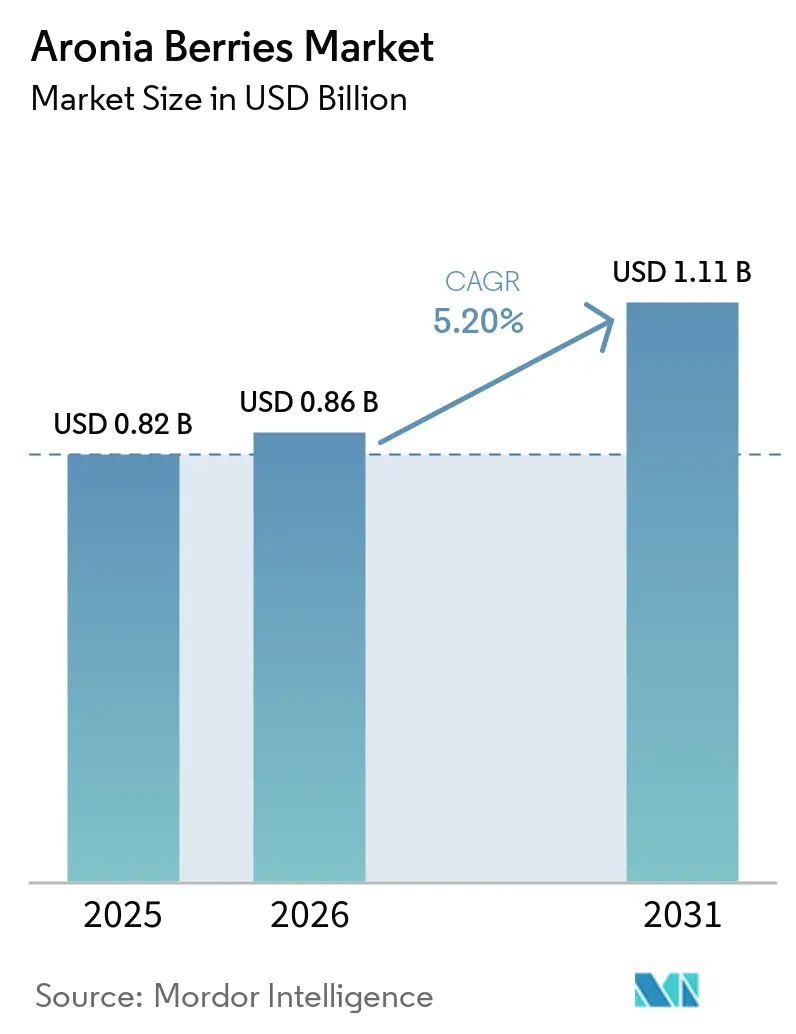
The aronia berries market size was valued at USD 0.82 billion in 2025 and estimated to grow from USD 0.86 billion in 2026 to USD 1.11 billion by 2031, registering a CAGR of 5.2% through 2026-2031. Established berry supply chains, accelerating nutraceutical demand, and widening cold-chain logistics underpin this trajectory. North America maintained the largest share in 2025 on the strength of processor contracts that reward standardized polyphenol levels, while Asia-Pacific is the fastest region, as Vietnam and Thailand add temperature-controlled warehouses that reduce in-transit anthocyanin loss. Conventional farms will remain dominant through 2031, however, premiums commanded by certified organic fruit are tilting incremental acreage toward chemical-free practices, especially in the European Union, where subsidy programs offset conversion costs. Competitive dynamics remain fluid, with no supplier holding a double-digit share, encouraging mid-sized growers to move forward with freeze-dry or extraction lines that capture higher margins from bioactive-oriented customers.
Key Report Takeaways
- By geography, North America retained the largest 34.5% share of the aronia berries market share in 2025, while Asia-Pacific is the fastest region with a 9.5% CAGR through 2026-2031.
Note: Market size and forecast figures in this report are generated using Mordor Intelligence’s proprietary estimation framework, updated with the latest available data and insights as of January 2026.
Global Aronia Berries Market Trends and Insights
Drivers Impact Analysis*
| Driver | (~) % Impact on CAGR Forecast | Geographic Relevance | Impact Timeline |
|---|---|---|---|
| Increased Demand for Aronia Berries Due to Health Benefits | +1.8% | North America and Europe, with spillover to the Asia‑Pacific | Medium term (2–4 years) |
| Adoption of precision horticulture | +1.2% | North America and Europe core, with a gradual uptake in South America | Medium term (2–4 years) |
| Rising functional-food processing capacity | +1.4% | Global, concentrated in Europe and North America | Short term (≤ 2 years) |
| Government crop incentives in Europe and United States | +1.6% | North America and Europe | Long term (≥ 4 years) |
| Cold-chain build-out in South-East Asia | +1.3% | Asia‑Pacific core, spillover to the Middle East and Africa | Medium term (2–4 years) |
| Polyphenol-standard contracts by nutraceutical majors | +1.5% | Global, strongest in North America and Europe | Medium term (2–4 years) |
| Source: Mordor Intelligence | |||
Increased Demand for Aronia Berries Due to Health Benefits
The 2025 Nutrients article “Black Chokeberry Extracts (Aronia melanocarpa) as an Ingredient of Functional Food Potential, Challenges and Directions of Development” by Skupien and Jędryczka demonstrated that aronia anthocyanins improved lipid profiles and lowered systolic blood pressure, elevating the berry from commodity fruit to a bioactive-rich input accepted by supplement formulators. United States organic berry sales grew 10.5% year over year in 2025, confirming shopper willingness to pay a premium for scientifically supported health benefits[1]Source: Organic Trade Association, “U.S. Organic Marketplace Achieved Significant Growth in 2025,” ota.com. Processors consequently convert spot purchases into multi-year contracts that specify minimum polyphenol content, guaranteeing offtake for growers who can document batch chemistry. This migration toward evidence-backed positioning lifts average selling prices and underpins the strong growth outlook for the aronia berries market.
Adoption of Precision Horticulture Using Internet of Things-Enabled Fertigation and Drones
Growers are integrating unmanned aerial vehicles, soil-moisture sensors and weather stations to optimize irrigation and nitrogen, cutting waste and improving berry phytochemical uniformity. In 2025, The European Commission’s FRIETS project showed that remotely sensed vegetation indices predict yields weeks in advance, allowing processors to sequence harvest deliveries and minimize cold-store congestion. Water-stress management is critical because anthocyanin accumulation rises when deficits are precisely timed, and buyers now penalize loads falling below declared potency. Finnish Superberries oversees 220 hectares of organic orchards that run sensor-guided fertigation and sell up to 2.5 million kilograms annually to European beverage brands. Precision systems lower unit costs over time, enabling technologically advanced farms to secure nutraceutical contracts and strengthen the market’s future growth.
Government crop incentives in Europe and United States
Subsidies targeting diversification into specialty crops subsidize orchard establishment and harvester purchase, reducing early-year cash-flow risk. The United States Department of Agriculture project, running through 2027, offers growers cost-share for organic transition on subprime riparian land, while the European Union Common Agricultural Policy rewards climate-resilient crops like aronia that require fewer pesticides. Such public-funded programs anchor grower returns long enough to lock processor supply contracts, uplifting to the long-term growth outlook. Regions without similar support see slower adoption and remain price takers in the global trade matrix.
Cold-chain build-out in South-East Asia
Vietnam, Thailand, and Indonesia added more than 150,000 square meters of temperature-controlled warehousing during 2024-2026, reducing spoilage and enabling bulk imports of fresh aronia destined for retail produce sections. The Australian Department of Agriculture, Fisheries and Forestry notes that 5% of berry consignments undergo residue testing, so importers prefer suppliers with documented hazard analysis systems[3]Source: Australian Government Department of Agriculture, Fisheries and Forestry, “Risk Background: Fresh Berries for Human Consumption,” agriculture.gov.au. European exporters with grade-A cold-storage certification, therefore, win market entry faster than opportunistic traders, locking three-year distribution deals that guarantee volume. Improved facilities also enable repacking of whole fruit for supermarket distribution, boosting Asia-Pacific’s share of fresh aronia berry consumption.
Restraints Impact Analysis*
| Restraint | (~) % Impact on CAGR Forecast | Geographic Relevance | Impact Timeline |
|---|---|---|---|
| Pest and viral disease pressure | −0.9% | North America and Europe, moderate impact in the Asia‑Pacific | Medium term (2–4 years) |
| Growing incidence of berry-fruit allergies | −0.6% | Global, concentrated in Australia and Canada | Short term (≤ 2 years) |
| Price shocks from Poland–Ukraine logistic bottlenecks | −1.1% | Europe's core, spillover to the Middle East and Africa | Short term (≤ 2 years) |
| Tight labor for mechanical harvest retrofits | −0.8% | North America and Europe have a moderate impact, and South America | Medium term (2–4 years) |
| Source: Mordor Intelligence | |||
Pest and viral disease pressure
Excessive rainfall during the 2025 Midwest season, including one of the wettest Julys on record, caused a severe Southern Rust outbreak in Iowa. Iowa State University Extension reported yield losses of 20% to 40% in the worst-hit areas. Fungicides like Luna Tranquility are labeled, yet profit margins rarely justify multiple sprays, leaving many fields untreated. Surveillance resources already stretched by Plum pox virus management in stone fruit limit extension outreach for aronia, so knowledge transfer lags, thereby hindering the market.
Tight labor for mechanical harvest retrofits
Aging farm labor pools and migration constraints leave too few technicians to retrofit mechanical harvesters across Midwestern orchards, perpetuating reliance on hand picking. Wage inflation averaging 5% annually since 2024 outpaces farmgate price gains, pressuring margins. The United States Department of Agriculture Pacific Northwest project will publish enterprise budgets in 2027, but capital-poor growers struggle now to justify USD 150,000 harvesters that might sit idle outside a two-week window[2]Source: United States Department of Agriculture, Agricultural Research Service, “Project: Expanding Aronia and Elderberry Production on Subprime Land in the Pacific Northwest,” ars.usda.gov. European operators face similar hurdles even as protected-cultivation tunnels improve yields by 43%, because labor savings remain elusive without machinery.
*Our forecasts treat driver/restraint impacts as directional, not additive. The impact forecasts reflect baseline growth, mix effects, and variable interactions.
Geography Analysis
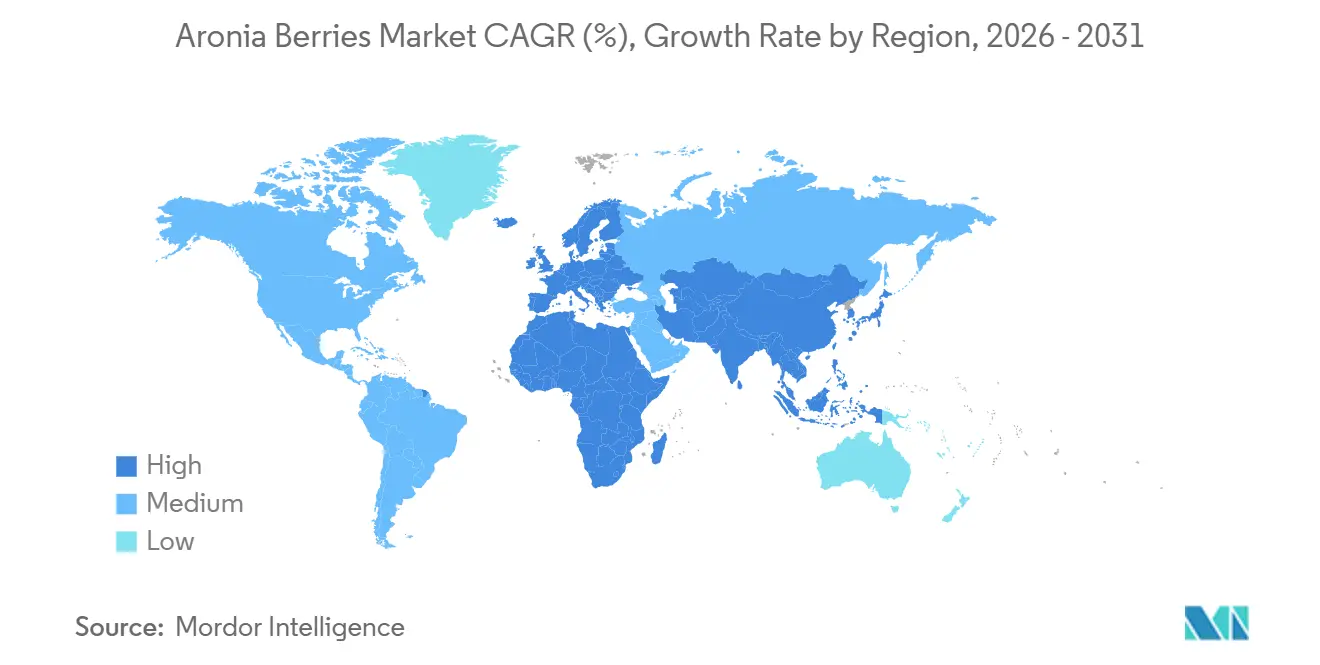
North America remained the largest region, accounting for 34.5% of the aronia berries market share in 2025, buoyed by established fresh-produce distribution networks, processor purchase agreements, and federal crop incentives. Fe Ongoing United States Department of Agriculture programs that underwrite organic transition on marginal land keep acreage expansion financially attractive. Asia-Pacific is the fastest region, advancing at a 9.5% CAGR during 2026-2031 as new temperature-controlled warehouses in Vietnam and Thailand reduce post-harvest losses and enable steady imports of standardized extracts. Collectively, these two regions set the pace for both volume growth and value-added product uptake within the global supply network.
Europe supplies much of the world’s raw fruit through Poland’s concentrated production base, while Germany acts as a redistribution hub for processors across Western Europe. Border disruptions have prompted Ukrainian growers to reroute exports through Germany and France, increasing freight costs but diversifying destination markets. South America gains relevance as Brazilian and Argentine orchards expand, leveraging lower labor costs and flexible planting windows. The Middle East and Africa continue importing primarily frozen fruit, although South African and Kenyan trials indicate rising local cultivation potential.
Regional demand patterns increasingly favor powder and extract formats, with Asia-Pacific beverage brands and European nutraceutical makers signing multi-year supply agreements that prioritize anthocyanin potency. North American processors deepen vertical integration to secure raw material for premium supplements, while European Union subsidies steer growers toward certified organic acreage. Emerging producers in South America, the Middle East, and Africa seek technology transfer and investment to meet importer traceability standards, positioning them for gradual share gains. Collectively, these geographic dynamics are anticipated to broaden the aronia berries market size well beyond current forecasts as cold-chain infrastructure and policy support converge worldwide.


Competitive Landscape
Superberries LLC (Westin Foods Company) leads by operating expansive Midwestern orchards and coordinating just-in-time field packing that meets supermarket shelf-life requirements. Its distribution agreements with regional grocers allow same-day delivery, keeping fruit firmness and anthocyanin levels within buyer specifications. Artemis International Inc. (Artemis International Inc.) maintains dedicated plantations in Indiana and partners with contract growers in the Great Lakes region to secure a consistent flow of premium, hand-harvested berries for fresh produce aisles.
GreenField Sp. z o.o. (GreenField Sp. z o.o.) anchors Poland’s supply, channeling orchard output to wholesale markets in Germany, France, and the United Kingdom within 48 hours of picking. Bellbrook Berry Farm LLC (Bellbrook Berry Farm LLC) focuses on community-supported agriculture boxes and farmers-market stalls, fostering direct consumer relationships and capturing loyalty for locally grown fresh fruit. Sawmill Hollow Family Farm LLC (Sawmill Hollow Family Farm LLC) blends agritourism with pick-your-own programs that encourage visitors to harvest berries at optimal ripeness, enhancing brand visibility while reducing labor costs. These three companies emphasize rapid post-harvest cooling and careful grading to protect berry skin integrity during short-haul transport.
All five firms are expanding acreage through long-term land leases and replanting with higher-yield cultivars that mature earlier, lengthening the fresh-market sales window. Investments in shade nets, drip irrigation, and canopy sensors improve berry size uniformity and reduce sun-scald losses, strengthening negotiating power with major retail chains. Several operators are also pursuing organic certification to meet grocer commitments to pesticide-free produce, a move anticipated to lift price realization in premium outlets. Collectively, these strategies position the leading growers to widen market access and underpin future growth in fresh aronia berry consumption.
Recent Industry Developments
- February 2026: The United States Department of Agriculture announced USD 1 billion in funding for the Assistance for Specialty Crop Farmers (ASCF) Program. This program offers one-time bridge payments to assist specialty crop producers, including berry growers, in addressing market disruptions, rising costs, and foreign competition. This federal support alleviates financial challenges for aronia producers, helping retain acreage and maintain the supply of fresh berries, including aronia.
- February 2025: The Australian Government Department of Agriculture, Fisheries and Forestry restated that imported fresh, chilled and frozen berries are classified as risk food and must carry Food Safety Management System certificates, with 5% of consignments selected for microbiological testing. This stricter oversight raises exporters’ compliance costs but enhances consumer confidence in product safety, supporting sustained demand for traceable premium fresh aronia berries in the Australian market.
- October 2025: Finnish Superberries introduced Sandås Auronia Noir, an alcohol-free organic aronia wine alternative positioned for premium beverage shelves. The launch broadens consumer awareness of aronia and signals new value-added pathways, encouraging growers to scale fresh-fruit output to meet anticipated demand from specialty retailers.


Global Aronia Berries Market Report Scope
Aronia berries, commonly known as chokeberries, are small, dark purple to black fruits celebrated for their high antioxidant content and associated health benefits. The Market is Segmented by Geography (North America (United States, Canada, and Mexico), South America (Brazil and Argentina), Europe (Germany, United Kingdom, France, and Russia) Asia-Pacifi (China, Japan, and Australia), Middle East (United Arab Emirates and Saudi Arabia) and Africa(South Africa and Kenya)). The Report Includes Production Analysis (Volume), Consumption Analysis (Value and Volume), Import Analysis (Value and Volume), Export Analysis (Value and Volume), Wholesale Price Trend Analysis and Forecast, List of Key Players, and More. The Market Forecasts are Provided in Terms of Value (USD) and Volume (Metric Tons).
| North America | United States | Production Analysis (Area Harvested, Yield, and Production Volume) |
| Consumption Analysis (Consumption Value and Volume) | ||
| Import Market Analysis (Import Value, Volume, and Key Supplying Markets) | ||
| Export Market Analysis (Export Value, Volume, and Key Destination Markets) | ||
| Wholesale Price Trend Analysis and Forecast | ||
| Regulatory Framework | ||
| List of Key Players | ||
| Logistics and Infrastructure | ||
| Seasonality Analysis | ||
| Canada | Production Analysis (Area Harvested, Yield, and Production Volume) | |
| Consumption Analysis (Consumption Value and Volume) | ||
| Import Market Analysis (Import Value, Volume, and Key Supplying Markets) | ||
| Export Market Analysis (Export Value, Volume, and Key Destination Markets) | ||
| Wholesale Price Trend Analysis and Forecast | ||
| Regulatory Framework | ||
| List of Key Players | ||
| Logistics and Infrastructure | ||
| Seasonality Analysis | ||
| Mexico | Production Analysis (Area Harvested, Yield, and Production Volume) | |
| Consumption Analysis (Consumption Value and Volume) | ||
| Import Market Analysis (Import Value, Volume, and Key Supplying Markets) | ||
| Export Market Analysis (Export Value, Volume, and Key Destination Markets) | ||
| Wholesale Price Trend Analysis and Forecast | ||
| Regulatory Framework | ||
| List of Key Players | ||
| Logistics and Infrastructure | ||
| Seasonality Analysis | ||
| South America | Brazil | Production Analysis (Area Harvested, Yield, and Production Volume) |
| Consumption Analysis (Consumption Value and Volume) | ||
| Import Market Analysis (Import Value, Volume, and Key Supplying Markets) | ||
| Export Market Analysis (Export Value, Volume, and Key Destination Markets) | ||
| Wholesale Price Trend Analysis and Forecast | ||
| Regulatory Framework | ||
| List of Key Players | ||
| Logistics and Infrastructure | ||
| Seasonality Analysis | ||
| Argentina | Production Analysis (Area Harvested, Yield, and Production Volume) | |
| Consumption Analysis (Consumption Value and Volume) | ||
| Import Market Analysis (Import Value, Volume, and Key Supplying Markets) | ||
| Export Market Analysis (Export Value, Volume, and Key Destination Markets) | ||
| Wholesale Price Trend Analysis and Forecast | ||
| Regulatory Framework | ||
| List of Key Players | ||
| Logistics and Infrastructure | ||
| Seasonality Analysis | ||
| Europe | Germany | Production Analysis (Area Harvested, Yield, and Production Volume) |
| Consumption Analysis (Consumption Value and Volume) | ||
| Import Market Analysis (Import Value, Volume, and Key Supplying Markets) | ||
| Export Market Analysis (Export Value, Volume, and Key Destination Markets) | ||
| Wholesale Price Trend Analysis and Forecast | ||
| Regulatory Framework | ||
| List of Key Players | ||
| Logistics and Infrastructure | ||
| Seasonality Analysis | ||
| United Kingdom | Production Analysis (Area Harvested, Yield, and Production Volume) | |
| Consumption Analysis (Consumption Value and Volume) | ||
| Import Market Analysis (Import Value, Volume, and Key Supplying Markets) | ||
| Export Market Analysis (Export Value, Volume, and Key Destination Markets) | ||
| Wholesale Price Trend Analysis and Forecast | ||
| Regulatory Framework | ||
| List of Key Players | ||
| Logistics and Infrastructure | ||
| Seasonality Analysis | ||
| France | Production Analysis (Area Harvested, Yield, and Production Volume) | |
| Consumption Analysis (Consumption Value and Volume) | ||
| Import Market Analysis (Import Value, Volume, and Key Supplying Markets) | ||
| Export Market Analysis (Export Value, Volume, and Key Destination Markets) | ||
| Wholesale Price Trend Analysis and Forecast | ||
| Regulatory Framework | ||
| List of Key Players | ||
| Logistics and Infrastructure | ||
| Seasonality Analysis | ||
| Russia | Production Analysis (Area Harvested, Yield, and Production Volume) | |
| Consumption Analysis (Consumption Value and Volume) | ||
| Import Market Analysis (Import Value, Volume, and Key Supplying Markets) | ||
| Export Market Analysis (Export Value, Volume, and Key Destination Markets) | ||
| Wholesale Price Trend Analysis and Forecast | ||
| Regulatory Framework | ||
| List of Key Players | ||
| Logistics and Infrastructure | ||
| Seasonality Analysis | ||
| Asia-Pacific | China | Production Analysis (Area Harvested, Yield, and Production Volume) |
| Consumption Analysis (Consumption Value and Volume) | ||
| Import Market Analysis (Import Value, Volume, and Key Supplying Markets) | ||
| Export Market Analysis (Export Value, Volume, and Key Destination Markets) | ||
| Wholesale Price Trend Analysis and Forecast | ||
| Regulatory Framework | ||
| List of Key Players | ||
| Logistics and Infrastructure | ||
| Seasonality Analysis | ||
| Japan | Production Analysis (Area Harvested, Yield, and Production Volume) | |
| Consumption Analysis (Consumption Value and Volume) | ||
| Import Market Analysis (Import Value, Volume, and Key Supplying Markets) | ||
| Export Market Analysis (Export Value, Volume, and Key Destination Markets) | ||
| Wholesale Price Trend Analysis and Forecast | ||
| Regulatory Framework | ||
| List of Key Players | ||
| Logistics and Infrastructure | ||
| Seasonality Analysis | ||
| Australia | Production Analysis (Area Harvested, Yield, and Production Volume) | |
| Consumption Analysis (Consumption Value and Volume) | ||
| Import Market Analysis (Import Value, Volume, and Key Supplying Markets) | ||
| Export Market Analysis (Export Value, Volume, and Key Destination Markets) | ||
| Wholesale Price Trend Analysis and Forecast | ||
| Regulatory Framework | ||
| List of Key Players | ||
| Logistics and Infrastructure | ||
| Seasonality Analysis | ||
| Middle East | United Arab Emirates | Production Analysis (Area Harvested, Yield, and Production Volume) |
| Consumption Analysis (Consumption Value and Volume) | ||
| Import Market Analysis (Import Value, Volume, and Key Supplying Markets) | ||
| Export Market Analysis (Export Value, Volume, and Key Destination Markets) | ||
| Wholesale Price Trend Analysis and Forecast | ||
| Regulatory Framework | ||
| List of Key Players | ||
| Logistics and Infrastructure | ||
| Seasonality Analysis | ||
| Saudi Arabia | Production Analysis (Area Harvested, Yield, and Production Volume) | |
| Consumption Analysis (Consumption Value and Volume) | ||
| Import Market Analysis (Import Value, Volume, and Key Supplying Markets) | ||
| Export Market Analysis (Export Value, Volume, and Key Destination Markets) | ||
| Wholesale Price Trend Analysis and Forecast | ||
| Regulatory Framework | ||
| List of Key Players | ||
| Logistics and Infrastructure | ||
| Seasonality Analysis | ||
| Africa | South Africa | Production Analysis (Area Harvested, Yield, and Production Volume) |
| Consumption Analysis (Consumption Value and Volume) | ||
| Import Market Analysis (Import Value, Volume, and Key Supplying Markets) | ||
| Export Market Analysis (Export Value, Volume, and Key Destination Markets) | ||
| Wholesale Price Trend Analysis and Forecast | ||
| Regulatory Framework | ||
| List of Key Players | ||
| Logistics and Infrastructure | ||
| Seasonality Analysis | ||
| Kenya | Production Analysis (Area Harvested, Yield, and Production Volume) | |
| Consumption Analysis (Consumption Value and Volume) | ||
| Import Market Analysis (Import Value, Volume, and Key Supplying Markets) | ||
| Export Market Analysis (Export Value, Volume, and Key Destination Markets) | ||
| Wholesale Price Trend Analysis and Forecast | ||
| Regulatory Framework | ||
| List of Key Players | ||
| Logistics and Infrastructure | ||
| Seasonality Analysis | ||
| By Geography | North America | United States | Production Analysis (Area Harvested, Yield, and Production Volume) |
| Consumption Analysis (Consumption Value and Volume) | |||
| Import Market Analysis (Import Value, Volume, and Key Supplying Markets) | |||
| Export Market Analysis (Export Value, Volume, and Key Destination Markets) | |||
| Wholesale Price Trend Analysis and Forecast | |||
| Regulatory Framework | |||
| List of Key Players | |||
| Logistics and Infrastructure | |||
| Seasonality Analysis | |||
| Canada | Production Analysis (Area Harvested, Yield, and Production Volume) | ||
| Consumption Analysis (Consumption Value and Volume) | |||
| Import Market Analysis (Import Value, Volume, and Key Supplying Markets) | |||
| Export Market Analysis (Export Value, Volume, and Key Destination Markets) | |||
| Wholesale Price Trend Analysis and Forecast | |||
| Regulatory Framework | |||
| List of Key Players | |||
| Logistics and Infrastructure | |||
| Seasonality Analysis | |||
| Mexico | Production Analysis (Area Harvested, Yield, and Production Volume) | ||
| Consumption Analysis (Consumption Value and Volume) | |||
| Import Market Analysis (Import Value, Volume, and Key Supplying Markets) | |||
| Export Market Analysis (Export Value, Volume, and Key Destination Markets) | |||
| Wholesale Price Trend Analysis and Forecast | |||
| Regulatory Framework | |||
| List of Key Players | |||
| Logistics and Infrastructure | |||
| Seasonality Analysis | |||
| South America | Brazil | Production Analysis (Area Harvested, Yield, and Production Volume) | |
| Consumption Analysis (Consumption Value and Volume) | |||
| Import Market Analysis (Import Value, Volume, and Key Supplying Markets) | |||
| Export Market Analysis (Export Value, Volume, and Key Destination Markets) | |||
| Wholesale Price Trend Analysis and Forecast | |||
| Regulatory Framework | |||
| List of Key Players | |||
| Logistics and Infrastructure | |||
| Seasonality Analysis | |||
| Argentina | Production Analysis (Area Harvested, Yield, and Production Volume) | ||
| Consumption Analysis (Consumption Value and Volume) | |||
| Import Market Analysis (Import Value, Volume, and Key Supplying Markets) | |||
| Export Market Analysis (Export Value, Volume, and Key Destination Markets) | |||
| Wholesale Price Trend Analysis and Forecast | |||
| Regulatory Framework | |||
| List of Key Players | |||
| Logistics and Infrastructure | |||
| Seasonality Analysis | |||
| Europe | Germany | Production Analysis (Area Harvested, Yield, and Production Volume) | |
| Consumption Analysis (Consumption Value and Volume) | |||
| Import Market Analysis (Import Value, Volume, and Key Supplying Markets) | |||
| Export Market Analysis (Export Value, Volume, and Key Destination Markets) | |||
| Wholesale Price Trend Analysis and Forecast | |||
| Regulatory Framework | |||
| List of Key Players | |||
| Logistics and Infrastructure | |||
| Seasonality Analysis | |||
| United Kingdom | Production Analysis (Area Harvested, Yield, and Production Volume) | ||
| Consumption Analysis (Consumption Value and Volume) | |||
| Import Market Analysis (Import Value, Volume, and Key Supplying Markets) | |||
| Export Market Analysis (Export Value, Volume, and Key Destination Markets) | |||
| Wholesale Price Trend Analysis and Forecast | |||
| Regulatory Framework | |||
| List of Key Players | |||
| Logistics and Infrastructure | |||
| Seasonality Analysis | |||
| France | Production Analysis (Area Harvested, Yield, and Production Volume) | ||
| Consumption Analysis (Consumption Value and Volume) | |||
| Import Market Analysis (Import Value, Volume, and Key Supplying Markets) | |||
| Export Market Analysis (Export Value, Volume, and Key Destination Markets) | |||
| Wholesale Price Trend Analysis and Forecast | |||
| Regulatory Framework | |||
| List of Key Players | |||
| Logistics and Infrastructure | |||
| Seasonality Analysis | |||
| Russia | Production Analysis (Area Harvested, Yield, and Production Volume) | ||
| Consumption Analysis (Consumption Value and Volume) | |||
| Import Market Analysis (Import Value, Volume, and Key Supplying Markets) | |||
| Export Market Analysis (Export Value, Volume, and Key Destination Markets) | |||
| Wholesale Price Trend Analysis and Forecast | |||
| Regulatory Framework | |||
| List of Key Players | |||
| Logistics and Infrastructure | |||
| Seasonality Analysis | |||
| Asia-Pacific | China | Production Analysis (Area Harvested, Yield, and Production Volume) | |
| Consumption Analysis (Consumption Value and Volume) | |||
| Import Market Analysis (Import Value, Volume, and Key Supplying Markets) | |||
| Export Market Analysis (Export Value, Volume, and Key Destination Markets) | |||
| Wholesale Price Trend Analysis and Forecast | |||
| Regulatory Framework | |||
| List of Key Players | |||
| Logistics and Infrastructure | |||
| Seasonality Analysis | |||
| Japan | Production Analysis (Area Harvested, Yield, and Production Volume) | ||
| Consumption Analysis (Consumption Value and Volume) | |||
| Import Market Analysis (Import Value, Volume, and Key Supplying Markets) | |||
| Export Market Analysis (Export Value, Volume, and Key Destination Markets) | |||
| Wholesale Price Trend Analysis and Forecast | |||
| Regulatory Framework | |||
| List of Key Players | |||
| Logistics and Infrastructure | |||
| Seasonality Analysis | |||
| Australia | Production Analysis (Area Harvested, Yield, and Production Volume) | ||
| Consumption Analysis (Consumption Value and Volume) | |||
| Import Market Analysis (Import Value, Volume, and Key Supplying Markets) | |||
| Export Market Analysis (Export Value, Volume, and Key Destination Markets) | |||
| Wholesale Price Trend Analysis and Forecast | |||
| Regulatory Framework | |||
| List of Key Players | |||
| Logistics and Infrastructure | |||
| Seasonality Analysis | |||
| Middle East | United Arab Emirates | Production Analysis (Area Harvested, Yield, and Production Volume) | |
| Consumption Analysis (Consumption Value and Volume) | |||
| Import Market Analysis (Import Value, Volume, and Key Supplying Markets) | |||
| Export Market Analysis (Export Value, Volume, and Key Destination Markets) | |||
| Wholesale Price Trend Analysis and Forecast | |||
| Regulatory Framework | |||
| List of Key Players | |||
| Logistics and Infrastructure | |||
| Seasonality Analysis | |||
| Saudi Arabia | Production Analysis (Area Harvested, Yield, and Production Volume) | ||
| Consumption Analysis (Consumption Value and Volume) | |||
| Import Market Analysis (Import Value, Volume, and Key Supplying Markets) | |||
| Export Market Analysis (Export Value, Volume, and Key Destination Markets) | |||
| Wholesale Price Trend Analysis and Forecast | |||
| Regulatory Framework | |||
| List of Key Players | |||
| Logistics and Infrastructure | |||
| Seasonality Analysis | |||
| Africa | South Africa | Production Analysis (Area Harvested, Yield, and Production Volume) | |
| Consumption Analysis (Consumption Value and Volume) | |||
| Import Market Analysis (Import Value, Volume, and Key Supplying Markets) | |||
| Export Market Analysis (Export Value, Volume, and Key Destination Markets) | |||
| Wholesale Price Trend Analysis and Forecast | |||
| Regulatory Framework | |||
| List of Key Players | |||
| Logistics and Infrastructure | |||
| Seasonality Analysis | |||
| Kenya | Production Analysis (Area Harvested, Yield, and Production Volume) | ||
| Consumption Analysis (Consumption Value and Volume) | |||
| Import Market Analysis (Import Value, Volume, and Key Supplying Markets) | |||
| Export Market Analysis (Export Value, Volume, and Key Destination Markets) | |||
| Wholesale Price Trend Analysis and Forecast | |||
| Regulatory Framework | |||
| List of Key Players | |||
| Logistics and Infrastructure | |||
| Seasonality Analysis | |||


Key Questions Answered in the Report
What is the projected value of the aronia berries market by 2031?
The aronia berries market is forecast to reach USD 1.11 billion by 2031.
Which region is the largest consumer of aronia berries?
North America held the largest 34.5% share in 2025, driven by robust nutraceutical and frozen-berry supply chains.
Why are organic-certified berries gaining traction?
Certified organic aronia earns 20-40% price premiums and benefits from rising consumer preference for clean-label functional foods.
What is the main restraint to rapid mechanization?
A shortage of skilled technicians to retrofit harvesters keeps labor as the largest variable cost, slowing large-scale adoption.
Page last updated on:


 Your data is secure and never sold or shared.


