
Argentina Management Consulting Services Market Size and Share
Market Overview
| Study Period | 2020 - 2031 |
|---|---|
| Forecast Data Period | 2026 - 2031 |
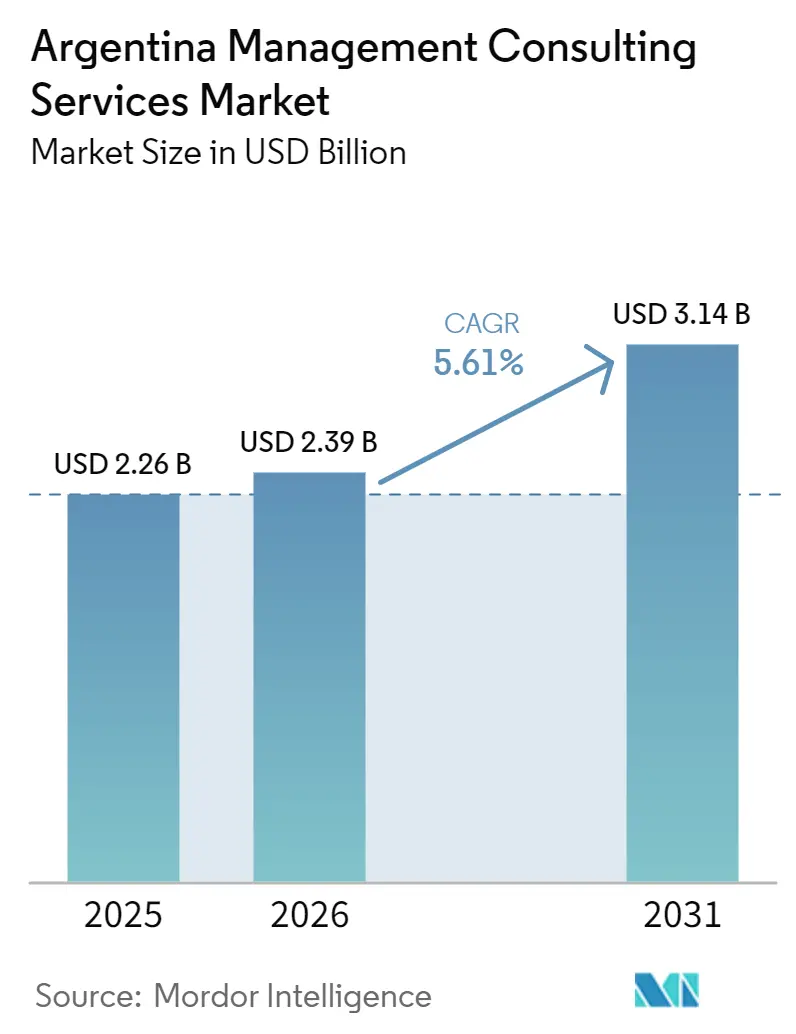
| Base Year Market Size (2025) | USD 2.26 Billion |
| Market Size (2026) | USD 2.39 Billion |
| Market Size (2031) | USD 3.14 Billion |
| Growth Rate (2026 - 2031) | 5.61 % |
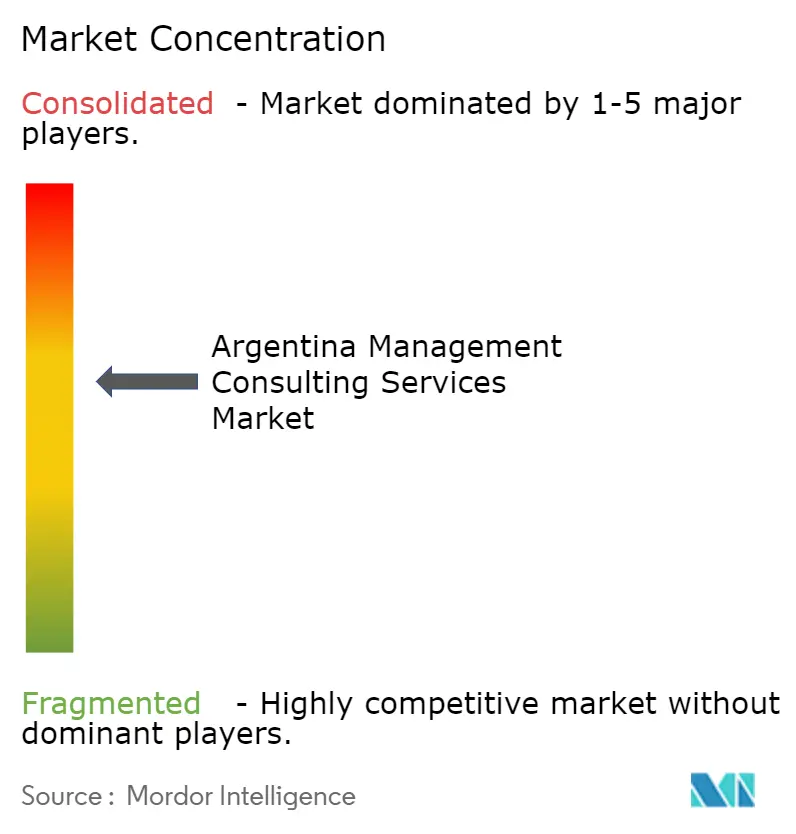
| Market Concentration | Medium |
Major Players *Disclaimer: Major Players sorted in no particular order Image © Mordor Intelligence. Reuse requires attribution under CC BY 4.0. | |
Argentina Management Consulting Services Market Analysis by Mordor Intelligence
The Argentina management consulting services market size is expected to grow from USD 2.26 billion in 2025 to USD 2.39 billion in 2026 and is forecast to reach USD 3.14 billion by 2031 at a 5.61% CAGR over 2026-2031. Currency liberalization in April 2025, combined with multilateral financing of sovereign programs, is stabilizing enterprise spending on advisory mandates. Board-level priorities have shifted toward digital transformation, with cloud adoption surpassing 80% among medium and large organizations, and toward risk and regulatory alignment following the overhaul of Argentina’s anti-money-laundering framework. At the same time, cost-optimization consulting remains resilient as 75% of chief financial officers intend to curb discretionary investment while inflation stays in the 20%-30% corridor. Large consultancies are deepening near-shore centers in Mendoza and Córdoba to secure talent and serve overseas clients, whereas boutiques are gaining share through fixed-fee, outcome-based engagements for small and medium-sized enterprises.
Key Report Takeaways
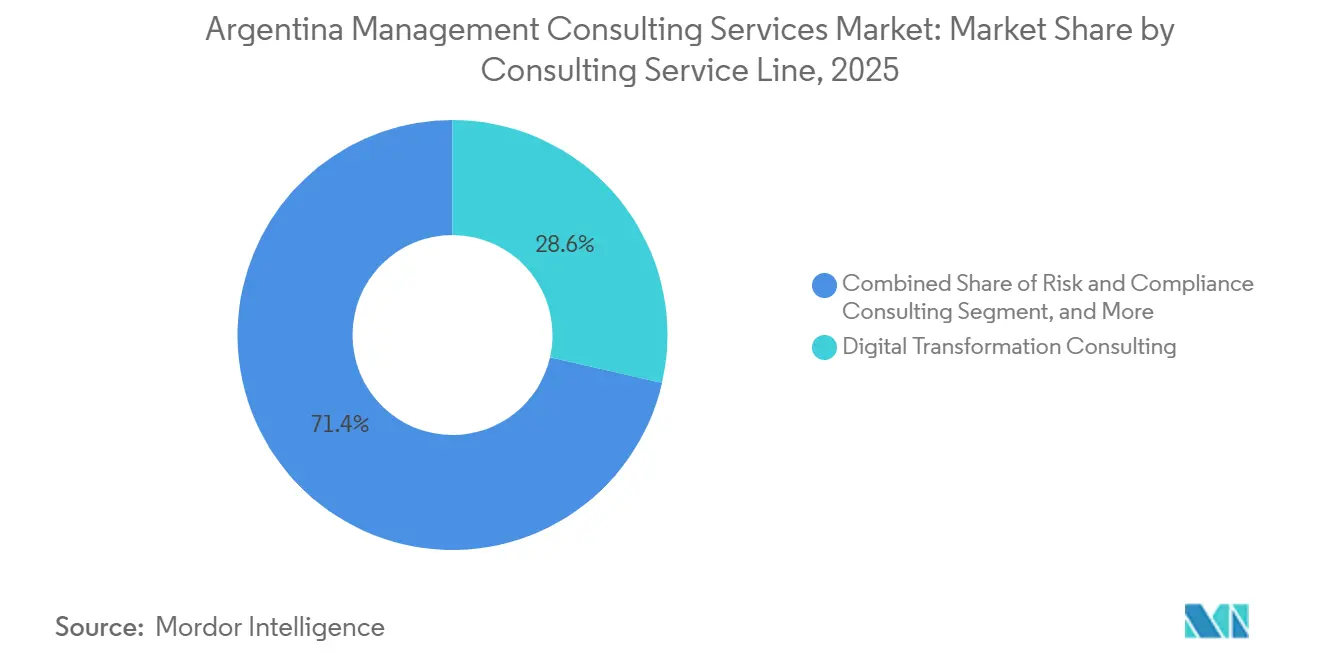
- By consulting service line, digital transformation led with 28.59% revenue share in 2025; risk and compliance consulting is projected to expand at a 6.09% CAGR through 2031.
- By organization size, large enterprises held 66.31% of the Argentina management consulting services market share in 2025, while small and medium-sized enterprises are poised for the fastest growth at 5.74% CAGR to 2031.
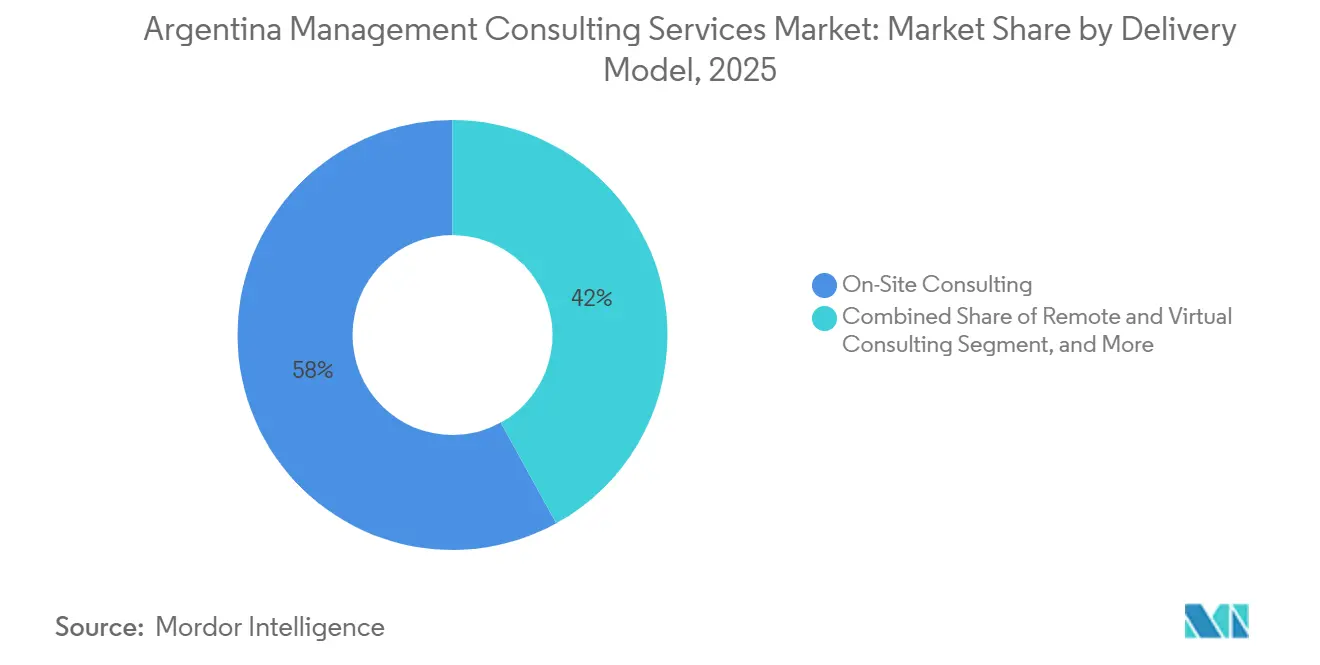
- By delivery model, on-site engagements captured 58.02% share of the Argentina management consulting services market size in 2025 and remote and virtual delivery is advancing at a 6.13% CAGR through 2031.
- By end user, IT and telecommunications led with 20.12% share in 2025 and healthcare consulting is forecast to register the quickest 5.98% CAGR to 2031.
Note: Market size and forecast figures in this report are generated using Mordor Intelligence’s proprietary estimation framework, updated with the latest available data and insights as of January 2026.
Argentina Management Consulting Services Market Trends and Insights
Drivers Impact Analysis*
| Driver | (~) % Impact on CAGR Forecast | Geographic Relevance | Impact Timeline |
|---|---|---|---|
| Digital-transformation spending surge among enterprises | +1.8% | National, concentrated in Buenos Aires, Córdoba, Rosario, Mendoza | Medium term (2-4 years) |
| Post-pandemic push for operational efficiency and cost optimization | +1.5% | National, strongest in manufacturing and banking sectors | Short term (≤ 2 years) |
| Government modernization and regulatory-reform programs | +1.2% | National, led by federal agencies with provincial spillover | Long term (≥ 4 years) |
| Rising cloud and AI adoption across industries | +1.0% | National, early gains in IT and telecommunications, energy, financial services | Medium term (2-4 years) |
| Peso-driven near-shoring of back-office consulting work | +0.4% | Buenos Aires, Córdoba, Rosario metropolitan areas | Medium term (2-4 years) |
| Demand for Spanish-language ESG-supply-chain compliance advisory | +0.3% | National, with cross-border relevance to Mercosur trade partners | Long term (≥ 4 years) |
| Source: Mordor Intelligence | |||
Digital-Transformation Spending Surge Among Enterprises
Argentine organizations allocated an estimated USD 2.5 billion to software and digital services in 2026, with cloud infrastructure reaching 80% penetration among medium and large companies.[1]Argentine Chamber of Software and Computer Services, “Software and Digital Services Spending 2026,” cessi.org.arThis migration is driven less by greenfield innovation and more by replacing peso-strained legacy systems that cannot scale. Accenture’s acquisition of Verum Partners in February 2026 enhances its ability to run integrated digital-physical programs from local hubs. Chief financial officers are demanding technology projects wrapped in cost-savings guarantees, a stance confirmed by a January 2026 survey where 75% ranked expense reduction above expansion. Consequently, consulting scopes now bundle change management, cybersecurity, and data-governance services, extending project lifecycles into recurring subscription contracts. Globant’s October 2025 launch of Digital Suppl.AI with YPF, which embedded 46 artificial-intelligence agents across supply-chain workflows, illustrates how firms are defending margins through proprietary intellectual property.
Post-Pandemic Push for Operational Efficiency and Cost Optimization
Persisting inflation in the 20%-30% range is compressing discretionary budgets, prompting enterprises to adopt zero-based budgeting, workflow automation, and supply-chain rationalization. The International Trade Centre reported that two-thirds of surveyed Argentine firms deploying digital logistics tools cut delivery times measurably, reinforcing demand for process-automation advisory.[2]International Trade Centre, “Helping SMEs in Argentina Go Digital,” intracen.org Boutique specialists are capturing small and medium-sized enterprise work through fixed-fee Lean Six Sigma sprints, whereas Big Four firms secure enterprise-wide mandates. Yet budgets remain tight: engagements are often phased into 90-day diagnostics with payback periods capped at 12 months. Artics found in 2025 that 73% of companies still rely on Excel and WhatsApp for mission-critical processes, leaving substantial headroom for digitization services.
Government Modernization and Regulatory-Reform Programs
Public-sector demand is scaling on the back of multilateral financing. The World Bank’s USD 300 million loan approved in July 2025 to digitalize tax administration is creating immediate need for enterprise architecture, change management, and data-integration expertise. Complementing this, the Inter-American Development Bank’s 2025-2028 strategy provides USD 9.75 billion in sovereign-guaranteed funds for fiscal reform, infrastructure, and social-sector technology upgrades.[3]Inter-American Development Bank, “IDB Approves Country Strategy for Argentina 2025-2028,” iadb.org New incentives for large-scale investments in mining and energy under the Régimen de Incentivo para Grandes Inversiones are spurring compliance mandates that favor firms with public-finance and international-tax expertise. Provincial governments in Mendoza, Córdoba, and Salta are mirroring federal digital programs, creating a cascading layer of subnational projects. These forces collectively widen the consulting opportunity set from Buenos Aires to secondary cities.
Rising Cloud and AI Adoption Across Industries
Despite high cloud uptake, Bain and Company observed in July 2025 that 67% of enterprises had scaled fewer than 20% of their artificial-intelligence initiatives. This execution gap fuels advisory needs in cloud migration, use-case prioritization, and data governance under Personal Data Protection Law 25,326. EY’s launch of EY.ai enterprise private in May 2025, delivered with Dell and NVIDIA, allows sector-specific artificial-intelligence applications while keeping data inside Argentina. Globant’s pivot toward subscription-based artificial-intelligence pods, announced in its third-quarter 2025 results, responds to client preference for outcome-priced services.[4]Globant Investor Relations, “Globant Reports Third Quarter 2025 Results,” investors.globant.com Early adopters in energy and resources, such as YPF, validate the model by embedding proprietary algorithms that create switching costs. However, delivery capacity is constrained by shortages in machine-learning talent, compelling firms to invest aggressively in local academies and offshore bridges.
Restraints Impact Analysis*
| Restraint | (~) % Impact on CAGR Forecast | Geographic Relevance | Impact Timeline |
|---|---|---|---|
| Macroeconomic Volatility and Inflation Weighing on Budgets | -1.2% | National, acute in consumer goods, retail, hospitality sectors | Short term (≤ 2 years) |
| Persistent Talent Brain-Drain to US and EU | -0.7% | National, concentrated outflow from Buenos Aires, Córdoba technology hubs | Medium term (2-4 years) |
| Currency-Control Hurdles for Cross-Border Fee Payments | -0.4% | National, affecting multinational consultancies with offshore delivery models | Short term (≤ 2 years) |
| Informal-Economy SME Fragmentation Limiting Addressable Demand | -0.3% | National, highest in construction, agriculture, personal services | Long term (≥ 4 years) |
| Source: Mordor Intelligence | |||
Macroeconomic Volatility and Inflation Weighing on Budgets
The January 2026 chief financial officer survey showed 73% expect inflation to stay between 20% and 30% during the year, causing 75% to prioritize cost reduction. Deloitte’s Argentina economic outlook revised 2026 GDP growth from 5% to 3% owing to fiscal consolidation and wage pressures. These headwinds shorten engagement horizons to 90-day sprints and drive down average project fees. The peso’s floating band of 1,000-1,400 per US dollar, introduced in April 2025, complicates pricing because firms must choose between peso contracts with monthly indexation or US-dollar quotes with conversion risk.[5]Central Bank of Argentina, “Comunicación A 8226,” bcra.gob.ar Consumer-facing industries have pared discretionary advisory budgets, leaving regulated sectors as the primary sources of stable demand.
Persistent Talent Brain-Drain to US and EU
Mid-career consultants continue emigrating, widening domestic skill gaps and inflating wage costs. EY Argentina’s creation of 800 new jobs in November 2025 raised headcount to about 5,000, largely to backfill departures and support export-oriented delivery. Accenture’s new Mendoza site, opened in August 2025 with 335 staff and plans to double within 18 months, exemplifies relocation to secondary cities for better retention.[6]Accenture Newsroom, “Accenture Opens New Office in Mendoza, Argentina,” newsroom.accenture.com Wage gaps remain stark: senior consultants in Buenos Aires earn 40%-60% less in purchasing-power-parity terms than peers in Miami or Madrid, sustaining outbound migration. Firms now offer remote servicing of US and European clients to supply dollar-linked income, accelerate promotion cycles, and invest in proprietary upskilling academies. These measures raise cost-to-serve and squeeze margins unless offset by higher-value, IP-rich offerings.
*Our forecasts treat driver/restraint impacts as directional, not additive. The impact forecasts reflect baseline growth, mix effects, and variable interactions.
Segment Analysis
By Consulting Service Line: Compliance Advisory Outpaces Tech Mandates
Digital-transformation engagements captured 28.59% of revenue in 2025, cementing the largest slice of the Argentina management consulting services market share. Risk and compliance consulting is projected to expand at a 6.09% CAGR, lifted by Law 27,739 and Financial Action Task Force follow-up obligations that require external audits for thousands of additional reporting entities. Over the next five years, the Argentina management consulting services market size for risk advisory is expected to widen as banking, fintech, and crypto-asset firms race to meet new suspicious-transaction thresholds and beneficial-ownership registry deadlines.
Strategy, operations, human-resources, and financial-advisory lines serve large clients seeking productivity analytics, zero-based budgeting, and carve-out valuation. Price pressure is rising, so firms are packaging diagnostic accelerators with subscription monitoring to protect margins. Sustainability advisory remains nascent but is gaining traction after 68% of companies signaled readiness for International Sustainability Standards Board reporting. Innovation consulting remains a discretionary purchase and trails the core lines, yet multinationals have begun piloting artificial-intelligence design studios embedded in transformation programs. All told, compliance complexity is steering wallet share toward higher-value, regulation-led services that promise non-discretionary budgets.



By Organization Size: Formalization Lifts SME Uptake
Large enterprises commanded 66.31% of 2025 spending, driven by multi-year cloud migration, shared-service-center rollouts, and restructuring mandates that require global-scale providers. Yet the small-and-medium-enterprise segment is forecast to grow at a 5.74% CAGR, the quickest within the Argentina management consulting services market.
Government and multilateral programs that incentivize tax compliance, digital invoicing, and logistics modernization are lowering adoption barriers for SMEs, particularly through subsidized advisory vouchers from Banco Galicia and the International Labour Organization. Boutique firms win here by offering fixed-fee templates that embed ERP light modules, Lean Six Sigma coaching, and quick-payback automation pilots. However, informal-economy prevalence still restricts penetration because many cash-based operators see limited value in formal advisory. For large organizations, demand is tilting toward outcome-based managed services as boards internalize repetitive technology tasks and retain consultants for governance, analytics, and high-end design.
By Delivery Model: Hybrid Becomes the Default
On-site work retained 58.02% share in 2025, especially for C-suite strategy, culture, and merger engagements that require trust-building workshops. Remote and virtual consulting, though, is advancing at a 6.13% CAGR, the fastest rate across delivery models, as firms tap provincial labor pools and near-shore to North American clients.
EY Global Delivery Services Argentina more than doubled its team to 3 200 between December 2025 and March 2026 and is exporting Spanish-language tax and assurance work across time-zone-aligned markets. Hybrid structures, onsite diagnostics followed by virtual build-and-run phases, deliver the travel-cost savings clients demand while preserving stakeholder contact. Documentation checks introduced after currency liberalization still delay some cross-border payments, so multinationals keep a thin onsite presence to expedite compliance and banking paperwork. Over time, automation of deliverables and standardized playbooks will enlarge the Argentina management consulting services market size for fully remote engagements, particularly in analytics, cybersecurity monitoring, and robotic-process-automation tuning.
By End User Industry: Health Data Drives New Spend
IT and telecommunications led with 20.12% revenue in 2025, reflecting 80% cloud penetration and persistent cybersecurity gaps. Healthcare consulting is projected to rise at a 5.98% CAGR as the National Digital Health Strategy mandates interoperable electronic health records, telemedicine networks, and data-governance frameworks.
Energy and resources projects tied to the Régimen de Incentivo para Grandes Inversiones, including lithium and copper developments, require environmental and tax-stability advisory, channeling spend toward firms with sectoral regulatory depth. Manufacturing clients continue piloting Industry 4.0 sensors and predictive-maintenance analytics, but inflation keeps pilot scopes narrow. Banking and insurance remain compliance heavy, absorbing anti-money-laundering and open-banking mandates that align with global Basel and ISO 20022 timelines. Public-sector bodies source consultants for tax-system modernization and infrastructure public-private partnerships funded by multilateral loans, providing long-duration, milestone-linked projects that insulate revenues in downturns.
Geography Analysis
Buenos Aires metropolitan area accounted for roughly 60%-65% of 2025 consulting spend, anchored by head offices of multinationals, federal ministries, and major banks. Its dominance is slowly eroding as cost-sensitive enterprises decentralize and as provincial governments launch parallel digital agendas. Córdoba and Rosario show robust growth, propelled by automotive, aerospace, and agribusiness clusters that demand logistics optimization and supply-chain traceability advisory. Mendoza is emerging as a delivery hotspot after Accenture opened its Chacras Park site in August 2025 and confirmed plans to double headcount inside 18 months, demonstrating investor confidence beyond the capital
Secondary cities benefit from peso-linked wage arbitrage that appeals to North American clients seeking near-shore Spanish-language support. The Argentina management consulting services market share in these provinces is still single-digit, yet CAGR outpaces the national average thanks to provincial incentive packages and talent retention. Subnational public-private partnerships fund road, energy, and social-infrastructure projects, widening opportunities for firms versed in procurement structuring and fiscal modeling. Currency-control easing reduced fee-collection friction, but new documentation rules prolong settlement cycles, so some boutiques co-locate finance teams in Buenos Aires to handle approvals centrally.
Cross-border delivery is another layer of geographic expansion. EY, Globant, and Accenture now export remote services to the United States and the European Union, leveraging Argentina’s time-zone overlap and competitive labor costs. This feeds a flywheel where foreign revenue lets firms pay partial dollar-denominated salaries, improving retention in Córdoba and Mendoza. Nonetheless, outbound migration of senior talent remains a brake on scalability, forcing continuous investment in local academies and in alliances with universities to replenish the pipeline.
Competitive Landscape
The Argentina management consulting services market is moderately fragmented. Big Four audit-ancillary firms and three global strategy houses together control an estimated 40%-45% of billings, leaving the remainder to technology integrators and regional boutiques. Accenture’s February 2026 acquisition of Verum Partners expanded its South America capital-projects bench and positions the firm to bundle digital twins with procurement excellence for mining and infrastructure clients. EY’s EY.ai enterprise private platform, launched in May 2025 with Dell and NVIDIA, differentiates through sector-specific artificial-intelligence accelerators hosted within Argentine data centers, a critical selling point for regulated industries.
Globant is pivoting toward subscription artificial-intelligence pod services after trimming its workforce by 1,000 in the third quarter of 2025, signaling margin pressure under traditional time-and-materials contracts. Deloitte, PwC, KPMG, and EY are doubling down on managed-service models in cyber, finance, and tax to lock in multiyear annuities. Boutique specialists flourish in risk and compliance, sustainability reporting, and SME digitization by offering outcome-based pricing and template libraries that slash project start-up time. Multinationals counter by expanding provincial outposts, Accenture in Mendoza, EY in Córdoba, to improve wage economics and capture local incentives.
Price competition is intensifying as 75% of chief financial officers prioritize expense control, so firms emphasize proprietary toolkits, global delivery precedents, and joint ventures with hyperscalers to justify premiums. Talent scarcity remains the gating factor: even with 800 new hires, EY Argentina admitted attrition is elevated among mid-level managers. Consequently, market leaders invest in upskilling hubs, university partnerships, and remote-first cultures to stem outbound migration while sustaining delivery quality.
Argentina Management Consulting Services Industry Leaders
Accenture plc
Deloitte Touche Tohmatsu Limited
McKinsey & Company, Inc.
PricewaterhouseCoopers International Limited
KPMG International Limited
- *Disclaimer: Major Players sorted in no particular order

Recent Industry Developments
- February 2026: Accenture completed the acquisition of Verum Partners, adding 180 infrastructure consultants to its South America operations.
- February 2026: Globant was named a Leader in the IDC MarketScape for Worldwide Experience Build Services 2025.
- February 2026: KPMG Argentina issued guidance on the updated Régimen de Incentivo para Grandes Inversiones, outlining tax-stability and customs benefits.
- January 2026: McKinsey released a report identifying lithium, Vaca Muerta shale, copper, and agroindustry as Argentina’s productivity levers.


Argentina Management Consulting Services Market Report Scope
The Argentina Management Consulting Services Market Report is Segmented by Consulting Service Line (Strategy Consulting, Operations Consulting, HR Consulting, Financial Advisory Consulting, Digital Transformation Consulting, Risk and Compliance Consulting, and Other Consulting Service Lines), Organization Size (Large Enterprises, and Small and Medium-Sized Enterprises), Delivery Model (On-Site Consulting, Remote and Virtual Consulting, and Hybrid Consulting), End User Industry (IT and Telecommunications, Manufacturing, Energy and Resources, Public Sector, Healthcare, Banking and Insurance, and Other End User Industries), and Geography. The Market Forecasts are Provided in Terms of Value (USD).
| Strategy Consulting |
| Operations Consulting |
| HR Consulting |
| Financial Advisory Consulting |
| Digital Transformation Consulting |
| Risk and Compliance Consulting |
| Other Consulting Service Lines |
| Large Enterprises |
| Small and Medium-Sized Enterprises |
| On-Site Consulting |
| Remote and Virtual Consulting |
| Hybrid Consulting |
| IT and Telecommunications |
| Manufacturing |
| Energy and Resources |
| Public Sector |
| Healthcare |
| Banking and Insurance |
| Other End User Industries |
| By Consulting Service Line | Strategy Consulting |
| Operations Consulting | |
| HR Consulting | |
| Financial Advisory Consulting | |
| Digital Transformation Consulting | |
| Risk and Compliance Consulting | |
| Other Consulting Service Lines | |
| By Organization Size | Large Enterprises |
| Small and Medium-Sized Enterprises | |
| By Delivery Model | On-Site Consulting |
| Remote and Virtual Consulting | |
| Hybrid Consulting | |
| By End User Industry | IT and Telecommunications |
| Manufacturing | |
| Energy and Resources | |
| Public Sector | |
| Healthcare | |
| Banking and Insurance | |
| Other End User Industries |


Key Questions Answered in the Report
What is the current value of the Argentina management consulting services market?
The market stood at USD 2.26 billion in 2025 and is projected to reach USD 2.39 billion in 2026.
Which consulting line is growing fastest in Argentina?
Risk and compliance advisory is forecast to post the quickest 6.09% CAGR through 2031, supported by new anti-money-laundering rules.
How fast are remote consulting models expanding in Argentina?
Remote and virtual delivery is advancing at a 6.13% CAGR as firms scale provincial centers and near-shore to U.S. clients.
Why are SMEs an attractive segment for consultancies?
Formalization incentives and subsidized digital-logistics programs are helping SMEs realize quick efficiency gains, driving a 5.74% CAGR in their consulting spend.
Which industry vertical is set to accelerate consulting demand the most?
Healthcare will grow the fastest, at a 5.98% CAGR, as the National Digital Health Strategy rolls out telemedicine and interoperable records.
How intense is competition among consulting firms in Argentina?
Market concentration is moderate, with the top seven firms holding about 45% of revenue, prompting rivalry on pricing, proprietary tools, and provincial talent access.
Page last updated on:


 Your data is secure and never sold or shared.


