
Aqua Gym Equipment Market Size and Share
Market Overview
| Study Period | 2021 - 2031 |
|---|---|
| Market Size (2026) | USD 648.32 Million |
| Market Size (2031) | USD 836.14 Million |
| Growth Rate (2026 - 2031) | 5.22 % |
| Fastest Growing Market | Asia-Pacific |
| Largest Market | North America |
| Market Concentration | Medium |
Major Players
*Disclaimer: Major Players sorted in no particular order Image © Mordor Intelligence. Reuse requires attribution under CC BY 4.0. |
|
Aqua Gym Equipment Market Analysis by Mordor Intelligence
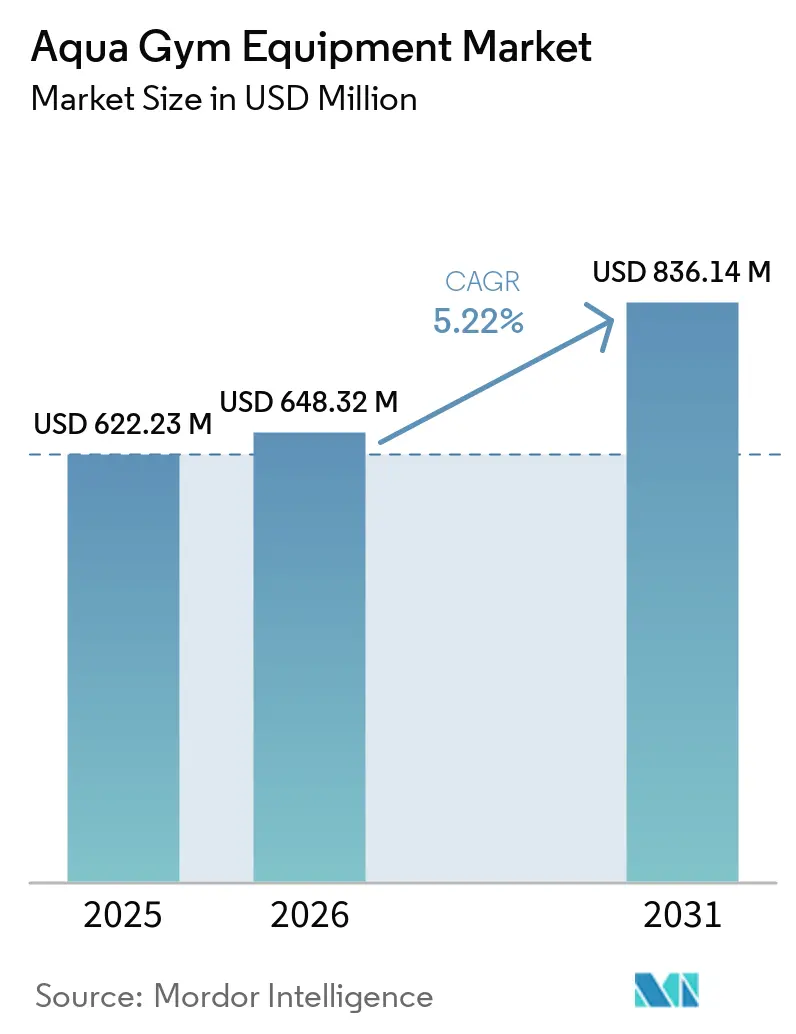
The aqua gym equipment market was valued at USD 622.23 million in 2025 and is projected to grow to USD 648.32 million in 2026, with forecasts suggesting it will reach USD 836.14 million by 2031, registering a CAGR of 5.22% during 2026–2031. This growth is attributed to the increasing adoption of water-based fitness solutions, which offer effective exercise benefits while minimizing physical strain. Growing awareness of low-impact workouts, preventive health measures, and maintaining an active lifestyle is driving the demand for aquatic exercise equipment. The market is further supported by growing interest in innovative and engaging fitness routines that combine resistance training and cardiovascular benefits through water-based exercises.
Key Report Takeaways
- By product type, aqua dumbbells led with 26.52% revenue share in 2025, while aqua bikes are forecast to expand at a 7.03% CAGR through 2031.
- By equipment type, cardiovascular equipment held 59.92% share in 2025, while strength training equipment recorded the highest projected CAGR at 6.55% through 2031.
- By end-user, female users held 56.34% share in 2025, while male users are projected to grow faster at a 5.91% CAGR through 2031.
- By application, health and fitness clubs accounted for 40.53% share in 2025, while rehabilitation centers and hospitals are advancing at a 6.92% CAGR through 2031.
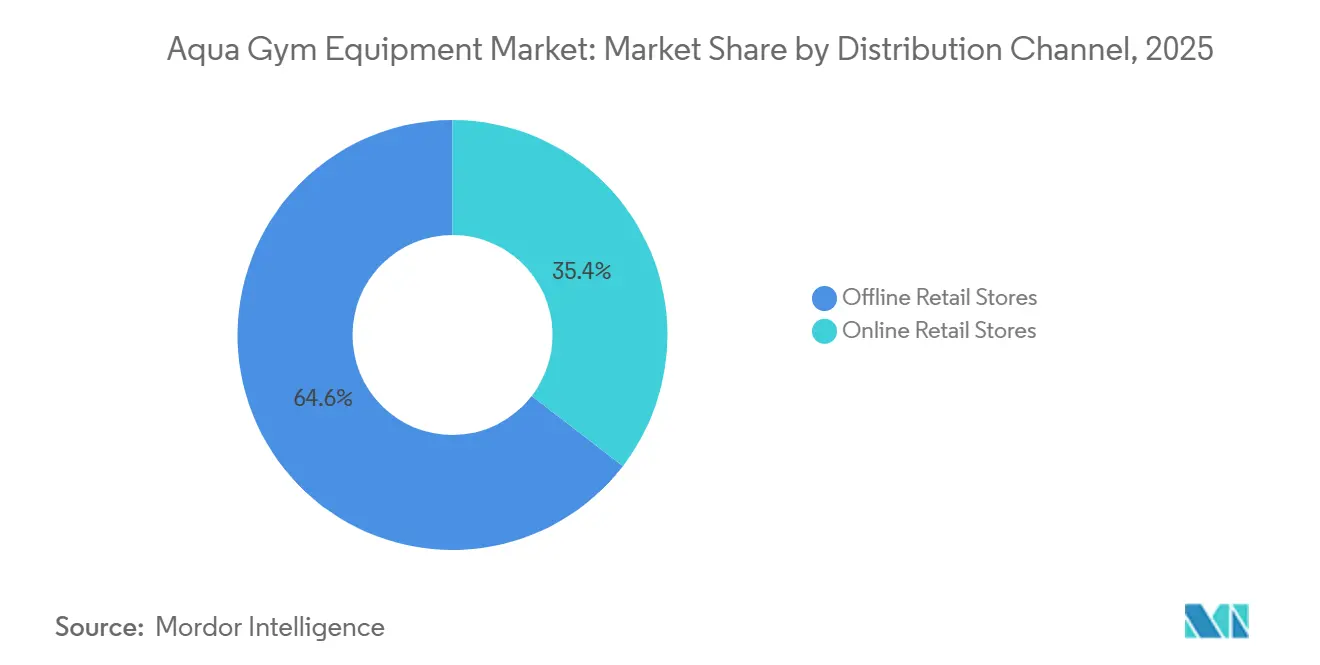
- By distribution channel, offline retail stores held 64.56% share in 2025, while online retail is forecast to grow at a 7.23% CAGR through 2031.
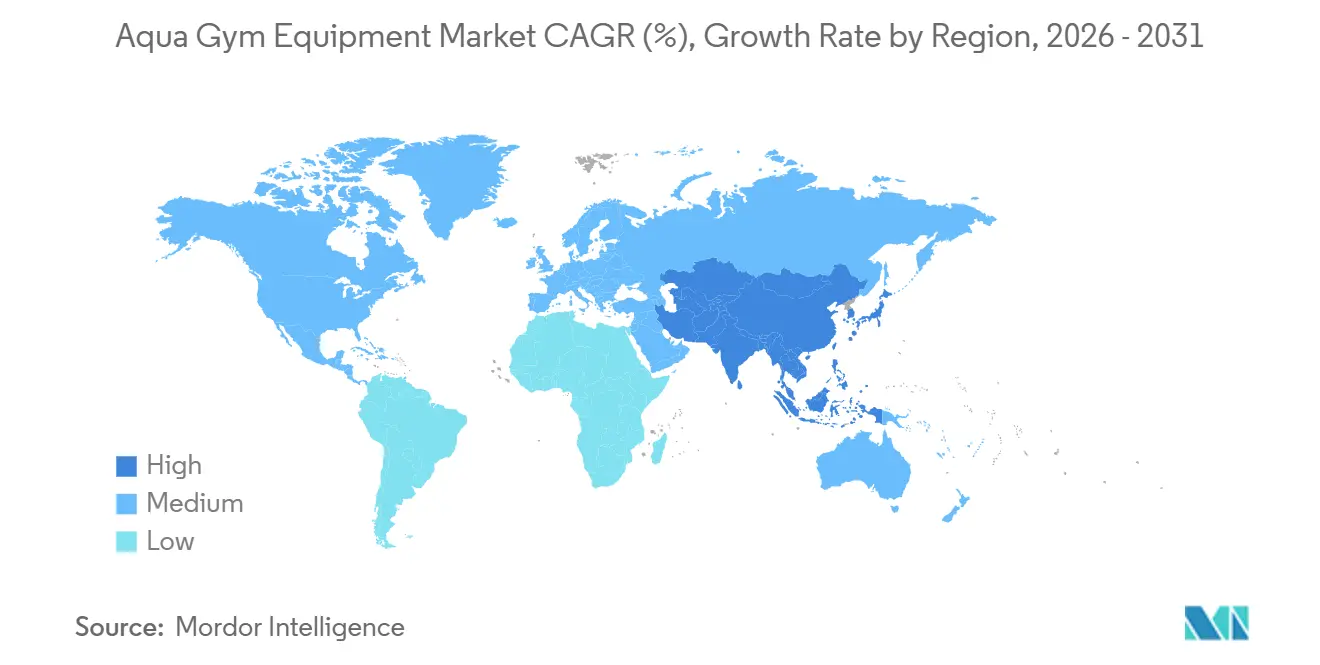
- By geography, North America held 34.23% share in 2025, while Asia-Pacific is projected to expand at a 6.87% CAGR through 2031.
Note: Market size and forecast figures in this report are generated using Mordor Intelligence’s proprietary estimation framework, updated with the latest available data and insights as of January 2026.
Market Trends and Insights
Drivers Impact Analysis of Aqua Gym Equipment Market*
| Driver | (~) % Impact on CAGR Forecast | Geographic Relevance | Impact Timeline |
|---|---|---|---|
| Rising focus on preventive healthcare | +1.3% | Global; strongest in North America and Western Europe | Medium term (2–4 years) |
| Growing demand for low-impact workouts | +1.0% | Global; concentrated in North America, Europe, and Asia-Pacific | Short term (≤2 years) |
| Popularity of aqua fitness programs | +0.8% | Europe (France, Germany, Netherlands), North America | Short term (≤2 years) |
| Growing senior fitness participation | +0.6% | North America, Europe, Japan, Australia | Long term (≥4 years) |
| Increasing sports rehabilitation applications | +0.7% | North America, Europe, South Korea, Australia | Medium term (2–4 years) |
| Advancements in aqua fitness equipment | +0.5% | Global; led by North America and Europe | Medium term (2–4 years) |
| Source: Mordor Intelligence | |||
Rising focus on preventive healthcare
The increasing emphasis on preventive healthcare is contributing to the growth of the aqua gym equipment market, as more individuals adopt fitness solutions aimed at promoting long-term wellness, improving mobility, and preventing diseases. Water-based exercises are becoming more popular due to their ability to provide low-impact cardiovascular training, muscle strengthening, and flexibility enhancement while minimizing stress on joints. This makes them an effective option for maintaining overall physical health. The focus on proactive health management and regular physical activity is driving the integration of aqua fitness equipment into wellness routines. For example, according to the Organisation for Economic Co-operation and Development (OECD), in 2024, the United States reported the highest per capita health expenditure, exceeding USD 14,884.9, underscoring the growing attention to healthcare and wellness initiatives [1]Source: Organisation for Economic Co-operation and Development (OECD), "Per capita health expenditure in selected countries", oecd.org.
Growing demand for low-impact workouts
The rising demand for low-impact workouts is driving growth in the aqua gym equipment market, as consumers increasingly prioritize fitness solutions that reduce stress on joints, muscles, and bones. Water-based exercises leverage natural buoyancy to decrease body weight pressure during movement while providing resistance that aids in building strength, improving endurance, and enhancing flexibility. This has led to greater adoption of aqua fitness equipment, particularly among individuals seeking safer alternatives to high-impact exercises for maintaining mobility, improving balance, and supporting long-term fitness goals. The combination of cardiovascular training and resistance exercises in a controlled aquatic environment continues to boost the demand for aqua gym equipment across various fitness requirements.
Popularity of aqua fitness programs
The increasing popularity of aqua fitness programs is driving growth in the aqua gym equipment market, as consumers show a preference for structured, low-impact water-based exercise routines aimed at improving endurance, strength, balance, and overall physical wellness. These programs leverage water resistance to provide effective full-body workouts while minimizing joint strain, making them accessible to individuals across various fitness levels. Additionally, the introduction of specialized aquatic exercise initiatives is enhancing awareness and participation in water-based fitness activities. For example, in January 2025, SWELL Palmerston collaborated with the Heart Foundation to launch Australia’s first ‘aqua walking’ program as part of the Foundation’s Walking campaign, promoting increased engagement in aquatic physical activities.
Growing senior fitness participation
The growing participation of seniors in fitness activities is driving the demand for aqua gym equipment, as older adults increasingly adopt water-based exercises to enhance mobility, flexibility, balance, and overall physical independence. Aqua workouts offer a supportive environment where water buoyancy minimizes joint pressure while facilitating resistance-based movements, making them well-suited for age-related fitness requirements. The emphasis on healthy aging, active lifestyles, and maintaining functional strength is promoting the use of aqua gym equipment to improve coordination, muscle endurance, and cardiovascular health among senior users. Furthermore, the rising popularity of aquatic exercise programs and wellness activities tailored to seniors is boosting the demand for specialized aqua fitness equipment designed to ensure safe, comfortable, and accessible workouts.
Restraints Impact Analysis of Aqua Gym Equipment Market*
| Restraint | (~) % Impact on CAGR Forecast | Geographic Relevance | Impact Timeline |
|---|---|---|---|
| High cost of aqua gym equipment | -1.2% | Global; most acute in South America, Middle East, and Southeast Asia | Medium term (2–4 years) |
| Limited access to swimming facilities | -0.9% | South Asia, Sub-Saharan Africa, rural markets globally | Long term (≥4 years) |
| Space constraints in fitness centers | -0.6% | Urban markets globally; dense-city Asia-Pacific especially | Medium term (2–4 years) |
| Seasonal dependency of pool activities | -0.5% | Northern Europe, Northern North America, mountainous regions | Short term (≤2 years) |
| Source: Mordor Intelligence | |||
High cost of aqua gym equipment
The high cost of aqua gym equipment remains a significant restraint for the market. Advanced aquatic fitness solutions often require specialized designs, corrosion-resistant materials, and durable components to withstand continuous use in water environments. Equipment such as aqua bikes, underwater treadmills, and advanced resistance systems incur higher manufacturing and installation costs compared to traditional fitness equipment, which limits their adoption among price-sensitive users. Furthermore, additional expenses related to pool compatibility, maintenance, repairs, and component replacement contribute to the overall ownership cost. These financial barriers hinder the growth of aqua fitness programs, particularly for smaller fitness facilities and individual buyers with constrained budgets, thereby slowing the broader adoption of aqua gym equipment.
Limited access to swimming facilities
Limited access to swimming facilities continues to be a significant constraint for the aqua gym equipment market, as the adoption of aquatic fitness solutions relies heavily on the availability of pools and supporting infrastructure. Many potential users encounter challenges due to the scarcity of dedicated aquatic exercise spaces, which limits regular participation in aqua fitness programs. Unlike traditional fitness equipment that can be easily set up in homes, gyms, or small fitness centers, aqua gym equipment requires access to properly maintained pools with appropriate water depth, safety features, and operational conditions. The need for specialized aquatic infrastructure poses obstacles to wider market penetration, particularly in regions with limited facility development.
*Our forecasts treat driver/restraint impacts as directional, not additive. The impact forecasts reflect baseline growth, mix effects, and variable interactions.
Aqua Gym Equipment Market Segment Analysis
By Product Type:
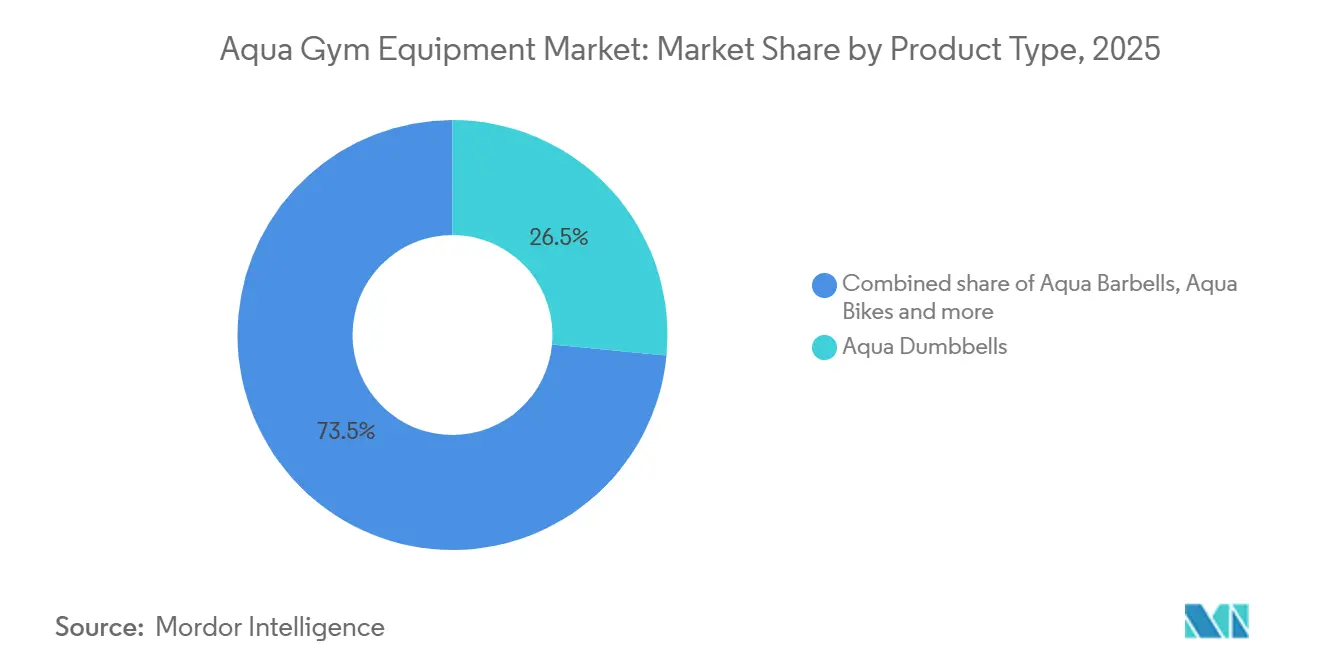
Aqua Bikes Drive Premiumization of Group FitnessAqua dumbbells accounted for the largest product share at 26.52% in 2025, primarily due to their effectiveness in providing buoyancy-based resistance for strength training, endurance enhancement, and overall body conditioning. The segment's growth is attributed to the rising preference for low-impact fitness solutions that improve muscle strength and flexibility while minimizing joint stress. Their lightweight design, ease of use, portability, and versatility in supporting various water-based exercises have driven their widespread adoption across different fitness levels. Aqua dumbbells facilitate controlled movements and adjustable resistance through water pressure, making them ideal for improving balance, coordination, and mobility. Furthermore, ongoing advancements in product design, such as improved grip, durable materials, and ergonomic structures, are enhancing user comfort and exercise efficiency.
Aqua bikes are the fastest-growing product segment, with a projected CAGR of 7.03% from 2026 to 2031. This growth is fueled by the increasing popularity of aquatic cycling as an advanced form of cardio and endurance training. Aqua bikes combine the benefits of cycling with water resistance, enabling effective calorie burning, improved cardiovascular health, and enhanced lower-body conditioning. The rising demand for structured water cycling sessions and performance-oriented aquatic workouts is driving the segment's expansion. Additionally, advancements in adjustable resistance systems, corrosion-resistant materials, ergonomic designs, and improved stability features are further enhancing workout intensity and user experience, contributing to the segment's rapid growth.



By Equipment Type:
Cardiovascular Segment Anchors Revenue While Strength Category AcceleratesCardiovascular aqua gym equipment held a 59.92% market share in 2025, driven by the growing emphasis on improving heart health, endurance, and overall cardiovascular performance through water-based exercises. This segment is gaining significant traction as aquatic cardio workouts provide effective resistance-based movements while minimizing joint strain, enabling users to engage in longer and more comfortable exercise sessions. Increasing awareness about maintaining cardiovascular fitness and addressing lifestyle-related health issues is boosting the adoption of equipment such as aqua bikes, treadmills, and other water-based cardio solutions. According to the Office for National Statistics (UK), approximately 438.9 thousand individuals in the United Kingdom were diagnosed with coronary heart disease in 2024, underscoring the rising demand for fitness activities that promote heart health and active lifestyles [2]Source: Office for National Statistics (UK), "Number of inpatient episodes with a main diagnosis of circulatory system disease", ons.gov.uk.
Strength training aqua gym equipment is the fastest-growing segment, with a projected CAGR of 6.55% from 2026 to 2031. This growth is driven by the increasing preference for water-based resistance workouts that enhance muscle strength, stability, and functional fitness. The segment is gaining momentum as aquatic strength training leverages natural water resistance to create controlled exercise intensity, enabling users to improve muscle activation and endurance without the need for heavy weights. Rising interest in full-body conditioning, balance improvement, and performance-focused training is driving the adoption of equipment designed for resistance-based movements. Furthermore, advancements in equipment design, such as adjustable resistance levels, enhanced durability, and user-friendly structures, are broadening the scope of strength-focused aquatic workouts.
By End-User:
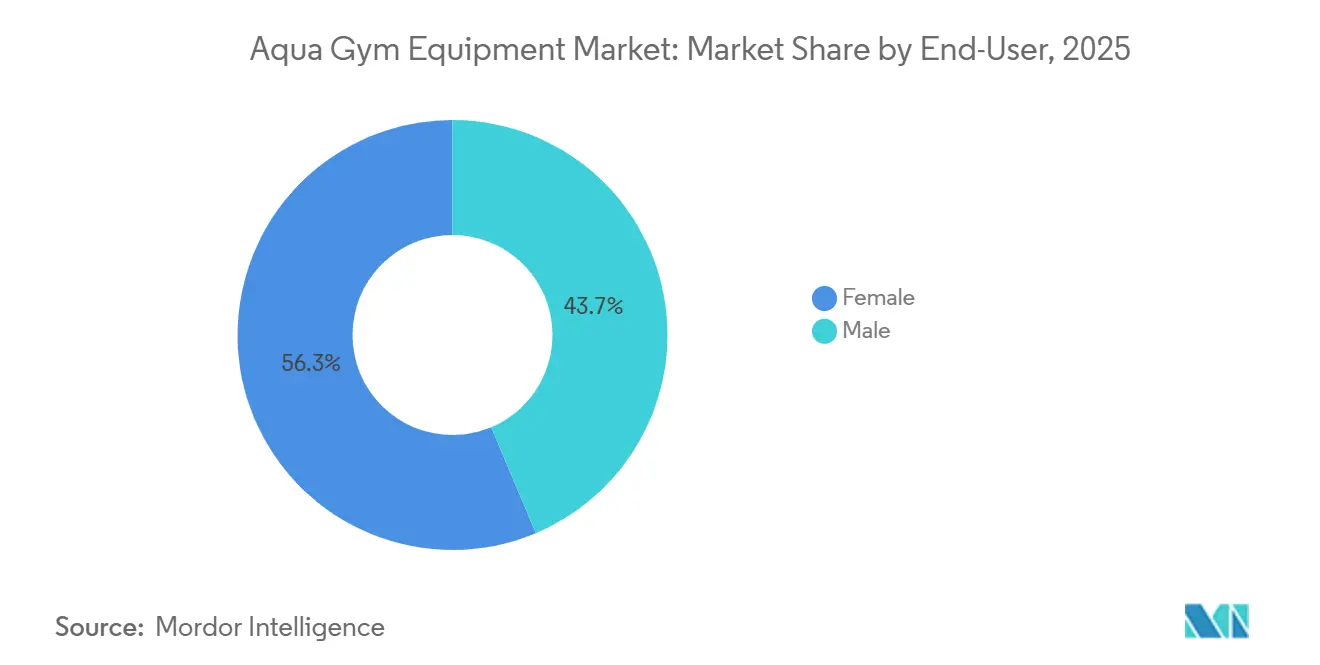
Female Demographic Sustains Core Demand as Male Participation Signals a Use-Case ShiftIn 2025, female users represented 56.34% of the aqua gym equipment market, driven by the growing adoption of water-based fitness routines aimed at improving flexibility, body toning, endurance, and overall wellness. This segment is experiencing significant growth due to increased participation in aquatic exercises, which offer effective full-body workouts with reduced physical strain compared to traditional high-impact training methods. Aqua fitness activities are particularly valued for their benefits in muscle conditioning, posture enhancement, and mobility improvement, all within a comfortable exercise environment. Additionally, the rising popularity of diverse workout formats, such as resistance-based aquatic exercises and structured fitness sessions, is further boosting the use of aqua gym equipment among female users.
The male segment is anticipated to grow at the highest CAGR of 5.91% from 2026 to 2031, driven by the increasing adoption of aquatic fitness routines focused on strength development, endurance enhancement, and performance-oriented training. This segment is gaining traction as more male users incorporate water-based workouts to improve cardiovascular capacity, muscle conditioning, and recovery efficiency. Aqua gym equipment is being increasingly utilized for resistance-based exercises, enabling users to build strength and enhance flexibility while minimizing stress on muscles and joints. The growing interest in alternative training methods beyond conventional gym workouts, coupled with a rising preference for high-intensity aquatic exercises, is further driving participation among male users.
By Application:
Rehabilitation Settings Define the Next Phase of Market ExpansionHealth and fitness clubs accounted for the largest application share of 40.53% in 2025, driven by the increasing integration of aquatic exercise programs into diversified fitness offerings. This segment is gaining prominence as fitness facilities adopt water-based training equipment to provide low-impact cardio, strength conditioning, and functional workout solutions for members seeking alternative exercise formats. The rising popularity of structured aqua fitness sessions, group training programs, and specialized aquatic workouts has led to a broader installation of aqua gym equipment. For example, according to EuropeActive, the number of gyms and health clubs in Europe increased to 67,515 in 2025 from 64,550 in 2024, highlighting the expansion of fitness infrastructure and growing opportunities for advanced aquatic fitness solutions [3]Source: EuropeActive, "Number of gyms and health clubs in Europe", europeactive.eu.
Rehabilitation centers and hospitals are the fastest-growing application segment, with a projected CAGR of 6.92% from 2026 to 2031. This growth is driven by the increasing adoption of aquatic exercise equipment for therapeutic recovery, mobility improvement, and patient rehabilitation programs. The segment is gaining traction as water-based exercises offer controlled resistance and buoyancy support, enabling safer movement for individuals recovering from injuries, surgeries, or physical limitations. Aqua gym equipment enhances flexibility, balance, muscle strength, and range of motion while reducing joint pressure, making it a preferred choice in rehabilitation-focused settings. The growing emphasis on advanced physiotherapy techniques, personalized recovery programs, and non-invasive treatment approaches further supports the integration of aquatic fitness solutions.
By Distribution Channel:
Offline Channels Hold Share as Online Platforms Disrupt Procurement EconomicsOffline retail stores accounted for the largest share, 64.56%, of the distribution landscape in 2025, primarily due to consumers' preference for physically evaluating aqua gym equipment before purchase. This segment benefits from the ability of offline channels to offer hands-on product demonstrations, quality assessments, and expert guidance tailored to fitness requirements. Aqua gym equipment often involves considerations such as material durability, resistance levels, grip comfort, and suitability for aquatic environments, making in-store experiences crucial for ensuring product performance and reliability. Additionally, offline retail channels provide immediate product availability, after-sales support, and personalized recommendations, which enhance customer confidence and influence purchasing decisions.
Online retail channels are expected to grow at the fastest CAGR of 7.23% from 2026 to 2031, driven by the increasing adoption of digital purchasing platforms for fitness and wellness products. This segment is gaining traction as online channels offer broader product availability, convenient comparison of aqua gym equipment options, and access to detailed product specifications and customer reviews. Features such as doorstep delivery, flexible purchasing options, and a wider range of specialized aquatic fitness equipment are encouraging consumers to opt for online platforms. Furthermore, enhanced digital shopping experiences, virtual product demonstrations, promotional strategies, and direct-to-consumer sales models are improving customer engagement and accessibility.
Geography Analysis
North America Aqua Gym Equipment Market
North America accounted for the largest market share of 34.23% in 2025, driven by the widespread adoption of aquatic fitness solutions, a well-established rehabilitation infrastructure, and the increasing integration of water-based exercise programs in wellness and therapy facilities. The region's dominance is further supported by a mature rehabilitation network, the availability of specialized aquatic therapy pools, and the acceptance of aqua gym equipment for injury recovery, mobility improvement, and fitness training. The growing focus on low-impact exercise solutions, preventive wellness, and advanced recovery techniques continues to drive the installation and use of aqua gym equipment across the region.
APAC and Europe Aqua Gym Equipment Market
Asia-Pacific is projected to be the fastest-growing region, with a CAGR of 6.87% from 2026 to 2031. This growth is fueled by increasing participation in fitness activities, rising awareness of aquatic workouts, and the expansion of wellness infrastructure. The adoption of modern exercise formats, the development of fitness facilities, and growing interest in rehabilitation-focused aquatic training are key factors supporting market expansion in the region. Europe continues to gain traction in the market due to its strong wellness culture, increasing adoption of hydrotherapy practices, and a growing preference for sustainable fitness solutions. These solutions emphasize healthy aging, mobility, and long-term physical well-being, contributing to the region's steady growth in the aqua gym equipment market.
MEA and South America Aqua Gym Equipment Market
South America is gradually developing demand pockets as aquatic fitness programs gain visibility through wellness facilities, rehabilitation services, and recreational fitness activities. The region is experiencing growing interest in water-based workouts as an alternative approach to improving strength, flexibility, and overall fitness. The Middle East and Africa region, though still emerging, is witnessing investment-led growth. This growth is supported by the expansion of premium wellness facilities, hospitality-based fitness infrastructure, and the rising adoption of advanced health and fitness solutions. These developments are creating new opportunities for the adoption of aqua gym equipment in the region.

Competitive Landscape
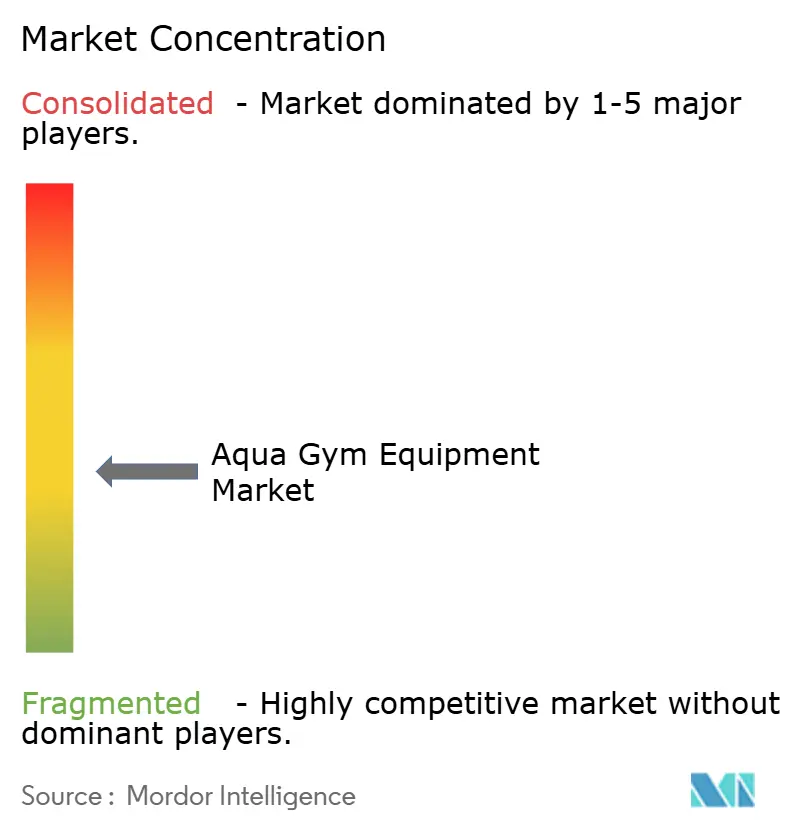
The aqua gym equipment market is moderately fragmented, with several established and specialized players competing through product innovation, technological advancements, and the expansion of aquatic fitness solutions. Key companies, including HydroWorx International Inc., SwimEx Inc., Aqua Creek Products, BECO Beermann GmbH & Co. KG, and Technogym S.p.A., are focusing on enhancing their market presence by improving equipment durability, incorporating ergonomic designs, and developing advanced aquatic training systems. These companies are prioritizing user-focused product development to address evolving needs in fitness, wellness, and rehabilitation applications.
Technological advancements are emerging as a significant competitive factor, with manufacturers integrating digital performance monitoring, smart tracking systems, and connected fitness features into aqua gym equipment. These innovations enable users to track workout performance, monitor progress, and customize aquatic exercise routines, thereby improving training efficiency and user engagement. Additionally, companies are concentrating on creating advanced cardiovascular and resistance-based aquatic solutions that merge traditional water workouts with modern fitness technologies to enhance the overall user experience.
The market is also experiencing growing demand for modular and infrastructure-light equipment, as users increasingly prefer flexible, easy-to-install, and space-efficient aquatic fitness solutions. Manufacturers are responding by developing portable, adaptable, and low-maintenance products that minimize reliance on large-scale aquatic infrastructure while improving accessibility. This trend toward compact and versatile aqua gym equipment is expected to heighten competition, driving companies to focus on product differentiation, customization, and innovation-led growth strategies.
Aqua Gym Equipment Industry Leaders
-
HydroWorx International Inc.
-
SwimEx Inc.
-
Aqua Creek Products
-
BECO Beermann GmbH and Co. KG
-
Technogym S.p.A.
- *Disclaimer: Major Players sorted in no particular order
Aqua Gym Equipment Market Companies Covered in this Report
- HydroWorx International Inc.
- SwimEx Inc.
- Aqua Creek Products
- BECO Beermann GmbH and Co. KG
- Technogym S.p.A.
- Waterflex
- Poolstar
- Aqua Fitness Systems
- Endless Pools
- Speedo International
- Sprint Aquatics
- HYDRO-FIT, Inc.
- AquaJogger
- FINIS, Inc.
- Aqua Lung International
- Acquapole S.a.S.
- PlayCore
- Hudson Aquatic Systems
- Narang Medical Limited
- Jacuzzi Inc.

Recent Industry Developments in Aqua Gym Equipment Market
- April 2026: The Rehabilitation Center at Bangkok Hospital has introduced an aquatic therapy method called the "aquatic treadmill." This therapy utilizes hydrostatic pressure, buoyancy, and water resistance to support rehabilitation and improve physical performance.
- September 2025: Aqua Creek Products introduced its new TruPro Rails & Ladders product line. The TruPro collection includes corrosion-resistant stainless steel rails and ladders designed to meet commercial standards, ensuring durability and safety.


Global Aqua Gym Equipment Market Report Scope
Acqua gym is a form of aerobic exercise performed in a swimming pool. The aqua gym equipment market is segmented by product type, equipment type, end-user, application, distribution channel, and geography. Based on product type, the market is segmented into aqua dumbbells, aqua barbells, aqua bikes, aqua treadmills, aqua ellipticals, and others. Based on equipment type, the market is segmented into cardiovascular aqua gym equipment, strength training aqua gym equipment, and others. Based on end-user, the market is segmented into male and female. Based on application, the market is segmented into health and fitness clubs, rehabilitation centers and hospitals, hotels, resorts and spas, and others. Based on distribution channel, the market is segmented into offline retail stores and online retail stores. Based on geography, the market is segmented into North America, Europe, Asia-Pacific, South America, and Middle East and Africa. The report provides market size and forecasts in both value (USD) and volume (tons) for all the mentioned segments.
| Aqua Dumbbells |
| Aqua Barbells |
| Aqua Bikes |
| Aqua Treadmills |
| Aqua Ellipticals |
| Others |
| Cardiovascular Aqua Gym Equipment |
| Strength Training Aqua Gym Equipment |
| Others |
| Male |
| Female |
| Health and Fitness Clubs |
| Rehabilitation Centers and Hospitals |
| Hotels, Resorts and Spas |
| Others |
| Offline Retail Stores |
| Online Retail Stores |
| North America | United States |
| Canada | |
| Mexico | |
| Rest of North America | |
| Europe | Germany |
| United Kingdom | |
| Italy | |
| France | |
| Spain | |
| Netherlands | |
| Poland | |
| Belgium | |
| Sweden | |
| Rest of Europe | |
| Asia-Pacific | China |
| India | |
| Japan | |
| Australia | |
| Indonesia | |
| South Korea | |
| Thailand | |
| Singapore | |
| Rest of Asia-Pacific | |
| South America | Brazil |
| Argentina | |
| Colombia | |
| Chile | |
| Peru | |
| Rest of South America | |
| Middle East and Africa | South Africa |
| Saudi Arabia | |
| United Arab Emirates | |
| Nigeria | |
| Egypt | |
| Morocco | |
| Turkey | |
| Rest of Middle East and Africa |
| By Product Type | Aqua Dumbbells | |
| Aqua Barbells | ||
| Aqua Bikes | ||
| Aqua Treadmills | ||
| Aqua Ellipticals | ||
| Others | ||
| By Equipment Type | Cardiovascular Aqua Gym Equipment | |
| Strength Training Aqua Gym Equipment | ||
| Others | ||
| By End-User | Male | |
| Female | ||
| By Application | Health and Fitness Clubs | |
| Rehabilitation Centers and Hospitals | ||
| Hotels, Resorts and Spas | ||
| Others | ||
| By Distribution Channel | Offline Retail Stores | |
| Online Retail Stores | ||
| By Geography | North America | United States |
| Canada | ||
| Mexico | ||
| Rest of North America | ||
| Europe | Germany | |
| United Kingdom | ||
| Italy | ||
| France | ||
| Spain | ||
| Netherlands | ||
| Poland | ||
| Belgium | ||
| Sweden | ||
| Rest of Europe | ||
| Asia-Pacific | China | |
| India | ||
| Japan | ||
| Australia | ||
| Indonesia | ||
| South Korea | ||
| Thailand | ||
| Singapore | ||
| Rest of Asia-Pacific | ||
| South America | Brazil | |
| Argentina | ||
| Colombia | ||
| Chile | ||
| Peru | ||
| Rest of South America | ||
| Middle East and Africa | South Africa | |
| Saudi Arabia | ||
| United Arab Emirates | ||
| Nigeria | ||
| Egypt | ||
| Morocco | ||
| Turkey | ||
| Rest of Middle East and Africa | ||


Key Questions Answered in the Report
How large is the aqua gym equipment market in 2026 and where is it headed by 2031?
The aqua gym equipment market stands at USD 648.32 million in 2026 and is forecast to reach USD 836.14 million by 2031, growing at a 5.22% CAGR over 2026-2031.
Which product type is growing fastest in aqua gym equipment?
Aqua bikes are the fastest-growing product type, with a projected 7.03% CAGR through 2031, helped by demand from group fitness and low-impact cardio formats.
Why are rehabilitation centers becoming more important buyers of aqua gym equipment?
Rehabilitation centers and hospitals are the fastest-growing application segment at 6.92% CAGR because stronger clinical evidence, aging populations, and recovery-focused care models are pushing demand upward.
Which region leads revenue and which region grows fastest?
North America held the largest regional share at 34.23% in 2025, while Asia-Pacific is the fastest-growing region with a projected 6.87% CAGR through 2031.
Page last updated on:


 Your data is secure and never sold or shared.


