
Fish Hunting Equipment Market Size and Share
Market Overview
| Study Period | 2021 - 2031 |
|---|---|
| Market Size (2026) | USD 19.52 Billion |
| Market Size (2031) | USD 24.71 Billion |
| Growth Rate (2026 - 2031) | 4.83 % |
| Fastest Growing Market | Asia-Pacific |
| Largest Market | North America |
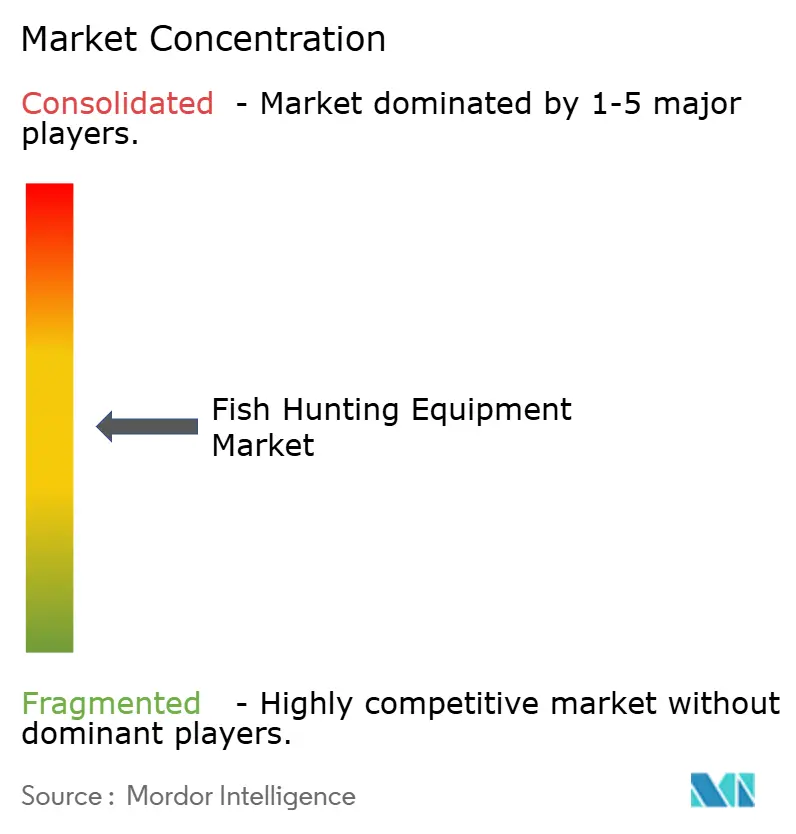
| Market Concentration | Medium |
Major Players *Disclaimer: Major Players sorted in no particular order Image © Mordor Intelligence. Reuse requires attribution under CC BY 4.0. | |
Fish Hunting Equipment Market Analysis by Mordor Intelligence
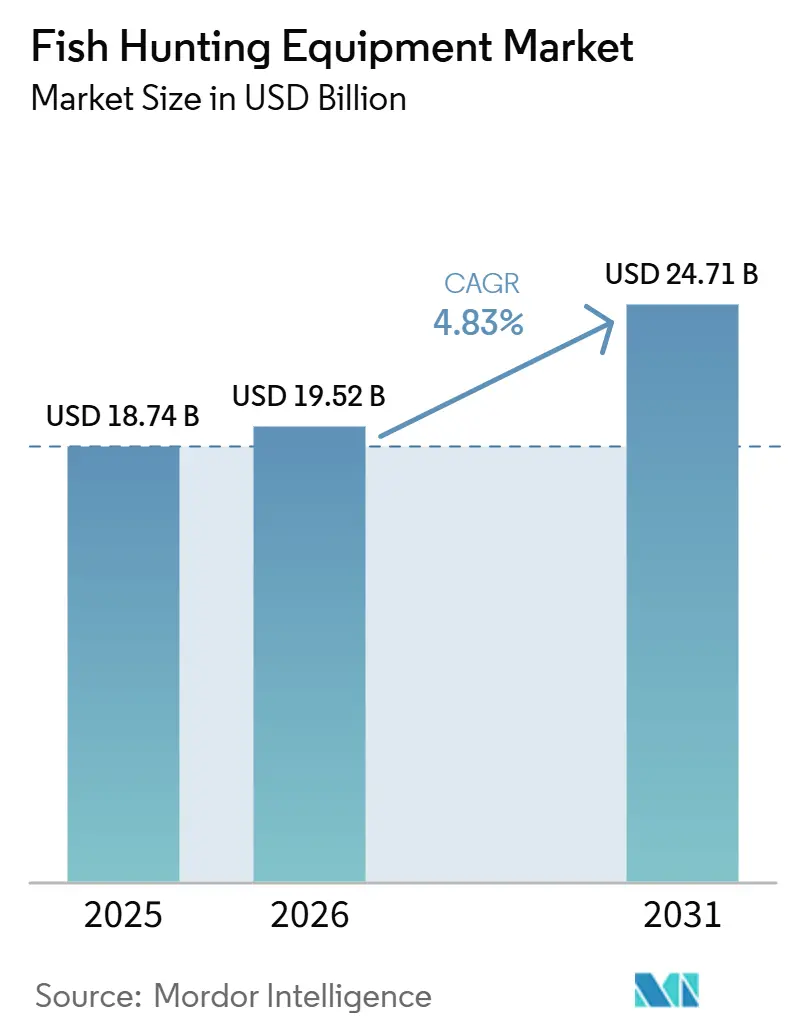
The fish hunting equipment market size is expected to grow from USD 18.74 billion in 2025 to USD 19.52 billion in 2026 and is forecast to reach USD 24.71 billion by 2031 at a 4.83% CAGR over 2026-2031. The fish hunting equipment market is supported by a broad participation base, as millions of Americans are participating in fishing. Product demand is also shifting toward connected and premium systems, as electronics upgrades, lighter composite materials, and integrated rod-reel-line designs are lifting average selling prices and raising consumer expectations for performance. The market is moderately fragmented, offering growth opportunities for mid-sized and regional players to compete through differentiated product portfolios, technological innovation, and targeted regional expansion. Demand is supported by rising recreational fishing participation, increasing adoption of connected fishing technologies, premiumization of equipment, and growing interest in outdoor recreation and personalized fishing gear.
Key Report Takeaways
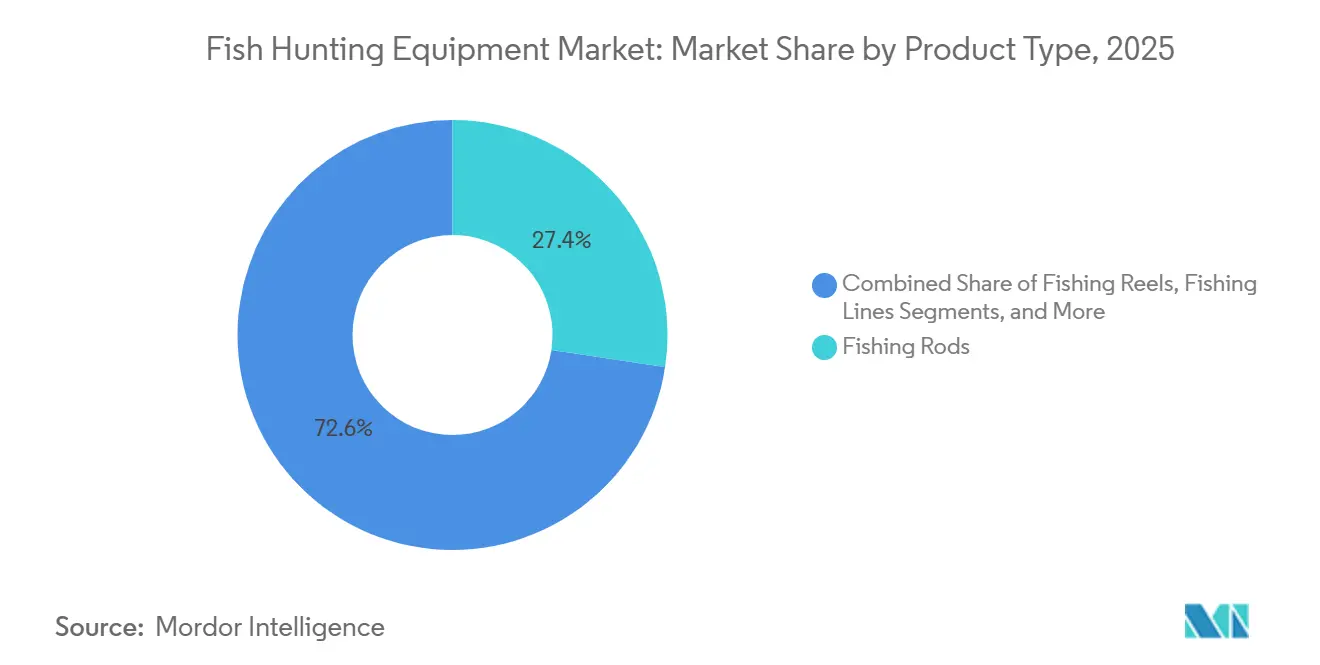
- By product type, fishing rods led with 27.38% revenue share in 2025, while smart electronic devices are forecast to expand at a 6.10% CAGR through 2031.
- By end user, recreational and leisure fishing held 61.08% share in 2025, while professional sport fishing recorded the highest projected CAGR at 5.75% through 2031.
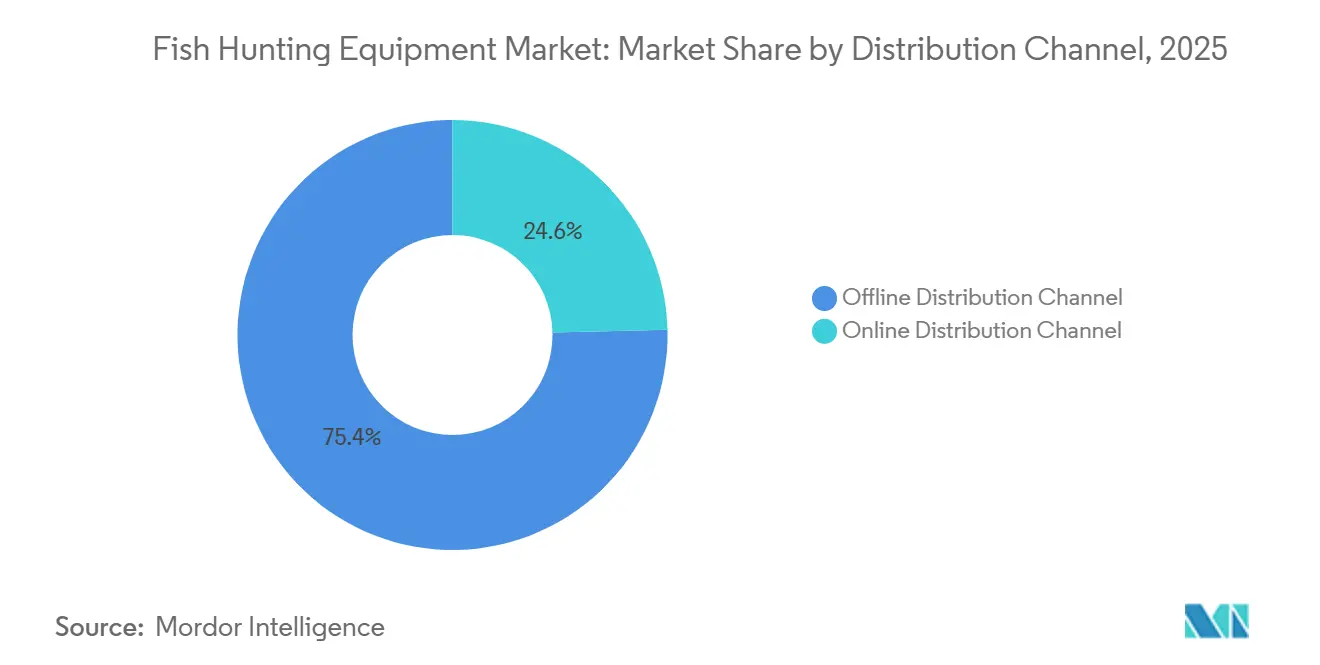
- By distribution channel, offline distribution channel accounted for 75.38% share in 2025, while online distribution channel are advancing at a 6.36% CAGR through 2031.
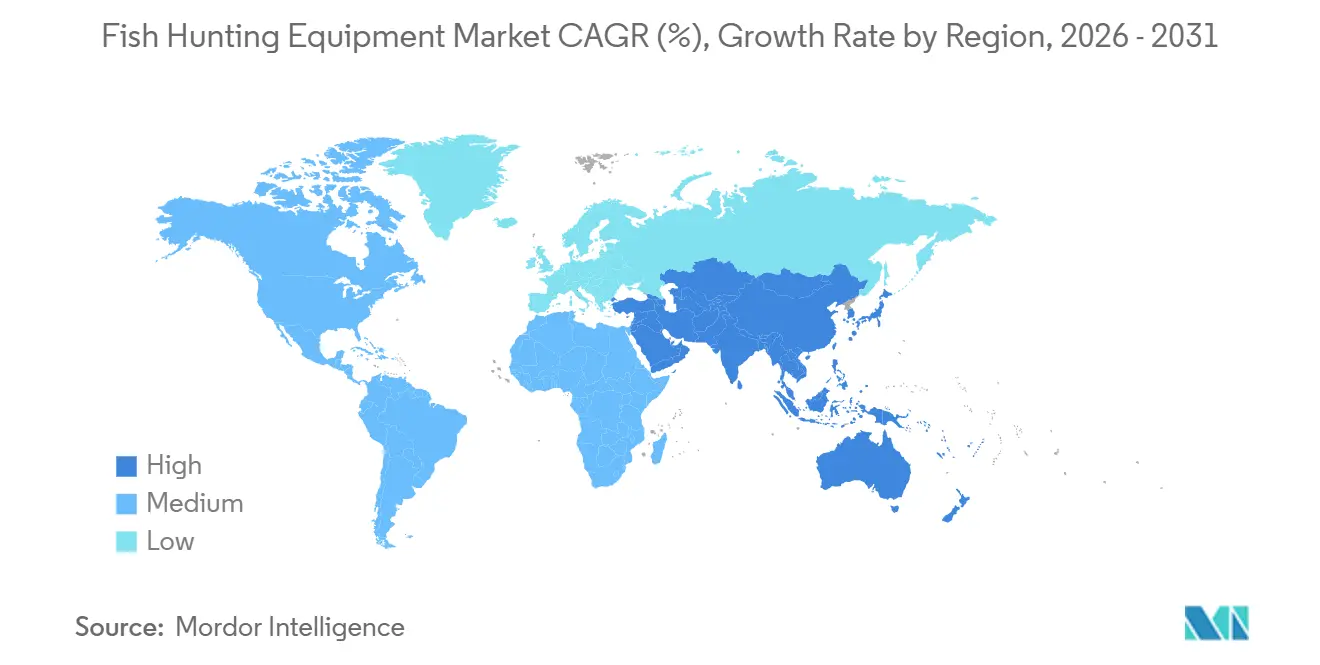
- By geography, North America held 34.07% share in 2025, while Asia-Pacific is forecast to grow at a 6.21% CAGR through 2031.
Note: Market size and forecast figures in this report are generated using Mordor Intelligence’s proprietary estimation framework, updated with the latest available data and insights as of January 2026.
Market Trends and Insights
Drivers Impact Analysis of Fish Hunting Equipment Market*
| Driver | (~) % Impact on CAGR Forecast | Geographic Relevance | Impact Timeline |
|---|---|---|---|
| Rising recreational angling participation | +1.3% | Global | Short term (≤ 2 years) |
| Smart sonar, GPS, and app-connected gear upgrades | +1.1% | Global, with concentration in North America and Asia-Pacific | Medium term (2-4 years) |
| Premiumization through lightweight composite materials | +0.8% | North America and Europe | Medium term (2-4 years) |
| Growth in outdoor and adventure tourism | +0.7% | Asia-Pacific and North America | Medium term (2-4 years) |
| Expanding community networks and social influence | +0.5% | Global | Short term (≤ 2 years) |
| Growing preference for product customization | +0.3% | North America and Europe | Long term (≥ 4 years) |
| Source: Mordor Intelligence | |||
Rising recreational angling participation
The steady rise in recreational angling participation is a key factor driving demand in the fish hunting equipment market, as a larger base of anglers translates into higher purchases of fishing rods, reels, tackle, bait, landing nets, and other accessories. According to the National Marine Manufacturers Association (NMMA), a record 57.9 million Americans participated in recreational fishing in 2024, marking the highest participation level ever recorded[1]. They also highlighted that 5.1 million Americans tried fishing for the first time in 2024, accounting for 9% of all participants, reflecting continued expansion of the consumer base and creating sustained demand for entry-level and replacement fishing equipment [2]. Participation growth has also broadened across multiple demographic segments, supporting long-term market expansion for fish hunting equipment manufacturers. The NMMA noted that 5.5 million Black Americans, and 6.6 million Hispanic Americans participated in recreational fishing during 2024, with both group representing record-high participation levels[3]. Additionally, saltwater fishing participation increased to 15.1 million anglers, while fly fishing surpassed 8 million participants for the second consecutive year, indicating growing interest across specialized fishing categories that require diverse and higher-value equipment. As recreational fishing continues to attract new participants and expand across demographic groups, manufacturers are benefiting from increased demand for specialized, premium, and beginner-friendly fishing gear.
Smart sonar, GPS, and app-connected gear upgrades
Advancements in smart fishing technologies are emerging as a significant growth driver for the fish hunting equipment market, as anglers increasingly seek tools that improve precision, efficiency, and overall fishing success. Modern fishing equipment is shifting from conventional hardware toward connected ecosystems that provide real-time insights. Innovations such as portable sonar systems capable of identifying fish activity, underwater structures, and depth changes, along with GPS-enabled location saving, are enabling anglers to reduce search time and improve catch rates, driving higher adoption of premium electronic fishing equipment.
The integration of mobile connectivity and intelligent analytics is further accelerating demand for technologically advanced fish hunting gear. The growing adoption of app-connected reels and accessories allows users to track fishing sessions, log catches, and analyze long-term performance, while AI-assisted sonar systems simplify the interpretation of underwater data by identifying fish and recognizing activity patterns. In addition, smart reels that monitor casting distance, retrieval speed, and drag adjustments, together with Bluetooth-enabled bite alarms, are enhancing the fishing experience through data-driven decision-making.
Premiumization through lightweight composite materials
The growing adoption of lightweight composite materials is driving premiumization in the fish hunting equipment market, as anglers increasingly seek high-performance gear that combines durability with reduced weight. Materials such as graphite carbon, woven carbon fiber, and reinforced composite polymers improve structural rigidity, corrosion resistance, and handling comfort while reducing fatigue during extended fishing sessions. These material innovations allow manufacturers to position products in premium price segments by offering enhanced casting precision, greater strength-to-weight ratios, and longer service life, appealing to both professional and recreational anglers.
Recent product developments reflect this demand toward premium composite-based equipment. For example, Guru's 2026 launch of the N-Gauge Pro Reel features a lightweight graphite carbon body and rotor paired with a 3K woven carbon rotor cover, delivering improved rigidity, lower rotational weight, and smoother retrieval under demanding fishing conditions. Similarly, the XS Carbon Cookie Pole Float incorporates a reinforced carbon stem and high-density foam body to improve durability and responsiveness while maintaining a lightweight design. These developments illustrate how manufacturers are using advanced composite materials to differentiate products, justify premium pricing, and support growth in the global fish hunting equipment market.
Growth in outdoor and adventure tourism
The rapid expansion of outdoor and adventure tourism is emerging as a key growth driver for the fish hunting equipment market. Increasing participation in nature-based recreational activities is boosting demand for specialized fishing gear, accessories, and premium equipment. According to an October 2025 publication by the United Nations Development Programme (UNDP), sustained investments in adventure tourism infrastructure, skills development, and eco-tourism are significantly increasing visitor participation in outdoor experiences. As more domestic and international tourists engage in activities such as recreational fishing, river expeditions, and wilderness excursions, demand for fishing reels, rods, tackle, apparel, and related fish hunting equipment continues to expand alongside tourism growth.
The UNDP report highlights the scale of this growth through strong quantitative indicators. In Kyrgyzstan, foreign tourist arrivals rose from 14,880 to more than 36,000, while 44 entrepreneurs participated in the program, over 110 tourism professionals received training, 17 sustainable tourism practices were implemented, and more than 20 tour operators developed cross-border adventure tourism products [4]. These developments illustrate how expanding adventure tourism ecosystems are creating larger consumer bases for recreational fishing activities, thereby accelerating demand for fish hunting equipment across emerging tourism destinations.
Restraints Impact Analysis of Fish Hunting Equipment Market*
| Restraint | (~) % Impact on CAGR Forecast | Geographic Relevance | Impact Timeline |
|---|---|---|---|
| Seasonal demand volatility and weather-related trip cancellations | -0.5% | Global | Short term (≤ 2 years) |
| Stricter catch, licensing, and gear-use regulations | -0.3% | North America and Europe | Medium term (2-4 years) |
| Compliance challenges driven by regional sustainability requirements | -0.2% | Europe and Asia-Pacific | Long term (≥ 4 years) |
| Volatility in premium input costs for graphite, carbon fiber, and electronics | -0.4% | Global | Medium term (2-4 years) |
| Source: Mordor Intelligence | |||
Seasonal demand volatility and weather-related trip cancellations
Demand for fishing equipment is highly seasonal, as recreational fishing activity depends heavily on weather conditions, water temperatures, and fish behavior throughout the year. Extreme heat, severe cold, storms, heavy rainfall, and strong winds often discourage anglers from fishing or lead to trip cancellations, reducing short-term purchases of rods, reels, bait, tackle, and related accessories. Since fishing participation peaks only during specific seasonal windows, equipment sales experience pronounced fluctuations, creating inconsistent revenue streams for manufacturers and retailers.
Fish feeding patterns and catch rates vary considerably across seasons and throughout the day, influencing consumer confidence and participation levels. Fishing is generally more productive during cooler morning and evening hours in summer, while prolonged periods of extreme temperatures often result in lower fish activity during much of the day. Similarly, cold conditions in early spring and winter can reduce fish movement and limit successful catches. These seasonal and weather-related uncertainties discourage discretionary spending on fishing equipment, increase inventory management challenges for suppliers, and constrain stable year-round market growth.
Stricter catch, licensing, and gear-use regulations
Stricter catch, licensing, and gear-use regulations restrain the fish hunting equipment market by limiting fishing activity and reducing the frequency of equipment purchases. Governments and fisheries management authorities increasingly enforce measures such as catch quotas, seasonal fishing closures, protected fishing zones, licensing requirements, and restrictions on the number of fishing units to preserve fish populations and maintain sustainable harvest levels. While these regulations are essential for long-term resource conservation, they reduce fishing opportunities and can discourage participation among both recreational and commercial anglers.
Regulations governing minimum catch sizes, mesh-size requirements, and restrictions on specific fishing gear compel anglers to modify or replace equipment to remain compliant, while in some cases prohibiting the use of certain gear altogether. Temporary bans during spawning seasons, protected breeding areas, and limitations on destructive fishing methods further reduce fishing days and equipment utilization. Frequent updates to regulatory frameworks across different regions also increase compliance complexity for manufacturers, retailers, and consumers, creating uncertainty that can delay purchasing decisions and moderate overall market growth.
*Our forecasts treat driver/restraint impacts as directional, not additive. The impact forecasts reflect baseline growth, mix effects, and variable interactions.
Fish Hunting Equipment Market Segment Analysis
By Product Type:
Smart Integration Reshaping a Rod-Dominated MarketFishing rods account for the largest share of the market, representing 27.38% of total revenue in 2025. This is driven by their essential role across recreational, sport, and commercial fishing activities. Demand is supported by frequent product replacement, expanding participation in freshwater and saltwater angling, and continued premiumization through lightweight, high-performance materials. Manufacturers are also broadening their product portfolios across entry-level and professional-grade offerings, ensuring sustained demand across diverse consumer segments. Continuous innovation in rod construction further reinforces the segment's position.
Smart electronic devices are projected to be the fastest-growing product segment, registering a CAGR of 6.10% through 2031. Growth is supported by the increasing adoption of fish finders, GPS systems, sonar technologies, and connected fishing solutions. Rising consumer preference for data-driven fishing experiences and advancements in wireless connectivity are accelerating demand for smart equipment. Companies continue to expand their electronics portfolios with improved navigation, mapping, and real-time fish detection capabilities. Growing integration with mobile applications and digital ecosystems is expected to further support long-term market growth.

By End User:
Recreational Base Anchors Demand, Professionals Drive Premium GrowthRecreational and leisure fishing holds the largest share of the end-user market at 61.08% in 2025, supported by growing participation across all age groups and the increasing popularity of outdoor recreational activities. Rising disposable incomes, expanding fishing tourism, and greater accessibility to fishing equipment continue to strengthen demand. The segment also benefits from repeat purchases of rods, reels, tackle, and accessories, making it the primary revenue contributor to the global fishing equipment market.
Professional sport fishing is projected to be the fastest-growing end-user segment, expanding at a CAGR of 5.75% through 2031. Growth is driven by the rising popularity of competitive fishing tournaments, increasing sponsorship investments, and greater media coverage of professional angling events. These developments encourage the adoption of premium, high-performance equipment and accelerate the commercialization of advanced fishing technologies. As competitive anglers increasingly influence consumer purchasing decisions, manufacturers are introducing specialized products tailored to tournament and performance-focused fishing, further supporting segment growth.
By Distribution Channel:
Offline Dominance Gives Way to Digital CommerceOffline distribution channels account for the largest market share at 75.38% in 2025, reflecting consumers' preference to physically evaluate fishing equipment before purchase. Specialty fishing stores and sporting goods retailers remain the primary sales channels, offering expert guidance, product demonstrations, and personalized recommendations that are particularly valuable for high-value equipment such as rods, reels, and electronics. Strong customer loyalty, in-store experiences, and broad product availability continue to reinforce the segment's market leadership.
Online distribution channels are projected to be the fastest-growing segment, registering a CAGR of 6.36% through 2031. Growth is driven by increasing e-commerce adoption, wider product availability, competitive pricing, and the convenience of home delivery. Manufacturers and retailers are investing in digital platforms, enhanced product content, customer reviews, and omnichannel strategies to improve the online shopping experience. Rising smartphone usage and expanding direct-to-consumer sales channels are expected to further accelerate online market growth during the forecast period.
Geography Analysis
North America Fish Hunting Equipment Market
North America accounted for the largest share of the global fishing equipment market at 34.07% in 2025, supported by high recreational fishing participation, well-established specialty retail networks, and strong consumer spending on outdoor activities. The region benefits from widespread adoption of premium fishing gear, frequent product replacement, and a mature distribution ecosystem across the United States and Canada. Continued product innovation and growing demand for technologically advanced equipment are expected to sustain North America's dominant market position throughout the forecast period.
APAC Fish Hunting Equipment Market
Asia-Pacific is projected to be the fastest-growing regional market, registering a CAGR of 6.21% during 2026–2031. Growth is driven by rising disposable incomes, expanding recreational fishing participation, increasing coastal and inland tourism, and improving access to modern fishing equipment. China, India, Australia, and Southeast Asian countries are witnessing increasing demand for premium rods, reels, and smart fishing electronics as outdoor leisure activities gain popularity. Investments by global manufacturers in regional distribution networks and localized product offerings are further supporting market expansion.
EMEA and South America Fish Hunting Equipment Market
Europe remains a mature and significant market, driven by strong recreational fishing traditions and a well-developed network of specialty fishing retailers across countries such as the United Kingdom, Germany, France, and Italy. Meanwhile, South America is emerging as a growth region, supported by expanding sport fishing tourism and increasing participation in recreational angling, particularly in Brazil and Chile. The Middle East and Africa represents an early-stage market, where improving tourism infrastructure, growing interest in sport fishing, and rising disposable incomes in countries such as South Africa and Saudi Arabia are gradually creating new opportunities for fishing equipment manufacturers.
Competitive Landscape
The global fish hunting equipment market is moderately fragmented, with a mix of established multinational manufacturers and numerous regional and niche players competing across different product categories. Leading companies, including Globeride (Daiwa), Shimano, Pure Fishing, and Rapala VMC, collectively account for a notable share of the global market, while the remaining revenue is distributed among regional brands, specialty manufacturers, and private-label suppliers. Competition is driven by product innovation, brand reputation, pricing strategies, and distribution networks.
Leading manufacturers continue to strengthen their competitive positions through product innovation, capacity expansion, and strategic investments. Companies are introducing lightweight rods, advanced reels, connected fishing electronics, and sustainable fishing products to address evolving consumer preferences. They are also expanding manufacturing capabilities, optimizing supply chains, and investing in digital sales channels to improve operational efficiency and customer reach. Strategic partnerships, acquisitions, and new product launches remain key approaches for maintaining market position.
Alongside established brands, several emerging regional manufacturers and direct-to-consumer companies are gaining market presence by offering specialized, competitively priced, and digitally marketed fishing equipment. These companies are focusing on niche customer segments, sustainable materials, and smart fishing technologies to differentiate their offerings. Increasing e-commerce penetration and growing demand for customized fishing gear are enabling smaller players to expand beyond domestic markets, intensifying competition and driving continuous innovation across the global fishing equipment market.
Fish Hunting Equipment Industry Leaders
-
Shimano Inc.
-
Globeride, Inc
-
Rapala VMC Corp.
-
Pure Fishing, Inc.
-
Johnson Outdoors Inc.
- *Disclaimer: Major Players sorted in no particular order
Fish Hunting Equipment Market Companies Covered in this Report
- Shimano Inc.
- Pure Fishing, Inc.
- Globeride, Inc.
- Rapala VMC Corporation
- Johnson Outdoors Inc.
- Okuma Fishing Tackle Co., Ltd.
- St. Croix Rods
- Eagle Claw
- Mustad and Son AS
- Pradco Outdoor Brands
- Zebco Brands
- Tica Fishing Tackle
- Orvis Company
- Bass Pro Shops
- Cabela's
- Decathlon
- J.M. Gillies
- Jarvis Walker Pty Ltd
- BONE Fishing World
- Snowbee International
Recent Industry Developments in Fish Hunting Equipment Market
- May 2026: Globeride (Daiwa) introduced its compact SEABORG 300J and SEABORG 500J electric reels, featuring palmable power-assist technology designed to improve accessibility for youth, seniors, and adaptive anglers while expanding the adoption of electric fishing reels in recreational sport fishing.
- March 2026: Globeride (Daiwa) unveiled its 2026 Flagship Collection at the Pacific Coast Sportfishing Show, introducing new products including the RYOGA 150, SALTIGA 30000P, Dog Fight Rods, and Procyon Inshore SW Rods to expand its portfolio of high-performance saltwater and sport fishing equipment.
- February 2026: Shimano launched INFINITYCONNECT, an integrated rod, reel, and line system engineered to enhance casting performance by delivering smoother line release, improved casting control, greater casting distance, and enhanced line durability through optimized gear compatibility.
Global Fish Hunting Equipment Market Report Scope
By product type, the report analyzes the market across major equipment categories to assess product demand, innovation, and revenue contribution. The segments covered include Fishing Rods, Fishing Reels, Hooks and Terminal Tackle, Fishing Lines, Lures and Baits, Nets and Traps, Accessories (apparel, coolers, bags, etc.), Smart Electronic Devices, and Other Product Types.
By end user, the study evaluates demand across key customer segments based on usage patterns and purchasing behavior. The analysis covers Commercial Fishing, Recreational and Leisure Fishing, and Professional Sport Fishing to provide a comprehensive view of market opportunities.
By distribution channel, the report examines how fishing equipment reaches end users through both traditional and digital sales platforms. The market is segmented into Offline Distribution Channels and Online Distribution Channels, reflecting evolving retail and e-commerce trends.
By geography, the report provides regional and country-level analysis across North America, Europe, Asia-Pacific, South America, and the Middle East and Africa. Key countries covered within each region include the United States, Canada, Germany, the United Kingdom, China, India, Japan, Australia, Brazil, South Africa, Saudi Arabia, the UAE, and other major markets, with the aim of assessing regional growth dynamics and competitive developments.
| Fishing Rods |
| Fishing Reels |
| Hooks and Terminal Tackle |
| Fishing Lines |
| Lures and Baits |
| Nets and Traps |
| Accessories (apparel, coolers, bags, etc.) |
| Smart Electronic Devices |
| Other Product Types |
| Commercial Fishing |
| Recreational and Leisure Fishing |
| Professional Sport Fishing |
| Offline Distribution Channel |
| Online Distribution Channel |
| North America | United States |
| Canada | |
| Mexico | |
| Rest of North America | |
| Europe | Germany |
| United Kingdom | |
| Italy | |
| France | |
| Spain | |
| Netherlands | |
| Poland | |
| Belgium | |
| Sweden | |
| Rest of Europe | |
| Asia-Pacific | China |
| India | |
| Japan | |
| Australia | |
| Indonesia | |
| South Korea | |
| Thailand | |
| Singapore | |
| Rest of Asia-Pacific | |
| South America | Brazil |
| Argentina | |
| Colombia | |
| Chile | |
| Peru | |
| Rest of South America | |
| Middle East and Africa | South Africa |
| Saudi Arabia | |
| United Arab Emirates | |
| Nigeria | |
| Egypt | |
| Morocco | |
| Turkey | |
| Rest of Middle East and Africa |
| By Product Type | Fishing Rods | |
| Fishing Reels | ||
| Hooks and Terminal Tackle | ||
| Fishing Lines | ||
| Lures and Baits | ||
| Nets and Traps | ||
| Accessories (apparel, coolers, bags, etc.) | ||
| Smart Electronic Devices | ||
| Other Product Types | ||
| By End User | Commercial Fishing | |
| Recreational and Leisure Fishing | ||
| Professional Sport Fishing | ||
| By Distribution Channel | Offline Distribution Channel | |
| Online Distribution Channel | ||
| By Geography | North America | United States |
| Canada | ||
| Mexico | ||
| Rest of North America | ||
| Europe | Germany | |
| United Kingdom | ||
| Italy | ||
| France | ||
| Spain | ||
| Netherlands | ||
| Poland | ||
| Belgium | ||
| Sweden | ||
| Rest of Europe | ||
| Asia-Pacific | China | |
| India | ||
| Japan | ||
| Australia | ||
| Indonesia | ||
| South Korea | ||
| Thailand | ||
| Singapore | ||
| Rest of Asia-Pacific | ||
| South America | Brazil | |
| Argentina | ||
| Colombia | ||
| Chile | ||
| Peru | ||
| Rest of South America | ||
| Middle East and Africa | South Africa | |
| Saudi Arabia | ||
| United Arab Emirates | ||
| Nigeria | ||
| Egypt | ||
| Morocco | ||
| Turkey | ||
| Rest of Middle East and Africa | ||
Key Questions Answered in the Report
What is the 2031 value forecast for fish hunting equipment?
The fish hunting equipment market is forecast to reach USD 24.71 billion by 2031, up from USD 19.52 billion in 2026.
How fast is this sector growing through 2031?
The fish hunting equipment market is projected to grow at a 4.83% CAGR from 2026 to 2031.
Which buyer group drives most demand?
Recreational and leisure fishing held 61.08% of end-user demand in 2025, making it the core revenue base for the category.
Which region is growing the fastest?
Asia-Pacific is the fastest-growing region with a projected 6.21% CAGR through 2031, while North America remained the largest market in 2025 with a 34.07% share.